Pubmed로 검색한 주의력결핍-과잉행동장애 환아의 뉴로피드백 효과에 관한 문헌고찰
장석주․김장현․민상연
동국대학교 한의과대학 소아과교실
Received: April 26, 2019 ∙ Revised: May 15, 2019 ∙ Accepted: May 18, 2019 Corresponding Author: Min Sang Yeon
Department of Korean Pediatrics, Dongguk University International Hospital, Siksa-dong, Ilsandong-gu, Goyang-si, Gyeonggi-do 10326, Republic of Korea Tel: +82-31-961-9072, Fax: +82-31-961-9009
E-mail: [email protected]
ⓒ The Association of Pediatrics of Korean Medicine. All rights reserved. This is an open-access article distributed under the tenus of the Creative Commons Attribution Non-Commercial License (http://creativecommons.org/licenses/by-nc/3.0/), which permits unrestricted non-commercial use, distribution, and reproduction in any medium, provided the original work is properly cited.
Abstract
Effectiveness of Neurofeedback Therapy in Attention Deficit/Hyperactivity Disorders
Chang Seok Joo․Kim Jang Hyun․Min Sang Yeon Department of Pediatrics, College of Korean Medicine, Dongguk University Objectives
The purpose of this study is to review the effectivenss of Neurofeedback Therapy in children with Attention Deficit/Hyperactivity Disorders
Methods
16 randomized controlled trials (RCT) of Neurofeedback Treatment in ADHD from 2009 to 2019 in PubMed were reviewed and analyzed their methods of assessment, treatment, results and adverse effect.
Results
In 16 RCT, the most frequently used diagnostic tool in ADHD was DSM-Ⅳ. Most of the studies reported Neurofeedback Treatment isn’t superior than placebo or medication group but still effective in ADHD. In 6 out of the 16 studies, there were no adverse effect reported.
Conclusion
Most of the studies have shown neurofeedback treatment was effective in ADHD symptoms. More clinical studies are needed to prove the effectiveness of neurofeedback in ADHD.
Key words: Attention Deficit/Hyperactivity Disorders (ADHD), Neurofeedback, Randomized controlled trials, Pubmed, Literature study
ISSN 1226-8038(Print), 2287-9463(Online), https://doi.org/10.7778/jpkm.2019.33.2.069
Ⅰ. Introduction
주의력결핍 과잉행동 장애 (Attention Deficit/Hype- ractivity Disorders, ADHD)는 짧은 주의집중의 폭, 과 잉활동증, 충동성을 나타내는 질환이다1). 일반적인 증 상들은 5세 이전에 시작되며 상당수가 청소년 및 성인 까지 지속된다.
진단율은 진단 방법이나 연구대상의 나이, 지역에 따라 다르게 보고되나 전체 인구의 3-7%로 추정되고, 대부분의 문화권에서 ADHD는 아동에서 약 5%, 성인 에서 약 2.5%가 진단되며, 남녀의 비는 2-9:1로, 여아 에 비해 남아에서 흔하다2-3). 2009년 미국에서 시행한 Mutimodal Treatment Study of Children with ADHD (MTA 연구)에 따르면 ADHD의 유병률은 7-9세에서 집단에서 6년 후 43%, 8년 후 30%로 관찰되었다4). 국 내의 경우 지역에 따라 농촌지역에서는 1.99%, 중소도 시에서 2.4%, 서울과 대전에서 7.6%로 다양하게 보고 되며. 연령에 따라 초등학생에 약 13%, 중·고등학생에 게 7% 내외로 확인되며, 소아 정신과 질환으로 소아 정신과 외래 내원 아동의 30-50%가 진단된다2,5).
ADHD의 진단을 확정 할 수 있는 검사는 없으나, DSM (Diagnostic and Statistical Manual of Mental Disorders)-
Ⅳ-TR, DSM-Ⅴ를 통해 핵심증상들을 확인하여 추정하 는 것이 가장 유의미하다고 보고되고, 부주의형, 과잉 행동-충동형을 중심으로, 부주의 우세형, 과잉행동-충 동 우세형. 복합형으로 분류된다. DSM-Ⅳ-TR, DSM-Ⅴ 은 진단뿐만 아니라 치료효과에 대한 평가지표로도 사 용된다6,7). 연령이 증가하면서 과잉행동 양상이 감소하 는 것을 고려하여 최근 개정된 DSM-Ⅴ에서는 발병연 령을 7세 이전에서 12세 이전으로 상향시켰으며, 17세 이상의 성인에서 부주의와 과잉행동/충동성 두 영역 모두에서 5개 이상의 진단기준을 충족하는 것으로 변 경되었다3).
2017년에 발표된 체계적 문헌 고찰에 의하면 meth- ylphenidate, amphetamine, atomoxetine 등의 약물 치료 가 ADHD의 증상 개선에 효과적인 것으로 밝혀졌으 나, 식욕부진, 체중저하, 불면 등과 같은 부작용이 보고 되고 있으며 약물의 장기간 사용 시 효과와 안전성에 대한 연구가 부족하다. 이러한 약물 치료의 한계로, 인 지행동치료, 부모-교사 교육 치료, 뉴로피드백 등의 비 약물 치료가 개발되었으며, 이 중 인지행동치료와 부 모-교사 교육 치료의 효과가 검증되었다2,8,9).
한의학에서 ADHD의 개념은 陽氣 혹은 七情의 항 진, 氣와 神明의 불균형, 火의 작용으로 心, 肝, 膽, 脾 胃에 병리적으로 영향을 미치는 것으로 볼 수 있으며, 소아의 경우 小兒多動證, 兒童多動證 등으로 불리며,
‘躁動’, ‘健忘’, ‘失總’ 등의 한의학적 범주에 속하며 腎 虛肝亢, 心脾不足, 痰熱擾心으로 변증하여 滋腎潛陽, 寧神益智, 養心健脾, 安神定志, 淸熱化痰, 開竅安神등 의 치법을 고려한다10,11). 2007년에 발표된 문헌 고찰에 의하면 실제 임상에서 사용된 변증으로 음허가 가장 많았으며, 한의학적 치료방법으로 한약투여, 침치료, 섬관요법, 추나요법등이 다양하게 이루어졌으며, 양약 대조군 연구들에서 한약 치료군이 양약 치료군과 동등 하거나 더 우수한 치료효과를 보고하였다12). 그러나 2011년에 발표된 ADHD 환아의 침치료에 관한 체계적 문헌고찰에 의하면 효과에 관한 결론을 내릴 수 없다 고 보고하였다13).
뉴로피드백은 바이오피드백의 한 종류로 전기뇌파 생체 되먹임 (Electroencephalograhic Biofeedback)이라고 불리며 뇌파를 조절하여, ADHD 치료에 효과가 있다고 보고된 비약물 치료방법이다. ADHD의 증상은 비정상 적인 뇌파 형태와 관련이 있으며, 건강한 남아가 독서, 계산, 경청을 할 때 우측 전두엽 부위의 β 파가 증가하 지만, ADHD 남아의 경우 θ파가 증가한다고 한다는 연 구결과를 통해 ADHD 환아들은 정상 아동에 비해 느린 뇌파 (θ파: 4-8㎐)의 활동성이 높고 불규칙한 파형을 보 이며, 빠른 뇌파 (β 파: 13-20㎐)의 활동성이 낮다는 것 을 알 수 있다. 뉴로피드백은 이러한 ADHD 환아들의 비정상적 뇌파 양상인 β 파의 활동을 증가시키고, θ파 의 활동을 감소시키는 역할을 한다14-16).
이에 저자는 본 연구에서 국외에서 활용되고 있는 뉴로피드백에 대한 연구 현황 및 치료효과를 알아보고 자 PubMed 검색을 통하여 Randomized Control Trial (RCT) 연구들을 검색, 조사, 분석하였고, 약간의 지견 을 얻었기에 보고하는 바이다.
Ⅱ. Materials and Methods
논문의 검색은 PubMed를 사용하였다. 검색조건을 Article types에 RCT로 하였고, Publication dates은 10years, Species는 Human, Ages는 Child: birth-18years, Text availability, Languages, Sex, Subjects 등 다른 조건
에는 제한을 두지 않았다. 검색어는 ‘ADHD’, ‘Attention Deficit/Hyperactivity Disorders’와 ‘Neurofeedback’을 사 용하여 총 39편의 논문이 검색되었다.
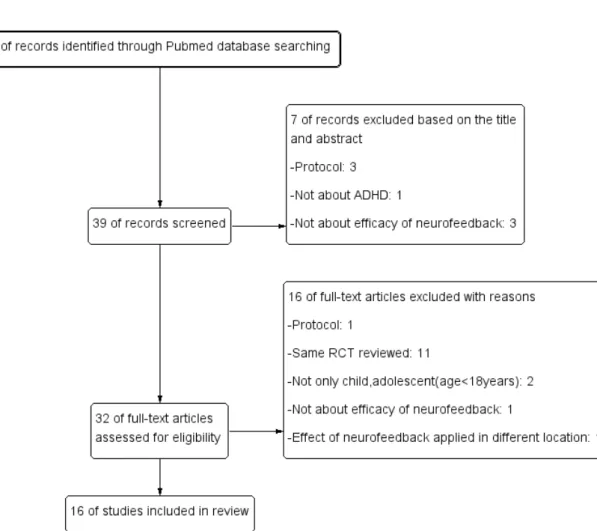
이 가운데 protocol에 관한 논문 4편, 뉴로피드백의 치료효과와 무관한 논문 4편, ADHD와 무관한 논문 1 편, 뉴로피드백을 시행한 부위에 따른 효과에 관한 논 문 1편, 소아청소년 (18세 이하)만 대상으로 하지 않은 논문 2편, 동일한 연구를 분석한 논문 11편을 제외하고 총 16개의 연구를 살펴보았다 (Fig. 1).
모든 논문은 full text를 이용하여 평가하였으며, 각 연구유형 및 연구대상, 진단기준, 치료기간, 유효성 평 가방법, 치료결과, 부작용에 대해 조사하였다.
Ⅲ. Results
1. 연구유형 및 연구대상
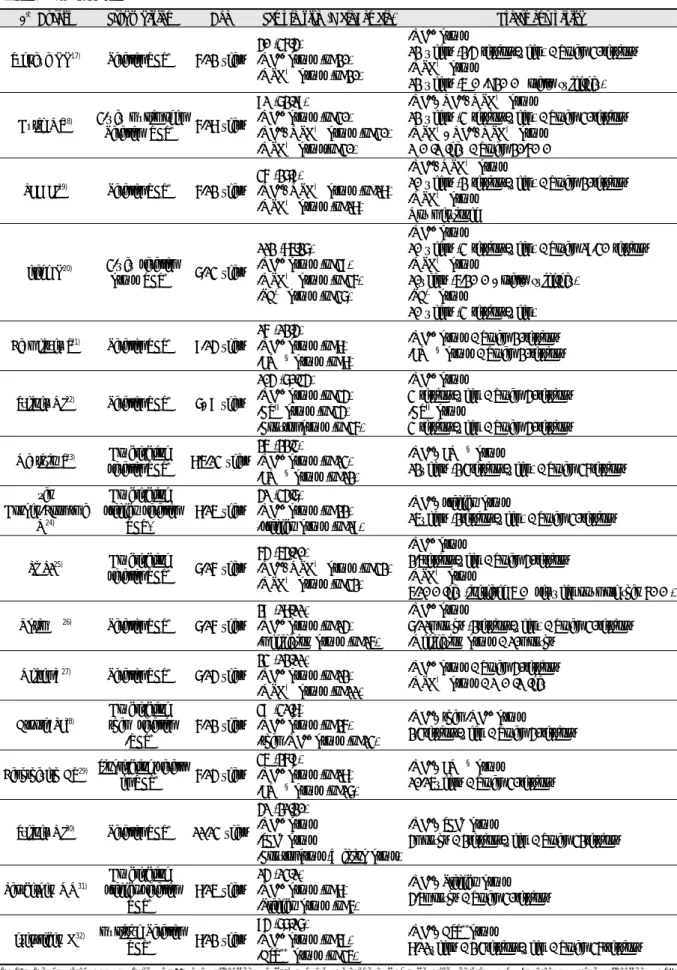
선정된 16개17-32)의 연구 모두 parallel-RCT이며, dou- ble-blind-placebo/sham RCT가 3개24,28,31), double-blind RCT가 2개23,27), single-blind RCT가 1개29)였으며, 대조 군으로 약물 치료군이 7개17-20,25,26,27)
, 인지행동 치료군 이 4개20,22,30,32)
, 근전도피드백 (EMG-feedback)군이 2개
21,29)
등으로 다양했다. 연구 대상 연령대는 6-16세에서 다양하게 분포되었는데, 6-12세인 경우가 3개17,19,28)로 가장 많았다. 연구 대상자수는 14명에서 112명으로 다 양했다. 치료기간은 2.5개월에서 11개월까지 있었으 나, 3개월 시행한 연구가 3개17,18,23)로 가장 많았다. 총 시행횟수는 20-40회로 다양했으나, 30회가 6개17,18,24,
26,29,31)로 가장 많았다 (Table 1).
Fig. 1. Flow diagram of searching and article selection
1st Author Study design Age Sample size (Male/Female) Treatment period
Sudnawa KK17) Parallel RCT* 6-12 years
40 (36/4) -NF+ group (n=20) -MPH† group (n=20)
-NF+ group
12 weeks (2-4 sessions/week) / Total: 30sessions -MPH† group
12 weeks (5 ㎎->20 ㎎ orally twice/day)
Duric NS18) 3-way multimodel
Parallel RCT* 6-18 years
91 (72/19) -NF+ group (n=30) -NF++MPH† group (n=30) -MPH† group(n=30)
-NF+, NF++MPH† group
12 weeks (3 sessions/week) / Total: 30sessions -MPH†, NF++MPH† group
1 ㎎/㎏/day / Total: 20-60 ㎎
LEE EJ19) Parallel RCT* 6-12 years
36 (27/9)
-NF++MPH† group (n=18) -MPH† group (n=18)
-NF++MPH† group
10 weeks (2 sessions/week) / Total: 20sessions -MPH† group
Not mentioned
Gelade K20) 3-way parallel
group RCT* 7-13 years
112 (85/27) -NF+ group (n=39) -MPH† group (n=36) -PA‡ group (n=37)
-NF+ group
10 weeks (3 sessions/week) / Total: 19-30 sessions -MPH† group
10weeks (5-20 ㎎, orally twice/day) -PA‡ group
10 weeks (3 sessions/week) Baumeister S21) Parallel RCT* 9-14 years
16 (12/4) -NF+ group (n=8) -EMG§ group (n=8)
-NF+ group / Total: 20sessions -EMG§ group / Total: 20sessions
Steiner NJ22) Parallel RCT* 7, 9 years
104 (70/34) -NF+ group (n=34) -CTII group (n=34) -Control group (n=36)
-NF+ group
3 sessions/week / Total: 40sessions -CTII group
3 sessions/week / Total: 40sessions Maurizio S23) Double-blind
parallel RCT* 8.5-13 years
25 (22/3) -NF+ group (n=13) -EMG§ group (n=12)
-NF+, EMG§ group
12weeks (2-3sessions/week) / Total: 36sessions van
Dongen-Boomsma M24)
Double-blind placebo parallel
RCT*
8-15 years
41 (34/7) -NF+ group (n=22) -placebo group (n=19)
-NF+, placebo group
15weeks (2sessions/week) / Total: 30sessions
Li L125) Double-blind
parallel RCT* 7-16 years
64 (54/10)
-NF++MPH† group (n=32) -MPH† group (n=32)
-NF+ group
2-5sessions/week / Total: 40sessions -MPH† group
5-10 ㎎/day (increased 5 ㎎ per week not more than 60 ㎎)
Ogrim G26) Parallel RCT* 7-16 years
29 (18/11) -NF+ group (n=14) -medication group (n=15)
-NF+ group
7-11months (2sessions/week) / Total: 30sessions -Medication group / 10months
Meisel V27) Parallel RCT* 7-14 years
23 (12/11) -NF+ group (n=12) -MPH† group (n=11)
-NF+ group / Total: 40sessions -MPH† group / 1 ㎎/㎏/day
Arnold LE28)
Double-blind sham parallel
-RCT*
6-12 years
39 (31/8) -NF+ group (n=26) -sham-NF+ group (n=13)
-NF+, sham-NF+ group
2-3sessions/week / Total: 40sessions
Bakhshayesh AR29) Single-blind-parall
el RCT* 6-14 years
35 (26/9) -NF+ group (n=18) -EMG§ group (n=17)
-NF+, EMG§ group
10-15weeks / Total: 30sessions
Steiner NJ30) Parallel RCT* 11-13 years
41 (21/20) -NF+ group -SCF¶ group
-Control group (Waiting group)
-NF+, SCF¶ group
4months / 2sessions/week / Total: 32sessions
Lansbergen MM31)
Double-blind placebo-parallel
RCT*
8-15 years
14 (13/1) -NF+ group (n=8) -Placebo group (n=6)
-NF+, Placebo group 4-5months / Total: 30sessions
Gevensleben H32) multisite Parallel
RCT* 8-12 years
94 (77/17) -NF+ group (n=59) -AST** group (n=35)
-NF+, AST**group
8-11weeks / 2-3sessions/week / Total: 36ssessions RCT*: Randomised Control Trial, NF+: Neurofeedback, MPH†: Methylphenidate, PA‡: Physcial activity, EMG§: electromyogram feedback, CTII: Cognitive training, SCF¶: attention training through standard computer format, AST**: Attention skills training
Table 1. Study Design
2. 진단기준
연구대상자 선정 시 진단기준으로 DSM-Ⅳ (Diagnostic and Statistical Manual of Mental Disorders, fourth edi- tion)만 사용한 연구가 9개19-22,24-26,28,31), DSM-Ⅳ와 ICD-10 (International Classification of Disease-10)을 사 용한 연구가 1개18), DSM-Ⅳ와 SNAP (Swanson, Nolan and Pelham Rating Scale-Ⅳ)를 사용한 연구가 1개26), DSM-Ⅳ와 semi-structured clinical interview를 사용한 연구가 1개32), Vanderbilt ADHD Diagnostic Rating Scale만 사용한 연구가 1개17), PACS (Parent Account of Children’s Symptoms)와 CTRS (Conners’ Teacher Rating Scale Revised)를 사용한 연구가 1개23), Semi-structured clinical interview for parent만 사용한 연구가 1개27), ICD-10만 사용한 연구가 1개29)이다.
연구대상자 포함기준으로 지적능력 (Intelligence Quotient: IQ)가 70이상인 연구가 3개17,18,26), 80이상인 연구가 10개19,20,22-25,27-29,31)이다. 연구대상자 배제기준 으로 품행장애, 불안장애, 우울장애가 배제기준인 연 구가 2개17,23), 반항장애 및 불안장애를 제외한 정신적 장애가 배제기준인 연구가 3개18,19,31), 품행장애를 제외 한 정신적 장애가 배제기준인 연구가 1개27), 다른 정신 적 장애가 있는 경우 배제기준인 연구가 3개22,25,30)이
다. 신경학적 장애 및 다른 장기의 이상이 배제기준인 연구가 1개32), 신경학적 장애 및 심혈관계 이상이 배제 기준인 연구가 4개18,19,24,31), 신경학적 장애가 배제기준 인 연구가 3개20,23,29)이다 (Table 2).
3. 유효성 평가방법 및 시기
유효성 평가도구는 대부분 부모와 교사 및 시험자 가 환아의 증상을 관찰하여 조사하는 설문 방식과 환 아의 임무 및 과제수행을 통한 평가이었다.
부모와 교사 및 시험자의 환아에 대한 평가에 사용 된 진단 도구로는 반데르빌트 평정척도 (Vanderbilt ADHD Diagnostic Rating Scale, Barkley’s Defiant Children:
A Clinician’s Manual for Assessment and Parent Training), ADHD 평정척도 (ADHD Rating Scale for parents:
ARS), 코너스 평정척도 (Conners Behavior Rating Scale:
CRS), 주의력 장애 진단시스템 (ADHD Diagnostic System: ADS), 파탄적 행동장애 평정척도 (Disruptive Behavior Disorders Rating Scale: DBDRS), German diag- nostic system for mental disorders (DISYPS-Ⅱ), 실행기 능척도 (Behavior Rating Inventory of Executive Function rating scale: BRIEF), Swanson, Kotkin, Agler, M-Flynn and Pelham scale (SKAMP), Behavioral Observation of
1st Author Diagnostic criteria& inclusion exclusion
Sudnawa KK17) -Vanderbilt ADHD Diagnostic Rating Scale* -Age: 6-12 years
-intellectual disability (IQ+<70) -conduct disorder
-anxiety disorder -depressive disorder
Duric NS18)
-ICD-10†
-DSM-Ⅳcriteria for the diagnosis of ADHD‡ -Age: 6-18 years,IQ+>70
-involvement in another clinical trial
-co-morbid disorders other than anxiety disorder or ODD§ -neurological and/or cardiovascular condition
LEE EJ19) -DSM-Ⅳ-TRII diagnosis of ADHD
-Treated medicine for different condition
-Co-morbid disorders other than anxiety disorder or ODD§ -Neurological and/or cardiovascular condition
-Involvement in another clinical trial -Received NF++ in past
-Full-scale IQ+<80 Gelade K20) -DSM-Ⅳ-TRII diagnosis of ADHD -Neurological disorders
-+IQ<80
Baumeister S21) -DSM-Ⅳ‡
Contraindications for MRI measuremnts -Left-handedness
-Co-morbid disorders other than conduct, reading disorder or ODD§
Steiner NJ22)
-DSM-Ⅳ‡ -Age: 7,9 years
-Ability to speak and understand English sufficiently
-Coexisting diagnosis of conduct disorder, autism spectrum, or other serious of mental illness
-IQ+<80 Table 2. Diagnostic Criteria & Include/Exclude
1st Author Diagnostic criteria& inclusion exclusion
Maurizio S23) -PACS¶ -CTRS**
-Age: 8.5-13 years -IQ+≥80
-no known neurological disorder
-no severe comorbid conduct, depression or anxiety disorders
van Dongen-Booms
ma M24)
-DSM-IV-TRII diagnosis of ADHD -full-scale IQ+≥80
-qEEG†† deviated at least 1.5 SD‡‡ from normative data
-Involved in psychotherapy
-Used medication other than ADHD medication
-Comorbid disorder other than ODD§ or any anxiety disorder -Neurological disorder, cardiovascular disease
-Participated in another clinical trial simultaneously -Received NF++ in the past
-Used alcohol or drugs
Li L125) -DSM-Ⅳ‡
-Age<7years
-Afflicted by severe mental illness -fast β waves upon EEG examination -IQ+<80
Ogrim G26)
-DSM-Ⅳ‡ -Learning disabilities
-behavioral and emotional comorbidities
-IQ+<70
Meisel V27)
-Semi-structured clinical interview for parents -IQ+≥80
-Not receiving medicine 2weeks before starting treatment -Concurring psychotheraphy
-Comorbid disorder other than ODD§
Arnold LE28) -DSM-Ⅳ‡ -SNAP§§
-IQ+<80 -Age<6years
-Cormorbid disorder requiring psychoactive medication -Medical disorder requiring medication that had psychoactive
effects
-Previous NF++ treatment>5
-Antipsychotic medication within 6 months pre baseline -Fluoxetine/atomoxetine 4-weeks prebaseline, -Stimulant 1-week
prebaseline
-any other psychotropic medication 2-weeks prebasline
Bakhshayesh AR29)
-ICD-10† -IQ+≻80
-No known neurological or gross organic diseases
-No hyperkinetic conduct disorders or pervasive developmental disorders
-
Steiner NJ30) -Diagnosis of ADHD confirmed by their physician -Sufficient English
-Coexisting diagnosis of conduct disorder, pervasive developmental disorder, other serious mental illness
Lansbergen MM31)
-DSM-Ⅳ-TRII diagnosis of ADHD -IQ+≻80
-qEEG†† deviated at least 1.5SD‡‡ from normative database -Room for improvement(average score of more than 1SD‡‡ above
the mean on DSM-Ⅳ‡
-Involved in intensive individual or group psychotherapy during the experiment
-Used medication other than psycho-stimulants or atomoxetine -Comorbid disorder other than ODD§ or anxiety disorder -Neurological disorder and cardiovascular disease -Participated in another clinical trial
-Received NF++ in the past -Used alcohol or drugs
Gevensleben H32)
-DSM-Ⅳ‡
-Semi-structured clinical interview
-Diagnostic Checklist for Hyperkinetic Disorders/ADHD -Drug-free and without concurring psychotherapy for at least
6weeks before starting the training
-Comorbid disorders other than disorder, emotional disorder, tic disorder and dyslexia
-gross neurological or other organic disorders
Vandrbilt ADHD Diagnostic Rating Scale*: Vandrbilt Attention Deficit Hyperactivity Disorder Diagnostic Rating Scale, IQ+: Intelligence quotient, ICD-10†: International Classification of Disease, DSM-Ⅳ‡: Diagnostic and Statistical Manual of Mental Disorders, fourth edition, ODD§: oppositional defiant disorder, DSM-Ⅳ-TRII: Diagnostic and Statistical Manual of Mental Disorders, fourth edition, Text-Revised, PACS¶: Parent Account of Children’s Symptoms, CTRS**: Conners’ Teacher Rating Scale Revised, NF++: neruofeedback, qEEG††: quantitative electroencephalogram, SD‡‡: standard deviations, SNAP§§: Swanson, Nolan and Pelham Rating Scale-Ⅳ
Students in Schools (BOSS), German standardized DSM-
Ⅳ questionnaire for ADHD (FBB-HKS), 부모 강점난점 설문지 (Parents’ Strengths and Difficulties Questionnaire:
SDQ), ADHD 평정척도 IV (ADHD Rating Scale IV), 전반적 임상 인상척도 (Clinical improvement as meas- ured by the Clinical Global Impressions-Improvement scale: CGI-I), DSM-Ⅳ parent-teacher questionnaire for ADHD, Rutter Children’s Behaviour questionnaire, Achenbach Child Behaviour Checklist, Peer inteeractions assessment scale, school report card, 총괄기능평가척도 (global assessment of functioning scale: GAF), 적대적 반 항성 장애평가척도 (oppositional defiant disorder rating scale based on DSM-IV: ODDRS-IV), academic perform- ance rated by teachers, semi-structured clinical interview for parents, 아동청소년행동평가척도 (child behavior checklist for ages 6-18 for parents: CBCL), Weiss Functional Impairment Rating Scale for parents (WFIRS-P), 스완슨, 놀란, 펠럼 설문지 (Swanson, Nolan and Pelham Rating Scale-Ⅳ: SNAP), 전반적 임상 인상척도 (Clinical Global Impression-Improvement Scale: CGI-S), 아동행동진단검 사 (Behavior Assessment Scales for Children-2: BASC-2), Homework Problem Checklist (HPC), German Rating Scale for Oppositional Defiant/Conduct Disorders (FBB-SSV), The Home Situations Questionnaire (HSQ), evaluation scale이 이용되었다.
환아의 임무 및 과제수행에 대한 평가도구로 한 국 웩슬리 아동지능검사 (Korean-Wechsler Intelligence Scale for Children-Ⅲ: K-WISC-Ⅲ), 귀 별난 작업 (Auditory oddball task), 정지신호과제 (stop-signal task:
SST), visual spatial working memory task (VSWM), Test for Attentional Performance for Children (KITAP), 2일 후 집중력 테스트 (D2 Test of Attention), 시각지속검사 (Visual Continuous Performance: VCPT), 웩슬러 개인 성취 검사 제2판 (Wechsler Individual Achievement Tests-2nd Edition), 광범위 성취검사 (Wide-Range Achievement Tests-4th Edition), Timed math test, 웩슬 러 약식 지능 검사 (Wechsler Abbreviated Scale of Intelligence), 7 Brain Resource Center computer-based normed neruopsychological test, 연속수행과제 (continuous performance task), paper-and-pencil attention tests, 시청 각지속수행검사 (Intergrated Visual and Auditory Continuous Performance Test: IVA-CPT)이 이용되었다.
환아의 활성화된 뇌 영역을 평가하는 도구로 기능적
자기 공명 영상 (functional magnetic resonance imaging:
fMRI)를 이용했으며 뇌파를 확인하기 위해 Encephalo- fluctuograph Technology (ET), 정량적 뇌파도 (quantitative electroencephalogram: QEEG)가 이용되었다.
평가 시기는 연구에 따라 다양하게 분포하였으나, 처치직전과 처치직후에 평가한 연구가 10개17,19-21,23,24, 26,29-31)
, 처치직전, 처치직후와 6개월 후에 평가한 연구
가 2개18,22), 처치직전, 처치중간, 처치직후와 6개월 후
에 평가한 연구가 2개25,32), 처치직전, 처치직후, 2개월 후에 평가한 연구가 1개28), 처치직전, 처치직후, 2개월 후, 6개월 후에 평가한 연구가 1개27)이다 (Table 3).
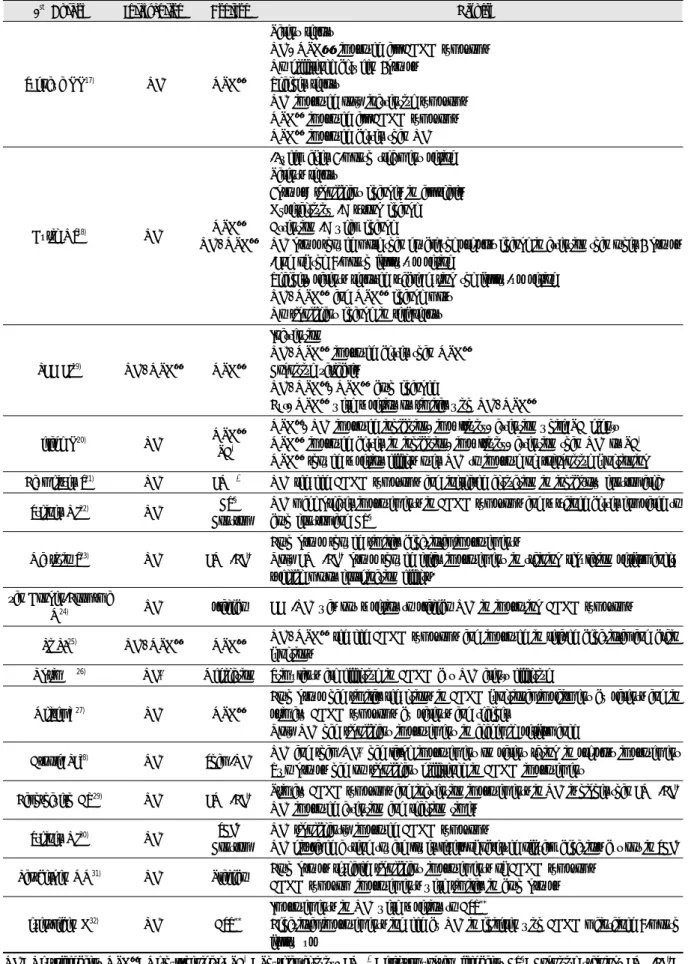
4. 치료결과
뉴로피드백과 약물적 치료 효과를 비교한 5개17,18,20,
26,27)의 연구에서 ADHD 증상 개선에 약물적치료가 뉴
로피드백에 비해 더 효과적이라는 연구는 4개17,18,20,26)
이었고, 주의력결핍개선효과에서 치료직후 뉴로피드 백만 시행한 군이 약물치료 군에 비해 2배 이상 유의미 한 효과적 차이가 있다고 보고한 연구가 1개18)있었고, 학업적 능력 향상에 뉴로피드백만 시행한 군이 효과적 이라는 연구가 1개27) 있었다.
뉴로피드백 및 약물을 병용한 군과 약물만 투여한 군을 비교한 3개18,19,25)의 연구에서 치료직후와 6개월 이후 ADHD 증상개선에 두 군의 차이가 없다는 연구 1개18), 주의력결핍 개선은 병용 치료군이 효과적이었 으나, 인지기능향상은 유사하거나 약물 치료군이 우월 하다는 연구가 1개19), 병용 치료군이 ADHD 증상개선 과 뇌기능활성에 효과적이라는 연구 1개25)가 있었다.
뉴로피드백과 다른 인지치료효과를 비교한 3개
20,22,30)의 연구에서는 모두 뉴로피드백이 인지치료에
비해 우월하다고 보고하였다.
뉴로피드백과 근전도-바이오피드백의 효과를 비교
한 4개21,23,29,32)의 연구에서는 뉴로피드백이 ADHD 증
상을 완화시키고, 뇌의 충동조절부위를 활성화시킨다 는 연구가 1개21), 두 군 모두 유사한 행동적 증상개선 을 보였으나, 운동조절 및 제어에 근전도-바이오피드 백이 더 유효하다는 연구가 1개23), 일차적인 ADHD 증 상 완화에 뉴로피드백이 우월하며, 특히 주의력 결핍 과 반응시간 개선에 효과적이라는 연구 1개29), 뉴로피 드백이 ADHD 증상 완화에 우월할 뿐 아니라 6개월 후에도 증상개선효과가 일부 유지된다는 연구 1개32)가 보고되었다.
1st Author Assessment Outcome date Sudnawa KK17) -Vanderbilt ADHD Diagnostic Rating Scale* Pre-treatment
Post-treatment
Duric NS18)
Parents and teachers report
- Barkley’s Defiant Children: A Clinician’s Manual for Assessment and Parent Training
Self-report
- Self-Report Questionnaire designed based on the Self-rated Scale of Self-regulating Function and the Piers-Harris Children’s Scale of Self-concept
1week before treatment initiation 1week after 3-month treatment period End of the 6-month follow-up period
LEE EJ19)
-K-WISC-Ⅲ+ -ARS† -CRS‡ -ADS§
Pre-treatment Post-treatment
Gelade K20)
-DBDRSII
-Auditory oddball task -SST¶
-VSWM**
Pre-treatment Post-treatment
Baumeister S21) -DISYPS-Ⅱ++
-fMRI††
Pre-treatment Post-treatment
Steiner NJ22)
-Conners 3-Parent -BRIEF‡‡
-SKAMP§§
-Conners 3-Teacher -BOSSIIII
Pre-treatment Post-treatment 6-month follow-up
Maurizio S23)
-FBB-HKS¶¶
-CPRS***
-SDQ+++
-BRIEF‡‡
-CTRS†††
-TAP‡‡‡
-KITAP§§§
-D2 Test of Attention
Pre-treatment Post-treatment
van Dongen-Boomsma
M24)
-ADHD Rating Scale IV -CGI-IIIIIII
Baseline Endpoint
Li L125)
-DSM-Ⅳ¶¶¶ parent-teacher questionnaire for ADHD -Conners’ parent-teacher questionnaire
-Rutter Children’s Behaviour questionnaire -Achenbach Child Behaviour Checklist -Peer inteeractions assessment scale -School report card
-GAF****
-ET++++
Baseline After 20sessions After 40sessions 6-month follow-up
Ogrim G26)
-CPRS***
-CTRS†††
-BREIF‡‡
-VCPT††††
-QEEG‡‡‡‡
Pre-treatment Post-treatment
Meisel V27)
-ADHD Rating Scale IV -ODDRS-IV§§§§
-Academic performance rated by teachers -Semi-structured clinical interview for parents -CBCLIIIIIIII for parents
-WFIRS-P¶¶¶¶ for parents
Pre-treatment Post-treatment 2-month follow up 6-month follow up Table 3. Assessment
뉴로피드백과 placebo의 효과를 비교한 3개24,28,31)의 연구에서는 두 군 모두 ADHD 증상을 완화되었으나, 두 군 사이에 유의미한 효과적 차이는 없다고 보고되 었다 (Table 4).
5. 부작용
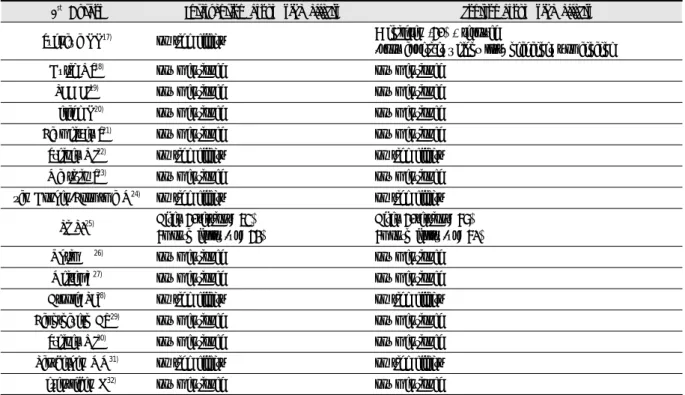
10개18-21,23,26,27,29,30,32)의 연구에서는 부작용 및 안전
성에 대한 언급이 없었다. 부작용 및 안전성을 언급한
6개17,22,24,25,28,31)의 연구에서 모두 뉴로피드백으로 인한
어떤 부작용도 발생하지 않았다고 보고하였다.
Sudnawa KK 등17)의 연구에 따르면 methylphenidate 투약군의 8명 (40%)가 부작용으로 식욕부진, 체중감 소, 두통, 복통을 호소하였으며, Li L 등25)의 연구에 의 하면 병용 치료군에서는 기존의 methylphenidate 투약 으로 인해 발생한 부작용을 53%에서 42%까지 감소시 킴과 동시에 약물의 용량도 19.6 ± 9.8 ㎎에서 15.2 ± 8.2 ㎎으로 감량시켰으나, 대조군 (약물투여군)에서는 부작용이 67%에서 61%로 감소하였고, 약물의 용량은 19.2 ± 7.3 ㎎으로 유지되었다 (Table 5).
1st Author Assessment Outcome date
Arnold LE28)
-DSM-Ⅳ¶¶¶
-SNAP*****
-CPRS***
-CTRS†††
-BRIEF‡‡
-CGI-S+++++
-Wechsler Individual Achievement Tests-2nd Edition -Wide-Range Achievement Tests-4th Edition -Timed math test
-Wechsler Abbreviated Scale of Intelligence
-7 Brain Resource Center computer-based normed neruopsychological test -EEG activity
Pre-treatment After 12-treatment After 24-treatment Post-treatment 2-month follow up
Bakhshayesh AR29)
-FBB-HKS¶¶
-Continuous Performance Task -Paper-and-pencil attention tests
Pre-treatment Post-treatment
Steiner NJ30)
-CRS‡ -BRIEF‡‡
-BASC-2†††††
-IVA-CPT‡‡‡‡‡
Pre-treatment Post-treatment
Lansbergen MM31) -DSM-Ⅳ¶¶¶
-CGI-IIIIIII
Pre-treatment Post-treatment
Gevensleben H32)
-FBB-HKS¶¶
-FBB-SSV§§§§§
-HSQIIIIIIIIII -HPC¶¶¶¶¶
-Evaluation Scale
Pre-treatment
Intermediate assessment(After 18sessions) Post-treatment
6-months follow up
Vanderbilt ADHD Diagnostic Rating Scale*: Vanderbilt Attention Deficit Hyperactivity Disorder Diagnostic Rating Scale, K-WISC-Ⅲ+: Korean-Wechsler Intelligence Scale for Children-Ⅲ, ARS†: ADHD Rating Scale for parents, CRS‡: Conners Behavior Rating Scale, ADS§: ADHD Diagnostic System, DBDRSII: Disruptive Behavior Disorders Rating Scale, SST¶: stop-signal task, VSWM**: visual spatial working memory task, DISYPS-Ⅱ++: German diagnostic system for mental disorders, fMRI††: functional magnetic resonance imaging, BRIEF‡‡: Behavior Rating Inventory of Executive Function rating scale, SKAMP§§: Swanson, Kotkin, Agler, M-Flynn and Pelham scale. BOSSIIII: Behavoiral Observation of Students in Schools, FBB-HKS¶¶: German standardized DSM-Ⅳ questionnaire for ADHD, CPRS***: Conners’ Parents Rating Scale, SDQ+++: Parents’ Strengths and Difficulties Questionnaire, CTRS†††: Conners’ Teacher Rating Scale, TAP‡‡‡: Test for Attentional Performance, KITAP§§§: Test for Attentional Performance for Children, CGI-IIIIIII: Clinical improvement as measured by the Clinical Global Impressions-Improvement scale, DSM-Ⅳ¶¶¶: Diagnostic and Statistical Manual of Mental Disorders, GAF****: global assessment of functioning scale, ET++++: encephalofluctuograph technology, VCPT††††: Visual Continuous Performance Test, QEEG‡‡‡‡: quantitative electroencephalogram, ODDRS-IV§§§§: Oppositional defiant disorder rating scale based on DSM-IV, CBCLIIIIIIII: child behavior checklist for ages 6-18, WFIRS-P¶¶¶¶: Weiss Functional Impairment Rating Scale, SNAP*****: Swanson, Nolan and Pelham Rating Scale-Ⅳ, CGI-S+++++: Clinical Global Impression-Improvement Scale, BASC-2†††††: Behavior Assessment Scales for Children-2, IVA-CPT‡‡‡‡‡: Intergrated Visual and Auditory Continuous Performance Test, FBB-SSV§§§§§: German Rating Scale for Oppositional Defiant/Conduct Disorders, HSQIIIIIIIIII: The Home Situations Questionnaire, HPC¶¶¶¶¶: Homework Problem Checklist
1st Author Intervention Control Results
Sudnawa KK17) NF* MPH+
Parent report
NF*, MPH+ improved all ADHD symptoms No difference between 2groups
Teacher report
NF* improved only inattentive symptoms MPH+ improved all ADHD symptoms MPH+ improved better than NF*
Duric NS18) NF* MPH+
NF*+MPH+
-1week after 3-month treatment period Parents report
3groups: significant changes in all scales Hyperactivity -> strong change Attention -> weak change
NF* group showed more than double the pre-post change in attention than other 2 groups -End of the 6-month follow-up period
Teacher, parents reported stable during the follow-up period NF*+MPH+ and MPH+ change most
No significant change in self report
LEE EJ19) NF*+MPH+ MPH+
Inattention
NF*+MPH+ improved better than MPH+ Cognitive variables
NF*+MPH+, MPH+ both changed
But, MPH+ were superior or similar with NF*+MPH+
Gelade K20) NF* MPH+
PA†
MPH+, NF* improved inhibition, impulsivity, attention while PA didn’t MPH+ improved better in inhibition, impulsivity, attention than NF* or PA† MPH+ showed superior effects over NF* to improve neurocognitive functioning Baumeister S21) NF* EMG‡ NF* reduced ADHD symptoms and increased activation in inhibitory control area.
Steiner NJ22) NF* CT§
Control
NF* made greater improvements in ADHD symptoms and sustained better compared to both control and CT§
Maurizio S23) NF* EMG-BFII
Both group showed similar behavioral improvements
Only EMG-BFII group showed clear improvement in training regulation performance, specific motor coordination effects.
van Dongen-Boomsma
M24) NF* placebo EEG-NF* was not superior to placebo NF* in improving ADHD symptoms
Li L125) NF*+MPH+ MPH+ NF*+MPH+ reduced ADHD symptoms and improved in related behavioral and brain functions
Ogrim G26) NF* Medication Stimulants are effective in ADHD but NF* aren’t effective
Meisel V27) NF* MPH+
Both group had similar reductions in ADHD functional impairment by parents and in primary ADHD symptoms by parents and teacher
Only NF* had significant improvement in academic performance
Arnold LE28) NF* Sham-NF* NF* and sham-NF* had large improvement on parent rating in pre-post improvement Two groups had no significant difference in ADHD improvement
Bakhshayesh AR29) NF* EMG-BFII Primary ADHD symptoms and inattention improvements in NF* is higher than EMG-BFII NF* improved attention and reaction times
Steiner NJ30) NF* SCF¶
Control
NF* significantly improved ADHD symptoms
NF* displayed a trend toward lower levels of observed off-task behaviors but not in SCF¶ Lansbergen MM31) NF* Placebo Both groups revealed significant improvements of ADHD symptoms
ADHD symptom improvements were similar in both groups
Gevensleben H32) NF* AST**
Improvements in NF* were superior to AST**
Behavioral improvements induced by NF* in children with ADHD maintained 6-month follow up
NF*: Neurofeedback, MPH+: Methylphenidate, PA†: Physcial activity, EMG‡: electromyogram feedback, CT§: Cognitive training, EMG-BFII: electromyographic biofeedback, SCF¶: attention traing through standard computer format, AST**: attention skils training
Table 4. Results of Study
Ⅳ. Discussion
ADHD의 진단은 대부분 DSM-Ⅳ 또는 DSM-Ⅴ에 의거하거나, 이를 기반으로 핵심증상들을 포함한 자체 적인 평가도구를 만들어 이용하며, 부주의 우세형, 과 잉행동-충동 우세형, 복합형으로 분류된다. 반수 이상 이 4세 이전에 나타나는데, 주로 남아에서 많이 보이 며, 기능적인 측면에서 보면 뇌의 전두엽 및 선조체의 기능 장애로, 도파민 D4 수용체 유전자의 이상과 관련 이 있으며, MRI 또는 SPECT 검사를 통해 정상인과 차 이가 있다고 보고된다. ADHD의 대표적 치료 약물인 methylphenidate의 효과를 평가하기 위해서는 최소 2-3 주가 필요하며, 대다수 환아의 경우에서는 부작용이 가볍고 단기간에 나타나지만, 일부 환아의 경우에서는 부작용이 너무 심하게 나타나 다른 성분의 약물로 대 체하기도 한다. 연령이 증가함에 따라 과잉행동증은 감소하지만, 학습부진은 청소년까지 지속될 수 있으며, 급한 성격, 인내심 부족, 반사회적 성격 등의 증상은 성인까지 지속될 수 있다. ADHD환자의 50%이상에서 동반 질환이 나타나며, 국내의 경우 외래 방문 ADHD 환아의 45-76%에서 진단되고, 동반질환에는 주로 적 대적 반항장애 50%, 불안장애 33%, 기분장애 14%가 있다2,33).
뉴로피드백의 효과는 시행시간, 시행빈도, 총 시행 횟수, 접촉부위, 성별 및 연령 등에 따라 그 효과가 상 이할 수 있다. Cheong 등34)에 따르면 시행시간은 20-30 분, 30-40분, 40-50분의 순으로, 시행빈도의 경우 주 3 회, 주 2회, 주5회 순으로 효과적인데, Arnold 등에 연 구28)에 따르면 주 2회보다 주 3회 시행 시 더욱 효과적 이라는 결과는 위의 연구 결과를 뒷받침하는 근거가 되며 뇌파 훈련이 48시간 안에 지속효과를 보인다는 보고도 일치한다. 따라서 본 연구에서는 주 3회를 시행 한 연구는 3개18,20,22)로 다른 연구에 비해 뉴로피드백이 더욱 효과적이라는 결과가 나올 개연성이 클 것으로 판단된다.
총 시행횟수의 경우 40회 초과, 20회 이하, 20회 이 하, 20회 초과-30회 이하, 30회 초과-40회 이하 순으로 효과적이라는 연구결과34)가 있다. 이는 Janssen 등의 연 구35)에서 ADHD 증상 중 학습효과 및 집중력 향상을 위한 β 파의 증가는 대개 30회 이상의 뉴로피드백을 시행해야 유의미한 효과가 있다고 보고를 함께 살펴보 았을 때 총 시행횟수 자체의 기준은 일치하지 않으나 장기간의 시행이 효과적이라는 면에서는 동일하다. 본 연구에서는 30회가 6개17,18,24,26,29,31)로 가장 많은 연구에 시행되었으며, 30회 이상 시행한 연구가 7개22,23,25,27,28, 30,32)
, 30회 이하로 시행한 연구가 3개19-21)인 점을 고려
1st Author Intervention group side effects control group side effects
Sudnawa KK17) no side effects 8 children (40%) reported
-poor appetite, weight loss, headache, stomachache
Duric NS18) not mentioned not mentioned
LEE EJ19) not mentioned not mentioned
Gelade K20) not mentioned not mentioned
Baumeister S21) not mentioned not mentioned
Steiner NJ22) no side effects no side effects
Maurizio S23) not mentioned not mentioned
van Dongen-Boomsma M24) no side effects no side effects Li L125) After 40sessions: 53%
6month follow-up: 42%
After 40sessions: 67%
6month follow-up: 61%
Ogrim G26) not mentioned not mentioned
Meisel V27) not mentioned not mentioned
Arnold LE28) no side effects no side effects
Bakhshayesh AR29) not mentioned not mentioned
Steiner NJ30) not mentioned not mentioned
Lansbergen MM31) no side effects no side effects
Gevensleben H32) not mentioned not mentioned
Table 5. Side Effects