Successful salvage treatment of acute graft-versus-host disease after liver transplantation by withdrawal of immunosuppression:
a case report
Wei Qiu1, Guo-Yue Lv1, Chao Jiang1, Ping Zhang1, Xiao-Dong Sun1, Xiao-Ju Shi1, Xue-Yan Liu2, and Guang-Yi Wang1
1Department of Hepato-biliary Pancreatic Surgery, First Hospital of Jilin University,
2Department of Cardiology, China-Japan Union Hospital of Jilin University, Changchun, China
Acute graft-versus-host disease (GVHD) following liver transplantation is a rare but fatal complication. The correct diag- nosis and management of GVHD after liver transplantation are still major challenges. Herein, we reported successful salvage treatment of acute GVHD by withdrawal of immunosuppression in a patient who presented with fever, skin rashes, and decreased blood cell counts after liver transplantation. This case highlights the need for awareness of drug-induced liver injury if liver function tests are elevated during treatment, especially in patients taking multiple poten- tially hepatotoxic drugs, such as broad-spectrum antibiotics. When occurs, an artificial liver support system is a useful tool to provide temporary support of liver function for the patient in the event of drug-induced liver injury. (Korean J Hepatobiliary Pancreat Surg 2016;20:38-43)
Key Words: Graft-versus-host disease; Liver transplantation; Drug-induced liver injury
Received: August 25, 2015; Revised: November 24, 2015; Accepted: November 30, 2015 Corresponding author: Guang-Yi Wang
Department of Hepato-biliary Pancreatic Surgery, First Hospital of Jilin University, Changchun 130021, China Tel: +86-431-88783331, Fax: +86-431-88783331, E-mail: [email protected]
Copyright Ⓒ 2016 by The Korean Association of Hepato-Biliary-Pancreatic Surgery
This is an Open Access article distributed under the terms of the Creative Commons Attribution Non-Commercial License (http://creativecommons.org/
licenses/by-nc/4.0) which permits unrestricted non-commercial use, distribution, and reproduction in any medium, provided the original work is properly cited.
Korean Journal of Hepato-Biliary-Pancreatic Surgery ∙ pISSN: 1738-6349ㆍeISSN: 2288-9213
INTRODUCTION
Acute graft-versus-host disease (GVHD), a reaction of donor immune cells against host tissues, is a frequent com- plication (35%-50%) after allogeneic hematopoietic stem cell transplantation.1 In 1988, Burdick et al.2 first de- scribed acute GVHD after orthotopic liver transplantation (OLT). However, acute GVHD after liver transplantation is rare, occurring in 0.1%-2% of patients, but a severe complication with a 85% mortality rate in adult recipients.3-6 Acute GVHD typically occurs 1-8 weeks af- ter liver transplantation with symptoms of fever, diarrhea, and skin rashes in the early clinical course, followed by pancytopenia, sepsis, and even death.7 Currently, the cor- rect diagnosis and management of GVHD following liver transplantation remain major challenges. Herein, we re- ported a patient with acute GVHD after liver trans- plantation that was successfully managed by withdrawal of immunosuppression.
CASE
Patient characteristics
A 47-year-old man with compensated hepatic cirrhosis due to a 28-year history of hepatitis B infection underwent OLT from a 19-year-old ABO-identical male donor after cardiac death in November 2013. The warm ischemic time and cold ischemic time were 5 minutes and 265 minutes, respectively. The recipient had severe complications of liver cirrhosis including hepatic encephalopathy and hyper- splenism; and his Model for End-Stage Liver Disease (MELD) score was 30. Total blood loss during the surgery was 1956 ml, and the patient was given 8 units of red blood cells and 1000 ml plasma. Post-transplant immunosuppression regimens consisted of induction with anti-interleukin-2 re- ceptor monoclonal antibody (basiliximab) followed by maintenance with steroids (methylprednisolone and pre- dnisolone), tacrolimus (4.5 mg/d), and mycophenolate mo- fetil (750 mg, twice per day). The tacrolimus dose was ad-
Fig. 1. Maculopapular rashes on the palm (A), foot (B), and chest (C) of the patient at postoperative day (POD) 28; and ulcer lesions in the oral mucosa at POD 29 (D).
justed to maintain the whole blood trough level at 8-12 ng/ml. Methylprednisolone and prednisolone were given at initial doses of 240 mg and 20 mg on postoperative day (POD) 1, respectively, and gradually tapered to 0 within 3 months. The postoperative course was uneventful, and the patient was discharged from the hospital approximately 3 weeks after surgery.
Acute GVHD after liver transplantation
On POD 28, the patient developed a fever of 38.7oC, and he was treated with cephalosporin at a local hospital due to suspected bacterial infection. Unfortunately, the pa- tient’s condition deteriorated rapidly, and he showed signs of systemic inflammatory response syndrome (SIRS). He was then transferred to the intensive care unit in our hospital. On POD 29, the patient developed skin rashes on his limbs and trunk (Fig. 1A-C), and the rashes gradu-
ally spread to the whole body and integrated with each other. The patient also developed multiple oropharyngeal ulcers (Fig. 1D) and complained of dysphagia. The patient did not suffer from watery diarrhea during the entire clin- ical course. The blood tests showed that white blood cell (WBC) and platelet counts had dropped to 2.7×10⁹/L and 22×109/L, respectively. Abdominal and chest computed tomography (CT) scans showed no positive findings.
Cultures of blood, urine, and sputum for bacteria and viral serologic tests for cytomegalovirus (CMV) were all negative. A skin biopsy showed histological features con- sistent with GVHD (grade II), including focal liquefaction degeneration of the basal cells, scattered necrotic keratino- cytes in stratum spinosum, and moderate lymphocytic in- filtration in the dermis (Fig. 2).8,9 GVHD was suspected despite lack of chimerism of host- and donor-circulating lymphocytes among peripheral blood cells.
Fig. 3. Clinical course and laboratory changes following liver transplantation. (A) Serum AST and ALT concentrations during the postoperative period, (B) serum TBIL and DBIL concentrations during the postoperative period. ALSS, artificial liver support system; AST, aspartate aminotransferase; ALT, alanine aminotransferase; TBIL, total bilirubin; DBIL, direct bilirubin.
Fig. 2. Skin biopsy stained with hematoxylin-eosin (H&E at
×20), showing basal cell hydropic changes in epidermis, mul- tiple apoptotic keratinocytes, and moderate lymphocytic in- filtration in the dermis.
Because his fever did not improve, the patient was giv- en cefmenoxime, cefoperazone/shuba tanner, meropenem, and teicoplanin to treat a possible bacterial infection, and fluconazole, caspofungin, and voriconazole for possible fungal infection. The immunosuppression therapy was gradually withdrawn, and only steroid (methylprednisolone, 2 mg/kg/day) was used in combination with gamma- globulin. Interleukin-11, colony-stimulating factors, and platelets were used for improving thrombocytopenia and promoting blood cell production. From POD 32, we noted a gradual disappearance of the skin rashes, followed by a decrease in temperature (36.5oC). On POD 35, the GVHD was finally confirmed by a skin biopsy and periph-
eral blood analysis employing fluorescence-activated cell sorting (FACS) and the immunosuppressive drugs includ- ing tacrolimus and mycophenolate mofetil were com- pletely withdrawn. The plasma concentration of tacrolimus decreased to 0 on POD 38, and no immunosuppressive therapy was given between POD 35 and POD 42.
Drug-induced liver injury
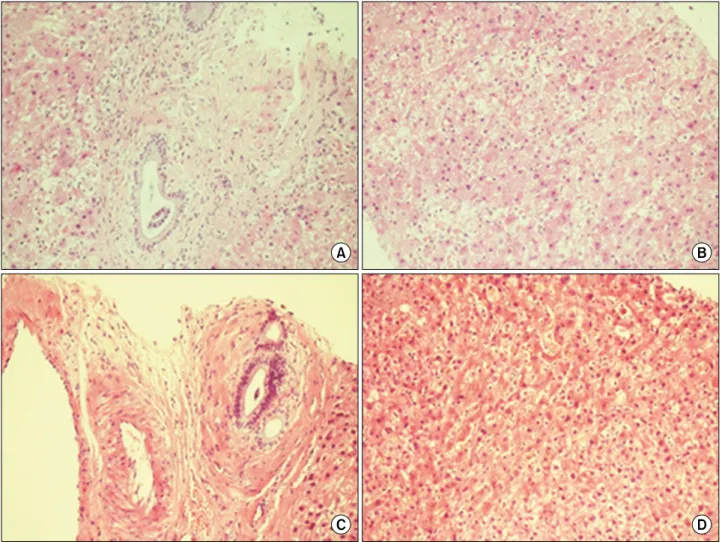
On POD 42, the patient’s aspartate aminotransferase (AST), alanine aminotransferase (ALT), total bilirubin (TBIL), and direct bilirubin (DBIL) levels were elevated to high levels (Fig. 3). Immunosuppressive drugs, in- cluded tacrolimus, mycophenolate mofetil, and high-dose methylprednisolone (500 mg/day for 3 days), were imme- diately used in the patient due to the risk of acute rejection. However, liver functions deteriorated despite these treatments, and the patient’s clinical condition grew progressively worse. Thus, a liver biopsy was planned to explore the actual cause of abnormal liver function. The results of a subsequent liver biopsy were compatible with drug-induced liver injury (DILI, Fig. 4). On POD 53, ra- pamycin was used instead of tacrolimus, and drugs that might induce liver injury, such as meropenem, teicopla- nin, and caspofungin, were withdrawn. The artificial liver support system was implemented in the patient to treat hepatic insufficiency on POD 55 and POD 59. Another liver biopsy was performed on POD 64, which confirmed the recovery of the liver from drug-induced injury. The patient was discharged with satisfactory clinical outcomes on POD 86 (Fig. 5).
Fig. 4. Liver biopsy findings (H&E ×200). (A) Periportal infiltration of a few periportal neutrophils and lymphocytes at POD 50, (B) zone 3 cholestasis and lobular hepatocyte necrosis consistent with DILI at POD 50, (C) periportal infiltration of extremely few lymphocytes at POD 64, and (D) zone 3 cholestasis and lobular hepatocyte necrosis, eosinophilic bodies, and liver cell proliferation at POD 64.
DISCUSSION
Acute GVHD following OLT is a rare but fatal compli- cation that poses both diagnostic and therapeutic challenges. Usually, the diagnosis of acute GVHD is based on the presence of clinical manifestations and histo- pathological evidences.5,10 In the present case, the patient was readmitted 4 weeks after liver transplantation, pre- senting with symptoms of fever, skin rashes, decreased blood cell counts, and other typical signs of acute GVHD.
The patient was finally diagnosed with acute GVHD by skin biopsy. In addition, earlier testing for chimerism by identifying donor’s HLA antigen may lead to an earlier diagnosis of GVHD.6 The donor’s HLA typing can be de- tected by polymerase chain reaction (PCR)-se- quence-specific primers.3,11,12 However, chimerism of
host- and donor-circulating lymphocytes was not observed among peripheral blood cells in this case. One reason is that chimerism usually peaks in the first week, declines rapidly thereafter, and is usually absent beyond 3-4 weeks post transplantation, as reported by Taylor et al.13,14
Currently, most therapeutic modalities for acute GVHD are based on GVHD management after hematopoietic stem cell transplantation and focus on increasing immuno- suppression. However, this treatment does not demonstrate any survival benefit.3,15 Thus, some investigators have pro- posed reducing and even completely withdrawing im- munosuppression as a treatment for GVHD after liver transplantation.3 Lehner et al.16 reported successful salvage treatment of acute GVHD in a liver allograft recipient by withdrawal of immunosuppression; they presented evi- dence that withdrawal of immunosuppressive therapy al-
Fig. 5. The patient recovered with satisfactory clinical outcomes. (A) The skin rashes on the hands healed at POD 50, (B) the jaundice was resolved at the leg at POD 50, (C) the skin rashes on the feet healed at POD 80, and (D) new fingernails grew to replace old ones at POD 80.
lowed the patient’s immune system to reconstitute itself, reject offending lymphocytes, and avoid lethal septic complications. Our experience showed that a patient with acute GVDH can benefit from the novel therapeutic regi- men including a high-dose of steroid, withdrawal of im- munosuppression, and supplementation with gamma globulin.
In this case, when the patient discontinued the im- munosuppressive drugs, he experienced elevations in the liver function tests. We first considered an acute rejection episode. However, the patient did not exhibit any im- provement even after resuming immunosuppression. A subsequent liver biopsy helped to make a timely diagnosis of DILI. DILI is liver injury caused by various medi- cations, leading to abnormalities in liver tests or liver dysfunction.17 The clinical presentation of DILI is highly variable from asymptomatic, reversible elevation of liver
enzymes to fulminant hepatic failure.18 The diagnosis of DILI is difficult in patients with chronic liver disease and in those taking multiple potentially hepatotoxic drugs.17 In this case, all drugs that might induce liver injury were im- mediately withdrawn from the patient at the time of diag- nosis of DILI. In addition, we used artificial liver support system to provide temporary support of liver function for the patient with success.
In conclusion, withdrawal of immunosuppression may serve as an effective treatment for acute GVHD after liver transplantation. During treatment, in addition to acute re- jection episodes, awareness of drug-induced liver injury is necessary if the results of liver function tests are ele- vated, especially for patients taking multiple potentially hepatotoxic drugs, such as broad-spectrum antibiotics.
REFERENCES
1. Faraci M, Caviglia I, Biral E, Morreale G, Giardino S, Garbarino L, et al. Acute graft-versus-host disease in pediatric allogeneic hematopoietic stem cell transplantation. Single-center experience during 10 yr. Pediatr Transplant 2012;16:887-893.
2. Burdick JF, Vogelsang GB, Smith WJ, Farmer ER, Bias WB, Kaufmann SH, et al. Severe graft-versus-host disease in a liv- er-transplant recipient. N Engl J Med 1988;318:689-691.
3. Chen XB, Yang J, Xu MQ, Wen TF, Yan LN. Unsuccessful treatment of four patients with acute graft-vs-host disease after liver transplantation. World J Gastroenterol 2012;18:84-89.
4. Rogulj IM, Deeg J, Lee SJ. Acute graft versus host disease after orthotopic liver transplantation. J Hematol Oncol 2012;5:50.
5. Perri R, Assi M, Talwalkar J, Heimbach J, Hogan W, Moore SB, et al. Graft vs. host disease after liver transplantation: a new approach is needed. Liver Transpl 2007;13:1092-1099.
6. Taylor AL, Gibbs P, Sudhindran S, Key T, Goodman RS, Morgan CH, et al. Monitoring systemic donor lymphocyte mac- rochimerism to aid the diagnosis of graft-versus-host disease af- ter liver transplantation. Transplantation 2004;77:441-446.
7. Post GR, Black JS, Cortes GY, Pollack RB, Wolff DJ, Lazarchick J. The utility of fluorescence in situ hybridization (FISH) analysis in diagnosing graft versus host disease following orthotopic liver transplant. Ann Clin Lab Sci 2011;41:188-192.
8. Mazariegos GV, Abu-Elmagd K, Jaffe R, Bond G, Sindhi R, Martin L, et al. Graft versus host disease in intestinal transplantation. Am J Transplant 2004;4:1459-1465.
9. Joffe RA. An assist to the next (10th) edition of Lever's Histopathology of the Skin. Am J Dermatopathol 2009;31:26-30.
10. Guo ZY, He XS, Wu LW, Zhu XF, Ju WQ, Wang DP, et al.
Graft-verse-host disease after liver transplantation: a report of two cases and review of literature. World J Gastroenterol 2008;14:974-979.
11. Schöniger-Hekele M, Müller C, Kramer L, Dauber E, Mayr WR, Wrba F, et al. Graft versus host disease after orthotopic liver transplantation documented by analysis of short tandem repeat polymorphisms. Digestion 2006;74:169-173.
12. Schrager JJ, Vnencak-Jones CL, Graber SE, Neff AT, Chari RS, Wright KJ Jr, et al. Use of short tandem repeats for DNA finger- printing to rapidly diagnose graft-versus-host disease in solid or- gan transplant patients. Transplantation 2006;81:21-25.
13. Taylor AL, Gibbs P, Bradley JA. Acute graft versus host disease following liver transplantation: the enemy within. Am J Transplant 2004;4:466-474.
14. Thin L, Macquillan G, Adams L, Garas G, Seow C, Cannell P, et al. Acute graft-versus-host disease after liver transplant: novel use of etanercept and the role of tumor necrosis factor alpha inhibitors. Liver Transpl 2009;15:421-426.
15. Romagnuolo J, Jewell LD, Kneteman NM, Bain VG. Graft-ver- sus-host disease after liver transplantation complicated by sys- temic aspergillosis with pancarditis. Can J Gastroenterol 2000;
14:637-640.
16. Lehner F, Becker T, Sybrecht L, Lück R, Schwinzer R, Slateva K, et al. Successful outcome of acute graft-versus-host disease in a liver allograft recipient by withdrawal of immunosuppression.
Transplantation 2002;73:307-310.
17. Suk KT, Kim DJ. Drug-induced liver injury: present and future.
Clin Mol Hepatol 2012;18:249-257.
18. Ghabril M, Chalasani N, Björnsson E. Drug-induced liver injury:
a clinical update. Curr Opin Gastroenterol 2010;26:222-226.