ISSN 2234-3806 • eISSN 2234-3814
Ann Lab Med 2012;32:264-269
http://dx.doi.org/10.3343/alm.2012.32.4.264
Rapid Diagnosis of Tuberculosis and Multidrug Resistance Using a MGIT 960 System
Won-Jung Koh, M.D.1,*, Yousang Ko, M.D.1,*, Chang-Ki Kim, M.D.2, Kyung Sun Park, M.D.3, and Nam Yong Lee, M.D.3
Division of Pulmonary and Critical Care Medicine1, Department of Medicine, Samsung Medical Center, Sungkyunkwan University School of Medicine, Seoul;
Korean Institute of Tuberculosis2, Osong; Department of Laboratory Medicine & Genetics3, Samsung Medical Center, Sungkyunkwan University School of Medicine, Seoul, Korea
Background: The purpose of this study was to compare the turnaround time for liquid cul- turing and primary anti-tuberculous drug susceptibility testing (DST) performed using the mycobacteria growth indicator tube (MGIT) 960 system (Becton Dickinson, USA) with that for conventional culturing and DST (by the absolute concentration method) performed us- ing solid culture medium and to determine the concordance rates of DST results obtained using these 2 methods.
Methods: In this retrospective study, we compared the turnaround times from receiving the request for mycobacterial culture to reporting the DST results before and after the in- troduction of the MGIT 960 system. Further, we determined the concordance between DST results for isoniazid and rifampin for Mycobacterium tuberculosis isolates obtained using the MGIT 960 system and the absolute concentration method, which was conduct- ed at the Korean Institute of Tuberculosis.
Results: The overall turnaround time for mycobacterial culturing and DST was 27 days for liquid culturing and DST using the MGIT 960 system versus approximately 70 days for cul- turing on solid medium and DST with the absolute concentration method (P <0.001). There was a good concordance between findings of DST obtained with the 2 methods (97.2%, kappa coefficient=0.855 for rifampin; and 95.6%, kappa coefficient=0.864 for isoniazid), for 1,083 clinical isolates.
Conclusions: The automated MGIT 960 system for culturing and DST of M. tuberculosis was successfully introduced in a hospital laboratory setting in Korea with significant short- ening of the turnaround time.
Key Words: Drug resistance, Microbial sensitivity tests, Mycobacterium tuberculosis, Rifampin, Isoniazid
Received: December 2, 2011 Revision received: March 19, 2012 Accepted: May 22, 2012
Corresponding author: Nam Yong Lee Department of Laboratory Medicine &
Genetics, Samsung Medical Center, Sungkyunkwan University School of Medicine, 81 Irwon-ro, Gangnam-gu, Seoul 135-710, Korea
Tel: +82-2-3410-2706 Fax: +82-2-3410-2719 E-mail: [email protected]
*Won-Jung Koh and Yousang Ko contributed equally to this work.
© The Korean Society for Laboratory Medicine.
This is an Open Access article distributed under the terms of the Creative Commons Attribution Non-Commercial License (http://creativecom- mons.org/licenses/by-nc/3.0) which permits unrestricted non-commercial use, distribution, and reproduction in any medium, provided the original work is properly cited.
INTRODUCTION
Multidrug-resistant tuberculosis (MDR-TB), which is tuberculo- sis (TB) resistant to at least isoniazid and rifampin, is a major threat to TB control worldwide, including Korea [1-6]. Early de- tection of MDR-TB allows initiation of an appropriate treatment;
this directly and positively impacts the control of the disease [7, 8]. Conventional culturing methods and drug susceptibility test-
ing (DST) using solid egg- or agar-based media is a standard technique that is still utilized in many countries, including Korea [9, 10]. However, this technique is relatively time-consuming;
the median interval from initiation of anti-TB treatment to receipt of DST results is as long as 2-3 months [11, 12]. Recently, rapid liquid culture-based techniques have been designed that can detect growth-dependent changes such as CO2 production (BACTEC 460; Becton Dickinson, Sparks, MD, USA) or oxygen
ISSN 2234-3806 • eISSN 2234-3814
consumption (mycobacteria growth indicator tube [MGIT]; Bec- ton Dickinson) [7-9].
In 2007, WHO recommended the widespread adoption of liq- uid culture techniques and DST, even in low- and middle-in- come countries [13]. Therefore, conventional culturing and DST performed using solid media has been replaced by automated liquid culture systems such as the MGIT 960 system (Becton Dickinson), which makes it possible to perform DST for first-line drugs using prepared kits [7, 8].
In Korea, MDR-TB strains account for 2.7-3.9% of new TB cases and 14.0-27.2% of previously treated cases [14, 15]. Liquid culture systems such as the MGIT 960 system are now increas- ingly used in Korea [16]. However, to date, liquid culture systems for DST have not been established in routine clinical practice in Korea [17-19]. The present study aimed to compare the turn- around time for liquid culturing and primary anti-tuberculous DST performed with the MGIT 960 system (defined as MGIT 960 method in the present study) with that of solid culturing and DST by the absolute concentration method (defined as the AC method in the present study). Further, the concordance rates of DST re- sults obtained by these 2 methods were determined.
METHODS 1. Study setting
This study was conducted at the Samsung Medical Center, a 1,960-bed tertiary referral hospital in Seoul, Korea. Prior to Janu- ary 1, 2009, 3% Ogawa solid media (Shinyang, Seoul, Korea) was used for mycobacterial culturing at this institution, and all specimens were processed and pretreated, as described else- where [15]. All isolates of Mycobacterium tuberculosis were re- ferred for DST to the Korean Institute of Tuberculosis, a WHO- designated Supranational Reference Laboratory. Our institution had an automatic system for requesting DST of M. tuberculosis isolates obtained from every patient for whom previous DST re- sults were not available. If multiple isolates were obtained from the same patient, only the first isolate was used for DST. In the Korean Institute of Tuberculosis, DST for isoniazid and rifampin was performed by the AC method using the Löwenstein-Jensen (LJ) medium, and the critical concentrations of isoniazid and ri- fampin were 0.2 μg/mL and 40.0 μg/mL, respectively [14].
Starting on January 1, 2009, the MGIT 960 method was intro- duced at our institution. Therefore, both solid and liquid media were used to culture mycobacteria. All isolates of M. tuberculo- sis were tested for resistance to isoniazid and rifampin using the MGIT 960 system and were referred to the Korean Institute of
Tuberculosis for conventional DST. The drug concentrations used for the MGIT 960 system were 0.1 μg/mL for isoniazid and 1.0 μg/mL for rifampin. Therefore, primary anti-TB DST by both the MGIT 960 and AC method were performed in parallel for all M. tuberculosis isolates, and all results were available.
2. Study design
This study compared the turnaround times from receiving the request of mycobacterial culture to reporting the DST results before and after the introduction of the MGIT 960 system. We reviewed the data from the mycobacterial laboratory from Janu- ary to June 2008 (culturing and DST performed using solid me- dia) and from January to June 2010 (culturing and DST per- formed using liquid media).
Further, we determined the rates of concordance of DST re- sults for isoniazid and rifampin for M. tuberculosis isolates ob- tained by the MGIT 960 system and the AC method using LJ medium, which was conducted at the Korean Institute of Tuber- culosis. All patients with culture-confirmed TB who were diag- nosed over the 2-yr period between January 2009 and Decem- ber 2010 were identified, and their DST results were analyzed.
3. Statistical analysis
Results presented in the text and tables are expressed as me- dian values + the interquartile range (IQR) or as the number (percentage). Categorical variables were analyzed using the Pearson χ2-test or Fisher’s exact test. Continuous variables were analyzed using the t-test. All P values were 2-sided; P less than 0.05 was considered to be statistically significant. Kappa corre- lation statistics for the concordance of DST results for the 2 techniques were performed. Analyses were conducted using the Predictive Analytics Software (PASW, version 19.0 for Win- dows; SPSS Inc., Chicago, IL, USA).
4. Ethics statement
The study protocol was approved by the institutional review board of the Samsung Medical Center (IRB No. 2011-09-070). Informed consent was waived by the institutional review board.
RESULTS
1. Turnaround times for reporting positive cultures and DST results for clinical isolates of M. tuberculosis
The median time for reporting positive cultures was 17 days for liquid culturing with the MGIT 960 system (for the 262 isolates identified as M. tuberculosis) and 30 days for culturing on the
solid Ogawa medium (for the 247 isolates identified as M. tuber- culosis) (Table 1). DST of the isolates required an additional 10 days for the MGIT 960 system after liquid culturing and an addi- tional 38 days for the AC method after solid culturing. Therefore, the overall turnaround time, for both mycobacterial culturing and DST, was 27 days for the MGIT 960 method and approxi- mately 70 days for the AC method using the LJ medium.
For smear-positive specimens, the overall turnaround times from culturing to DST results were 23 days and 67 days for the MGIT 960 and AC methods, respectively (Table 2). For smear- negative specimens, the corresponding overall turnaround times were 30 days and 74 days. The differences in the turnaround times between smear-positive and smear-negative specimens obtained for both the MGIT 960 and AC methods were statisti- cally significant (P <0.001).
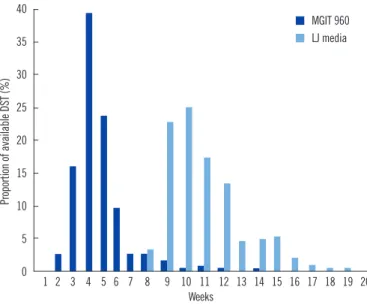
By the end of the first 4 weeks of anti-TB treatment, DST re- sults were reported for 58% of the patients using the MGIT 960 method, whereas no DST results for clinical isolates using the AC method were reported by this time (Fig. 1). By the end of the first 8 weeks of treatment, DST results were available for 97% of the patients using the MGIT 960 method and for only 3% of the patients using the AC method (P <0.001).
2. Rate of concordance of DST results obtained by the AC and MGIT 960 methods
During the 2-yr study period, 1,083 M. tuberculosis isolates were
tested for drug susceptibility using both the MGIT 960 and AC methods. Of these, 183 (16.9%) and 225 (20.8%) isolates were identified to be resistant to isoniazid by the AC and MGIT meth- ods, respectively. Further, 138 (12.7%) LJ-grown isolates and 122 (11.3%) MGIT-grown isolates showed resistance to rifampin.
Of these 1,083 isolates, 115 (10.6%) and 112 (10.3%) isolates were identified as MDR-TB by the AC and MGIT methods, re-
Table 1. Time (days) to report positive cultures and drug susceptibility testing results for M. tuberculosis clinical isolates
AC method*, days (IQR) MGIT 960 method†, days (IQR) P value
Time for reporting positive cultures of M. tuberculosis 30 (25-39) 17 (14-20) <0.01
Time to DST results for isolates 38 (36-42) 10 (8-12) <0.01
Total time interval from request for culture to DST results 70 (63-80) 27 (23-32) <0.01
*Culture on Ogawa medium and DST by absolute concentration method using Löwenstein-Jensen (LJ) medium (obtained between January and June 2008);
†Liquid culture and DST using MGIT 960 system (obtained between January and June 2010).
Abbreviations: IQR, interquartile range; MGIT, mycobacteria growth indicator tube; DST, drug susceptibility testing; AC, absolute concentration.
Table 2. Time (days) to report positive cultures and drug susceptibility testing results for M. tuberculosis clinical isolates, according to smear status
AC method*, days (IQR) MGIT 960 method†, days (IQR)
Smear (+) Smear (-) Smear (+) Smear (-)
N of isolates 114 133 104 158
Time for reporting positive culture for M. tuberculosis 28 (23-33) 34 (28-44) 13 (10-16) 19 (17-22)
Time to DST report for isolates 39 (36-43) 38 (36-42) 9 (8-13) 10 (8-12)
Total time interval from request for culture to DST results 67 (62-75) 74 (65-84) 23 (20-37) 30 (26-35)
*Culture on Ogawa medium and DST by absolute concentration method using Löwenstein-Jensen (LJ) medium (obtained between January and June 2008);
†Liquid culture and DST using MGIT 960 system (obtained between January and June 2010).
Abbreviations: IQR, interquartile range; MGIT, mycobacteria growth indicator tube; DST, drug susceptibility testing; AC, absolute concentration.
Fig. 1. Weekly availability of the results of drug susceptibility tests after request of mycobacterial culture.
Abbreviations: DST, drug susceptibility testing; MGIT, mycobacteria growth indicator tube; LJ, Löwenstein-Jensen.
Proportion of available DST (%)
40 35 30 25 20 15 10 5
0 1 2 3 4 5 6 7 8 9 10 11 12 13 14 15 16 17 18 19 20 Weeks
MGIT 960 LJ media
spectively.
There was good concordance between DST results obtained using the 2 methods, with an agreement of 97.2% (kappa coef- ficient=0.855, 95% confidence interval [CI], 0.816-0.895) for ri- fampin resistance and 95.6% (kappa coefficient =0.864, 95% CI, 0.817-0.912) for isoniazid resistance (Table 3). Eighteen TB isolates (1.7%) were found to be rifampin-resistant using the AC method but not using the MGIT 960 method. Conversely, 12 (1.1%) isolates were identified as rifampin-susceptible by the AC method performed on the LJ medium, but as rifampin-resis- tant using the MGIT 960 method. Forty five of the isolates (4.2%) that were identified as susceptible to isoniazid using the AC method performed on the LJ medium were identified as resis- tant to isoniazid using the MGIT 960 method. Only 3 isolates (0.3%) identified as susceptible to isoniazid using the MGIT 960 method were identified as resistant by the AC method.
DISCUSSION
Rapid diagnosis is essential for treating and preventing trans- mission of MDR-TB. Choosing the appropriate treatment early is an essential determinant of a favorable outcome, and rapid de- termination of drug resistance can allow a customized approach for providing treatment early in the course of the disease [1, 2].
In addition, early diagnosis of drug resistance is also important for patients with drug-susceptible TB; ethambutol can be dis- continued when DST shows the infecting organism to be drug- susceptible [20]. In addition, pyrazinamide can be withdrawn
after 2 months of intensive treatment [20]. The long turnaround time of DST conducted using the solid media method could prolong the use of these potentially toxic drugs because clini- cians may continue these drugs until confirmed results for drug resistance are available.
The conventional culturing and DST method uses solid media and requires long waiting periods to yield results [11, 12]. How- ever, this method is still used in many laboratories in Korea be- cause it is inexpensive and easily accessible. A previous study demonstrated that the average time from the initiation of treat- ment to confirmation of DST was 80 days, and DST results for only 15% of the patients were available to clinicians by the end of a 2-month intensive phase of anti-TB treatment [21].
Several new approaches such as liquid culture systems have been developed to fasten detection of MDR-TB. The most com- monly used and commercially available automated liquid culture DST system is the MGIT 960 system. In our study, introduction of the MGIT 960 method can significantly decrease the overall turnaround times for DST results to 27 days, compared to ap- proximately 70 days using the AC method. In addition, DST re- sults were available for 58% and 97% of the patients using the MGIT 960 method but for only 0% and 3% of the patients using the AC method at the end of the first 4 and 8 weeks of anti-TB treatment, respectively.
Accurate diagnosis of isoniazid and rifampin resistance is very important. The second purpose of this study was to evaluate the reliability of the newly introduced MGIT 960 system for suscepti- bility testing of the two most important anti-TB drugs. Although the overall DST agreement rate and kappa coefficient value was high between the MGIT and AC methods, discrepant results were obtained for 4.5% of the isolates for isoniazid and for 3.0% of the isolates for rifampin. The discrepancies of DST results be- tween the two methods may be caused by several factors.
In our study, 45 (4.2%) strains were identified as susceptible to isoniazid by the AC method performed using the LJ medium but as resistant to this drug by the MGIT 960 method. In a previ- ous study [22], of the 30 strains which were resistant to isoniazid by the MGIT 960 system but susceptible by the proportion method when the Ogawa medium was used, 28 strains (93%) were identified as resistant to isoniazid (minimum inhibitory concentration [MIC] 0.4-0.8 μg/mL) by the proportion method when Middlebrook agar plates were used. Furthermore, these 28 isolates had katG and inhA gene mutations. In addition, 18 strains were identified as susceptible to rifampin by the MGIT 960 method but as resistant by the AC method. A previous study reported that low level rifampin resistance, linked to specific Table 3. The results of drug susceptibility testing of M. tuberculosis
clinical isolates for isoniazid and rifampin obtained using the MGIT 960 system and the absolute concentration method on the LJ me- dium
Total isolates Isoniazid Rifampin
1,083 1,083
AC-S & MGIT-S 855 (78.9%) 943 (87.1%)
AC-R & MGIT-R 180 (16.6%) 110 (10.2%)
AC-R & MGIT-S 3 (0.3%) 18 (1.7%)
AC-S & MGIT-R 45 (4.2%) 12 (1.1%)
Agreement 95.6% 97.2%
Kappa coefficient between the 2 methods was 0.855 (95% confidence in- terval [CI], 0.816-0.895) for isoniazid and 0.864 (95% CI, 0.817-0.912) for rifampin.
Abbreviations: LJ, Löwenstein-Jensen; AC, absolute concentration (culture on Ogawa medium and drug susceptibility testing by absolute concentration method using Löwenstein-Jensen medium); MGIT, mycobacteria growth in- dicator tube (liquid culture and drug susceptibility testing using MGIT 960 system); S, susceptible; R, resistant.
rpoB mutations, is sometimes missed by standard growth-based methods, particularly automated broth-based systems such as MGIT 960 [23].
The important limitation of the present study is lack of geno- typic DST data for the isolates with discordant results between solid and liquid DSTs. Several molecular or genotypic DST meth- ods are currently available for rapid diagnosis of MDR-TB. These genotypic DST methods are based on identification of resistance- conferring mutations in the bacillary genome. However, the main problem is that these mutations have not been well character- ized; this may explain why genotypic DST methods fail to docu- ment mutations in phenotypically resistant strains [24]. Correla- tion between phenotypic and genotypic DST data remains prob- lematic due to our insufficient knowledge of the mutations un- derlying drug resistance [24]. Further studies using both pheno- typic and genotypic techniques will, therefore, be required to confirm the accuracy of DST by the MGIT method.
In addition, the results of DST for isoniazid and rifampin can differ, depending on DST methods [18]. In the AC method using LJ medium, resistance is defined as growth of more than 20 colony-forming units at a particular drug concentration, which generally is the critical concentration. However, the variations in the number of bacilli in the inoculums can alter the interpreta- tion of the test results. Moreover, the reproducibility of the anti- TB DST results can be influenced by the physicochemical envi- ronment [9]. A previous study reported that efficiency scores varied from 90 to 99% (mean, 95%) for isoniazid and 77 to 100% (mean, 94%) for rifampin, even though these had been obtained by 16 national reference laboratories [25]. The participating lab- oratories used their own DST methods, the AC method, the re- sistance ratio method, or the proportion method.
In contrast, the MGIT 960 system is a semi-automated tech- nique with standardized media and reagents and therefore, can provide standardized data and reduce transcription errors. How- ever, until recently, the Food and Drug Administration (FDA) had cleared the use of the MGIT 960 system for initial susceptibility testing for only the primary anti-tuberculous drugs.
In conclusion, the MGIT 960 liquid culture system is a rapid and reliable tool, having the advantage of an automated non-ra- diometric system for the diagnosis of TB and MDR-TB. The MGIT 960 method was successfully introduced into a routine laboratory setting in a referral hospital in Korea. High rates of MDR-TB in Korea make the introduction of rapid DST assays particularly useful.
Authors’ Disclosures of Potential Conflicts of Interest
No potential conflicts of interest relevant to this article were re- ported.
Acknowledgements
The authors thank Mr. Yuyean Hwang and Onkyun Kang for their help in data collection and analysis.
This study was supported by a grant of the Korea Health Tech- nology R&D Project, Ministry for Health, Welfare & Family Affairs, Republic of Korea (A100027) and by the Mid-career Researcher Program through an National Research Foundation of Korea (NRF) grant funded by the MEST (2011-0015546).
REFERENCES
1. Orenstein EW, Basu S, Shah NS, Andrews JR, Friedland GH, Moll AP, et al. Treatment outcomes among patients with multidrug-resistant tu- berculosis: systematic review and meta-analysis. Lancet Infect Dis 2009; 9:153-61.
2. Johnston JC, Shahidi NC, Sadatsafavi M, Fitzgerald JM. Treatment out- comes of multidrug-resistant tuberculosis: a systematic review and me- ta-analysis. PLoS One 2009;4:e6914.
3. Kim HR, Hwang SS, Kim HJ, Lee SM, Yoo CG, Kim YW, et al. Impact of extensive drug resistance on treatment outcomes in non-HIV-infected patients with multidrug-resistant tuberculosis. Clin Infect Dis 2007;45: 1290-5.
4. Kwon YS, Kim YH, Suh GY, Chung MP, Kim H, Kwon OJ, et al. Treatment outcomes for HIV-uninfected patients with multidrug-resistant and ex- tensively drug-resistant tuberculosis. Clin Infect Dis 2008;47:496-502. 5. Kim DH, Kim HJ, Park SK, Kong SJ, Kim YS, Kim TH, et al. Treatment
outcomes and long-term survival in patients with extensively drug-resis- tant tuberculosis. Am J Respir Crit Care Med 2008;178:1075-82. 6. Jeon DS, Shin DO, Park SK, Seo JE, Seo HS, Cho YS, et al. Treatment
outcome and mortality among patients with multidrug-resistant tuber- culosis in tuberculosis hospitals of the public sector. J Korean Med Sci 2011;26:33-41.
7. Van Deun A, Martin A, Palomino JC. Diagnosis of drug-resistant tuber- culosis: reliability and rapidity of detection. Int J Tuberc Lung Dis 2010; 14:131-40.
8. O’Grady J, Maeurer M, Mwaba P, Kapata N, Bates M, Hoelscher M, et al. New and improved diagnostics for detection of drug-resistant pulmo- nary tuberculosis. Curr Opin Pulm Med 2011;17:134-41.
9. Kim SJ. Drug-susceptibility testing in tuberculosis: methods and reliabil- ity of results. Eur Respir J 2005;25:564-9.
10. Wright A, Zignol M, Van Deun A, Falzon D, Gerdes SR, Feldman K, et al. Epidemiology of antituberculosis drug resistance 2002-07: an updat- ed analysis of the Global Project on Anti-Tuberculosis Drug Resistance Surveillance. Lancet 2009;373:1861-73.
11. Schaberg T, Reichert B, Schulin T, Lode H, Mauch H. Rapid drug sus- ceptibility testing of Mycobacterium tuberculosis using conventional sol- id media. Eur Respir J 1995;8:1688-93.
12. Muralidhar S and Srivastava L. Evaluation of three methods to determine
the antimicrobial susceptibility of Mycobacterium tuberculosis. Indian J Med Res 2004;120:463-7.
13. World Health Organization (WHO), ed. Use of liquid TB culture and drug susceptibility testing (DST) in low- and medium-income settings. Sum- mary report of the Expert Group Meeting on the Use of Liquid Culture Media, Geneva, Switzerland: WHO, 2007.
14. Bai GH, Park YK, Choi YW, Bai JI, Kim HJ, Chang CL, et al. Trend of anti-tuberculosis drug resistance in Korea, 1994-2004. Int J Tuberc Lung Dis 2007;11:571-6.
15. Choi JC, Lim SY, Suh GY, Chung MP, Kim H, Kwon OJ, et al. Drug Re- sistance Rates of Mycobacterium tuberculosis at a Private Referral Cen- ter in Korea. J Korean Med Sci 2007;22:677-81.
16. Bae E, Im JH, Kim SW, Yoon NS, Sung H, Kim MN, et al. Evaluation of combination of BACTEC mycobacteria growth indicator tube 960 sys- tem and Ogawa media for mycobacterial culture. Korean J Lab Med 2008;28:299-306.
17. Kim BJ, Lee IH, Lee DH, Bai GH, Kong SJ, Lee SH, et al. The current status of multidrug-resistant tuberculosis in Korea. Tuberc Respir Dis 2006;60:404-11.
18. Oh SH, Kim YJ, Park SK, Hwang SH, Kim HH, Lee EY, et al. Compari- son of anti-mycobacterial drug susceptibility test results by institutes and methods. Korean J Clin Microbiol 2008;11:43-8.
19. Han MD, Im JS, Yim J, Oh DK. A study on the drug susceptibility test of
multi-drug resistant tuberculosis patients. Korean J Epidemiol 2008;30: 301-8.
20. Blumberg HM, Burman WJ, Chaisson RE, Daley CL, Etkind SC, Fried- man LN, et al. American Thoracic Society/Centers for Disease Control and Prevention/Infectious Diseases Society of America: treatment of tu- berculosis. Am J Respir Crit Care Med 2003;167:603-62.
21. Joh JS, Lee CH, Lee JE, Park YK, Bai GH, Kim EC, et al. The interval between initiation of anti-tuberculosis treatment in patients with culture- positive pulmonary tuberculosis and receipt of drug-susceptibility test results. J Korean Med Sci 2007;22:26-9.
22. Abe C, Kobayashi I, Mitarai S, Wada M, Kawabe Y, Takashima T, et al.
Biological and molecular characteristics of Mycobacterium tuberculosis clinical isolates with low-level resistance to isoniazid in Japan. J Clin Mi- crobiol 2008;46:2263-8.
23. Van Deun A, Barrera L, Bastian I, Fattorini L, Hoffmann H, Kam KM, et al. Mycobacterium tuberculosis strains with highly discordant rifampin susceptibility test results. J Clin Microbiol 2009;47:3501-6.
24. Van Deun A, Martin A, Palomino JC. Diagnosis of drug-resistant tuber- culosis: reliability and rapidity of detection. Int J Tuberc Lung Dis 2010; 14:131-40.
25. Bai GH, Kim SJ, Chang CL. Proficiency analysis of drug susceptibility testing by national-level tuberculosis reference laboratories from 1995 to 2003. J Clin Microbiol 2007;45:3626-30.