MS Jang, et al
376 Ann Dermatol
Ann Dermatol Vol. 24, No. 3, 2012 http://dx.doi.org/10.5021/ad.2012.24.3.376
LETTER TO THE EDITOR
Received October 19, 2011, Revised November 20, 2011, Accepted for publication November 20, 2011
Corresponding author: Kee Suck Suh, M.D., Department of Dermatology, Kosin University College of Medicine, 262, Gamcheon-ro, Seo-gu, Busan 602-831, Korea. Tel: 82-51-990-6145, Fax: 82-51-990-3041, E-mail: [email protected]
This is an Open Access article distributed under the terms of the Creative Commons Attribution Non-Commercial License (http://
creativecommons.org/licenses/by-nc/3.0) which permits unrestricted non-commercial use, distribution, and reproduction in any medium, provided the original work is properly cited.
Comment on “Pseudopautrier's Abscess”
Dear Editor:
We read with great interest the article by Lee et al.1 entitled “The three dimensional conformal radiotherapy for hyperkeratotic plantar mycosis fungoides”1. We agree with the effectiveness of three-dimensional conformal radiotherapy for hyperkeratotic plantar mycosis fungoides (MF) and appreciate the educational figures. However, in this case report, the authors have described “the presence of intraepidermal collections of mononuclear cells show- ing hyperchromatic atypical cells that were compatible with Pautrier’s microabscesses (PA)”. We would like to suggest intraepidermal mononuclear collections described by the authors are not consistent with PA, but with pseudopautrier abscesses (PPA), regarded as a marker of spongiotic processs.
PA are one of the pathologic hallmarks of MF. They represent “punch-out” spaces in the epidermis filled with malignant T-lymphocytes (sometimes cerebriform). The aggregates of clonal T cells around Langerhans’ cells explain the dependence of the T cells on interactions with these dendritic cells, particularly in the early stages of the disease2. PPA were first described as spongiotic stimulants of PA by Ackerman et al.3 in 1974. They consist of Langerhans cells, histiocytes, stellate keratinocytes and rare lymphocytes. In one study by Candiago et al.4, they were found in a variety of inflammatory disorders showing epidermal spongiosis, and were particularly frequent in spongiotic (43.4%), in lichenoid dermatitis (10%), and notably in MF (13.3%). Moreover, according to Kang et al.5, PPA were expressed in up to 25.5% of MF (24/94).
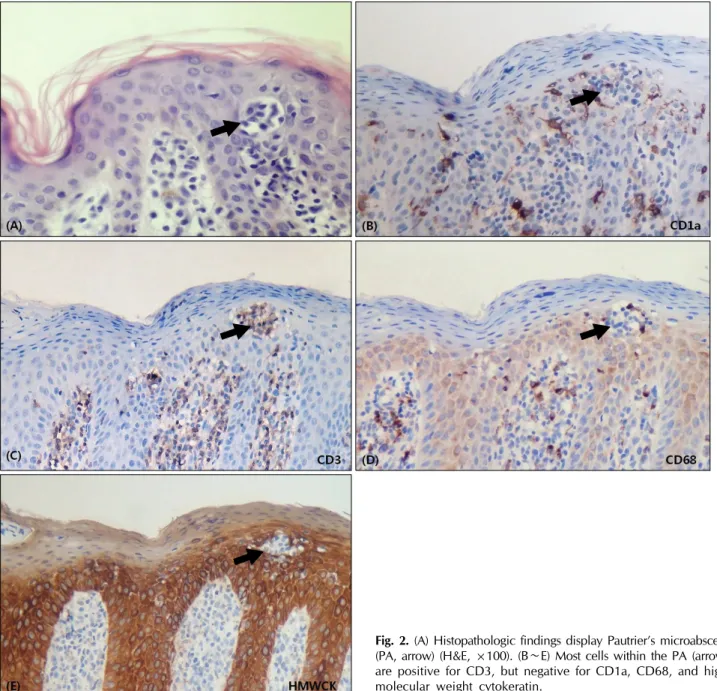
They emphasize that the differential diagnostic hallmarks between PPA and PA are morphology, cell types, and particularly additional immunohistochemical findings, as shown in Fig. 1, 2.
Histologic findings considered as PA by Lee et al.1 favor more PPA, judging from adjacent prominent spongiosis, and predominance of nonlymphoid cells, showing pre-
sence of histiocyte, Langerhans cell, and stellate keratinocyte without atypical features. Additional immunohistochemical study will be also useful in the differential diagnosis, using CD1a, CD3, CD4, CD68, and high molecular cyto- keratin5.
PPA are not an infrequent histologic finding in MF, particularly more common with MF palmaris et plantaris referring to the hyperkeratotic MF5. Thus, it is not suitable to exclude the diagnosis of MF unquestionably, when PPA are seen in biopsy specimen. In addition, when collec- tions of intraepidermal mononuclear cells are observed in typical MF, the clinician should be cautious before concluding they are PA, and a careful histological and immunohistochemical evaluation must be performed carefully to distinguish PPA from PA.
Min Soo Jang, M.D., Dong Young Kang, M.D., Jong Bin Park, M.D., Jin Seuk Kang, M.D., Sang Tae Kim, M.D., Kee Suck Suh, M.D.
Department of Dermatology, Kosin University College of Medicine, Busan, Korea
REFERENCES
1. Lee SY, Kwon HC, Cho YS, Nam KH, Ihm CW, Kim JS. The three dimensional conformal radiotherapy for hyperkeratotic plantar mycosis fungoides. Ann Dermatol 2011;23 Suppl 1:S57-60.
2. Girardi M, Heald PW, Wilson LD. The pathogenesis of mycosis fungoides. N Engl J Med 2004;350:1978-1988.
3. Ackerman AB, Breza TS, Capland L. Spongiotic simulants of mycosis fungoides. Arch Dermatol 1974;109:218-220.
4. Candiago E, Marocolo D, Manganoni MA, Leali C, Facchetti F. Nonlymphoid intraepidermal mononuclear cell collections (pseudo-Pautrier abscesses): a morphologic and immuno- phenotypical characterization. Am J Dermatopathol 2000;
22:1-6.
5. Kang DY, Baek JW, Jang MS, Suh KS, Kim ST. Expression patterns of pseudopautrier abscesses in mycosis fungoides.
Korean J Dermatol 2011;49(Suppl 2):180-181.
Comment on “Pseudopautrier's Abscess”
Vol. 24, No. 3, 2012 377 Fig. 1. (A) Histopathologic findings show pseudopautrier abscess (PPA, arrow) with focal spongiosis and spongiotic vesicles (H&E,
×100). (B∼D) CD1a (B) as well as CD68 (D) is expressed on most cells within PPA (arrow), but negative for CD3 (C). (E) Stellate keratinocytes (arrow) positive for high molecular weight cytokeratin (HMWCK).
MS Jang, et al
378 Ann Dermatol
Fig. 2. (A) Histopathologic findings display Pautrier’s microabscess (PA, arrow) (H&E, ×100). (B∼E) Most cells within the PA (arrow) are positive for CD3, but negative for CD1a, CD68, and high molecular weight cytokeratin.
Comment on “Pseudopautrier's Abscess”
Vol. 24, No. 3, 2012 379 ERRATUM
In the article by Lee et al.1, case report and figure legend of 2B were published incorrectly. The correct version of them are shown below:
CASE REPORT
The biopsy findings of the keratotic plaque were as follows: the epidermis showed compact hyperparakeratosis, acanthosis, spongiosis and mononuclear cell exocytosis (Fig. 2A). On higher power microscopy, intraepidermal collections of mononuclear cells showed hyperchromatic atypical cells that were compatible with pseudopautrier abscesses (PPA) (Fig. 2B). The infiltrated cells were mostly CD4 positive (Fig. 2C). These findings were consistent
with the diagnosis of patchy stage IA of MF.
FIGURE LEGENDS
Fig. 2. (B) The higher magnification of intraepidermal mononuclear cells showed atypical hyperchromatic nuclei of cells compatible pseudopautrier abscesses (PPA) (H&E, x400).
REFERENCE
1. Lee SY, Kwon HC, Cho YS, Nam KH, Ihm CW, Kim JS. The three dimensional conformal radiotherapy for hyperkeratotic plantar mycosis fungoides. Ann Dermatol 2011;23 Suppl 1:S57-60.