Original Article: Food Science/Microbiology
Evaluation of Anti-inflammatory Activities and
Mechanisms of Microalga Phaeodactylum tricornutum
Jeong Hwa Kim · Sang Min Kim · Cheol-Ho Pan · Joong-Kook Choi · Jae Kwon Lee*
Received: 6 November 2012 / Accepted: 17 November 2012 / Published Online: 30 June 2013
© The Korean Society for Applied Biological Chemistry 2013
Abstract Due to their diversity and abundancy, marine resources have emerged as important biological resources to compensate the limited sources of terrestrial biological materials. Phaeodactylum tricornutum (PT) is one of classical model diatoms most widely studied for its ecology, physiology, biochemistry and molecular biology. In this study, four different PT extracts on lipopolysaccharide (LPS)-stimulated macrophages were compared for anti-inflammatory effect and investigated for the underlying mechanisms. The extracts of PT inhibited nitric oxide production from LPS stimulated RAW 264.7 cells in a dose dependent manner. These extracts also inhibited the expression of mRNA and production of proteins of pro-inflammatory cytokines such as interleukin (IL)- 1β, IL-6 and tumor necrosis factor-α. These inhibitory effects were found to be caused by blockage of nuclear factor-κB activation and phosphorylation of p38 mitogen-activated protein kinases, extracellular signal-regulated kinases 1 and 2 and c-Jun N-terminal kinase.
Keywords anti-inflammation · cytokine · marine resources · Phaeodactylum tricornutum
Introduction
Marine resources are very diverse and abundant. Its importance as the biological resources has increased to compensate for the lack of terrestrial biological resources. Marine microalga has been
considered as an important primary modulator of marine environments and plays a critical role in supporting aquatic animals (Muller-Feuga, 2000). Marine microalga as primary producers in the food chain has already been perceived for their physiological and nutritional value.
Over 15,000 compounds, including fatty acids, sterols, phenolic compounds, terpenes, enzymes, polysaccharides, alkaloids, toxins and pigments (lutein, β-carotene etc.) were isolated form cultured microalga (Pasquet et al., 2011). Especially, Phaeodactylum tricornutum (PT) contains eicosapentaenoic acid (EPA) as much as 35% of the polyunsaturated fatty acids (Robles Medina et al., 1998; Molina Grima et al., 2003; Wen and Chen, 2003). PT contains 36.4% crude protein, 26.1% available carbohydrate, 18.0% lipid, 15.9% ash, and 0.25% neutral detergent fiber, on a dry weight (dw) basis (Pulz and Gross, 2004). PT showed analgesic and immune modulatory effects in paw edema model (Guzman et al., 2001; 2003). In addition, there was a report that PT polysaccharide increased the phagocytic activity of fish’s leukocytes (Cerezuela et al., 2012). However, there has been no report for an anti-inflammatory effect of PT.
Bacteria derived lipopolysaccharide (LPS) are known to initiate a cascade of intracellular signaling to generate inflammatory mediators. Among these, nitric oxide (NO) is a representative inflammatory indicator involved in a severe inflammation (Lowenstein et al., 1996; Stichtenoth and Frolich, 1998). In addition, pro-inflammatory cytokines (tumor necrosis factor (TNF)-α, interleukin (IL)-1β, IL-6)) are produced in response to infection, immune responses, inflammation. (Dinarello, 2000).
In this study, we extracted active compound from PT, and demonstrated the anti-inflammatory effects of PT extracts and the underlying mechanisms in LPS-stimulated macrophages.
Materials and Methods
Extraction from PT. Ten grams of dried PT was extracted three times at room temperature with 100% ethanol for 3 h (300 mL each time). The extracted solution was combined, filtrated with J. H. Kim · J. K. Lee
Department of Biology Education, College of Education, Chungbuk National University, Chungcheongbuk-Do, 361-763, Republic of Korea S. M. Kim · C.-H. Pan
Functional Food Center, Korea Institute of Science and Technology (KIST), 679 Saimdang-ro, Gangneung 210-340, Republic of Korea
J.-K. Choi
Division of Biochemistry, College of Medicine, Chungbuk National University, Chungcheongbuk-Do, 361-763, Republic of Korea
*Corresponding author (J. K. Lee: [email protected])
obtained from Sigma-Aldrich (USA). Monoclonal antibodies of inhibitory (I) κB-α, p38, ERK 1/2, phosphor-ERK 1/2, JNK, β- actin, and peroxidase-conjugated secondary antibody were from Santa Cruz Biotechnology (USA). phospho-p38, phosphor-JNK purchased were from Cell Signaling Technology, Inc. (USA) Cell Viability. Cell viability was measured by the WST-8 based colorimetric assay (Dojindo, Japan), which depends on the ability of living cells to reduce a tetrazolium salt to a soluble colored formazan product. RAW 264.7 cells were cultured at 5×10⁵ cells/
well in flat-bottom 96-well plates in triplicate for 24 h. The various concentrations of samples were treated with and without LPS (1µg/mL). After 30 h of culture, WST-8 reagent was added to both RAW 264.7 cells and blank samples, and the mixture was incubated at 37oC under 5% CO for 2 h. The level of the dye formed was then measured using a Bio-rad spectrophotometer at the wavelength of 450 nm. The blank value without cells was subtracted from each experimental value as background.
NO Assays. The cells suspension of 5×10⁵ cells/well was cultures in flat-bottom 96-well plate in triplicate for 24 h. Thereafter, 100 µL of medium was replaced with fresh medium containing either LPS (1µg/mL) alone or LPS with various concentrations of each sample for additional culture for 30 h. The culture supernatant was collected at the end of culture for nitrite assay. The culture supernatant (50µL) was mixed with an equal volume of Griess reagent and the absorbance was measured at 550 nm. Finally, the concentration of nitrite was calculated from a standard curve drawn with known concentration of sodium nitrite dissolved in DMEM.
Reverse transcriptase-polymerase chain reaction (RT-PCR).
RAW 264.7 cells were cultured in the presence of each sample alone or in combination with LPS in a 6-well plate (1×10⁶ cells/
2 mL) for 6 h. Total RNA was isolated using the RNeasy mini kit (Qiagen, USA) following the guidelines. Total RNA (1µg/mL) was reverse-transcribed in cDNA using AccuPower RT-PCR premix (Bioneer, Korea). The PCR primers used in this study are listed below and were purchased from Bioneer: sense strand TNF- α 5'-GGCAGGTTCTGTCCCTTTCACTC-3', antisense strand TNF-α 5'-CACTTGGTGGTTTGCTACGACG-3'; sense strand IL-1β 5'-GCTACCTGTGTCTTTCCCGTGG-3', antisense strand IL-1β 5'-TTGTCGTTGCTTGGTTCTCCTTG-3'; sense strand IL- 6 5'-TGTGCAATGGCAATTCTGAT-3', antisense strand IL-6 5'-
guidelines; TNF-α by DuoSet ELISA Development Kit, R&D Systems, IL-1β, and IL-6 by DuoSet ELISA Development Kit.
Western blot analysis. RAW 264.7 cells were cultured in the presence of LPS or in combination of LPS with each sample in a 6-well plate (1×10⁶ cells/2 mL). After removal of the supernatants, extracts of RAW 264.7 cells were directly prepared in lysis buffer (0.5% Triton, 50 mM β-glycerophosphate pH 7.2, 0.1 mM sodium vanadate, 2 mM MgCl, 1 mM EGTA, 1 mM dithiothreitol, 0.1 mM phenylmethylsulfonyl urea, 2µg/mL of leupeptin, and 4 µg/
mL of aprotinin). The lysates were resolved by 10% SDS-PAGE and transferred to PVDF membranes (Roche, Germany). The membranes were blocked in Tris-buffered saline (10 mM Tris-Cl pH 7.4) containing 0.5% Tween 20 and 5% non-fat dry milk, incubated with the first specific antibody in blocking solution for 24 h at room temperature, washed, and incubated with the developing second antibody for 50 min at room temperature. The protein bands were detected by chemiluminescence (Amersham Pharmacia, Biotech).
Statistics. Statistical analyses of data were performed by Student’s t-test to determine statistical significance. Values are given as mean ± SD.
Results
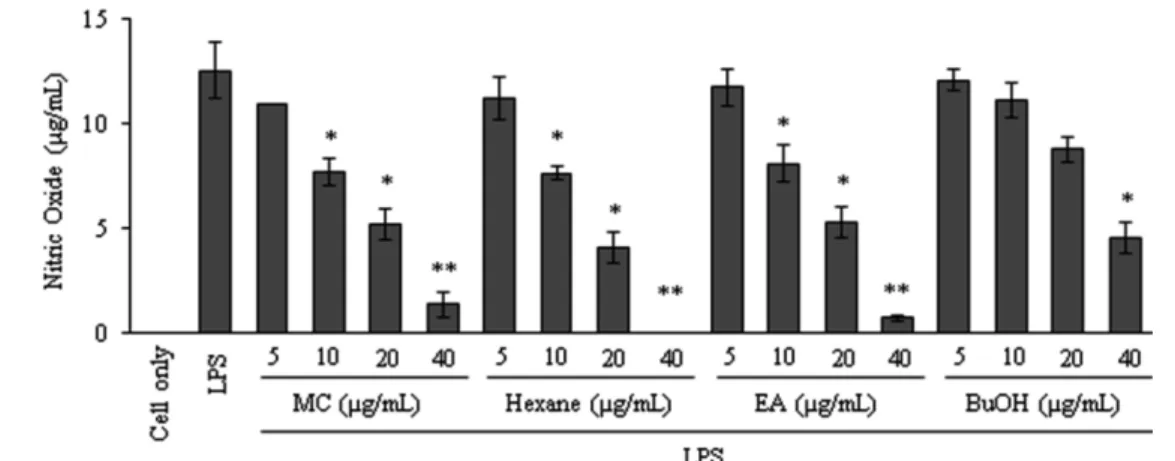
Cell viability and NO assay of the RAW 264.7 cells. To analyze the anti-inflammatory activities of PT, RAW 264.7 cells were used since they can produce NO by stimulation with LPS. The cells were pretreated with LPS (1µg/mL) for an hour, followed by treatment with various concentrations (5, 10, 20, 40µg /mL) of PT extracts. The control (cell-only) group received neither LPS nor extract. The cell culture media were harvested and the NO levels were quantified using the Griess reagent. As shown in Fig. 1, RAW 264.7 cells did not produce the detectable concentration of NO in the resting condition. However, LPS increased NO production up to 12µg/mL, from the basal level of 0−0.53 µg/mL and pretreatment of PT extracts reduced NO production in a dose- dependent manner (5, 10, 20, 40µg/mL).
To demonstrate that the inhibitory effect of PT on NO production is not attributed to the cytotoxic effects, we measured the cytotoxic effect of PT using WST-8 assay and the same concentration for
NO assay. As shown in Fig. 2, there was no evidence of cytotoxicity under various concentrations of samples. Thus the inhibitory effects of PT, at various concentrations, on NO production cannot be attributed to the cytotoxic effects.
Effects of PT on COX-2 production. Since PT extracts turned out to bea potent inhibitor of NO, we further investigated its effect on the expression levels of COX-2 by western blot. As shown in Fig. 3, non-activated cells express low level of COX-2, whereas treatment with LPS induced high levels of COX-2. Under these conditions, pre-treatment of RAW 264.7 cells with PT extracts on reduced COX-2 expression.
Effects of PT extracts on the mRNA and protein levels of pro- inflammatory cytokines. To further demonstrate the anti- inflammatory activities of PT extracts, we investigated the effects of PT on the expression and production of pro-inflammatory cytokines such as IL-1β, IL-6, and TNF-α by RT-PCR and ELISA. RAW 264.7 cells were incubated with LPS (1µg/mL) for 6 h after pretreated with the extracts for 1h, and then mRNA were extracted. The mRNA levels of the pro-inflammatory cytokines
increased by treatment with LPS, and these increases were significantly decreased by pre-treatment of 40µg/mL PT extracts.
Especially, the expression of IL-1β was disappeared by the treatments of MC, EA and BuOH extracts. IL-6 and TNF-α also showed a similar results with IL-1β expression. Conclusively, the extracts of PT inhibited the mRNA expressions of these pro- inflammatory cytokines (Fig. 4).
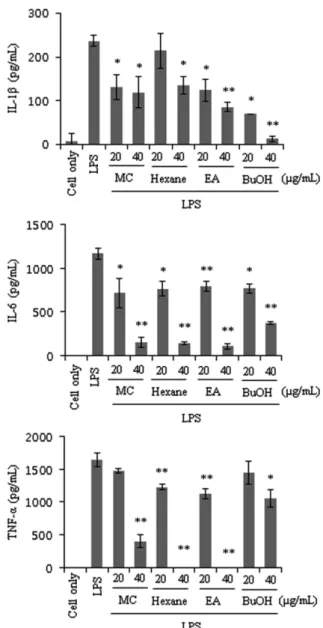
Because PT extracts showed a potent inhibitory activity on the mRNA expressions of the pro-inflammatory cytokines, we tried to confirm whether the reduction of the mRNA expression is correlated with a change in the protein level. To measure the production of pro-inflammatory cytokines, RAW 264.7 cells were pretreated with PT extracts for 1 h and then stimulated with LPS (1µg/mL). After 24 h, the culture supernatants were collected for measurement of the amounts of IL-1β, IL-6, and TNF-α.
Consistent with RT-PCR results, PT inhibited LPS-induced IL-1β, IL-6, and TNF-α production (Fig. 5). Especially EA extract of PT decreased the productions of IL-1β, IL-6, and TNF-α. In summary, these results indicated that the extracts of PT inhibited Fig. 1 Effects of PT extract on the NO production of the LPS-stimulated RAW 264.7 cells. RAW 264.7 cells were treated with various concentrations (5, 10, 20 and 40 µg/mL) of samples for 1 h and then the cells were stimulated with 1 µg/mL of LPS. After 24 h, the culture supernatants were subjected to nitrite assay. The values shown are the means ± SDs for three independent experiments.
Fig. 2 Cytotoxicity of PT extracts on RAW 264.7 cells. The test samples were treated as described in Fig. 1. Cytotoxicity was determined using the WST-8 reagent. The values that are shown are the means ± SDs of the three independent experiments.
the secretion of pro-inflammatory cytokines almost to the basal level.
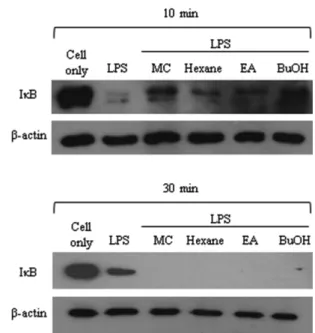
Effects of PT on IκB-degradation. Translocation of NF-κB to the nucleus is preceded with IκB-α protein degradation. The effect of PT on LPS-induced IκB-degradation was examined by western-bolt analysis. RAW 264.7 cells were pretreated with PT (40µg/mL) extracts for 1h and then stimulated with LPS (1 µg/
mL) for 10 and 30 min. The total lysates were probed with anti- IκB-α antibody. As shown in Fig. 6, PT (40 µg/mL) extracts prevented LPS-induced IκB-α degradation. These protective effects by PT lasted less than 30 min. We suppose that the reduced IκB-degradation is partially involved in the anti-inflammatory activity of PT.
Effects of PT on the activation of p38 MAPK, ERK 1/2, and JNK. To confirm whether the anti-inflammatory activities of PT are mediated though the MAP kinase pathway, we examined the effects of PT on LPS-induced phosphorylation of p38 MARK, ERK 1/2, and JNK in RAW 264.7 cells using western-blot analysis. The murine macrophage cells were stimulated with LPS for 10 min and 20 min after pretreated with extract (40µg/mL) for 1h. Subsequently, we used antibodies against the phosphorylated forms of the various MAPKs. As shown in Fig. 7, phosphorylations of MAP kinases including p38 MARK, ERK 1/2, and JNK were increased by LPS treatment. The extracts of PT specifically decreased the phosphorylation of ERK 1/2 and JNK. However, a specific antibody were performed in triplicate, and all of them showed
similar results.
Fig. 4 Effects of PT extracts on mRNA expression of IL-1β, IL-6, and TNF-α in RAW 264.7 cells. RAW 264.7 cells were pretreated with each sample for 1 h, and then LPS (1µg/mL) was added. The total cellular RNA of each RAW 264.7 cell was isolated after 6 h of LPS treatment, and the expression levels of IL-1β, IL-6, and TNF-α were analyzed transcriptionally by RT-PCR. In all experiments, the β-actin transcription level was used as a control. The experiment was repeated three times, with similar results.
Fig. 5 Effects of PT extracts on IL-1β, IL-6, and TNF-α production.
RAW 264.7 cells were pretreated with each sample for 1 h, then LPS (1 µg/mL) was added and the cells were incubated for 24 h. The culture supernatant, which was subject to enzyme immunoassay of cytokines, was harvested. The values shown are means ± SD for three independent experiments.
LPS-induced p38 phosphorylation was not influenced by pretreatment of PT extracts.
Discussion
Monocytes and macrophages play important roles in both innate and adaptive immunity in vertebrate animals. The host defense activities of macrophages are shown by phagocytic activity and the secretion of immune stimulatory mediators. However, these immune mediators are involved in many inflammatory diseases.
Inflammation is the first response of the immune system to infection or irritation. During the inflammatory process, the pro- inflammatory mediators, such as NO, COX-2 and pro- inflammatory cytokines, are rapidly produced in large amount (Posadas et al., 2000). NO is required in immunological defense mechanisms and maintaining the dilation of blood vessels (Huk et al., 1998). Higher concentration of NO can cause oxidative damage, which is involved in various pathological processes (Stichtenoth and Frolich, 1998; Weinberg, 1998; Nagy and Perl, 2006). Cyclooxygenase (COX) is considered as an important enzyme for blood clotting and inflammation. The increase of COX-2 production signals an inflammatory response. Therefore, the development of anti-COX-2 drug is considered as a valuable trial (Kurumbail et al., 2001). Thus, agents that inhibit the production of these inflammatory mediators have been previously considered as potential candidates for anti-inflammatory drugs. To examine the potential of PT as a modulator of inflammation process, we used Raw 264.7 cell line, which was established from mouse peritoneal macrophage derived tumor cells. This cell line is often used in inflammatory and metabolic studies (Pan et al., 2008; Oh et al., 2010). Our study showed that the pretreatment of PT extracts inhibited NO and COX-2 production from LPS- Fig. 6 Effect of PT extracts on NF-κB signaling pathways. RAW 264.7
cells were pretreated with each extracts for 1 h and then the cells were stimulated with 1µg/mL of LPS. The total protein lysate of each RAW 264.7 cell was prepared after 10 min and 30 min, and cell signaling proteins were detected by western blot analysis. The expression levels of IκB-α was compared with β-actin as a control. Western blot analyses using a specific antibody were performed in triplicate, and all of them showed similar results.
Fig. 7 Effect of PT extracts on MAP kinases signaling pathways. RAW 264.7 cells were pretreated with samples for 1 h and then the cells were stimulated with 1 µg/mL of LPS. The total protein lysate of each RAW 264.7 cell was prepared after 10 and 20 min, and cell signaling proteins were detected by western blot analysis. The expression levels of p38 MAPK, JNK, and ERK were compared with phosphorylated proteins. Western blot analyses using a specific antibody were performed in triplicate, and all of them showed similar results.
(singlet oxygen, free radical and hydroxy radical) (Miki et al., 1991). The extracts of PT show anti-inflammatory effects in the paw edema test and immunomodulatory effects in the delayed hypersensitivity test (Guzman et al., 2001). A pharmacological study of hydrosoluble and liposoluble extracts of the marine microalgae Chlorella stigmatophora and PT indicated that hydrosoluble components of both species show significant anti- inflammatory, analgesic and free radical scavenging activity (Guzman et al., 2003). These activities were not detected in the liposoluble fractions (Guzman et al., 2001; 2003).
Pro-inflammatory cytokines, including TNF-α, IL-1β and IL-6, are important initiators of the inflammatory response and mediators of the development of a variety of inflammatory diseases (Mannel and Echtenacher, 2000). In our results, PT extracts reduced LPS- induced TNF-α, IL-1β, and IL-6 mRNA expression as well as protein production. TNF-α was recently identified as a main mediator in inflammatory diseases, (van den Berg et al., 1994;
Butler et al., 1997). Production of IL-1β and IL-6 is correlated with the amount of TNF-α in the culture supernatant of macrophages. These results implicated that PT extracts reduce the overall inflammatory mediators.
ERK1/2, p38, and JNK belong to MAP Kinases (Ruland and Mak, 2003). The phosphorylation of MAP Kinases is induced by stress or bacterial LPS, and they are involved in inflammatory responses (Johnson and Lapadat, 2002; Hommes et al., 2003;
Bian et al., 2011). The phosphorylation of p38 is induced by LPS stimulation which leads to the production of iNOS, COX-2, and TNF-α. ERK is also activated in LPS stimulated macrophage and consequently induce the production of pro-inflammatory cytokines and iNOS (Bhat et al., 1998; Ajizian et al., 1999). JNK regulates the expression of LPS stimulated iNOS (Uto et al., 2005). In this study, we demonstrated that the PT extracts inhibited the phosphorylation of MAP Kinases. Phosphorylation of ERK and JNK were reduced by pretreatment of PT extracts. These results demonstrate that the phosphorylation of MAP Kinases may contribute to the anti-inflammatory effects of PT in LPS- stimulated RAW 264.7 macrophage cell lines.
NF-κB is a mammalian transcription factor, which regulates the expression of various genes, involves inflammatory responses such as the production of NO, COX-2, and pro-inflammatory cytokines in macrophages (Barnes and Karin, 1997; Romashkova
Acknowledgments This work was by a grant from the Next-Generation BioGreen 21 Program to JK Choi (No. PJ00812701).
References
Ajizian SJ, English BK, and Meals EA (1999) Specific inhibitors of p38 and extracellular signal-regulated kinase mitogen-activated protein kinase pathways block inducible nitric oxide synthase and tumor necrosis factor accumulation in murine macrophages stimulated with lipopolysaccharide and interferongamma. J Infect Dis 179, 939–44.
Barnes PJ and Karin M (1997) Nuclear factor-kappaB: a pivotal transcription factor in chronic inflammatory diseases. N Engl J Med 336, 1066–71.
Bhat NR, Zhang P, Lee JC, and Hogan EL (1998) Extracellular signal regulated kinase and p38 subgroups of mitogen-activated protein kinases regulate inducible nitric oxide synthase and tumor necrosis factoralpha gene expression in endotoxin-stimulated primary glial cultures. J Neurosci 18, 1633–41.
Bian ZM, Elner SG, Khanna H, Murga-Zamalloa CA, Patil S, and Elner V (2011) Expression and functional roles of caspase-5 in inflammatory responses of human retinal pigment epithelial cells. Invest Ophthalmol Vis Sci 52, 8646–56.
Butler DM, Malfait AM, Mason LJ, Warden PJ, Kollias G, Maini RN et al.
(1997) DBA/1 mice expressing the human TNF-alpha transgene develop a severe, erosive arthritis: characterization of the cytokine cascade and cellular composition. J Immunol 159, 2867–76.
Cerezuela R, Guardiola FA, González P, Meseguer J, and Esteban MÁ (2012) Effects of dietary Bacillus subtilis, Tetraselmis chuii, and Phaeodactylum tricornutum, singularly or in combination, on the immune response and disease resistance of sea bream (Sparus aurata L.), Fish Shellfish Immunol 33, 342–9.
Dinarello CA (2000) Proinflammatory Cytokines, CHEST 118, 503−508.
Guzman S, Gato A, and Calleja JM (2001) Antiinflammatory, analgesic and free radical scavenging activities of the marine microalgae Chlorella stigmatophora and Phaeodactylum tricornutum. Phytother Res 15, 224–
30.
Guzman S, Gato A, Lamela M, Freire-Garabal M, and Calleja JM (2003) Anti-inflammatory and Immunomodulatory Activities of Polysaccharide from Chlorella stigmatophora and Phaeodactylum tricornutum.
Phytother Res 17, 665–70.
Hommes DW, Peppelenbosch MP, and van Deventer SJ (2003) Mitogen activated protein (MAP) kinase signal transduction pathways and novel anti-inflammatory targets. Gut 52, 144–51.
Huk I, Brovkovych V, Nanobash Vili J, Weigel G, Neumayer C, Partyka L et al. (1998) Bioflavonoid quercetin scavenges superoxide and increases nitric oxide concentration in ischaemia-reperfusion injury: an experimental study. Br J Surg 85, 1080–5.
Johnson GL and Lapadat R (2002) Mitogen-activated protein kinase pathways mediated by ERK, JNK, and p38 protein kinases. Science 298, 1911–2 Kim SK, Byun HG, Baek HC, Park PJ, Kang OJ, and Kim JB (2001)
Structure and Isolation of Antioxidative Substance Derived from
Phaeodactylum tricornutum. Korean Journal of Fish Aquat Sci 34, 556–
62.
Kurumbail RG, Kiefer JR, and Marnett LJ (2001) Cyclooxygenase enzymes:
catalysis and inhibition. Curr Opin Struct Biol 11, 752–60.
Lawrence T, Gilroy DW, Colville-Nash PR, and Willoughby DA (2001) Possible new role for NF-kappaB in the resolution of inflammation. Nat Med 7, 1291–7.
Lowenstein CJ, Hill SL, Lafond-Walker A, Wu J, Allen G, Landavere M et al (1996) Nitric oxide inhibits viral replication in murine myocarditis. J Clin Invest 97, 1837–43.
Mannel DN and Echtenacher B (2000) TNF in the inflammatory response.
Chem Immunol 74, 141–61.
Miki W (1991) Biological functions and activities of animal carotenoids. Pure Appl Chem 63, 141–6.
Molina Grima E, Belarbi EH, Acién Fernández FG, Robles Medina A, and Chisti Y (2003) Recovery of microalgal biomass and metabolites:
process options and economics. Biotechnol 20, 491–515.
Muller-Feuga A (2000) The role of microalgae in aquaculture: situation and trends. J App Phycol 12, 527–34.
Nagy G and Perl A (2006) The role of nitric oxide in abnormal T cell signal transduction in systemic lupus erythematosus. Clin Immunol 118, 145–
51.
Oh SY, Kim YH, Bae DS, Um BH, Pan CH, Kim CY et al. (2010) Anti- inflammatory effects of gomisin N, gomisin J, and schisandrin C isolated from the fruit of Schisandra chinensis. Biosci Biotechnol Biochem 74, 285–91.
Pan CH, Kim ES, Jung SH, Nho CW, and Lee JK (2008) Tectorigenin inhibits IFN-gamma/LPS-induced inflammatory responses in murine macrophage RAW 264.7 cells. Arch Pharm Res 31, 1447–56.
Pasquet V, Chérouvrier JR, Farhat F, Thiéry V, Piot JM, Bérard JB et al.
(2011) Study on the microalgal pigments extraction process: Performance
of microwave assisted extraction. Process Biochem 46, 59–67.
Posadas I, Terencio MC, Guillén I, Ferrándiz ML, Coloma J, Payá M et al.
(2000) Coregulation between cyclo-oxygenase-2 and inducible nitric oxide synthase expression in the time-course of murine inflammation.
Naunyn-Schmiedebergs. Arch Pharmacol 361, 98–106.
Pulz O and Gross W (2004) Valuable products from biotechnology of microalgae. Applied Microbiology and Biotechnology 65, 635−648.
Rebolloso-Fuentes MM, Vavarro-Pérez A, Ramos-Miras JJ, and Guil- Guerrero JL (2001) Biomass Nutrient Profiles Of The Microalga Phaeodactylum tricornutum. J Food Biochem 25, 57–76.
Robles Medina A, Molina Grima E, Giménez Giménez A, and Ibáñez González MJ (1998) Downstream processing of algal polyunsaturated fatty acids. Biotechnol Adv 16, 517–80.
Romashkova JA and Makarov SS (1999) NF-kappaB is a target of AKT in anti-apoptotic PDGF signalling. Nature 401, 86–90.
Ruland J and Mak TW (2003) Transducing signals from antigen receptors to nuclear factor kappaB. Immunol Rev 193, 93–100.
Stichtenoth DO and Frolich JC (1998) Nitric oxide and inflammatory joint diseases. Br J Rheumatol 37, 246–57.
Uto T, Fujii M, and Hou DX (2005) 6-(Methylsulfinyl)hexyl isothiocyanate suppresses inducible nitric oxide synthase expression through the inhibition of Janus kinase 2-mediated JNK pathway in lipopolysaccharide-activated murine macrophages. Biochem Pharmacol 70, 1211–21.
van den Berg WB, Joosten LA, Helsen M, and van de Loo FA (1994) Amelioration of established murine collagen-induced arthritis with anti- IL-1 treatment. Clin Exp Immunol 95, 237–43.
Weinberg JB (1998) Nitric oxide as an inflammatory mediator in autoimmune MRL-lpr/lpr mice. Environ Health Perspect 106, 1131–7.
Wen ZY and Chen F (2003) Heterotrophic production of eicosapentaenoic acid by microalgae. Biotechnol Adv 21, 273–94.