www.krspine.org
Lumbar Spine Fracture Secondary to a Virtual Reality Game - A Case Report -
Ho Sung Han, M.D., Jemin Yi, M.D., Ph.D.
J Korean Soc Spine Surg 2020 Decemberr;27(4):147-151.
Originally published online December 31, 2020;
https://doi.org/10.4184/jkss.2020.27.4.147
Korean Society of Spine Surgery
SMG-SNU Boramae Medical Center, 20, Boramae-ro 5-gil, Dongjak-gu, Seoul 07061, Korea Tel: +82-2-831-3413 Fax: +82-2-831-3414
©Copyright 2017 Korean Society of Spine Surgery pISSN 2093-4378 eISSN 2093-4386
The online version of this article, along with updated information and services, is located on the World Wide Web at:
http://www.krspine.org/DOIx.php?id=10.4184/jkss.2020.27.4.147
This is an Open Access article distributed under the terms of the Creative Commons Attribution Non-Commercial License (http://
creativecommons.org/licenses/by-nc/4.0) which permits unrestricted non-commercial use, distribution, and reproduction in any medium, provided the original work is properly cited.
Journal of Korean Society of
Spine Surgery
Lumbar Spine Fracture Secondary to a Virtual Reality Game - A Case Report -
Ho Sung Han, M.D., Jemin Yi, M.D., Ph.D.
*Department of Orthopaedic Surgery, SL Seoul Hospital, Yagnju, Korea
*Department of Orthopaedic Surgery, Dankook University College of Medicine, Cheonan, Korea
Study Design: Case report.
Objectives: We report a case of lumbar spine fracture sustained during a virtual reality (VR) game.
Summary of Literature Review: As video games have evolved, so have video game-related injuries. Because VR gamers wear headsets that block their ability to see the surroundings, it is thought that VR gamers are more at risk than previous video gamers.
However, no VR game–related injuries have yet been reported.
Materials and Methods: A 53-year-old man sustained a lumbar spine fracture during a VR game. Because the game simulated his fall from a building, he lost his balance and fell down on the floor. A compression fracture of the third lumbar vertebra was demonstrated by imaging and conservative management using rigid orthosis was done.
Results: At a 1-year follow up, computed tomography showed complete bone union of L3.
Conclusions: Even though the activity was simulated, the resulting injury was all too real. Clinicians should never underestimate the risk of VR game injuries and should consider them in the differential diagnosis of musculoskeletal injuries.
Key words: Lumbar vertebra, Compression fracture, Virtual reality game
Received: June 28, 2020 Revised: July 10, 2020 Accepted: October 12, 2020 Published Online: December 31, 2020 Corresponding author: Jemin Yi, M.D, Ph.D.
ORCID ID: Ho Sung Han: https://orcid.org/0000-0001-5080-3862 Jemin Yi: https://orcid.org/0000-0002-4688-5647 Department of Orthopaedic Surgery Dankook University Hospital 201 Manghyang-ro, Dongnam-gu, Cheonan 31116, Korea
TEL: +82-41-550-3950, FAX: +82-41-556-0551 E-mail: [email protected]
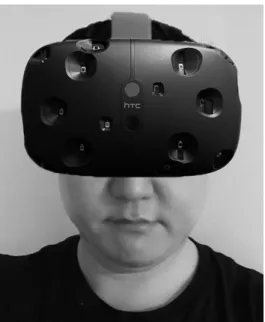
Video game related injury was first reported by Brasington in 1990 as pain to the right thumb and called “Nintendinitis”.1) In 2006, Nintendo Wii, a console with remote controller that detects movement in three dimensions was introduced and multitude of game related injuries has come.2) Apart from motion detecting controllers, VR gamers wear headset blocking ability to see surroundings (Fig. 1). Therefore, it is thought that VR gamers are more at risk than Nintendo Wii gamers.
However, as far as we know, there is no reported VR game related injury yet. We report a case of 53-year-old man who presented with lumbar spine fracture sustained during virtual reality (VR) game.
Case Report
A 53-year-old man presented to the emergence department with a complaint of low back pain in May 2018. He was playing a VR game with a headset covering his face in the arcade. VR instrument was HTC Vive (High Tech Computer Corporation, Taipei, Taiwan) using a headset and wireless controllers (Fig. 2). VR game title was Richie’s plank
experience (Toast VR Pty Ltd, Queensland, AU). Because the game simulated his fall from the 80-story building, he lost his balance and fell down on the floor covered with artificial turf. The patient had a history of hypertension with no other underlying disease. On neurologic examination, there was only low back tenderness without radiating pain or weakness in lower limbs.
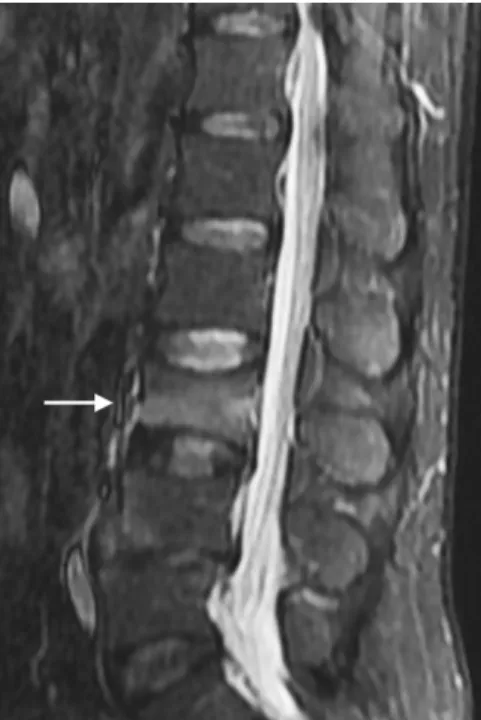
Magnetic resonance imaging (MRI) of the lumbar spine showed a decreased signal intensity at L3 on a T1-weighted sequence (Fig. 3) and computed tomography (CT) confirmed
Ho Sung Han et al Volume 27 • Number 4 • December 31 2020
www.krspine.org 148
cortical breakage of the L3 (Fig. 4).
His blood calcium level was 8.8 mg/dl (8.4-10.4 mg/
dl), and phosphorus level was 2.5 mg/dl (2.7-4.5 mg/dl).
25-hydroxyvitamin D level was 37.0 ng/ml (30-100 ng/
ml) and C-telopeptide level was 0.121 ng/ml (50-71 aged men <0.704). Bone mineral density (BMD) T-score was -1.7 measured in L1-4 and -0.3 at the Lt total proximal femur.
Because posterior ligamentous complex injury was not
detected on short tau inversion recovery (STIR) sequences (Fig.
5) and the patient had a normal neurologic examination, we’
ve determined that the nonoperative treatment is sufficient.
Fig. 1. VR headset completely blocking a gamer’s ability to see the sur- roundings.
Fig. 2. Gamers use a headset and wireless controllers during VR games.
Fig. 3. T1-weighted sagittal magnetic resonance imaging shows de- creased signal intensity at L3 (arrow).
Fig. 4. Computed tomographic scan shows cortical breakage of L3 (arrow).
The patient was instructed to wear the rigid brace for a total of twelve weeks and took pain medication as necessary.
At the one year follow up, CT showed complete bone union of the L3 (Fig. 6).
This paper has been reviewed since IRB approval (2019-09- 014).
Discussion
Video game injury has evolved since Brasington originally described Nintendinitis in 1990 as pain to the extensor tendon of the right thumb of a 35-year-old woman. 1) The description of Nintendinitis has expanded to include Wiiitis and Playstation thumb.3,4) The Wii was launched in the autumn of 2006 by the Nintendo Corporation. Video game injury patterns are divided between before and after the launching of the Wii. Before Wii, video game injuries were tendinitis and ulcerative variations related to to simply pushing buttons or moving levers. The Wii differs from other previous gaming consoles due to its unique user interface. The controller of Wii containing accelerometers and gyroscopes can detect motion, speed, and position in three dimensions. It allows players to interact with game physically
and changed gaming environment from sedentary to active.
However, this did not only start new era of recreational technology but also resulted in new types of injury, mostly traumatic ones.5) Brown and McKenna6) first described a Wii- related fracture in 2009. A 38-year-old man sustained an acute C7 spinous process fracture after heavily swinging his Wii game console controller. Starting with this, there have been reports of Wii related injuries which range from mild to life threatening. Wii related injuries include fractures, patella dislocation, acute cruciate ligament rupture and even massive hemothorax.7-9)
The prevalence of video game injury is known to be obscure.
Some researchers independently ran website to collect cases of video game injuries.2)
Since virtual reality peripherals (e.g. Gear VR, Oculus Rift and HTC Vive) came to the market in 2015, VR game became widely popular. Another important event has taken place that will change injury pattern of video games. VR gamers wear a headset apart from motion detecting controllers. Wearing the VR headset will completely block ability to see surroundings, gamers have the risk of tripping and falling. Blindness to actual topography even makes gamers hard to do defensive behavior.
Fig. 5. STIR sagittal magnetic resonance imaging shows increased signal intensity at L3 (arrow) and a normal low signal intensity of the posterior ligamentous complex of the lumbar spine.
Fig. 6. Computed tomographic scan shows complete bone union of L3 (ar- row).
Ho Sung Han et al Volume 27 • Number 4 • December 31 2020
www.krspine.org 150
VR game has also a danger from the motion detecting controllers like Nintendo Wii. VR gamers can hit things because their hands are flailing rapidly in all directions during game. Therefore VR game is judged to be more dangerous than Wii.
However despite these high risks, there have been no reported VR related injury except our case. To the best of our knowledge, this is the first report of VR game related injury.
We present this case to present that as technology advances, so do the injury patterns in the gaming environment. Even though the activity is simulated, the resulting injury is all too real. Clinicians should never underestimate the risk of VR game injuries and should consider it as part of the differential for musculoskeletal injuries.
REFERENCES
1. Brasington R. Nintendinitis. N Engl J Med. 1990 May 322(20):1473–4.
2. Sparks DA, Coughlin LM, Chase DM. Did too much Wii cause your patient’s injury? J Fam Pract. 2011 Jul;60(7):404-9.
3. Bonis J. Acute Wiiitis. N Engl J Med. 2007 Jun 7;356(23):2431-2. DOI: 10.1056/NEJMc070670.
4. Karim SA. Playstation thumb: a new epidemic in children. S Afr Med J. 2005 Jun;95(6):412.
5. Jalink MB, Heineman E, Pierie JP, ten Cate Hoedemaker HO. Nintendo related injuries and other problems: review.
BMJ. 2014 Dec 16;349:g7267. DOI: 10.1136/bmj.g7267.
6. Brown CN, McKenna P. A Wii-related clay-shoveler’s fracture. Scientific World Journal. 2009 Nov 1;9:1190-1.
DOI: 10.1100/tsw.2009.134.
7. Hirpara KM, Abouazza OA. The “Wii knee”: a case of patellar dislocation secondary to computer video games.
Injury Extra. 2008 Mar 39(3):86-7. DOI:10.1016/
j.injury.2007.07.034.
8. Müller SA, Vavken P, Pagenstert G. Simulated activity but real trauma: a systematic review on Nintendo Wii injuries based on a case report of an acute anterior cruciate liga- ment rupture. Medicine(Baltimore). 2015 Mar;94(12):e648.
DOI: 10.1097/MD.0000000000000648.
9. Peek AC, Ibrahim T, Abunasra H, Waller D, Natarajan R. White-out from a Wii: traumatic haemothorax sus- tained playing Nintendo Wii. Ann R Coll Surg Engl. 2008 Sep;90(6):W9-10. DOI: 10.1308/147870808X303100.
가상 현실 게임에 의한 요추 골절 - 증례 보고 -
한호성 • 이제민*
에스엘서울병원 정형외과, *단국대학교 의과대학 정형외과학교실
연구 계획: 증례 보고
목적: 가상 현실 게임에 의한 요추 골절을 1예를 보고하고자 한다.
선행 연구문헌의 요약: 비디오 게임이 발달함에 따라 비디오 게임 관련 손상 역시 진화해왔다. 가상 현실 게임자들은 주위를 볼 수 있는 시각을 차단하는 헤드셋을 착용하므로 기존의 비디오 게임자들보다 더 위험에 처한 것으로 생각된다. 하지만 아직 가상 현실 게임 관련 손상은 보고된 바 없다.
대상 및 방법: 53세 남자가 가상 현실 게임 중 요추 골절이 발생하였다. 게임이 건물에서 추락하는 것을 가장하였으므로 그는 균형을 잃고 바닥 위에 넘어 졌다. 영상에서 제 3요추 압박 골절이 관찰되었으며 경성 보조기를 사용한 보존적 치료를 시행하였다.
결과: 1년 추시 전산화 단층 촬영상 제 3요추의 완전한 유합이 관찰되었다.
결론: 가장된 활동이었더라도 손상은 완전히 현실로 나타난다. 임상가들은 가상 현실 게임의 위험성을 간과하지 말고 근골격 손상 감별의 한 부분으로 고 려해야 한다.
색인 단어: 요추, 압박 골절, 가상 현실 게임 약칭 제목: 가상 현실 게임 중 요추 골절
접수일: 2020년 6월 28일 수정일: 2020년 7월 10일 게재확정일: 2020년 10월 12일 교신저자: 이제민
충남 천안시 동남구 망향로 201 단국대학교병원 정형외과
TEL: 041-550-3950 FAX: 041-556-0551 E-mail: [email protected]