• 검색 결과가 없습니다.

Successful Outcome of an Elderly Patient with Small Cell Lung Cancer with only Alternative Treatments: A Case Report

N/A
N/A
Protected

Academic year: 2021

Share "Successful Outcome of an Elderly Patient with Small Cell Lung Cancer with only Alternative Treatments: A Case Report"

Copied!
6
0
0

로드 중.... (전체 텍스트 보기)

전체 글

(1)

Successful Outcome of an Elderly Patient with Small Cell Lung Cancer with only Alternative Treatments:

A Case Report

Sanghun Lee

1

, Jeonghyun Joo

2

, Songha Chon

3

1

Department of Medical Consilience, Graduate school, Dankook University

2

Department of Korean Internal Medicine, Comprehensive and Integrative Medicine Hospital

3

Department of Hemato-oncology, Comprehensive and Integrative Medicine Hospital Case Report

⋅Received:6 March 2018 ⋅Revised:3 May 2018 ⋅Accepted:3 May 2018

⋅Correspondence to:Songha Chon

Department of Hemato-oncology, Comprehensive and Integrative Medicine Hospital, 77, Duryugongwon-ro, Nam-gu, Daegu, Republic of Korea

Tel:+82-53-670-5737, Fax:+82-53-670-6001, E-mail:[email protected]

Background: Small cell lung cancer (SCLC) tends to grow more rapidly and spread much faster than non-small cell lung cancer (NSCLC). A concurrent combination of chemotherapy and thoracic radiotherapy is suggested as the standard conventional treatment, but it is more challenging for elderly patients having pulmonary and cardiovascular comorbidities.

Case presentation: Here we present a case of an 80-year-old male, current smoker diagnosed with SCLC in limited stage T3N0M0 (36mm right upper lobe, satellite nodule) in Dec, 2015. The standard concurrent chemoradiotherapy was not available for his comorbidities, which included chronic obstructive pulmonary disease (COPD) and angina pectoris. Furthermore, he and his family refused the recommended chemotherapy or radiotherapy exclusively.

Alternatively, he received various non-conventional treatments including local radiofrequency hyperthermia, mistletoe, and Traditional Korean medicine including acupuncture, moxibustion and herbs since Jan. 2016. Despite the progression in primary tumor size, there have been no other distant relapse so far, and the patient has been in stable condition ever since.

Conclusion: We suggest that a combination of various alternative treatments could be a candidate for elderly patients intolerable to conventional cytotoxic treatments.

Key Words : Small cell lung cancer, Elderly patients, Alternative therapy

Introduction

Lung cancer is the leading cause of cancer death worldwide, and is divided into small cell lung cancer (SCLC, 15% of all cases) and non-small cell lung cancer (NSCLC, 85% of all cases). In the past few decades, advances in targeted chemotherapy have been helpful to treat non-small cell lung cancer (NSCLC), but not

for SCLC

1)

. Furthermore, prognosis in SCLC is very

dismal compared to NSCLC by its rapid doubling time,

high grow fraction, early development of widespread

metastases. Therefore, the staging system in SCLC is

simply dichotomized into a limited stage (a tumor

volume encompassed in one radiation portal) and

extensive stage (all other disease spread) owing to

aggressive early loco-regional and distant spread of

(2)

SCLC

2)

. By reason that a local treatment such as surgery is not beneficial for a limited stage, systemic chemotherapy combined with chest irradiation is strongly recommended. However, most patients die from recurrent disease in spite of the dramatic initial response to the chemotherapy and radiation

3)

.

SCLC risk increases with the cumulative duration and intensity of smoking, and more than 90% of patients are elderly heavy current or ex-smokers with various pulmonary, cardiovascular, and metabolic comorbidities

4)

. Thus, elderly patients older than 70 years have inferior outcomes when compared to younger patients because they are less likely to be subjected to conventional treatments

5)

. In cases without treatment, median survival has been reported to be 2–4 months

6)

. In view of this dismal prognosis, there is a need to propose treatment to improve the health-related quality of life and overall survival. The following report concerns the successful outcome in an elderly heavy smoker patient with SCLC and pulmonary and cardiovascular comorbidities via non-conventional treatments.

Patients and Method

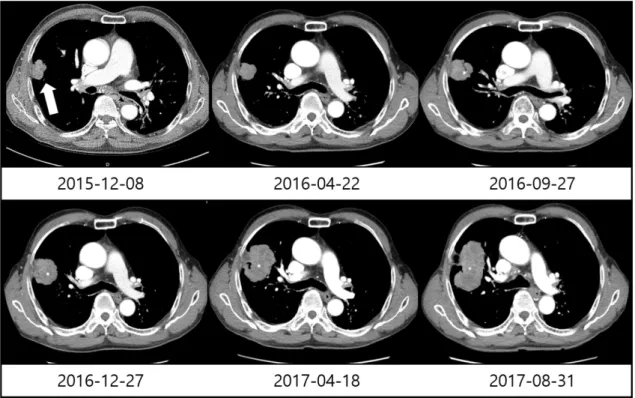
1. Patient characteristics and medical history An 80-year-old Korean male patient was diagnosed with SCLC in a limited stage (T3N0M0, 36mm right upper lobe, satellite nodule) in December 2015 following presentation with a routine check-up. (Fig.

1) His medical history included tuberculosis lymphadenitis 25 years ago, which was cured after medication, and colon cancer 7 years ago, which was surgically resected. He has been diagnosed with moderate chronic obstructive pulmonary disease (COPD) and angina pectoris since 2009. His social history was significant for smoking one pack of cigarettes daily for 50 years, occasional alcohol use,

and no other substance use. His European Cooperative Oncology Group (ECOG) performance status was 1, meaning restricted in physically strenuous activity, but ambulatory and able to carry out work of a light or sedentary nature, e.g., light house work, office work.

The standard concurrent chemoradiotherapy was not intolerable for his comorbidities. Furthermore, he and his family refused either chemotherapy or radiotherapy exclusively after considering the clinical benefits and physiological costs of cytotoxic treatment.

2. Treatment course

For these reasons, the patient visited us in January 2016 to receive alternative therapy. The treatment plan included local radiofrequency hyperthermia, mistletoe, and Traditional Korean treatments such as acupuncture, moxibustion and herbs. Local radiofrequency hyperthermia was carried out using the EHY 2000 device (Oncotherm GmbH, Troisdorf, Germany). A 30-cm-diameter electrode was applied and performed for 60 min per session, three sessions per week, for a total of 12 sessions. The applied power was gradually and linearly increased from 60 to 140 W, depending on the tolerance of the patient. Abnobaviscum

®

F, a standardized preparation of aqueous European mistletoe extract from the host tree Fraxinus manufactured by Abnoba GmbH, Germany was injected subcutaneously.

The initial dose was 0.02 mg three times a week, which

was gradually increased 10-fold. Thereafter, 20 mg

twice a week was administered since April 2016, and

the number of times per week has been reduced to

once a week since August 2016. He was administered

with a herbal extract including Rhus verniciflua stokes

and a decoction of Bojungikki-tang prepared from a

mixture of chopped crude herbs (Astragalus

membranaceus (6g), Panax ginseng C.A.Meyer (4g),

Atractylodes macrocephala Koidzumi (4g) Glycyrrhiza

uralensis (4g), Angelica gigas Nakai (2g), Citrus unshiu

(3)

Fig. 1. A chest CT scan dated December 8, 2015 revealed an approximately 3.6 cm solid nodule in the upper right lobe. A follow-up chest CT scan dated April 22, 2016 showed stable disease of the mass after 15 weeks of non-conventional treatment. The sequential chest CT scans demonstrated the progression but no metastatic regions including the mediastinal lymph nodes.

Markovich (2g), Cimicifuga heracleifolia (2g), Bupleurum falcatum L. (2g)). He also received acupuncture and moxibustion weekly ever since to strengthen pulmonary function.

Results

A chest CT scan (Fig. 1) in April 2016, 15 weeks after the treatment initiation, showed a stable disease of the mass noted previously in the right upper lung.

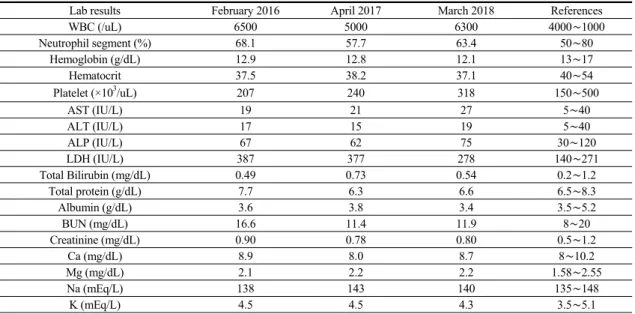
Despite the progression demonstrated by the sequentially followed CT scans (Fig. 1), there was no metastasis of his cancer in the lung and abdominopelvic cavity or elsewhere. The biochemical parameters associated with liver and renal functions and the complete blood count test were within the normal range

(Table 1), and no significant adverse effects from various treatments have been observed. His overall survival is over 2 years at this time, and he is fully active and doing well without weight loss (61kg).

Discussion

In the past decade, cancer research has included

investigations of the tumor microenvironment and

interaction with cancer cells because various

surrounding cells, including immune cells play, an

important role in tumorigenesis

7)

. However, until

recently, conventional cancer treatments have been

generally cytotoxic not only to tumor cells. Thus,

broad damage of the cells surrounding the tumor leads

to cancer progression and metastasis

8)

. Therefore, a

(4)

Table 1. Laboratory Examinations

Lab results February 2016 April 2017 March 2018 References

WBC (/uL) 6500 5000 6300 4000∼1000

Neutrophil segment (%) 68.1 57.7 63.4 50∼80

Hemoglobin (g/dL) 12.9 12.8 12.1 13∼17

Hematocrit 37.5 38.2 37.1 40∼54

Platelet (×10

3

/uL) 207 240 318 150∼500

AST (IU/L) 19 21 27 5∼40

ALT (IU/L) 17 15 19 5∼40

ALP (IU/L) 67 62 75 30∼120

LDH (IU/L) 387 377 278 140∼271

Total Bilirubin (mg/dL) 0.49 0.73 0.54 0.2∼1.2

Total protein (g/dL) 7.7 6.3 6.6 6.5∼8.3

Albumin (g/dL) 3.6 3.8 3.4 3.5∼5.2

BUN (mg/dL) 16.6 11.4 11.9 8∼20

Creatinine (mg/dL) 0.90 0.78 0.80 0.5∼1.2

Ca (mg/dL) 8.9 8.0 8.7 8∼10.2

Mg (mg/dL) 2.1 2.2 2.2 1.58∼2.55

Na (mEq/L) 138 143 140 135∼148

K (mEq/L) 4.5 4.5 4.3 3.5∼5.1

novel approach to optimizing therapy for tumor microenvironments is necessary to control multiple pathways supporting the survival of cancer cells as well as the surrounding cells. Our case suggests that a combination of alternative treatments could be a candidate to control the tumor and surrounding cells, such in SCLC, the most aggressive cancer type.

Several herbs that are traditionally used in East Asia have been proven to improve tumor microenvironments by immunomodulating or anti-angiogenic effects

9),10)

,

Bojungikki-tang (Bu-Zhong-Yi-Qi-Tang in Chinese or Hochu-ekki-to in Japanese) was clinically reported to be beneficial for elderly people to restore age-related impairment of the immune function by enhancing the natural killer activity against tumor cells and a significant increase in the serum IFN-γ level

11)

. Preclinical studies also demonstrated that it enhances immune activity including the restoration of anti-tumor T-cell response, an induction of the augmentation of natural killer activity, dendritic cell maturation, and mitogenic activity to lymphocytes

12),13)

. Rhus verniciflua stokes were reported to inhibit angiogenesis by some

preclinical models

14)

.

Local radiofrequency hyperthermia has been proposed as an acceptable adjuvant to treat SCLC

15)

. Cancer cells are vulnerable to heat due to the disorganized and compact vascular structure compared to healthy tissues that maintain their temperature more easily. Hyperthermia is a direct cause for tumor cells to undergo apoptosis as well as produce heat shock proteins providing a tumor-selective target recognition structure for natural killer cells

16)

. Similarly, mistletoe (Viscum album) extract is currently used as an important part of adjuvant tumor therapy

17)

. Three components of mistletoe, namely viscotoxins, polysaccharides, and lectins, may be responsible for stimulating the immune system and inhibiting cancer growth. In addition, treatment with Viscum album extract has caused a significant inhibition of angiogenesis in vitro and in vivo. In summary, these alternative treatments might be responsible for the anti-cancer effects in the way of ameliorating tumor microenvironments

18)

.

In general, elderly patients, like our case, are expected

to show poor survival compared to younger patients

(5)

due to greater comorbidities and poor performance.

Despite the dismal prognosis in SCLC, our case subject has lived over 2 years after taking non-conventional treatment exclusively. Furthermore, no toxicities were observed for over 2 years. We suggest that the treatment mentioned above could be a candidate to inhibit the progression of SCLC in elderly patients even though primary therapy could not be determined. Therefore, it is necessary to investigate the synergy through various treatments in the future.

Acknowledgment

This work was supported by a grant of Comprehensive and Integrative Medicine R&D project through Comprehensive and Integrative Medicine Institute, funded by the Ministry of Health & Welfare, Republic of Korea (Grant Number : 090-091-3000- 3038-301-320-01)

Disclosure

The authors report no conflicts of interest in this work.

References

1. Arcaro A. Targeted therapies for small cell lung cancer: Where do we stand? Crit Rev Oncol Hemat.

2015;95(2):154-64.

2. van Meerbeeck JP, Fennell DA, De Ruysscher DK. Small-cell lung cancer. Lancet. 2011;378 (9804):1741-55.

3. Stupp R, Monnerat C, Turrisi AT, 3rd, Perry MC, Leyvraz S, Small cell lung cancer: state of the art and future perspectives. Lung Cancer.

2004;45(1):105-17.

4. De Ruysscher D, Botterweck A, Dirx M,

Pijls-Johannesma M, Wanders R, Hochstenbag M, et al. Eligibility for concurrent chemotherapy and radiotherapy of locally advanced lung cancer patients: a prospective, population-based study.

Annals of Oncology, 2009;20(1):98-102.

5. Owonikoko TK, Ragin CC, Belani CP, Oton AB, Gooding WE, Taioli E, et al. Lung cancer in elderly patients: An analysis of the surveillance, epidemiology, and end results database. Journal of Clinical Oncology. 2007;25(35):5570-7.

6. Kato Y, Ferguson TB, Bennett DE, Burford TH.

Oat cell carcinoma of the lung. A review of 138 cases. Cancer. 1969;23(3):517-24.

7. Quail DF, Joyce JA. Microenvironmental regulation of tumor progression and metastasis.

Nature medicine. 2013;19(11):1423-37.

8. Chabner BA, Roberts TG. Timeline - Chemotherapy and the war on cancer. Nature Reviews Cancer.

2005;5(1):65-72.

9. Kang CH, Kang H, Shin HK, Shim BS, Kim SH, Choi SH, et al. Experimental Studies on the Anti-angiogenesis and Anti-metastasis Effects of Ekong-san. Journal of Korean traditional oncology. 2006;11(1):41-54.

10. Lee SG, Ha JH. Antitumor and immunomodulatory effects of Ikongsan on murine melanoma-induced lung metastasis. Koren Journal of Oriental Medical Pathology. 1997;11(1):21-30.

11. Kuroiwa A, Liou S, Yan H, Eshita A, Naitoh S, Nagayama A. Effect of a traditional Japanese herbal medicine, hochu-ekki-to (Bu-Zhong-Yi-Qi Tang), on immunity in elderly persons. Int Immunopharmacol. 2004;4(2):317-24.

12. Nabeshima S, Murata M, Hamada M, Chong Y, Yamaji K, Hayashi J. Maturation of monocyte- derived dendritic cells by Hochu-ekki-to, a traditional Japanese herbal medicine. Int Immunopharmacol. 2004;4(1):37-45.

13. Li T, Tamada K, Abe K, Tada H, Onoe Y,

(6)

Tatsugami K, et al. The restoration of the antitumor T cell response from stress-induced suppression using a traditional Chinese herbal medicine Hochu-ekki-to (TJ-41:Bu-Zhong-Yi-Qi-Tang).

Immunopharmacology. 1999;43(1):11-21.

14. Choi W, Jung H, Kim K, Lee S, Yoon S, Park J, et al. Rhus verniciflua Stokes against Advanced Cancer: A Perspective from the Korean Integrative Cancer Center. Journal of biomedicine &

biotechnology. 2012;2012:874276.

15. Szasz A. Current status of oncothermia therapy for lung cancer. The Korean journal of thoracic and cardiovascular surgery. 2014;47(2):77-93.

16. Hegyi G, Szigeti GP, Szasz A. Hyperthermia versus Oncothermia: Cellular Effects in Complementary Cancer Therapy. Evidence-based complementary and alternative medicine : eCAM.

2013;2013:672873.

17. Melzer J, Iten F, Hostanska K, Saller R.

Efficacy and Safety of Mistletoe Preparations (Viscum album) for Patients with Cancer Diseases A Systematic Review. Forschende Komplementarmedizin. 2009;16(4):217-26.

18. Elluru SR, Van Huyen JPD, Delignat S, Prost F, Heudes D, Kazatchkine MD, et al. Antiangiogenic Properties of Viscum Album Extracts Are Associated with Endothelial Cytotoxicity.

Anticancer research. 2009;29(8):2945-50.

ORCID

Sanghun Lee: https://orcid.org/0000-0002-0573-9555

수치

Fig.  1.  A  chest  CT  scan  dated  December  8,  2015  revealed  an  approximately  3.6  cm  solid  nodule  in  the  upper  right  lobe
Table  1.  Laboratory  Examinations

참조

관련 문서

Results: 44 of 1048 patients with gastric cancer(4.1%) had synchronous and metachronous cancers. The average time interval between gastric cancer and secondary primary cancer

Caffeic acid phenethyl ester induces E2F-1-mediated growth inhibition and cell-cycle arrest in human cervical cancer cells.

4 > Effects of Taro on COX-2 expression and iNOS expression(hot water) in human thyroid cancer cells. The cells were pretreated for 48hours with either

For my study, this being diagnosed with prostate cancer receiving treatment in patients with complementary and alternative therapies for their experience

In the present study, consistent to that report, up-regulation of VEGF mRNA was observed in the colon cancer cell with the acquired resistance to 5-FU and this

Bone is a common site of distant metastasis in prostate cancer. Association of bone and metastatic cancer cells are important in this site-specific manifestation

 Although van der Waals equation is still less accurate at high

Therefore, elucidating the effect of oleic acid, a substance derived from broccoli sprout extract, on breast cancer stem cells along with broccoli sprout extract, can