https://doi.org/10.9721/KJFST.2021.53.1.92
92
©The Korean Society of Food Science and Technology
Effects of heat-moisture treatment of rice flour on the properties in tofu
Shu An1, Kwang Yeon Lee1, and Hyeon Gyu Lee1,*1Department of Food and Nutrition, Hanyang University
Abstract The effects of heat-moisture treatment (HMT) on rice flour (RF) have been investigated for possibility of texture modifier in protein-based foods matrix, tofu. The optimum condition for preparation of tofu with maximum textural parameters was investigated by using response surface methodology (RSM). Rice flour was subjected to moisture content (10-30%) and heating temperature (100-140oC). Based on the response surface and superimposed plots, the optimized conditions of hydrothermally treated rice flour was as followed: moisture content, 22%; temperature, 130oC, which showed lower swelling power as compared to native RF and became more stable during continuous heating and agitation than native one. Tofu, prepared with HMT-RF, showed a denser network structure than that with RF, thereby inducing an increase in textural parameters. From the above results, the addition of HMT-RF could preserve the quality of tofu and be useful for developing an acceptable protein-based food product.
Keywords: heat-moisture treatment, RSM, rice flour, textural properties, tofu
Introduction
Rice is one of the major cereals in the world and its products such as rice cakes, rice noodles, and rice pasta has been regarded as staple foods, especially in eastern countries which are mainly made of rice flour (Wu et al., 2010). Because of particular characteristics such as being hypoallergenic properties, bland taste, and colorless, rice flour has been gained increasing interests as effective modifier for novel foods (e.g. gluten-free products, processed meat, beverages, puddings, and salad dressing) (Kadan et al., 2006; Wu et al., 2010). Several researchers have investigated on the gel properties including rheological, textural, pasting of rice flours (Kapri & Bhattacharya, 2008; Katekhong & Charoenresin, 2012). However, native rice flour has the shortcoming such as poor resistance to shear force, and gel quality by low elastic gel-formation.
There is an increasing interest in physical modification with a safe and completely natural product concept. Many researchers have reported heat-moisture treated (HMT) starches have been importantly used in the food processing due their higher thermal stability and reduced retrogradation, in particular (Adebowalea et al., 2005). HMT is carried out under restricted moisture content (≤30%) and higher temperatures (≥90oC) (Maache-Rezzoug et al.,
2008). This is known as a process involving the following properties: (a) increased gelatinization transition temperature, (b) suppressed granular swelling and amylose leaching, and (c) improved thermal stability. HMT is considered to be natural
modification method and commonly used to change functional properties of polysaccharides at a low cost (Zavareze & Dias, 2011).
Soybeans are extensively processed into tofu, a highly nutritious food product being the most widely accepted soy food. Tofu is extensively consumed in many Asian countries due to its cheap and high-quality (with good amino acids balance) proteins with high digestibility (Prabhankaran et al., 2006). Tofu is regarded as water based gel coagulated with salts or acids, containing soybean lipids, proteins, and other constituents in its network (Kohyama et al., 1995). The texture of tofu is determined by several processing factors. It is well known that the final texture notably affects the taste of tofu (Jackson et al., 2002). Also, the yield, moisture content, texture, and color of tofu is known to important factor in the quality and acceptability (Cai et al., 1997). In particular, curd formation of tofu involves complex interactive mechanism between soybeans proteins, coagulants and non-protein compound, such as carbohydrate, lipid, and phytate (Hou & Chang, 1998). Several studies on the quality characteristics of tofu with natural food materials such as fresh egg, horseradish, hydrocolloids, and oyster shell powder has been conducted (Kim et al., 2007; Maizura et al., 2016; Shin et al., 2010). Those natural food materials could increase nutrient content and improve antibacterial, and antioxidant properties. Nevertheless, they exerted an influence on the textual characteristics such as firmness of tofu, and then the deceased textural parameters of tofu lead to a low acceptability.
In contrast, HMT-treated rice starch and flour has been reported to be applied for noodle and cookies preparation with low- or intermediate-moisture content (Hormdok & Noomhorm, 2007; Marston et al., 2016), its texture modifier has not been widely studied in the various food systems, e.g. tofu with high-moisture content. However, various aspects of HMT-treated rice starch properties have been reported, whereas relatively little work studies investigated on properties and utilization of rice flour. Under-*Corresponding author: Hyeon Gyu Lee, Department of Food and
Nutrition, Hanyang University, Seoul 04763, Korea Tel.: +82-2-2220-1202
Fax: +82-2-2281-8285
E-mail: [email protected]
Received November 21, 2020; revised December 17, 2020; accepted December 30, 2020
standing the characteristics for the interactions between soy protein and macromolecules such as HMT-treated rice flour is important for developing a novel gel texture. However, to our knowledge, there is little information related to gel properties of HMT-rice flour and soy bean protein combination, mainly texture properties. Here we investigated the potential applications the HMT-treated rice flour as a texture modifier in protein-based food matrix, tofu gel. The present study was employed to understand the effects of optimized HMT parameters such as heating temperature and water content upon the textural properties of tofu gel, and properties of rice flour and tofu made under optimum conditions in comparison to native rice flour. This information is helpful to incorporate HMT-treated rice flour into protein-based food formulation in order to modify their textural properties such as gel-like products.
Materials and Methods
Materials
Yellow soybeans (Gyeoungbuk, Korea) and rice (Oryza sativa L., Gyongnam, Korea) and were purchased from Nong-Hyup Market. Food grade calcium sulfate was obtained from Taejin GNS Co., Ltd. (Incheon, Korea).
Preparation of rice flour (RF)
Rice grains were soaked in water for 4 h and dried 1 h, and then grounded in a double-disk stone mill. The sample was then dried in a drying oven at 40oC until the moisture content reached 10%. The dried sample was collected, ground in a powder (100 mesh) and kept at 4oC until used (Cham & Suwannaporn, 2010).
Experimental design and statistical analysis
Response surface methodology (RSM) was used in this study to determine heat-moisture conditions on textural properties of rice tofu. A two-factor, five-level central composite design was used to optimize the HMT conditions. The design provided 10 experimental points comprising six fractional points, two axial points, and two replicates at the center point. X1=moisture content and X2= heating temperature were two treatment conditions examined as independent variables. Based on experiments, the actual values of each variable were coded at five levels for statistical analysis (Table 1). The second-order polynomial response surface was used to model the effects of two independent variables: X1 and X2 on the responses (Y, dependent variables).
The following equation was derived using the prediction of the response variables:
(1)
where, Y is the predicted response; β0, is the value of the fixed response at the central point of the experiment that is the point (0,0); β1 and β1 are the linear, β11 and β22 are the quadratic and β12 are the interactions regression terms. The resultant regression models were used to generate contour plots for further elucidation of the relationship. The combination effect between the independent
variables and the response was obtained using Statistical Analysis System (SAS) program 9.1 (SAS Institute Inc., Cary, NC, USA).
Preparation of heat-moisture treatments of rice flour The moisture content of RF was adjusted from 10 to 30% (X1; −2 to 2 levels). The mixture was incubated overnight in sealed aluminum foil bags, and then heated in a drying oven at temperatures of 100-140oC (X2; −2 to 2 levels) for 1.5 h. After that, samples were dried at 40oC until its moisture content reached 10%.
Preparation of rice tofu
Soybeans (90 g) were soaked in distilled water at 25oC for 5 h. Thereafter, the drained beans were added with distilled water (1,530 mL) and ground for 15 min and then boiled for 8 min by using a tofu maker (IOM-201A, Seoul, Korea). The slurry was pressed with a muslin cloth to obtain soymilk (≈1,350 mL). The soymilk added native or HMT rice flour, mixed with 100 mL distilled water was coagulated with calcium sulfate (4.05 g) at 80-85oC water bath for 10 min. The curd was transferred to a cheesecloth-lined plastic form (9×7×5 cm) and pressed for 20 min with a 1 kg load. Thereafter, the tofu was immersed in the water for 1 h and drained to remove excess mixture before being analyzed. Control tofu was prepared with same coagulant without rice flour.
Optimization and verification of HMT conditions
Optimal basic ingredients levels of HMT conditions were determined by superimposing the plots for all response variables (Capanzana & Buckle, 1997; Gan et al., 2007). The optimum conditions were used for calculating the predicted values of response variables by RSM. The optimum HMT conditions for producing rice tofu were verified. The rice tofu made using the optimal condition was analyzed and the results were statistically compared with the predicted values of the mathematical model.
Particle size analysis
Granule size distribution was measured using a Malvern Master Sizer (Malvern Instruments, Ltd, Worcestershire, UK) at room temperature. The volume distribution was carried out in triplicate for each sample. From its distribution, the results are presented as the median volume diameter (Dv, 0.5).
Hydration properties
Water hydration properties (water absorption index [WAI], water solubility [WS], and swelling power [SP]) of optimum HMT rice flour were investigated and compared with those of native rice flour (Lai & Cheng, 2004). After mixing each sample (0.2 g) in distilled water (4 mL), the dispersion was placed at 80oC water bath for 30 min and then cooled to room temperature, rapidly. The suspensions were centrifuged at 1,000×g for 30 min, and the settled residue and supernatant were collected and weighed. Thereafter, the supernatant was dried at a 105oC oven to obtain the constant weight. The hydration properties were calculated as follows:
∑ ∑
∑
∑
= + = + = > + = 2 1 3 3 1 2 3 1 0 i j i ij i j i ii i i i i X X X X Y β β β βWAI=Residual sample weight/dry sample weight WS (%)=dry supernatant weight/dry sample weight×100 SP=wet sediment weight/dry sample weight×(1−(WS/100)) Pasting properties
Pasting properties of native and modified rice flour were studied using a Rapid Visco Analyser (RVA-4, Newport Scientific Pty. Ltd, Warriewood, Australia). The rice flour sample (3.0 g, dry basis) was mixed with 25 mL of distilled water using a paddle in an aluminum can. The heating and cooling cycles were set as follows: The sample was held at 50oC for 1 min, heated from 50oC to 95oC at 12oC per min and held at 95oC for 2.5 min. Finally, the sample was cooled from 95oC to 50oC at a rate of 12oC per min and was held at 50oC for 2 min.
Yield, moisture content, and color of tofu
Tofu yield was calculated as the fresh tofu weight obtained from soybeans of 100 g. Moisture content was analyzed by drying tofu of 5 g at 105oC in drying oven until weight was constant (Cai et al., 1997). The color of tofu was measured using a colorimeter (Minolta, Chroma meter, CR-400, Tokyo, Japan) and ‘L’ (lightness), ‘a’ (red/green), and ‘b’ (yellow/blue) was measured.
Determination of tofu texture
A TA-XT2i Texture Analyzer (Stable Micro Systems, Surrey, UK) fitted with a 5-kg load cell was used to determine the textures of tofu. Cube samples of tofu (1×1×1 cm) were deformed 80% by compression using a compression plunger (D: 35 mm). The pre-test, test and post-test speeds were set to 1, 1 and 1 mm/ s, respectively. Each sample was done to 12 replicate tests. Texture parameters such as hardness, springiness, cohesiveness, gumminess and chewiness were selected as important response variables (Noh et al., 2005).
Microstructure of tofu
The microstructure of the native and optimum HMT rice tofu was observed using a scanning electron microscope (SEM). Freeze-dried tofu samples were dried for 24 h in an oven at 40oC. The dried samples were placed on the aluminum stub, fixed using double-sided adhesive carbon-tapes and coated with a platinum layer. SEM analysis was measured using a FE-SEM (NOVA NANO SEM 450, Tokyo, Japan). The samples were measured with a magnification of 500×.
Statistical analysis
All experiments were carried out three times, and the resultant values were shown as mean and standard deviation. Duncan's multiple range tests and t-tests (p<0.05) were conducted using SPSS statistical software (Version 21.0 software, Chicago, IL, USA) as statistical analyses.
Results and Discussion
Effect of heat-moisture treatment on tofu with rice flour The particle size distributions of native and HMT rice flour are
shown in Fig. 1. The native RF presents a narrow size distribution with a median diameter in volume (Dv, 0.5) of 23.46 µm. An increase of Dv, 0.5 was observed in HMT-RF (117.32 µm). This increase of Dv may be ascribed to the increased swelling capacity of starch granules induced by the HMT and the existence of agglomerates (Bahrani et al., 2012). Bahrani et al. (2012) have reported similar results for maize starch with the same tendency of the size distributions induced by hydrothermal treatments.
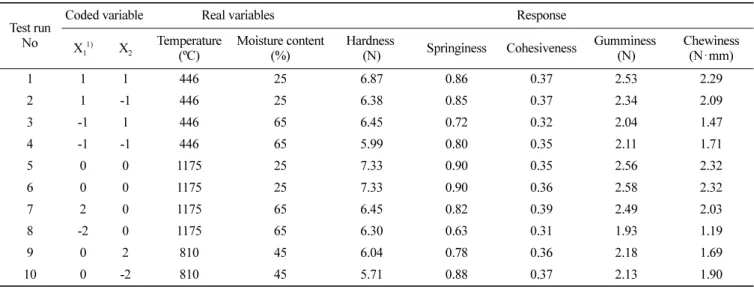
The effects of moisture content and temperature on the textural parameters of tofu with rice flour are reported by the coefficient of the second-order polynomials (Tables 1 and 2). To aid in visualization, the response surfaces for these response variables are shown in Fig. 2(a). Instrumental TPA was carried out on the tofu with HMT-RF and texture attributes were selected as the response variables. Except for cohesiveness, all of the textural parameters of the HMT-RF tofu depended on the heating temperature with a positive linear effect at p<0.05. Thus, an increase in heating temperature may contribute to an increase in the hardness of the product. However, the moisture content (%) showed negative quadratic effects (p<0.05) on the hardness, gumminess, and chewiness of HMT-RF tofu.
Optimization of the basic formulation and verification of the model
Some contour plots (six of each response) were generated (Fig. 2(a)) and compared visually. The contour plots were superimposed, and the area of optimum performance was determined for all of the response variables in which the limits of each response had been established (Fig. 2(b)). The region that satisfied all of the limits was selected as the optimum point. The contour plots were analyzed and the relationships between the response and variables were evaluated to present an optimum condition of HMT for rice tofu with moderate textural parameters. These superimposed plots represent that the optimum condition of the HMT was 22% of moisture content and 130oC of heating temperature. The predicted values for each of the response variables were as follows: hardness 7.03 N, springiness 0.89, cohesiveness 0.37, gumminess 2.59 N, Fig. 1. Particle size distribution of heat-moisture treated rice flour according to optimized conditions (Temperature: 130oC, Moisture content: 22%).
and chewiness 2.33 N·mm. Once the optimum heat-moisture treatment was determined, it was used to produce rice flour and tofu, and all the response variables of the final products were analyzed. The experimental values obtained were as followed: 7.09 N, 0.89, 0.38, 2.71 N, and for 2.41 N·mm for hardness, springiness, cohesiveness, gumminess, and chewiness of tofu, respectively. The experimental and predicted values were within the range and there were no statistically significant differences at the 5% level. Thus, the model applied to optimize the HMT conditions of rice flour for tofu making.
Characteristics of native and HMT rice flour
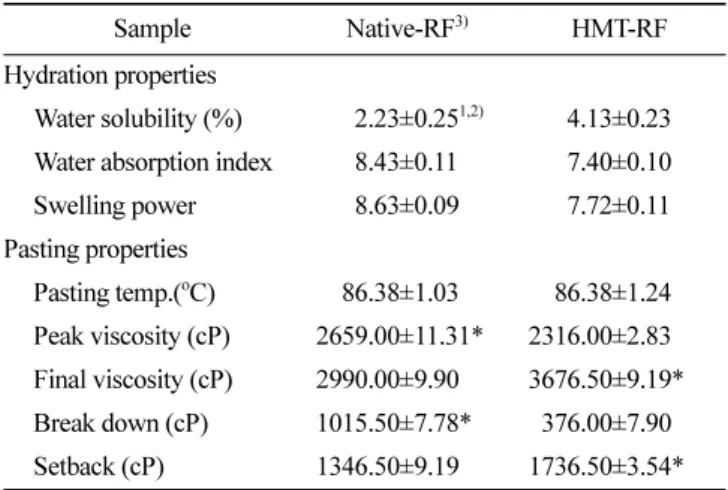
The hydration properties at 80oC of native and HMT rice flour were significantly different (p<0.05) (Table 3). The water solubility was increased, but the swelling power and water absorption index were reduced by HMT because the ordered rearrangement of the starch molecule limited starch hydration and swelling capacity (Hoover & Vasanthan, 1994). The pasting properties of native and HMT rice flour are present in Table 3. HMT affected the paste
viscosities of rice flour differently. As compared to native- and HMT-RF exhibited a significantly higher final viscosity and setback (p<0.05). Cham et al. (2010) state that increases in the setback and storage modulus of rice flour gel treated by HMT and annealing are due to the modification process that tends to increase the region of crystallinity. During continued heating and shearing, the breakdown of HMT-RF was significantly reduced compared to native rice flour (p<0.05). The HMT-induced reduction in breakdown indicates that starches are more stable against continuous heating and agitation and this is supported by Adebowale et al., (2005).
Yield, moisture content, and color of tofu
The study by Cai et al. (1997) demonstrated that higher moisture content was positively related with higher tofu yield. The yield of tofu in this experiment was in the order of: native-RF > HMT-RF > control (Table 4). The moisture content of tofu with native and HMT rice flour added were significantly higher than the control tofu (p<0.05), which is also reflected in the higher yield of tofu. Tofu prepared with Native-RF had a higher moisture content Table 1. Central composite design arrangement and experimental result for the response variables of texture profile of HMT-RF tofu
Test run No
Coded variable Real variables Response
X11) X2 Temperature (ºC) Moisture content (%) Hardness (N) Springiness Cohesiveness Gumminess (N) Chewiness (N·mm) 1 1 1 446 25 6.87 0.86 0.37 2.53 2.29 2 1 -1 446 25 6.38 0.85 0.37 2.34 2.09 3 -1 1 446 65 6.45 0.72 0.32 2.04 1.47 4 -1 -1 446 65 5.99 0.80 0.35 2.11 1.71 5 0 0 1175 25 7.33 0.90 0.35 2.56 2.32 6 0 0 1175 25 7.33 0.90 0.36 2.58 2.32 7 2 0 1175 65 6.45 0.82 0.39 2.49 2.03 8 -2 0 1175 65 6.30 0.63 0.31 1.93 1.19 9 0 2 810 45 6.04 0.78 0.36 2.18 1.69 10 0 -2 810 45 5.71 0.88 0.37 2.13 1.90 1)The X
1 and X2 were the temperature (oC) and moisture content (%), respectively.
Table 2. Regression equation coefficients for the effects of heat-moisture treatment conditions on HMT-RF tofu qualities
Coefficients Response Hardness (N) Springiness Cohesiveness Gumminess (N) Chewiness ( N·mm) Constant β0 -3098.26431) -4.7407* 0.4024 956.5288 2132.6588* Linear β1 52.8216* 0.0954** 0.0013 18.4211* 38.2965** β2 56.108 -0.0341 -0.0233* 0.5406 -7.6919 Quadratic β11 -0.2171* -0.0004** -0.00001 -0.0808* -0.1680** β22 -1.3710** -0.0006 0.0001 -0.3804* -0.4905* Interaction β21 0.0118 0.0005 0.0002 0.1253 0.2213 Lack of fit P 0.0047 <.0001 0.6628 0.0763 0.0071 Overall model P 0.0654 0.0054 0.0042 0.0218 0.0079 Coefficients of determination R2 0.8691 0.9643 0.9685 0.9268 0.9566 1)*, **significant at p<0.1, p<0.01, respectively
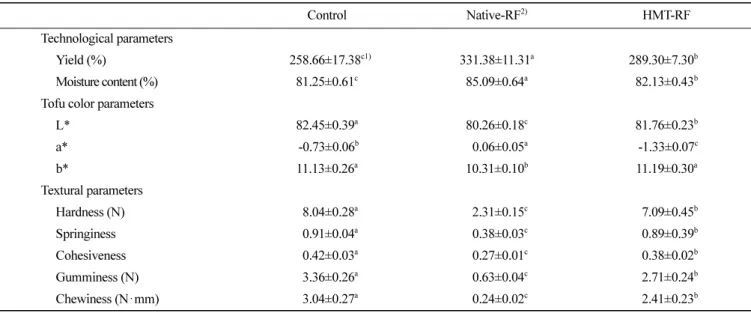
compared to tofu prepared with HMT-RF. It is well known that good quality tofu is generally white or yellow in color. The effects of native and HMT rice flour on the color of tofu are presented in Table 4. Tofu prepared with HMT-RF had slightly lower L and a value than control tofu. However, the differences between the b values of HMT-RF tofu and those of the control tofu were not significant.
Texture properties
Generally, the textural properties of tofu play a main role for final quality and consumer acceptability (Jayasena et al., 2010). The textures of tofu prepared with native and HMT-RF are shown in Table 4. The textual parameters of tofu prepared with Native-RF (2.31 N) were apparently reduced compared to that with control tofu (8.04 N) without RF or HMT-RF. Although the result was significantly different form control tofu, HMT-RF tofu produced the slightly decreased hardness value (7.09 N). The results showed
that HMT-RF tofu produced the similar textural characteristics as that of the control. The hardness of tofu has been reported to be associated with its moisture content (Prabhankaran et al., 2006). Normally higher moisture contents of tofu are associated with lower hardness while lower moisture contents of tofu are associated with more compact structures and higher hardness. In this study, the moisture content of tofu was in the following order: Native-RF tofu > HMT-RF tofu > control tofu, indicating that the structure of tofu made with Native-RF was less dense and weaker than control and HMT-RF tofu. The results showed no significant difference in springiness between HMT-RF tofu and the control tofu, with values ranging from 0.89 to 0.91. On the contrary the Native-RF tofu showed the lowest springiness (0.38). Cohesiveness appeared to decrease with addition of Native-RF tofu (0.42→0.27). However, HMT-RF tofu (0.38) only showed a slight change in cohesiveness compared to the control tofu. Similar hardness, springiness, and cohesiveness, gumminess and chewiness also notably decreased in Fig. 2. Contour plots for the tofu containing the HMT-RF (a) and its superimposed plots of the five response variables (b).
Native-RF tofu, compared to control and HMT-RF tofu.
The microstructure of tofu
Figure 3 shows the scanning electron micrographs of tofu prepared with Native- and HMT-RF tofu (500×). The surface of RF tofu showed larger and wider pores than those of HMT-RF tofu. When RF was added, the continuation of the protein network might be decreased in soy milk, leading to an unstable structure with lower hardness, springiness, and cohesiveness (Liu et al., 2013). Tofu prepared with HMT-RF showed a denser network compared to RF tofu, which induced an increase in the textural parameters (Table 4). These results suggest that HMT-RF had greater effects than native one on the formation of homogeneous and stable gel networks for tofu making.
Conclusion
The treatment conditions used markedly affected the textural properties of tofu made with RF. Based on the contour and superimposed plots the heat-moisture treatment (HMT) conditions obtained the desired rice tofu quality by incorporating 22% of moisture content and 130oC of heating temperature. The experimental data for the response variables were as follows: hardness was 7.09±0.45 N, springiness was 0.89±0.40, cohesiveness was 0.38± 0.02, gumminess was 2.71±0.24 N, and chewiness was 2.41±0.23 N·mm. No statistically difference was found between the experimental and predicted values (p>0.05). Addition of RF to tofu dramatically deteriorates all textural characteristics. Heat-moisture treated-RF, however, apparently modified hydration and pasting properties of RF, and the tofu added with HMT-RF showed significantly improved all textural parameters comparable to the tofu made with RF, close to those of the control tofu. From these results, it is concluded that HMT-RF could be useful for improving the texture properties as well as quality of protein based food product and
applied in the formulation of gel-like foods, though further research on nutrition, gelation mechanism-related properties are needed.
Conflict of Interest
The Authors declare no conflict of interest.
References
Adebowalea KO, Afolabib TA, Olu-Owolabi BI. Hydrothermal treat-ments of Finger millet (Eleusine coracana) starch. Food Hydro-colloid. 19: 974-983 (2005)
Bahrani SA, Loisel C, Rezzoug S-A, Doublier J-L, Maache-Rezzoug Table 3. Hydration and pasting properties of native and
heat-moisture treated rice flour under optimum conditions
Sample Native-RF3) HMT-RF
Hydration properties
Water solubility (%) 0002.23±0.251,2) 0004.13±0.23 Water absorption index 0008.43±0.11 0007.40±0.10 Swelling power 0008.63±0.09 0007.72±0.11 Pasting properties Pasting temp.(oC) 0086.38±1.03 0086.38±1.24 Peak viscosity (cP) 2659.00±11.31* 2316.00±2.83 Final viscosity (cP) 2990.00±9.90 3676.50±9.19* Break down (cP) 1015.50±7.78* 0376.00±7.90 Setback (cP) 1346.50±9.19 1736.50±3.54* 1)Results are expressed as means±standard error of measurement. 2)*Comparison of response between Native-RF and HMT-RF by paired t-test was significant at p<0.05.
3)Native-RF, native rice flour; HMT-RF, heat-moisture treated rice flour
Fig. 3. Scanning electron microscopes of control and rice tofu (500×). (a) Control tofu; (b) native rice tofu; (c) heat-moisture treated rice tofu.
Z. Role of vacuum steps added before and after steaming treat-ment of maize starch. Impact on pasting, morphological and rhe-ological properties. Carbohydrate Polym. 89: 810-820 (2012) Cai TD, Chang KC, Shih MC, Hou HJ, M JI. Comparison of bench
and production scale methods for making soymilk and tofu from 13 soybean varieties. Food Res. Int. 9: 659-668 (1997)
Capanzana MV, Buckle KA. Optimization of germination conditions by response surface methodology of a high amylose rice (Oryza sativa) cultivar. LWT-Food Sci. Technol. 30: 155-163 (1997) Cham S, Suwannaporn P. Effect of hydrothermal treatment of rice
flour on various rice noodles quality. J. Cereal Sci. 3: 284-291 (2010)
Gan HE, Karim R, Muhammad SKS, Bakar JA, Hashim DM, Rah-man R. Abd. Optimization of the basic formulation of a tradi-tional baked cassava cake using response surface methodology. LWT - Food Sci. Technol. 4: 611-618 (2007)
Hoover R, Vasanthan T. Effect of heat-moisture treatment on the structure and physicochemical properties of cereal, legume, and tuber starches. Carbohydr. Res. 252: 33-53 (1994)
Hormdok R, Noomhorm A, Hydrothermal treatments of rice starch for improvement of rice noodle quality. LWT-Food Sci. Technol. 40: 1723-1731 (2007)
Hou HJ, Chang SKC. Yield and quality of soft tofu as affected by soybean physical damage and storage. J. Agr. Food Chem. 46: 4798-4805 (1998)
Jackson C-JC, Dini JP, Lavandier C, Rupasinghe HPV, Faulkner H, Poysa V, Buzzell D, DeGrandis S. Effects of processing on the content and composition of isoflavones during manufacturing of soy beverage and tofu. Process Biochem. 10: 1117-1123 (2002) Jayasena V. Khu WS, Nasarabbass SM. The development and
sen-sory acceptability of Lupin-based tofu. J. Food Quality. 1: 85-97 (2010)
Kadan RS, Robinson MG, Thibodeux DP, Pepperman AB. Texture and other physicochemical properties of whole rice bread. J. Food Sci. 66: 940-944 (2006)
Katekhong W, Charoenresin S. The effect of rice aging on the freeze-thaw stability of rice flour gels. Carbohydr. Polym. 89: 777-782 (2012)
Kapri A, Bhattacharya S. Gelling behavior of rice flour dispersions at
different concentrations of solid and time of heating. J. Texture stud. 39: 231-251 (2008)
Kim YS, Choi YM, Noh DO, Cho SY, Suh HJ. The effect of oyster shell powder on the extension of the shelf life of tofu. Food Chem. 103: 155-160 (2007)
Kohyama K, Sano Y, Doi, E. Rheological characteristics and gelation mechanism of tofu (soybean curd). J. Agr. Food Chem. 7: 1808-1812 (1995)
Lai HM, Cheng HH. Properties of pregelatinized rice flour made by hot air or gum puffing. Int. J. Food Sci. Technol. 39: 201-212 (2004)
Liu H-H, Chien J-T, Kuo M-I. Ultra high pressure homogenized soy flour for tofu making. Food Hydrocolloid. 32: 278-285 (2013) Maache-Rezzoug Z, Zarguili I, Loisel C, Queveau D, Buléon, A.
Structural modifications and thermal transitions of standard maize starch after DIC hydrothermal treatment. Carbohydr. Polym. 74: 802-812 (2008)
Maizura M, Aminah A, Wan Aida WM, Antioxidant capacity and consumer acceptability of herbal egg tofu. LWT-Food Sci. Tech-nol. 65: 549-556 (2016)
Marston K, Khouryieh H, Aramouni F. Effects of heat treatment sor-ghum flour on the functional properties of gluten-free bread and cake. LWT-Food Sci. Technol. 65: 637-644 (2016)
Noh EJ, Pak JI, Hong ST, Yun SE. Coagulation of soymilk and qual-ity of tofu as affected by freeze treatment of soybeans. Food Chem. 4: 715-721 (2005)
Prabhankaran MP, Perera CP, Valiyaveettil S. Effect of different coagulants on the isoflavone levels and physical properties of prepared firm tofu. Food Chem. 3: 492-499 (2006)
Shin I-S, Han J-S, Choi K-D, Chung D-H, Choi G-P, Ahn J. Effect of isothiocyanates from horseradish (Armoracia rusticana) on the quality and shelf life of tofu. Food Control. 21: 1081-1086 (2010)
Wu Y, Chen ZX, Li XX, Wang ZJ. Retrogradation properties of high amylose rice flour and rice starch by physical modification. LWT-Food Sci. Technol. 3: 492-497. (2010).
Zavareze, EdR Dias ARG, Impact of heat-moisture treatment and annealing in starches: A review. Carbohydr. Polym. 2: 317-328 (2011)
Table 4. Physicochemical properties of native and HMT-RF tofu
Control Native-RF2) HMT-RF
Technological parameters
Yield (%) 0258.66±17.38c1) 331.38±11.31a 289.30±7.30b0
Moisture content (%) 81.25±0.61c 85.09±0.64a 82.13±0.43b
Tofu color parameters
L* 82.45±0.39a 80.26±0.18c 81.76±0.23b a* .-0.73±0.06b 00.06±0.05a .-1.33±0.07c b* 11.13±0.26a 10.31±0.10b 11.19±0.30a Textural parameters Hardness (N) 08.04±0.28a 02.31±0.15c 07.09±0.45b Springiness 00.91±0.04a 00.38±0.03c 00.89±0.39b Cohesiveness 00.42±0.03a 00.27±0.01c 00.38±0.02b Gumminess (N) 03.36±0.26a 00.63±0.04c 02.71±0.24b Chewiness (N·mm) 03.04±0.27a 00.24±0.02c 02.41±0.23b
1)Means with different superscripts within a row are significantly different (p<0.05). 2)Native-RF, native rice flour; HMT-RF, heat-moisture treated rice flour.