Arthroscopic rotator cuff repair is currently a popular and well-established technique with well documented satisfac- tory clinical outcomes.1-3) However, some patients report persistent pain and poor shoulder function after rotator cuff repair. Thus, identification of factors associated with poor clinical outcomes for the procedure is clinically im- portant and has received increasing attention.3,4)
Age, gender, duration of symptoms, preoperative
stiffness, working status, workers’ compensation claims, tear size, and tendon quality are associated with clinical outcomes of rotator cuff repair.1-8) Despite numerous stud- ies, factors related to pain and functional disability remain unclear.4)
Little attention has been paid to the impact of gen- der on clinical outcomes of rotator cuff repair. Recently, the impact of gender on postoperative pain in various surgeries has attracted interest.9-12) Many studies have documented gender-related differences in pain after ex- perimental exposure to noxious stimuli, with lower pain thresholds or higher pain ratings for women than for
men.11,13) Women and men may have different experiences,
behaviors, and expectations related to clinical outcomes after surgery.11,13-16)
Only a limited number of studies have investigated
Gender Affects Early Postoperative Outcomes of Rotator Cuff Repair
Chul-Hyun Cho, MD, Hee-Uk Ye, MD, Jae-Won Jung, MD, Young-Kuk Lee, MD*
Department of Orthopedic Surgery, Dongsan Medical Center and Pain Research Center, Keimyung University School of Medicine, Daegu,
*Department of Orthopedic Surgery, Hanmi Hospital, Daegu, Korea
Background: The literature does not provide consistent information on the impact of patients’ gender on recovery after rotator cuff repair. The purpose of this study was to determine whether gender affects pain and functional recovery in the early postopera- tive period after rotator cuff repair.
Methods: Eighty patients (40 men and 40 women) were prospectively enrolled. Pain intensity and functional recovery were evalu- ated, using visual analog scale (VAS) pain score and range of motion on each of the first 5 postoperative days, at 2 and 6 weeks and at 3, 6, and 12 months after surgery. Perioperative medication-related adverse effects and postoperative complications were also assessed.
Results: The mean VAS pain score was significantly higher for women than men at 2 weeks after surgery (p = 0.035). For all other periods, there was no significant difference between men and women in VAS pain scores, although women had higher scores than men. Mean forward flexion in women was significantly lower than men at 6 weeks after surgery (p = 0.033) and the mean degree of external rotation in women was significantly lower than men at 6 weeks (p = 0.007) and at 3 months (p = 0.017) after surgery.
There was no significant difference in medication-related adverse effects or postoperative complications.
Conclusions: Women had more pain and slower recovery of shoulder motion than men during the first 3 months after rotator cuff repair. These findings can serve as guidelines for pain management and rehabilitation after surgery and can help explain postop- erative recovery patterns to patients with scheduled rotator cuff repair.
Keywords: Rotator cuff, Arthroscopic repair, Gender, Pain, Function
Copyright © 2015 by The Korean Orthopaedic Association
This is an Open Access article distributed under the terms of the Creative Commons Attribution Non-Commercial License (http://creativecommons.org/licenses/by-nc/4.0) which permits unrestricted non-commercial use, distribution, and reproduction in any medium, provided the original work is properly cited.
Clinics in Orthopedic Surgery • pISSN 2005-291X eISSN 2005-4408 Received October 9, 2014; Accepted December 14, 2014
Correspondence to: Chul-Hyun Cho, MD
Department of Orthopedic Surgery, Dongsan Medical Center and Pain Research Center, Keimyung University School of Medicine, 56 Dalseong- ro, Jung-gu, Daegu 700-712, Korea
Tel: +82-53-250-7729, Fax: +82-53-250-7205 E-mail: [email protected]
the relationship between gender and clinical outcomes of rotator cuff repair.1-4,6-8,14,17,18) Although several studies have documented that female gender is a negative prognostic factor for clinical outcomes of rotator cuff repair,1,4,6,7,14) the information on the impact of patients’ gender on recovery from the procedure has been inconsistent.8,17-20) Further- more, few prospective studies have reported standardized serial evaluation of gender-related difference on clinical outcomes during the first year after rotator cuff repair.
Identifying existing differences between men and women regarding pain and function recovery would be helpful in the search for better models of care and optimal clinical management after rotator cuff repair.14)
The primary objective of this study was to deter- mine whether gender affects pain and functional recovery in the early postoperative period after arthroscopic rotator cuff repair. The study hypothesis was that women have more pain and slower recovery of range of motion (ROM) than men. The secondary objective was to compare the in- cidence of perioperative medication-related adverse effects and postoperative complications for men versus women.
METHODS
Keimyung University Dongsan Medical Center Institu- tion’s Review Board approved all protocols and all patients provided written informed consent. Between January 2009 and September 2010, 80 consecutive patients who had un- dergone arthroscopic rotator cuff repair were prospective- ly enrolled; they were divided among 2 groups of 40 men and 40 women. Inclusion criteria included rotator cuff tear diagnosed by clinical findings and imaging studies, failure of conservative treatment of at least 3 months’ duration, and complete restoration of anatomical footprint. Exclu- sion criteria included irreparable tear, workers’ compensa- tion claim, revision surgery, an additional procedure such as biceps tenodesis, repair of a superior labral tear from anterior to posterior, stabilization for instability, and distal clavicular resection. All operations were performed by the same surgeon, who used an arthroscopic technique for ro- tator cuff repair.
In both groups, perioperative and postoperative pain was controlled according to a standard multimodal protocol. All patients received preemptive oral medication preoperatively and an intraoperative injection of a cocktail of local analgesics. For postoperative pain control, imme- diate-release oxycodone HCl, acetaminophen, and cyclo- oxygenase-2 selective inhibitor were given orally after sur- gery and through postoperative day 2. A cyclooxygenase-2 selective inhibitor plus a tablet containing a combination
of 37.5 mg of tramadol and 325 mg of acetaminophen was given on postoperative days 3 through 5. For patients who required subsequent pain control, oral analgesics (tablet containing a combination of 37.5 mg of tramadol and 325 mg of acetaminophen) were prescribed for use until 4 weeks after surgery.
The postoperative rehabilitation protocol was the same for both groups. All patients engaged in pendulum exercises and exercises using a continuous passive motion machine until postoperative day 5, followed by the initia- tion of passive ROM exercises. They began active ROM exercises at 6 weeks after surgery, muscle-strengthening exercises at 3 months, and occupational or sports activities at 6 months.
Pain intensity was assessed using visual analog scale (VAS) pain scores (0, no pain; 10, unbearable pain) on each of the first 5 postoperative days, at 2 and 6 weeks, and at 3, 6, and 12 months. ROM was evaluated in 2 direc- tions i.e., forward flexion and external rotation at 2 and 6 weeks after surgery and at 3, 6, and 12 months. Periopera- tive medication-related adverse effects (nausea, vomiting, urinary retention, constipation, dizziness, urticaria, and headache) and postoperative complications (postoperative shoulder stiffness and infection) were also assessed. Stiff- ness was defined as passive forward flexion of < 120° and passive external rotation with the arm at the side of < 30°
at 12 months after surgery.
We defined a statistically significant 1.2-point dif- ference in VAS pain score between the 2 groups in a power analysis. A sample size of 36 patients per group was re- quired for a power of 80% at a 5% significance level with a standard deviation of 1.8 points. Expected follow-up loss was about 10%.
Statistical analysis was performed using SPSS ver.
14.0 (SPSS Inc., Chicago, IL, USA). We used the indepen- dent t-test and the chi-square test to compare baseline de- mographics between the 2 groups. The independent t-test and repeated-measures analysis of variance were used to evaluate the changes in VAS pain scores and ROM. Two- tailed p-values of < 0.05 were considered significant.
RESULTS
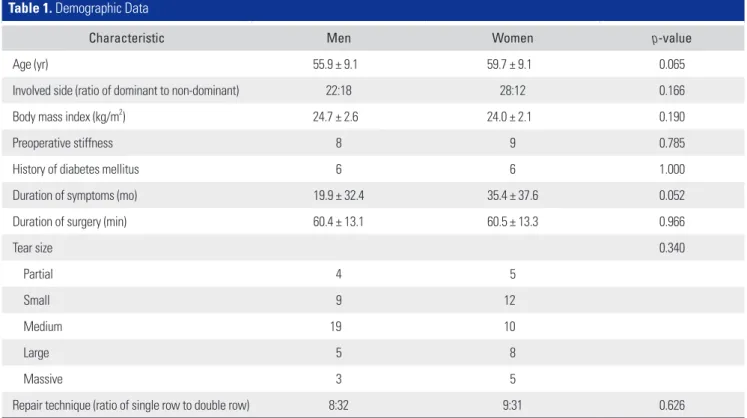
No significant differences were found between the 2 groups with regard to age, involved side, body mass index, preoperative shoulder stiffness, duration of symptoms, tear size, duration of surgery, or repair technique (p > 0.05) (Table 1). Additionally, there were no significant differenc- es between groups in mean preoperative VAS pain scores or ROM (p > 0.05).
All patients had significant improvement in VAS pain score and ROM at 12 months after surgery (p < 0.001).
The mean VAS pain scores from postoperative days 0 to 5 were 6.2, 4.6, 3.6, 3.3, 2.8, and 2.4 for men and 6.4, 4.8, 4.0, 3.2, 3.2, and 2.7 for women. At 2 weeks, 6 weeks, 3 months, 6 months, and 12 months after surgery, the mean scores were 2.4, 2.2, 1.9, 1.5, and 0.8, respectively, for the men and Table 1. Demographic Data
Characteristic Men Women p-value
Age (yr) 55.9 ± 9.1 59.7 ± 9.1 0.065
Involved side (ratio of dominant to non-dominant) 22:18 28:12 0.166
Body mass index (kg/m2) 24.7 ± 2.6 24.0 ± 2.1 0.190
Preoperative stiffness 8 9 0.785
History of diabetes mellitus 6 6 1.000
Duration of symptoms (mo) 19.9 ± 32.4 35.4 ± 37.6 0.052
Duration of surgery (min) 60.4 ± 13.1 60.5 ± 13.3 0.966
Tear size 0.340
Partial 4 5
Small 9 12
Medium 19 10
Large 5 8
Massive 3 5
Repair technique (ratio of single row to double row) 8:32 9:31 0.626
Values are presented as mean ± standard deviation.
Table 2. Comparison of Visual Analog Scale Pain Scores
Time point Men Women p-value
Preoperative 7.0 ± 1.4 7.3 ± 1.8 0.339
Postoperative
Day 0 6.2 ± 2.6 6.4 ± 2.1 0.608
1 day 4.6 ± 1.8 4.8 ± 1.9 0.632
2 day 3.6 ± 1.7 4.0 ± 1.9 0.259
3 day 3.3 ± 1.5 3.2 ± 1.5 0.716
4 day 2.8 ± 1.5 3.2 ± 1.7 0.318
5 day 2.4 ± 1.2 2.7 ± 1.7 0.298
2 wk 2.4 ± 0.9 2.9 ± 1.2 0.035*
6 wk 2.2 ± 1.4 2.7 ± 1.5 0.107
3 mo 1.9 ± 1.6 2.1 ± 1.2 0.580
6 mo 1.5 ± 1.6 1.3 ± 1.3 0.592
12 mo 0.8 ± 1.2 1.3 ± 1.6 0.125
Values are presented as mean ± standard deviation.
*Statistically significant.
Preoperative 10
9 8 7 6 5 4 3 2 1
VASpainscores
0
Men Women
Postoperative
0 day 1 day 2 day 3 day 4 day 5 day 2 wk 6 wk 3 mo 6 mo 12 mo
*
Fig. 1. Pain intensity was measured using visual analog scale (VAS) pain scores on each of the first 5 postoperative days and then at 2 weeks, 6 weeks, 3 months, 6 months, and 12 months after surgery. The mean VAS pain score was significantly higher for women than for men at 2 weeks after surgery (*p = 0.035).
2.9, 2.7, 2.1, 1.3, and 1.3, respectively, for the women. The mean score for the women was significantly higher than the mean for the men at 2 weeks after surgery (p = 0.035).
However, at all other time points, there was no significant difference between the groups (p > 0.05), even though the scores were higher in women than men (Table 2 and Fig. 1).
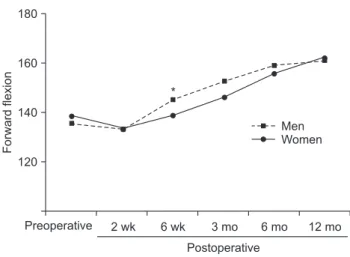
Mean forward flexion at 2 weeks, 6 weeks, 3 months, 6 months, and 12 months after surgery was 132.6°, 144.9°, 152.5°, 159.0°, and 160.8°, respectively, in the men and 132.8°, 138.5°, 145.9°, 156.0°, and 162.4°, respectively, in the women; it was significantly lower (p = 0.033) in the women than in the men at 6 weeks (Table 3 and Fig. 2).
Mean external rotation at 2 weeks, 6 weeks, 3 months, 6 months, and 12 months after surgery was 34.8°, 37.4°, 46.4°, 52.8°, and 57.5°, respectively, in the men and 31.0°, 32.5°, 39.9°, 48.3°, and 55.0°, respectively, in the women;
it was significantly lower in the women than the men at 6 weeks (p = 0.007) and at 3 months (p = 0.017) after sur- gery (Fig. 3).
In evaluating medication-related adverse effects, we found no significant differences between the 2 groups with regard to nausea, vomiting, urinary retention, constipa-
tion, dizziness, urticaria, or headache (p > 0.05) (Table 4).
Postoperative shoulder stiffness at 12 months after sur- gery was present in 2 men (5%) and in 5 women (12.5%), without statistical significance (p > 0.05). No local com- plications, including infection, were encountered in either group.
DISCUSSION
The current study showed that pain and functional recov- ery during the first 3 months after arthroscopic rotator cuff repair is associated with gender. The results were thus supportive of the hypothesis that women have more pain and slower recovery of ROM than men in the early post-
Table 3. Comparison of Shoulder Range of Motion
Time point Men Women p-value
Forward flexion
Preoperative 135.3 ± 25.2 138.0 ± 27.8 0.645 Postoperative
2 wk 132.6 ± 22.3 132.8 ± 26.5 0.982
6 wk 144.9 ± 9.8 138.5 ± 15.8 0.033*
3 mo 152.5 ± 14.1 145.9 ± 19.0 0.081 6 mo 159.0 ± 12.6 156.0 ± 14.0 0.317 12 mo 160.8 ± 20.0 162.4 ± 10.3 0.648 External rotation
Preoperative 37.1 ± 11.8 40.8 ± 13.7 0.208 Postoperative
2 wk 34.8 ± 9.9 31.0 ± 12.2 0.135
6 wk 37.4 ± 7.0 32.5 ± 8.6 0.007*
3 mo 46.4 ± 11.7 39.9 ± 12.2 0.017*
6 mo 52.8 ± 10.5 48.3 ± 11.5 0.072
12 mo 57.5 ± 10.5 55.0 ± 7.9 0.233
Values are presented as mean ± standard deviation.
*Statistically significant.
180
160
140
120
Forwardflexion
Men Women
Preoperative
Postoperative
2 wk 6 wk 3 mo 6 mo 12 mo
*
Fig. 2. Forward flexion was measured at 2 weeks, 6 weeks, 3 months, 6 months, and 12 months after surgery and was significantly lower for women than for men at 6 weeks (*p = 0.033).
80
60
40
20
Externalrotation
0
Men Women
*
*
Preoperative
Postoperative
2 wk 6 wk 3 mo 6 mo 12 mo
Fig. 3. External rotation was measured at 2 weeks, 6 weeks, 3 months, 6 months, and 12 months after surgery. Mean postoperative external rotation was significantly lower for women than for men at 6 weeks (*p = 0.007) and at 3 months (*p = 0.017).
operative period.
The goal of rotator cuff repair is to improve patients’
quality of life by reducing pain and enhancing shoulder function.5) Numerous short-term to midterm follow-up studies have demonstrated excellent clinical outcomes after arthroscopic rotator cuff repair.1-3) Appropriate peri- operative and postoperative pain management for patients undergoing rotator cuff repair is considered a major issue that can influence the effectiveness of treatment and reha- bilitation in the early postoperative period.21,22) Further- more, it is an important measure for judging postoperative satisfaction with rotator cuff repair.
Age, gender, duration of symptoms, preoperative stiffness, working status, workers’ compensation claims, tear size, and tendon quality are reportedly associated with clinical outcomes after rotator cuff repair.1-8) Of these pa- rameters, age and tear size are considered the most impor- tant prognostic factors influencing clinical and anatomical outcomes,4,5,18) whereas the effects of gender on clinical outcomes has received little attention. However, the impact of gender on pain perception and analgesic response is increasingly being studied.10,12) Women have a lower pain threshold and less tolerance for experimental and postop- erative pain than men.11,13,15,16) Some evidence suggests that responses to treatment may differ between women and men.11,15,23)
Only a limited number of studies have investigated the relationship between gender and clinical outcomes of rotator cuff repair.1-4,6-8,14,17,18) Several authors have sug-
gested that women have poorer clinical outcomes than men,1-4,6,7,14) but others have reported that gender does not influence clinical outcomes.17,20) Charousset et al.1) evaluat- ed 104 patients (53 men and 61 women) with arthroscopic rotator cuff repair and reported that female gender is a negative predictive factor for clinical results at a minimum of 2 years after surgery. Oh et al.4) evaluated 78 patients (39 men and 39 women) with rotator cuff repair and reported that women had lower Simple Shoulder Test scores after a mean final follow-up period of 19.6 months, but they found no significant difference in the American Shoulder and Elbow Surgeons scores between men and women.
Meanwhile, O'Holleran et al.20) reported that in 216 men and 95 women, gender was not a significant determinant of clinical outcomes and satisfaction after rotator cuff surgery. In addition, Feng et al.19) evaluated 1,120 shoul- ders (872 men and 248 women) after the procedure and reported that gender was not correlated with postoperative clinical outcome after a mean final follow-up period of 7.9 years. Surprisingly, Watson and Sonnabend8) reported that of the 667 patients who underwent open rotator cuff re- pair, men had less satisfactory clinical results than women after a mean final follow-up period of 3.8 years. Overall, previous studies did not produce consistent findings on the impact of gender on recovery from rotator cuff repair.
Razmjou et al.14) conducted a prospective longitu- dinal study to determine the overall gender-related differ- ences in disability at 6 months after rotator cuff surgery.
They documented that women have higher levels of post- operative disability than men, which is similar to the find- ings for our study. In the current study, women had higher VAS pain scores than men at 2 weeks after surgery, but although the women’s scores were higher for all other pe- riods, the difference was not statistically significant. Also, our study showed that compared with men, women had significantly less forward flexion at 6 weeks and signifi- cantly less external rotation at both 6 weeks and 3 months after surgery. These results indicated that the women in the current study had more pain or slower recovery of shoulder motion than men during the first 3 months.
Most previous studies comparing gender-related differences in clinical outcomes of rotator cuff repair were retrospective in nature. Furthermore, they focused on clinical outcome alone at final follow-up examination, and provided no evidence of gender-related differences in the early postoperative period. The main limitation of these investigations was that gender-related differences were not the primary outcome. The strengths of our study were its prospective design and primary research focus of gender- related differences. To our knowledge, this was the first Table 4. Comparison of Medication-Related Adverse Effects and
Postoperative Complications
Adverse effect Men Women p-value
Medication-related adverse effects
Nausea 6 (15.0) 13 (32.5) 0.066
Vomiting 0 5 (12.5) 0.055
Urinary retention 4 (10.0) 2 (5.0) 0.675
Constipation 6 (15.0) 13 (32.5) 0.066
Dizziness 2 (5.0) 5 (12.5) 0.205
Urticaria 1 (2.5) 2 (5.0) 1.000
Headache 1 (2.5) 2 (5.0) 1.000
Postoperative stiffness 2 (5.0) 5 (12.5) 0.205
Postoperative infection 0 0 1.000
Values are presented as number (%).
study to compare gender-related differences with respect to pain intensity and functional recovery in the periopera- tive and short-term postoperative periods.
Several studies have shown that the incidence of medication-related adverse effects, including nausea and vomiting, for postoperative analgesia is higher in women than in men.11,12) Although such adverse events were not statistically significant, possibly due to the small study cohort, we observed gender differences with respect to nausea (15.0% men vs. 32.5% women), vomiting (0% vs.
12.5%), and constipation (15.0% vs. 32.5%). The reported incidence of postoperative shoulder stiffness after arthroscop- ic rotator cuff repair ranges from 3.3% to 16.7%.24-28) How- ever, few studies have focused on gender differences with respect to postoperative stiffness. In the current study, postoperative shoulder stiffness was present at 12 months after surgery in 2 men (5%) and 5 women (12.5%), which did not represent a significant difference. Because the cur- rent study had a small sample size and a short follow-up period, the results of medication-related adverse effects and postoperative shoulder stiffness can only be extrapo- lated minimally. Hence, further study is needed to accu- rately evaluate the gender-related differences.
Our study had several limitations. First, sample size was relatively small. Second, only VAS pain scores and ROM were used as indicators of clinical outcome. Because
the study focused on pain intensity and recovery of ROM in the early postoperative period, shoulder-specific out- come measures and recovery of muscle power were not evaluated. Third, the study did not account for potentially confounding variables such as racial or ethnic, cultural, political, or social factors, which prevents a more complete interpretation of the results. Fourth, we did not determine gender-related differences in anatomical outcome because the structural integrity of repaired rotator cuffs was not assessed by ultrasonography or magnetic resonance imag- ing. Thus, further prospective longitudinal research with a large cohort is necessary.
Our results indicated that surgeons should consider gender-related differences when planning rotator cuff repair, because women may need novel and individual- ized regimens for pain management and rehabilitation to improve their comfort after surgery. An approach that considers gender-related differences will enable more suc- cessful clinical outcomes after arthroscopic rotator cuff repair.
CONFLICT OF INTEREST
No potential conflict of interest relevant to this article was reported.
REFERENCES
1. Charousset C, Grimberg J, Duranthon LD, Bellaiche L, Petrover D, Kalra K. The time for functional recovery after arthroscopic rotator cuff repair: correlation with tendon healing controlled by computed tomography arthrography.
Arthroscopy. 2008;24(1):25-33.
2. Chung SW, Park JS, Kim SH, Shin SH, Oh JH. Quality of life after arthroscopic rotator cuff repair: evaluation using SF- 36 and an analysis of affecting clinical factors. Am J Sports Med. 2012;40(3):631-9.
3. Nho SJ, Shindle MK, Adler RS, Warren RF, Altchek DW, MacGillivray JD. Prospective analysis of arthroscopic rota- tor cuff repair: subgroup analysis. J Shoulder Elbow Surg.
2009;18(5):697-704.
4. Oh JH, Kim SH, Ji HM, Jo KH, Bin SW, Gong HS. Prognos- tic factors affecting anatomic outcome of rotator cuff repair and correlation with functional outcome. Arthroscopy.
2009;25(1):30-9.
5. Baysal D, Balyk R, Otto D, Luciak-Corea C, Beaupre L.
Functional outcome and health-related quality of life after surgical repair of full-thickness rotator cuff tear using a
mini-open technique. Am J Sports Med. 2005;33(9):1346- 55.
6. Robinson PM, Wilson J, Dalal S, Parker RA, Norburn P, Roy BR. Rotator cuff repair in patients over 70 years of age: early outcomes and risk factors associated with re-tear. Bone Joint J. 2013;95(2):199-205.
7. Romeo AA, Hang DW, Bach BR Jr, Shott S. Repair of full thickness rotator cuff tears: gender, age, and other factors af- fecting outcome. Clin Orthop Relat Res. 1999;(367):243-55.
8. Watson EM, Sonnabend DH. Outcome of rotator cuff re- pair. J Shoulder Elbow Surg. 2002;11(3):201-11.
9. Aubrun F, Salvi N, Coriat P, Riou B. Sex- and age-related differences in morphine requirements for postoperative pain relief. Anesthesiology. 2005;103(1):156-60.
10. Cepeda MS, Carr DB. Women experience more pain and require more morphine than men to achieve a similar de- gree of analgesia. Anesth Analg. 2003;97(5):1464-8.
11. Fillingim RB, King CD, Ribeiro-Dasilva MC, Rahim-
Williams B, Riley JL 3rd. Sex, gender, and pain: a review of recent clinical and experimental findings. J Pain.
2009;10(5):447-85.
12. Schnabel A, Poepping DM, Gerss J, Zahn PK, Pogatzki-Zahn EM. Sex-related differences of patient-controlled epidural analgesia for postoperative pain. Pain. 2012;153(1):238-44.
13. Taenzer AH, Clark C, Curry CS. Gender affects report of pain and function after arthroscopic anterior cruciate liga- ment reconstruction. Anesthesiology. 2000;93(3):670-5.
14. Razmjou H, Davis AM, Jaglal SB, Holtby R, Richards RR.
Disability and satisfaction after rotator cuff decompression or repair: a sex and gender analysis. BMC Musculoskelet Disord. 2011;12:66.
15. Ochroch EA, Gottschalk A, Troxel AB, Farrar JT. Women suffer more short and long-term pain than men after major thoracotomy. Clin J Pain. 2006;22(5):491-8.
16. Rosseland LA, Stubhaug A. Gender is a confounding factor in pain trials: women report more pain than men after ar- throscopic surgery. Pain. 2004;112(3):248-53.
17. Bennett WF. Arthroscopic repair of full-thickness supraspi- natus tears (small-to-medium): a prospective study with 2- to 4-year follow-up. Arthroscopy. 2003;19(3):249-56.
18. Manaka T, Ito Y, Matsumoto I, Takaoka K, Nakamura H.
Functional recovery period after arthroscopic rotator cuff repair: is it predictable before surgery? Clin Orthop Relat Res. 2011;469(6):1660-6.
19. Feng S, Guo S, Nobuhara K, Hashimoto J, Mimori K. Prog- nostic indicators for outcome following rotator cuff tear repair. J Orthop Surg (Hong Kong). 2003;11(2):110-6.
20. O'Holleran JD, Kocher MS, Horan MP, Briggs KK, Hawkins RJ. Determinants of patient satisfaction with outcome after rotator cuff surgery. J Bone Joint Surg Am. 2005;87(1):121-6.
21. Cho CH, Song KS, Min BW, et al. Multimodal approach to postoperative pain control in patients undergoing ro- tator cuff repair. Knee Surg Sports Traumatol Arthrosc.
2011;19(10):1744-8.
22. Oh JH, Rhee KY, Kim SH, Lee PB, Lee JW, Lee SJ. Compari- son of analgesic efficacy between single interscalene block combined with a continuous intra-bursal infusion of ropiva- caine and continuous interscalene block after arthroscopic rotator cuff repair. Clin Orthop Surg. 2009;1(1):48-53.
23. Kamath AF, O'Connor MI. Breakout session: gender and ethnic disparities in pain management. Clin Orthop Relat Res. 2011;469(7):1962-6.
24. Cho CH, Song KS, Jung GH, Lee YK, Shin HK. Early post- operative outcomes between arthroscopic and mini-open repair for rotator cuff tears. Orthopedics. 2012;35(9):e1347- 52.
25. Chung SW, Huong CB, Kim SH, Oh JH. Shoulder stiffness after rotator cuff repair: risk factors and influence on out- come. Arthroscopy. 2013;29(2):290-300.
26. Denard PJ, Ladermann A, Burkhart SS. Prevention and management of stiffness after arthroscopic rotator cuff repair: systematic review and implications for rotator cuff healing. Arthroscopy. 2011;27(6):842-8.
27. Oh CH, Oh JH, Kim SH, Cho JH, Yoon JP, Kim JY. Effec- tiveness of subacromial anti-adhesive agent injection after arthroscopic rotator cuff repair: prospective randomized comparison study. Clin Orthop Surg. 2011;3(1):55-61.
28. Oh JH, Kim SH, Lee HK, Jo KH, Bin SW, Gong HS. Moder- ate preoperative shoulder stiffness does not alter the clinical outcome of rotator cuff repair with arthroscopic release and manipulation. Arthroscopy. 2008;24(9):983-91.