• 검색 결과가 없습니다.

Korean Medical Therapy for Knee Pain after Anterior Cruciate Ligament Reconstruction

N/A
N/A
Protected

Academic year: 2021

Share "Korean Medical Therapy for Knee Pain after Anterior Cruciate Ligament Reconstruction"

Copied!
13
0
0

로드 중.... (전체 텍스트 보기)

전체 글

(1)

Korean Medical Therapy for Knee Pain after Anterior Cruciate Ligament Reconstruction

Hye Ryeon Kim

1

, Yu Na Choi

1

, Seon Hye Kim

1

, Ha Ra Kang

1

, Yoon Joo Lee

2

, Chan Yung Jung

1

, Hyun Seok Cho

1

, Kyung Ho Kim

1

, Kap Sung Kim

1

, Eun Jung Kim

1,*

1

Dep. of Acupuncture & Moxibustion Medicine, College of Oriental Medicine, Dongguk University

2

Dept. of Acupuncture & Moxibustion Meridian & Acupoint, College of Korean Medicine, Dong-Eui University

[Abstract]

Objectives : TheaimofthisstudywastoreporttheeffectofKoreanmedicaltherapyonpain anddysfunctionafteranteriorcruciateligament(ACL)reconstruction.

Methods : A25-year-oldmanexperiencedseverepainafterrightACLreconstructionsurgery.

HereceivedKoreanmedicaltreatmentssuchasacupuncture,herbalmedicine,andphysio- therapyfromJuly10,2014toAugust2,2014.

Results : Afterthetreatments,hisvisualanaloguescalescoresgenerallydecreasedandthe rangeofmotionoftherightkneeimprovedfrom0°to90°.Furthermore,theKneeInfuryand OsteoarthritisOutcomeScoreincreasedfrom99to142.

Conclusion : ThefindingssuggestthatKoreanmedicaltreatmentsmightbeeffectivelyusedto treatpainanddysfunctionaftersoft-tissuesurgeriessuchasACLreconstruction.Neverthe- less,furtherresearchiswarrantedbecauseofthelimitedsamplesizeofthisstudy.

✱ Correspondingauthor:DepartmentofAcupuncture&MoxibustionMedicine,DonggukUniversity BundangOrientalHospital,268,Buljeong-ro,Bundang-gu,Seongnam-si,Gyeonggi-do,463-865, RepublicofKorea

Tel:+82-31-710-3751 E-mail:[email protected] Key words :

Anteriorcruciateliga- ment(ACL);

Acupuncture;

Koreanmedicalther- apy;

Anteriorcruciateliga- mentreconstruction

Received : 2017. 02. 02.

Revised : 2017. 02. 06.

Accepted : 2017. 02. 07.

On-line : 2017. 02. 20.

ThisisanOpen-AccessarticledistributedunderthetermsoftheCreativeCommonsAttributionNon-CommercialLicense(http://creativecommons.org/licenses/by- nc/3.0)whichpermitsunrestrictednon-commercialuse,distribution,andreproductioninanymedium,providedtheoriginalworkisproperlycited.

TheAcupuncture istheJournalofKoreanAcupuncture&MoxibustionMedicineSociety.(http://www.TheAcupuncture.org)

Copyright2017KAMMS.KoreanAcupuncture&MoxibustionMedicineSociety.Allrightsreserved.

(2)

I. Introduction

The number of knee joint surgeries being per- formed has increased at a rapid pace. According to the National Health Insurance Service, 54,097 knee joint surgeries were performed in 2009, and this was more than double the number of surgeries (25,414) performed 4 years ago in 2005

1)

. This in- crease may be attributed to an increase in the number of degenerative osteoarthritis cases

2)

, the number of people playing sports, the elderly popu- lation, and the frequency of knee injuries.

The increase in the number of surgeries has also resulted in an increase in the number of Korean medicinal approaches for pain control and man- agement

3)

. However, only a few studies have inves- tigated pain control and management after knee replacementsurgeryorsoft- tissuereconstruction.

Research on pain control after surgery has been lacking. In contrast, many studies have found that acupuncture is effecitve in controlling the pain causedbydegenerativekneeosteoarthritis

4)

, more- over, conservative treatment has been proven ef- fective for knee ligament injuries

5)

.

In the case of reconstruction of soft tissues such as ligaments and the meniscus, the collagen arrangement is irregular during 3 to 6 weeks after the surgery. Moreover, the tensile strength of these structures is weakened to 6.8% of the original structures

6)

. Therefore, pain control after surgery and functional care are crucial. Previous studies

6)

have shown that histological structures and blood vessels do not regain their original func- tion until the first year after surgery, and the bio- logical remodeling process may take from 9 months to 3 years or more. Thus, Korean medical treatment may be more effective to ensure proper knee function and to strengthen the weakened knee ligaments during the recovery period. We re- port a case of treatment based on Korean medicine that helped in pain control and functional im- provementofthekneeofapatientwhocomplained of persistent pain after anterior cruciate ligament

(ACL) reconstruction. In addition, we review articles on the use of Korean medical therapy after soft-tissue injuries.

II. Case

1.Subject

A 25-year-old man who had right ACL complete tear was admitted at Dongguk university bundang Oriental Hospital from July 10, 2014 to August 2, 2014.

2.Chief Complaint

Difficulty performing flexion or extension of the right knee, pain and swelling - Right. ACL com- plete tear

3.Onset Date

June 5, 2014.

4.Past Medical and Social History

No anomaly

Occupation: Undergraduate Smoking and alcohol use: None

5.Present Illness

The patient fell down, while playing soccer on ,

June 5, 2014. He underwent right knee plain radi-

ography and MRI at Chungbuk National University

Hospital. He was diagnosed as having right ACL

complete tear, which necessitated surgical treat-

ment. However, arthroscopic right ACL recon-

(3)

struction was performed at Dongguk university bundang Hospital on June 27, 2014. The patient was hospitalized for 7 days after the surgery. The knee pain worsened during recuperation after hos- pital discharge. Therefore, the patient sought Ko- rean medical treatment, and he was admitted to the hospital through the departments of acupunc- ture and moxibustion.

6.First Medical Examination Results

# Difficulty performing flexion or extension of the right knee, pain, and swelling

1)Location:redness and swelling

Severe edema, heat sensation when palpated on the right knee, and flare all over the right knee

2)Range of motion(ROM)

Active ROM flexion: 0°

Negative ROM (fixation of the thigh with both hands) flexion: 45°

3)Claudication

The patient experienced severe pain during or- thostatic posture with a knee brace and could not walk independently.

4)Severity

Knee Injury and Osteoarthritis Outcome Score (KOOS), 99; visual analogue scale (VAS) score, 6

The patient experienced an intense, aching pain and heat sensation, especially at night.

5)General condition

(1) Sleep pattern: maintaining light sleep from 12 A.M. to 8 A.M. because of pain.

(2) Dietary state: originally eupepsia (one bowl of rice per meal). His appetite had decreased after surgery (between a-one-half and one bowl of rice per meal).

(3) Urination: favorable

(4) Defecation: once a day, normal stool and fa-

vorable

(5) Thirst: usually drinking more than average and preference for cold water

(6) Sweating: usually sweating more than aver- age all over the body

(7) Tongue assessment: red tongue and slightly yellow tongue coating

(8) Radial pulse assessment: relaxed pulse (緩脈)

7.Physical and medical examination findings

1)Radiology

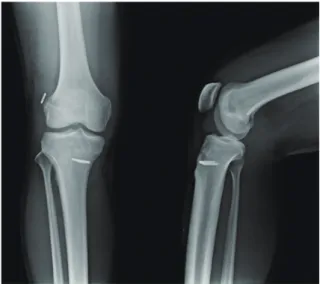
- Right knee MRI (2014/6/5) (Fig. 1)

Replacement of the normal striated appearance by a cloud-like high signal intensity

Discontinuity of the ligament and fibers, which were not parallel to the intercondylar roof

- Rightkneeplainradiography(2014/7/10) (Fig. 2) Postoperative clip

2)Physical examination

ROM flexion active, 0°; passive, 45°

extension active, 0°; passive, 20°

Apley compression test, uncheckable

Fig.1.Sagittalimageofrightknee(2014/6/5)

(4)

Apley distraction test, uncheckable Mcmurray test, uncheckable Abduction stress test, uncheckable Adduction stress test, uncheckable Dreyer’stest, uncheckable Drawer’ssign, uncheckable Patella grinding test, uncheckable Patella apprehension test, uncheckable

* Special test : unchecked because of pain

3)Blood test

ALT 91↑ CRP 105.1↑ Hb 12.9↓ Hct 39.3↓

Monocyte 12.7↑ ESR 50↑

4)Vital signs

Blood pressure, 140/100mmHg; heart rate, 87 beats/min; respiration, 20 breaths/min; tempera- ture, 36.7℃; BST, 101 mg/dl

8.Interventions 1)Acupuncture

Acupuncture was applied twice a day. The patient was treated at six acupoints on the unaf- fected side, Dadu (大都, SP02), Shaofu (少府, HT08), Jiexi (解谿, ST41), Qulinqi (足臨泣, GB41), Xiaxi (俠

谿, GB43) and Zutonggu (足通谷, BL66), by using the one-insertion method (單刺法) in the morning.

The needles were disposable stainless steel needles 0.30 mmindiameterand0.40 mminlength(Dong- bang Acupuncture Inc., South Korea). Meanwhile, in the afternoon, acupuncture was applied at Weizhong (委中, BL40), Liangqiu (梁丘, ST34), Xue- hai (血海, SP10), Yinshi (陰市, ST33), Jimen (箕門, SP11) and Biguan (脾關, ST31), by using with dis- posable stainless steel needles 0.35mm in diameter and 60mm in length (Dongbang Acupuncture Inc.) together with electrical stimulation (Es-160, ITO Co, Japan) at 1.5 V and 4 Hz at a constant mode for 15 min.

2)Medication

Modified Danggwijeomtong-Tang was prescribed from July 9, 2014, the first day of admission, to August 2, 2014 (Table 1). During hospitalization, the patient was given 80 cc of the medicine 30 min after each meal three times a day.

Fig.2.RightkneeAP&latX-ray(2014/7/10)

Table 1. TheCompositionofModifiedDanggwijeom- tong-Tang

Name of Herb Weight per Pack

(g)

茵蔯(Artemisia capillaris) 2

苦蔘(Sophora flavescens) 1

當歸(Angelica gigas) 1

知母(Anemarrhena asphodeloides) 1

猪笭(Polyporus umbellatus) 1

白朮(Atractylodes japonica) 1

葛根(Pueraria lobata) 1

蒼朮(Atractylodes japonica) 1

人蔘(Panax ginseng) 1

白茯笭(Poria cocos) 1

升麻(Cimicifuga acerina) 1

黃芩(Scutellaria baicalensis) 2

澤瀉(Alisma canaliculatum) 1

羌活(Angelica koreana) 2

防己(Sinomenium acutum) 1

甘草(Glycyrrhiza uralensis) 2

(5)

3)Physiotherapy

Quadriceps setting exercise (QSE) was prescribed to make the patient exercise voluntarily during any spare time. Rehabilitation treatment was performed from July 21 to August 2, 2014, and included transcutaneous electrical nerve stimula- tion, interferential current therapy (ICT), physio- therapy, cryotherapyandrehabilitativemanipulation.

9.Outcome Measures 1)VAS

7)

The VAS was used for evaluating the degree of pain. VAS is a measurement instrument for indi- cating the subjective level of pain by using a con- tinuous horizontal line. The patient indicated his degree of pain by marking a point on the 100 mm long line, with 0mm, indicating“no pain” and 100mm, indicating“the worst pain he could imag- ine”. The VAS score was measured as the point marked by the patient.

2)KOOS

8)

The KOOS was developed and validated by Roos Ewa M., Professor at the Department of Or- thopaedics, Lund University, Sweden, in 1998, as an assessment tool, which was an improvement over The Western Ontario and McMaster Universi- ties Osteoarthritis Index (WOMAC), for evaluating knee injuries and osteoarthritis after a trauma.

This instrument has been used for assessing vari- ous forms of acute knee injuries, such as ACL re- construction, meniscus injury, and post-traumatic osteoarthritis in young and physically active pa- tients aged between 14 and 78 years. It is an appro- priate assessment tool to monitor the chronic consequences of various combinations of knee in- juries, considering the process of osteoarthritis. In particular, questionnaires were designed to in- crease the sensitivity to traumatic arthritis by ex- amining five different subscales. In Western countries, the validity, reliability, and responsive- ness of KOOS have been verified through various

processes, and it is being used as a clinical meas- urement instrument. It is considered a more im- proved method than WOMAC. In Korea, similar results have been reported on the validity, reliabil- ity, and responsiveness of the Korean version of the KOOS.

9)

The KOOS consists of five subscales and 42 questions used to assess the function of the pa- tients’ knee and associated problems. These include symptoms and stiffness (seven questions), pain (five questions), activities of daily living (17 ques- tions), sport and recreation function (five questions) and knee-related quality of life (four questions).

The questionnaire evaluats the patient’s status during the past week. The patient fills out the questionnaire, and it requires about 5 to 10 min to complete.

The response options for each question are given on a 5-point Likert scale (0=none, 1=mild, 2=mod- erate, 3=severe, and 4=extreme). The raw score in the assessment instrument is in the range of 0-168 points, and a lower score indicates a healthier sta- tus. However, forconvenience, aconvertedscoreis used in which each subscale has a range of 0-100 points, andahigherscoreindicatesabetterquality of life.

10.Treatment Progress 1)At the time of admission

At the time of admission, the patient was unable

to bend his right knee. After the thigh was fixed

with both hands, a passive flexion of 45° was pos-

sible. Active extension was impossible to perform

and only passive extension was possible. The pa-

tient experienced severe pain when standing with

a knee brace on and was unable to walk independ-

ently. In addition, when the right knee was pal-

pated, swelling, fever, and redness were very

severe, and he complained of a severe aching pain

and heat sensation at night. The KOOS (total) was

99, and the VAS score was 6.

(6)

2)Thefirstweekoftreatment

(fromJuly10,2014toJuly17,2014)

(1) Active flexion was possible up to 30-40°, and the pain improved by 40% when standing with a knee brace on.

(2) The severity of the most uncomfortable, achingpainatnightwasreducedby50%. Pre- viously prescribed analgesics, such as Para- macet and Pelubi tablets (both were antipyretic, analgesic, and anti-inflamma- tory), were taken when pain occurred, disre- garding recommended usage. The average daily dose of five to six times a day was re- duced to three times a day.

(3) Based on the patient’s self-evaluation, the flare from the right knee to the thigh im- proved by 30%, and the heat sensation im- proved by 20%.

(4) The KOOS (total) was 94, and the VAS score was 3.

3)The second week of treatment (from July 15,2014to July 24,2014)

(1) Active flexion was restored to 85°, and the pain experienced during flexion improved.

The patient was able to walk with a knee brace and performed rehabilitation exercises from July 21.

(2) The aching pain at night disappeared, but a dull and stiff pain remained. The patient started walking independently with the exist- ing knee brace. The pain was slightly im- proved. Therefore, the usage of Pelubi tablets

was decreased to one tablet twice a day.

(3) Flare evaluated by the patient was improved by 60%, and the heat sensation was reduced by 50%.

(4) The KOOS (total) was 109, and the VAS score was 2.

4)The third week of treatment

(from July 25,2014to August 2,2014)

(1) Active flexion improved to 90° and there was almost no pain. However, the patient com- plained of stiff pain for 1 to 2 h after the reha- bilitation exercises.

(2) Stiff pain at night was improved by 90% and almost never felt. The average daily dose of Pelubi tablets was reduced to tone tablet a day, taking it every time he had pain.

(3) Flare disappeared and 90% of the heat sensa- tion was lost.

(4) The KOOS Score was 142, and the VAS score was 2.

Fig.3.ChangeofVisualAnalogueScale(VAS)of rightkneepain

Table 2. ChangeintheKneeInjuryandOsteoarthritisOutcomeScore(KOOS)oftheRightKnee Subscale

Date KOOS

Pain KOOS Symptom &

stiffness KOOS

ADL

*

KOOS Sport &Recreation

function KOOS

QOL

Total

7/10 25 39 29 0 6 99

7/17 36 39 19 0 0 94

7/24 39 36 28 0 6 109

7/31 50 36 43 0 13 142

* ADL: Activities of Daily Living.

†QOL: Quality of Life.

(7)

11.Literature search

In order to investigate previous studies on Korean medical treatment after soft- tissue sur- gery, we conducted a literature search of all papers published in Korea and overseas from the date of publication of each database up to January 1, 2017.

The search for English papers was conducted using two databases, PubMed (www.pubmed.com) and the Cochrane Library (www.cochranelibrary.

com). The Korean papers were searched using the Korean Studies Information Service System ( kiss.

kstudy.com), Oasis (oasis.kiom.re.kr), and Korea Education and Research Information Service (www.riss.kr).

Korean and English were used as the search lan- guages. In Korean, the search was performed using the keywords“침”, “침술”, “무릎 OR 인대 OR 반 월판”, and related search keywords; moreover“재 활” and“수술” were combined and searched for. In English, the following search expressions were used.

#1. Acupuncture[mh]

#2. Acup*[tiab]

#3. (#1 OR #2)

#4. knee[tiab]

#5. knee joint

#6. anterior cruciate ligament

#7. menisci

#8. collateral ligament

#9. patella ligament

#10. (#4 OR #5 OR #6 OR #7 OR #8 OR #9)

#11. ligament reconstruction

#12. post surgical pain

#13. rehabilitation

#14. (#11 OR #12 OR #13)

#15. (#3 AND #10 AND #14)

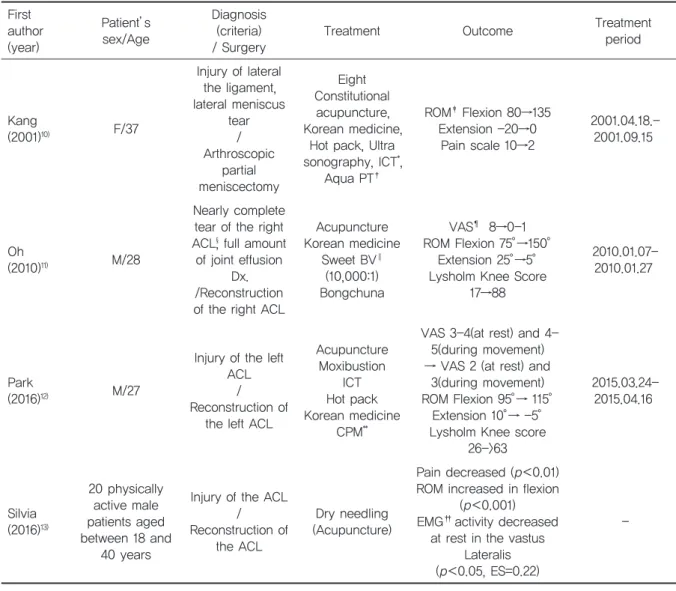
The searches yielded 554 papers from abroad and 111 Korean papers. Through the review of the titles, abstracts, and, if possible, the original texts of these papers, we first identified three relevant papers from Korea and nine from abroad. Eleven of these papers were case reports, and one was a

Fig.4.Flowchartofinclusionstudies

(8)

randomized controlled trial. All three Korean pa- pers and five from abroad were included in our analysis. These studies described the treatment and management after ACL reconstruction or meniscectomy, excluding three studies on total knee arthroplasty and one on fracture surgery be- sides soft-tissue surgery. Six of the eight papers were finally selected, three from Korea

10-12)

and three from abroad

13-15)

, excluding two papers whose

main articles could not be found (Tables 3 and 4).

According to Kang et al.

10)

(2010), eight constitu- tional acupuncture was applied in a patient with persistent pain after meniscal surgery. Compared with body acupuncture, the eight constitutional acupuncture resulted an improvement in myofas- cial pain syndrome, pain intensity, recurrence, and ROM.

Oh et al.

11)

(2010) reported two cases of treatment

Table 3. SummaryofStudiesIncludedinAnalysis(CaseReports) First

author (year)

Patient’s sex/Age

Diagnosis (criteria) / Surgery

Treatment Outcome Treatment

period

Kang

(2001)

10)

F/37

Injury of lateral the ligament, lateral meniscus

tear / Arthroscopic

partial meniscectomy

Eight Constitutional acupuncture, Korean medicine,

Hot pack, Ultra sonography, ICT

*

,

Aqua PT

ROM

Flexion 80→135 Extension -20→0

Pain scale 10→2

2001.04.18.- 2001.09.15

Oh

(2010)

11)

M/28

Nearly complete tear of the right ACL

§

, full amount

of joint effusion Dx.

/Reconstruction of the right ACL

Acupuncture Korean medicine

Sweet BV

(10,000:1) Bongchuna

VAS

8→0-1 ROM Flexion 75°→150°

Extension 25°→5°

Lysholm Knee Score 17→88

2010.01.07- 2010.01.27

Park

(2016)

12)

M/27

Injury of the left ACL

/ Reconstruction of

the left ACL

Acupuncture Moxibustion

ICT Hot pack Korean medicine

CPM

**

VAS 3-4(at rest) and 4- 5(during movement)

→ VAS 2 (at rest) and 3(during movement) ROM Flexion 95°→ 115°

Extension 10°→ -5°

Lysholm Knee score 26->63

2015.03.24- 2015.04.16

Silvia (2016)

13)

20 physically active male patients aged between 18 and

40 years

Injury of the ACL / Reconstruction of

the ACL

Dry needling (Acupuncture)

Pain decreased (p<0.01) ROM increased in flexion

(p<0.001) EMG

††

activity decreased

at rest in the vastus Lateralis (p<0.05, ES=0.22)

-

* ICT: Interferential Current Therapy.

†PT: Physiotherapy.

‡ROM: Range of Motion.

§ACL: Anterior Cruciate Ligament.

∥BV: Bee Venom.

¶VAS: Visual Analogue Scale.

** CPM: Continuous Passive Motion.

† †EMG: Electromyography.

(9)

based on Korean medicine for ACL rupture. One of the patients complained of persistent pain even after ACL reconstruction. This patient was treated with acupuncture twice a day, 30 times, at Damjeonggyeok (Sa-am Gallbladder Tonification) oftheunaffectedsidewithSanyinjiao(三陰交, SP6), Weizhong (委中, BL40), Xiyan (膝眼, EX17), Zusanli (足三里, ST36), Yanglingquan (陽陵泉, GB34), Xue- hai (血海, SP10) and Liangqiu (梁丘, ST34) of the af- fected side. Approximately 0.2 cc of sweet bee venom per day was injected at a ratio of 100,000: 1.

In addition, Gamijihwang-tang was administered in combination with Bongchuna, and the treatment showed significant effects on the index of VAS, ROM, and Lysholm score.

In another study, Park et al.

12)

(2016), reported the case of a 27-year-old man with persistent pain afterACLreconstruction. Hereceivedacupuncture twice daily at Dubi (犢鼻, ST35), Chengshan (承山, BL57), Xuehai (血海, SP10), and Yanglingquan (陽陵 泉, GB34), and wasa treated with continuous pas- sive motion twice daily for 20 min. In addition, in- direct moxibustion, ICT, hotpack, and herbal medication were performed concurrently. The treatments were proven to have significant efficacy in terms of parameters such as the VAS, ROM, and Lysholm score.

Silvia et al.

13)

(2016) applied electroacupuncture to 20 patients who underwent ACL reconstruction but had with persistent pain and incomplete ROM.

After electroacupuncture stimulation, pain in the knee decreased and electromyographic(EMG)

changes in the vastus lateralis and vastus medialis muscles were observed.

In a study conducted by Nikiforos et al.

14)

(2009), a 62-year-old woman who had complained of chronic pain after meniscal resection was treated with 2-week electroacupuncture. After this, the level of subjective pain experienced by the patient decreased.

Liang

15)

(2006) conducted a randomized controlled trial that included 32 patients who un- derwentACLreconstruction, andwhoweredivided into two groups of 16 patients each. One group re- ceived rehabilitation treatment and acupuncture, and the other group received only rehabilitation.

The patients who received the combination of herbal medication and acupuncture showed less pain and swelling than did the patients who re- ceived only rehabilitation.

Ⅲ. Discussion

The number of knee surgeries being performed has increased and the use of Korean medicinal ap- proach for the control and management of pain after various surgeries has been increasing. How- ever, only a few studies have investigated the pa- tient’s pain control and management after soft tissue reconstruction. We reported a case in which Korean medicinal treatment was applied after Table 4. SummaryofStudyIncludedinAnalysis(RandomizedControlledTrial)

First author (year)

Sample size Sex(M/F)

Mean

Diagnosis (criteria)

Intervention group(regimen)

Control group(regime

n)

Main outcomes

Intergroup differences

Liang (2006)

14)

32 inpatients (19 males and

13 females)

Injuries of the anterior cruciate

ligament / anterior cruciate

ligament reconstruction

(A) TCM

*

(acupuncture)

combining rehabilitation

training (n=16)

(B) only rehabilitation

(n=16)

Pain level ROM Knee joint

function

p<0.05

* TCM: Traditional Chinese Medicine.

(10)

knee surgery and conducted a literature review on this subject.

Our literature search yielded six reference arti- cles, including Liang’s article

15)

from 2006, which was a randomized controlled trial, and five other case reports. Among them, they included a maxi- mum of two cases per study except Silvia’s research that included 20 cases. Further studies shouldincludemanymorecasestodrawmoresolid conclusions.

In each study, several instruments were used as an index to evaluate the recovery of patients. VAS, which is an objective pain index, and ROM were the most commonly used indexex, as in the current study.

In addition, studies by Oh et al.

11)

(2010) and Park et al.

12)

(2016) used the Lysholm score to assess knee ligament function. The Lysholm score consists of eight questions on pain, swelling, limp- ness, squatting, instability, support, stair- climbing and locking. Of the total score of 100, pain and instability account for 25 points each

16)

. EMGs were performed in a study by Silvia et al.

13)

(2016) to evaluate the strength of the weakened quadriceps muscle after ACL reconstruction. In our case, the VAS, ROM, and KOOS were used as the indexes to evaluate the recovery of the patient.

The patient in this study was treated for 7 days after the arthroscopic right ACL reconstruction on June 27, 2014, and was treated after discharge.

However, he continued to experience pain, and his ROM did not recover. He visited the departments of acupuncture and moxibustion because he was unable to walk independently. Afterwards, he was admitted to the hospital and received Korean med- ical treatment from July 10, 2014 to August 2, 2014.

The knee is referred to“肝之合, 膝也”, “腎主骨”

and is closely related to the liver and kidney in Ko- rean medicine theory. According to the theory, the river is responsible for/connected to the muscle and the kidney is responsible for/connected to the bone. When the two organs weaken, pathogenic qi[邪氣] of wind-cold-dampness[風寒濕] invades in the weakened state of the bone and muscle or

blood stasis because of injury, and this results in disturbances in the circulation of qi and blood.

Thus, knee diseases such as 膝痛, 膝中痛, 膝重, 膝外 廉通, 鶴膝風, and 膝痺 occur. These cases are ac- companied by symptoms, such as pain[疼 痛 ], swelling[腫脹], numbness[痲木], joint swelling[關節 腫大] and difficulty in flexion or extension[屈伸不 利], and they are recommended 淸熱, 散寒濕, 强筋骨, 滋陰養血, 補氣血, 補肝腎, 活血去瘀, 補腎將陽, 消腫止 痛 and 溫經通絡 as treatment methods

11)

In this case, the patient was diagnosed with and treated for damp-heat[濕熱] based on severe knee edema and pain at the time of admission, difficulty in flexion or extension, knee joint fixation, and systemic conditions such as heaviness of the body.

Acupuncture was the main treatment method in this case and was performed twice a day, once in the morning and again in the afternoon. In the morning, Dadu (大都, SP02), Shaofu (少府, HT08), Jiexi (解谿, ST41), Qulinqi (足臨泣, GB41), Xiaxi (俠 谿, GB43) and Zutonggu (足通谷, BL66) were se- lected to help improve the circulation of the merid- ians. In the afternoon, Weizhong (委 中 , BL40), Liangqiu (梁丘, ST34), Xuehai (血海, SP10), Yinshi (陰市, ST33), Jimen (箕門, SP11) and Biguan (脾關, ST31) were selected as local acupoints and stimu- lated via electroacupuncture.

In various studies, acupuncture has been known to induce the release of neuropeptides at the nerve endings, thus dilating blood vessels and exerting anti-inflammatory effects

17)18)

. The effect of acupuncture on the proliferation of collagen in the ligament has also been reported

19)

, and we presumed that it was effective in improving the strength of the weakened cruciate ligament.

Danggwijeomtong-Tang, used in this patient, is

a prescription in the Oehyeong chapter of Dongui-

bogam. It is known to cure swelling and pain

caused by beriberi resulting from damp-heat. In

this case, the patient had a well-built physique

and usually experienced heaviness of the body and

sweating more than average. Furthermore, he had

severe swelling and a feeling of heat at the knee at

the time of admission; thus, he was diagnosed as

(11)

having damp-heat[濕熱]. We tried to remove the damp-heat to improve the knee symptoms. In ad- dition, the long-term use of Danggwijeomtong- Tang has been reported to reduce anti-collagen antibody levels and to decrease CRP levels and the ESR

20)

. Therefore, the decreased CRP and ESR and increased collagen level of the patient were ex- pected.

QSE was performed voluntarily for the rapid re- covery of the weakened muscle strength after sur- gery. QSE is an isometric exercise to enhance the strength of the quadriceps muscle, and it is a method to induce isometric contraction by pushing a towel under the knee in a sitting position with the knee extended

21)

. The results of the study showed that the peak torque, peak torque per body weight, maximum repetition total work, average power, and total work showed a statistically signif- icant increase in patients with ACL reconstruction who underwent QSE of the extensor muscle

22)

.

The patient could not perform active movement of the right knee joint and could not walk inde- pendently. In the first week of treatment, active flexion of the right knee joint was possible up to 30-40°, and in the second week, it was restored to 85° and independent walking was possible. The ROM recovered up to 90° of active flexion in the third week of hospitalization.

Pain at the time of admission decreased from VAS score 6 to VAS score 2 in the first week of ad- mission. Thereafter, it decrease steadily, and there was little pain at the time of discharge. Moreover, theflareatthetimeofadmissioncompletelydisap- peared, and the heat sensation decreased by 90%.

The KOOS showed a total score of 99 at the time of admission, but improved to 142 at the time of dis- charge, showing improvements in the evaluation of stiffness, activities of daily living, sports and recreation function as well as pain. With respect to progression, the pain was rapidly recovered from the first week, and other subscales related to func- tion improved by the third week of treatment.

Thus, acupuncture combined with herbal med- ication and physiotherapy was effective in improv-

ing the clinical symptoms of ACL reconstruction.

Although many studies have investigated acupuncture treatments for ligament injuries, only few cases involved the use of Korean medical treatment for post-operative symptoms. Even in those cases, most of the patients experienced symptoms immediately after the surgery. There- fore, the fact that the current patient develped symptoms 1 month after the surgery it is a differ- entiating factor.

In addition, it is significant that the degree of improvement of knee joint function can be assessed using the KOOS, which is an instrument for evaluating knee joint function similar to the ROM and VAS. The KOOS is better for prolonged monitoring than is the Lysholm score, which is usually used in domestic research. Future studies should apply the KOOS in young and active patients and verify its reliability and validity. Fur- thermore, another strength of the KOOS is that it entails a lower possibility of observer bias than does the Lysholm score.

8)

A limitation of this study was that only one case was evaluated, and there was no follow-up after discharge. In addition, acupuncture, the main treatmentinthiscase, aswellasherbalmedication and physiotherapy were combined; therefore, it is difficult to identify the individual effect of acupuncture. Moreover, there is a lack of imaging results such as MRI or plain radiography at dis- charge. Since just one case was reviewed, the pos- sibility of natural progression cannot be excluded.

Accordingly, further studies are warranted on Ko- rean medical treatment for postoperative symptoms in patients undergoing surgery, in order to develop a suitable postoperative treatment pro- tocol.

Ⅳ. References

1. Sohn GY. The effect on the volume of surgical

(12)

procedures by specific characteristics of medical Institutions-In case of spinal and knee surgery[dissertation]. Pocheon: CHAUniversity.

2013. Korean.

2. Koh IJ. Trends in use of total knee arthroplasty in Korea from 2001 to 2010[dis- sertation]. Bucheon: The Catholic University of Korea. 2014. English.

3. Wu MS, Chen KH, Chen IF et al. The Efficacy of Acucpuncture in Post-operative pain man- agement: A systematic Review and Meta- Analysis. PLoS One. 2016;11(3):1932-6203.

4. Kim TY, Kim JH, Park JH et al. The domestic trends of traditional Korean medicine treat- ments on degenerative knee arthritis. The Journal of Korea CHUNA Manual Medicine for Spine & Nerves. 2014;9(2):69-79.

5. Lee ES. Systematic review of clinical study on the effects of acupuncture on injured knee joint soft tissues[dissertation]. Seoul: Dongguk University. 2013. Korean.

6. Lee BK. Rehabilitation after anterior cruciate ligament reconstruction. Journal of Korean Arthroscopy Soc. 2008;12(2):87-90.

7. Lee ES, Oh JY, Yu AM et al. Development of oriental medical rating scale of knee pain and validity assessment. The Acupunct. 2013;30(5):

51-64.

8. Jung CY, Kim EJ, Hwang MS et al. The re- search of pain and functional disability assess- ment scales for knee joint disease. The Acupunct. 2010;27(2);123-42.

9. Seo SS, Chung KC, Kim YB. Assessment of va- lidity, reliability and responsiveness of Korean knee injury and osteoarthritis outcome score(KOOS) for the knee injury. J Korean Or- thop Assoc. 2006;41(3);441-53.

10. Kang YH, Kim SU, Son YS et al. A case report on performing constitutional acupuncture therapies for a case of arthroscopic partial menisectomy. Journal of Dong - Eui Oriental Medicine. 2001;5(0):67-75.

11. Oh WK, Kwon YD, Song YS. Effectiveness of Oriental Medical Therapy and Bongchuna on

Anterior Cruciate Ligament Rupture of Knee, Two Case Reports. JORM. 2010;20(4):241-54.

12. Park CH, Song YK. (The)Clinical Case Report about Postoperative Rehabilitation for the Tear of Anterior Cruciate Ligament Treated with Korean Medical Treatment and Continu- ous Passive Motion. The Jornal of Korea CHUNA Manual medicine for Spine & Nerves.

2016;11(1):97-107.

13. S Ortega-Cebrian, N Luchini, R Whiteley. Dry needling: Effectsonactivationandpassiveme- chanical properties of the quadriceps, pain and range during late stage rehabilitation of ACL reconstructed patients. Phys Ther Sport. 2016;

21:57-62.

14. N Galanis, C Stavraka, T Boutsiadou, JM Kirkos, G Kapetanos. Postoperative pain man- agement and acupuncture: a case report of meniscal cyst excision. Acupunct Med. 2009;

27(2):79-80.

15. Liang Y, Zhang SM, Hu Y et al. Effects of tra- ditional Chinese medicine and rehabilitation training on knee joint function after anterior cruciate ligament reconstruction in arthroscopy. Chineses Journal of Tissue Engi- neering Research. 2006;10(27):6-10.

16. Irrgang JJ, Anderson AF, Boland AL et al. De- velopment and Validation of the International Knee Documentation Committee Subjective Knee Form. Am J Sports Med. 2001;29:600-13.

17. Zijlstra FJ, van den Berg-de Lange I, Huygen FJ, Klein J. Anti-inflammatory actions of acupuncture. Mediators Inflamm. 2003;12(2):

59-69.

18. Kavoussi B, Ross BE, The neuroimmune basis of anti-inflammatory acupuncture, Integr Cancer Ther. 2007;6(3):251-7.

19. Almeida Mdos S, Oliveira LP, Vieira CP, Guerra Fda R, Pimentel ER. Birefringence of collagen fibres in rat calcaneal tendons treated with acupuncture during three phases of heal- ing. Acupunct Med. 2016;34(1):27-32.

20. Lee CH. Effect of Dangguijumtong -tang

(Dangguiniantong-tang) On TypeⅡ Collagen-

(13)

Induced Arthritis[dissertation]. Busan: Dongeui University. 2001. Korean.

21. Choi JC, Han DU. The Effects of Quadriceps Setting Exercise and Electrical Stimulation on Improvement of Quadriceps Muscle Strength.

J Kor Phys Ther. 2001;13(2);273-80.

22. Jang KM, Seo DI, Seo KM, Kim DK. The Use- fulness of Quadriceps Exercise for Improve- ment of Knee Extensor Muscular Function after Cruciate Ligament Reconstruction.

KAPTS. 2009;16(3):29-34.

수치

Table 1. TheCompositionofModifiedDanggwijeom- TheCompositionofModifiedDanggwijeom-tong-Tang
Table 3. SummaryofStudiesIncludedinAnalysis(CaseReports) First  author (year) Patient’s sex/Age Diagnosis(criteria)/ Surgery

참조

관련 문서

8) Jarvela T: Double-bundle versus single-bundle anterior cruciate ligament reconstruction: a prospective, randomize clinical study. Knee Surg Sports Traumatol Arthrosc,

The results were analyzed by pain, joint line tenderness, locking, McMurray test, the Marshall knee scoring scale and complications.. Results: Postoperativeiy two

The clinical results were eval 나 ated by IKDC ligament standard evaluation form, using KT-2000™ knee ligament arthrometer and also evaluated Lysholm knee scorin 응 scale.. Res 비

Marzo JM, Bowen MK, Warren RF, Wickiewicz TL and Altchek DW : Intraarticular fibrous nodule as a cause of loss of extension following anterior cruciate ligament

We evaluated clinical outcomes using such parameters as the IKDC score, Tegner activity score, Lysholm knee score, and arthrometric examination (side­to­side difference), radiologic

standard deviation, CI: confidence interval... assessed clinical parameters, such as the Lysholm knee function score and the Tegner activity score. Furthermore, the previous

In the fixed knee group, knee joint swelling persisted re- gardless of the period of fixation and it was thought that the causes were synovitis developed by immobilization and K-

standard deviation, CI: confidence interval... assessed clinical parameters, such as the Lysholm knee function score and the Tegner activity score. Furthermore, the previous