Introduction
Posterior cruciate ligament (PCL) injuries comprise 3% to 38%
of all acute knee injuries1). As the incidences of PCL injuries increase, various treatment techniques for posterior cruciate liga
ment reconstruction (PCLR) have been developed over the past several years. However, controversy regarding surgical techniques for PCLR still remains.
The PCL is the strongest ligament and acts as a primary re
straint of posterior tibial translation in the knee joint. It consists of an anterolateral (AL) bundle and a posteromedial (PM) bundle. Because of the anatomical structure of the PCL, surgi
cal techniques related to bundle type reconstruction have been the subject of debate among surgeons. Previously, the AL bundle was considered to be associated with linear stiffness and ulti
mate loading compared with the PM bundle2,3); thus, the focus was mainly on reconstruction of the anatomy of the AL bundle.
However, early studies showed its limited efficacy, such as per
sistent postoperative instability, particularly residual posterior laxity in full extension. Although posterior stability is restored in the flexed knee, because the PM bundle is taut in knee exten
sion, laxity remains in knee extension4). Therefore, some authors have suggested that doublebundle (DB) PCLR is superior to singlebundle (SB) PCLR in terms of restoration of posterior laxity of the knee5). Hou et al.6) reported that the results of their study showed that both SB and DB PCLR techniques produced
SingleBundle versus DoubleBundle Posterior
Cruciate Ligament Reconstruction: A MetaAnalysis of Randomized Controlled Trials
DongYeong Lee, MD
1and YoungJin Park, MD
21Department of Orthopaedic Surgery, The Armed Forces Daegu Hospital, Gyeongsan; 2Department of Orthopaedic Surgery, Gyeongsang National University Hospital, Gyeongsang National University School of Medicine, Jinju, Korea
Purpose: This metaanalysis evaluated the benefits of singlebundle (SB) and doublebundle (DB) surgical techniques for posterior cruciate ligament reconstruction (PCLR) in terms of clinical outcomes.
Methods: Five electronic databases were searched for relevant articles published until September 2016. Clinical outcomes of both techniques were evaluated using Lysholm knee function scores, Tegner activity scores, sidetoside differences, and International Knee Docu men ta tion Committee (IKDC) objective grades. The results are presented as a risk ratio (RR) for binary outcomes and a weighted mean difference (WMD) for continuous outcomes with a 95% confidence interval (CI).
Results: Four randomized controlled trials (RCTs) were included. There were no significant differences in the Lysholm knee function scores (WMD=1.63; 95% CI, 0.00 to 3.27; I2=0%), Tegner activity scores (WMD=0.17; 95% CI, –0.08 to 0.43; I2=20%), sidetoside differences (WMD=–0.97;
95% CI, –2.41 to 0.47; I2=78%), and IKDC objective grades (RR=1.18; 95% CI, 1.00 to 1.39; I2=0%) at the final followup.
Conclusions: The present study demonstrates that both SB and DB techniques for PCLR are comparable in terms of restoration of knee stability and improvement of knee function. However, it is still unclear which technique yields better clinical outcomes. To verify and further corroborate our results, more largerscale, highquality RCTs are encouraged.
Keywords: Knee, Posterior cruciate ligament, Reconstruction, Arthroscopy, Meta-analysis pISSN 2234-0726 · eISSN 2234-2451
Knee Surgery & Related Research
Received July 10, 2017; Revised August 27, 2017;
Accepted September 18, 2017
Correspondence to: DongYeong Lee, MD
Department of Orthopaedic Surgery, The Armed Forces Daegu Hospital, 42541 Daegyeongro, Hayangeup, Gyeongsan 38427, Korea
Tel: +82537501777, Fax: +82538540822 Email: [email protected]
246
This is an Open Access article distributed under the terms of the Creative Commons Attribution NonCommercial License (http://creativecommons.org/licenses/bync/4.0/) which permits unrestricted noncommercial use, distribution, and reproduction in any medium, provided the original work is properly cited.
Copyright © 2017 KOREAN KNEE SOCIETY www.jksrr.org
comparable clinical results; thus, the DB PCLR was not recom
mended as the preferred surgical procedure because it requires a longer recovery time and involves more trauma. However, other authors reported that although single AL bundle reconstruction best restored the normal PCL force profiles, laxity was greater than normal in low knee flexion angles. For these reasons, they suggested that additional reconstruction of the PM bundle would reduce laxity in low flexion angles, and DB PCLR would more closely restore the kinematics of the intact knee than SB PCLR79).
The primary goal of surgical interventions for PCL injuries is to restore normal knee stability. Several studies have demon
strated the superiority of DB PCLR to SB PCLR for restoration of anteroposterior (AP) stability and rotatory stability; conversely, others1012) showed no significant difference in knee stability be
tween the two procedures. The purpose of the present study is to perform a metaanalysis to compare the clinical outcomes of PCLRs using the SB and DB techniques under the hypothesis that the two techniques would not be significantly different in all outcome measures. There is only one previous metaanalysis that addresses the same topic we would like to discuss in this study; however, it only included retrospective studies and only 2 randomized controlled trials (RCTs), and parameters, such as sidetoside differences or International Knee Documentation Committee (IKDC) objective grades, were not evaluated in the study. In this study, we did not include retrospective studies to minimize bias and used 4 RCTs to compensate for weaknesses of the previous metaanalysis.
Methods
1. Study Selection
To identify relevant studies, we searched MEDLINE, EMBASE, the Cochrane Central Register of Controlled Trials, Web of Sci
ence, and Scopus databases using the controlled vocabulary and free text words described in Appendix 1. We attempted to iden
tify all relevant studies regardless of language, publication type (journal articles, posters, conference articles, instructional course lectures, etc.), journal title, and publication date. The search was completed in September 2016 and included reference lists of the studies and any review articles identified.
2. Eligibility Criteria
Studies were included if 1) the subjects were patients who un
derwent PCLR using an SB or DB technique, 2) clinical outcomes of SB and DB PCLRs were compared, and 3) clinical outcomes were evaluated with a more than 24 months of followup, and
4) the study design was RCT. NonRCTs, studies that did not compare the effects of surgical techniques, singlearm studies that only described femoral side reconstruction or tibial side reconstruction using an either SB or DB technique, studies that recommended surgical treatment for PCL injuries, in vitro stud
ies, and animal studies were not included in the present study.
Ultimately, 4 RCTs were included in this study, which focused on isolated PCL injury patients on whom either SB or DB PCLR was performed. Regarding posterolateral complex (PLC) injuries, Apsingi et al.13) suggested that isolated PCLR would not be suf
ficient to restore normal rotational laxity in the PCL/PLCinjured knee. Therefore, studies in which isolated PCL reconstructions were performed in the presence of a PLC injury were excluded.
3. Data Collection and Analysis
Two authors (DYL and YJP) independently assessed the titles or abstracts of studies identified by the search strategy, and then full texts were assessed for final inclusion. Uncertainty about in
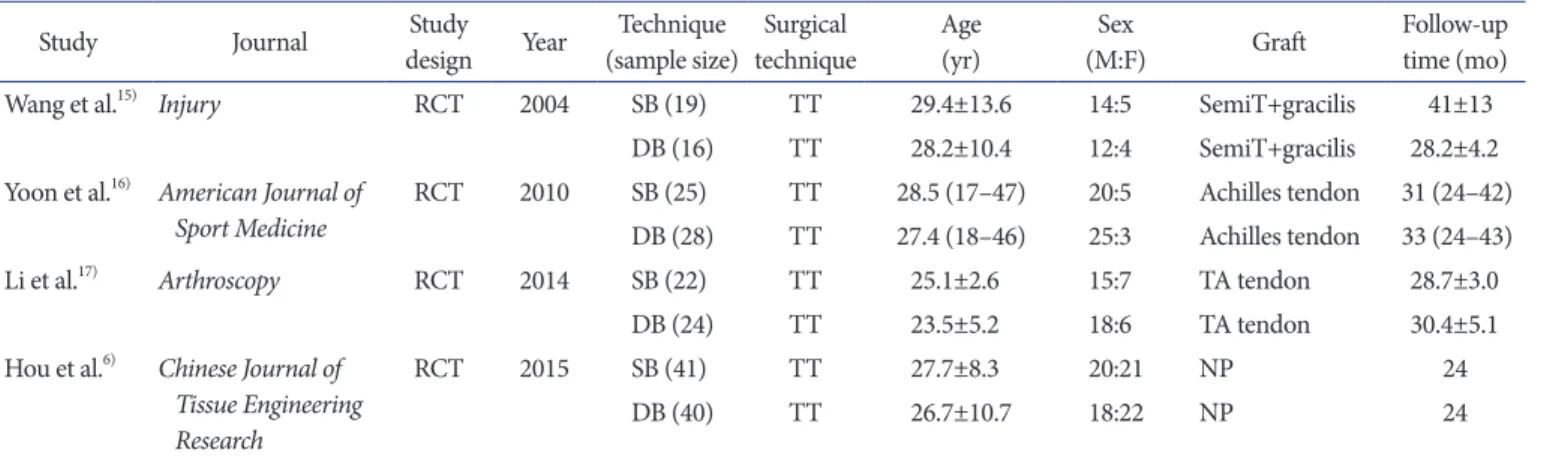
clusions was resolved through discussion and consensus. Eligible data were independently abstracted into predefined forms by the authors and checked for accuracy. We collected information on study characteristics (authors, journal, study design, publication year, and sample size), patient demographic data (sex, age, surgi
cal technique, number of subjects in each group, graft used for reconstruction, and followup time) (Table 1), and the results of clinical outcomes including Lysholm knee function scores, Teg
ner activity scores, sideto side differences, and IKDC objective grades (Table 2). In each study, the IKDC objective grades were reported using four categories (normal, nearly normal, abnormal, and severely abnormal). For the convenience of calculation, we classified the IKDC objective grades into normal or abnormal.
“Normal” included normal and nearly normal; “abnormal” in
cluded abnormal and severely abnormal. Based on tables and result data of 4 RCTs, the number of subjects or the means and standard deviations of demographic data and comparison of clinical outcomes between groups were investigated according to Cochrane Collaboration guidelines.
4. Assessment of Methodological Quality
Two authors (DYL and YJP) independently assessed the meth
odological quality of each RCT. Specifically, the risk of bias in each study was assessed using the Jadad quality assessment scale.
The maximum score is 5 in the Jadad scale, which consists of ran
domization (2), blinding (2), and an account of all patients (1)14). Any disagreements between the authors were resolved through discussion or review by the third author. We did not evaluate
publication bias because of the low statistical power as the num
ber of included studies was less than 10.
5. Statistical Analysis
The main purpose of this review was to evaluate the clini
cal outcomes after PCLRs using SB and DB techniques. These outcomes were evaluated by using knee scoring systems and by examining knee stability in each clinical study. To evaluate the reconstructed knees, we calculated the risk ratio (RR) or the weighted mean difference (WMD) of each result of the SB and DB PCLRs, and we also analyzed the differences in the outcome parameters between the groups. RevMan ver. 5.3 (The Nordic Cochrane Centre, Copenhagen, Denmark) was used to estimate the overall pooled effect size for each outcome. A metaanalysis of the included studies was done using a randomeffects model.
For continuous outcomes, we conducted WMD analysis using the inverse variance method. For binary outcomes, we calculated the RR between groups using the MantelHaenszel method.
Statistical heterogeneity among the studies was assessed using I
squared (I2), with values of 25%, 50%, and 75% considered low, moderate, and high, respectively, and Cochrane Q statistic (chi
square test) for heterogeneity. A pvalue <0.10 was defined as significant heterogeneity.
Results
1. Identification of Studies
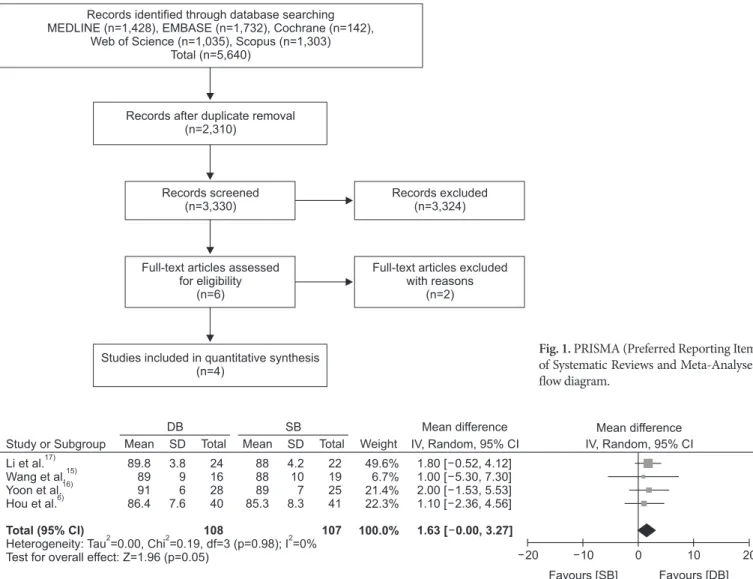
A total of 5,640 relevant articles were initially identified. Of these, 2,310 were duplicated in the databases. After screening of the remaining 3,330 articles using titles and abstracts, all but 6 Table 1. Characteristics of the Included Studies
Study Journal Study
design Year Technique
(sample size) Surgical
technique Age
(yr) Sex
(M:F) Graft Followup
time (mo)
Wang et al.15) Injury RCT 2004 SB (19) TT 29.4±13.6 14:5 SemiT+gracilis 41±13
DB (16) TT 28.2±10.4 12:4 SemiT+gracilis 28.2±4.2
Yoon et al.16) American Journal of
Sport Medicine RCT 2010 SB (25) TT 28.5 (17–47) 20:5 Achilles tendon 31 (24–42)
DB (28) TT 27.4 (18–46) 25:3 Achilles tendon 33 (24–43)
Li et al.17) Arthroscopy RCT 2014 SB (22) TT 25.1±2.6 15:7 TA tendon 28.7±3.0
DB (24) TT 23.5±5.2 18:6 TA tendon 30.4±5.1
Hou et al.6) Chinese Journal of Tissue Engineering Research
RCT 2015 SB (41) TT 27.7±8.3 20:21 NP 24
DB (40) TT 26.7±10.7 18:22 NP 24
Values are presented as mean±standard deviation (range).
RCT: randomized controlled trial, SB: singlebundle, DB: doublebundle, TT: transtibial, SemiT: semitendinosus, TA: tibialis anterior, NP: not provided.
Table 2. Comparison of Clinical Outcomes between Groups in Included Studies
Study Group
(no.) Lysholm knee
function score Tegner activity score Sidetoside
difference (mm) IKDC objective gradea) (normal/abnormal)
Wang et al.15) SB (19) 88±10 4.5±1.7 2.3±1.4 11/8
DB (16) 89±9 5.2±1.6 3.1±3.0 13/3
Yoon et al.16) SB (25) 89 (71–99) 6 (4–7) 4.5±2.3 18/7
DB (28) 91 (76–100) 6 (4–7) 3.1±2.4 24/4
Li et al.17) SB (22) 88.0±4.2 6.2±0.9 4.1±1.3 18/4
DB (24) 89.8±3.8 6.8±1.2 2.2±1.3 22/2
Hou et al.6) SB (41) 85.3±8.3 4.2±0.6 NP NP
DB (40) 86.4±7.6 4.3±0.6 NP NP
Values are presented as mean±standard deviation (range).
IKDC: International Knee Documentation Committee, SB: singlebundle, DB: doublebundle, NP: not provided.
a)IKDC objective grades A and B were regarded as normal and C and D as abnormal.
were excluded because they were irrelevant to the purpose of the present study. A thorough fulltext review of the 6 articles result
ed in exclusion of 2 lacking vital data, such as clinical outcomes or randomization. The majority of the excluded articles were not RCTs, inappropriate for comparison due to surgical techniques used for PCLR, evaluated patients who underwent conservative treatment for PCL injuries, introduced other surgical techniques, such as transtibial (TT) or tibial inlay (TI) technique for PCLR, or in vitro or animal studies. Four articles were included for data extraction and metaanalysis (Fig. 1)6,1517). Detailed data on sur
gical techniques (TT or TI), bundle types (SB or DB), and graft types of the 4 RCTs are described in Table 1.
2. Quality of the Included Studies
To evaluate the methodological quality, the Jadad quality assess
ment scale was used. The Jadad scale score of the included RCTs was ≥2 points (range, 2 to 4 points). These results indicated a low risk of bias of the included RCTs with the exception of one study2) which had a Jadad scale score of 2.
3. Lysholm Knee Function Score
All four studies (100%) reported the Lysholm knee function scores of the SB and DB groups. Of the total 215 patients, 108 patients were in the DB group and 107 patients were in the SB group. There were no significant differences in the Lysholm knee function scores between the SB and DB groups (WMD=1.63;
95% CI, 0.00 to 3.27; I2=0%) (Fig. 2).
4. Tegner Activity Score
All four studies (100%) reported the Tegner activity scores in
Records identified through database searching MEDLINE (n=1,428), EMBASE (n=1,732), Cochrane (n=142),
Web of Science (n=1,035), Scopus (n=1,303) Total (n=5,640)
Records after duplicate removal (n=2,310)
Records screened (n=3,330)
Full-text articles assessed for eligibility
(n=6)
Studies included in quantitative synthesis (n=4)
Records excluded (n=3,324)
Full-text articles excluded with reasons
(n=2)
Fig. 1. PRISMA (Preferred Reporting Items of Systematic Reviews and MetaAnalyses) flow diagram.
Study or Subgroup DB SB Weight IV, Random, 95% CIMean difference Mean difference Li et al.
Wang et al.
Yoon et al.
Hou et al.
Heterogeneity: Tau =0.00, Chi =0.19, df=3 (p=0.98); I =0%
Test for overall effect: Z=1.96 (p=0.05)
17) 15) 16) 6)
Total (95% CI)
2 2 2
89.889 86.491
49.6%
21.4%6.7%
22.3%
100.0%
1.80 [ 0.52, 4.12]
.00 [ 1.53, 5.53]5.30 1.10 [ 2.36, 4.56]
1.00 [ , 7.30]
2
1.63 [ 0.00, 3.27]
20 10 0 10 20
Favours [SB] Favours [DB]
Total
Mean SD Mean SD Total IV, Random, 95% CI
3.89 7.66
2416 2840 108
8888 85.389
4.210 8.37
2219 2541 107
Fig. 2. Forest plot of Lysholm knee function scores (points) in both techniques. DB: doublebundle, SB: singlebundle, SD: standard deviation, CI:
confidence interval.
the SB and DB groups. Of the total 215 patients, 108 patients were in the DB group and 107 patients were in the SB group.
There were no significant differences in the Tegner activity scores between the SB and DB groups (WMD=0.17; 95% CI, –0.08 to 0.43; I2=20%) (Fig. 3).
5. Side-to-Side Difference
Among the 4 studies, 3 studies (75%) reported on the side
toside differences of the SB and DB groups. Of the total 134 patients, 68 patients were in the DB group and 66 patients were in the SB group. There were no significant differences in sideto
side difference between the SB and DB groups (WMD=–0.97;
95% CI, –2.41 to 0.47; I2=78%) (Fig. 4).
6. IKDC Objective Grade
Among the 4 studies, 3 studies (75%) reported on IKDC objec
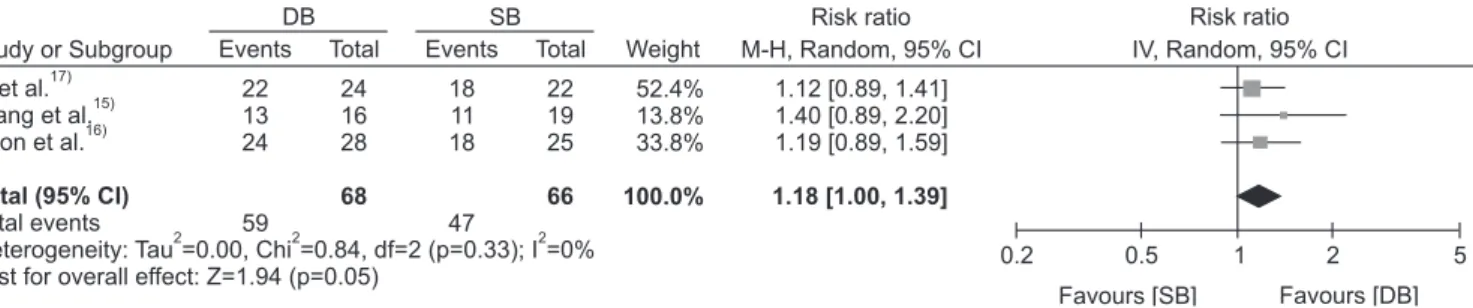
tive grades in SB and DB groups. Of the total 134 patients, 68 patients were in the DB group and 66 patients were in the SB group. There were no significant differences in the IKDC objec
tive grade between the SB and DB groups (RR=1.18; 95% CI, 1.00 to 1.39; I2=0%) (Fig. 5).
Discussion
There are several controversial issues in the surgical treatment of PCL tears. In the present study, we reviewed RCTs comparing outcomes of SB PCLR versus DB PCLR. Although there is a pre
vious metaanalysis on this topic18), it only included 2 RCTs that
Study or Subgroup DB SB Weight IV, Random, 95% CIMean difference Mean difference Li et al.
Wang et al.
Yoon et al.
Hou et al.
17) 15) 16) 6)
Total (95% CI)
Heterogeneity: Tau =0.01, Chi =3.73, df=3 (p=0.29); I =20%
Test for overall effect: Z=1.37 (p=0.17)
2 2 2
6.85.2 4.36
14.7%
28.9%5.0%
51.4%
100.0%
0.60 [ 0.01, 1.21]
0.70 0.39 .00 [ 0.40, 0.40]
0.10 [ 0.16, 0.36]
[ , 1.79]
0
0.17 [ 0.08, 0.43]
4 2 0 2 4
Favours [SB] Favours [DB]
Total
Mean SD Mean SD Total IV, Random, 95% CI
1.21.6 0.750.6
2416 2840 108
6.24.5 4.26
0.91.7 0.750.6
2219 2541 107
Fig. 3. Forest plot of Tegner activity scores (points) in both techniques. DB: doublebundle, SB: singlebundle, SD: standard deviation, CI: confidence interval.
Study or Subgroup Weight IV, Random, 95% CI
DB SB Mean difference Mean difference
Li et al.
Wang et al.
Yoon et al.
17) 15) 16)
Heterogeneity: Tau =1.24, Chi =8.97, df=2 (p=0.01); I =78%
Test for overall effect: Z=1.32 (p=0.19) Total (95% CI)
2 2 2
2.23.1 3.1
39.0%
28.4%
32.6%
100.0%
1.90 [ 2.65, 1.15]
0.80 0.80[ , 2.40]
1.40 [ 2.67, 0.13]
0.97 [ 2.41, 0.47]
10 5 0 5 10
Favours [SB] Favours [DB]
Total
Mean SD Mean SD Total IV, Random, 95% CI
1.33 2.4
2416 28 68
4.12.3 4.5
1.31.4 2.3
2219 25 66
Fig. 4. Forest plot of sidetoside differences (mm) in both techniques. DB: doublebundle, SB: singlebundle, SD: standard deviation, CI: confidence interval.
Study or Subgroup DB SB Weight M-H, Random, 95% CIRisk ratio Risk ratio
Li et al.
Wang et al.
Yoon et al.
17) 15) 16)
Total events
Heterogeneity: Tau =0.00, Chi =0.84, df=2 (p=0.33); I =0%
Test for overall effect: Z=1.94 (p=0.05) Total (95% CI)
2 2 2
2213 24 59
52.4%
13.8%
33.8%
100.0%
1.12 [0.89, 1.41]
1.40 [0.89, 2.20]
1.19 [0.89, 1.59]
1.18 [1.00, 1.39]
0.2 0.5 1 2 5
Favours [SB] Favours [DB]
Total
Events IV, Random, 95% CI
2416 28 68
Total Events
1811 18 47
2219 25 66
Fig. 5. Forest plot of International Knee Documentation Committee objective grades in both techniques. DB: doublebundle, SB: singlebundle, SD:
standard deviation, CI: confidence interval.
assessed clinical parameters, such as the Lysholm knee function score and the Tegner activity score. Furthermore, the previous metaanalysis included all peerreviewed studies published until April 2014. Thus, for more indepth, evidencebased comparison of SB PCLR versus DB PCLR, we conducted a metaanalysis on this topic. Ultimately, 4 RCTs, including the recent study, were evaluated. The subjects included in the 4 RCTs did not have com
bined injuries to the anterior cruciate ligament and PLC. Accord
ing to previous reports, the presence of a PLC injury would not be fully compensated by isolated PCLR for restoration of normal knee stability, so patients with PCL and PLC injuries were con
sidered inappropriate to be included for analysis. In addition to Lysholm knee function scores and the Tegner activity scores, the present study included other clinical parameters such as side
toside differences and the IKDC objective grades. Contrary to previous studies, our analysis showed no evidence of the superi
ority of DB PCLR in clinical outcomes assessed by the Lysholm knee function scores, Tegner activity scores, sidetoside differ
ences, and IKDC objective grades. Thus, the results of this meta
analysis support our hypothesis that the two techniques would not show significant differences in all outcome measures.
In previous studies, many authors reported that DB PCLR would be more beneficial in restoring the intact knee func
tion9,1921). However, such studies were confined to in vitro studies, and there are no clinical studies demonstrating that DB PCLR is superior to SB PCLR. In addition, DB PCLR is not recommended as the preferred surgical procedure due to the longer operation time, technical difficulty, and larger trauma. Thus, based on clini
cal trials, the superiority between the two techniques in terms of clinical improvement remains inconclusive.
Despite the recent increase in research on the PCL, we observed there were still insufficient data on surgical techniques for PCLR in our previous study22). One of the key controversies surround
ing the surgical techniques of PCLR is whether DB PCLR pro
vides superior outcomes compared to SB PCLR. In several bio
mechanical studies, Race and Amis20), Harner et al.9), and Markolf et al.7) showed statistically significant improvement in AP stability following DB PCLR compared to SB PCLR. Among the studies included in this metaanalysis, however, Wang et al.15) reported that the significance in differences between SB PCLR versus DB PCLR was unclear and concluded that further largescale stud
ies are needed to examine longterm results. On the other hand, both Li et al.17) and Yoon et al.16) demonstrated that DB PCLR showed better results in posterior knee stability and IKDC objec
tive grades. However, although posterior knee stability and IKDC objective grades were statistically significantly improved after DB
PCLR in the two studies, it is inconclusive whether DB PCLR is definitely superior to SB PCLR in terms of clinical and functional improvement because there was no significant difference in the subjective scores such as Lysholm knee function scores and Teg
ner activity scores. Hou et al.6) reported that the Lysholm knee function scores and Tegner activity scores both increased signifi
cantly in both DB and SB PCLR groups showing no statistically significant intergroup difference. Unlike other authors, however, Hou et al.6) did not recommend DB PCLR as the preferred sur
gical procedure because of the longer operation time and in
creased trauma. Despite the discrepancies among studies, clinical outcome scores, such as the Lysholm knee function scores, the Tegner activity scores, sidetoside differences, and IKDC objec
tive grades, were not significantly different between the SB and DB techniques in this metaanalysis. Although the improvement of Lysholm knee function score and IKDC objective score were more closely associated with DB PCLR since the pvalue was 0.05, the CI of Lysholm knee function score includes 0 and that of IKDC objective score includes 1, failing to convey statistical sig
nificance. Therefore, it is controversial to conclude that DB PCLR would result in better clinical outcomes. In addition, although some authors advocated DB PCLR for achieving knee stability in several biomechanical studies, there was no published clinical evidence demonstrating the superiority of DB PCLR. This find
ing corresponds to the results of our study and further supports the outcomes of previous studies as well. To obtain more reliable evidence, further studies conducted in the environment where various independent factors that can impact the outcomes of PCLR are controlled are needed.
The clinical studies included in this metaanalysis compared clinical outcomes of SB and DB techniques for PCL injuries. Ac
cording to the Jadad quality assessment scale, all clinical studies scored ≥2 points. Three or more points indicate a low risk of bias and thus a high quality study. Although one study6) was of low quality based on the Jadad scale (2 points), it demonstrated that the cohort was divided randomly and the fate of all patients in the trial was well described. Thus, we determined that it was ap
propriate to be included in the analysis in addition to the other studies considered eligible for the metaanalysis according to the Jadad scale score. Furthermore, screening and data extraction were done by two independent, blind reviewers in the present study. Although several recent systematic reviews focused on SB and DB PCLRs, only one metaanalysis of clinical studies on this topic was reported. As mentioned previously, the study evaluated only two clinical parameters using 2 RCTs and included 8 retro
spective cohort studies, increasing the risk of bias. Furthermore,
the previous study’s outcomes were evaluated at 12 months after surgery, whereas we evaluated clinical outcomes 24 months after surgery in this study. All of these are strengths of our study com
pared to the previous metaanalysis.
Despite its strengths, there are some limitations to the present study. First, a relatively small number of studies were included in this metaanalysis. The number of previously published RCTs related to the study topic was insufficient for accurate analysis.
However, all clinical studies included in this metaanalysis were RCTs that had a low risk of bias. Although the number itself was small, we believed that the results of each study carry valuable clinical significance and therefore included in the analysis. Sec
ond, technical factors of surgery that may affect the outcomes following PCLR should have been controlled. However, it was practically difficult to take into account all those factors associ
ated with SB or DB techniques as well as those associated with the TT or TI technique, open or arthroscopic surgery, the pres
ence of remnant fibers, tensioning protocol, graft type, and fixa
tion devices. Various factors could cause heterogeneity in this study. So, in an attempt to minimize the risk of bias, we included comparative studies conducted under the same protocol and used a randomeffect model. Third, we did not assess the postop
erative complications of PCLR. Fourth, we also did not evaluate the status of the remnant fibers in each study. In a previous study, remnantpreserving PCLR was associated with favorable clinical outcomes after PCLR23,24). Thus, these discrepancies should be controlled in future studies.
In conclusion, the present study demonstrates that both tech
niques for PCLR are associated with restoration of knee stability and improved knee function. However, which technique yields better improvement in clinical outcomes remains unclear. To ver
ify and further corroborate our results, more largerscale, high
quality RCTs are encouraged.
Conflict of Interest
No potential conflict of interest relevant to this article was re
ported.
References
1. Fanelli GC, Edson CJ. Posterior cruciate ligament injuries in trauma patients: part II. Arthroscopy. 1995;11:5269.
2. Amis AA, Gupte CM, Bull AM, Edwards A. Anatomy of the posterior cruciate ligament and the meniscofemoral liga
ments. Knee Surg Sports Traumatol Arthrosc. 2006;14:257
63.
3. Mauro CS, Sekiya JK, Stabile KJ, Haemmerle MJ, Harner CD. Doublebundle PCL and posterolateral corner recon
struction components are codominant. Clin Orthop Relat Res. 2008;466:224754.
4. Baker CL Jr, Norwood LA, Hughston JC. Acute combined posterior cruciate and posterolateral instability of the knee.
Am J Sports Med. 1984;12:2048.
5. Covey DC, Sapega AA, Sherman GM. Testing for isometry during reconstruction of the posterior cruciate ligament:
anatomic and biomechanical considerations. Am J Sports Med. 1996;24:7406.
6. Hou JH, Wu GY, Wang XS, Zhang YD. Single and double
bundle posterior cruciate ligament reconstruction under arthroscopy: a prospective cohort study. Chin J Tissue Eng Res. 2015;19:32715.
7. Markolf KL, Feeley BT, Jackson SR, McAllister DR. Biome
chanical studies of doublebundle posterior cruciate liga
ment reconstructions. J Bone Joint Surg Am. 2006;88:1788
94.
8. Markolf KL, Jackson SR, McAllister DR. Single versus doublebundle posterior cruciate ligament reconstruction:
effects of femoral tunnel separation. Am J Sports Med. 2010;
38:11416.
9. Harner CD, Janaushek MA, Kanamori A, Yagi M, Vogrin TM, Woo SL. Biomechanical analysis of a doublebundle posterior cruciate ligament reconstruction. Am J Sports Med. 2000;28:14451.
10. Whiddon DR, Zehms CT, Miller MD, Quinby JS, Mont
gomery SL, Sekiya JK. Double compared with singlebundle open inlay posterior cruciate ligament reconstruction in a cadaver model. J Bone Joint Surg Am. 2008;90:18209.
11. Bergfeld JA, Graham SM, Parker RD, Valdevit AD, Kambic HE. A biomechanical comparison of posterior cruciate liga
ment reconstructions using single and doublebundle tibial inlay techniques. Am J Sports Med. 2005;33:97681.
12. Apsingi S, Nguyen T, Bull AM, Unwin A, Deehan DJ, Amis AA. Control of laxity in knees with combined posterior cruciate ligament and posterolateral corner deficiency: com
parison of singlebundle versus doublebundle posterior cruciate ligament reconstruction combined with modified Larson posterolateral corner reconstruction. Am J Sports Med. 2008;36:48794.
13. Apsingi S, Nguyen T, Bull AM, Unwin A, Deehan DJ, Amis AA. The role of PCL reconstruction in knees with combined PCL and posterolateral corner deficiency. Knee Surg Sports
Traumatol Arthrosc. 2008;16:10411.
14. Jadad AR, Moore RA, Carroll D, Jenkinson C, Reynolds DJ, Gavaghan DJ, McQuay HJ. Assessing the quality of reports of randomized clinical trials: is blinding necessary? Control Clin Trials. 1996;17:112.
15. Wang CJ, Weng LH, Hsu CC, Chan YS. Arthroscopic single
versus doublebundle posterior cruciate ligament recon
structions using hamstring autograft. Injury. 2004;35:12939.
16. Yoon KH, Bae DK, Song SJ, Cho HJ, Lee JH. A prospective randomized study comparing arthroscopic singlebundle and doublebundle posterior cruciate ligament reconstruc
tions preserving remnant fibers. Am J Sports Med. 2011;39:
47480.
17. Li Y, Li J, Wang J, Gao S, Zhang Y. Comparison of single
bundle and doublebundle isolated posterior cruciate liga
ment reconstruction with allograft: a prospective, random
ized study. Arthroscopy. 2014;30:695700.
18. Zhao JX, Zhang LH, Mao Z, Zhang LC, Zhao Z, Su XY, Zhang LN, Gao Y, Sun Y, Tang PF. Outcome of posterior cruciate ligament reconstruction using the single versus double bundle technique: a metaanalysis. J Int Med Res.
2015;43:14960.
19. Mannor DA, Shearn JT, Grood ES, Noyes FR, Levy MS.
Twobundle posterior cruciate ligament reconstruction. An
in vitro analysis of graft placement and tension. Am J Sports Med. 2000;28:83345.
20. Race A, Amis AA. PCL reconstruction. In vitro biomechani
cal comparison of ‘isometric’ versus single and double
bundled ‘anatomic’ grafts. J Bone Joint Surg Br. 1998;80:173
9.
21. Shearn JT, Grood ES, Noyes FR, Levy MS. Twobundle pos
terior cruciate ligament reconstruction: how bundle tension depends on femoral placement. J Bone Joint Surg Am. 2004;
86:126270.
22. Lee DY, Kim DH, Park JS, Nam DC, Cho SH, Jeong JH, Hwang SC. Systematic review of cadaveric studies on ana
tomic posterior cruciate ligament reconstruction: the land
marks in anatomic posterior cruciate ligament reconstruc
tion. Knee Surg Relat Res. 2014;26:1918.
23. Lee SH, Jung YB, Lee HJ, Jung HJ, Kim SH. Remnant pres
ervation is helpful to obtain good clinical results in posterior cruciate ligament reconstruction: comparison of clinical results of three techniques. Clin Orthop Surg. 2013;5:27886.
24. Song JG, Kim HJ, Han JH, Bhandare NN, Shetty GM, Kang SB, Song YW, Nha KW. Clinical outcome of posterior cruci
ate ligament reconstruction with and without remnant pres
ervation. Arthroscopy. 2015;31:1796806.