• 검색 결과가 없습니다.

Simulation of the Blood Pressure Estimation Using the Artery Compliance Model and Pulsation Waveform Model

N/A
N/A
Protected

Academic year: 2021

Share "Simulation of the Blood Pressure Estimation Using the Artery Compliance Model and Pulsation Waveform Model"

Copied!
6
0
0

로드 중.... (전체 텍스트 보기)

전체 글

(1)

1. INTRODUCTION

As population aging is taking place all over the world, there is a growing interest and demand for development of medical devices that can monitor health of a patient using convenient and non-invasive methods. Currently there are on-going researches on home/portable medical devices as well as medical instruments that use non-invasive methods to minimize patient's pain. In particular, the blood pressure

of a patient is used as an important vital sign for determining the patient's health status [1-3]. One of the non-invasive blood pressure measurement methods is the oscillometric method [4]. Forster [5] proposed oscil- lometric model considering the pressure and volume of the blood vessels, and analyzed MAP and various parameters that determine the systolic and diastolic pressure. Then he reported that characteristic ratio between the blood pressures is influenced by arterial pressure's waveform and compliance of the arteries. Mauck [6] presented an artery model and found out that cuff pressure at maximum oscillation point was equal to MAP. Gizdulich [7] modeled relationship between pressure and volume of the arteries in the form of an arc-tangent function. Ursino [8, 9] proposed a model that took various factors that affect the blood pressure when applying oscillometric method into consideration. The proposed model considered the characteristics of biological tissue and cuff. Then simulation was executed for the proposed model and analyzed. However this method has several disadvantages

1

Dept. of Biomedical-engineering, School of Medicine, Pusan National Unversity (Yangsan Campus),

Yangsan 626-870, South Korea

2

Dept. of Computer Aided Science, Inje University, Kimhae 621-749, South Korea

3

Dept. of Anesthesia and Pain Medicine, School of Medicine, Yangsan Pusan National University,

Yangsan 626-770, South Korea

+
Corresponding author: [email protected]

(Received : Dec. 6, 2012, Revised : Jan. 18, 2013, Accepted : Jan, 22, 2013) This is an Open Access article distributed under the terms of the Creative Commons Attribution Non-Commercial License(http://creativecommons.org/licenses/by- nc/3.0)which permits unrestricted non-commercial use, distribution, and reproduction in any medium, provided the original work is properly cited.

http://dx.doi.org/10.5369/JSST.2013.22.1.38 pISSN 1225-5475/eISSN 2093-7563

Simulation of the Blood Pressure Estimation Using the Artery Compliance Model and Pulsation Waveform Model

Ahyoung Jeon

1

, Junghoon Ro

1

, Jaehyung Kim

2

, Seongwan Baik

3

, and Gyerok Jeon

1,+

Abstract

In this study, the artery's compliance model and the pulsation waveform model was proposed to estimate blood pressure without applying HPF (High Pass Filter) on signal measured by the oscillometric method. The method proposed in the study considered two ways of estimating blood pressure. The first method of estimating blood pressure is by comparing and analyzing changes in pulsation waveform's dicrotic notch region during each cardiac period. The second method is by comparing and analyzing morphological changes in the pulsation waveform during each cardiac period, which occur in response to the change in pressure applied on the cuff. To implement these methods, we proposed the compliance model and the pulsation waveform model of the artery based on hemodynamic theory, and then conducted various simulations. The artery model presented in this study only took artery's compliance into account.

Then, a pulsation waveform model was suggested, which uses characteristic changes in the pulsation waveform to estimate blood pressure. In addition, characteristic changes were observed in arterial volume by applying artery's pulsation waveform to the compliance model. The pulsation waveform model was suggested to estimate blood pressure using characteristic changes of the pulsation waveform in the arteries. This model was composed of the sum of sine waves and a Fourier's series in combination form up to 10th harmonics components of the sinusoidal waveform. Then characteristic of arterial volume change was observed by inputting pulsation waveform into the compliance model. The characteristic changes were also observed in the pulsation waveform by mapping the arterial volume change in accordance with applied cuff's pressure change to the pulsation waveform's change according to applied pressure changes by cuff. The systolic and diastolic blood pressures were estimated by applying positional change of pulsation waveform's dicrotic notch region.

Keywords : Blood pressure estimation, Artery compliance model, Pulsation waveform model

(2)

as follows. The raw signal from the oscillometric method is a mixed signal due to cuff pressure and the oscillation waveform, which is the arterial pulsation signal in response to applied cuff pressure. Thus, to extract the oscillation waveform, cuff pressure is subtracted from the original signal. For this, usually a high pass filter (HPF) is used, but different oscillation waveforms are displayed depending on frequency bandwidth of HPF. That is, the oscillation signal may be distorted or attenuated. Next, maximum amplitude of the oscillation waveform is set as the mean arterial pressure (MAP) [10]. And finally, the systolic and diastolic pressure is estimated by applying characteristic ratio (CR) on the MAP. But the characteristic ratio does not take into account patient's arterial condition, gender, age, disease, etc., and instead applies a constant CR. Therefore the oscillometric method may measure inaccurate blood pressure.

In this study, we tried to come up with a method to estimate the blood pressure without applying HPF on signal measured by the oscillometric method. To do this, we tried to estimate the blood pressure by analyzing and comparing locational changes in pulsation waveform's dicrotic notch region during each cardiac period and morphological changes that occur in pulsation waveform during each cardiac period, in response to change in applied pressure on the cuff. And we suggested a model for estimating the blood pressure based on hemodynamic theory, and then executed simulations. The suggested model and simulation execution process are as follows.

The artery model suggested in this study took only the compliance of the arteries into account, hence it was named the compliance model [11-13], which represents changes in the arterial volume according (in response to) to change in the transmural pressure. To estimate the blood pressure using characteristic changes in the pulsation waveform, the pulsation waveform model was presented. The pulsation waveform in the artery consists of the sum of sine wave and a Fourier's series in combination form up to the 10th harmonics components of the sinusoidal waveform is deployed. Also, we observed characteristic change in blood volume in arterial vessel by inputting pulsation waveform to the compliance model. In other words, change in arterial blood volume in response to change in cuff pressure by externally applied force was observed. Then we observed characteristic changes in the pulsation waveform by mapping the arterial volume change in accordance with applied cuff's pressure change to the pulsation waveform's change in response to change in applied cuff pressure. And

finally, we estimated the systolic and diastolic blood pressures by analyzing locational changes in pulsation waveform's dicrotic notch region during each cardiac periods, represented by the arterial volume change in applied cuff pressure.

2. EXPERIMEND METHODS 2.1 Pulsation Waveform Model

Characteristics of the arteries may involve various factors affecting the blood flow, such as elasticity, compliance, and viscoelasticity. In general, hemodynamic characteristics of the arteries represent the arterial volume changing aspects in various type depending on the change of pressure.

In this study, we created compliance model by considering only one of characteristics of the artery model and then executed simulation using Matlab (Matlab2009b, Mathworks Co., USA). Since it reflects characteristics of the arterial volume change due to changes in internal pressure of the arteries, it was named the compliance model. Transmural pressure is the arterial pressure when the blood from heart perfuse with artery, subtracted by the external pressure applied on the cuff.

(1)

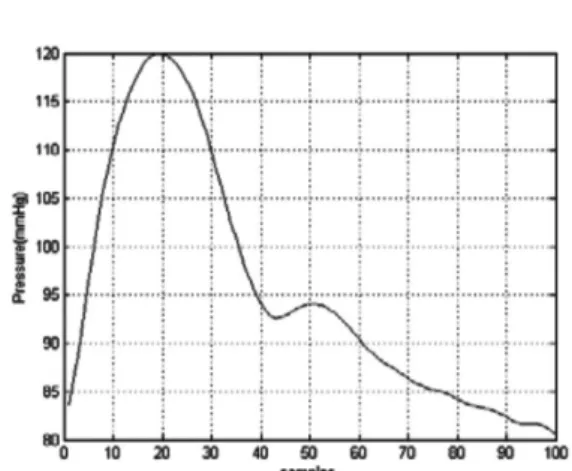
Fig. 1. Pulsation waveform applied to the artery's pulsation

waveform model.

(3)

In this study, we estimated blood pressure using characteristics changes in pulsation waveform of the arteries. To do this, the arterial pulsation waveform from Jeon's [14] study was applied. The pulsation waveform in the artery consists of the sum of sine waves and a Fourier's series in combination form up to 10th harmonics components of the sinusoidal waveform is utilized.

Following equation is applied to the arterial pulsation waveform model, and the resulting pulsation waveform looks like Fig. 1.

2.2 The Blood Volume Change considered Compli- ance of the Artery

In this study, we observed characteristic changes in the arterial blood volume by inputting the pulsation waveform to the compliance model. Based on the compliance model of the artery, we presented the volume-change model of the artery during each cardiac period according to change in pressure applied on the cuff. Simulation process, which took compliance of the artery into consideration, on the arterial blood volume change is as follows. First, the transmural pressure was found and then change in arterial blood volume in response to change in trasmural pressure was observed. Next, we observed change in the pulsation waveform while pressure applied on the cuff was increase from 1 mmHg to 180 mmHg. The observation results are shown in Fig. 2. Fig. 2 indicates change in the pulsation waveform in response to the blood volume change due to the cuff pressure change. Fig. 2 is result of the simulation, which was conducted to observe change in pulsation waveform. The x-axis of Fig. 2 represents time series data of the pulsation waveform. The y-axis represents change in pulsation waveform in response to change in applied cuff pressure. As shown in Fig.2, the pulsation waveform changes in the direction from top to bottom. This phe- nomenon means that the pulsation waveform should be change according to the blood volume of the artery change in response to the applied cuff pressure increase which is come down more in direction from top to bottom in y-axis.

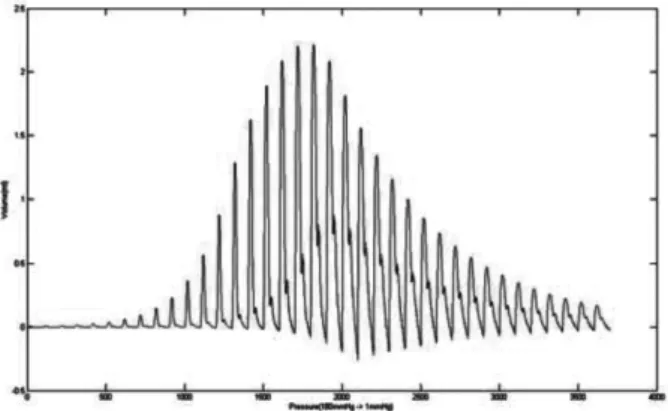
Fig. 3 shows change in pulsation waveform in response to change in arterial blood volume according to externally applied pressure on the cuff. That is, change in the pulsation waveform is represented by change in arterial blood volume according to applied cuff's pressure change while cuff pressure decreased from 180 mmHg to 1 mmHg. In Fig. 3, the pulsation waveform's amplitude was smaller when pressure applied on the cuff was higher. On

the other hand, the pulsation waveform's amplitude was greater when applied the cuff's pressure decreased. We confirmed this phenomenon by observing decrease in amplitude of the pulsation waveform in response to decrease in pressure applied on the cuff. Also, the pulsation waveform's dicrotic notch region, which is the inflection portion generated by reflected wave, represent changing phenomenon according to applied the cuff's pressure. This dicrotic notch portion included in each pulsation waveform is represented by the change in arterial blood volume according to change in pressure applied on the cuff.

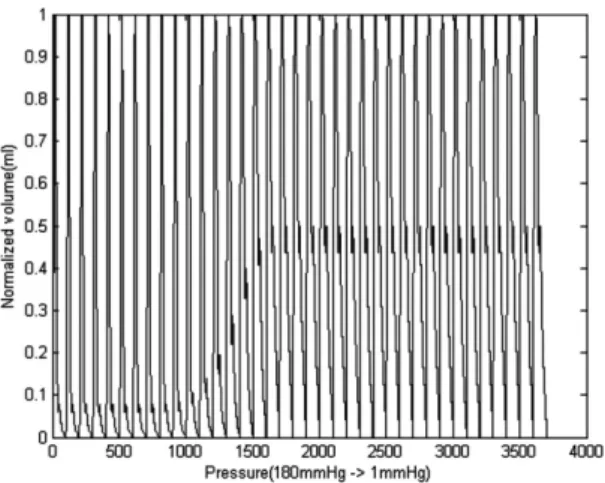
To conveniently compare and analyze, and observe distinctive locational changes in the pulsation waveform's dicrotic notch region, normalization process was applied to this study. (The normalization result is shown in Fig. 4)

Fig. 2. The pulsation waveform's changing aspect according to change of the cuff's pressure.

Fig. 3. A mapped result waveform that the arterial volume change

in accordance with applied cuff's pressure change to the

pulsation waveform's change according to applied the cuff's

pressure change.

(4)

3. SIMULATION 3.1 Simulation Methods

Simulation was carried out to estimate the systolic and diastolic blood pressure from the positional change of pulsation waveform's dicrotic notch region in artery during each cardiac period according to applied the cuff's pressure.

Simulation process is as follows.

First, according to Hemodynamic theory, the blood vessel volumes change due to the cuff pressure degree. The compliance model considered only artery's compliance, and it showed arterial volume change according to the transmural pressure. The pulsation waveform model was suggested to estimate blood pressure using characteristic changes of the pulsation waveform in the arteries. This model was composed of the sum of sine waves and a Fourier's series in combination form up to 10th harmonics components of the sinusoidal waveform. Then charac- teristic of arterial volume change was observed by inputting pulsation waveform into the compliance model.

In other words, change in pulsation waveform was observed which results from arterial volume change caused by change in external pressure applied on the cuff. The characteristic changes were also observed in the pulsation waveform by mapping the arterial volume change in accordance with applied cuff's pressure change to the pulsation waveform's change according to applied pressure changes by cuff. The systolic and diastolic blood pressures were estimated by applying positional change of pulsation waveform's dicrotic notch region,

3.2 Simulation Results

As a result of simulation that in the pulsation waveform by mapping the arterial volume change in accordance with applied cuff's pressure change to the pulsation waveform's change according to applied pressure changes by cuff, one can observe the following phenomenon. When externally applied pressure is high, arterial volume decreases, resulting in very small pulsation waveform amplitude.

When pressure applied is decreased, amplitude of the pulsation waveform continues to increase. However, when pressure applied continues to decrease, amplitude of the pulsation waveform once again decreases exponentially.

This phenomenon is in accordance with the compliance model, which shows change in blood vessel volume in response to change in applied pressure. And in Fig. 5, one can observe that depending on externally applied pressure, position of the pulsation waveform's dicrotic notch region undergoes transition. Fig. 5 shows result of simulation, which was conducted to estimate systolic and diastolic blood pressure by observing positional change in dicrotic notch region. One can see from Fig. 8 that when X is 1300, position of periodic pulsation waveform's dicrotic notch region rises.

Since periodic pulsation waveform consists of 100 samples, it corresponds to 13th pulsation waveform. Thus, the starting position of change in pulsation waveform's dicrotic notch region is the previous waveform - the 12th pulsation waveform. We estimated that this point's pressure corresponds to systolic blood pressure. In addition, when X is 2000, the position of pulsation waveform's dicrotic notch region does not change and remain constant. This point corresponds to the 20th pulsation waveform and this point's pressure corresponds to diastolic blood pressure.

By slowly decreasing cuff pressure 5 mmHg at a time, we decreased the externally applied cuff pressure from 180 mmHg to 60 mmHg, and estimated systolic and diastolic blood pressure. When the 12th pulsation waveform's pressure is calculated, the resulting value is 60 mmHg (12th × 5mmHg). And the pressure of the 20th pulsation waveform is 100 mmHg (20th × 5mmHg). By subtracting the 20th waveform's pressure from the maximum pressure, we estimated that the diastolic pressure is 80 mmHg. By using methods mentioned above, we were able to estimate systolic and diastolic blood pressures.

Fig. 4. Change in pulsation waveform in response to change in

cuff pressure, after applying normalization.

(5)

4. CONCLUSIONS

In this study, we made models and conducted simulations to estimate systolic and diastolic pressure by observing positional change in dicrotic notch region of the periodically pulsation waveform. To do this, we presented artery's compliance model and pulsation waveform model.

We obtained the following results by applying the models to observe change in the area of pulsation waveform. When pressure applied on the cuff decreased, the area of pulsation waveform was increased in response to change in arterial volume. And when pressure applied on the cuff continued to decrease, the area of pulsation waveform was decreased.

In addition, we observed that dicrotic notch region (inflection region formed by the reflective waves) of the pulsation waveform, changed position in response to pressure applied on the cuff.

Using the two models presented in the study, we conducted simulation on estimating blood pressure using positional change in pulsation waveform's dicrotic notch region. The pulsation waveform model's systolic and diastolic blood pressure was set to 120 mmHg and 80 mmHg, respectively. Then positional change in the pulsation waveform's dicrotic notch region was observed when externally applied cuff pressure was reduced from 180 mmHg to 1 mmHg, 5 mmHg at a time. Simulation

result showed that pulsation waveform's dicrotic notch region first began to rise in the 12th pulsation waveform, and this point was estimated to be the systolic blood pressure. The systolic blood pressure was estimated by subtracting 60 mmHg (5 mmHg × 12) from 180 mmHg, which is 120 mmHg. Simulation result also showed that from the 20th pulsation waveform, dicrotic notch region's position became constant (unchanged), and this point was estimated to be the diastolic blood pressure. Diastolic blood pressure was calculated by subtracting 100 mmHg (5 mmHg × 20) from 180 mmHg, which is 80 mmHg. From the simulation results we were able to observe that pulsation waveform changes because arterial volume changes in response to change in cuff pressure.

AKNOWLEDGEMENT

This work was supported by a 2-year Research Grant of Pusan National University.

REFERENCES

[1] A. C. Guyton, Textbook of medical physiology. W.B.

Saunders Company, pp. 168-268, 2000.

Fig. 5. Estimated systolic and diastolic blood pressure by applying change in pulsation waveform's dicrotic notch region in response to change

in cuff pressure.

(6)

[2] D. H. Kang, Physiology, Shin Kwang Publishing Inc., 1998.

[3] H. K. Sung and K. H. Kim, Physiology, Ui Hak Moon Hwa Sa Publishing Inc., pp. 173-200, 1996.

[4] E. J. Marey, Pression et vitesse du sang, “Physiologic experimentable”. Masson, Paris, Vol. 2, ch. VII, pp.

307-343, 1876.

[5] F. K. Forster and D. Turney. “Oscillometric deter- mination of diastolic, mean, and systolic blood pressure. A numerical model”, ASME J. Biomech.

Eng., Vol. 108, pp. 359-364, 1986.

[6] G. W. Mauck, C. R. Smith, L. A. Geddes, and J. D.

Bourland, “The meaning of the point of maximum oscillations in cuff pressure in the indirect measurement of blood pressure: Part II”, ASME J.

Biomech. Eng., Vol. 102, pp. 28-33, 1980.

[7] P. Gizdulich and K. H. Wesseling, “Forearm arterial pressure-volume relationships in man”, CLin. Phys.

Physiol. Meas., Vol. 9, pp. 123-132, 1988.

[8] M. Ursino and C. Ccristalli, “Mathematical modelingn of noninvasive blood pressure estimation techniques-Part I : Pressure transmissionacross the arm tissue”, J. Biomech. Eng., Vol. 117, pp. 107-116, 1995.

[9] M. Ursino and C. Cristalli, “A mathematical study of some biomechanical factors affecting the oscill- ometric blood pressure measurement”, IEEE Trans.

Biomed. Eng., vol. 43, pp. 761-778, 1996.

[10] J. A. Posey, L. A., H. Williams, and A. G. Moore,

“The meaning of the point of maximum oscillations in cuff pressure in the indirect measurement of blood pressure: Part I”, Cardiovasc. Res. Center Bull., Vol 8, pp. 15-25, 1969.

[11] F. K. Forster and D. Turney. “Oscillometric deter- mination of diastolic, mean, and systolic blood pressure. A numerical model”, ASME J. Biomech.

Eng., Vol. 108, pp 359-364, 1986.

[12] H. H. Hardy and R. E. Collins, “On the pressure- volume relationship in circulatory elements”, Med.

Biol. Eng. Comput., Vol. 20, pp. 565-570, 1982.

[13] S. Sun, “New approasches to the noninvasive determination of arterial blood pressure and compliance profile,” PH. D. dissertation, University of Utah, Salt Lake city, USA, 1989.

[14] G. R. Jeon, J. H. Jung, I. C. Kim, A. Y. Jeon, S. H.

Yoon, J. M. Son, J. H. Kim, S. Y. Ye, J. H. Ro, D.

H. Kim, and C. H. Kim, “A simulation for esti- mation of the blood pressure using arterial pressure- volume model”, International Journal of Biological and Life Science, Vol. 4, No. 1, pp. 55-60, 2008.

[15] K. Barbe, W. Van Moer, and L. Lauwers,

“Oscillometric blood pressure measurements: A

signal Analysis”, J. Phys: Conf. Ser., 2010.

수치

Fig. 1. Pulsation waveform applied to the artery's pulsation waveform model.
Fig. 2. The pulsation waveform's changing aspect according to change of the cuff's pressure.
Fig. 4. Change in pulsation waveform in response to change in cuff pressure, after applying normalization.
Fig. 5. Estimated systolic and diastolic blood pressure by applying change in pulsation waveform's dicrotic notch region in response to change in cuff pressure.

참조

관련 문서

n Dynamic simulation-based power estimation with coarse-grained net model from power macro model database and testbench.. i is

-The square module stands free in the garden of the house as a canopy -consisted of a thin shell supported at each of its corners by equally thin reinforced concrete piers.

In this study, the kinetic model based on the coupled reaction model was used to investigate the compositions and amount changes among the molten steel, slag and inclusions

After dissolution of fuel with optimized ratio, the temperature changes in molten steel was measured during oxygen blowing and simulated by the coupled reaction model....

Abbreviations: yr, year; DM, Diabetes Mellitus type 2; HTN, Hypertension; M, mean; SD, standard deviation; SBP, systolic blood pressure; DBP, diastolic blood pressure;

Through the superposition modeling of single hole waveform, I obtained the vibration waveform on the blasting condition changes and conducted dynamic

With these results, we can suggest the hypothesis that increased cardiac output in the patients who administered ketamine increased muscle blood flow, and this is the

In this thesis, tracked vehicle's dynamic performance of the two models, single-body model and Multi-body model, were compared through the numerical simulation.. The