Introduction
Stroke causes damage to motor and sensory nerves. Such damage induces functional disorders in stroke patients, including gait disturbances (Williams et al, 1999). Among stroke patients, 75% can walk independently, but 50% of them still have gait dis- turbances (Hyndman et al, 2002). Reduced muscles activity, difficulty in weight shift, and a decline in balance functions due to degraded proprioceptive senses mainly cause gait disturbances. Compared to healthy individuals, stroke patients show reduced mobility and stability and different gait patterns, re- sulting in increased energy costs and limited gait endurance (Patterson et al, 2007). In addition, com- pensated motor patterns, such as circumduction gaits are found in stroke patients (Gillen, 2010; Kim and Eng, 2003; Roth et al, 1997).
Balance is an ability to maintatin the line of grav-
ity of a body withing the base of support with mini- mal postural sway (Shumway-Cook et al, 1988). For maintaining balance need to visual feedback, ves- tibular and proprioceptive sense (Pollock et al, 2000).
Stroke patients have decrease control mobility, weak muscle power and hemianesthesia that affect balance problems. They have been implicated in the poor re- covery of activities of daily living (ADL) and mobility and an increased risk of falls. Thus Stroke patients are necessary to improve balance ability for functional mobility, stability and ADL (Tyson et al, 2006).
Stroke patients may also exhibit breathing dis- orders, with breathing problems due to the weaken- ing of the diaphragm, the intercostal muscles, and the abdominal muscles (Lanini et al, 2003). Stroke patients with neuromuscular system disease are un- able to take deep breaths at regular intervals. The decreased breathing ability reduces physical abilities, functional mobility, and independent gait ability (Kang, Corresponding author: Jong-duk Choi [email protected]
Effects of Underwater Treadmill Gait Training on Gait, Balance, and Pulmonary Function in Stroke Patients
Ho-june Yang1, BHSc, PT, Jong-duk Choi2, PhD, PT
1Dept. of Physical Therapy, The Graduate School, Daejeon University
2Dept. of Physical Therapy, College of Health & Medical Science, Daejeon University
Abstract1)
The purpose of this study was to compare the effects of underwater treadmill gait training (UTGT) and overground treadmill gait training (OTGT) on the gait, balance ability and pulmonary function of stroke patients. Twenty subjects were recruited for this study. The subjects were randomly assigned to two groups: UTGT (n1=10) and OTGT (n2=10). The 10 m walk test (10 MWT), Berg Balance Scale, Timed Up and Go (TUG) test, center of pressure, pulmonary function of forced vital capacity (FVC), forced expiratory volume after 1 sec (FEV1) and FEV1/FVC were measured before and after 4 weeks of training. Both groups undertook the gait training for 30 min a day, 3 times a week, for 4 weeks, and rating of perceived exertion of the groups were measured and compared. All the studied variables were significantly improved in both groups (p<.05) at the end of the study, except in the FEV1 of OTGT (p>.05). There was significant between-group difference in all of the variables, except in the 10 MWT (p>.05). These findings suggest that UTGT is more effective than OTGT in improving the balance and pulmonary functions of stroke patients.
Key Words: Balance; Gait training; Pulmonary function; Stroke; Underwater treadmill.
2003). Independent gait ability is an important element in quality of life and participation in daily living. In rehabilitation treatment, it is one of the most im- portant abilities to improve for a return to daily living (Flansbjer et al, 2005; Lord et al, 2004). According to previous studies, appropriate rehabilitation exercises for pulmonary functions should be included in the re- habilitation treatment of stroke patients.
Overground treadmill gait training (OTGT) is gait training using mechanical assistance, such as a har- ness or belt. With practice, OTGT improves the timing of the lower extremity during gaits to increase the extension of the hip joint during stance phases.
Changes in gait patterns contribute to improvements in the symmetry of gaits (Ada et al, 2003; Harris-Love et al 2001). Providing positive feedback to a patient taking part in OTGT can improve a patient’s spirits and motivate the patient to feel more confident about walking (Moore et al, 2010). In addition, OTGT can strengthen the lower extremity muscles and improve gait velocity, gait endurance, and cardiopulmonary functions (Macko et al, 2001; Silver et al, 2000).
Underwater treadmill gait training (UTGT) is sim- ilar to OTGT in terms of body support, but it en- ables gait training with reduced weight using the buoyancy of water (Simmons and Hansen, 1996).
Water has various physical characteristics, such as buoyancy, hydrostatic pressure, and viscosity that affect the human body (Becker, 2009). In OTGT, the patient has to wear a harness or belt for weight bearing. This is not necessary in UTGT where the water assists the stroke patient’s balance ability.
Furthermore, training in water reduces the patient’s fear of falling and aids their sense of stability (Jung et al, 2010). A previous study that compared UTGT and OTGT implemented at the same velocity re- ported that the gait patterns and muscle strength of the UTGT group improved to a greater extent than those of the OTGT group (Park et al, 2012). As re- cent study investigated the effects of UTGT on the peak torque of the knee in stroke patients, UTGT showed an increase in the peak knee extension tor-
que (Lee et al, 2015). In addition, Aquatic exercise showed that to enhance the balance and decrease the depression of stroke patients (Kim et al, 2014).
UTGT in adults with osteoarthritis was more effec- tive than OTGT for improving balance ability (Bressel et al, 2014). Water immersion and UTGT may reduce the workload of the cardiovascular system. The mean maximum increases in blood pressure, heart rate and the rate pressure product of UTGT were significantly lower than that of OTGT (Yoo et al, 2014). In another study, the metabolic costs and the heart rates and rating of perceived ex- ertion (RPE) scores of the UTGT group were higher than those of the UTGT group at the same stride length (Masumoto et al, 2013).
In rehabilitation treatment, underwater exercises are attracting increased attention. However, there are limited studies of UTGT among stroke patients and even fewer studies of the effects of UTGT on stroke patient’s balance and pulmonary functions. In addi- tion, earlier studies had used velocity-based in- dicators which were objective and did not consider subjective issues, such as a patient’s psychological stability or the environment. In the our study, we hypothesized that UTGT would be more effective than OTGT in improving the gait, balance, and pul- monary function of stroke patients. To test this hy- pothesis, we examined differences in the effects of UTGT and OTGT on stroke patients’ balance, gaits, and pulmonary functions at the same exercise in- tensity according to the patients’ RPE scores.
Methods
Subjects
The study consisted of 20 stroke patients with gait disturbances and poor respiratory function in D Hospital in Daejeon. All of the protocols used in this study were approved by the University of Daejeon.
The participant’s rights were protected according to the guidelines of the University of Daejeon (approval
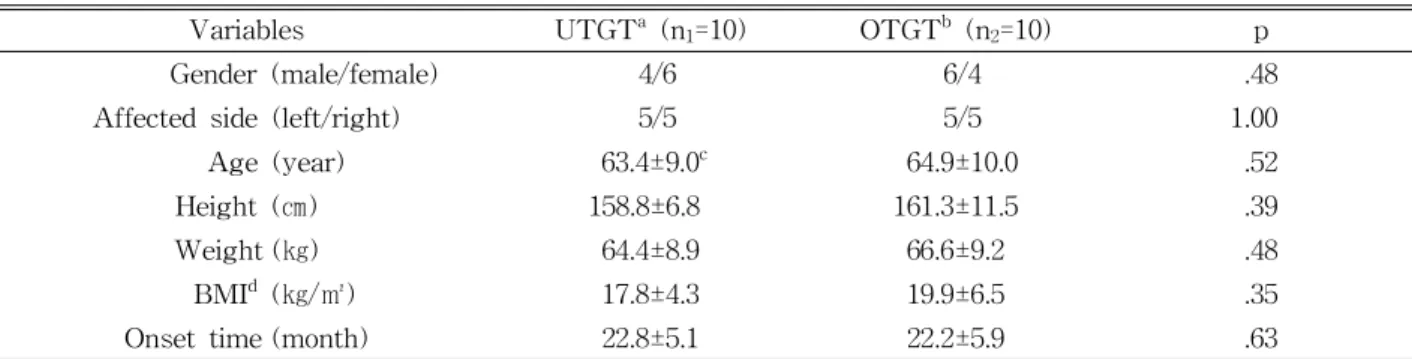
number: 1040647-201506-HR-031-03). The subjects sufficiently understood the explanations given about the purpose and method of the study and voluntarily agreed to take part in the study. The subjects were randomly assigned to an UTGT group (n1=10) or an OTGT group (n2=10). The inclusion criteria were subjects with heights in the range of 150∼175 ㎝ who could independently walk for at least 10 m us- ing a walking aid or under the supervision of a therapist, a score of less than 45 points on the Berg Balance Scale (BBS), no musculoskeletal disease or other neurological disease, and a score of 24 points or higher on the Korean version of Mini-Mental Status Examination for the measurement of RPE score ac- cording to the Borg scale. The intergroup character- istics of the 20 subjects in the UTGT group (n1=10) and OTGT group (n2=10) are shown in Table 1.
Measurement tools and methods
Rating perceived exertion (RPE)
To ensure the same exercise intensity in both the UTGT and OTGT groups, the patient’s perceptions of their heart rates according to their RPE scores, newly modified by Borg and translated into Korean, were used.
The RPE scale is an easy self-assessment measurement method of exertion that requires no direct physiological measurements of maximal oxygen uptake. A subjective rating of 13 points is equal to approximately 130 heart beats per min and an metabolic equivalent of 50%
(Altenburger et al, 2013; Masumoto et al, 2008).
Assessment of gait ability: 10 m walk test (10 MWT)
To assess the patient’s gait ability, the 10 m walk test (10 MWT) was used (Hunt et al, 1981). The 10 MWT, which measures the level of gait functions, has been shown to have high intrarater reliability (r=.89∼1.00). In the tests, to reduce errors due to the acceleration and deceleration at the beginning and end of walking, each subject walked 14 m, and the time to walk 10 m excluding the 2 m each at the beginning and the end was measured (Dean et al, 2000).
Assessment of balance: Timed up and go (TUG) test
Timed Up and Go (TUG) tests were conducted to assess the patients’ dynamic balance and gait ability.
The assessment method consists of standing, walk- ing 3 m, and returning to sit again. TUG test is usefully used for stroke patients with lower extremity disorders because the measuring method is not com- plicated and has been reported as having high val- idity and reliability (intra-class coefficient=.99) (Ng and Hui-Chan, 2005).
Assessment of balance: Berg balance scale (BBS)
The Berg Balance Scale (BBS) was used to measure functional gait ability in relation to balance.
The BBS is an objective measure of static balance ability and dynamic balance ability and has high in-
Variables UTGTa (n1=10) OTGTb (n2=10) p
Gender (male/female) 4/6 6/4 .48
Affected side (left/right) 5/5 5/5 1.00
Age (year) 63.4±9.0c 64.9±10.0 .52
Height (㎝) 158.8±6.8 161.3±11.5 .39
Weight (㎏) 64.4±8.9 66.6±9.2 .48
BMId (㎏/㎡) 17.8±4.3 19.9±6.5 .35
Onset time (month) 22.8±5.1 22.2±5.9 .63
aunderwater treadmill gait training, boverground treadmill gait training,cmean±standard deviation, dbody mass index.
Table 1. General characteristics of the subjects (N=20)
tra-rater (r=.99) and inter-rater reliability (r=.98) (Berg et al, 1992).
Assessment of balance: Center of pressure The limit of stability, which identifies dynamic balance control ability, measured using BioRescue (RM INGENIERIE, Rodez, France). BioRescue has a 610×580×10 ㎜ baropodometric platform equipped with 1,600 pressure sensors, which can be used to evaluate weight bearing, body movements, and bal- ance between the left and the right lower limbs using pressure sensors under the feet. All the sub- jects were instructed to stand in an upright posi- tion and to keep their eyes forward. They were then instructed to move their center of pressure, following the arrow on the BioRescue screen. The average values of three measurements were used (Kim and Cha, 2015).
Assessment of pulmonary function The forced vital capacity (FVC), forced expiratory volume after 1 sec (FEV1), and FEV1/FVC were measured using a spirometer (CHESTGRAPH HI-101, CHEST M.I. Inc., Tokyo, Japan). An interval of 5 min was given between each assessment. The FEV refers to the amount of air than can be max- imally inhaled and exhaled, and the FEV1 refers to the volume of forced exhalation after 1 sec. The FEV1/FVC is the ratio of FEV in 1 sec to the FVC. The values were measured three times, and the average values were recorded. Restrictive pulmo- nary disease in stroke patients can be identified us-
ing these values. The FEV1/FVC provides an in- direct assessment of the volume of the thorax and respiratory muscle strength (Kisner and Colby, 2007;
Lee et al, 2011).
Intervention
Underwater treadmill gait training (UTGT)
The gait training was undertaken for 30 min on an underwater treadmill (Aqua Zone, SUNION, Hwaseong-si, Korea) (Figure 1). The water temper- ature was maintained at approximately 33 ℃, and the water depth was set to the depth at which the water filled the tank up to the area between the pa- tient’s xiphoid process and umbilicus. On the under- water treadmill, the subject walked at a comfortable speed at the beginning and increased the walking speed 5 min later to maintain an RPE score of 13 points. The RPE was continuously checked to adjust the speed for 20 min. The subject was instructed to maintain a comfortable speed for the last 5 min as a cooling-down exercise. A physical therapist observed to patients for safety (Brach et al, 2015).
Overground treadmill gait training (OTGT)
The OTGT was undertaken for 30 min using commonly used overground treadmill (T-5300, MAXTON, Gwangju-si, Korea). All subsequent pro- tocols were the same as in the UTGT program (Brach et al, 2015).
A B
Figure 1. Underwater treadmills (A) and underwater treadmill gait training (B).
Procedures
The subjects were randomly assigned to the ex- perimental group (n1=10, UTGT group) and the con- trol group (n2=10, OTGT group). Both groups under- went the interventions for 30 min per time, 3 times per week, for 4 weeks. An initial assessment was conducted before the intervention, and a final assess- ment was conducted 4 weeks.
Data analysis
The data collected in the present study were statistically processed using PASW ver. 18.0 (SPSS Inc., Chicago, IL, USA). The intergroup normality was tested, and the data did not satisfy the re- quired normality. Therefore, non-parametric tests were conducted. Intergroup homogeneity was veri- fied through chi-squared tests and the Mann-Whitney U test. Wilcoxon’s signed-rank tests were conducted to compare the pre- and post-inter- vention values, and the Mann-Whitney U test was conducted to compare differences in the pre- and post-intervention values of the experiment group and the control group. The significance level was set to p<.05.
Results
Comparison of the pre- and post- intervention values of the experimental and control groups
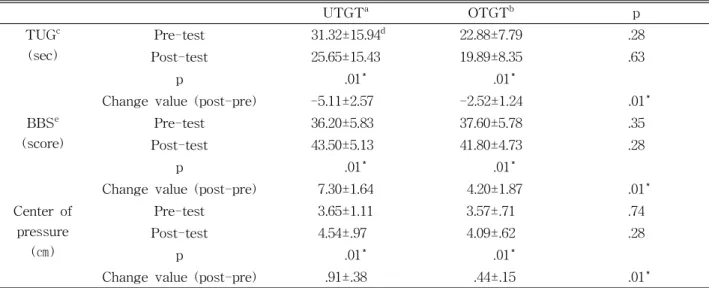
According to the pre- and post-intervention values of the gait ability (Table 2), balance ability (Table 3),
and pulmonary function (Table 4) in the UTGT group versus those in the OTGT group, all the re- sultant values significantly improved (p<.05), except the FEV1 (p>.05) in the OTGT group. According to the between-group comparisons, the improvements were significantly greater in the UTGT group (p<.05), except in the 10 MWT (p>.05).
Discussion
In the our study, the gait ability, balance ability, and pulmonary functions of both the UTGT and OTGT groups improved, but the balance ability and pulmonary functions were better in the UTGT group.
The gait ability was the same in both groups. The results of the gait ability, balance ability, and pulmo- nary functions of the two groups revealed that the UTGT was more effective than that of the OTGT with respect to improvements in balance ability and pulmonary functions but not in gait ability.
In the our study, although UTGT was more effec- tive than OTGT in improving balance ability, but its effects on gait ability were insignificant. The effects of UTGT and OTGT on stroke patients, the gait and balance ability were significantly more improved in the UTGT group (Kim et al, 2011). Park et al (2014) reported that gait training in stroke patients using UTGT increased the gait and balance ability. In oth- er studies of stroke patients, UTGT increased bal- ance ability with the weight shift to the paretic side, so that overall the weight shifts of the feet and heels increased (Park et al, 2010). In a study of
10 MWTc (s) UTGTa OTGTb p
Pre-test 24.49±8.79d 20.64±6.27 .24
Post-test 20.64±6.27 17.04±5.43 .31
p .01* .01*
Change value (post-pre) -3.93±1.92 -3.60±1.84 .52
aunderwater treadmill gait training, boverground treadmill gait training, c10 m walk test,dmean±standard deviation,
*p<.05.
Table 2. Comparison of gait ability outcomes within groups and between groups
UTGT by Jung et al (2010) that applied additional weight to the paretic side of stroke patients with re- duced circumduction gaits due to hip joint abduction, adding weight to the paretic side during gait training improved balance ability. UTGT against water flow increased gait and balance ability then OTGT in eld- erly women (Shono et al, 2007). In recent study, UTGT in adults with osteoarthritis was more effective
than OTGT for reducing joint pain, improving balance and mobility (Bressel et al, 2014). We thought that buoyancy, hydrostatic pressure, and viscosity of water affect the balance ability of stroke patients such as supporting the body sway and the weight bearing.
In the our study, the pulmonary function of the UTGT group was better than that of the OTGT group. Chu et al (2004) reported that underwater ex-
UTGTa OTGTb p
FVCc (L) Pre-test 1.52±.62d 2.08±1.03 .17
Post-test 1.94±.65 2.24±.97 .27
p .01* .01*
Change value (post-pre) .42±.06 .16±.17 .01*
FEV1e (L) Pre-test 1.31±.51 1.81±.88 .15
Post-test 1.77±.55 2.02±.87 .21
p .01* .44
Change value (post-pre) .45±.06 .16±.17 .01*
FEV1/FVC (%) Pre-test 86.37±3.34 87.09±2.09 .30
Post-test 91.39±3.36 90.43±2.03 .33
p .01* .01*
Change value (post-pre) 5.01±1.80 3.33±1.16 .04*
aunderwater treadmill gait training, boverground treadmill gait training,cforced vital capacity, dmean±standard deviation, eforced expiratory volume at one second, *p<.05.
Table 4. Comparison of pulmonary function outcomes within groups and between groups
UTGTa OTGTb p
TUGc (sec)
Pre-test 31.32±15.94d 22.88±7.79 .28
Post-test 25.65±15.43 19.89±8.35 .63
p .01* .01*
Change value (post-pre) -5.11±2.57 -2.52±1.24 .01*
BBSe (score)
Pre-test 36.20±5.83 37.60±5.78 .35
Post-test 43.50±5.13 41.80±4.73 .28
p .01* .01*
Change value (post-pre) 7.30±1.64 4.20±1.87 .01*
Center of pressure
(㎝)
Pre-test 3.65±1.11 3.57±.71 .74
Post-test 4.54±.97 4.09±.62 .28
p .01* .01*
Change value (post-pre) .91±.38 .44±.15 .01*
aunderwater treadmill gait training, boverground treadmill gait training,ctimed up and go, dmean±standard deviation,
eBerg balance scale, *p<.05.
Table 3. Comparison of balance ability outcomes within groups and between groups
ercise was effective in improving the breath- ing/ventilation abilities, heart rates, and maximum oxygen uptake of stroke patients. In a comparison of UTGT and OTGT gait training performed by elderly people, those who performed the UTGT had higher activity of the lower extremity muscles, higher car- diopulmonary responses, and higher RPE scores (Masumoto et al, 2008). In a study of the effects of UTGT at different water depths on stroke patients’
physical responses, gait, and trunk muscle activity, UTGT at all water depths significantly increased heart rates and trunk muscle activity compared to OTGT at all speeds (Sin, 2012). UTGT may affect to increase the strength of respiratory muscles, improves trunk muscle activity, and exerts physiological effects on cardiopulomonary endurance, cardiovascular responses, and breathing ability with the characteristics of water.
Most previous stroke studies of UTGT and OTGT focused on speed, and they were conducted for short periods as one-off studies, with small numbers of subjects. More studies on underwater exercise by stroke patients are needed that include psycho- logical/physiological elements, such as different water depths. Studies of the impacts of UTGT training ex- ercise on the pulmonary function of stroke patients are also needed. In the our study, we compared the RPE scores of stroke patients who participated in UTGT and OTGT. According to previous studies, UTGT resulted in higher RPE scores, higher activity of the lower extremity muscles, and higher trunk muscle activity than OTGT. However, the stroke pa- tients who participated in the present study indicated that the UTGT was easier than the OTGT. Thus, it appears that psychology plays a role and may act as a constraint during gait training.
These results suggest that underwater exercise programs should be included in the rehabilitation treatment of stroke patients and that these under- water exercise programs should include UTGT.
UTGT can improve stroke patients’ functional mobi- lity and independent gait ability and shorten the time necessary for a return to daily living. As the study
group consisted of only 20 patients and was limited to stroke patients of a specific height range to en- sure the same water depth in the UTGT, the results cannot be generalized. he subjects of the present study was limited to 20 patients, and many diverse subjects could not be included. We suggest to future study with greater numbers of patients that include more physiological and psychological factors are needed to determine the impact of UTGT on stroke patients.
Conclusion
The current study findings provide clinical evi- dence that UTGT is more effective to improve the gait, balance and pulmonary ability in stroke patients.
The subjects were underwent UTGT and OTGT for 30 min per time, 3 times per week, for 4 weeks. The results show that UTGT results in improved balance ability and pulmonary functions then OTGT. We can conclude that UTGT is more effective than OTGT in improving balance ability and pulmonary functions.
Based on the findings of the present study, various physical characteristics of water such as buoyancy, hydrostatic pressure, and viscosity may provide resist to respiratory muscles, stability to body sway and efficient exercise with reducing fear of falling in the stroke patients. Our results suggest that UTGT should included in be the exercise programs of stroke patients. We can also conclude that UTGT can help to improve the pulmonary functions of stroke patients.
References
Ada L, Dean CM, Hall JM, et al. A treadmill and overground walking program improves walking in persons residing in the community after stroke:
A placebo-controlled, randomized trial. Arch Phys Med Rehabil. 2003;84(10):1486-1491.
Altenburger PA, Dierks TA, Miller KK, et al.
Examination of sustained gait speed during ex-
tended walking in individuals with chronic stroke.
Arch Phys Med Rehabil. 2013;94(12):2471-2477.
http://dx.doi.org/10.1016/j.apmr.2013.06.015
Becker BE. Aquatic therapy: Scientific foundations and clinical rehabilitation applications. PM R.
2009;1(9):859-872. http://dx.doi.org/10.1016/j.pmrj.
2009.05.017
Berg KO, Maki BE, Williams JI, et al. Clinical and laboratory measures of postural balance in an elderly population. Arch Phys Med Rehabil.
1992;73(11):1073-1080.
Brach JS, Lowry K, Perera S, et al, Improving motor control in walking: A randomized clinical trial in older adults with subclinical walking difficulty.
Arch Phys Med Rehabil. 2015;96(3):388-394. http://
dx.doi.org/10.1016/j.apmr.2014.10.018
Bressel E, Wing JE, Miller AI, et al. High-intensity interval training on an aquatic treadmill in adults with osteoarthritis: Effect on pain, bal- ance, function, and mobility. J Strength Cond Res.
2014;28(8):2088-2096. http://dx.doi.org/10.1519/JSC.
0000000000000258
Chu KS, Eng JJ, Dawson AS, et al. A randomized controlled trial of water-based exercise for car- diovascular fitness in individuals with chronic stroke. Arch Phys Med Rehabil. 2004;85(6):
870-874.
Dean CM, Rechards CL, Malouin F. Task-related circuit training improves performance of locomo- tor tasks in chronic stroke: A randomized, con- trolled pilot trial. Arch Phys Med Rehabil. 2000;
81(4):409-417.
Flansbjer UB, Holmbäck AM, Downham D, et al.
Reliability of gait performance tests in men and women with hemiparesis after stroke. J Rehabil Med. 2005;37(2):75-82.
Gillen G. Stroke Rehabilitation: A function-based approach. 3rd ed. St Louis, Mosby, 2010:389-415.
Harris-Love ML, Forrester LW, Macko RF, et al.
Hemiparetic gait parameters in overground versus treadmill walking. Neurorehabil Neural Repair.
2001;15(2):105-112.
Hunt SM, McKenna, SP, Williams J. Reliability of a population survey tool for measuring perceived health problems: A study of patients with osteoarthrosis. J Epidemiol Community Health.
1981;35(4):297-300.
Hyndman D, Ashburn A, Stack E. Fall events among people with stroke living in the community:
Circumstances of falls and characteristics of fallers. Arch Phys Med Rehabil. 2002;83(2):
165-170.
Jung T, Lee D, Charalambous C, et al. The influence of applying additional weight to the affected leg on gait patterns during aquatic treadmill walking in people poststroke. Arch Phys Med Rehabil.
2010;91(1):129-136. http://dx.doi.org/10.1016/j.apmr.
2009.09.012
Kang SW. Breathing retraining. Pediatr Allergy Respir Dis. 2003;13(1):1-7.
Kim CM, Eng JJ. Symmetry in vertical ground re- action force is accompanied by symmetry in tem- poral but not distance variables of gait in persons with stroke. Gait Posture. 2003;18(1):23-28.
Kim JS, Son YH, Hwang YB, et al. Effect of sub- merged treadmill gait training on gait and bal- ance function in people with hemiparesis. Kor J Neural Rehabil. 2011;1(2):63-70.
Kim NH, Cha YJ. Effect of gait training with con- strained-induced movement therapy (CIMT) on the balance of stroke patients. J Phys Ther Sci.
2015;27(3):611-613. http://dx.doi.org/10.1589/jpts.27.
611
Kim SH, Lee DK, Kim EK. Effect of aquatic ex- ercise on balance and depression of stroke patients.
J Korean Soc Phys Ther. 2014;26(2):104-109.
Kisner C, Colby LA. Therapeutic Exercise: Foundations and techniques. 5th ed. Philadelphia, PA, F.A.
Davis Co., 2007:851-862.
Lanini B, Bianchi R, Romagnoli I, et al. Chest wall kinematics in patients with hemiplegia. Am J Respir Crit Care Med. 2003;168(1):109-113.
Lee DG, Jeong SK, Kim YD. Effects of underwater treadmill walking training on the peak torque of
the knee in hemiplegic patients. J Phys Ther Sci.
2015;27(9):2871-2873. http://dx.doi.org/10.1589/jpts.
27.2871
Lee SM, Kang JH, Ko TS, et al. Cardiovascular and Pulmonary Physical Therapy. 1st ed. Seoul, Hyunmoon, 2011:210-214.
Lord SE, McPherson K, McNaughton HK, et al.
Community ambulation after stroke: How im- portant and obtainable is it and what measures appear predictive? Arch Phys Med Rehabil.
2004;85(2):234-239.
Macko RF, Smith GV, Dobrovolny CL, et al. Treadmill training improves fitness reserve in chronic stroke patients. Arch Phys Med Rehabil. 2001;82(7):
879-884.
Masumoto K, Applequist BC, Mercer JA. Muscle ac- tivity during different styles of deep water run- ning and comparison to treadmill running at matched stride frequency. Gait Posture. 2013;
37(4):558-563. http://dx.doi.org/10.1016/j.gaitpost.
2012.09.019
Masumoto K, Shono T, Hotta N, et al. Muscle acti- vation, cardiorespiratory response, and rating of perceived exertion in older subjects while walk- ing in water and on dry land. J Electromyogr Kinesiol. 2008;18(4):581-590.
Moore JL, Roth EJ, Killian C, et al. Locomotor train- ing improves daily stepping activity and gait ef- ficiency in individuals poststroke who have reached a “plateau” in recovery. Stroke. 2010;41 (1):129-135. http://dx.doi.org/10.1161/STROKEAHA.
109.563247
Ng SS, Hui-Chan CW. The timed up & go test: Its reliability and association with lower-limb im- pairments and locomotor capacities in people with chronic stroke. Arch Phys Med Rehabil.
2005;86(8):1641-1647.
Patterson SL, Forrester LW, Rodgers MM, et al.
Determinants of walking function after stroke:
Differences by deficit severity. Arch Phys Med Rehabil. 2007;88(1):115-119.
Park SE, Kim SH, Lee SB, et al. Comparison of
underwater and overground treadmill walking to improve gait pattern and muscle strength after stroke. J Phys Ther Sci. 2012;24(11):
1087-1090.
Park SE, Lee MJ, Yoon BC, et al. Comparison of underwater and overground treadmill walking exercise to improve gait and physical function in people after stroke. J Int Acad Phys Ther Res.
2010;1(2):120-125.
Park SW, Lee KJ, Shin DC, et al. The effect of un- derwater gait training on balance ability of stroke patients. J Phys Ther Sci. 2014;26(6):899-903.
http://dx.doi.org/10.1589/jpts.26.899
Pollock AS, Durward BR, Rowe PJ, et al. What is balance? Clin Rehabil. 2000;14(4):402-406.
Roth EJ, Merbitz C, Mroczek K, et al. Hemiplegic gait. Relationships between walking speed and other temporal parameters. Am J Phys Med Rehabil. 1997;76(2):128-133.
Shumway-Cook A, Anson D, Haller S. Postural sway biofeedback: Its effect on reestablishing stance stability in hemiplegic patient. Arch Phys Med Rehabil. 1988;69(6):395-400.
Simmons V, Hansen PD. Effectiveness of water ex- ercise on postural mobility in the well elderly:
An experimental study on balance enhancement. J Gerontol A Biol Sci Med Sci. 1996;51(5):233-238.
Sin J. The effects of treadmill gait on physical re- sponses, gait, and trunk muscle activation of stroke. Seoul, Sahmyook University, Master Thesis. 2012.
Silver KH, Macko RF, Forrester LW, et al. Effects of aerobic treadmill training on gait velocity, ca- dence, and gait symmetry in chronic hemiparetic stroke: A preliminary report. Neurorehabil Neural Repair. 2000;14(1):65-71.
Shono T, Masumoto K, Fujishima K, et al. Gait pat- terns and muscle activity in the lower ex- tremities of elderly women during underwater treadmill walking against water flow. J Physiol Anthropol. 2007;26(6):579-586.
Tyson SF, Hanley M, Chillala J, et al. Balance dis-
ability after stroke. Phys Ther. 2006;86(1):30-38.
Williams GR, Jiang JG, Matchar DB, et al. Incidence and occurrence of total (first-ever and recurrent) stroke. Stroke. 1999;30(12):2523-2528.
Yoo JH, Lim KB, Lee HJ, et al. Cardiovascular re- sponse during submaximal underwater treadmill
exercise in stroke patients. Ann Rehabil Med.
2014;38(5):628-636.
This article was received October 6, 2015, was reviewed October 6, 2015, and was accepted November 9, 2015.