VOL. 19, NO. 2, 2020 Case Report
CLINICAL PAIN
97 https://doi.org/10.35827/cp.2020.19.2.97
접수일 : 2020 년 3 월 18 일 , 게재승인일 : 2020 년 5 월 18 일 책임저자 : 황기훈 , 부산시 부산진구 양정로 62
뿸 47227, 동의의료원 재활의학교실
Tel: 051-850-8508, Fax: 051-867-5162 E-mail: [email protected]
신경내 결절종과 연관된 척골 신경병증의 초음파 진단
동의의료원 재활의학교실
강인현ㆍ배민준ㆍ허양록ㆍ황기훈
Diagnosis of Ulnar Neuropathy Caused by Intraneural Ganglion at Elbow with Ultrasound
Inhyun Kang, M.D., Minjoon Bae, M.D., Yangrok Hur, M.D. and Kihun Hwang, M.D.
Department of Physical Medicine and Rehabilitation, Dong Eui Hospital, Busan, Korea
An intraneural ganglion in the peripheral nerve and the resulting ulnar neuropathy at the elbow are uncommon and may show various symptoms ranging from local pain to motor and sensory impairment. We report a case of a 76-year-old man who was diagnosed with ulnar neuropathy caused by an intraneural ganglion derived from the elbow. We also discuss the pathophysiology, treatment, prognosis, and diagnostic value of ultrasonography in neuropathy caused by a ganglion. (Clinical Pain 2020;19:97-100)
Key Words: Ulnar neuropathies, Ganglion cysts, Ultrasonography
INTRODUCTION
Ulnar neuropathy at the elbow is the second most com- mon mononeuropathy in the upper limb after carpal tunnel syndrome. It is mainly caused by extrinsic compression in the retroepicondylar groove or neuroentrapment in the cubi- tal tunnel.
1In addition, ulnar neuropathy at the elbow may be caused by a space-occupying lesion such as a tumor gen- erated from surrounding tissues. The most common such tu- mor causing this neuropathy in the arm is lipoma, followed by ganglion.
2Ganglions originate from joints or tendons and are commonly found in the wrist or hand.
3It rarely oc- curs in the elbow, especially in the peripheral nerves. We report a case of ulnar neuropathy caused by a ganglion that originated from the elbow and extended to a distal site and using ultrasonography was helpful in earlier diagnosis.
CASE REPORT
A 76-year-old man visited our clinic because of pain and
numbness in his right hand that had persisted for a month.
He had no history of trauma. A physical examination re- vealed that the numbness was confined the fourth and fifth fingers of the right hand, volar and dorsal area. And sensa- tion was decreased to 50% or less than that in the left hand.
We did not observe limited range of motion or a decrease in muscle strength in the right elbow and wrist, but weak- ness was observed in flexion and abduction of the fourth and fifth fingers of the right hand by Manual muscle test grade 2. Tinel’s sign at the elbow was negative, and deep tendon reflexes in the body limbs were normal. And there were no visual abnormalities in right upper arm.
Electrodiagnostic study conducted 1 month after symp- tom onset revealed normal latency, conduction velocity and amplitude of motor, sensory conduction study in both me- dian nerves and ulnar nerve on the left side. However, in the motor conduction study of the ulnar nerve on the right side, an electrical potential was not induced when the distal and proximal sites from the wrist and medial epicondyle were stimulated. In addition, an electrical potential was not induced in the sensory conduction study include dorsal ul- nar cutaneous nerve of the right (Table 1). Needle electro- myography on the right side showed no abnormalities other than poor volition of the first dorsal interosseous muscle (Table 2).
Considering the clinical symptoms and electrodiagnostic
VOL. 19, NO. 2, 2020
CLINICAL PAIN
98
Table 1. Result of Conduction Study of Ulnar Nerve
Nerve Stimulation site Recording site Latency (ms) Amplitude (mV) Velocity (m/s)
Left Right Left Right Left Right
Motor Wrist ADM 2.6 None 9.1 None
BE ADM 6.6 None 8.8 None 58.0 None
AE ADM 8.3 None 8.6 None 59.0 None
Sensory Wrist 5th finger 2.5 None 22.0 None 68.0 None
DUCN Wrist 4th inger web space 2.3 None 12.3 None 64.2 None
BE: 3 cm below elbow from medial epicondyle, AE: 7 cm above elbow from medial epicondyle, DUCN: Dorsal ulnar cutaneous nerve, ADM: Abductor digit minimi.
Table 2. Result of Needle Electromyography (Right)
Muscle Insertional activity Spontaneous Fib/PSW MUAP Recruitment
Flexor carpi ulnaris Normal Normal Normal Normal
First dorsal interosseus Normal Normal Normal Poor volition
Abductor digit minimi Normal Normal Normal Normal
Abductor pollicis brevis Normal Normal Normal Normal
Flexor carpi radialis Normal Normal Normal Normal
Lower cervical paraspinalis Normal Normal Normal Normal
PSW: Positive sharp wave.
Fig. 1. Ultrasonography shows a 1.6 × 1.3 cm hypoechoic round shaped space-occupying lesion on coronal view (A) and transverse view (B).
study results, lesions of the right ulnar nerve were con- firmed. But we could not understand mismatch of con- duction, electromyography study and history including dis- ease duration. Therefore, ultrasound imaging was per- formed along the path of the ulnar nerve. Ultrasonography revealed a 1.6 × 1.3 cm hypoechoic round shaped space- occupying lesion, which was located in the path of the ul- nar nerve at 5 cm distal from the medial epicondyle, and thickened nerve fibers were observed (Fig. 1).
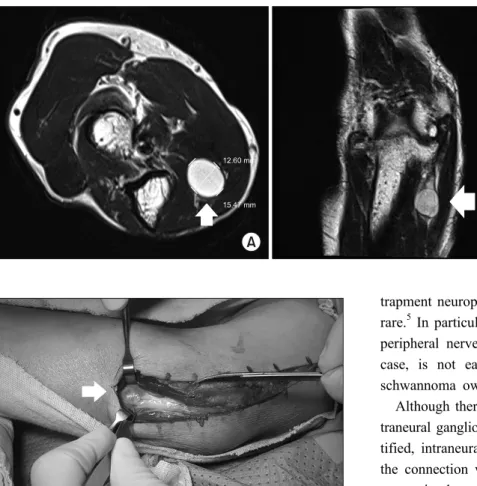
After a provisional diagnosis of ulnar neuropathy caused by a schwannoma or ganglion, magnetic resonance image was additionally performed. It showed a 1.5 × 1.3 × 4.6 cm space-occupying lesion 5 cm distal from the medial epi- condyle (Fig. 2).
Operative findings included a thickened ulnar nerve and
a cystic mass encased in the sheath compressing the ulnar
nerve in the distal site at the elbow (Fig. 3). Aspiration of
the cystic mass and surgical detachment of the cyst wall
강인현 외 3인: 신경내 결절종과 연관된 척골 신경병증의 초음파 진단
CLINICAL PAIN
99 Fig. 2. Magnetic resonance images show a 1.5 × 1.3 × 4.6 cm space- occupying lesion(arrow) 5 cm dis- tal from the medial epicondyle on transverse view (A) and coronal view (B).
Fig. 3. Operative findings include a thickened ulnar nerve and a cystic mass (arrow).
were performed. The mass was observed to continue to the elbow joint, indicating that the mass was an intraneural ganglion derived from the elbow. On pathological examina- tion, the isolated tissue was identified as a ganglion filled with mucous fluid in the cyst. Two weeks after the oper- ation, the numbness in the right hand had disappeared and sensation had returned to normal. The muscle weakness of the fourth and fifth fingers showed some improvement, but still existed.
DISCUSSION
Ganglion is the second most common tumor that causes entrapment neuropathy in the arm, occurring mainly in the joints or tendons and protruding and extending into the sur- rounding soft tissues.
4According to domestic reports, gan- glion occurs mainly in the carpal tunnel followed by the knee joint, foot joint, hand joint, and elbow joint, and en-
trapment neuropathy in the elbow caused by a ganglion is rare.
5In particular, ganglion, which exerts pressure on the peripheral nerves as well as the joints as in the present case, is not easily observed and may be mistaken as schwannoma owing to the location of the lesion.
Although there are disagreements about the cause of in- traneural ganglion because it has not yet been clearly iden- tified, intraneural ganglion is expected to occur owing to the connection with the surrounding joint or mucous sac or cystic degeneration of the fibrous supporting tissues around the nerve.
6Spinner et al. reported that intraneural ganglion occurs because of a conduit between the synovial joint and the articular branch of the cyst and the adjacent nerve owing to a capsular defect.
7In addition, in some in- traneural ganglion cases, the ganglion was linked to the surrounding joints,
8and the present case partially supports this hypothesis.
Surgery is the most preferred treatment for intraneural
ganglion with neurological symptoms such as paresthesia
or muscle weakness and includes aspiration, partial re-
section, and total resection. Complete resection of the cyst
is the most effective surgical treatment, but partial resection
may be considered if nerve tissue damage is a concern.
9In general, the prognosis after surgical treatment of intra-
neural ganglion is good, but intraneural ganglion recurred
in 30% of cases when only aspiration was performed.
10In
our case, detachment of the connected part to the cyst wall
and joint was performed along with aspiration to reduce the
risk of recurrence. Because of the short follow-up period,
recurrence could not be determined, but a low recurrence
rate was expected.
VOL. 19, NO. 2, 2020
CLINICAL PAIN