2011, Vol. 55, No. 5
Printed in the Republic of Korea
http://dx.doi.org/10.5012/jkcs.2011.55.5.781
Facile Synthesis of New Pyrazolopyrimidine Derivatives of Potential Biosignificant Interest
Aly A. Aly and Iman A. Gad El-Karim*
Chemistry Department, Faculty of Science, Benha University, Benha, Egypt.
*E-mail: [email protected]
(Received March 31, 2011; Accepted July 27, 2011)
ABSTRACT. An easy and efficient route for the synthesis of some imidazo[1,2-c]pyrazolo[4,3-e]pyrimidines 3-6, imidazo [1,2-c]pyrazolo[4,3-e]triazine 8, pyrazolo[4,3-e]triazolo[1,5-c]pyrimidines 12-15 and pyrazolo-[3',4':4,5]pyrimido[1,6-b]triazines 16, 17 was described through the reaction of readily available 5-aminopyrazole-4-carbonitrile 1 with different reagents. The in vitro antimicrobial activity of some synthesized compounds was examined. Most of the tested compounds proved to be active as antibacterial and antifungal agents.
Key words: Imidazole pyrimidine, Pyrazole and triazine
INTRODUCTION
Pyrazolopyrimidine and related heterocyles are found to possess wide applications in the field of medicine and agriculture. They are biologically active isomeric purine analogues and have useful properties as antimetabolites in purine biochemical reactions.1-3 They exhibit diversified pharmacological activities like tuberculostatic4 antimicro- bial activities,5 neuroleptic,6 CNS depressant,7 antihy- pertensive8 and antileishmanial.9 Moreover, the pyrazole ring has shown to be the basic moiety for a number of dyes, drugs and agrochemicals.10-14 Prompted by the var- ied biological activities of these heterocycles and as a part of our program aimed at developing new selective and environmentally friendly methodologies for the prepara- tion of heterocyclic compounds,15-17 we conducted the presented research to evaluate the potential of their anti- microbial activity. Herein, we found that 5-amino-1-(4- phenylphthalazin-1-yl)-1H-pyrazole-4-carbonitrile (1) is a highly versatile and useful building block for the syn- thesis of a wide range of pyrazolopyrimidine derivatives.
EXPERIMENTAL
Melting points were uncorrected. IR spectra in KBr were recorded on a Perkin-Elmer 298 spectrophotometer.
1H and 13C NMR spectra were obtained on a Varian Gem- ini 200 MHz instrument using TMS as internal reference with chemical shifts expressed as δ ppm. Mass spectra were recorded on a Shimadzu GCMS-QP 1000 instru- ment (70 eV EI mode).
5-Amino-1-(4-phenylphthalazin-1-yl)-1H-pyrazole- 4-carbonitrile (1)
A mixture of 1-hydrazinyl-4-phenylphthalazine (2.4 g, 6 mmol) and ethoxymethylenemalononitrile (0.64 g, 6 mmol) in absolute ethanol (40 mL) was heated at 80oC for 4 h in a water bath. The reaction mixture was cooled, poured into ice-cold water and the precipitated product was filtered off and recrystallized from ethanol to give 1.
Yield, 63%; m.p. 186-188oC; IR (KBr): υ 3410, 3200 (NH2), 2215 cm-1 (CN); 1H NMR (DMSO-d6): δ 6.40 (brs, 2H, NH2), 7.11-8.15 (m, 10H, ArH); Ms: m/z=312 (M+);
Anal. calcd for C18H12N6 (312.33): C, 69.22; H, 3.87; N, 26.91%. Found: C, 69.38; H, 3.99; N, 26.76%.
4-(4,5-Dihydro-1H-imidazol-2-yl)-1-(4-phenylphth- alazin-1-yl)-1H-pyrazol-5-amine (2)
To a mixture of 1 (1.6 g, 5 mmol) and ethylenediamine (4 mL) in absolute ethanol (15 mL), carbon disulfide (1 mL) was added dropwise. The reaction mixture was heated in a water bath for 10 h. After cooling, the reaction mixture was poured into ice-cold water and the solid precipitate was filtered off, washed with water and recrystallized from ethanol to give 2. Yield, 60%; m.p. 196-198oC; IR (KBr): υ 3430-3160 cm-1 (multiple bands, NH2, NH); 1H NMR (DMSO-d6): δ 3.30, 3.50 (2t, 4H, 2CH2), 6.30 (brs, 2H, NH2), 7.13-8.10 (m, 10H, ArH), 8.50 (s, 1H, NH, exchangeable); 13C NMR: δ=125.1, 127.2, 128.1, 129.3, 131.1, 134.2, 135.5 (C- of phenylphhthalzinyl moiety), 30.5, 44.3 (2 CH2), 76.3 (C-2 of imidazolyl moiety), 100.2 (C-4), 139.5 (C-3), 140.2 (C-5); Anal. calcd for C20H17N7
(355.40): C, 67.59; H, 4.82; N, 27.59%. Found: C, 67.70;
H, 4.98; N, 27.38%.
7-(4-Phenylphthalazin-1-yl)-6,7-dihydro-2H-imidazo [1,2-c]pyrazolo[4,3-e]pyrimidine-5(3H)-thione (3)
A mixture of 2 (0.7 g, 2 mmol) and carbon disulfide (5 mL) in dry pyridine was heated in a water bath for 20 h.
The reaction mixture was cooled and poured into ice-HCl.
The formed solid filtered off, washed with water and recrystallized from DMF to give 3. Yield, 57%; m.p. 280- 282oC; IR (KBr): υ 3210 (NH), 1265 cm-1 (CS); 1H NMR (CDCl3): δ 3.70-3.90 (2t, 4H, 2CH2), 7.01-8.12 (m, 10H, ArH), 8.51 (s, 1H, NH, exchangeable); Anal. calcd for C21H15N7S (397.46): C, 63.46; H, 3.80; N, 24.67%. Found:
C, 63.25; H, 3.59; N, 24.83%.
7-(4-Phenylphthalazin-1-yl)-3,7-dihydro-2H-imidazo [1,2-c]pyrazolo[4,3-e]pyrimidine (5)
A mixture of 2 (0.7 g, 2 mmol), triethyl orthoformate (4 mL) and glacial acetic acid (3 mL) was heated under reflux for 4 h. On cooling to room temperature, the solid precipitate that formed was filtered off and recrystallized from dioxane to give 4. Yield, 71%; m.p. 241-243oC; IR (KBr): υ 1610-1600 cm-1 (C=N); 1H NMR (CDCl3): δ 3.60- 3.90 (2t, 4H, 2CH2), 7.11-8.10 (m, 11H, ArH); Anal. calcd for C21H15N7 (365.39): C, 69.03; H, 4.14; N, 26.83%. Found:
C, 69.20; H, 4.25; N, 26.65%.
5-Phenyl-7-(4-phenylphthalazin-1-yl)-3,5,6,7-tetrahy- dro-2H-imidazo[1,2-c]pyrazolo[4,3-e]pyrimidine (6)
A mixture of 2 (0.7 g, 2 mmol) and benzaldehyde (0.2 mL) in absolute ethanol (20 mL) containing concentrated HCl (0.3 mL) was stirred at 70 oC for 6 h. After cooling the mixture was neutrallized with aqueous sodium carbonate solution. The solid product obtained was filtered off and recrystallized from n-butanol to give 6. Yield, 59%; m.p.
220-222oC; IR (KBr): υ 3215 (NH), 1610-1605 cm-1 (C=N);
1H NMR (CDCl3): δ 3.40-3.62 (2t, 4H, 2CH2), 4.36 (s, 1H, CH), 7.15-8.11 (m, 15H, ArH), 8.40 (s, 1H, NH, exchan- geable); Ms: m/z=443 (M+); Anal. calcd for C27H21N7
(443.50): C, 73.12; H, 4.77; N, 22.11%. Found: C, 73.26;
H, 4.98; N, 22.01%.
7-(4-Phenylphthalazin-1-yl)-3,7-dihydro-2H-imidazo [1,2-c]pyrazolo[4,3-e][1,2,3]- triazine (8)
A concentrated solution of HCl (6 ml) was added to a solution of 2 (0.7g, 2 mmol) in acetic acid (6 ml). The mix- ture was cooled to 0-5oC and sodium nitrite (1 g) was added gradually with stirring. The reaction mixture was left to stand in an ice bath for 2 h, then diluted with water,
filtered off, washed with water and recrystallized from DMF to give 8. Yield, 51%; m.p. 237-239oC; IR (KBr): υ 1605-1600 cm-1 (C=N); 1H NMR (DMSO-d6): δ 3.40, 3.70 (2t, 4H, 2CH2), 7.05-8.11 (m, 10H, ArH); Anal. calcd for C20H14N8 (366.38): C, 65.56; H, 3.85; N, 30.58%. Found:
C, 65.34; H, 3.61; N, 30.70%.
Ethyl N-4-cyano-1-(4-phenylphthalazin-1-yl)-1H- pyrazol-5-ylformimidate (9)
A mixture of 1 (3.1 g, 10 mmol), triethyl orthoformate (5 mL) and acetic anhydride (20 mL) was heated under reflux for 5 h. The solvent was removed under reduced pressure. The residue obtained was recrystallized from benzene to give 9.Yield, 67%; m.p. 217-219oC; IR (KBr):
υ 2217 cm-1 (CN); 1H NMR (DMSO-d6): δ 1.25 (t, 3H, CH3), 4.2 (q, 2H, CH2), 7.05-8.13 (m, 11H, ArH and CH=N);
Anal. calcd for C21H16N6O(368.39): C, 68.47; H, 4.38; N, 22.81%. Found: C, 68.30; H, 4.18; N, 22.97%.
4-Imino-1-(4-phenylphthalazin-1-yl)-1H-pyrazolo[3,4- d]pyrimidin-5(4H)-amine (10)
A mixture of 9 (3.7 g, 10 mmol) and hydrazine hydrate (2 mL) in ethanol (30 mL) was stirred for 1 h, at room tem- perature. The precipitate which formed was filtered off, washed with water and recrystallized from dioxane to give 10. Yield, 63%; m.p. 246-248oC; IR (KBr): υ 3375-3210 cm-1 (multiple bands NH2, NH); 1H NMR (DMSO-d6): δ 6.40 (brs, 2H, NH2), 7.10-8.13 (m, 11H, ArH), 8.95 (s, 1H, NH, exchangeable); Anal. calcd for C19H14N8 (354.37): C, 64.40; H, 3.98; N, 31.62%. Found: C, 64.25; H, 3.75; N, 31.86%.
General procedure for the preparation of 11a,b A mixture of 10 (0.7 g, 2 mmol) and aromatic aldehydes viz benzaldehyde and p-chlorobenzaldehyde (2 mmol) in absolute ethanol (25 mL) was heated under reflux for 5 h.
The precipitate formed was filtered off, washed with water and recrystallized from ethanol to give 11a,b.
N-Benzylidene-4-imino-1-(4-phenylphthalazin-1-yl)- 1H-pyrazolo[3,4-d]pyrimidin-5(4H)-amine (11a): Yield, 59%; m.p. 207-209oC; IR (KBr): υ 3210 cm-1 (NH); 1H NMR (CDCl3): δ 7.11-8.10 (m, 17H, ArH and CH=N), 8.70 (s, 1H, NH, exchangeable); Anal. calcd for C26H18N8 (442.47): C, 70.58; H, 4.10; N, 25.32%. Found: C, 70.63;
H, 4.21; N, 25.48%.
N-(4-Chlorobenzylidene)-4-imino-1-(4-phenylphthalazin-1- yl)-1H-pyrazolo[3,4-d]pyrimidin-5(4H)-amine (11b):
Yield, 61%; m.p. 231-233oC; IR (KBr): υ 3215 cm-1 (NH); 1H NMR (CDCl3): δ 7.14-8.12 (m, 16H, ArH and
CH=N), 8.65 (s, 1H, NH, exchangeable); Anal. calcd for C26H17ClN8 (476.92): C, 65.48; H, 3.59; N, 23.50%.
Found: C, 65.24; H, 3.40; N, 23.64%.
General procedure for the preparation of 12a-e A mixture of 10 (0.7 g, 2 mmol) and triethyl orthofor- mate or acetyl chloride or benzoyl chloride (2 mmol) in dry benzene (25 mL) was heated under reflux for 4 h. The solid formed was filtered off and recrystallized from diox- ane to give 12a-c. While a mixture of 10 (0.7 g, 2 mmol) and ethyl cyanoacetate or diethyl oxalate (2 mmol) in absolute ethanol (25 mL) was heated under reflux for 5 h.
The solid formed was filtered off and recrystallized from dioxane to give 12d,e respectively.
7-(4-Phenylphthalazin-1-yl)-7H-pyrazolo[4,3-e][1,2,4]tri- azolo[1,5-c]pyrimidine (12a): Yield, 70%; m.p. 251-253
oC; IR (KBr): υ 1610-1600 cm-1 (C=N); 1H NMR (CDCl3): δ 7.10-8.05 (m, 12H, ArH); Anal. calcd for C20H12N8 (364.36):
C, 65.93; H, 3.32; N, 30.75%. Found: C, 65.78; H, 3.20;
N, 30.87%.
2-Methyl-7-(4-phenylphthalazin-1-yl)-7H-pyrazolo[4,3- e][1,2,4]triazolo[1,5-c]pyrimidine (12b): Yield, 73%; m.p.
265-267oC; IR (KBr): υ 1605-1600 cm-1 (C=N); 1H NMR (DMSO-d6): δ 2.20 (s, 3H, CH3), 7.05-8.12 (m, 11H, ArH);
Anal. calcd for C21H14N8 (378.39): C, 66.66; H, 3.73; N, 29.61%. Found: C, 66.78; H, 3.96; N, 29.40%.
2-Phenyl-7-(4-phenylphthalazin-1-yl)-7H-pyrazolo[4,3- e][1,2,4]triazolo[1,5-c]pyrimidine (12c): Yield, 69%; m.p.
227-229oC; IR (KBr): υ 1610-1605 cm-1 (C=N); 1H NMR (CDCl3): δ 7.12-8.10 (m, 16H, ArH); Anal. calcd for C26H16N8 (440.46): C, 70.90; H, 3.66; N, 25.44%. Found:
C, 70.72; H, 3.51; N, 25.56%.
2-[7-(4-Phenylphthalazin-1-yl)-7H-pyrazolo[4,3-e][1,2,4]- triazolo[1,5-c]pyrimidin-2-yl]acetonitrile (12d): Yield, 74%;
m.p. 246-248oC; IR (KBr): υ 2218 cm-1 (CN); 1H NMR (CDCl3): δ 4.3 (s, 2H, CH2), 7.10-8.12 (m, 11H, ArH);
Anal. calcd for C22H13N9 (403.40): C, 65.50; H, 3.25; N, 31.25%. Found: C, 65.69; H, 3.41; N, 31.12%.
Ethyl 7-(4-phenylphthalazin-1-yl)-7H-pyrazolo[4,3-e]
[1,2,4]triazolo[1,5-c]pyrimidine-2-carboxylate (12e): Yield, 63%; m.p. 266-268oC; IR (KBr): υ 1730 cm-1 (CO); 1H NMR (DMSO-d6): δ 1.30 (t, 3H, CH3), 4.40 (q, 2H, CH2), 7.12-8.15 (m, 11H, ArH); Anal. calcd for C23H16N8O2 (436.43): C, 63.30;
H, 3.70; N, 25.68%. Found: C, 63.42; H, 3.93; N, 25.51%.
Ethyl 2-oxo-7-(4-phenylphthalazin-1-yl)-2H-pyrazolo [4,3-e][1,2,4]triazolo[1,5-c]-pyrimidine-3(7H)-carbox- ylate (14)
A mixture of 10 (0.7 g, 2 mmol) and ethyl chlorofor-
mate (5 mL) in dry benzene was heated under reflux for 8 h. On cooling, the solid obtained was recrystallized from dioxane to give 14. Yield, 65%; m.p. 263-265oC; IR (KBr):
υ 1730, 1680 cm-1 (CO); 1H NMR (CDCl3): δ 1.35 (t, 3H, CH3), 4.35 (q, 2H, CH2), 7.12-8.11 (m, 11H, ArH); Ms: m/
z=452 (M+); Anal. calcd for C23H16N8O3 (452.42): C, 61.06;
H, 3.56; N, 24.77%. Found: C, 61.20; H, 3.70; N, 24.54%.
7-(4-Phenylphthalazin-1-yl)-3,7-dihydro-2H-pyrazolo [4,3-e][1,2,4]triazolo[1,5-c]-pyrimidine-2-thione (15)
A mixture of 10 (0.7g, 2 mmol), carbon disulfide (3 mL) and potassium hydroxide (0.3 g) in ethanol (25 mL) was heated under reflux for 15 h. The solvent was removed under reduced pressure and the residue was acidified with acetic acid. The formed precipitate was filtered off and recrystallized from benzene to give 15. Yield, 54%; m.p.
272-274oC; IR (KBr): υ 3240 (NH), 1260 cm-1(CS); 1H NMR (DMSO-d6): δ 7.10-8.10 (m, 11H, ArH), 8.45 (s, 1H, NH, exchangeable); Anal. calcd for C20H12N8S (396.43):
C, 60.59; H, 3.05; N, 28.27%. Found: C, 60.71; H, 3.20;
N, 28.10%.
8-(4-Phenylphthalazin-1-yl)-2,8-dihydropyrazolo[3',4':
4,5]pyrimido[1,6-b][1,2,4]triazin-3(4H)-one (16) Method a: A mixture of 10 (0.7 g, 2 mmol) and ethyl chloroacetate (2 mmol) in ethanolic sodium ethoxide solution [prepared from sodium metal (46 mg) and absolute eth- anol (20 ml) was heated under reflux for 6 h. The reaction mixture was cooled, poured onto ice (25 g). The formed precipitate was filtered off and recrystallized from dio- xane to give 16. Yield, 63%.
Method b: A mixture of 10 (0.7 g, 2 mmol) and chlo- roacetyl chloride (2 mmol) in dry dioxane (25 mL) was allowed to stand overnight at room temperature. The formed precipitate was filtered off and recrystallized from diox- ane to give 16. Yield, 60%; m.p. 270-272oC; IR (KBr): υ 3220 (NH), 1670 cm-1(CO); 1H NMR (DMSO-d6): δ 3.80 (s, 2H, CH2), 7.13-8.14 (m, 11H, ArH), 8.50 (s, 1H, NH, exchangeable); Anal. calcd for C21H14N8O (394.39): C, 63.95; H, 3.58; N, 28.41%. Found: C, 63.76; H, 3.45; N, 28.59%.
8-(4-Phenylphthalazin-1-yl)-4,8-dihydropyrazolo[3',4':
4,5]pyrimido[1,6-b][1,2,4]triazin-2,3-dione (17) To a solution of 10 (0.7g, 2 mmol) in dry benzene (25 mL), oxalyl chloride (3 mL) was added and the reaction mixture was heated under reflux for 10 h. On cooling the formed solid product was filtered off and recrystallized from DMF to give 17. Yield, 55%; m.p. 226-228oC; IR
(KBr): υ 3230 (NH), 1675-1670 cm-1 (CO); Ms: m/z = 408 (M+); Anal. calcd for C21H12N8O2 (408.37): C, 61.76;
H, 2.96; N, 27.44%. Found: C, 61.54; H, 2.81; N, 27.56%.
RESULTS AND DISCUSSION
The condensation of 1-hydrazinyl-4-phenylphthalazine with ethoxymethylene-malononitrile in absolute ethanol afforded the target compound, 5-amino-1-(4-phenylph- thalazin-1-yl)-1H-pyrazole-4-carbonitrile (1), Scheme 1.
The IR spectrum of 1 showed absorption bands in the regions 3410, 3200 and 2215 cm-1 for amino and nitrile groups. The 1H NMR spectrum of 1 showed signals at δ 6.40 ppm for amino group and aromatic multiplet in the region at δ 7.11-8.15 ppm. In addition, their mass spec- trum revealed the corresponding molecular ion peak for the molecular formula C18H12N6. The reaction of 1 with ethylenediamine in the presence of a catalytic amount of carbon disulfide furnished 4-(4,5-dihydro-1H-imidazol-2- yl)-1-(4-phenylphthalazin-1-yl)-1H-pyrazol-5-amine (2).
The structure of 2 was deduced from their elemental anal- yses and spectral data. Its IR spectrum showed multiple absorption bands in the region 3430-3160 cm-1 due to NH2 and NH groups and devoid any absorption band due to nitrile group.
Poly-functionalized heterocyclic compounds play impor- tant role in the drug industry and represent 68% of the drugs on the market.18 Therefore; it is not surprising that synthesis of poly-functionalized heterocyclic compounds
has received significant attention. In that direction, we carried out the reaction of 2 with carbon disulfide in dry pyridine to afford the imidazo[1,2-c]-pyrazolo[4,3-e]pyri- midine derivative 3. Alternative approaches for other imi- dazopyrazolopyrimidine derivatives 5,6 can be achieved through the reaction of 2 with triethyl orthoformate and/or benzaldehyde, respectively. When the pyrazole derivative 2 was treated with sodium nitrite in acetic acid, it yielded one isolable product which was analyzed correctly for C20H14N8. The structure of the isolated product was assigned as 7-(4-phenylphthalazin-1-yl)-3,7-dihydro-2H-imidazo[1,2- c]pyrazolo[4,3-e][1,2,3]triazine (8) based on its elemen- tal analysis and spectral data, Scheme 1. Its IR spectrum was free of amino and NH absorption bands in the region 3450-3000 cm-1. In further exploratory studies, we observed that the condensation of 1 with triethyl orthoformate in refluxing acetic anhydride yielded formimidate deriva- tive 9, which underwent further cyclization upon treat- ment with hydrazine hydrate at room temperature affording 4-imino-1-(4-phenylphthalazin-1-yl)-1H-pyrazolo[3,4-d]
pyrimidin-5(4H)-amine (10). The structure of 10 was established on the basis of IR spectrum which showed the absence of any absorption band for nitrile group, Scheme 2. The reactivity of compound 10 towards some carbon electrophiles was also investigated. Thus, when compound 10 was treated with aromatic aldehydes viz benzaldehyde
Scheme 1. i) H2N(CH2)2NH2, CS2; ii) CS2; iii) HC(OEt)3; iv) PhCHO; v) NaNO2/HCl, AcOH.
Scheme 2. i) HC(OEt)3, AC2O; ii) N2H4.H2O; iii) RCHO; iv) HC(OEt)3 or CH3COCl or PhCOCl or NCCH2CO2Et or (COOEt)2; v) 2 ClCO2Et.
and p-chlorobenzaldehyde it afforded the corresponding pyrazolo[3,4-d]pyrimidine derivatives 11a,b, respectively.
The next goal was the synthesis of derivatives of another heterocyclic systems of pyrazolo[4,3-e][1,2,4] triazolo [1,5-c]pyrimidines and pyrazolo[3',4':4,5]pyrimido[1,6-b]tri- azin-3-(4H)-ones. Thus, the reaction of 10 with triethyl orthoformate or acetyl chloride or benzoyl chloride or ethyl cyanoacetate or diethyl oxalate afforded the substi- tuted triazolo[1,5-c]pyrimidine derivatives 12a-e, respec- tively. Next, the treatment of 10 with two moles of ethyl chloroformate in dry benzene afforded the ester deriva- tive 14. Formation of 14 was assumed to proceed via the intermediate bis(ethoxycarbonyl) derivative 13, which cyclized into 14 with elimination of ethanol molecule, Scheme 2.
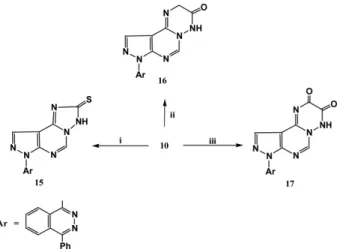
Also, the treatment of 10 with carbon disulfide in alco- holic potassium hydroxide solution gave pyrazolo[4,3- e][1,2,4]triazolo[1,5-c]pyrimidine-2-thione derivative 15, Scheme 3.
As an extension of this synthetic route, the behavior of
compound 10 for construction of polyfunctionally sub- stituted bioactive triazine derivatives19,20 was investigated.
Thus, the interaction of compound 10 with ethyl chloro- acetate in ethanolic sodium ethoxide solution afforded pyrimidotriazine derivative 16. Compound 16 was alter- natively obtained by an independent synthesis via treat- ment of compound 10 with chloroacetyl chloride in dry dioxane. Similarly, when compound 10 was subjected to react with an equimolar amount of chloroacetyl chloride in dry benzene, it furnished pyrimidotriazin-2,3-dione deriv- ative 17, Scheme 3. The structures of the synthesized com- pounds were assigned on the basis of elemental analysis and spectral data. (cf. experimental).
ANTIMICROBIAL ACTIVITY
The antimicrobial activities of some synthesized com- pounds were determined in vitro using the hole plate and filter paper methods21 against Gram-positive bacteria (Staphylococcus aureus) and Gram-negative bacteria (Escherichia coli) in addition to some fungal plant patho- gen (Aspergillus flavus and Candida albicans). Also, a comparison between the activity of our synthesized com- pounds and standard drugs (Tetracycline, Amphotericin B) was carried out. The tested compounds were dissolved in dimethyl sulfoxide (DMSO) to obtain 1 mg/mL solu- tion. DMSO alone showed no inhibition zone. The inhi- bition zones of microbial growth produced by different compounds were measured in millimeters at the end of an incubation period of 48 h at 28oC. As can be seen from Table 1, good to improved antibacterial and antifungal activity was observed for most of the tested compounds against the selected micro-organisms used in the study.
In conclusion, we have been able to describe convenient protocols for the preparation of a number of annulated Scheme 3. i) CS2; ii) ClCH2CO2Et or ClCOCH2Cl; iii) ClCO-
COCl.
Table 1. The antimicrobial activity of tested compounds
Compound No Staphylococcus aureus Escherichia coli Aspergillus flavus Candida albicans
2 15 14 -- --
3 16 22 15 14
6 13 15 -- --
8 13 15 -- --
10 14 15 -- 12
12a 17 18 19 10
12d 23 19 12 14
14 28 14 10 11
15 29 18 12 10
17 24 17 13 11
Tetracycline 28 32 -- --
Amphotericin B -- -- 15 17
pyrazolopyrimidine derivatives, which exhibited good to excellent antimicrobial activity against most of the tested strains.
REFERENCES
1. Tollefson, M. B.; Acker, B. A.; Jacobsen, E. J.; Hughes, R. O.; Walker, J. K.; Fox, D. N. A.; Palmer, M. J.; Free- man, S. K.; Yu, Y. Bond, Bioorg. Med. Chem. Lett. 2010, 20(10), 3120.
2. Kumar, R.; Joshi, Y. C. Indian. J. Chem. Sect. B 2010, 49B(1), 84.
3. Ivachtchenko, A. V.; Dmitriev, D. E.; Golovina, E. S.;
Dubrovskaya, E. S.; Kadieva, M. G.; Koryakova, A. G.;
Kysil, V. M.; Mitkin, O. D.; Tkachenko, S. E.; Okun, I.
M.; Vorobiov, A. A. Bioorg. Med. Chem. Lett. 2010, 20(7), 2133.
4. Bakavoli, M.; Bagherzadeh, G.; Vaseghifar, M.; Shiri, A.;
Pordel, M.; Mashreghi, M.; Pordeli, P.; Araghi, M. Eur. J.
Med. Chem. 2010, 4(2), 647.
5. Curran, K. J.; Verheijen, J. C.; Kaplan, J.; Richard, D. J.;
Toral-Barza, L.; Hollander, I.; Lucas, J.; Ayral-Kaloustian, S.; Yu, K.; Zask, A. Bioorg. Med. Chem. Lett. 2010, 20(4), 1440.
6. Kim, I.; Song, J. H.; Park, C. M.; Jeong, J. W.; Kim, H.
R.; Ha, J. R.; No, Z.; Hyun, Y. L.; Cho, Y. S.; Kang, N.
S.; Jeon, D. J. Bioorg. Med. Chem. Lett. 2010, 20(3), 922.
7. Bakavoli, M.; Bagherzadeh, G.; Vaseghifar, M.; Shiri, A.;
Pordel, M.; Mashreghi, M.; Pordeli, P.; Araghi, M. Eur. J.
Med. Chem. 2010, 45(2), 647.
8. Ali, H. I.; Fujita, T.; Akaho, E.; Nagamatsu, T. Molecular Design 2010, 24(1), 57.
9. Schenone, S.; Brullo, C.; Bruno, O.; Bondavalli, F.; Mosti, L.; Maga, G.; Crespan, E.; Carraro, F.; Manetti, F.; Tin- tori, C.; Botta, M. Eur. J. Med. Chem. 2008, 43(12), 2665.
10. Rana, P. B.; Patel, J. A.; Mistry, B. D.; Desai, K. R. Indian.
J. Chem. Sect. B 2009, 48B(11), 1601.
11. Gilbert, A. M.; Nowak, P.; Brooijmans, N.; Bursavich, M.
G.; Dehnhardt, C.; Santos, E. D.; Feldberg, L. R.; Hollander, I.; Kim, S.; Lombardi, S.; Park, K.; Venkatesan, A. M.;
Mallon, R. Bioorg. Med. Chem. Lett. 2010, 20(2), 636.
12. Verheijen, J. C.; Richard, D. J.; Curran, K.; Kaplan, J.; Lefe- ver, M.; Nowak, P.; Malwitz, D. J.; Brooijmans, N.; Toral- Barza, L.; Zhang, W.-G.; Lucas, J.; Hollander, I.; Ayral-Kalous- tian, S.; Mansour, T. S.; Yu, K.; Zask, A. J. Med. Chem.
2009, 52(24), 8010.
13. Karci, F.; Karci, F. Dyes and Pigments 2008, 76(1), 147.
14. Brough, P. A.; Barril, X.; Beswick, M.; Dymock, B. W.;
Drysdale, M. J.; Wright, L.; Grant, K.; Massey, A.; Surgenor, A.; Workman, P. Bioorg. Med. Chem. Lett. 2005, 15(23), 5197.
15. Aly, A. A. Curr. Org. Chem. 2009, 13, 1758.
16. El Ashry, E. S. H.; Aly, A. A.; Aouad, M. R.; Amer, M.
R. Nucleosides, Nucleotides Nucleic Acids. 2010, 29, 698.
17. Aly, A. A. J. Heterocycl. Chem. 2008, 45(4), 993.
18. Dömling, A. Chem. Rev. 2006, 106(1), 17.
19. Zhou, Y.; Liu, G.; Chen, J.; Reddy, P. S. M. M.; Yoon, I.
S.; Zhang, M.; Zhang, B.; Barber, J. R.; Ng, S. C. Bioorg.
Med. Chem. Lett. 2009, 19(21), 6114.
20. Sztanke, K.; Markowski, W.; Œwieboda, R.; Polak B.
Eur. J. Med. Chem. 2010, 45(6), 2644.
21. Leiferet, C.; Chidbouree, S.; Hampson, S.; Workman, S.;
Sigee, D.; Epton, H. A.; Harbour, A. J. Appl. Bacteriol.
1995, 78, 97.