JoumoloftheKorean Clwnicai Soriety 2000, vol. 44, No. 3
Printed in tfre Republic of Korea
A Practice and Evaluation of New In-Service Training Program for Science Teachers about Computer Inquiry Experiments Using
Interface and Probes in Chemistry
Jongbaik Ree*, Jongwon Park, Heegyun Oh, and Kyunghwan Mooni Depament
of
Science Education, College of Education,Chonmzm National Universiy, Kwangju 5G0757 Korea
‘Depament of Chemistry Graduate School, Chonnam National University, Kwan~”u 500-757 Korea
(Received July 21, 1999)
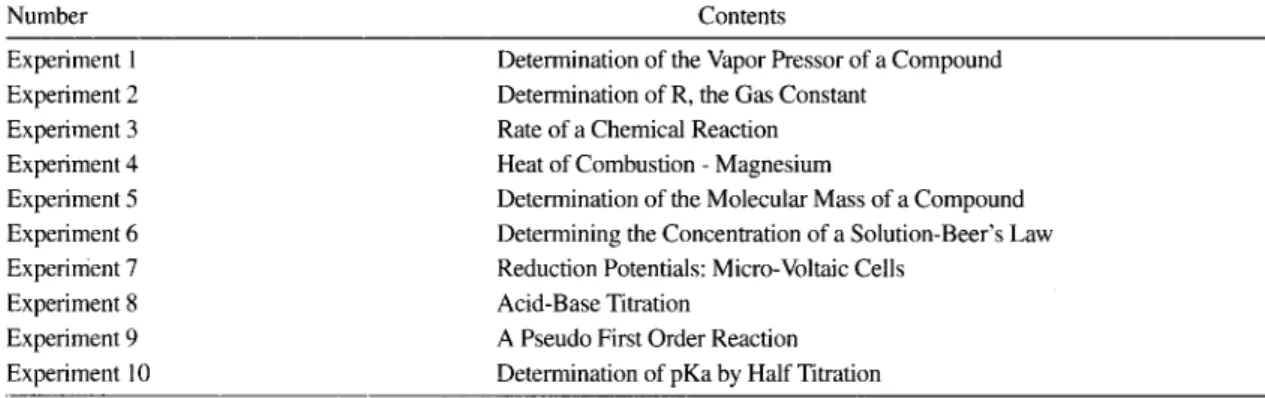
using computer interface and probes for science teachers. The purposes of the training program are the improvement of scientific inquiry teaching ability in chemistry, the understamhng of scientific concepts, inquiry skills, and the computer manipulation ability. This training program consists of ten experiments using computer interface and various kinds of probes. Before practicing, the program was tested and modified by 9 science teachers. Then, 27 science teachers participated in the 5 days of in-service training, which ran for three hours a day. The questionnaire for investigating the effectiveness of the program after the training showed that many teachers (1) voluntarily participated in this program with intemaf motivation, (2) were satisfied with the level of program difficulty, professionalism of lecturer, and classroom environment, (3) gave positive responses about the achievement of the purposes of this program, (4) showed strong intention for applying this program to their school teaching.
.
—— 1
Fig. 1. Science Workshop demonstration.
Table 1.Contents of computer inquiry experiments using interface
Number Contents
Experiment 1 Experiment 2 Experiment 3 Experiment 4 Experiment 5 Experiment 6 Experiment 7 Experiment 8 Experiment 9 Experiment 10
Determination of the Vapor Pressor of a Compound Determination of R, the Gas Constant
Rate of a Chemical Reaction Heat of Combustion - Magnesium
Determination of the Molecuku Mass of a Compound Determining the Concentration of a Solution-Beer’sLaw Reduction Potentials: Micro-Voltaic Cells
Acid-Base Titration
A Pseudo First Order Reaction Determination of pKa by Half Titration
Journal of the Korean Chemical Society
zHH ?]Ebi]”kx+ 4!’;%014Y4%%
%T~% ‘+ +
261Table 2, Questionnaire for evaluation of in-service training programme
Category Content Item #
Gender 1
Teaching years 2
Background
major 3
status of school(middle or high school) 4
Participation Motivation motivation for participation 5
appropriateness of training coume fee 6
appropriateness of training course time 7
Curriculum appropriateness of training course time according to the contents 8
appropriateness of difficultylevel 9
contents being difticult to understand 10
interests about curriculum 11
professionality of lecturer 14
Instruction appropriateness of teaching method 15
Process interaction between lecturer and student teachers 16
interaction between student teachers 17
comfortableness of Iearnirw environment 18
learning aids from training course 13
degree of satisfaction 19
Effects improvement of computer manipulation skill 20
improvement of understanding of scientific concepts and inquiry ability 21
improvement of scientific inquiry teaching skill 22
applicability to school teaching 12
Application application plan toschoolteaching 23
conditions for application to school teaching 24
262 %&W&i.N$%iE . %%3% . X52&?
Table 3.Backgrounds of participants (N=27)
Status of school Major Teaching Years
middle high Phy. Chem. Bio. Earth 1-5 6-10 11-15 16-20 20 more
33% 67% 52% 31% 1170 6% 22% 14% 31% 2270 1170
Pfdtcbmxltwiv%liin
Wn,wtsm ,“ml!,y
Fig, 2. Participation motivation.
-.—-.—
hstruclulnmocem [Omllclmt(w)
,Dr. -... . ... ..— .- . ..- .- —.- .-. -. ———. —.— .—.
E ’& adl.,
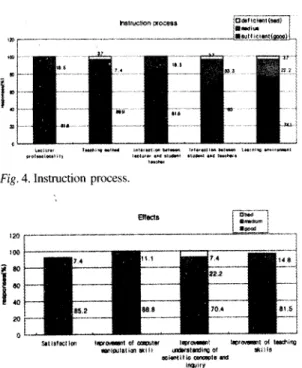
Fig, 4.Instruction process.
L~
.5=-.Elmcm
mm. 1
,~ —--- ,—— -- —. —. —_. ———. — mm-- -—.
1
.
Sltl,fwl.m Mw3mml ofwt% ImmamtIwo.lwll 01twhm
mallil!!*t,al *I 11 Ic4mlaaw 01 *II M
-lull tl 10-+* aw
ha!,,”
Fig. 5.Effects of training course.
Table 4.Learning Benefits form Training Course
Learning Aids form Training Course No. of Responses
*Atm]icabilitv to school teachirw 12(44%)
1.
I found the new method for teaching experiment. 3(11%)
I could obtain new experimental results which could not be obtained in usual school experiments. 6(22%) 1 realized the utilization of interface and probes to school experiment 2( 7%)
I drilled new teaching strategy 1( 4%)
*Improvemem of understanding of chemistry concepts 7(26%)
Interests about chemistry are increased 1( 4%)
I could understand chemical concepts. 4(15%)
Experiment could confirm the theoretical concepts. 2( 7%)
*Recognization of the new experimental method 9(33%)
I reahzed new inquiry method using interface and probes 3(11%)
I ex~enenced alternative experimental method. 2( 7%)
I made a new experience. 2.( 7%)
I could find new and various experimental techniques. 2( 7%)
2000,Vol.44, No. 3
WI
Fig. 6, Applicability,
Table5.Plan of application to school teaching
——
Plan of .4pplication No. of Responses
for science class, outdoor classroom activities, or special class 12(44%)
as a demonstration for classroom teaching 5(19%)
for showing detailed and exact graph 3(11%)
to provoke interests 1( 4%)
to use to special experiment of which results cannot be obtained easily 1( 4%)
Table 6. Conditions for application to school teaching (N=27)
Conditions for Application No, of Responses
sufficient hardware and software 18(67%)
various and concrete teaching materials 4(15%)
deep knowledge in major 3(11%)
rnoditication of’the number of students in a class and lesson hour 2( 7%)
improvement of teachers’ ability and necessity of in-service training 1( 4%)
development of method to visualize data using computer 1( 4%)
Journal ofthe Korean Chemical Socie~
2000, V(J 44, No, 3