• 검색 결과가 없습니다.

Journal of Korean Biological Nursing Science

N/A
N/A
Protected

Academic year: 2021

Share "Journal of Korean Biological Nursing Science"

Copied!
6
0
0

로드 중.... (전체 텍스트 보기)

전체 글

(1)

INTRODUCTION

1. Research Necessity

Adolescence is a crucial and transition period from childhood to adulthood. Adolescence experience changes in physical and mental ca- pabilities [1]. In physiological maturation, secondary sex-characteristics are appeared by hormonal changes and body size is increased. Mean- while, adolescence is emotional sensitive period so emotional response is delicate, flexible [2,3]. Thus, the adolescents appear prominent tenden- cies toward risk-taking, sensation-seeking, and reckless behaviors (e.g., experimentation with alcohol and smoking) [3,4].

National survey on drug use and health (NSDUH) [6] reported 11.6%

of adolescent aged 12 to 17 had experiences of alcohol use. Furthermore, binge drinking and heavy drinking rates were reported 6.2% and 1.2%, re- spectively. Alcohol use during adolescence is more harmful in cognitive

function than the adulthood because cortico-limbic regions (e.g., hippo- campus) are developed through neuronal plasticity during in this period [1,7]. In alcohol used adolescence, hippocampal volume as well as verbal and learning and memory function were diminished significantly [8,9].

In adolescence animal model, intermittent ethanol exposure caused in- flammatory damage in prefrontal cortex and hippocampus and impair- ment of short-term memory, long-term memory and motor function [10].

Hippocampus plays important role in the learning and memory. Hip- pocampal neuroplasticity is regulated by neurotrophic factors, such as brain-derived neurotrophic factor (BDNF), nerve growth factor (NGF), neutrophin-3 (NT-3). BDNF is the most abundant factor in hippocam- pus [11,12]. BDNF is a major regulator of synaptic transmission, play a role in plasticity such as long-term potentiation (LTP) [12] and regulated by cAMP response element-binding (CREB), c-fos that are known as transcription factors [13,14].

Effect of Environmental Enrichment on Cognitive Impairment- induced by Ethanol Exposure in Adolescent Rat

Yoon Ju Kim

1

, Jong Min Park

1,2

, Min Kyung Song

1

, Ho Hyun Seong

1

, Youn Jung Kim

1,3

1

College of Nursing Science, Kyung Hee University, Seoul;

2

Department of Nursing, Gyeongbuk College of Health;

3

East-west Nursing Research Institute, Kyung Hee University, Seoul, Korea

Purpose: Adolescents who experienced the alcohol consumption have gradually increased. Adolescence is a critical period of the neu- ral plasticity in the brain. Neural plasticity is mediated by neurotrophins and has an impact on cognitive function. Environmental en- richment ameliorates the cognitive function and increases neurotrophins. Thus, we investigated the neuroprotective effect of environ- mental enrichment on ethanol induced cognitive impairment in adolescent rats. Methods: The ethanol groups and the controls groups were injected with ethanol (0.5g/kg) and phosphate buffered saline, respectively, through intraperitoneal from 28th day of birth for 11 days. The environmental enrichment groups were provided larger cages containing toys than the standard cage . Passive avoidance test and Y-maze test were performed to evaluate the spatial memory. Results: Environmental enrichment+ethanol group showed higher alterations than the standard environment+ethanol group in Y-maze test (p< .05). In hippocampus, The environmen- tal enrichment+ethanol group showed significantly higher level of the number of c-fos positive celsl and density of tropomyosin re- ceptors kinase B receptor than the standard environment+ethanol group (p< .05). Conclusion: So, we suggested that the environ- mental enrichment played a role as a prophylaxis for prevention of memory impairment induced by ethanol exposure in adolescence.

Key Words: Environmental enrichment, Ethanol, Cognition, Adolescent 국문주요어: 풍요로운 환경, 에탄올, 인지, 청소년

Corresponding author: #

College of Nursing Science, Kyung Hee University # 1 Hoegi-Dong, Dongdaemun-gu, Seoul 02447, Korea Tel: +82-2-961-0311 Fax: +82-2-961-9398 E-mail: [email protected]

* This work was supported by National Research Foundation of Korea (NRF) funded by the Ministry of Education, Science and Technology (NRF-2014R1A2A2A01007909).

Received: October 31, 2016 Revised: November 21, 2016 Accepted: November 22, 2016

This is an Open Access article distributed under the terms of the Creative Commons Attribution Non-Commercial License (http://creativecommons.org/licenses/by-nc/4.0) which permits

unrestricted non-commercial use, distribution, and reproduction in any medium, provided the original work is properly cited.

(2)

Environmental enrichment (EE) is housing condition that promotes enhanced sensory, cognitive, motor, social stimulation compare to the standard housing condition [14]. EE exposure has been reported to in- crease brain neurotrophins. Especially, BDNF level in hippocampus was significantly higher in EE group than the standard environment group [11,14].

Neuroprotective effect of EE in cognitive function have been reported in various neuronal disease such as Alzheimer’s disease [15,16]; Parkin- son’s disease [17]; Attention Deficit Hyperactivity Disorder (ADHD) [18]. However, there is little known about the effect of EE in ethanol-in- duced cognitive impairment. In the present study, we conducted to con- firm the neuroprotective effect of EE on ethanol-induced cognitive im- pairment in adolescence.

2. Research Purpose

The purpose was to investigate the effect of EE on cognitive impair- ment in ethanol-induced cognitive impairment in adolescent rats. The specific purposes in the study are as follows:

1) Evaluates the effect of EE on spatial memory using behavior tests in ethanol exposed adolescent rats.

2) Evaluates the effect of EE on neuroplasticity mediating factor levels in hippocampus in ethanol exposed adolescent rats.

MATERIALS and METHODS

1. Experiment Design

The number of animals in each group was as follows: (1) SE+PBS group (n=12); (2) SE + EtOH group (n=12); (3) EE+PBS group (n=16);

(4) EE+EtOH group (n=16)(Figure1). EE groups were provided the large cage (75x45x25cm) containing tunnels, platforms, toys (e.g., toy balls, colorful plastic or wooden blocks), running wheels to stimulate learning, memory, sensory and motor function, and social interactions. We re- placed old toys with new toys once a week. And new toys were selected with different shape or size or color or texture from old toys because of

frequent changes of toys facilitate neural activity [20]. On the 28th days of birth, the ethanol was administered by intraperitoneal injection for 11days, dose of 0.5g/kg. Meanwhile, the control groups were received isovolumetric phosphate buffered saline (PBS) injections to maintain equivalent experiment conditions. The experiment was performed in accordance with the animal experimentation of ‘K’ University in Korea, and NIH guide for the care and use of laboratory animals.

2. Animals

The four pregnant rats of the Sprague-Dawley (Orient Bio, Seongnam, Korea) were obtained after timed mating. At two days before delivery, two of pregnant rats were moved into EE cage (n=2) and the others were re- mained in standard environment (SE) (n=2) randomly. All of animals were housed in a temperature (23± 2˚C), humidity (50-55%), light (12h light-dark cycle)-controlled environment with access to food and water ad libitum

3. Methods 1) Y-maze test

Y-maze test is used to assesses short-term spatial memory in rodents.

The maze was made of wood and 3 arms were positioned at equal an- gles. The serial arm entries were recorded for 5 min. Passing by half of the arm was recorded as entry. Alternation was considered as non-over- lapping triplet set entries. The test was executed on the 39th day of birth.

Alteration rates were calculated with followed formula, ‘Percentage of al- ternation (%) = (alternation / total number of arm entries- 2) × 100’.

Closer to 100% alteration percentage of rat it means spatial memory function is better than lower alteration rat.

2) Passive-avoidance test

In rodent, passive avoidance test is a popular and easily used behavior test measuring long-term memory related to hippocampus function [20].

The apparatus consisted of light and dark acryl compartment. These two

compartments were separated with a guillotine door. During the acquisi-

tion trial, rats were placed in the light compartment for 10s of habituation

and guillotine door was opened. Immediately after rat entered the dark

compartment, door was closed meanwhile electrical shock delivered

(0.75mA, 50Hz) for 2 s through stainless steel floor. 24h later, the retention

test was proceeded. The latency time until entering the dark compartment

was measured without electrical shock. The maximum latency time was

600s. The test was executed on the 39th day of birth after Y-maze test. The

Figure 1. Design of experiment.

(3)

latency time positively correlates with long-term memory [20].

3) Immunohistochemistry

Using immunohistochemical techniques, we evaluated c-fos and CREB expression in hippocampus. c-fos and CREB are transcription factors that bind to DNA and regulate BDNF expression. Animals were sacrificed un- der anesthesia. Then, animals were perfused and immersed with ice-cold PBS followed by 4% paraformaldehyde in 0.1M phosphate buffer (pH 7.4).

Fixed brain tissues were storage in the sucrose solution for 3days on 4˚C.

Serial coronal sections of brains were cut into 40um thick with a microtome (CM3050S, Leica, Nussloch, Germany) and were immersed in storing solu- tion. The brain sections were incubated in the primary antibody c-fos (1:1000; Santa Cruz Biotechnology, Santa Cruz, CA, USA) and phospho- CREB (1:1000; Millipore, Temecula, CA, USA) for 24h. Then sections were washed with PBS and incubated in a biotinylated anti-rabbit secondary an- tibody (1:400; Vector Laboratories, Brulingame, CA, USA) for 1hr. Next, the sections were incubated in avidin–biotin–peroxidase complex (Vector Laboratories, Brulingame, CA, USA) for 1hr. For the developing of color, 0.4% diaminobenzidine (Vector Laboratories, Brulingame, CA, USA) was used as the chromogen. The number of c-fos and phospho-CREB positive cells in the hippocampus was measured with image analysis system (Im- agePro Plus, Media Cyberbetics Inc., Silver Spring, MD, USA).

4) Western blot

The BDNF and trkB protein levels in hippocampus were evaluated by western blot. Increased expression of BDNF and trkB indicate the hippo- campal synaptic plasticity and LTP. Hippocampal tissues were homoge-

nized in a lysis buffer (iNtRON Biosystems, Seongnam, Korea). Proteins were resolved by 10% sodium dodecyl sulfate (SDS) polyacrylamide gels and electro-transferred onto a nitrocellulose membrane. The membranes were blocked with 5% skim milk in Tris-buffered saline, 0.1% Tween 20 (TBST). Membranes were then incubated with anti-BDNF (1:1000; Santa Cruz Biotechnology, Santa Cruz, CA, USA) and anti-trkB (1:1000; Cell Signaling Technology, Beverly, MA, USA) for a day. Membranes were in- cubated for 2h with horseradish peroxidase conjugated secondary anti- body (anti-rabbit antibody, 1:5000, Molecular Probes, Eugene, OR, USA) in 5% skim milk in TBST and developed using enhanced chemilumines- cence western blotting detection system (SuperSignal West Pico, Thermo Scientific, Rockford, IL, USA). The relative optical densities of the bands visible on X-ray film were scanned and digitized by Image J 1.42q soft- ware (NIH, Bethesda, MD, USA). All relative intensities were normalized to β-actin expression in the same sample.

4. Statistical Analysis

Statistical analyses were performed by SPSS 22.0. All data were pre- sented as mean ±SE. Statistical comparison processed with one-way ANOVA, followed by Tukey post-hoc test for comparisons among groups. The p<.05 was used as the criterion for statistical significance.

RESULT

1. Environmental enrichment protected memory impairment induced by ethanol exposure

The Y-maze and passive avoidance test were employed to evaluate the

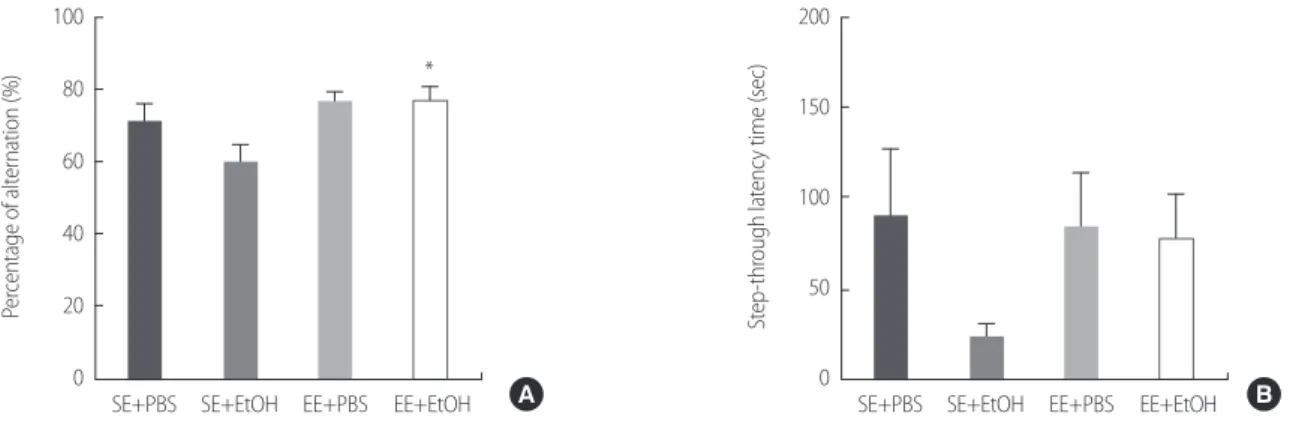
Figure 2. Improvement of cognitive function by environmental enrichment in ethanol exposure induced cognitive impairment adolescent rat on behavior test. Result of Y-maze test is shown in (a). Result of Passive avoidance test is shown in (b). Data are expressed as mean± SE. *p< .05 com- pared to the SE+EtOH group.

SE, Standard Environment; EE, Enriched Environment; PBS, Phosphate Buffered Saline; EtOH, Ethanol.

200

150

100

50

0

St ep -thr ough la tenc y time (sec)

SE+PBS SE+EtOH EE+PBS EE+EtOH B 100

80

60

40

20

0

Per cen tage of alt er na tion (%)

SE+PBS SE+EtOH EE+PBS EE+EtOH A

*

(4)

memory function of all the rats. The result of Y-maze test showed that EE+EtOH group (77.10±9.30) had significantly higher percentage of al- ternation compare to the SE+EtOH group (60.28±11.61) (p<.05) (Fig- ure 2A). The passive avoidance test showed a difference without signifi- cance between SE+EtOH group (25.00 ±5.47) and EE+EtOH group (79.71± 20.63) (Figure 2B).

2. Environmental enrichment enhanced c-fos expression in hippocampus

To investigate the transcriptional factor affecting the expression of BDNF, we performed the immunostaining of c-fos and phospho-CREB.

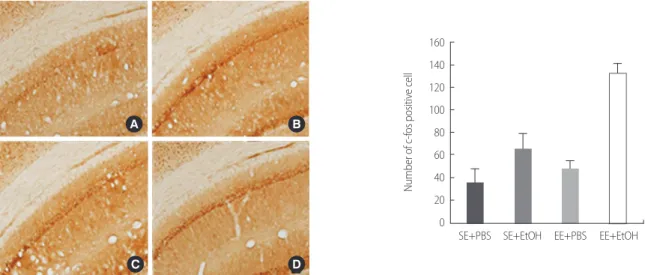
The number of c-fos positive cell in the EE+EtOH (131.50±15.89) group was significantly increased than the SE+EtOH group (65.17±32.95) (p<.05) (Figure 3). However, the phospho-CREB positive cells in SE+EtOH (61.33±

8.24) group was a lot more than the EE+EtOH (58.67±6.00) (Figure 4).

A B

C D

160 140 120 100 80 60 40 20 0

Number of c-f os positiv e c ell

SE+PBS SE+EtOH EE+PBS EE+EtOH

Figure 3. Immunostaining of c-fos in hippocampus CA1 in ethanol exposure induced cognitive imparement adolescent rat. Sections were stained for c-Fos-positive cells (reddish brown). Scale bar represents 100 um. (A) SE+PBS, (B) SE+EtOH, (C) EE+PBS and (D) EE+EtOH group. Data are ex- pressed as mean± SE. *p< .05 compared to the SE+EtOH group.

SE, Standard Environment; EE, Enriched Environment; PBS, Phosphate Buffered Saline; EtOH, Ethanol.

A B

C D

80 70 60 50 40 30 20 10 0

Number of c-f os positiv e c ell

SE+PBS SE+EtOH EE+PBS EE+EtOH

Figure 4. Immunohistochemistry of phospho-CREB in hippocampus CA1 in ethanol exposure induced cognitive impairment adolescent rat. Scale bar represents 100 um. (A) SE+PBS, (B) SE+EtOH, (C) EE+PBS and (D) EE+EtOH group. Data are expressed as mean± SE. *p< .05 compared to the SE+EtOH group.

p-CREB, phosphor-CREB; SE, Standard Environment; EE, Enriched Environment; PBS, Phosphate Buffered Saline; EtOH, Ethanol.

(5)

3. Environmental enrichment increased trkB expression in hippocampus

Neural plasticity is influenced by several neurotrophic factors, one of the factors is BDNF.

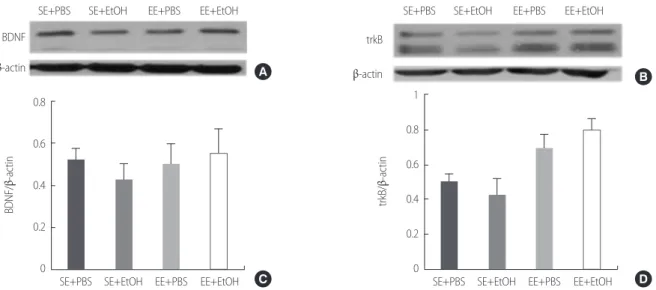
In western blotting, the expression of BDNF showed difference with- out significance between EE+EtOH group (.55±.22) and SE+EtOH group (.42±.15) (Figure 5-A). The expression of trkB that is highest af- finity to the binding the BDNF showed that the EE+EtOH group (.80

±.12) had significantly higher density compared to the SE+EtOH group (.42±.18) (Figure 5-B) (p<.05).

DISCUSSION

Our study was designed to confirm the positive effect of EE on cogni- tive impairment induced by ethanol in adolescent rats. In the present study, the c-fos positive cells were significantly increased in the EE+EtOH group compared to the SE+EtOH group. Also, the trkB pro- tein levels were increased in the EE+EtOH group compared to the SE+EtOH group, representing increased synaptic plasticity in hippo- campus. Also, these neurobiological changes were reflected in behavior- al memory function test. These results demonstrated that EE protected the cognitive impairment induced by ethanol exposure in adolescence.

The results of Y-maze and passive avoidance test presented that EE protected ethanol induced memory impairment. Particularly, in the

EE+EtOH group, spatial memory showed a significant difference com- pared to that of the SE+EtOH.

The number of c-fos positive cells in the hippocampus was signifi- cantly increased in EE+EtOH group compared to the SE+EtOH. The c- fos is an immediate early gene family of transcription factor as a marker of stimulus-induced change in the central nervous system [21]. And many studies have shown that c-fos might be used a marker of neuronal activity and closely involved in the formation of long-term memory [21,22]. Also, Zhang et al. [14] reported that c-fos mediated neuronal ex- citability and survival in kainic acid treatment. Thus, these previous re- sults were consistent with our result of study. The CREB is a transcrip- tion factor and plays a role in learning and memory through the regula- tion of synaptic plasticity. However, the number of phospho-CREB posi- tive cells in the hippocampus presented no differences among groups.

BDNF enhances glutamatergic synaptic transmission and phosphory- lation of the subunits of N-methyl-D-aspartate (NMDA) receptors result- ing in lasting LTP in the hippocampus. And the effects of BDNF in LTP are mediated by TrkB receptor [23]. Impairment of LTP in the BDNF mutant mice with intact TrkB was ameliorated by the exogenous BDNF [24]. In our result, the level of BDNF showed no differences among groups. However its receptor, trkB level was increased in the EE+EtOH group compared to the SE+EtOH group. So, we believe that elevated trkB level enhanced BDNF downstream and protected memory function.

In this study, we designed to investigate the influence of EE in ethanol BDNF

SE+PBS SE+EtOH EE+PBS EE+EtOH

β-actin A

trkB

β-actin

SE+PBS SE+EtOH EE+PBS EE+EtOH

B 0.8

0.6

0.4

0.2

0 BDNF/ β-ac tin

SE+PBS SE+EtOH EE+PBS EE+EtOH C

1

0.8

0.6

0.4

0.2

0

trkB/ β-ac tin

SE+PBS SE+EtOH EE+PBS EE+EtOH D

Figure 5. The synaptic plasticity in ethanol exposure induced cognitive impairment adolescent rat of by western blotting. Representative western blot of BDNF is shown in (a). BDNF densitometry analyses are shown in (b). Representative western blot of trkB is shown in (c). trkB densitometry analyses are shown in (d). Data are expressed as mean± SE. *p< .05 compared to the SE+EtOH group.

SE, Standard Environment; EE, Enriched Environment; PBS, Phosphate Buffered Saline; EtOH, Ethanol.

(6)

exposed adolescent using behavioral and molecular research methods.

As a result, we confirmed that the EE during adolescent period plays a role as prophylaxis from cognitive impairment in adolescence. So, we suggest that the quality of living environment is important to cognitive function during infancy to adolescence. Also, this finding would be con- tribute to evidence based nursing in environmental nursing intervention.

CONCLUSION

The results of our study suggest that the EE prevented the memory impairment and enhanced synaptic plasticity in ethanol exposed ado- lescent rat.

REFERENCES

1. DAHL RE. Adolescent brain development: a period of vulnerabilities and op- portunities. keynote address. Annals Of The New York Academy Of Sciences.

2004;1021(1):1–22. 10.1196/annals.1308.001

2. Spear LP. Adolescent neurodevelopment. Journal Of Adolescent Health.

2013;52(2):S7–13. 10.1016/j.jadohealth.2012.05.006

3. Yurgelun-Todd D. emotional and cognitive changes during adolescence. Current Opinion In Neurobiology. 2007;17(2):251–257. 10.1016/j.conb.2007.03.009 4. Steinberg L, Albert D, Cauffman E, Banich M, Graham S, Woolard J. Age differ-

ences in sensation seeking and impulsivity as indexed by behavior and self-re- port: Evidence for a dual systems model. Developmental Psychology. 2008;

44(6):1764–1778. 10.1037/a0012955

5. Casey B, Jones RM. Neurobiology of the adolescent brain and behavior: implica- tions for substance use disorders. Journal Of The American Academy Of Child

& Adolescent Psychiatry. 2010;49(12):1189–1201. 10.1016/j.jaac.2010.08.017 6. Substance Abuse and Mental Health Services Administration. Results from the

2013 National Survey on Drug Use and Health: Summary of National Findings.

Final report. Rockville: Dept. of Health and Human services (US), Substance Abuse And Mental Health Services Administration: 2014 Sep. Publication No.

(SMA) 14-4863.

7. Jacobus J, Tapert SF. Neurotoxic Effects of alcohol in adolescence. Annual Re- view Of Clinical Psychology. 2013;9(1):703–721. 10.1146/annurev-clinpsy- 050212-185610

8. De Bellis MD. Hippocampal volume in adolescent-onset alcohol use disorders.

American Journal Of Psychiatry. 2000;157(5):737–744. 10.1176/appi.ajp.157.5.737 9. Medina KL, Schweinsburg AD, Cohen-Zion M, Nagel BJ, Tapert SF. Effects of

alcohol and combined marijuana and alcohol use during adolescence on hip- pocampal volume and asymmetry. Neurotoxicology And Teratology. 2007;

29(1):141–152. 10.1016/j.ntt.2006.10.010

10. Pascual M, Blanco AM, Cauli O, Miñarro J, Guerri C. Intermittent ethanol ex- posure induces inflammatory brain damage and causes long-term behavioural

alterations in adolescent rats. European Journal Of Neuroscience. 2007;25(2):

541–550. 10.1111/j.1460-9568.2006.05298.x

11. Ickes BR, Pham TM, Sanders LA, Albeck DS, Mohammed AH, Granholm A-C. Long-term environmental enrichment leads to regional increases in neu- rotrophin levels in rat brain. Experimental Neurology. 2000;164(1):45–52.

10.1006/exnr.2000.7415

12. Yamada K, Nabeshima T. Brain-derived neurotrophic factor/trkB signaling in memory processes. Journal Of Pharmacological Sciences. 2003;91(4):267–270.

10.1254/jphs.91.267

13. West AE, Griffith EC, Greenberg ME. Regulation of transcription factors by neuronal activity. Nature Reviews Neuroscience. 2002;3(12):921–931. 10.1038/

nrn987

14. Zhang J, Zhang D, McQuade JS, Behbehani M, Tsien JZ, Xu M. C-Fos Regulates neuronal excitability and survival. Nature Genetics. 2002;30(4):416–420. 10.1038/

ng859

15. Nithianantharajah J, Hannan AJ. Enriched environments, experience-depen- dent plasticity and disorders of the nervous system. Nature Reviews Neurosci- ence. 2006;7(9):697–709. 10.1038/nrn1970

16. Lazarov O, Robinson J, Tang Y-P, Hairston IS, Korade-Mirnics Z, Lee VM-Y, et al. Environmental enrichment reduces Aβ levels and amyloid deposition in transgenic mice. Cell. 2005;120(5):701–713. 10.1016/j.cell.2005.01.015 17. Jadavji NM, Kolb B, Metz GA. Enriched environment improves motor func-

tion in intact and unilateral dopamine-depleted rats. Neuroscience. 2006;

140(4):1127–1138. 10.1016/j.neuroscience.2006.03.027

18. Pamplona FA, Pandolfo P, Savoldi R, Prediger RDS, Takahashi RN. Environ- mental enrichment improves cognitive deficits in spontaneously hypertensive rats (SHR): relevance for attention deficit/hyperactivity disorder (ADHD).

Progress In Neuro-Psychopharmacology And Biological Psychiatry. 2009;

33(7):1153–1160. 10.1016/j.pnpbp.2009.06.012

19. Hannan AJ. Review: environmental enrichment and brain repair: harnessing the therapeutic effects of cognitive stimulation and physical activity to enhance experience-dependent plasticity. Neuropathology And Applied Neurobiology.

2014;40(1):13–25. 10.1111/nan.12102

20. Jee Y-S, Ko I-G, Sung Y-H, Lee J-W, Kim Y-S, Kim S-E, et al. Effects of treadmill exercise on memory and c-fos expression in the hippocampus of the rats with intracerebroventricular injection of streptozotocin. Neuroscience Letters. 2008;

443(3):188–192. 10.1016/j.neulet.2008.07.078

21. Duncan GE, Knapp DJ, Breese GR. Neuroanatomical characterization of fos induction in rat behavioral models of anxiety. Brain Research. 1996;713(1–2):

79–91. 10.1016/0006-8993(95)01486-1

22. Grimm R, Schicknick H, Riede I, Gundelfinger ED, Herdegen T, Zuschratter W, et al. Suppression of c-fos induction in rat brain impairs retention of a brightness discrimination reaction. Learn Mem. 1997;3(5):402–413. 10.1101/lm.3.5.402 23. Figurov A, Pozzo-Miller LD, Olafsson P, Wang T, Lu B. Regulation of synaptic

responses to high-frequency stimulation and LTP by neurotrophins in the hip- pocampus. Nature. 1996;381(6584):706–709. 10.1038/381706a0

24. Patterson SL, Abel T, Deuel TAS, Martin KC, Rose JC, Kandel ER. Recombi-

nant BDNF rescues deficits in basal synaptic transmission and hippocampal

LTP in BDNF knockout mice. Neuron. 1996;16(6):1137–1145. 10.1016/S0896-

6273(00)80140-3

수치

Figure 2. Improvement of cognitive function by environmental enrichment in ethanol exposure induced cognitive impairment adolescent rat on  behavior test
Figure 3. Immunostaining of c-fos in hippocampus CA1 in ethanol exposure induced cognitive imparement adolescent rat
Figure 5. The synaptic plasticity in ethanol exposure induced cognitive impairment adolescent rat of by western blotting

참조

관련 문서

Changes in the composition and structure of Mediterranean rokey-shore communities following a gradient of nutrient enrichment: Descriptive study and test

XRD analysis, surface roughness test, FE-SEM imaging, and biaxial flexural strength test were performed... Results: In the result of XRD analysis, an phase change occurred

&#34;The Principle of Separating Economics from Politics, and Prospects for Improvement in North-South Relations.&#34; East Asian Review.. The Korean Journal

In contrast, Chiropractic has shown better result than sports massage in the range of motion of the shoulder joint, Thoracic Scapular rhythm test, and the

The result of this study on the intervention of function words in children with language development delay shows that intervention of function words by grammatically

“Characteristics of Meteorological Variables in the Leeward Side associated with the Downslope Windstorm over the Yeongdong Region.” Journal of the Korean

1 John Owen, Justification by Faith Alone, in The Works of John Owen, ed. John Bolt, trans. Scott Clark, &#34;Do This and Live: Christ's Active Obedience as the

Stimulation of cell surface-expressed ENO1 induced faster repopulation of FLS in the scratch test assay, and increased PDGF-induced transwell migration.. Cytoplasmic