https://doi.org/10.5468/ogs.2018.61.3.352 pISSN 2287-8572 · eISSN 2287-8580
Introduction
Ovarian cancer is a leading cause of death from gynecologic cancers worldwide [1]. The standard treatment is optimal debulking surgery followed by taxane-platinum-based com- bination chemotherapy regimens for first-line chemotherapy.
Despite a high initial response rate (RR) to 1st line chemo- therapy, 60–70% patients eventually relapsed [2]. In platinum sensitive recurrence (recurrence more than 6 months after
Retrospective study of combination chemotherapy
with etoposide and ifosfamide in patients with heavily pretreated recurrent or persistent epithelial ovarian cancer
Wonkyo Shin
1, Hye-joo Lee
1, Seong J. Yang
2, E sun Paik
1, Hyun-jin Choi
1, Tae-Joong Kim
1, Chel Hun Choi
1, Jeong-Won Lee
1, Duk-Soo Bae
1, Byoung-Gie Kim
11Department of Obstetrics and Gynecology, Samsung Medical Center, Sungkyunkwan University School of Medicine; 2Department of Statistics, Hankuk University of Foreign Studies, Seoul, Korea
Objective
This retrospective study is to evaluate the efficacy and toxicity of combination chemotherapy with etoposide and ifosfamide (ETI) in the management of pretreated recurrent or persistent epithelial ovarian cancer (EOC).
Methods
Patients with recurrent or persistent EOC who had measurable disease and at least one chemotherapy regimen were to receive etoposide at a dose of 100 mg/m
2/day intravenous (IV) on days 1 to 3 in combination with ifosfamide 1 g/m
2/day IV on days 1 to 5, every 21 days.
Results
From August 2008 to August 2016, 66 patients were treated with ETI regimen. Most patients were heavily pretreated prior to ETI: 53 (80.3%) patients had received 3 or more chemotherapy regimens. The response rate (RR) of ETI chemotherapy was 18.2% and median duration of response was 6.8 months (range, 0–30). Median survival of all patients was 5 months at a median follow up of 7.2 months. Platinum-free interval (PFI) more than 6 months prior to ETI has statistically significant correlation with overall survival (OS; 9.2 vs. 5.6 months; P=0.029) and RR (34.5% vs. 5.4%;
P<0.010). However, treatment free interval before ETI, number of prior chemotherapy regimen, and optimality of
primary surgery did not show significant difference for RR or OS. Grade 3 or 4 hematologic toxicities were observed in 7 cases (3%) of the 232 cycles of ETI.
Conclusion
The ETI combination regimen shows comparatively low toxicity and modest activity in heavily pretreated recurrent or persistent EOC patients with more than 6 months of PFI after last platinum treatment.
Keywords: Ovarian cancer; Recurrence; Platinum-free interval
Received: 2017.05.26. Revised: 2017.09.28. Accepted: 2017.10.10.
Corresponding author: Byoung-Gie Kim
Department of Obstetrics and Gynecology, Samsung Medical Center, Sungkyunkwan University School of Medicine, 81 Irwon- ro, Gangnam-gu, Seoul 06351, Korea
E-mail: [email protected]
https://orcid.org/0000-0002-0572-8450
Articles published in Obstet Gynecol Sci are open-access, distributed under the terms of the Creative Commons Attribution Non-Commercial License (http://creativecommons.
org/licenses/by-nc/3.0/) which permits unrestricted non-commercial use, distribution, and reproduction in any medium, provided the original work is properly cited.
Copyright © 2018 Korean Society of Obstetrics and Gynecology
last treatment), platinum based combination chemotherapy can be given with more than 60% of response. However, the management of tumor recurrence remains a clinical chal- lenge, since in the platinum-resistant (recurrence less than 6 months) population the chance of response to a second- ary treatment is currently less than 20% [3]. Several single chemotherapeutic agents have been used in this setting and have demonstrated modest activity such as topotecan [4,5], gemcitabine [6,7], liposomal doxorubicin [8], oral etoposide [9], and ifosfamide [10]. It cannot be overemphasized the im- portance of clinical trials to identify agents active in this group of resistant patients.
Etoposide is a semisynthetic glucosidic derivative of podo- phyllotoxin. The inhibition of DNA topoisomerase II is known to be a major mechanism of action. Ifosfamide is a part of nitrogen mustard’s alkylating agents. Very little information is available to combination chemotherapy with etoposide and if- osfamide (ETI) as salvage treatment of epithelial ovarian cancer (EOC) after more than 2 chemotherapy regimens. In various animal tumors, etoposide has shown synergy with cyclophos- phamide [11]. Additionally, the combination of ETI has also been demonstrated to be an effective regimen in solid neo- plasms such as small cell lung cancer [12]. In EOC, a few phase II studies have been reported. Some indicated reasonable ef- ficacy and another [13] showed dismal results which included only “true” platinum-resistant patients. We also have previ- ously reported the results of phase II study of the combination chemotherapy with ETI in particular in patients with heavily pretreated recurrent EOC [14]. The RR was 18.9%, median duration of response 7 months (range 1–15 months), and 9 months of median survival in the study. It was estimated good treatment option in such patients with modest activity and tolerable toxicity, so the regimen has been incorporated in clinical practice of our institution since 2008. Here we evalu- ated the efficacy and toxicity of the combination chemothera- py with ETI in real world clinical practice and compared them with those of previous phase II clinical trial setting.
Materials and methods
We used electric medical record data base for EOC treated by ETI at Samsung Medical Center from August 1, 2008 to Au- gust 31, 2016. Eligible patients should have measurable dis- ease on computed tomography (CT) or magnetic resonance
image (MRI) before administration of ETI. Other eligibility criteria included no previous treatment with either ifosfamide or etoposide, normal end-organ function, white blood count of 3,000/μL or higher, platelet count of 100,000/μL or higher, granulocyte count of 1,000/μL or higher, a serum creatinine within institutional normal limits, hepatic enzymes (serum glutamic oxaloacetic transaminase, serum glutamic pyruvic transaminase, and alkaline phosphatase) less than or equal to 2.5 times the upper level of institutional norm and biliru- bin less than or equal to 1.5 times the upper level of insti- tutional norm, and a Eastern Cooperative Oncology Group performance score 0–2. Informed consent was obtained ac- cording to the guidelines of our hospital Institutional Review Boards. Patients received ifosfamide 1 g/m
2/day on days 1 to 5 as an intravenous (IV) infusion in 500 mL 5% dextrose solution over 1 hour in association with adequate hydration and mesna uroprotection [15]. Etoposide was given at a dose of 100 mg/m
2/day IV on days 1 to 3 over 1 hour. Cycles were repeated every 3 weeks, while a minimum of 4 courses were given to responders. Delay of treatment was permitted if there was hematological toxicity greater than grade 3 dur- ing the previous cycle. Toxicity evaluations were conducted just before next treatment cycle by performing a complete blood count, urinalysis, renal and liver function tests, and a performance status evaluation. Toxicity was defined according to World Health Organization standard criteria. The patients’
response to treatment was assessed every 2 or 3 cycles by imaging techniques (CT and/or MRI) and every cycle by cancer antigen 125. The response is confirmed by image analysis according to Response Evaluation Criteria In Solid Tumors cri- teria [16]. The response duration was defined from the time of partial response (PR) or complete response (CR) to the ap- pearance of progressive disease. Survival was measured from the time of the initiation of ETI therapy to the time of death or to the date of the last contact. We drew a line between sensitive to platinum (recurrence more than 6 months) and re- sistant (recurrence less than 6 months) according to response showed at platinum-based previous therapy. Treatment-free interval (TFI) prior to ETI is the month(s) from the first day of last chemotherapy cycle to the first day of ETI chemotherapy.
Platinum-free interval (PFI) is treatment free interval from first
day of last platinum chemotherapy regardless of any lines to
first day of ETI. Descriptive summary statistics were used to
evaluate demographics and adverse events. Statistical analyses
of frequency data were performed by means of the χ
2test.
Overall survival (OS) and response duration were measured with the Kaplan-Meier method. P-value of less than 0.05 was considered as significant. The SPSS 11.0 (SPSS Inc., Chicago, IL, USA) was used for statistical analysis.
Results
Between August 2008 and August 2016, a total of 66 pa- tients were eligible. The characteristics of the 66 patients are summarized in Table 1. The majority of the patients (84.9%) had high-grade serous type. Sixty patients (90.9%) had initial International Federation of Gynecology and Obstetrics stage III. Median OS for all 66 patients was 5 months (95% confi- dence interval, 4–8 months; Fig. 1).
Sixty-six patients were evaluable for response by radiologic image. The RR was 18.1% and median duration of response
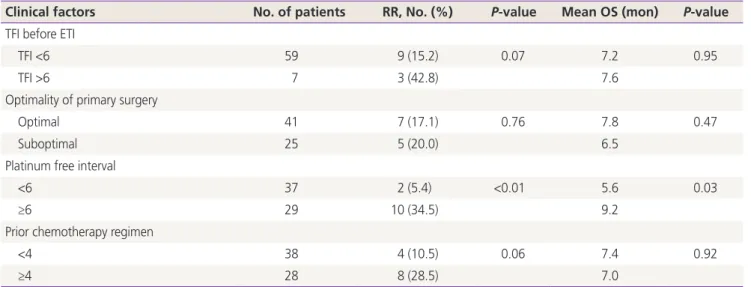
was 6.8 months (range, 0–30). There were 3 patients (4.5%) with CR; 9 patients (13.6%) showed a PR, 2 (3.0%) showed stable disease and 51 (77.2%) progressed. Three patients who showed CR. Table 2 shows outcome according to clinical factors after ETI. The RR of patients with TFI ≥6 months was about 2 times higher than that with TFI <6 months without statistical significance: 42.8% (3/7) with TFI ≥6 months and 15.2% (9/59) with TFI <6 months respectively (P=0.073).
Median survival also was not significantly different by TFI (7.6 months with TFI and >6 and 7.2 months with TFI <6 months, respectively, P=0.952). Number of prior chemo- therapy regimen, optimality of primary surgery also did not show difference for RR or OS. Interestingly, only PFI prior to ETI chemotherapy exhibited statistically different RR and OS to ETI chemotherapy. Prior to ETI chemotherapy, 29 (43.9%) patients showed PFI more than 6 months (Table 2). Ten (34.5%) of these 29 patients responded to ETI chemotherapy.
In contrast, 2 (5.4%) of 37 patients who showed less than 6 months of PFI responded to ETI chemotherapy (P<0.01). In addition, there were statistically significant correlations be- tween OS and PFI >6 months before ETI chemotherapy (9.2 vs. 5.6 months; P=0.029, Table 2 and Fig. 2).
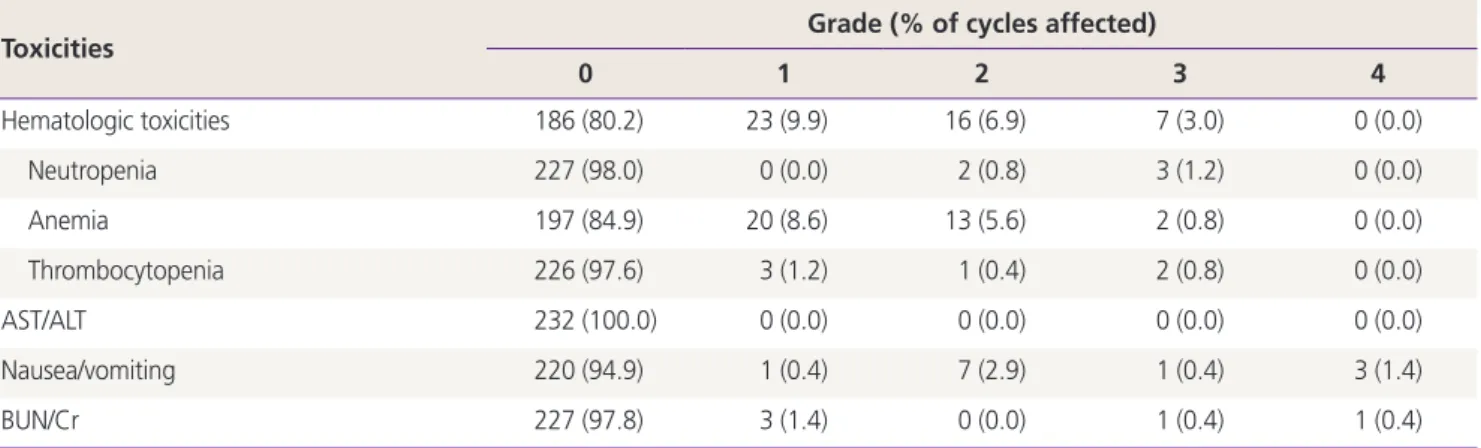
A total of 232 courses of ETI regimen were administered to the patients. Table 3 shows the toxicity profile. There was no treatment related death. The grade 3–4 hematological toxicity
Table 1. Characteristics of patients (n=66)Characteristics No. of patients (%)
Median age 53
Histology
Serous 56 (84.9)
Clear cell 3 (4.5)
Mucinous 1 (1.5)
Endometrioid 0 (0.0)
Others 6 (9.1)
FIGO stage
I 1 (1.5)
II 2 (3.1)
III 60 (90.9)
IV 3 (4.5)
First-line regimen
Paclitaxel/carboplatin 64 (96.8)
Docetaxel/carboplatin 1 (1.6)
Irinotecan/cisplatin 1 (1.6)
No. of chemotherapy regimen prior to ETI
1 4 (6.2)
2 9 (13.6)
3 25 (37.8)
4 23 (34.8)
5 5 (7.6)
FIGO, International Federation of Gynecology and Obstetrics; ETI, etoposide and ifosfamide.
Fig. 1. Overall survival of patients who received etoposide and ifos- famide.
Overall survival curve
Months 1.0
0.8
0.6
0.4
0.2
0.0
Survival rate
0 5 10 15 20 25 30
was observed in 7 of 232 cycles (3.0%). There were 4 grade 3–4 gastrointestinal toxicity (severe vomiting) and 2 grade 3–4 renal toxicity. Other toxicities were negligible.
Discussion
This is a single institutional retrospective study in real world clinical practice setting that evaluated the efficacy and toxicity
of ETI regimen for heavily pretreated patients with recurrent or persistent EOC. We have previously published the results of ETI chemotherapy in these patients in phase II clinical trial [14]. The RR of 18.9% and 9 months of median survival were regarded as modest activity and it can be a good treatment option in these patients together with tolerable toxicity. So, the regimen has been incorporated in clinical practice of our institution since 2008, out of clinical trial setting. It might be worth to evaluate the efficacy and toxicity of the regimen in real world clinical practice and compare them with those of previous phase II clinical trial since these 2 conditions have different settings: clinical trials are performed with more strict inclusion criteria, less flexibility of each physician’s discretion for treatment, and more careful monitoring of patients etc.
than real world clinical practice. So, it is possible that different results were observed in real world clinical practice compare to clinical trial and the new treatment could not be incorpo- rated into real world clinical practice sometimes. For example, randomized clinical trials of intraperitoneal chemotherapy demonstrated that it was superior to IV chemotherapy in OS of ovarian cancer patients, but it has not been widely ac- cepted in real world clinical practice due to problem of toxicity management [17]. Therefore, we performed a retrospective analysis of ETI chemotherapy after incorporation of the regi- men into real world clinical practice.
In regard to outcome of ETI chemotherapy, RR was 18.2%
in this study similar to 18.9% in previous clinical trial [14], but CR was observed in 3 patients in the current study compare
Fig. 2. Overall survival in the subdivided groups of patients byplatinum-free interval.
Platinum free interval
Months
<6
≥6 1.0
0.8
0.6
0.4
0.2
0.0
Survival rate
0 5 10 15 20 25 30
Table 2. Outcome according to clinical factors
Clinical factors No. of patients RR, No. (%) P-value Mean OS (mon) P-value
TFI before ETI
TFI <6 59 9 (15.2) 0.07 7.2 0.95
TFI >6 7 3 (42.8) 7.6
Optimality of primary surgery
Optimal 41 7 (17.1) 0.76 7.8 0.47
Suboptimal 25 5 (20.0) 6.5
Platinum free interval
<6 37 2 (5.4) <0.01 5.6 0.03
≥6 29 10 (34.5) 9.2
Prior chemotherapy regimen
<4 38 4 (10.5) 0.06 7.4 0.92
≥4 28 8 (28.5) 7.0
RR, response rate; OS, overall survival; TFI, treatment-free interval; ETI, etoposide and ifosfamide.
to no CR in previous one. Duration of response was similar (7.0 vs. 6.8 months), but OS was worse in this study (5.0 months) than previous one (9.0 months). Toxicity profile was also simi- lar in this study (Table 3).
No prognostic parameter affecting OS was demonstrated in previous study. In previous our study [14], there was a trend for correlation with OS and platinum sensitivity in first-line chemotherapy without statistical significance (median survival, 11 vs. 6 months; P=0.064). Also in this study, we did not ob- serve correlation between OS and initial platinum sensitivity (11.5 vs. 6.4 months; P=0.154, data not shown). Interestingly, however, we found PFI more than 6 months (from last dose of platinum to start of ETI chemotherapy regardless of non- platinum regimen used during the period) exhibited survival advantage (9.2 vs. 5.6 months; P=0.029) as well as higher RR (34.5% vs. 5.4%; P<0.01) in this study. Notably, all 3 patients who showed CR had long PFI (14, 15, and 16 months) and they exhibited favorable survival. One patient died 30 months after ETI chemotherapy and 2 patients are alive until last fol- low up (28 and 3 months) (Table 4).
The PFI is well known the most important predictive factor of a response to subsequent lines of chemotherapy and the most important prognostic factor for progression-free and OS in patients with recurrent EOC [18]. In this study, we also demonstrated PFI was strong predictor for survival advantage as well as good response to ETI chemotherapy (Table 2). The molecular mechanism for better outcome of long PFI has been extensively investigated. Among the studies, germline BRCA mutation was most frequently reported to be associ- ated with platinum sensitivity and better survival [19]. In the current study, we could not confirm such a correlation since we unfortunately did not perform mutational study for BRCA gene in most of our patients. In addition, it has been also reported that prolonged PFI by itself could make re-sensitize platinum treatment in several reports [20-22]. Although mode of action mechanism may be different, prolonged PFI could sensitize ETI chemotherapy. Therefore, ETI regimen could be administered in patients with EOC pretreated 3 or more plati- num chemotherapy showing progression more than 6 months after last dose of platinum chemotherapy (or regardless of
Table 3. Toxicity of etoposide and ifosfamide regimen according to World Health Organization criteriaToxicities Grade (% of cycles affected)
0 1 2 3 4
Hematologic toxicities 186 (80.2) 23 (9.9) 16 (6.9) 7 (3.0) 0 (0.0)
Neutropenia 227 (98.0) 0 (0.0) 2 (0.8) 3 (1.2) 0 (0.0)
Anemia 197 (84.9) 20 (8.6) 13 (5.6) 2 (0.8) 0 (0.0)
Thrombocytopenia 226 (97.6) 3 (1.2) 1 (0.4) 2 (0.8) 0 (0.0)
AST/ALT 232 (100.0) 0 (0.0) 0 (0.0) 0 (0.0) 0 (0.0)
Nausea/vomiting 220 (94.9) 1 (0.4) 7 (2.9) 1 (0.4) 3 (1.4)
BUN/Cr 227 (97.8) 3 (1.4) 0 (0.0) 1 (0.4) 1 (0.4)
Values are presented as number (%).
AST, aspartate transaminase; ALT, alkaline phosphatase; BUN, blood urea nitrogen; Cr, creatinine.
Table 4. The characteristics of the patients who showed complete response after etoposide and ifosfamide Histology No. of prior
chemotherapy regimen
FIGO stage
Initial platinum sensitivity
Optimality of primary
surgery
TFI before ETI (mon)
Platinum free interval before
ETI (mon)
Previous line
treatment ETI cycles OS
(mon)
Transitional 4 IIIc Yes Suboptimal 0 14 PC → PC→ ToC → D 6 30
Serous 3 IIIc No Optimal 0 16 PC → Topotecan → D 6 28a)
Serous 5 IV No Optimal 5 15 PC → PC → ToC →
DC → PLD 6 3a)
ETI, etoposide and ifosfamide; FIGO, International Federation of Gynecology and Obstetrics; TFI, treatment-free interval; OS, overall survival;
PC, paclitaxel/carboplatin; ToC, topotecan/carboplatin; D, docetaxel; DC, docetaxel/carboplatin; PLD, pegylated liposomal doxorubicin.
a)Alive.