Microsurgical Ligation for Painful Varicocele: Effectiveness and Predictors of Pain Resolution
Hyun Tae Kim, Phil Hyun Song, and Ki Hak Moon
Department of Urology, College of Medicine, Yeungnam University, Daegu, Korea.
Received: March 30, 2011 Revised: May 12, 2011 Accepted: May 13, 2011
Corresponding author: Dr. Ki Hak Moon, Department of Urology, College of Medicine, Yeungnam University,
317-1 Daemyeong 5-dong, Nam-gu, Daegu 705-717, Korea.
Tel: 82-53-620-3692, Fax: 82-53-627-5535 E-mail: [email protected]
∙ The authors have no financial conflicts of interest.
© Copyright:
Yonsei University College of Medicine 2012 This is an Open Access article distributed under the terms of the Creative Commons Attribution Non- Commercial License (http://creativecommons.org/
licenses/by-nc/3.0) which permits unrestricted non- commercial use, distribution, and reproduction in any medium, provided the original work is properly cited.
Purpose: We evaluated the effectiveness of microsurgical ligation for painful vari- cocele and predictive factors of pain resolution. Materials and Methods: Between January 2006 and March 2009, a total of 114 patients (mean age, 30.2±8.9 years), who underwent microsurgical inguinal varicocelectomy for painful varicocele, were included and followed up for 1 year after the surgery. The quantity of preop- erative and postoperative pain was assessed by means of 11-point numeric rating scale (NRS). We retrospectively analyzed the outcome of surgical ligation and pre- dictive factors of pain resolution using patient age, height, weight, body mass in- dex, grade and location of varicocele, duration, quantity and quality (dull, drag- ging, aching) of pain, and postoperative pain resolution. Results: In 104 patients (91.2%), complete or marked resolution of pain was reported at follow-up 1 year after surgery. Only 10 patients (8.8%) had recurrent or persistent pain (≥3 points in NRS scores). On multivariate analysis, low quantity (≤6 points in NRS scores) and dull or dragging natured preoperative pain were independent factors associated with surgical success rates (p=0.004; odds ratio=1.62, p=0.012; odds ratio=1.76, respectively). Conclusion: Microsurgical ligation is an effective treatment of pain- ful varicocele. The quantity and quality of preoperative pain are independent pre- dictive factors of pain resolution after surgery.
Key Words: Varicocele, ligation, pain
INTRODUCTION
Varicocele is the most commonly diagnosed peripubertal andrologic disease and the most commonly treatable cause of male-related impaired fertility potential.1 Also, varicocele is associated with chronic scrotal pain, but this relationship has been less widely investigated.2 It is evaluated that the prevalence of painful varico- celes is 2-10%. This pain was described as a dull, throbbing pain, worsening with exertion and strain.3
Varicocele ligation has been assessed as an effective treatment of painful varico- cele.4 Other comparative reports have assessed different techniques, but at present there is no consensus as to which surgical method is best suited for varicocele treatment, although microsurgical techniques of varicocelectomy have gained pop- ularity with minimal complication rates and good outcomes.4-7 Also, little data ex-
and 1 year after surgery, at which time they were evaluated with a careful symptom review, scrotal examination at su- pine and standing positions, and 11-point NRS to assess the quantity of postoperative pain. Also, Doppler USS was per- formed when deemed clinically necessary for discovery of varicocele recurrence.
Definition
Varicocele was classified into the following grades: grade I, varicocele palpable during a Valsalva maneuver when up- right; grade II, varicocele palpable when upright without Valsalva maneuver; and grade III, varicocele palpable and visually detectable.9 Surgical success was defined as the lack of palpable scrotal veins on physical examination and reporting of scores in the lowest range on the 11-point NRS scale (≤2 points) after surgery.
Analysis
Our primary objective was to analyze overall surgical suc- cess rates after microsurgical inguinal varicocelectomy. Our secondary objective was to determine which preoperative factors influenced the pain resolution after surgery by eval- uation clinical factors. Normally distributed variables were compared using ANOVA and Student’s t-tests. The Fisher’s exact and chi-square tests were used for dichotomous vari- ables. To determine the predictive factors affecting the reso- lution of pain, univariate analysis was performed using a logistic regression analysis. A 5% level of significance was used for all statistical testing and all statistical tests were two-sided. Analyse was performed using the statistical soft- ware SPSS (14.0KO for Windows, Release 14.0.2).
RESULTS
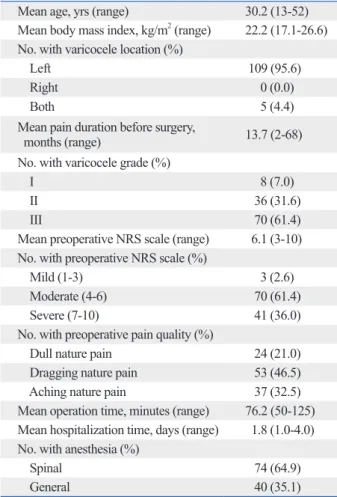
One hundred and fourteen patients with painful varicocele underwent microsurgical inguinal varicocelectomy with complete follow-up, and all patients who underwent sur- gery failed an initial conservative treatment (scrotal sup- port, non-steroidal anti-inflammatory treatment and exer- cise limitation) for 4-24 weeks. Baseline characteristics of the 114 men are illustrated in Table 1.
Of the 114 patients, 104 (91.2%) reported complete or marked resolution of pain at follow-up 1 year after surgery.
Only 10 (8.8%) had recurrent or persistent pain (≥3 points in 11-point NRS scores).
Four patients (3.5%) had recurrence of pain (mean points ists regarding the outcome of surgical treatment of painful
varicoceles and factors able to predict success. This retro- spective study, in a selected homogeneous population eval- uated the effectiveness of microsurgical ligation against painful varicocele, including the predictive factors affecting pain resolution.
MATERIALS AND METHODS
Patients
Between January 2006 and March 2009, a total of 114 pa- tients (mean age, 30.2±8.9 years) who underwent microsur- gical inguinal varicocelectomy for pain were included and followed up for at least 1 year (mean; 15.8 months: range, 13-49) after surgery. Written consent from each patient was obtained. Diagnosis of varicocele was made using self-di- agnosed symptoms, such as scrotal discomfort or pain, and on clinical grounds of both physical examination and Dop- pler ultrasound scan (USS). Patients whose cause of scrotal pain was ambiguous and who had a previous history of scro- tal trauma or surgery were excluded from this study. Men with lower urinary tract symptoms were also excluded, as were men with a documented psychological disturbance.
Preoperative evaluations
Medical records were retrospectively investigated to docu- ment patient demographics [age, height, weight, body mass index (BMI), etc.], grade (I, II, III) and, location of varico- cele (right, left or bilateral), duration (months) and quality (dull, dragging, aching) of pain before surgery. To evaluate the quantity of pain, we used a 11-point numeric rating scale (NRS) where 0 indicated no pain and 10 indicated the worst pain imaginable (0, 1-3, 4-6, 7-10: none, mild, moderate, severe; respectively).
Procedure
The microsurgical inguinal varicocelectomy was performed under general or spinal anesthesia by a single experienced surgeon using a similar technique previously described,8 except for we did not deliver the testicle or examine the gu- bernaculum. An operative microscope (10-25X) was used during spermatic cord dissection to identify and preserve the testicular artery and lymphatics.
Follow-up evaluation
All patients were asked to visit the clinic at 1 month, 3 months
pain qualities, we found that the success rates were 78.4% in men with aching pain, 96.2% with dragging pain and 100%
with dull pain (p=0.003, OR 1.91). There was also a signifi- cant difference in success rates among patients’ groups ac- cording to preoperative NRS scores (1-3, 4-6, 7-10: mild, moderate, severe group) (p=0.002, OR 2.24).
Multivariate analysis indicated that quality and quantity of preoperative pain were independent factors related to success rates (p=0.012, OR 1.76 and p=0.004, OR 1.62, re- spectively) (Fig. 1). However, when the relationships be- tween pain resolution and patient age, height, weight, BMI, duration of pain before surgery, grade and location of vari- cocele were examined, none of these factors significantly predicted the resolution of pain (p>0.05).
There were no intraoperative or early postoperative com- plications, such as orchitis, infection, or scrotal hematoma.
At 1 year follow-up, as aforementioned, 10 patients had re- current or persistent scrotal pain and 1 had varicocele recur- rence; but no patients had hydrocele formation, evidence of testicular loss or progressive hypotrophy.
in 11-point NRS scores, 4.0±0.8 points) after an initial peri- od of resolution (mean period, 1.8±0.5 months). All 4 pa- tients with recurrent pain were subjected to Doppler USS and no patient had varicocele recurrence.
Six patients (5.3%) reported persistent pain (mean points in 11-point NRS scores, 4.7±1.4 points) at follow-up 1 year after surgery. Of those, one complained that his symptoms were worse. All 6 patients with persistent pain were also sub- jected to Doppler USS, and only one (0.8%) had varicocele recurrence. However, although successful radiographic em- bolization was performed in this patient, his pain persisted.
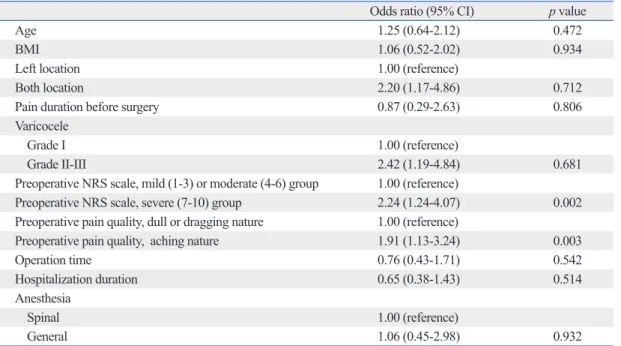
Table 2 shows the preoperative characteristics in the fail- ure group of pain resolution. From the viewpoint of pain quality, all patients with recurrent or persistent pain had dragging or aching preoperative pain at follow-up 1 year af- ter surgery.
Univariate analysis of the preoperative factors demonstrat- ed that the quality and quantity of preoperative pain were as- sociated with surgical success rates (Table 3). When we di- vided the patients into three groups according to preoperative Table 1. Characteristics of 114 Patients
Mean age, yrs (range) 30.2 (13-52)
Mean body mass index, kg/m2 (range) 22.2 (17.1-26.6) No. with varicocele location (%)
Left 109 (95.6)
Right 0 (0.0)
Both 5 (4.4)
Mean pain duration before surgery,
months (range) 13.7 (2-68)
No. with varicocele grade (%)
I 8 (7.0)
II 36 (31.6)
III 70 (61.4)
Mean preoperative NRS scale (range) 6.1 (3-10) No. with preoperative NRS scale (%)
Mild (1-3) 3 (2.6)
Moderate (4-6) 70 (61.4)
Severe (7-10) 41 (36.0)
No. with preoperative pain quality (%)
Dull nature pain 24 (21.0)
Dragging nature pain 53 (46.5)
Aching nature pain 37 (32.5)
Mean operation time, minutes (range) 76.2 (50-125) Mean hospitalization time, days (range) 1.8 (1.0-4.0) No. with anesthesia (%)
Spinal 74 (64.9)
General 40 (35.1)
NRS, numeric rating scale.
Table 2. Preoperative Characteristics in the Failure Group of Pain Resolution (n=10)
Mean age, yrs (range) 21.5 (13-29)
Mean body mass index, kg/m2 (range) 22.5 (18.9-26.6) No. with varicocele location (%)
Left 8 (80.0)
Right 0 (0.0)
Both 2 (20.0)
Mean pain duration before surgery,
months (range) 4.2 (2-7)
No. with varicocele grade (%)
I 1 (10.0)
II 4 (40.0)
III 5 (50.0)
Mean preoperative NRS scale (range) 9.0 (7-10) No. with preoperative NRS scale (%)
Mild (1-3) 0 (0.0)
Moderate (4-6) 0 (0.0)
Severe (7-10) 10 (100.0)
No. with preoperative pain quality (%)
Dull nature pain 0 (0.0%)
Dragging nature pain 2 (20.0%)
Aching nature pain 8 (80.0%)
Mean operation time, minutes (range) 80.5 (70-100) Mean hospitalization duration, day (range) 2.1 (1.0-4.0) No. with anesthesia (%)
Spinal 7 (70.0)
General 3 (30.0)
NRS, numeric rating scale.
high inguinal, inguinal, subinguinal, laparoscopic, and mi- crosurgical ligation, might be implemented to relieve pain of varicoceles.2
Surgical treatment of painful varicocele is controversial, because a few literature supports its use and surgical ligation is only recommended in men who have specific pain com- plaints and in whom conservative treatments has failed.4-6 The studies by Peterson, et al.11 and by Yaman, et al.3 re- ported complete resolution of pain in 86% and 88% of pa- tients, respectively. Yaman, et al.3 suggested that the failure rate was associated with preoperative varicocele grade. Also, Karademir, et al.1 reported similar results using inguinal and subinguinal ligation and suggested that surgical approaches may influence outcomes with best outcomes achieved with inguinal or sub-inguinal ligation. However, Al-Buheissi, et al.12 showed that although surgical ligation is an effective
DISCUSSION
The most common grievance in men with varicocele is a dull and throbbing scrotal pain that aggravated during strain- ing and exercise.1 Urologists often meet patients with pain- ful varicocele, whose jobs need working mostly in standing positions or vigorous physical effort. However, most urolo- gists cannot form an objective opinion based on their own experience.
Conventional treatment of painful varicocele is conserva- tive treatment followed by surgery. Generally used conser- vative methods are scrotal elevation, nonsteroidal anti-in- flammatory medication and decreased physical activity, that often lead to unacceptable lifestyle restrictions.10 Also, per- cutaneous embolization or various surgical options, such as
Table 3. Univariate Analysis of Preoperative and Intraoperative Parameters of Determinants for Surgical Suc- cess Rates at 1 Year Follow Up State
Odds ratio (95% CI) p value
Age 1.25 (0.64-2.12) 0.472
BMI 1.06 (0.52-2.02) 0.934
Left location 1.00 (reference)
Both location 2.20 (1.17-4.86) 0.712
Pain duration before surgery 0.87 (0.29-2.63) 0.806
Varicocele
Grade I 1.00 (reference)
Grade II-III 2.42 (1.19-4.84) 0.681
Preoperative NRS scale, mild (1-3) or moderate (4-6) group 1.00 (reference)
Preoperative NRS scale, severe (7-10) group 2.24 (1.24-4.07) 0.002
Preoperative pain quality, dull or dragging nature 1.00 (reference)
Preoperative pain quality, aching nature 1.91 (1.13-3.24) 0.003
Operation time 0.76 (0.43-1.71) 0.542
Hospitalization duration 0.65 (0.38-1.43) 0.514
Anesthesia
Spinal 1.00 (reference)
General 1.06 (0.45-2.98) 0.932
95%CI, 95% confidence interval; BMI, body mass index; NRS, numeric rating scale.
Fig. 1. Success rates by preoperative NRS scale and pain quality. The multivariate analysis of preoperative factors demonstrated that NRS scale and pain quality might predict the success rates of microsurgical ligation in painful varicocele patients. NRS, numeric rating scale.
0 20 40 60 80 100
Success rate (%)
Mild group
(1-3) Moderate
group (4-6) Severe group
(7-10) Dull nature
pain Dragging
nature pain Aching nature pain
Preoperative NRS scale Preoperative pain quality
p=0.004 p=0.012
and quality of preoperative pain are independent predictive factors of pain resolution after surgery. A prospective ran- domized study with long term follow-up comparing surgi- cal treatments of painful varicocele using different surgical approaches is needed to support the present data.
ACKNOWLEDGEMENTS
This research was supported by the Yeungnam University research grants in 2009.
REFERENCES
1. Karademir K, Senkul T, Baykal K, Ateş F, Işeri C, Erden D. Evalu- ation of the role of varicocelectomy including external spermatic vein ligation in patients with scrotal pain. Int J Urol 2005;12:484-8.
2. Chawla A, Kulkarni G, Kamal K, Zini A. Microsurgical varicoce- lectomy for recurrent or persistent varicoceles associated with or- chalgia. Urology 2005;66:1072-4.
3. Yaman O, Ozdiler E, Anafarta K, Göğüş O. Effect of microsurgi- cal subinguinal varicocele ligation to treat pain. Urology 2000;
55:107-8.
4. Gontero P, Pretti G, Fontana F, Zitella A, Marchioro G, Frea B. In- guinal versus subinguinal varicocele vein ligation using magnify- ing loupe under local anesthesia: which technique is preferable in clinical practice? Urology 2005;66:1075-9.
5. Riccabona M, Oswald J, Koen M, Lusuardi L, Radmayr C, Bartsch G. Optimizing the operative treatment of boys with vari- cocele: sequential comparison of 4 techniques. J Urol 2003;
169:666-8.
6. Amelar RD. Early and late complications of inguinal varicocelec- tomy. J Urol 2003;170:366-9.
7. Shin JH, Lim JS. Surgical repair of varicocele: a comparative study of the retroperitoneal approach of palomo, the modified pal- omo technique and the microsurgical inguinal approach of ivanis- seivich’s technique. Korean J Urol 2006;47:1086-92.
8. Lipshultz LI, Thomas AJ Jr, Khera M. Surgical management of male infertility. In Wein AJ, Kavoussi LR, Novick AC, Partin AW, Peters CA eds, Campbell-Walsh Urology. 9th ed. Philadelphia:
WB Saunders; 2007. p.654-717.
9. Ishikawa T, Fujisawa M. Effect of age and grade on surgery for patients with varicocele. Urology 2005;65:768-72.
10. Ribé N, Manasia P, Sàrquella J, Grimaldi S, Pomerol JM. Clinical follow-up after subinguinal varicocele ligation to treat pain. Arch Ital Urol Androl 2002;74:51-3.
11. Peterson AC, Lance RS, Ruiz HE. Outcomes of varicocele liga- tion done for pain. J Urol 1998;159:1565-7.
12. Al-Buheissi SZ, Patel HR, Wazait HD, Miller RA, Nathan S. Pre- dictors of success in surgical ligation of painful varicocele. Urol Int 2007;79:33-6.
13. Cayan S, Kadioglu TC, Tefekli A, Kadioglu A, Tellaloglu S. Com- parison of results and complications of high ligation surgery and microsurgical high inguinal varicocelectomy in the treatment of varicocele. Urology 2000;55:750-4.
treatment of painful varicocele, there was no correlation be- tween the surgical approach used and failure of pain resolu- tion. They also reported that the quality of pain was a detri- mental factor when selecting patients for varicocele ligation.
In our study, of the 114 patients, 104 (91.2%) reported complete or marked resolution of pain at follow-up 1 year after surgery. We also found that the quality and quantity of preoperative pain were independent factors related to suc- cess rates (p=0.012, OR 1.76 and p=0.004, OR 1.62, respec- tively) in the present multivariate analysis. Accordingly, the degree of postoperative pain resolution was related with low quantity [≤6 points in visual analogue scale (VAS) scores]
and dragging or dull natured preoperative pain. However, when the relationships between pain resolution and patient age, BMI, duration of pain before surgery, grade and loca- tion of varicocele were investigated, none of these factors significantly predicted the resolution of pain (p>0.05).
With regard to varicocele recurrence as postoperative complications, microsurgical varicocelectomy is better than non-microsurgical methods.13,14 It has been reported that varicocele recurrence generally results from incomplete li- gation of collateral veins,2 and that magnification of the spermatic vessels by operating microscope reduces the pos- sibility of such complications.15 Levine, et al.16 also report- ed that complete dissection of the spermatic cord using op- erative microscope might be effective for chronic scrotal pain because that procedure might result in partial denerva- tion of the testis.
In this study, we used microsurgical inguinal varicocelec- tomy with complete dissection of the spermatic cord, such that it only included the spermatic artery, lymphatics, and the vas deferens and its accompanying artery. As a result, 10 patients (8.8%) had recurrent or persistent scrotal pain and only one (0.8%) had varicocele recurrence at 1 year of follow-up; however, no patients had hydrocele formation, evidence of testicular loss or progressive hypotrophy.
In our study, the 11-point NRS was used to evaluate the quantity of pain. Although the VAS and the NRS have been reported that they provide almost identical results in the same patient at several times after surgery, the NRS, with numbers from 0 to 10 (‘no pain’ to ‘worst pain imaginable’), is more practical and easier to understand than the VAS.17 Therefore, in our study, response criteria is based on subjective patients against other most studies.
In conclusion, microsurgical ligation has a high success rate (91.2%) with low recurrence rate (0.8%) for the treat- ment of painful varicocele. Also, we show that the quantity
16. Levine LA, Matkov TG, Lubenow TR. Microsurgical denervation of the spermatic cord: a surgical alternative in the treatment of chronic orchialgia. J Urol 1996;155:1005-7.
17. Breivik H, Borchgrevink PC, Allen SM, Rosseland LA, Romund- stad L, Hals EK, et al. Assessment of pain. Br J Anaesth 2008;
101:17-24.
14. Lee JW, Paick JS, Kim SW. Microsurgical subinguinal varicoce- lectomy: comparison of pediatric and adult patients. Korean J Urol 2008;49:1029-34.
15. Yaman O, Soygur T, Zumrutbas AE, Resorlu B. Results of micro- surgical subinguinal varicocelectomy in children and adolescents.
Urology 2006;68:410-2.