• 검색 결과가 없습니다.

The Study of Opportunistic Infection in the Medical Radiation Environment

N/A
N/A
Protected

Academic year: 2021

Share "The Study of Opportunistic Infection in the Medical Radiation Environment"

Copied!
5
0
0

로드 중.... (전체 텍스트 보기)

전체 글

(1)

◈ Original Article ◈

The Study of Opportunistic Infection in the Medical Radiation Environment

Hyun Soo Kim

1

ㆍKyung Rae Dong

2,3

ㆍHo Sung Park

4

1

Department of Radiological Technology, Shingu University·

2

Department of Radiological Technology, Gwangju Health College University·

3

Department of Nuclear Engineering, Chosun University·

4

Cardiovascular center, Bundang Cha Hospital

2)

Abstract

With the development of medical technologies and the growth of household incomes, most of the people have become to be interested in health as it leads to significant early detection and cure of diseases.

However the pattern of disease becomes diverse and it makes the imaging diagnosis department crowded with many patients. Therefore the opportunistic infection could be serious there. The hospital becomes the place which provides high risks of infection danger but it is true that the opportunistic infection of the hospital employees is not still recognized well. The imaging diagnosis department has developed a lot but it becomes the medium of secondary infection of patients and employees. So this study analyzesthe status of bacteria infection of the examination table, the handle of diagnostic equipment and the hands of radiation staffs in imaging diagnosis department of the general hospitals and individual ones. And the result shows that some bacteria were found even though it's little. We are trying to make the hospitals to be free of secondary infection securing safety measure to prevent the secondaryinfection from occurring to patients and hospital employees.

Key Words : Hospital employees, Diagnosis department, Secondary infection, Infection danger

Ⅰ. Introduction

With the progress of medical technology and high household income, people have been more interested in their health. However the pattern of disease gets diverse and the imaging diagnosis department is crowded with lots of patients.

1~3

As

Received May 20, 2011/ 1st Revised June 08, 2011/ 2nd Revised June 27, 2011/ Accepted for Publication July 15, 2011 Corresponding Author: Kyung Rae Dong

Department of Radiological Technology, Gwangju Health College University

(506-701) 683, Shinchang-dong, Gwangsan-gu, Gwangju, Republic of Korea

Tel: 062) 958-7668 Fax: 062) 958-7669 E-mail: [email protected]
many patients visit it, it could be a place with

high risks of hospital infection. As the result,

hospitals become the dangerous environment as

much as industrial work places but the infection

of hospital employees is not recognized well. The

hospital infection which is significant danger to

patients and hospital employees means the one

which occurs during hospitalization period or in

30 days after leaving hospital. Patients come to

hospital to get free of diseases and visit imaging

diagnosis department to take examination. In

order to improve the accuracy of examination,

imaging diagnosis has developed a lot however

now it becomes the media of secondary infection

(2)

of patients and employee.

4~7

As the medical insurance system started in the year 1977 and national medical care insurance was inaugurated, many patients come to hospitals and the hospital infections are getting increased. So the guide for infection control has been arranged with the proposed standards of hospital infection from the year 1981.

8~9

We tried to identify the status of pathogens rampancy on the patients examination tables and handles along with in the hand of radiation staffs infection of the two sample general hospitals each in Seoul and Kyungki-Do and 8 sample individual hospitals in Seongnam city so that we could identify the status of pathogens existence in the rooms of imaging diagnosis departments in order to make hospitals to get free of pathogens therefore we can prevent the secondary infection from occurring to patients and hospital employees.

Ⅱ. Material & Method

1. The object of study

1) Imaging diagnosis department of one general hospital in Seoul.

2) Imaging diagnosis department of one general hospital in Kyungki-Do.

3) Imaging diagnosis departments of 7 indivi- dual hospitals in Sung-Nam

4) Radiation practice room of the imaging diag- nosis department of Shingu College.

5) Questionnaire survey about sanitation recog- nition in imaging diagnosis department.

2. Sampling method

1) Sampling from examination table

We got samples from wiping both edges, center, up and down side of examination table with cotton stick and fixed them to special culture medium.

2) Sampling from examination handles

We got samples in the same way and fix them to special culture medium.

3) Sampling from hands of radiation staffs We got samples from hands of radiation staffs using cotton stick and fixed them to special culture medium.

3. Culturing and analysis of samples

1) Culturing of samples

We sent samples collected to micro organism examination room of the clinical laboratory and cultured bacterias.

2) Analysis

We analyzed bacterias collected and proposed the result of collectionand analysis of bacterias which were supposed to be pathogenic.

4. Distribution of survey questionnaire about radiology department

We distributed questionnaire about radiology department and analyzed the recognition of bacteria infection.

Ⅲ. Result

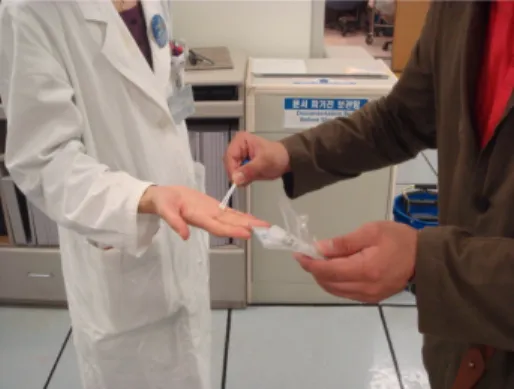
We requested the bacteria fixed to special absorption culture medium to microorganism examination room. We could find that so many kinds of bacteria were detected(Fig. 1).

Fig. 1. Inspection of bacteria in the

hands using absorption culture medium

(3)

1. Infection status in the imaging diagno- sis department

Hospital Examination table

C, E, G, H, J ㆍPseudomonas putida. Gram negative ㆍGramnegative bacilli(Unidentification)

D, F ㆍPseudomonas oryzihabitans, Gram negative

A, I, J ㆍEnterobactor cloacae. Gram negative.

B ㆍNothing

Table 1. Vacteria detection quantity of examination table

Hospital Examination handle

F, G ㆍAcinetobacter baumannii. Gram negative

I, J

ㆍAcinetobacter baumannii, Gram negative ㆍPseudomonas oryzihabitans, Gram negative ㆍBacillus specios Gram positive

C, B ㆍBacillus specios Gram positive

H ㆍPseudomonas oryzihabitans, Gram negative A, D ㆍNothing

Table 2. Vacteria detection quantity of examination handle

2. Infection status in the hands of radia- tion staffs

Hospital Hand

B, C, I

ㆍMicrococcus species. Gram positive ㆍCoagulase Negative Staphylococcus. Gram

positive

E, F ㆍCoagulase Negative Staphylococcus. Gram positive

A, D ㆍCoagulase Negative Staphylococcus. Gram positive

H, G ㆍNothing(Not examination in J hospital) Table 3. Vacteria detection quantity of radiorogist hand

3. Result of examination for bacterias cultivated separate.

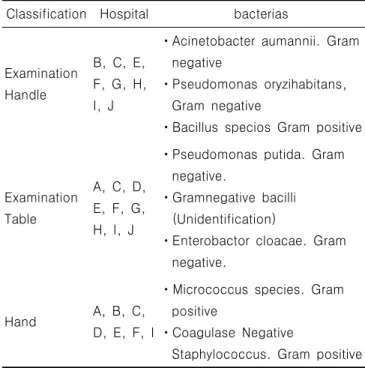
Classification Hospital bacterias

Examination Handle

B, C, E, F, G, H, I, J

ㆍAcinetobacter aumannii. Gram negative

ㆍPseudomonas oryzihabitans, Gram negative

ㆍBacillus specios Gram positive

Examination Table

A, C, D, E, F, G, H, I, J

ㆍPseudomonas putida. Gram negative.

ㆍGramnegative bacilli (Unidentification)

ㆍEnterobactor cloacae. Gram negative.

Hand A, B, C, D, E, F, I

ㆍMicrococcus species. Gram positive

ㆍCoagulase Negative

Staphylococcus. Gram positive Table 4. Vacteria interpretation result

4. Questionnaire survey result

A. Do you keep the sanitation rule of tools when you examine the patient who has risks of infection?

B. Do you think the secondary infection is possible when the infection of tools is confirmed?

C. Do you wash your hands before starting the examination of another patient?

D. Are you satisfied with the environment for sanitation of hands in your hospital?

Fig. 2. The survey result for 3rd medical organizations

(4)

Fig. 4. The right way of washing hands Fig. 3. The survey result for 1st medical organizations

Ⅳ. Discussion

Recently here was an occasion in which hospital infection became an issue due to the rampant child enteritis in several hospitals. The infection in the hospitals usually occurs to patients who have weak immunity but the guardians who visit hospitals and related hospitals staffs could be infected. However what is more important is that they are playing the conveyer of bacterias.

10~11

The people who work in the imaging diagnosis department that patient of diverse diseases visit could have the higher risk of infection. As imaging diagnosis departments should recognize it, they have to be aggressively interestedin personal sanitation along with the through disinfection of tools in contact of patients after medical examination.

The first step for itis washing hands. as the Figure 4 shows, the way of washing hands is first rub both hands, second rub one hand against the back of other hand, third rub space between fingers face to face, fourth rub palms of other hand with ends of fingers, fifth rub other thumb with wrapping and revolving it in other hand and finally rub nails to the palm of other hand strongly. You should make sure to do it before contact with patients, before and after wearing globes and before contact with contaminants (blood, body fluid, mucous membrane, impaired

skin and contaminated tools). The rubbing time should be 10~15 seconds. You have to remove water from the hands by drying them with paper towel or hand dryer after washing your hands.

For the second you have to make sure to get rid of the infectious bacterias with disinfection material after visiting the patients who keep some strong infectious diseases. You should make the imaging diagnosis safe from hospital infection as providing more comfortable environment and medical service by practicing disinfection activities more aggressively than related employees to prevent invisible bacteria infection.

Ⅴ. Conclusion

As the result of measuring bacteria contami-

nation status, we found that small amount of

Gram (-) Acine to bacter baumannii, Gram (-)

Pseudomonas oryzihabitans and Gram (+) Bacillus

specios Gram were detected on the handle of

photographing tools and some of Gram (-)

Pseudomonas putida. Gramnegative bacilli(Uniden-

tification), Pseudomonas oryzihabitans, Gram (-)

Enterobactor cloacae were found on the photogra-

phing tables. And bacterias such as ram (+)

Micrococcus species. Gram (+) Coagulase Negative

Staphylococcus were found in the hands of staffs

(5)

who work in imaging diagnosis department. On the whole the result shows small amount of bacteria was detected in the first medical organization. This survey result supports the fact the people who work in imaging diagnosis department of 1st medical organization keep high level of recognition for the risk of opportunistic infection but the environment around them is poor. And it shows the sanitation of equipments in the third medical organization is relatively in good condition but some bacteria were found in the hands of people. What is surprising in this study is that some bacteria was found even though it's little in the third medical organization appraised to be in positive condition from the questionnaire of disinfection of equipment and hand. In the event we found the possibility of opportunistic infection is related with disinterest of employees due to increasing number of inpatients in 3rd medical organization and recognition level of employees in first medical organization.

References

1. Lee JS, Jeong KH, Kim KH, Im IC, Kweon DC, Goo EH. et al. Radiology Department Infection Control According to Radiography Frequency and Disinfection Period. Journal of the Korean Society of Radiology 2011; 5: 73-80.

2. Bergogne-Berezin E, Tower KJ. Acinetobacter spp. as Nosocomial Pathogens: Microbiological, Clinical, and Epidemiological Features. Clinical Microbiolo Rev 1996; 9: 148-65.

3. Han EO, Kwon DM, Dong KR, Han SM. A Model for Protective Behavior against the Harmful Effects of Radiation based on Medical Institution Classifications. J Korea Asso Radiat Prot 2010; 35: 157-62.

4. Dong KR, Ro SH, Kweon DC, Ryu YH, Dong CB, Yu EY, et al. A Study Regarding Measurements of Bacterial Contamination Levels in Radiology Room within the Depart- ment of Radiological Technology. Journal of Korean Society for Indoor Environment 2009;

6: 275-84.

5. Kweon DC, Kim MS, Kim DS, Park B. A Survey of the Radiographic Cassettes Disinfection of University Hospitals in Seoul. Journal of the Korean Society of Radiology 2001; 24: 65-70.

6. Merrer J, Santoli F, Apperede Vecchi C, Tran B, De Jonghe B, Outin H. Colonization pre- ssure and risk of acquisiiton of methicillin- resistant Staphylococcus aureus in a medical intensive care unit. Infect Control Hosp Epidemiol 2000; 21: 718-23.

7. Kweon DC, Jeon YW, Cho A. Disinfection Efficacy of an Ultraviolet Light on Film Cassettes for Preventive of the Nosocomial Infection. Journal of the Korean Society of Radiology 2001; 24: 27-32.

8. Hughes, J. M. Study on the efficacy of noso comial infection control(SENIC Project): result and implications for the future. Chemotherapy 1988; 34: 553-61.

9. Kweon DC, Chung KM, Choi JW. A Study on Contamination and Disinfection of Film Cassette. Journal of the Korean Society of Radiology 2000; 23: 55-61.

10. Bae SH, Lee MS, Lim CS, Kim GJ. A Study on the Measurement of the Pollution Level of Bacteria and Disinfection of Table and IP Cassette. Journal of the Korean Society of Radiology 2008; 31: 229-37.

11. Castle M. Hospital infection control(principle and practice): A Wiley Medical Publication.

JAMA 1962; 180: 805-8.

수치

Fig.  1.  Inspection  of  bacteria  in  the  hands  using  absorption  culture  medium
Table  1.  Vacteria  detection  quantity  of  examination  table
Fig.  4.  The  right  way  of  washing  handsFig.  3.  The  survey  result  for  1st  medical  organizations

참조

관련 문서

After choosing the type of bike, the next step is the right bike size. the right size for you from

44 글의 첫 번째 문장인 The most important thing in the Boat Race is harmony and teamwork.을 통해 Boat Race에서 가장 중요한 것은 조 화와 팀워크임을

Now that you have the right bike for you, it is important to learn the right riding position.. A poor riding position can lead to injuries

44 글의 첫 번째 문장인 The most important thing in the Boat Race is harmony and teamwork.을 통해 Boat Race에서 가장 중요한 것은 조 화와 팀워크임을

웹 표준을 지원하는 플랫폼에서 큰 수정없이 실행 가능함 패키징을 통해 다양한 기기를 위한 앱을 작성할 수 있음 네이티브 앱과

_____ culture appears to be attractive (도시의) to the

- quadriceps tendon 이 슬개골 하연에서 tibial tuberocity에 부착.

The index is calculated with the latest 5-year auction data of 400 selected Classic, Modern, and Contemporary Chinese painting artists from major auction houses..