http://dx.doi.org/10.5333/KGFS.2015.35.3.232 ISSN 2287-5832 (Online)
* Corresponding author : Prof. Nag-Jin Choi, Department of Animal Science, Chonbuk National University, Jeonju 561-756, Korea, Tel:
+82-63-270-2579, Fax: +82-63-270-2612, E-mail: [email protected]
Research Article
Effect of Dietary Lysophospholipid (LIPIDOL
TM) Supplementation on the Improvement of Forage Usage and Growth Performance in Hanwoo Heifer
Wan-Sun Song
1, Jinho Yang
1, Il Hwan Hwang
2, Sangbuem Cho
3and Nag-Jin Choi
1*
1
Department of Animal Science, Chonbuk National University, Jeonju 561-756, Korea,
2
EAZYBIO Co., Ltd., Seoul, 135-754, Korea,
3
CALS Co., Ltd., Seongnam, 463-741, Korea
ABSTRACT
The present study investigated the effects of Lysophospholipid (LPLs, LIPIDOLTM) on the growth performance and nutrient digestibility of Hanwoo heifers. A feeding trial was performed for 120 days until slaughter using a herd of 24 Hanwoo heifers.
Eight heifers were assigned to each of 3 experimental groups (control, 0.3% LIPIDOLTM and 0.5% LIPIDOLTM). Growth performance, nutrient digestibility, and carcass characteristics were investigated. Significantly improved nutrient digestibility was found in the LIPIDOLTM treatment group compared to the control (p<0.05). No significant effect by LIPIDOLTM supplementation on growth performance was observed (p>0.05). However, interestingly, greater carcass weight was detected in the treatment of LIPIDOLTM where less daily gain was found. Although not a significant effect, greatly decreased back-fat thickness and increased loin area were detected in the treatment of LIPIDOLTM. In meat characteristics, LIPIDOLTM increased intramuscular fat and tenderness. Therefore, the present study results suggest that the inclusion of LIPIDOLTM in the diet of Hanwoo heifers can improve carcass performance and meat quality by increasing the carcass index and the meat quality index. The results also suggest that a level of 0.3% might be more efficient than 0.5% with regard to economic effectiveness.
(Key words : Lysophospholipids, LIPIDOLTM, Nutrient digestibility, Hanwoo heifer, Growth performance)
. INTRODUCTION
Roughage is one of the primary energy sources for the ruminants. It has an important role in the ruminal development and energy supply. Recently, the importance of forage feeding to produce more health beef becomes a issue by many researches (Ahn et al., 2000; Cho et al., 2012;
Kook et al., 2011). The study was reported that the quality of forage could influence the meat quality in Hanwoo, and good forage could improve meat color, intramuscular fat deposition and carcass performance (Cho et al., 2012). And the quality of forage is closely connected to ruminal digestibility and animal performance. Bio-availability of nutrients in diet was regarded the important factor to determin the farming household income (Church, 1988). It also could be hypothesized that improving bioavailability of concentrate diet could increase amount of forage content in diet during fattening period. Forage diet could not be
increased because of its low bioavailability.
Lysophospholipids (LPLs) have been suggested a potential compound that can activate biological membrane and increase transportation of macro-nutrients across cell membrane (Koo and Noh, 2007; Lundbaek and Anderseon, 1994). The role of LPLs was suggested to alter fluidity of membrane and permeability of nutrient across the membrane via modification of membrane lipid bilayer (Shier et al., 1976; Tagesson et al., 1985). Few studies have been conducted to investigate the effect of LPLs on animal nutrition and most of them were for swine and poultry (Xing et al., 2004). The effect of LPLs on in vitro rumen fermentation was investigated (Cho et al., 2013). However, there were limited studies to evaluate the effect of LPLs on beef performance, particularly Hanwoo.
The present study aimed to evaluate the effect of LPLs
on the improvement of the bio-availability of diet for the
beef productivity in Hanwoo.
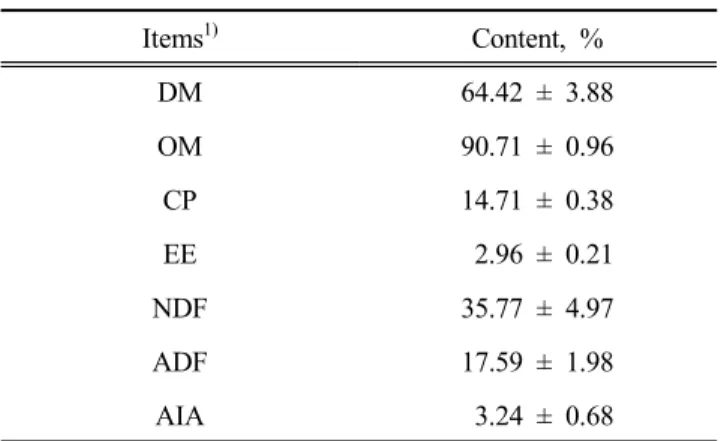
Table 1. Chemical composition of total mixed ration (DM basic)
Items
1)Content, %
DM 64.42 ± 3.88
OM 90.71 ± 0.96
CP 14.71 ± 0.38
EE 2.96 ± 0.21
NDF 35.77 ± 4.97
ADF 17.59 ± 1.98
AIA 3.24 ± 0.68
1)DM, dry matter; OM, organic matter; CP, crude protein; EE, ether extract; NDF. neutral detergent fiber; ADF, acid detergent fiber; AIA, acid insoluble ash.
. MATERIALS AND METHODS 1. Animal and experimental design
A feeding trial was conducted for 120 days at Hanwoo farm located in Jeonbuk, Korea with twenty four Hanwoo heifers (24~25 months, average body weight, 586 ± 38 kg).
Aliquot 12 kg of total mixed ration (TMR) were fed twice in a day (08:00 and 17:00) and water and mineral block were accessed ad libitum. TMR was composed the mixture of concentrate and forage at 8.5 to 1.5 ratio. Mixture of whole crop barely, rice straw and annual ryegrass were used as forage sources. Chemical composition of diet is shown in Table 1.
Total 3 experimental groups were prepared and 8 heifers were assigned into each group randomly. The Control did not include LPLs and two treatments included LPLs in different levels (0.3%, 0.5%, w/w). LPLs (LIPIDOLTM) was provided by EASYBIO Co. Ltd (Seoul, Korea)
2. Analyses
1) Nutrient digestibility
Nutrient digestibility was determined using fecal digestibility assessment (Van Keulen and Young, 1997). Briefly, fecal samples at 0, 30, 60 and 90 days of experiment were dried at 60 for 48 h and ground through a 1 mm screen using cutter miller (IKA MF 10.1, IKA. Staufen, Germany) and
then used for analysis. Nutrient digestibility of diet was calculated by comparing the content of acid insoluble ash in feces sample.
2) Growth performance
Body weight of heifer was measured at start of feeding trial, 90 and 120 days of experiment. Average daily gain (ADG) was calculated based on measured body weight.
Feed intake (FI) was measured weekly. Feed requirement was determined using ADF and FI.
3) Carcass performance
Carcass weight, carcass index, intramuscular fat, meat color, fat color, maturity and texture were investigated. All parameters involved in carcass characteristics were determined at Korea Institute for Animal Products Quality Evaluation (KAPE) after slaughter.
4) Meat sample analysis
After slaughter, meat samples were collected immediately from the loin area of each carcass. The split of carcass was stored at a chilling room for 24 h and then vacuum packed. The pH of meat was measured using a pH meter (NWK binar, pH-K21, Germany) through direct injection of pH probe into meat sample. The color of sample was measured using a Chroma meter (Konica Minolta-CM-2500d, Japan). Three categories of color, brightness (CIE L*), redness (CIE a*) and yellowness (CIE b*), were employed.
A white tile standard color board consisting of Y=92.40, x=0.3136 and y=0.3196 was used as a reference. For shearing force analysis, sample was heated until internal temperature reached to 70 and then cooled at cool bath for 30 min. Shearing force of prepared sample was measured using Shear Force Meter (G-R Elec. Mfg. Co.
USA). Cooking loss was measured according to the method reported by Honikel (1998).
3. Statistical analysis
Effect of treatment was analyzed by analysis of variance (ANOVA) using general linear model (GLM) and posthoc test was performed using Duncan’s multiple range test.
Significance level was determined using 95% probability.
Table 2. Effect of LIPIDOL
TMsupplementation levels on nutrient digestibility (%) of Hanwoo heifers
Day Control LIPIDOL
TMSEM
1)p value
0.3% 0.5%
30 52.90
a54.61
b53.71
ab1.452 <0.050
60 56.35
a57.83
ab60.41
b1.126 <0.050
90 48.84
a49.27
ab55.28
b1.876 0.099
Overall 51.17
a59.10
b60.56
b1.121 <0.050
1)SEM = Standard error of mean.
a, bDifferent superscript in same row means significantly different (p<0.05).
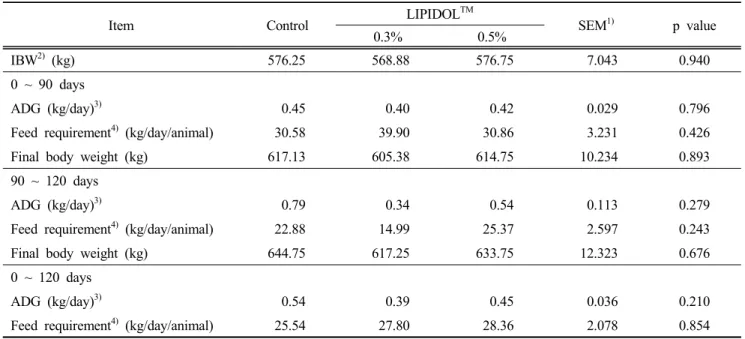
Table 3. Effect of LIPIDOL
TMsupplementation levels on growth performance of Hanwoo heifers
Item Control LIPIDOL
TMSEM
1)p value
0.3% 0.5%
IBW
2)(kg) 576.25 568.88 576.75 7.043 0.940
0 ~ 90 days
ADG (kg/day)
3)0.45 0.40 0.42 0.029 0.796
Feed requirement
4)(kg/day/animal) 30.58 39.90 30.86 3.231 0.426
Final body weight (kg) 617.13 605.38 614.75 10.234 0.893
90 ~ 120 days
ADG (kg/day)
3)0.79 0.34 0.54 0.113 0.279
Feed requirement
4)(kg/day/animal) 22.88 14.99 25.37 2.597 0.243
Final body weight (kg) 644.75 617.25 633.75 12.323 0.676
0 ~ 120 days
ADG (kg/day)
3)0.54 0.39 0.45 0.036 0.210
Feed requirement
4)(kg/day/animal) 25.54 27.80 28.36 2.078 0.854
1)SEM = Standard error of mean.
2)IBW = Initial body weight.
3)ADG = Average daily gain.
4)Feed requirement = feed intake/daily weight gain.
. RESULT AND DISCUSSION 1. Nutrient digestibility
Effect of LIPIDOL
TMsupplementation on nutrient digestibility is summarized in Table 2. Treatments with LIPIDOL
TMshowed significantly greater digestibility over all experimental periods compared to the control (p<0.05). In early period (~30 days), 0.3% LIPIDOL
TMshowed significantly greater digestibility (p<0.05) and then greatest digestibility was detected at 0.5% LIPIDOL
TMtreatment (p<0.05). The improved digestibility in treatment might be caused by the
action of LPLs on membrane activity toward enhancing its permeability of nutrient. Improvement of digestibility by LPLs was also reported in pig and broilers (Xing et al., 2004).
2. Growth performance
Effect of LIPIDOL
TMsupplementation on growth performance of Hanwoo heifers is shown in Table 3.
During entire periods, no significant effect of LIPIDOL
TMon growth performance was found. Even though LIPIDOL
TMshowed increased digestibility, there was no effect on ADG.
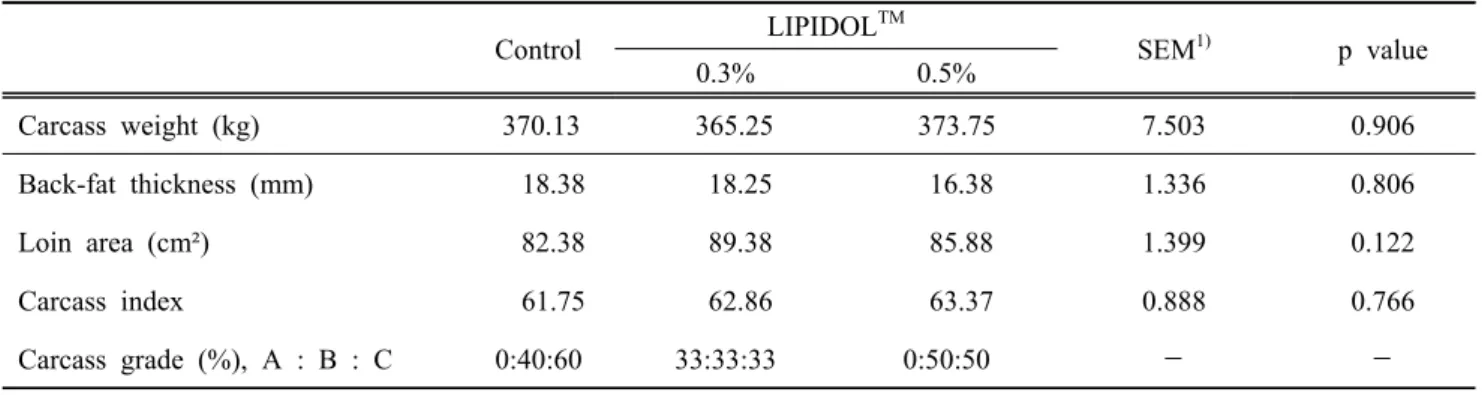
Table 4. Effect of LIPIDOL
TMsupplementation levels on carcass characteristic of Hanwoo heifers
Control LIPIDOL
TMSEM
1)p value
0.3% 0.5%
Carcass weight (kg) 370.13 365.25 373.75 7.503 0.906
Back-fat thickness (mm) 18.38 18.25 16.38 1.336 0.806
Loin area (cm²) 82.38 89.38 85.88 1.399 0.122
Carcass index 61.75 62.86 63.37 0.888 0.766
Carcass grade (%), A : B : C 0:40:60 33:33:33 0:50:50 - -
1)SEM = Standard error of mean.
Table 5. Effect of LIPIDOL
TMsupplementation levels on carcass weight rate in Hanwoo heifers
Control LIPIDOL
TMSEM
1)p value
0.3% 0.5%
Carcass yield (%)
2)57.43 59.13 58.98 0.400 0.159
1)SEM = Standard error of mean.
2) Carcass weight/body weight at slaughter.
Digestibility of nutrient should be positively related to weight gain in beef cattle. However, there can be many possible factors alter the relationship and short experimental period also could be considered on this discrepancy.
3. Carcass characteristic
Effect of LIPIDOL
TMsupplementation on carcass characteristic of Hanwoo heifers is summarized in Table 4.
Carcass weight is regarded as an important characteristic determining beef productivity (Rhee et al., 2003). Increment of carcass yield and improvement of meat quality are recognized as a key factor influencing farm economics.
Even though the LIPIDOL
TMsupplementation did not affect those beef characteristics in the present study, back fat thickness tended to be decreased linearly by increased supplementation levels of LIPIDOL
TM. Loin area and carcass index were increased with increased levels of LIPIDOL
TM. The occurrence of grade B in carcass grade was increased in treatment and grade C was decreased.
The present study investigated the ratio of carcass weight from body weight at slaughter and the result is summarized in Table 5. The treatment with 0.3% LIPIDOL
TMsupplemen- tation showed the greatest carcass yield. Treatment of 0.3%
LIPIDOL
TMshowed the lowest average daily gain in growth performance result. These contrary results might be interpreted by the feature of LIPIDOL
TMin energy partitioning. It could be supposed that LIPIDOL
TMcould alter energy partitioning toward increased carcass yield.
Effect of LIPIDOL
TMon meat quality is summarized in Table 6. Same with the effect on carcass performance, there was no significant difference among experimental groups.
However, distinctly improved marbling, meat color, fat color, maturity and texture in treatment fed LIPDOL
TMwere found. Particularly, 0.3% supplementation level of LIPDOL
TMshowed the greatest occurrence of grade 1
+.
4. Physical characteristics
Changes of physical characteristics of beef in control and treatments are shown in Table 7. Meat color is known as a determinative feature for the customer’s choice. Slightly decreased brightness (CIE L*) in treatments was found.
Redness and yellowness were greater in treatments with 0.5% and 0.3% LIPIDOL
TM, respectively. However, there were no significance differences (p>0.05) among the treatments.
Significantly low shearing force was detected in treatment
with 0.5% LIPIDOL
TM(p<0.05). Greater cooking loss was
Table 6. Effect of LIPIDOL
TMsupplementation levels on beef productivity of Hanwoo heifers
Control LIPIDOL
TMSEM
1)p value
0.3% 0.5%
Intramuscular fat deposition 4.38 4.75 4.63 0.385 0.928
Meat color 4.88 5.00 5.00 0.095 0.837
Fat color 2.88 3.00 3.13 0.085 0.508
Maturity 3.00 3.00 2.88 0.165 0.943
Texture 1.63 1.38 1.38 0.104 0.546
Meat grade (%) of 1
++:1
+:1:2:3 0:30:10:60:0 0:70:10:20:0 0:20:20:60:0 - -
1)SEM = Standard error of mean.
Table 7. Effect of LIPIDOLTM supplementation levels on meat characteristics of Hanwoo heifers
Control LIPIDOL
TMSEM
1)p value
0.3% 0.5%
CIE L
*2)36.04 33.72 34.36 0.505 0.153
a
*19.14 18.54 20.18 0.374 0.199
b
*14.09 13.07 13.65 0.363 0.546
WBs
3)(kgf) 3.97
b4.37
b2.78
a0.157 <0.050
Cooking loss (%) 17.82 19.22 18.57 0.317 0.210
pH 5.54 5.61 5.49 0.033 0.342
1)SEM = Standard error of mean.
2)CIE = Commission Internationale de l’Eclairage; L*: brightness, a*: redness, b*: yellowness.
3)WBs = Warner-bratzler shear force.
a, bDifferent superscript in same row means significantly different (p<0.05).
found in 0.3% LIPIDOL
TMtreatment, but, not significant (p>0.05). Meat pH in this study ranged between 5.49 to 5.61 and this range of pH was reported as normal meat characteristics (Yung et al., 2005; Wulf and Page, 2000).
The result of meat physical characteristics represented the effect of LIPIDOL
TMcould be found at tenderness of meat.
LIPIDOL
TMsupplementation could be related to more soft meat production.
. ACKNOWLEDGEMENT
Following are results of a study on the “Leaders in INdustry-university Cooperation” Project, supported by the Ministry of Education and the National Research Foundation of Korea (NRF).
. REFERENCES
Church, D.C. 1988. The ruminant animal. Digestive physiology and nutrition, Prentice Hall.
Cho, S., Lee, S.M. and Kim, E.J. 2012. Effect of different forages on growth performance, meat production and meat quality of Hanwoo steers: Meta-analysis. Journal of Korean Grassland and Forage Science. 32:175-184.
Cho, S., Kim, D.H., Hwang, I.H. and Choi, N.J. 2013. Investigation of dietary lysophospholipid (LIPIDOLTM) to improve nutrients availability of Diet with in vitro rumen microbial fermentation test. Journal of the Korean Society of Grassland and Forage Science. 33:206-212.
Folch, J., Lees, M. and Sloane-Stanley, G. 1957. A simple method for the isolation and purification of total lipids from animal tissues. The Journal of Biological chemistry. 226:497-509.
Koo, S.I. and Noh, S.K. 2007. Green tea as inhibitor of the intestinal absorption of lipids: potential mechanism for its lipid-lowering effect. The Journal of Nutritional Biochemistry. 18:179-183.
Lundbaek, J.A. and Andersen, O.S. 1994. Lysophospholipids modulate channel function by altering the mechanical properties of lipid bilayers. The Journal of General Physiology. 104:645- 673.
Rhee, Y., Jeon, K., Choi, S., Seok, H., Kim, S., Song, Y. and Lee, S. 2003. Prediction of Carcass Yield by Ultrasound in Hanwoo.
Journal of Animal Science and Technology. 45:335-342.
Rule, D.C. 1977. Direct transesterification of total fatty acids of adipose tissue, and of freeze-dried muscle and liver with boron- trifiluoride in methanol. Meat Science. 46:23-32.
Shier, W.T., Baldwin, J.H., Nilsen-Hamilton, M., Hamilton, R.T. and Thanassi, N.M. 1976. Regulation of guanylate and adenylate cyclase activities by lysolecithin. Proceedings of the National academy of Sciences. 73:1586-1590.
Tagesson, C., Franzen, L., Dahl, G. and Westrom, B. 1985.
Lysophosphatidylcholine increases rat ileal permeability to macromolecules. Gut. 26:369-377.
Van Keulen, J. and Young, B. 1977. Evaluation of acid-insoluble ash
as a natural marker in ruminant digestibility studies. Journal of Animal Sciences. 44:282-287.
Wheeler, T., Shackelford, S. and Koohmaraie, M. 2000. Relationship of beef longissimus tenderness classes to tenderness of gluteus medius, semimembranosus, and biceps femoris. Journal of Animal Science. 44:282-287.
Wulf, D. and Page, J. 2000. Using measurements of muscle color, pH, and electrical impedance to augment the current USDA beef quality grading standards and improve the accuracy and precision of sorting carcasses into palatability groups. Journal of Animal Science. 78:2595-2607.
Xing, J., Van Heugten, E., Li, D., Touchette, K., Coalson, J., Odgaard, R. and Odle, J. 2004. Effects of emulsification, fat encapsulation, and pelleting on weanling pig performance and nutrient digestibility. Journal of Animal Science. 82:2601-2609.
Young, O., Zhang, S., Farouk, M. and Podmore, C. 2005. Effects of pH adjustment with phosphates on attributes and functionalities of normal and high pH beef. Meat Science. 70:133-139.
(Received August 12, 2015 / Revised September 5, 2015 / Accepted September 7, 2015)