• 검색 결과가 없습니다.

Research on the influence of union-pay M-payment quality and brand personality on user viscosity

N/A
N/A
Protected

Academic year: 2021

Share "Research on the influence of union-pay M-payment quality and brand personality on user viscosity"

Copied!
7
0
0

로드 중.... (전체 텍스트 보기)

전체 글

(1)

JKSCI

Research on the influence of union-pay M-payment quality and brand personality on user viscosity

1)

Zi-Yang Liu*, Jun-Lin Wang*, Jiayu Liu*, Xiao-yin Liu*, Kai Liao*

*Professor, Dept. of Global Business Graduate School, Kyonggi University, Suwon, Korea

*Student, Dept. of Global Business Graduate School, Kyonggi University, Suwon, Korea

*Student, Dept. of Global Business Graduate School, Kyonggi University, Suwon, Korea

*Student, Dept. of Global Business Graduate School, Kyonggi University, Suwon, Korea

*Student, Dept. of Global Business Graduate School, Kyonggi University, Suwon, Korea [Abstract]

The purpose of this study is to explore the impact of Union-Pay mobile payments on user viscosity from the perspective of service quality and brand personality. In the future, it is meaningful for CUP to obtain a stable and loyal user group in China's mobile payment market. This study uses SPSS22.0 and AMOS statistical analysis tools to conduct empirical research. In this case, this study uses mobile service quality and The brand personality is the independent variable, and the user's viscosity is the dependent variable, which studies the impact on the user's viscosity in the context of China Union-Pay mobile payment. the study. According to the analysis results, the research goal: service quality has a significant positive correlation effect on user perceived value; service quality has a significant positive correlation effect on user viscosity; perceived value has significant positive correlation effect on user viscosity; brand personality to user Viscosity has a significant positive correlation effect; brand personality has a significant positive correlation effect on user perceived value. Through this research, we can make Suggestions on the industrial development of mobile payment enterprises and provide better opinions on the development of mobile payment.

▸Key words: Union-Pay, M-payment ,Service quality, Brand personality, User viscosity [요 약]

이 연구의 목적은 서비스 품질 및 브랜드 특성의 관점에서 Union-Pay 모바일 결제가 사용자 점도에

미치는 영향을 탐색하는 것이다 . 앞으로 중국Union-Pay가 모바일결제 시장에서 안정적이고 충실한 사용자

그룹을 확보하는 것이 의미가 있다. 이 연구는 SPSS22.0 및 AMOS 통계 분석 도구를 사용하여 경험적 연구를 수행을 했다. 본 연구는 모바일 서비스 품질을 사용하고 브랜드 성격은 독립 변수이고, 사용자의 점도는 종속 변수이며 , China Union-Pay 모바일 결제와 관련하여 사용자의 점도에 미치는 영향을 연구하였

다 . 연구 분석결과에 따르면, 서비스 품질이 사용자가 인식 한 가치에 유의 한 영향을 미친다는 결과

나타났다. 서비스 품질은 사용자 점도에 유의 한 양의 관계를 갖다. 인식 된 값은 사용자 점도에 유의

한 양의 효과를 나타났다 . 사용자에 대한 브랜드 특성이 사용자 점도에 유의한 양의 효과를 나타났다.

브랜드 성격은 사용자가 인식 한 가치에 유의 한 양의 관계 영향을 미친다 . 이 연구를 통해 모바일 결제 기업의 산업 발전에 대한 제안을 했고 모바일 결제발전에 대한 더 나은 의견을 제시 하였다.

▸주제어: Union-pay, M 지불, 서비스 품질, 브랜드 특성, 사용자 점도

∙First Author: Zi-Yang Liu, Corresponding Author: Kai Liao

*Zi-Yang Liu ([email protected]), Dept. of Global Business Graduate School, Kyonggi University *Jun-Lin Wang ( [email protected]), Dept. of Global Business Graduate School, Kyonggi University *Jiayu Liu ([email protected]), Dept. of Global Business Graduate School, Kyonggi University *Xiao-yin Liu ([email protected]), Dept. of Global Business Graduate School, Kyonggi University *Kai Liao ([email protected]), Dept. of Global Business Graduate School, Kyonggi University

∙Received: 2020. 03. 06, Revised: 2020. 04. 09, Accepted: 2020. 04. 10.

Copyright ⓒ 2020 The Korea Society of Computer and Information http://www.ksci.re.kr pISSN:1598-849X | eISSN:2383-9945
(2)

I. Introduction

China Union-Pay was established in March 2003.

As of September 2019, China Union-Pay has become the world's largest organization of card issuance, nearly 8 billion bank cards, and the banking network is spread across China's urban and rural areas and extends to 174 countries and regions outside China.

The difference between the cloud flash payment mobile payment brand launched by China Union-Pay and the We-Chat and Ali-pay (social, e-commerce) positioning is that it serves the users with the official background of the “housekeeper and more ”closer“ to the users. Through the differentiated competition policy of Linked Banks, we will compete with We-Chat and Ali-pay in the mobile payment market, and integrate the resources of major banks so that users can enjoy the common rights of all banks through an app: inter-bank card management and support for all bank cards. Fixed, large amount of transfer, institutional advantages.

Moreover, the policy of “breaking-straight has become an important opportunity for the development of Uion-pay Pay mobile payment.

II. Preliminaries

1. Related works 1.1 Service Quality

So far, the impact on the theory of service quality research has been more mature. The service quality gap model proposed by PZB (1985) mentioned that the SERVQUAL scale. The quality of service is divided into five dimensions:

tangibility, reliability, responsiveness, assurance, and empathy[1]. RUST, OLIVER (1993) mentioned that proposed a three-factor model of service quality, which judges the quality of service from three dimensions: service product, service delivery and service environment[2]. Stiakakis.E (2014) mentioned that based on the e-commerce service quality model, through the empirical analysis of the

mobile service quality model, the results show that the mobile service quality is divided into three dimensions: interaction quality, environmental quality, and quality of results[3]. Huang, E. Y (2015) mentioned that based on the e-commerce model, empirically analyzes the mobile service quality through the user shopping experience of virtual products and physical products: contact, response, fulfillment, and efficiency have higher user shopping experience. Positive impact[4]. Jun, M (2016) mentioned that The key dimensions of mobile banking service quality indicate that mobile convenience, accuracy, diverse mobile application service capabilities, ease of use and continuous improvement are considered to be the main sources of customer satisfaction.is often represented in text form and classified into multiple categories. In the information space spanned by the categories, upon receiving a document, automatic text filtering and text classification are essential. One of the popular ways to achieve the task is to delegate a classifier to each category[5].

1.2 Brand personality

In today's mobile payment market, products, software and services are highly homogenized, and brand image has increasingly become an important competitive means for various third-party mobile payment companies. Because the image is only the identity of the consumers, and the personality can cause worship. Kelley (1998) once suggested that

“brand personality is conducive to customers' emotional positioning of brands and easy to obtain customer's psychological identity[6]. Aaker (1999) through the empirical research to obtain the dimension scale of brand personality – is divided into:

“innocent The five dimensions of stimulating,

stimulating, nurturing, and nurturing[7]. Xu Qian

(2018) conducted an empirical study on the social

media brand personality into six dimensions: joy,

time, newness, negative, caring, honesty and

wisdom[8]. Wu, Z (2019) proposed in the theory and

modeling of user-aware brand personality based on

mobile application IU: calculating user interface

(3)

descriptors, including color, organization and texture elements and page level, can effectively predict the perceived personality of the user. High accuracy[9].

1.3 User Perceived Value

Zeitham I (1988) defines user perceived value as:

Value is the overall measure of a user's utility for a product or service based on perceptions of income and loss[12]. Liu Jiaojiao (2018) analyzes the customer's customer value based on customer value in the analysis of customer value: 1.

Functional value 2. Social value 3. Emotional value 4. Knowledge value 5. Convenience value[11].

Karjaluoto, H (2019) reveals that self-consistency and product novelty are the main drivers of user perception of the value of MFSAS (Mobile Financial Services Apps). In addition, the survey results show that the perceived value of MFSAS has a strong positive impact on the overall satisfaction and commitment of customers[10].

1.4 User Viscosity

The term user viscosity originally came from the Internet. Davenport (2000) believes that user viscosity refers to the strength of the user's willingness to continue using a product[14]. Lin, C.

C (2007) argues that user viscosity is the ability of a website to retain online customers and extend the time per stay[15]. Hsu, C (2016) The impact of mobile application viscosity and in-app purchase willingness through a model of perceived value and social impact found that viscosity and social identity significantly affect users' willingness to purchase in-app purchases[13]

III. The Proposed Scheme

3.1 Research Model

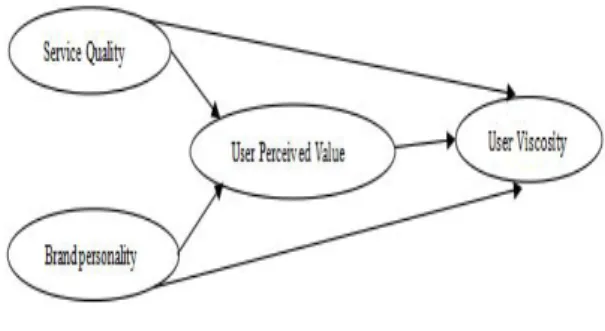
Based on the above literature review, this study constructs a theoretical model of Union-Pay mobile payment, as shown in Figure 1:

Fig. 1. Research model

3.2 Variable Operation Definition

The definition of operation of service quality refers to the three-factor model of service quality proposed by RUST, OLIVER (1994).Suggested that the quality of service is judged from three dimensions: service product, service delivery and service environment.

The definition of operation of brand personality is defined. Aaker (1999)mentioned that dimension scale consisting of brand personality obtained through empirical research: “The five dimensions of innocence, stimulation, ability, education and roughness; user perception value reference Liu jiaojiao(2018) mentioned that enterprise competitiveness strategy based on customer value In the analysis, the service enterprise customer value is divided into: 1. functional value 2. social value 3.

emotional value 4. knowledge value 5. convenience value; user sticky operation definition reference Luis Casal (2008) by measuring user viscosity Dimensions[17], the user viscosity can be expressed by the user's satisfaction, dependence, loyalty and willingness to reuse the product.

3.3 Reliability Test

According to the research objectives of this paper

and the specific characteristics of the research

objects, the questionnaire survey method will be

used. The survey time for mobile payment users in

China will be investigated from September 5, 2019 to

October 2, 2019. First, 100 questionnaires were

prepared. It is hoped that the information in the

questionnaire can be found through the feedback of

100 customers, so that the modification of the

questionnaire can be improved, and the formal

(4)

questionnaire is issued. A total of 445 questionnaires were sent out. After the questionnaires were collected, the data was checked by Excel. There were 21 invalid questionnaires, and 424 valid questionnaires were actually collected. The actual recovery rate was 95%. Finally, 424 valid questionnaires were used for analysis, and SPSS 22.0 was used for reliability analysis, factor analysis, and structural equation modeling.

Through the SPSS statistical analysis software, we can find that the Cronbach's α coefficient values in the above table are all above 0.6. It can be judged that the internal consistency of each item exists and has good stability, which is in full compliance with the scope of the reliability determination of this study.

Cronbach’ α Number of

Items

SQ 0.903 3

BR 0.917 3

UPV 0.939 3

UV 0.911 3

Table 1. Reliability analysis results

3.4 Validity Test

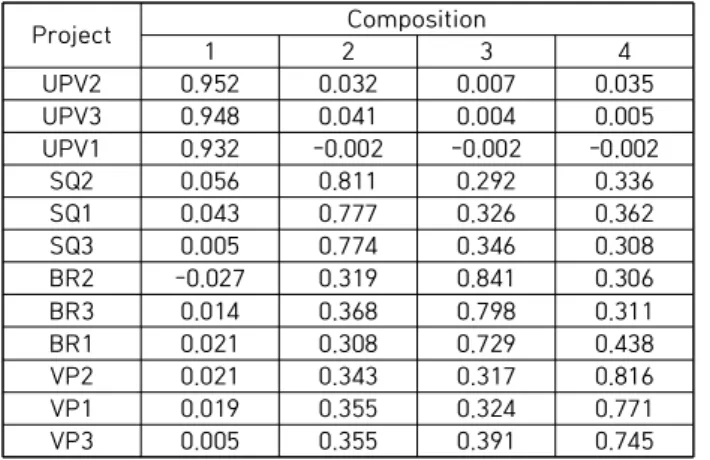
The SPSS23.0 statistical analysis software was used to obtain the validity model results of the above table. Using the factor analysis, we can see that the weighting values of each variable exceeded 0.7, indicating that the scale has good construction validity.

Project Composition

1 2 3 4

UPV2 0.952 0.032 0.007 0.035

UPV3 0.948 0.041 0.004 0.005

UPV1 0.932 -0.002 -0.002 -0.002

SQ2 0.056 0.811 0.292 0.336

SQ1 0.043 0.777 0.326 0.362

SQ3 0.005 0.774 0.346 0.308

BR2 -0.027 0.319 0.841 0.306

BR3 0.014 0.368 0.798 0.311

BR1 0.021 0.308 0.729 0.438

VP2 0.021 0.343 0.317 0.816

VP1 0.019 0.355 0.324 0.771

VP3 0.005 0.355 0.391 0.745

Table 2. Validity analysis result Table

3.5 Research Result

Fig. 2. Structural equation model

Standardized

Estimate Estimate AVE

SQ1 <--- SQ 0.87 0.316

0.73

SQ2 <--- SQ 0.92 0.211

SQ3 <--- SQ 0.86 0.324

UPV1 <--- UPV 0.85 0.374

0.63

UPV2 <--- UPV 0.91 0.256

UPV3 <--- UPV 0.78 0.63

UV1 <--- UV 0.84 0.456

0.69

UV2 <--- UV 0.88 0.29

UV3 <--- UV 0.89 0.284

BR1 <--- BR 0.87 0.371

0.71

BR2 <--- BR 0.91 0.256

BR3 <--- BR 0.89 0.291

Table 3. AVE Result Table

In the verification of the basic adaptation index

of the model, according to the test method of

Bogozzi (1988) and other scholars[16], as shown in

Figure 2.We can get the chi-square value =

128.243, GFI = 0.950, AGFI = 0.118, RMSEA < 0.08

and other results, according to the index criteria,

we can completely determine that the results can

be passed the model adaptation criteria. By

calculating the average extracted variance value

for each latent variable (AVE) > 0.5, as shown in

Table 5. The four potential variables of this study

have good convergence validity.

(5)

Hypothesis Esti

mate S.E. C.R. P Conclusion

H1

(SQ→UPV) 0.457 0.08 5.749 *** Supported H2

(SQ→UV) 0.348 0.066 5.303 *** Supported H3

(UPV→UV) 0.250 0.049 5.089 *** Supported H4

(BR→UV) 0.396 0.059 6.739 *** Supported H5

(BR→UPV) 0.305 0.072 4.218 *** Supported Table 4.Hypothetical Result Test

The indicators for evaluating the hypothesis test results are compiled, as shown in Table 6.

According to the hypothesis test results of the structural equation, we can get the following research results:

H1: Quality of service has a significant positive correlation effect on user perceived value

H2: Service quality has a significant positive correlation effect on user viscosity

H3 user perceived value has a significant positive correlation effect on user viscosity

H4: Brand personality has a significant positive correlation on user retention

H5: Brand personality has a significant positive correlation effect on user perceived value

IV. Conclusions

After empirical analysis, this study has the following conclusions:

1. Service quality has a significant positive correlation effect on user perceived value and user viscosity. That is, the higher the service quality of Union-Pay mobile payment, the higher the user perceived value; the stronger the user viscosity.

Among them, the service delivery dimension in service quality has the greatest influence. It shows that the current Union-Pay mobile payment should pay attention to the corresponding promotion channels for products. As the Union-Pay payment that enters the mobile payment market later, the

user has not yet relied on the use and habits. It is also necessary for Union-Pay to unite the strengths of all parties in the industry, focusing on product promotion channels, continuously optimizing the acceptance of the environment and enriching the use scenarios, so as to formulate a new round of publicity and marketing plans.

2. Brand personality has a significant positive correlation effect on user perceived value and user viscosity. The more accurate the brand image positioning of Union-Pay mobile payment, the higher the perceived value of users and the stronger the user's viscosity, indicating that not only the service quality of products should be improved. At the same time, product marketing must be upgraded to an emotional and value marketing model. Because the functions of major brands of mobile payment are similar, how to realize differentiated positioning from the perspective of brand and give Union-Pay mobile payment soul, so in the future, Union-Pay mobile payment can give pure, powerful and rough products from the perspective of brand personality.

The identification and the user's personality psychology form a consensus, improve the user's perceived value, and ultimately form user viscosity.

3. User perceived value has a significant positive correlation effect on user viscosity. That is, Union-Pay mobile payment can effectively maintain user viscosity and achieve the formation of loyal user group by improving user perceived value.

Therefore, in the perceived value of users, the future Union-Pay mobile payment can be improved from three aspects: functional value, social value and convenience value.

This study mainly summarizes the characteristics

of the study by summarizing the characteristics of

the literature and the characteristics of the

Union-Pay mobile payment. However, in the past

literature, there are still many factors affecting

user viscosity, such as external environment, user

experience, social factors, etc., so the selection of

(6)

variable dimensions has certain limitations;

considering that Union-Pay mobile payment is entering China in recent years. In the mobile payment market, the choice of samples has certain limitations. In the future, for the study of the impact of Union-Pay mobile payment on user viscosity, in terms of service quality and brand personality, we can obtain user information and method of combining theoretical literature from big data mining, break through the study of regional restrictions, and obtain more accurate What are the factors that maintain user viscosity?

REFERENCES

[1] GiocondaMele;ValentinaNdou;GiustinaSecundo.,(2018),Creating value from Social Big Data: Implications for Smart Tourism Destinations, Information Processing&Management, volume54,pa ge847-860

[2] Ulrike Gretzel;Marianna Sigala;Zheng Xiang;Chulmo Koo.,(2015) .Smart tourism: foundations and developments, Electronic Markets ,volume25,pp179-188

[3] Yan, Y. , Huang, C. , Wang, Q. , & Hu, B.,(2018). Data mining of customer choice behavior in internet of things within relationship network. International Journal of Information Management.

[4] Delone W H, Mclean E R.,(2004).Measuring e-commerce success:Applying the De Lone & Mc Lean information systems success model. International Journal of Electronic Commerce,9 (1): 31-47.

[5] Moorman C, Zaltman G, Despande R.,(1993). Factors affecting trust in market research relationships. Journal of marketing,57 (01):81-101.

[6] Zhou T.,(2013).An empirical examination of continuance intention of mobile payment services.Decision Support Systems, 54(2):

1085-1091.

[7] Lee M K O, Turban E.,(2001).A trust model for consumer internet shopping. International Journal of Electronic Commerce,6(1):

75-91.

[8] Kujala, S. , Roto, V. , V??N?Nen-Vainio-Mattila, K. , Karapanos, E. , & Sinnel,A.,(2011). Ux curve: a method for evaluating long-term user experience. Interacting with Computers, 23(5), 473-483.

[9] Dahai,D & Yufang,J.,(2003). Research on the antecedents of consumer behavioral preferences. Nankai Management Review,

6 (6), 46-51.

[10] Warshaw, P. R., & Davis, F. D.,(1985). Disentangling behavioral intention and behavioral expectation. Journal of Experimental Social Psychology, 21(3), 213-228.

[11] Aizhong, H&Wanchen,G.,(2010).A Preliminary Study on the Mechanism and Models of the Effect of Online Shopping Experience on Customer Behavior Tendency. East China Economic Management (3), 112-116.

[12] Bagozzi, R.P. ,& Yi,Y.,(1988). On the evaluation of structural equation model. Journal of Academy of Marketing Science, 16 (1), 74-94.

[13] Hull, R., Kumar, B., Daniel Lieuwen, Peter F. PatelSchneider,

Sahuguet, A., & Varadarajan, S., et al. ,(2003). “everything

personal, not just business:” improving user experience through

rule-based service customization. Lecture Notes in Computer

Science, 29-10, page. 149-164.

(7)

Authors

Zi-Yang Liu. Received the B.A. degree in Management from Army superintend institute of shijiazhuang China PLA ,China, in 2006, M.A. degree and Ph.D. degree in Management from Kyonggi University, Korea,

in 2010 and 2013, reapectively. Dr. Liu joined the faculty of the Global Business Kyongggi University, Korea in 2015. He is currently an Assistant Professor in the Global Business Kgonggi University. He is interested in Quality Management.

Management Information Systems, International economics, E-business etc.

Jun-Lin Wang. Master of Real Estate Finance and Investment, Konkuk University, Ph. D candidate in International Management, Kyonggi University. Mainly engaged in the field of big data analysis of business

management and internet big data analysis. Founder of Korea's largest Chinese overseas students’ website "icnkr.com"

with over 15 years of internet operation experience.

Jiayu Liu. Received the B.A.and the M.A.

degree from Shandong University of Arts , Currently studying for a Doctoral Course in Global Business from Kyonggi University.

During in Doctoral Course Mainly engaged in

the field of Big data and Business, Consumer Psychology, and E-business.

Xiao-yin Liu. Received the Bachelor's and Master's Degrees from Konyang University, Currently Studying for a Doctoral Course in Global Business from Kyonggi University.

During in Doctoral Course Mainly engaged in

the field of Big Data and Business, Consumer Psychology, and E-business.

Kai Liao. Graduated from Dhurakij Pundit

University. Now studying for a doctor degree

at Kyonggi University. During the school

period, the main research interest is Global

Business.

수치

Fig.  1.  Research  model
Table  3.  AVE  Result  Table

참조

관련 문서

The effect of sportsmanship of middle school students on personality development through net type competitive sport activities was positively

The paper has suggested characters that can elevate cognition on family restaurant brands, and it examines effects of characters upon brand cognition through

It is necessary to reconsider the Chinese brand image in the current market environment of the world where the influence of China is increasing. Therefore, in this

model development and empirical testing. Brand authenticity: Towards a deeper understanding of its conceptualization and measurement.. Brand authenticity: Testing

1) Transition boundary between Newtonian and non‐Newtonian flow behavior 2) Iso‐viscosity contours representing stress and temperature effect on viscosity 3)

Along with the results of the analysis of visual design elements of outdoor signboards and consumer surveys conducted to enhance the brand image of

Competence had a positive (+) influence on satisfaction with human relationships and self-confidence also had the positive (+) influence. However, in attractiveness,

In order to extract the factors of brand personality, prior literature review in the fields of consumer behavior theory and psychology was performed. The