• 검색 결과가 없습니다.

Word-final Coda Acquisition by English-Speaking Childrea with Cochlear Implants

N/A
N/A
Protected

Academic year: 2021

Share "Word-final Coda Acquisition by English-Speaking Childrea with Cochlear Implants"

Copied!
9
0
0

로드 중.... (전체 텍스트 보기)

전체 글

(1)

말소리와 음성과학 제3권 제4호 (2011) pp. 23~31

ABSTRACT

This paper examines the production patterns of the acquisition of coda consonants in monosyllabic words in English-speaking children with cochlear implants. The data come from the transcribed speech of children with cochlear implants. This study poses three questions. First, do children with cochlear implants acquire onset consonants earlier than codas? Second, do children’s productions have a bimoraic-sized constraint that maintains binary feet? Third, what patterns emerge from production of coda consonants? The results revealed that children with cochlear implants acquire onset consonants earlier than codas. With regard to the bimoraic-sized constraints, the productions of vowel type (i.e., monomoraic and bimoraic) were more accurate for monomoraic vowels than bimoraic ones for some children with cochlear implants, although accuracy in vowel productions showed high proportion regardless of vowel types. The variations of coda production exhibited individual differences. Some children produced less sonorant consonants with high frequency and others produced more sonorant ones.

The results of this study were similar to those pertaining to children with normal hearing. In the process of coda consonant acquisition, the error patterns of prosody-sensitive production may be regarded as articulatory challenges to produce higher-level prosodic structures.

Keywords: coda acquisition, monomoraic and bimoraic vowels, prosodic structure, cochlear implants

1. Introduction

This paper investigates the acquisition of coda consonants in monosyllabic (i.e., CVC) words produced by children with cochlear implants. The acquisition of word-final coda consonants has been examined in various languages as well as in English-speaking children (Fikkert, 1994; Ota, 1999, 2006; Kehoe

& Stoel-Gammon, 2001; Lleó, 2003, 2006; Stites, Demuth, &

Kirk, 2004; Demuth, Culbertson, & Alter, 2006; Vigário, Freitas,

& Frota, 2006; Prieto, 2006). In early stages of acquisition, the production of coda consonants has been discussed with respect to

1) Yeungnam University, [email protected]

The earlier work of this paper was supported by grants from the National Institutes of Health, R01DC005594 to Indiana University (Steven B. Chin, Department of Otolaryngology-Head and Neck Surgery, Indiana University School of Medicine).

Received: November 3, 2011 Revised: December 12, 2011 Accepted: December 16, 2011

the preference for CV prosodic structure, vowel insertion, bimoraic words constraints, and frequency effects.

In the early stage of acquisition, there is greater variability in acquiring segments, and certain acquired segment is preferred to others depending on the motor development compared to those other segments. Furthermore, the acquisition of segments in some contexts tends to have more variability than in other contexts.

This variation in children’s segmental production has particularly

been researched with regard to the development of prosodic

structures. Prosodic units such as moras, syllables, feet and

prosodic words have been emphasized as an important part of the

variation of segmental acquisition. In other words, in early

acquisition, children do not produce codas in the development of

prosodic structures, and CV as the core syllable is the earliest

form for the production of codas by children (Jakobson,

1941/1968; Fikkert, 1994). Cross-linguistically, the CV syllable is

regarded as the unmarked prosodic structure of the syllable

(Blevins, 1995; Levelt & Van de Vijver, 1998). Blevins (1995)

(2)

investigated the different prosodic structures of twelve languages.

The different prosodic shapes are dependent on different languages. The CV prosodic structure is the most common and unmarked shape of syllables for all languages, which is consistent with the earliest prosodic shape of children’s acquisition. Hua permits CV syllables as the only prosodic shape, comparing to other languages that allow more complex prosodic structures. The CVC shape is shown in eight languages and is less unmarked than CV. The prosodic structures, V(C) and CVCC are more marked than CVC but less marked than CCV(C). (C)(C)VCC is the most marked for all languages. In Blevin’s survey, Dutch was the language with the most marked prosodic structures.

Considering these common prosodic shapes cross-linguistically, the development of prosodic structure is predictable, in that the unmarked prosodic shape is acquired before marked ones in the process of acquisition.

The process of prosodic development is strongly dependent on language-specific properties. The present study focuses on word-final coda acquisition in CVC prosodic structures.

English-speaking children tend to produce the unmarked CV prosodic structures for the target CVC, or to insert a vowel after the word-final consonant as CVCV (Matthei, 1989; Roark &

Demuth, 2000). The examples in (1) illustrate the variation in coda acquisition of the CVC prosodic structure by English-speaking children.

(1) Examples from children with normal hearing a) Coda deletion

/dɑg/ → [dɑ] ‘dog’ Demuth (1996) /ka:r/ → [ka:]~[ka] ‘car’ Fikkert (1994) b) Vowel insertion

/bʊk/ → [bʊkɔ] ‘book’ Matthei (1989)

(1a) shows final coda deletion and (1b) shows vowel insertion in the CVC production of children with normal hearing. In (1a), vowel lengthening occurs instead of coda deletion in the production data of ‘car’. These examples display variability in that coda acquisition is more marked than the acquisition of open syllables.

It has been argued whether the other variability on word-final coda acquisition, bimoraic words constraints, is satisfied. Models for the development of prosodic structures have emerged from studies of Fikkert (1994) and Demuth (1995). The model for the prosodic development in (2) is adapted from Demuth (1995).

(2) Stages in the development of prosodic structure (Demuth, 1995)

Stage I. Core syllables – CV Stage II. Minimal Words/Binary Feet

a. Core syllables – (C)VCV b. Closed syllables – (C)VC

c. Vowel length distinctions – (C)VV

The examples in (2) present the two stages containing the variation of production data for each stage in the acquisition of prosodic structure. After acquiring the core syllable, children tend to have complications with their acquisition of well-formed prosodic shapes, including a word-final coda. Some children who are entering a stage that displays minimal word effects produce CVCV shapes without a word-final coda, or have vowel lengthening. Other children produce prosodic words with a coda.

The literature on the acquisition of prosodic units has emphasized the importance of the developmental process (Fikkert, 1994;

Demuth, 1996; Pater, 1997). Based on this hierarchy of prosodic acquisition, final consonant deletion has been found to have a specific influence on prosodic structure (Rvachew and Andrews, 2002). The variation in consonant production in early stages occurs in order to aid the acquisition of a higher-level in the hierarchy of prosodic structure (Fudge, 1969; Stoel-Gammon, 1983). That is, variation related to the deletion of the word-final coda position may be due to the constraints of the interaction between the segments and syllables at different levels of the prosodic structure.

On the other hand, frequency effects may be one of the factors accounting for the acquisition of word-final consonants. Lleó

(2006) investigated the acquisition of prosodic structure for Spanish monolingual and Spanish-German bilingual children. The Spanish monolinguals produced CVC with a CV prosodic shape and acquired the coda consonant later, whereas Spanish-German bilinguals produced CVC earlier than CV. This is attributed to frequency effects because Spanish-German bilinguals hear many more instances of word-final consonants than Spanish monolinguals do. In early prosodic acquisition, children’s production is language-specific and sensitive to prosodic structures with a high frequency (Levelt, Schiller, and Levelt, 2000).

Given the development of prosodic acquisition, coda consonant

acquisition is dependent on the effect of prosodic position in the

process of phonological acquisition. There seems to be an

interesting interaction between segmental and prosodic factors,

particularly for coda acquisition in CVC prosodic structure. The

word-final consonant acquisition of English-speaking children has

(3)

often been identified as the acquisition of onset (Goad and Brannen, 2003), that is, an onset to an empty syllable; however, Demuth, Culbertson, and Alter (2006) do not consider it as such.

Fikkert (1994) has also proposed that vowel insertion for CVC prosodic structure in the speech of English-speaking children is regarded as a way to ensure the acquisition of word-final coda consonants rather than producing disyllabic feet. Demuth, Culbertson, and Alter (2006) suggest that, in the early stage of acquisition, deletion of word-final consonants, vowel insertion, and aspiration in coda position appear as the variations of articulatory properties in producing word-final consonants for some English-speaking children.

This paper examines whether similar features of acquisition in the development of prosodic structures appear for children with normal hearing and those with cochlear implants. This research poses three questions. First, do children with cochlear implants acquire onset consonants earlier than codas? Second, do children’s productions have a bimoraic-sized constraint that maintains binary feet? Third, what patterns emerge from production of coda consonants? This paper is concerned with the variability of production error patterns with respect to coda acquisition in the word-final position. Children with cochlear implants use auditory prosthesis that helps speech perception and their production is finely tuned to ambient language. Their production errors in the word-final coda position are variegated by different patterns and individual variations. However, there is little research on production errors of coda acquisition related to the development of prosodic structures in children with cochlear implants. The purpose of this study is to demonstrate how the production patterns of coda consonants with respect to the prosodic structure of children with cochlear implants can be accounted for by comparing them with those of children who have normal hearing.

2. Method

In this study, we examine the patterns of word-final consonants in the CVC prosodic structure produced by English-speaking children with cochlear implants. The data analyzed were identical to those used by Kim and Chin (2008). The data source is described in detail in the study of Kim and Chin; for the present study, this is briefly summarized below.

2.1 Participants

The participants were 10 children with cochlear implants raised in English-speaking households. They participated in a series of

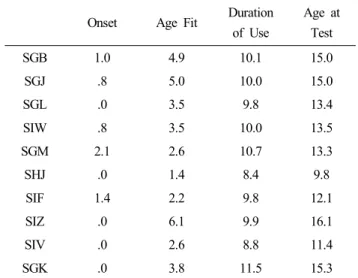
studies on phonological acquisition at the Indiana University Medical Center located in Indianapolis, Indiana, USA. The demographic information for all the participants was adapted from Kim and Chin (2008). Table 1 shows demographic information for 10 children. With respect to the 10 children, their age at onset of deafness ranged from .9 - 2.1 years. The age at which they were fitted with a cochlear implant ranged from 1.4 - 6.1 years. The duration of cochlear implant use at time of testing ranged from 8.4 - 11.5 years. Further, their age at the time of being tested ranged from 9.8 - 16.1 years. In Table 1, the Code column presents the trilateral characters that were randomly assigned to each participant.

Table 1. Demographic information for 10 children

Onset Age Fit Duration of Use

Age at Test

SGB 1.0 4.9 10.1 15.0

SGJ .8 5.0 10.0 15.0

SGL .0 3.5 9.8 13.4

SIW .8 3.5 10.0 13.5

SGM 2.1 2.6 10.7 13.3

SHJ .0 1.4 8.4 9.8

SIF 1.4 2.2 9.8 12.1

SIZ .0 6.1 9.9 16.1

SIV .0 2.6 8.8 11.4

SGK .0 3.8 11.5 15.3

2.2 Data analysis

The data used in the present study are a subset of data analyzed in Kim and Chin (2008). The data for all participants were collected in an isolated-word picture-naming task. The monosyllabic words with CVC prosodic structures were excerpted;

42 words with onset consonants and 40 words with coda consonants were analyzed. The total number for 10 participants was 420 words with onset consonants and 400 words with coda consonants. The words produced by the 10 children with cochlear implants were recorded and phonetically transcribed by an English linguistic researcher and an English speech-language pathologist (Kim and Chin, 2008). All analyses in the present paper were based on consensus transcriptions by the two transcribers as in Kim and Chin (2008).

For the statistical analysis in the pooled results, one-way repeated measures analysis of variance was conducted.

Within-subject factors were onset and coda production patterns

and vowel type. The Greenhouse-Geisser correction was reported

(4)

if data violated the equality of variances of the differences between conditions. The individual production patterns of children with cochlear implants were reported as percent error or correct as in the studies of Kehoe and Stoel-Gammon (2001) and Demuth, Culbertson, and Alter (2006). An onset or coda consonant was regarded as correctly produced if it was identical to the target (e.g., [dɑg] ‘dog’, [kʰʌp] ‘cup’, [lif] ‘leaf’). In addition, a chi-square analysis was employed to report clear evidence for the individual differences in production of vowel type.

3. Results

3.1 Onset and coda production

Figure 1 displays onset and coda production errors. All the children showed higher percentages of coda errors than onset production errors; the proportion of onset production errors was 22% and coda errors 57%. This result shows that children were more sensitive in the acquisition of onset consonants than codas in the CVC prosodic structure, F(1, 9) = 94.925, p < .05. With respect to individual variations, the participants, SIW, SIZ, and SGK exhibited higher percentages of coda production errors than onset production errors. Their proportional difference between onset and coda production errors was over 40%. SGL showed the least proportional difference; that is, for this participant, onset production error was 26% and coda production error was 35%.

Figure 1. Percentage of onset production and coda production errors

The participants in the present study exhibited a rapid acquisition of onset consonants in the CVC prosodic structure.

This indicates that the coda acquisition of children with cochlear implants is delayed just as it is in children with normal hearing, thereby producing higher percentages of production errors in codas than onsets. In the following sections, we analyze what

factors affect the acquisition of coda consonants in the CVC prosodic structure.

3.2 Coda production development and vowel type Figure 2 presents the percentages of words produced with and without the coda; vowel insertion in the word-final coda position is presented in order to account for the development of coda acquisition in children with cochlear implants. The percentages of coda production in Figure 2 included the incorrect as well as the correct target coda productions in order to examine whether coda productions maintain the bimoraic prosodic structure in English.

The overall result in Figure 2 indicates that coda production was 87%, production without coda was 9% and vowel insertion was 4%. The result shows that children with cochlear implants displayed the tendency to produce coda consonants rather than deleting codas or inserting vowels, F(2, 18) = 447.877, p < .05, though coda production errors still occurred. The error distribution without a coda occurred in all children with cochlear implants, although the percentages of its occurrence were not as much. SHJ and SIZ had the highest percentage, at 18%. In the case of word-final vowel insertions, half of the children exhibited the occasional use of a vowel insertion. The highest percentage of vowel insertion was found in SGJ’s production, at 13%.

Figure 2. Percentage of target words produced with and without coda, or word-final vowel insertion

In order to investigate the effect of vowel type on the coda acquisition in the word-final position as discussed in introduction, Figure 3 presents the percentages of monomoraic and bimoraic vowels produced by children with cochlear implants. Short or lax vowels were regarded as monomoraic and long/tense or diphthong vowels were regarded as bimoraic, as in Kehoe and Stoel-Gammon (2001) and Demuth, Culbertson, and Alter (2006).

The accurate production with monomoraic vowels for all the

children was 81% and bimoraic vowels 73%. There was no

(5)

significant difference between the productions of monomoraic and bimoraic vowels, F(1, 9) = 3.794, p > .05. However, with respect to individual variations, a chi-square analysis showed that the productions of SGL, SIZ, SIW, and SIV on monomoraic vowels were much more accurate than those of bimoraic vowels (SGL χ

2

(1) = 39.52, p < .001; SIZ χ

2

(1) = 18.32, p < .001; SIW χ

2

(1)

= 5.60, p = .018; SIV χ

2

(1) = 5.60, p = .018).

Figure 3. Percentage of monomoraic or bimoraic vowels produced by children with cochlear implants

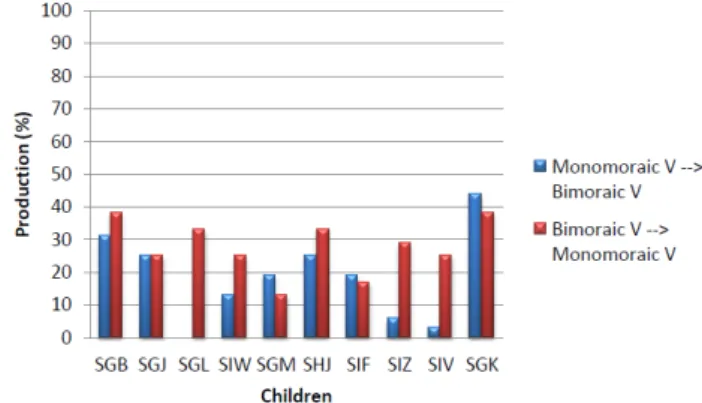
In order to support the results presented in Figure 3, we investigated the percentage of monomoraic vowels realized as bimoraic vowels and bimoraic vowels as monomoraic vowels.

Figure 4 shows that monomoraic vowels were changed to bimoraic vowels 19% of the time, and bimoraic vowels were changed to monomoraic vowels 28% of the time. The result shows that children with cochlear implants were not significantly affected by vowel type, F(1, 9) = 4.638, p > .05. However, the realization of monomoraic vowels as bimoraic vowels indicates that some children in the present study prefer to produce monomoraic vowels (SGL χ

2

(1) = 39.52, p < .001; SIZ χ

2

(1) = 18.32, p < .001; SIV χ

2

(1) = 20.10, p < .001; SIW χ

2

(1) = 4.67, p = .031). SGL and SIZ, with the highest percentage of monomoraic vowels in Figure 4, also showed the preference for monomoraic vowels. The realization of monomoraic vowels instead of bimoraic vowels was 33% for SGL and 29% for SIZ, whereas there was no vowel change with respect to monomoraic vowels for SGL and 6% for SIZ. SIV showed a tendency to produce monomoraic vowels (25%) rather than bimoraic vowels (3%), as evident from Figure 4.

Figure 4. Percentage error in realizing vowel type

Considering the results presented in Figure 3 and 4, children with cochlear implants do not seem to have a significant effect on the vowel type for producing word-final coda consonants.

However, we observed the preference to produce monomoraic vowels in the case of some children with cochlear implants.

In addition, we analyzed the data without target coda production. If children with cochlear implants are sensitive to constraints that require a bimoraic prosodic structure in English, then children should produce bimoraic vowels when a coda is not produced. As given in Figure 2, the percentage of vowels without target coda production was 9%. Out of the smaller percentages, as shown in Figure 5, 3% produced bimoraic vowels without coda consonants and 2% produced monomoraic vowels. The result shows that the type of vowel was not significantly affected by a final coda deletion, F(1, 9) = 1.714, p > .05. In the bimoraic vowel production of SHJ, two of the examples contained vowel lengthening (e.g., /kɪŋ/ → [kʰi:] ‘king’, /mun/ → [mu:] ‘moon’).

However, on the basis of this observation across all children, the tendency to change monomoraic vowels into bimoraic vowels with a final coda deletion was not found.

Figure 5. Percentage of vowels realized as monomoraic or bimoraic vowels in the CVC prosodic structure

without target coda production

(6)

3.3 Variability of coda production

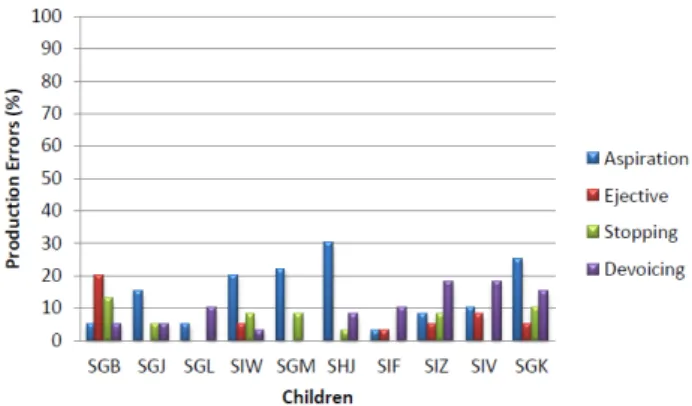
In Figure 2, 87% of the coda production contained correct and incorrect target codas in the manner of production. In order to examine the patterns of coda production more specifically, Figure 6 presents the percentage of correct target coda produced in terms of function of sonority, and Figure 7 presents the percentage error of coda production and error patterns.

In Figure 6, the result indicates that coda production was significantly affected by function of sonority, F(3, 27) = 66.991, p < .05. Just as for children with normal hearing, stops were acquired earlier than fricatives for four of the children with cochlear implants (SGB, SIW, SHJ, SGK), and vice versa for six children (SGJ, SGL, SGM, SIF, SIZ, SIV). The ratios of stops to fricatives in coda production were higher than the ratio of fricatives to stops. For these children, nasals were acquired after stops or fricatives. SIW and SGL showed more variability. SIW produced stops without any errors, but fricatives were acquired later than nasals. The production of fricatives and nasals for SGL was more accurate than stops. Although the coda production for liquids was produced in only two words, the percentage of correct production was 10% across all children with cochlear implants.

Figure 6. Percentage of target coda consonants produced as a function of sonority

Figure 7 presents the error patterns of coda consonants in the word-final position. The result shows that the differences in means between the error patterns were statistically significant, F(1.88, 16.95) = .042, p < .05. In coda production, the error percentage of aspiration was much higher than other error patterns. SGJ, SIW, SGM, SHJ, and SGK showed the highest error percentages for aspiration, with four of them over 20%.

Devoicing patterns in individual variations were below 20%, although SGL, SIF, SIZ, and SIV showed higher devoicing percentages than aspiration. The error patterns of SGB were somewhat different, with 20% for ejectives and 13% for stopping.

From among all the error patterns from children with cochlear implants, 14% contained aspiration. Aspiration, stopping, and devoicing patterns in the word-final position are often observed in children’s production with normal hearing, whereas ejectives are a unique pattern belonging to some of the children with cochlear implants. In the present study, SGB, SIW, SIF, SIZ, SIV, and SGK produced ejectives. With regard to the productions of English-speaking adults, there are occasional uses of ejectives in English word-final positions (Ladefoged & Maddieson, 1996;

Ladefoged, 2006). However, ejectives produced by some children with cochlear implants may be considered as a unique type representing glottalization, because some children with normal hearing tend to substitute a glottal stop instead of the target coda (Goad & Brannen, 2003).

Figure 7. Error patterns of target coda consonants

4. Discussion

This paper investigates coda acquisition in CVC structure. The results for children with cochlear implants will be compared to the development of coda acquisition in children with normal hearing.

4.1 Onset and coda acquisition

In the results of this study, children with cochlear implants

showed a higher percent error in the coda production than onset

in the CVC prosodic structure. The preference for onset

acquisition occurs in children with normal hearing. These results

confirm that children with cochlear implants acquire onset and

coda consonants in a similar manner as children with normal

hearing. Figure 1 displays the individual variations in the

differences of onset and coda acquisition. However, for eight out

of ten children with cochlear implants, that difference was over

50%, thereby indicating that onsets were acquired faster than

codas. This finding supports the tendency of children with normal

(7)

hearing’ production, in that accuracy of onset production is related to that of coda production (Bemhardt & Stemberger, 1998;

Stoel-Gammon & Dunn, 1985). Word-final coda consonants are more difficult to produce or identify than onsets even for adults (Redford & Diehl, 1999).

4.2 Relationship between coda development and vowel type The results of this study reveal that the percentages of coda production were much higher than coda deletion or vowel insertion. However, the present analysis does not support the hypothesis that children with cochlear implants acquire earlier CVC structure than CV or CVCV, since the coda production contains incorrect forms. This indicates that children with cochlear implants strive to maintain the CVC structure even though they produce incorrect codas. The error patterns of coda deletion and vowel insertion, as with the variations of coda production, reveal similar patterns in production of words among children with normal hearing, as was discussed in introduction. The examples of coda deletion and vowel insertion from production of words among children with cochlear implants are given below.

(3) Examples from children with cochlear implants a) Coda deletion

/mæd/ → [mæ] ‘mad’ SIZ /but/ → [bu] ‘boot’ SGL /kʰʌp/ → [kʰʌ] ‘cup’ SGJ b) Vowel insertion

/dɔg/ → [dɒgʷɪ] ‘dog’ SIZ /bed/ → [bɛdʊ] ‘bed’ SGJ

The error patterns in (3) produced by children with cochlear implants were not different from those produced by children with normal-hearing as is evident from (1). Among the children with cochlear implants who participated in this study, word-final coda consonants were deleted regardless of place, manner, and voicing of consonants. However, in the present study, the error patterns of vowel insertion occurred when the coda consonants were voiced.

There was no vowel insertion following voiceless consonants.

Although the percentages of coda deletion and vowel insertion were low, the production patterns observed in children with cochlear implants revealed identical patterns to those of children with normal hearing (Matthei, 1989; Fikkert, 1994; Demuth, 1996). However, it seems that the unmarked status of coda deletion or vowel insertion in CVC across languages makes it rare for those children with cochlear implants who participated in the present study. Furthermore, half of the children did not

exhibit the process of vowel insertion. It was not clear whether vowel insertion played a role in maintaining bimoraic-sized constraint or binary feet, given the nature of variations in coda acquisition for children with cochlear implants.

Do the variations of coda acquisition affect vowel types in CVC structure? With respect to vowel insertion, we cannot be sure whether children with cochlear implants have insertion processes of vowels to become aware of the moraic structure. In CVC, the percentages realized as monomoraic vowels were higher than those of bimoraic vowels. In Figure 3, six out of ten children had higher percentages of monomoraic vowels than bimoraic ones. For one child, the percentages of both vowel types were identical. Although three out of ten children showed higher percentages of bimoraic vowels than monomoraic ones, the difference between both vowel types was approximately 7%, each.

On the basis of this observation, we can say that children with cochlear implants tend to produce a higher percentage of monomoraic vowels than bimoraic ones. The percentages indicating the change of vowel type in Figure 4 support this finding. That is, the percentages realized as monomoraic vowels instead of bimoraic ones were higher than those realized as bimoraic vowels instead of monomoraic ones. In the cases of coda deletion, as seen in Figure 5, the realization of bimoraic vowels appeared as 3 - 10% for six out of ten children, even though these were very low percentages. The findings here replicate those reported for production of words among children with normal-hearing (Kehoe & Stoel-Gammon, 2001; Demuth Culbertson, & Alter, 2006), in that English vowels in monosyllabic words showed the tendency to be produced accurately and there was no significantly distinctive change of vowel type when word-final coda consonants were not produced.

However, some children with cochlear implants produced more accurately monomoraic vowels than bimoraic vowels in monosyllabic words.

4.3 Word-final coda consonant development

The results of this study with regard to word-final coda

acquisition indicate that six out of ten children with cochlear

implants showed higher percentages for fricatives on coda

position than stops. One child revealed a more accurate

production of fricatives and nasals than stops. Four out of ten

children showed the higher percentages of stops than fricatives or

nasals. This finding concurs with that of children with normal

hearing because it shows that English-speaking children with

normal hearing acquire stops as the first coda consonants (Kehoe

(8)

& Stoel-Gammon, 2001; Stites, Demuth, & Kirk, 2004; Demuth, Culbertson, & Alter, 2006), and exhibit individual variations in coda production (Demuth, Culbertson, & Alter, 2006). According to previous studies (Pater, 1997; Boersma & Levelt, 2003;

Gnanadesikan, 2004; Stities, Demuth, & Kirk, 2004, Demuth, Culbertson, & Alter, 2006; Kim & Chin, 2008), in coda production of children with normal hearing, more sonorant consonants in the sonority hierarchy tend to be acquired easily and accurately by children with normal hearing. Nonetheless, the frequency effects of English word-final codas appear 43% for stops, 20% for fricatives, 16% for nasals, and 19% for liquids (Demuth, Culbertson, & Alter, 2006). In this regard, Demuth, Culbertson, and Alter (2006) point out that children with normal hearing map their prosodic structures into higher-frequency segments in coda position than lower-frequency ones. The current findings support this claim for the four children who participated in this study. The other six children revealed the earlier acquisition of more sonorant consonants (i.e., fricatives or nasals) than less sonorant one (i.e., stops).

With respect to the error patterns of coda consonant acquisition, children with cochlear implants in this study exhibited higher percentages of aspiration than other error patterns, such as ejectives, stopping, and devoicing. A consistent trend is shown in children with normal hearing. Previous studies (Kaye, 1990; Harris, 1994; Goad & Brannen, 2003; Demuth, Culbertson, & Alter, 2006) of children with normal hearing suggest that aspiration emerges when coda consonants are regarded as onsets of following syllables rather than codas. This indicates the lateness of coda acquisition causes the high proportion of aspiration (Goad & Brannen, 2003).

On the other hand, the ejectives and stopping of children with cochlear implants in word-final coda positions were not widely found in children with normal hearing. In this study, one out of ten children with cochlear implants revealed a higher proportion of ejectives and stopping than aspiration and devoicing. With regard to devoicing, children with cochlear implants showed similar patterns as those with normal hearing. Adults with normal hearing tend to make word-final voiced obstruents voiceless partially or completely.

5. Conclusion

Pediatric cochlear implant users exhibit word-final coda acquisition similar to those of children with normal hearing. The results of this study demonstrate that children with cochlear implants acquired word-final coda consonants later than onsets in

the word-initial position, as is seen in all children. With respect to variations in coda acquisition, the role of bimoraic-sized constraints did not provide clear evidence, in the sense that the insertion processes of vowels emerged as very low percentages and the CV syllables did not have high percentages of bimoraic vowels with coda deletion. However, in this regard, there were individual variations across all children with cochlear implants.

Some children displayed higher accurate production of monomoraic vowels than bimoraic ones in CVC structure, thereby reflecting a bimoraic-sized constraint in the stage of prosodic development. Furthermore, the results of this study imply that the acquisition of coda consonants for children with cochlear implants may correlate with prosody-structural markedness and consonant acquisition on the basis of perceptual and articulatory properties. I leave the details of this matter for future research.

References

Bernhardt, B. & Stemberger, J. (1998). Handbook of phonological development. San Diego: Academic Press.

Blevins, J. (1995). The syllable in phonological theory. In J.Goldsmith (Ed.), The handbook of phonological theory.

Oxford, England: Blackwell.

Boersma, P. & Levelt, C. (2003). Optimality theory and phonological acquisition. Annual Review of Language Acquisition, Vol. 3, 1-50.

Demuth, K. (1995). Markedness and the development of prosodic structure. In J. Beckman (Ed.), Proceedings of the North East Linguistic Society, Vol. 25, (13-25). Amherst, MA: GLSA, University of Massachusetts.

Demuth, K. (1996). Stages in the acquisition of prosodic structure. Paper presented at the 27th Child Language Research Forum, Standford University.

Demuth, K., Culbertson, J. & Alter, J. (2006). Word-minimality, epenthesis and coda licensing in the early acquisition of English. Language and Speech, Vol. 49, 137-174.

Fikkert, P. (1994). On the acquisition of prosodic structure.

University of Leiden, The Netherlands.

Fudge, E. (1969). Syllables. Journal of Linguistics, Vol. 5, 253-286.

Gnanadesikan, A. (2004). Markedness and faithfulness constraints in child phonology. In R. Kager, J. Pater & W. Zonneveld (Ed.), Constraints in phonological acquisition (73-108).

Cambridge: Cambridge University Press.

Goad, H. & Brannen, K. (2003). Phonetic evidence for

(9)

phonological structure in syllabification. In J. van de Weijer, V. J. van Heuven & H. van der Hulst (Ed.), The phonological spectrum, Vol. 2, (3-30). Amsterdam: John Benjamins.

Harris, J. (1994). English sound structure. Oxford: Blackwell.

Jakobson, R. (1941/1968). Child language, aphasia and phonological universals (A.R. keiler, Trans.). The Hague:

Mouton.

Kaye, J. (1990). Coda licensing. Phonology, Vol. 7, 301-330.

Kehoe, M. & Stoel-Gammon, C. (2001). Development of syllabic structure in English-speaking children with particular reference to rhymes. Journal of Child Language, Vol. 28, 393-432.

Kim, J. & Chin, S. B. (2008). Fortition and lenition patterns in the acquisition of obstruents by children with cochlear implants. Clinical Linguistics & Phonetics, Vol. 22, 233-251.

Ladefoged, P. (2006). A course in phonetics, 5

th

ed., Thomson Wadsworth.

Ladefoged, P. & Maddieson, I. (1997). The sounds of the world’s language, Blackwell.

Levelt, C., Schiller, N. & Levelt, W. (2000). The acquisition of syllable types. Language Acquisition, Vol. 8, 237-264.

Levelt, C. & van de Vijver, R. (1998). Syllable types in cross-linguistic and developmental grammar. Paper presented at the 3rd Utrecht Biannual Phonology Workshop, Utrecht, The Netherlands.

Lleó, C. (2003). Prosodic licensing of codas in the acquisition of Spanish. Probus, Vol. 15, 257-281.

Lleó, C. (2006). The acquisition of prosodic word structures in Spanish by monolingual and Spanish-German bilingual children.

Language and Speech, Vol. 49, 205-229.

Matthei, E. H. (1989). Crossing boundaries: more evidence for phonological constraints on early multi-word utterances. Journal of Child Language, Vol. 16, 41-54.

Ota, M. (1999). Phonological theory and the acquisition of prosodic structure: Evidence from child Japanese. University of Georgetown.

Ota, M. (2006). Input frequency and word truncation in child Japanese: structural and lexical effects. Language and Speech, Vol. 49, 261-295.

Pater, J. (1997). Minimal violation and phonological development.

Language Acquisition, Vol. 6, 201-253.

Prieto, P. (2006). The relevance of metrical information in early prosodic word acquisition: A comparison of Catalan and Spanish. Language and Speech, Vol. 49, 231-259.

Redford, M. A. & Diehl, R. L. (1999). The relative perceptual

distinctiveness of initial and final consonants in CVC syllables.

Journal of the Acoustical Society of America, Vol. 106, 1555-1565.

Roark, B. & Demuth, K. (2000). Prosodic constraints and the learner's environment: A corpus study. Paper presented at the 24th Annual Boston University Conference on Language Development, Somerville, MA.

Rvachew, S. & Andrews, E. (2002). The influence of syllable position on children’s production of consonants. Clinical Linguistics & Phonetics, Vol. 16, 183-198.

Stites, J., Demuth, K., & Kirk, C. (2004). Markedness vs.

frequency effects in coda acquisition. Paper presented at the 28th Annual Boston University Conference on Language Development, Somerville, MA.

Stoel-Gammon, C. (1983). Constraints on consonant-vowel sequences in early words. Journal of child language, Vol. 10, 455-458.

Stoel-Gammon, C. & Dunn, C. (1985). Normal and disordered phonology in children. Austin, TX: PRO-ED.

Vigário, M., Freitas, M.J. & Frota, S. (2006). Grammar and frequency effects in the acquisition of prosodic words in European Portuguese. Language and Speech, Vol. 49, 175-203.

• Kim, Jungsun

Department of English Language and Literature Yeungnam University

214-1 Dae-Dong, Gyungsan, Gyungsangbuk-Do, Korea 712-749

Email: [email protected]

수치

Table 1. Demographic information for 10 children
Figure 1 displays onset and coda production errors. All the  children showed higher percentages of coda errors than onset  production errors; the proportion of onset production errors was  22% and coda errors 57%
Figure 3. Percentage of monomoraic or bimoraic vowels produced  by children with cochlear implants
Figure 6. Percentage of target coda consonants produced as a function of sonority

참조

관련 문서

In other words the mother's scholarship who have a lot of conversation time with child in home also influences the father's open communication type and

3 Mean percentages of bone implant contact ratio in the control group and experimental groups at 6 and 12 weeks after placement of the

phonics and whole-word approaches, interests in reading English words, reading English with visual and auditory phoneme discrimination in elementary

To compare the evaluation results on four functions, that is, speaking, listening, reading, and writing ability in only Korean English teachers with

The purpose of this study is to analyze the effects of word- recording on learning vocabulary, reading and listening of English. control groups to answer

- 각종 지능정보기술은 그 자체로 의미가 있는 것이 아니라, 교육에 대한 방향성과 기술에 대한 이해를 바탕으로 학습자 요구와 수업 맥락 등 학습 환경에 맞게

First, same words undergo the same phonological phenomena such as vowel shortening(diphthongs become simple vowels by glide deletion), tensing and

In the former part , the formulation of five vowel rules (Laxing Rule , Tensing Rule , Diphthongization Rule , Vowel Shift Rule) is discussed , while in the latter part ,