Thickness Effect on Compressive Fatigue Behavior of Al-Si-Ca Alloy Foam
Ilhyun Kim, Mynul Hossain and Amkee Kim
Al-Si-Ca 합금 폼의 피로 거동에 대한 두께 효과
김일현† · 마이눌† · 김엄기*
Key Words : Metallic Foam(메탈 폼), Thickness Effect(두께 효과), Compressive Fatigue Life(압축 피로 수명), Fatigue Strength(피로 강도)
Abstract
The compressive fatigue tests on the closed cell Al-Si-Ca alloy foams with two different thicknesses were performed using a load ratio of 0.1. The quasi-static and cyclic compressive behaviors were obtained respectively. The fatigue stress-life (S-N) curves were evaluated from the obtained cyclic compressive behaviors. S-N curves were presented for the onset of progressive shortening. It turned out that the fatigue strength showed higher value for the thicker foam and the onset of shortening of thinner foam took place earlier. The crushing was found to initiate in a single band which broadens gradually with additional fatigue cycles. Progressive shortening of the specimen took place due to a combination of low cycle fatigue failure and cyclic ratcheting.
1. Introduction
Metallic foams, especially aluminum and aluminum alloy foams have received a considerable amount of attention in recent years because of their extremely low density and unique functional properties such as impacting energy absorption, sound absorption, flame resistance and heat resistance. They are growing in use in sandwich structure for panels, tubes, shells, packaging, crash protection devices, and the weight sensitive construction parts in transportation and aerospace industries. Parts in vehicles and components in airplanes or helicopters are frequently subjected to vibrations and repeated strains, more commonly the cyclic compressions. The apparent maximum values of nominal stresses in such vibrations and/or cyclic compressions are often much less than the static yield stress of the material. Even though these cyclic loadings do not cause any instant failure, in long run they may
lead to fatigue damage of the material which may cause catastrophic consequences. Therefore, information about the fatigue behavior of aluminum(Al)-alloy foams are of great importance. While the monotonic compressive mechanical properties of foams have been extensively studied [4-9] during the last few decades, the cyclic stress-strain response of metallic foams has become at the center of attention for many of the metal foam researchers recently.
A-M. Harte, N.A. Fleck and M.F. Ashby [1] studied the tension-tension and compression-compression fatigue failure of the open cell “DUOCEL” and closed cell “ALPORAS” foams while Y. Sugimura et al. [2]
studied the compression fatigue of “ALPORAS” foams.
O. B. Olurin et al. [3] explored the fatigue properties of Alcan Al-alloy foams. B. Zettl et al. [10] investigated the fatigue properties of Al-Mg-Si and Al-Si foams under fully reversed loading condition using the ultrasonic fatigue testing method while O. Schultz et al.
[11] studied the fatigue behavior of AlSi7Mg+15%SiCa and AA6061 Al-alloy foams. A-M Harte, N.A. Fleck and M.F. Ashby [12] also studied the fatigue strength of sandwich beams with ALPORAS aluminum foam core.
Most of the above work showed that the foam structures subjected to repeated load rapidly lose their
† 공주대학교 기계공학과 대학원
*
공주대학교 기계자동차공학부 E-mail : [email protected]TEL : (041)850-8616 FAX : (041)854-1449
179
strength after a certain number of cycles depending on the stress amplitude and the mean stress. It was reported that fatigue damage is associated with the formation of bands (in case of compression) or macroscopic cracks (in case of tension) [1,2,13]. The progressive shortening of the specimen in compression-compression fatigue, and progressive lengthening in tension-tension fatigue were reported and were associated to a combination of low cycle fatigue failure and cyclic ratcheting. In literature, there are several reports about thickness effect on compressive properties [15-18] but hardly any report about thickness effect on cyclic compressive fatigue properties of metallic foam.
In this paper, we have studied the thickness effect on the cyclic compression fatigue properties of Al-Si-Ca foams. Following a brief description of the effect of thickness on the stress-strain behavior, we have described the influence of thickness on the cyclic compressive fatigue properties of closed cell Al-alloy foam.
2. Experimental
2.1 Materials and specimens
The material used in this study was closed cell Al-Si Ca foam obtained from commercial manufacturer (FOAMTECH Korea). The material was produced using the melt-based process and was obtained in the form of panel. The processing route of the foam is proprietary. Hence it is not disclosed here in detail.
The FOAMTECH foam has a relatively uniform microstructure. The foam used in this study had the cell diameter of about 3~4 mm and the relative density of about 0.11. Specimens of size 40x40x80 mm3, 40x40x40 mm3, were machined from the foam panel for static and fatigue tests.
2.2 Test method
All the cyclic and static compression tests on specimens with different thickness along the thickness direction were performed using an MTS 858 servo- hydraulic test machine at a load ratio of R = 0.1 and four different endurance ratios (|σmax|/ σpl) in the range of 0.6 to 0.90. Here, σmax is the maximum stress in the fatigue cycle and σpl is plateau stress which we have taken as average value within plateau region. The frequency of cyclic load was 50 Hz. The details of the fatigue test are shown in Table 1.
3. Results and Discussion
3.1 Quasi-static compression
In general, when foam is compressed, the stress- strain curve shows three regions. At low strains, the
Table 1 Specification of the fatigue test
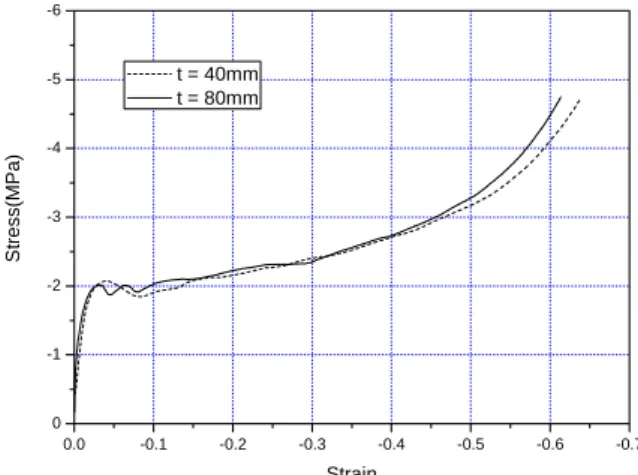
foam deforms in a linear elastic way. There is then a plateau of deformation at almost constant stress and finally there is a region of densification as the cell was crush together. The extent of each mainly depends on relative density. Fig. 1 shows the monotonic (static) stress-strain curve of Al-Si-Ca foam having different thicknesses. From the stress-strain curves, it is found that the linear elasticity only appears at a very low compressive strain (about -0.03 <) where partially reversible cell walls bending occurs, followed by a plastic plateau stress at which successive bands of cells collapse, buckle and yield, and finally densification region takes place at a strain level of approximately 0.45 where the stress rises sharply as complete compaction commences.
For different thickness specimens, the curves were similar having approximately same values of Young’s modulus, peak stress and plastic plateau stress. In fact, the influence of thickness on compressive properties did not appear, indicating that the thickness effect become negligible if the ratio of specimen thickness to the cell
0.0 -0.1 -0.2 -0.3 -0.4 -0.5 -0.6 -0.7
0 -1 -2 -3 -4 -5 -6
Stress(MPa)
Strain t = 40mm
t = 80mm
Fig. 1 The monotonic compressive stress-strain curve of Al-Si-Ca foam (relative density of 0.11).
Thickness (mm)
Endurance ratio (|σmax|/σpl)
Relative density (ρ*/ρs)
σpl| (MPa) 0.6 0.106 0.7 0.114 0.8 0.105 40
0.9 0.110 2.5
0.6 0.110 0.7 0.113 0.8 0.107 80
0.9 0.108 2.6
180
100 101 102 103 104 105 106 107 -0.8
-0.7 -0.6 -0.5 -0.4 -0.3 -0.2 -0.1 0.0 0.1
Nf Nf
Nf
Nf
t = 40mm
|σ|max/σ = 0.6 |σ|max/σ = 0.7 |σ|max/σ = 0.8 |σ|max/σ = 0.9
Strain
Number of Cycles
Fig. 2 The strain versus number of cycle graph of Al- Si-Ca foams showing the progressive shortening of specimens with t = 40mm
100 101 102 103 104 105 106 107
-0.8 -0.7 -0.6 -0.5 -0.4 -0.3 -0.2 -0.1 0.0 0.1
Nf
Nf N
f
Nf
t = 80mm
|σ|max/σ = 0.6 |σ|max/σ = 0.7 |σ|max/σ = 0.8 |σ|max/σ = 0.9
Strain
Number of Cycles
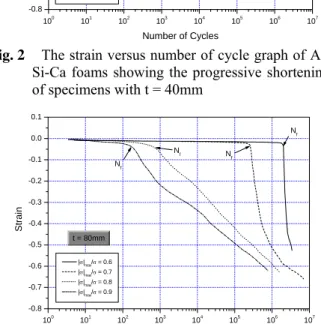
Fig. 3 The strain versus number of cycle graph of Al- Si-Ca foams showing the progressive shortening of specimens with t = 80mm
size is greater than about 7 times [15-18]. In our experiment, we got plateau stress 2.5 MPa for specimen of thickness 40 mm and 2.6MPa for 80 mm.
3.2 Compressive Fatigue Behavior
The strain versus number of cycle graphs of Al-Si-Ca foams in case of load ratio, R= 0.1 are shown in Figs.2 and 3. Two sets of specimens with different thicknesses (40 mm and 80 mm) were taken, and for each, four different endurance ratios (|σmax|/ σpl ≈0.6 to 0.9) were utilized.
All the figures show that the compressive strain increases with the number of cycle which means that progressive shortening of the specimen takes place with the increasing number of cycle. However, an incubation period is evident, for all values of endurance ratio, at the end of which the rate of shortening is accelerated abruptly. This sudden rise of the rate of progressive shortening takes place at a strain level of approximately 0.04 which is about equal to the static yield strain of the
100 101 102 103 104 105 106 107 108
0.0 0.2 0.4 0.6 0.8 1.0 1.2
t = 40 mm t = 80 mm
|σmax|/σpl
Number of Cycles
Fig. 4 The S-N curves of Al-Si-Ca foams in case of compressive fatigue test
foam. The number of cycles after which the abrupt increase of progressive shortening takes place is taken as the fatigue life at that stress in this study.
Fig. 4 represents the S-N curve of Al-Si-Ca foam.
The experimental data in Fig. 4 were fitted with straight line on a semi-logarithmic plot. It is known that Al- alloy foams generally show the endurance strength at 107 cycles [1, 2, 14]. For both the specimens with thicknesses of 40 mm and 80 mm, all failures were observed before 107 for endurance ratios of 0.6~0.9.
The endurance strength for the specimen with thickness of 80 mm is about 0.57 while it is about 0.33 for the specimen with thickness of 40 mm. From Fig. 4 it is evident that for the same endurance ratio, fatigue life is decreased with decreasing specimen thickness and for all specimens, fatigue life is decreased with increasing endurance ratio.
It is noticed that the endurance strength of the foam decreases as the thickness of foam decreases although the static strength such as yield stress and plateau stress between different thickness specimens are almost same.
4. Conclusions
The quasi-static and fatigue behavior of closed cell Al-Si-Ca foam with a relative density of about 0.11 produced by melt-based method were studied. The results can be summarized as follows:
1. Fatigue failure in Al-Si-Ca foams occurred at the quasi-static yield strain of the foams where the value was 0.04.
2. The difference of thickness doesn’t affect the measured value of Young’s modulus, yield stress and plastic plateau stress. The reason is that the thickness
181
effect becomes negligible because the ratios of specimen thickness to the cell size are greater than about 7 times (10 for 40 mm thick specimen and 20 for 80 mm thick specimen).
3. The endurance strength of Al-Si-Ca foams, however, decreases as the characteristic thickness of the foam decreases in compressive fatigue load. In case of Al-Si- Ca foams the endurance strength in terms of endurance ratio based on 107 cycles were 0.57 for specimen with thickness of 80 mm and 0.33 for specimen with thickness of 40 mm for a load ratio of 0.1.
Acknowledgement
The authors of this paper wish to acknowledge the financial support of Chungnam Automotive Technology Education Center (NURI) and BK 21 for this work.
References
(1) Harte, A-M., Fleck, N.A. and Ashby, M.F., 1999,
“Fatigue Failure of An Open Cell and A Closed Cell Aluminum alloy Foam”, Acta Mater. Vol. 47, No. 8, pp.
2511~2524
(2) Sugimura, Y., Rabiei, A., Evans, A.G., Harte, A. M.
and Fleck, N.A., 1999, “Compression Fatigue of a Cellular Al Alloy”, Mat. Sci. and Engineering, Vol.
269,No.1-2, pp. 38~48
(3) Olurin, O. B, Fleck, N. A. and Ashby, M. F., 1999,
“Fatigue of An Aluminum Alloy Foam”, In: Metal Foams and Porous Metal Structures, Verlag MIT Publishing, pp.365~371
(4) Andrew, E., Sanders, W. and . Gibson, L. J, 1999,
“Compressive and Tensile Behaviour of Aluminum Foams”, Mat. Sci. and Engineering, Vol. 270,No.2, pp.113~124
(5) Nieh, T. G., Higashi, K. and Wadsworth, J., 2000,
“Effect of cell morphology on the compressive properties of open-cell aluminum foams”, Materials Science and Engineering, Vol. 283,No.1-2, pp.105~110 (6) Ruan, D., Lu, G., Chen, F. L. and Siros, E., 2002,
“Compressive Behaviour of Aluminum Foams at Low and Medium Strain Rates”, Composite Structures Vol.
57, No.1-4, pp. 331~336.
(7) Koza, E., Leonowicz, M., Wojciechowski, S. and Simancik, F., 2003, “Compressive Strength of Aluminum Foams”, Materials Letters, Vol. 58, No.1-2, pp. 132~135.
(8) Sugimura, Y., Meyer, J., He, M. Y., Bart-Smith ,H., Grenestedt, J. and Evans, A.G., 1997, “On the Mechanical Performance of Closed cell Foams”, Acta Mater., Vol. 45,No.12, pp. 5245~5259.
(9) Kim, A., Anwarul Hasan, M., Nahm, S. H. and Jun, Y. D., 2003, “Compressive Mechanical Properties of Closed-Cell Al-Si-Cu-Mg Alloy Foams”, Proceeding of International conference on Mechanical Engg,
Bangladesh, Dec. 26-28, 2003, pp. ICME2003~AM40.
(10) Zettl, B., Mayer, M., Stanzl-Tschegg, S.E. and Degischer, H.P., 2000, “Fatigue Properties of Aluminum Foams at High Number of Cycles”, Materials Science and Engineering :A, Vol. 292,No.1, pp. 1~7
(11) Schultz, O., Des Ligneris, A., Haider, O. and Starke, P., 1999, “Fatigue Behavior, Strength and Failure of Aluminum Foam” In: Metal Foams and Porous Metal Structures, Verlag MIT Publishing, pp.379~386 (12) Harte, A-M., Fleck, N.A. and Ashby, M.F., 2000,
“The Fatigue Strength of Sandwich Beams With an Aluminum Alloy Foam Core”, International Journal of Fatigue. Vol. 23,No.6, pp. 499~507
(13) Banhart, J. and Brinkers, W., 1999, “Fatigue behavior of Aluminum Foams”, Journal of Material Science Letters, Vol.18,No.8, pp. 617~619
(14) Ashby, M. F., Evans, A.G., Gibson, L. J., Hutchinson, J. W., Fleck, N.A. and Wadley, H. G. N., 1998, “Cellular Metals: A Design Guide”, Butterworth Heinemann, pp. 92.
(15) Insu, Tadashi, 2005 “The effect of structural defects on the compressive behavior of closed-cell Al foam” Acta Mater. Vol.53, No.12, pp. 3415~3423.
(16) Ramamurty, U., Paul, A., 2004 “Variability in mechanical properties of a metal foam.” Acta Mater.
Vol. 52,No.4, pp. 869~876
(17) Bastawros, A-F., Bart-Smith, H., Evans, A.G., 2000,
"Experimental analysis of deformation mechanisms in a closed-cell aluminum alloy foam” J. Mechanics and physics of solids, Vol.48,No.2, p.p.(301~322)
(18) Andrews, E. W., Gioux, G., Onck, P., Gibson, L.J..
“Size effects in ductile cellular solids. Part 11:
Experimental results” Vol. 43, No.3, p.p. 701~713.
182