www.earticle.net
한국 재래흑염소의 산자수와 생시체중에 대한 유전모수 추정
김명직*․김상우․김재환․변미정․소충실․조영무 국립축산과학원
Estimation of Genetic Parameters for the Litter Size and Birth Weight in Korean Black Goats
Myung-Jick Kim*, Sang-Woo Kim, Jae-Hwan Kim, Mi-Jung Byeon, Chung-Sil So and Young-Moo Jo National Institute of Animal Science, R.D.A., Korea
ABSTRACT1)
The objective of this study was to estimate the genetic and phenotypic parameters of litter size and birth weight traits in three Korean black goat lines (Dangjin, Jangsoo and Tongyung) raised at the Animal Genetic Resources Station (AGRS) of the National Institute of Animal Science (NIAS). A total of 1,861 records collected from 2001 to 2013 were used for analyses with single trait animal models. The average litter size of Dangjin line was the largest (1.72 kids) and the average birth weight of Jangsoo line was the heaviest (1.88 kg) among the three lines. Heritability estimates of litter size and birth weight were 0.07 and 0.26, respectively. The average breeding value of litter size and that of birth weight of Jangsoo line were the greatest of all three lines, 0.15 heads and 1.88 kg, respectively. The correlation coefficients between phenotypic values and breeding values of litter size in the lines of Dangjin, Jangsoo and Tongyung were 0.054, -0.031 and 0.131, respectively. The correlation coefficients between phenotypic values and breeding values of birth weight in the lines of Dangjin, Jangsoo and Tongyung were 0.570, 0.454 and 0.521, respectively. The phenotypic correlation and breeding value correlation between litter size and birth weight were 0.031 and 0.003 in Dangjin line, -0.038 and 0.094 in Jangsoo line, and 0.109 and 0.121 in Tongyung line, respectively. These data suggest that the genetic parameters estimated for litter size and birth weight in this study could be used to improve genetic potentials of Korean black goats in industrial level.
(Key words: Litter size, Birth weight, Genetic correlation, Heritability, Korean black goat)
Ⅰ. 서론
우리나라 재래흑염소는 예로부터 약용으로 사육되어 왔 으나 웰빙 식품을 선호하는 소비자의 요구에 따라 기능성 식품으로 각광받고 있다. 그러나 소형종으로서 육량 생산 량이 낮은 재래흑염소는 수익성이 없어 대부분 사육농가에
서는 육량 증대를 위해 외래종 육용 염소와의 무계획적인 난교잡에 의해 생산된 교잡종 염소를 씨염소로 선택하여 활용함으로써 오히려 고기 생산능력과 균일도가 저하되고 있다. 체계적인 잡종교배 계획에 의해 생산되지 않은 교잡 종은 균일도가 떨어지고, 교배에 이용되는 다른 품종간의 장점을 서로 보완할 수 없는 한계가 있어 오히려 생산성을
* Corresponding author: Myung-Jick Kim, National Institute of Animal Science, R.D.A., Namwon 590-832, Korea. Tel: +82-63-620-3530, E-mail: [email protected]
This is an Open Access journal distributed under the teams of the Creative Commons Attribution Non-Commercial License (http://creativecommons.org/licenses(by-nc/3.0) which permits unrestricted non-commercial use, and reproduction in any medium, provided the original work is properly cited.
[Provider:earticle] Download by IP 118.70.52.165 at Monday, December 20, 2021 7:57 PM
www.earticle.net
저하시킬 수도 있다. 혈통관리와 개체기록 확보 등 우량 종자 생산과 공급을 위한 개방기반이 조성되어 있지 않고, 우수한 씨수염소 확보가 어려워 근친번식에 따른 생시체 중 감소와 발육저하가 나타나고 있다. 이의 개선을 위해서 는 우수 씨염소의 확보와 혈통 및 개체능력기록을 유지하 고 관리하여 활용할 수 있도록 농가의 개량체계를 확립할 필요가 있다. 그러므로 맛과 육질이 우수한 재래흑염소의 원종을 보존하고 번식능력 등 주요 경제형질에 대한 유전 특성 평가 연구를 통한 기초자료를 확보하여 번식능력 개 량과 생산성 향상을 도모할 필요가 있다.
따라서 본 연구는 우리나라 재래흑염소 유전자원의 산 자수와 생시체중에 대한 표현형 및 유전특성을 구명하여 번식능력 개량을 위한 기초자료를 확보함으로써 재래흑염 소의 생산성을 향상시켜 흑염소 사육농가가 이를 육종소 재로 활용하여 산업화에 기여토록 하기 위해 수행되었다. 국립축산과학원에서 보존하고 있는 재래흑염소는 1996년 에 옛 문헌에 기록된 외모를 중심으로 각 지역에서 수집하 여 폐쇄축군으로 보존해 온 당진계통, 장수계통, 통영계통 등 3개 근교계통이 있으며, 본 연구에서는 이들 축군에 대 하여 각 계통별로 2001년부터 2013년까지 조사한 재래흑 염소 1,861두의 산자수와 생시체중 기록자료를 분석하여 단형질 애니멀 모델로 유전모수를 추정하였다.
Ⅱ. 재료 및 방법
1. 공시재료
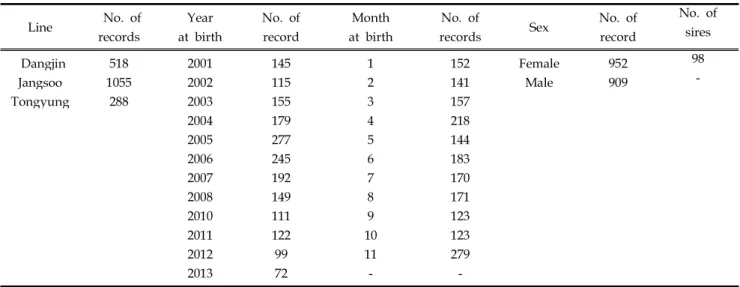
본 연구에 공시된 재료는 국립축산과학원 가축유전자원 시험장에서 보존하고 있는 당진계통, 장수계통, 통영계통 등 3개 근교계통 재래흑염소의 산자수와 생시체중에 대해 2001년부터 2013년까지 확보한 466두의 산자 기록과 1,861 두의 생시체중 기록으로, 이에 대한 계통, 출생년도, 출생 월 및 성별 기록 두수는 Table 1과 같다.
2. 유전모수 추정
본 연구에 공시된 우리나라 재래흑염소의 산자수와 생 시체중 능력 자료에 대하여 1985년 캐나다 돼지 개량프로 그램인 단형질 애니멀 모델(Hudson and Kennedy, 1985) 의 유전분산 및 공분산분석 프로그램인 MTDFREML Package(Boldman과 Van Vleck, 1991)을 이용하여 분석하 였으며, 본 연구에서 조사된 산자수 및 생시체중 등 번식 능력 형질의 유전모수 추정에 사용된 Linear model은 다 음과 같다.
산자수 : Yijklm = μ + Bi + Fyj + Fmk + aijkl + eijkm
여기서 μ는 전체평균, Bi는 i번째 종모축의 고정효과, FYj
는 j번째 분만년도의 고정효과, Fmk는 k번째 분만월의 고정 효과, aijkl은 각 개체의 상가적 유전효과이며, eijkm은 각 개 체의 고유한 임의오차이다.
생시체중 : Yijklm= μ + Yrj + Mj + Sk+ aijkl+ eijkm
Table 1. Number of records by the classes of the effects in the models analyzed
Line No. of
records
Year at birth
No. of record
Month at birth
No. of
records Sex No. of
record
No. of sires Dangjin
Jangsoo Tongyung
518 1055
288
2001 2002 2003 2004 2005 2006 2007 2008 2010 2011 2012 2013
145 115 155 179 277 245 192 149 111 122 99 72
1 2 3 4 5 6 7 8 9 10 11 -
152 141 157 218 144 183 170 171 123 123 279 -
Female Male
952 909
98 -
[Provider:earticle] Download by IP 118.70.52.165 at Monday, December 20, 2021 7:57 PM
www.earticle.net
Litter size Birth weight
0.07 0.26
여기서 μ는 전체평균, Yri는 i번째 출생년도의 고정효과, Mj는 j번째 출생월의 고정효과, Sk는 k번째 성의 고정효과, aijkl은 각 개체의 상가적 유전효과이며, eijkm은 각 개체의 고유한 임의오차이다.
또한 본 연구에서 분석한 생시체중과 산자수간의 표현형 상관 및 유전상관은 각 형질의 육종가와 표현형 능력에 대 해 SAS프로그램을 이용하여 pearson 상관계수를 추정하여 분석하였다.
Ⅲ. 결과 및 고찰
본 연구에서 조사된 한국재래흑염소의 계통별 산자수와 생시체중의 평균치와 표준편차는 Table 2에 나타난 바와 같이 3개 계통 중 산자수는 당진계통 1.72±0.65두로 가장 많았고, 생시체중은 장수계통이 1.880.40kg으로 가장 컸다.
이러한 결과는 Oh(1985)가 보고한 생시체중 1.960.06kg보 다 작았으나, Kim 등(2002)이 보고한 장수계통의 생시체중 1.780.32kg 보다는 큰 것으로 나타나 생시체중 능력이 향상 된 결과를 보였다. 생시체중은 대부분 품종(Morand-Fehr, 1981:Mourad, 1993), 사양방법(Haddad, 2005), 성별(Kuchtik 과 Sedlackova, 2005)과 계절(Jimenze-Badallo 등, 2009)의 영향을 많이 받는 것으로 알려져 있어 한국재래흑염소의
계통별 생시체중도 이들의 영향을 받은 것으로 생각된다. 본 연구의 유전모수 추정에 이용한 국립축산과학원 가 축유전자원시험장 재래흑염소의 산자수와 생시체중에 대 한 유전력은 각각 0.07과 0.26이었다(Table 3). 생시체중의 유전력은 Kim 등(2002)이 모체유전효과에 대해 추정한 0.28과 비슷하였으며, 이 결과는 Gursoy 등(1995)이 보고한 Awassi 면양에서의 생시체중에 대한 유전력 0.16보다 높 았으나, Ribeiro 등(2000)이 보고한 브라질의 Saanen종, Alpine종, Toggenburg종의 생시체중에 대한 유전력 0.29 보다는 낮았다.
산자수와 생시체중 등 재래흑염소 암컷의 번식능력 개 량을 위해 특정한 선발이 이루어지지 않았지만 3개 계통의 폐쇄축군 중 이들에 대한 잠재적 유전능력을 보인 계통으 로서 장수계통은 평균 산자수에서 0.1499±0.8723의 육종가 와 평균 생시체중에서 1.8783±0.4034의 육종가를 나타내 향후 생산성 향상을 위한 긍정적인 유전적 개량량의 증대 효과를 가져올 수 있는 계통으로 보였다.
한국재래흑염소의 산자수와 생시체중에 대한 표현형상 관과 유전상관을 계통별로 분석한 결과는 Table 5~7에 나 타난 바와 같다. 산자수의 표현형과 육종가간 상관계수는 당진계통에서 0.05421, 장수계통에서 -0.03128 그리고 통영 계통에서 0.13051이었으며, 생시체중의 표현형과 육종가간 상관계수는 당진계통 에서 0.56953, 장수계통에서 0.45423
Table 2. Number of records and overall means for litter size and birth weight by the inbred lines of Korean black goat
Line No. of
records of litter size
Overall means±SD No. of
records of birth weight
Overall means±SD
Litter size (head) Birth weight (kg)
Dangjin 142 1.71±0.648 518 1.819±0.3834
Jangsoo 260 1.68±0.604 1,055 1.878±0.4034
Tongyung 64 1.64±0.545 288 1.779±0.5400
Table 3. Heritability estimates of the traits estimated
Table 4. Average breeding values for litter size and birth weight by inbred lines
Line Average breeding value±SE
Litter size (head) Birth weight (kg)
Dangjin -0.0096±0.2040 -0.0108±0.0378
Jangsoo 0.1499±0.8723 1.8783±0.4034**
Tongyung 0.0070±0.0328 -0.0019±0.0381**
** p<0.001
[Provider:earticle] Download by IP 118.70.52.165 at Monday, December 20, 2021 7:57 PM
www.earticle.net
Table 5. Correlations between phenotypic values and breeding values of litter size and birth weight in Dangjin inbred line of Korean Black Goats.
Trait Litter-PH Litter-BV BWT-PH BWT-BV
Litter-PH - 0.05421 0.03112 -0.08830
Litter -BV 0.05421 - 0.07111 0.00336
BWT-PH 0.03112 0.07111 - 0.56953
BWT-BV -0.08830 0.00336 0.56953 -
* Litter-PH: Phnotype of litter size
* BWT-PH: Phnotype of birth weight
* Litter-BV: Breeding value of litter size
* BWT-BV: Breeding value of birth weight
Table 6. Correlations between phenotypic values and breeding values of litter size and birth weight in Jangsoo inbred line
Trait Litter-PH Litter-BV BWT-PH BWT-BV
Litter-PH - -0.03128 -0.03836 -0.05332
Litter-BV -0.03128 - -0.01519 0.09386
BWT-PH -0.03836 -0.01519 - 0.45423
BWT-BV -0.05332 0.09386 0.45423 -
* Litter-PH: Phnotype of litter size
* BWT-PH: Phnotype of birth weight
* Litter-BV: Breeding value of litter size
* BWT-BV: Breeding value of birth weight
Table 7. Correlations between phenotypic values and breeding values of litter size and birth weight in Tongyung inbred line
Trait Litter-PH Litter-BV BWT-PH BWT-BV
Litter-PH - 0.13051 0.10906 0.05262
Litter-BV 0.13051 - 0.12100 0.32357
BWT-PH 0.10906 0.12100 - 0.52090
BWT-BV 0.05262 0.32357 0.52090 -
* Litter-PH: Phnotype of litter size
* BWT-PH: Phnotype of birth weight
* Litter-BV: Breeding value of litter size
* BWT-BV: Breeding value of birth weight
그리고 통영계통에서 0.52090으로 나타났다. 생시체중과 산자수의 표현형 및 육종가별 상관계수는 당진계통에서 각각 0.03112과 0.00336이었으며, 장수계통에서는 각각 -0.03836과 0.09386 그리고 통영계통에서는 각각 0.10906과 0.12100으로 나타났다.
Ⅳ. 요약
본 연구는 우리나라 재래흑염소 유전자원의 표현형 및
유전특성을 구명하여 재래흑염소 원종을 보존하고 흑염소 사육농가의 생산성 향상을 위한 육종소재를 확보하여 산 업화 활용에 기여코자 수행되었으며, 국립축산과학원에서 보존하고 있는 재래흑염소 당진계통, 장수계통, 통영계통 등 3개 근교계통에 대하여 2001년부터 2013년까지 조사한 재래흑염소 1,861두의 산자수와 생시체중 기록자료를 분석 하여 단형질 애니멀 모델로 유전모수를 추정하였다. 산자 수와 생시체중의 유전력은 각각 0.07 및 0.26이었다. 산자 수는 당진계통 1.72±0.65두, 생시체중은 장수계통이 1.88±0.40kg으로 가장 많았다. 이들 형질에 대한 육종가를
[Provider:earticle] Download by IP 118.70.52.165 at Monday, December 20, 2021 7:57 PM
www.earticle.net
추정한 결과 장수계통은 평균 산자수에서 0.1499±0.8723의 육종가와 평균 생시체중에서 1.8783±0.4034의 육종가를 나 타내 향후 생산성 향상을 위한 긍정적인 유전적 개량량의 증대효과를 가져올 수 있는 계통으로 보였다. 한국재래흑 염소의 산자수와 생시체중에 대한 표현형 및 육종가의 상 관계수를 계통별로 분석한 산자수의 표현형과 육종가간 상관계수는 당진계통에서 0.05421, 장수계통에서 -0.03128 그리고 통영계통에서 0.13051이었으며, 생시체중의 표현형 과 육종가간 상관계수는 당진계통 에서 0.56953, 장수계통 에서 0.45423 그리고 통영계통에서 0.52090으로 나타났다.
생시체중과 산자수의 표현형 및 육종가별 상관계수는 당 진계통에서 각각 0.03112과 0.00336이었으며, 장수계통에서 는 각각 -0.03836과 0.09386 그리고 통영계통에서는 각각 0.10906과 0.12100으로 나타났다. 본 연구에서 추정한 재 래흑염소의 번식형질 유전모수 자료를 재래흑염소 능력향 상 연구와 사육방법 개선을 위한 기초자료로 활용함으로 써 재래흑염소의 산업화에 기여할 수 있을 것으로 기대된 다.
Ⅴ. REFERENCES
1. Boldman, K. and Van Vleck, L. D. 1991.
Derivative-free restricted maximum likelihood estimation in animal models with a spares matrix solver. J. Dairy Sci. 74:4337.
2. Gursoy, O., Kirk, K., Cebeci, Z. and Pollot, G. E. 1995.
Genetic evaluation of growth performance in Awassi sheep. CIHEAM-IAMZ. P. 193-201.
3. Haddad, S. G. 2005. Effect of dietary forage:
concentrate ratio on growth performance and carcass characteristics of growing Baladi kids. Small Rum.
Res. 57:43-49.
4. Hudson, G. F. S. and Kennedy, B. W. 1985. Genetic evaluation of swine for growth rate and backfat thickness. J. Anim. Sci. 61:83.
5. Jimenez-Balillo, M., Rodrigues, R. S., Sanudo, C. and Teixeira, A. 2009. Non-genetic factors affecting live weight and daily gain weight in Serrana Transmontano kids. Small Rum. Res. 84:125-128.
6. Kuchtik, J. and Sedlackova, H. 2005. Effect of some non-genetic factors on the growth of kids of the brown short-haired breed. Czech J. Anim. Sci.
50:104-108.
7. Morand-Fehr, P. 1981. Growth. In: Goat Production.
(Gall, C., Ed.).OAcademic Press. London. pp. 53-283.
8. Mourad, M. 1993. Reproductive performances of alpine and Zaraibi goats and growth of theirifirst cross in Egypt. Small Rum. Res. 12:379-384.
9. Ribeiro, A. C., Ribeiro, S. D. A., Queiroz, S. A. and Resende, K. T. 2000. Environmental and genetic effects on birth weight in dairy goats in Brazil. 7th International conference on Goats France. 224-225.
10. Kim, Y. K., Lee, J. W., Choi, S. H., Son, S. K., Na, K.
J., Moon, S. J. and Kim, J. H. 2002. Parameter estimates for genetic effects on growth traits of Korean Native Goats. J. Anim. Sci. Technol. (Kor.) 44(2):171-180
11. Oh, W. Y. 1985. Effects of certain environmental factors affecting preweaning Growth in Korean native goat. master's thesis in Jeonbuk Univ.
(Received 06 November 2014, Revised 08 May 2015, Accepted 11 May 2015)
[Provider:earticle] Download by IP 118.70.52.165 at Monday, December 20, 2021 7:57 PM