Effect of Polyolefine Greenhouse Covering Film on Growth of Lettuce and Cucumber in Cool Season Cultivation
Joon-Kook Kwon1*, Kyoung-Sub Park1, Hyo-Gil Choi1, Sun-Yi Lee1, K. Bekhzod1, and Nam-Jun Kang2
1Nat’l Institute of Horticultural & Herbal Science, RDA, Busan 618-800, Korea
2Dept. of Horticulture, Gyeongsang Nat’l Univ. Jinju 660-701, Korea
Abstract. This study evaluated the effect of polyolefine greenhouse covering film on growth of lettuce and cucumber. The growth of lettuce and cucumber plants under conventional film (polyethylene plus ethylene- vinyl acetate, PE + EVA) and polyolefine (PO) film were evaluated in a greenhouse. The physical qualities of PO film, such as tensile strength and tear strength, were stronger than conventional PE + EVA film. PO film showed 4% higher transmission performance in photosynthetic active radiation (PAR) than PE + EVA film. The average day and night temperature in greenhouse under PO film were 1.5oC and 0.8oC higher but there was no significant difference in relative humidity compared with conventional film. Chlorophyll con- tent of lettuce and cucumber plants grown under PO film were higher than conventional film. Growth char- acteristics; plant height, leaf area, fresh weight and dry weight of cucumber was shown better for PO film.
The yields of cucumber and lettuce was increased 14.0% and 13.6% respectively, when the crops were grown under PO covering film greenhouse.
Key words : cucumber, growth, lettuce, PAR, polyethylene (PE), polyolefine (PO)
Introduction
Greenhouses are used in order to create a more favor- able environment that is essential for plant growth and productivity, especially in a semi-arid region like Korea.
A greenhouse allows plants to grow during any season of the year by controlling light, air temperature, air humid- ity and carbon dioxide levels. The greenhouses are usu- ally covered with a material (i.e., glass or plastic) that has the ability to transmit light to provide essential energy for plant growth and production. Conditions of light inten- sity, duration, and spectral distribution greatly affect plant physiological responses. Light intensity varies greatly according to the climatic zone, season of the year, cloud cover, and anthropogenic factors, e.g. the cleanness and thickness of windows in a greenhouse or the type of film covering the greenhouse. As observed by Pirog (1993), reducing the light intensity by 1% might result in 1%
decrease in yield of plants. This is due to the fact that in the process of photosynthesis, compound forming the
biomass of plants are produced and the energy necessary for the metabolic process is released.
A wide range of plastic cover materials have been tested as greenhouse covers to save energy subsequently hasten the growth, development and yield of greenhouse crops. Approximately 10% light is lost each time a layer of transparent materials is added, actually amount vary- ing with the material and the angle of incident light (Hurd, 1983). Loss of light has been a major concern in the greenhouse industry as low photosynthesis rate when photosynthetic photon flux density (PPFD) is low, may result in reduction in yield and quality (Challa and Schapendonk, 1984; Cockshull, 1992).
In commercial greenhouse production, more than 90%
PE and EVA film are used in Korea (Kwon, 1992; Kwon et al., 2001). PE film is widely used in greenhouse due to the high light transmittance rate, characteristics of less dust particle attachment, and low price, while the disad- vantage is low durability (Kwon, 1992; Geoola et al., 1999). In general the quality and quantity of light trans- mission into the greenhouse depends mainly on green- house film. The greenhouse environmental conditions, such as temperature and air humidity, have significant
*Corresponding author: [email protected]
*Received September 4, 2012; Revised November 13, 2012;
*Accepted November 20, 2012
impact on the plant growth and development. The range of PAR (400~700 nm) is the most effective for plant growth and development. In this regard, the aim of this study was to evaluate the effect of conventional (PE + EVA) and polyolefine covering film to the growth and quality of lettuce, and cucumber plants.
Materials and Methods
This experiment was carried out in 1.5 m × 1.8 m × 3 m (W × H × L) greenhouses covered with conventional PE + EVA film (0.1 mm, Ihlshin Chemical) and polyole- fine (PO, 0.1 mm, Nextchem) greenhouse film, with two replications, in the Protected Horticultural Research Sta- tion, RDA, Busan Korea, in 2010. The area of the green- house was cropped with a cucumber and lettuce.
Cucumber (Black Pearls, Seminis Korea Co.) and lettuce (Red Tukseom, Syrians seeds Co.) seeds were sown in a nursery greenhouse and transplanted to the growing pot (peat moss : loamy soils : composite manure = 5 : 4 : 1).
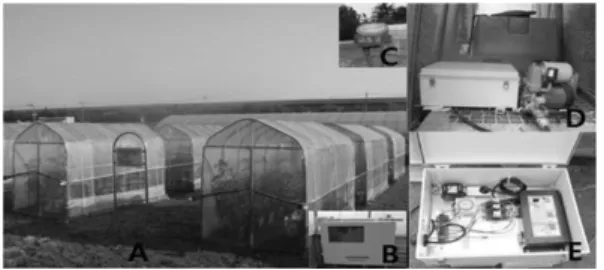
Cucumber and lettuce were harvested at five and four weeks after transplanting, respectively. The experimental greenhouses were well ventilated to maintain tempera- ture around 25~30oC, using temperature, RH and rain sensors. Auto aero dripper irrigation system was devel- oped following electric soil moisture meter. Commer- cially available nutrient solution was supplied to the plant every one or two weeks (Fig. 1D, E). Portable spectro
Table 1. Major physical characteristics of covering films analyzed by Korea testing and research institute.
Covering film
Tensile strength (Widthwise, N/m2)
Tensile strength (Lengthwise, N/m2)
Elongation (Widthwise, %)
Elongation (Lengthwise, %)
Tear strength (Widthwise, N/m2)
Tear strength (Lengthwise, N/m2)
PE + EVA 2,038 2,528 708 522 1,254 1,087
PO 3,440 3,850 687 644 1,480 1,370
Fig. 1. View of experimental small greenhouse (A), ventila- tion controller (B), rain sensor (C), irrigated water tank (D), automatic irrigation controller (E).
radiometer (LI-COR, 300~1100 nm) was used to mea- sure plant photosynthetic rate during 12:00 to 13:00 with three replications. Relative humidity (RH) and tempera- ture were recorded using portable datalogger (Thermo recorder TR-72U, T&D Corp. Japan), installed at 1.5 m height above the ground in the center of the greenhouse.
Growth data were taken for number of fruits per plant, weight of each fruit of cucumber, and number of leaves and weight of lettuce plant. For chlorophyll analysis, 20 ml methanol added to the 0.5 g plant sample in an erlenmeyer flask kept for 24 hr at room temperature. The absorbance of extract solution was measured at 665.2, 652.4 and 470 nm wavelength using UV- visible spec- trophotometer (Cary-100, Varian, Australia).
Results and Discussion
1. Physical characteristics of covering films
Physical characteristics of two different films are shown on Table 1. The PO covering film showed supe- rior physical characteristics in all the parameters, com- pared to the conventional PE + EVA film.
2. Transmittance of covering films
The characteristics of UV, visible, and near infrared (NIR) light transmittance in PO film and conventional covering film are shown in Fig. 2. UV (300~400 nm), visible (400~700 nm) and NIR (700~1100 nm) light transmittance was 0.8%, 4.1%, and 3.6% higher in PO film compared to conventional film (PE + EVA), respec- tively. The transmittance for whole light spectrum (300~
1100 nm) was 4.3% higher in PO film than conventional film.
The greenhouse inside climate management is very important for the improvement of the resources use effi- ciency for crop production. Light permission character- istics is greatly affected by the different covering materials.
Our findings show that polyolefine film transmits more light compared to conventional film because of its phys-
ical properties. Light transmission might be also affected by the color, thickness, and strength of greenhouse film (Roberts 1998; Chun et al., 2006).
3. Temperature and air humidity in greenhouse Air temperature is significantly higher; 1.5oC at day and 0.8oC at night in PO film covered greenhouse, but no significant difference was found for air humidity (Table 2). In low temperature season, PO film increased the air temperature by 1.5oC during daytime and by 0.9oC dur- ing nighttime (Table 3). Average temperature increased 1.6oC in PO film compared to conventional greenhouse film.
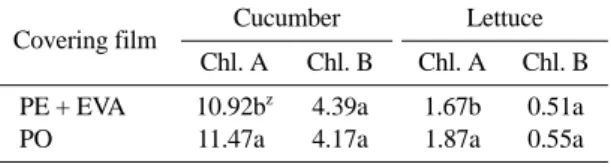
4. Growth and yield of cucumber and lettuce Increasing trend of chlorophyll content in lettuce and cucumber leaf was found in PO film compared to con- ventional film treatment (Table 4). It is reported that the close relationship between light intensity and chloro- phyll content in plant could be generally observed.
Spence and Chrystal (1970) found that more light inten- sity could be more chlorophyll content. However, the ratio of chlorophyll-a and b was found to decrease
sequentially from the high light intensity to the low light intensity (Marcus, 1980).
Growth characteristics of cucumber plant were signif- icantly affected by the covering film (Table 5). All the growth parameters were greatly increased under PO film covering treatment compared to conventional PE + EVA film. The number of leaves (28.0 ea/plant) and leaf weight (114.3 g/plant) of lettuce, and number of fruits (5.1 ea/plant) and fruit weight (841 g/plant) in cucumber were significantly higher in PO film covering treatment than conventional greenhouse covering film (Table 6).
The yield of greenhouse-grown lettuce was greatly affected by the type of covering film. Using a film with a higher PAR transmittance resulted in heavier weights.
Since solar radiation is the source of energy used in the process of photosynthesis by which assimilates are formed and chemical energy is produced that is respon- Fig. 2. Light transmittance of UV (300~400 nm), visible
(401~700 nm), and near infrared (701~1100 nm) of con- ventional (PE + EVA) and PO films.
Table 2. Average day and night temperature and air humidity in greenhouses covered with conventional (PE + EVA) and PO films. Measured from October 1st to November 2nd, 2010.
Covering film
Air temperature (oC) Air humidity (%)
Mean Day
(08:00~18:00)
Night
(18:00~07:00) Mean Day
(08:00~18:00)
Night (18:00~07:00)
PE + EVA 15.7bz 23.7b 09.7b 85.0a 67.0a 98.9a
PO 16.8az 25.2a 10.5a 84.8a 67.2a 99.0a
zDMRT .05.
Table 3. Average day and night temperature in greenhouse covered with conventional (PE + EVA) and PO films during the low temperature season. Measured 3rd to march 14th 2010.
Covering film
Air temperature (oC)
Mean Day
(08:00~18:00)
Night (18:00~07:00)
PE + EVA 10.1bz 23.2b 0.9b
PO 11.7az 24.7a 1.8a
zDMRT .05.
Table 4. Chlorophyll content in leaves of cucumber and let- tuce grown under the conventional (PE + EVA) and PO films.
Covering film Cucumber Lettuce
Chl. A Chl. B Chl. A Chl. B PE + EVA 10.92bz 4.39a 1.67b 0.51a
PO 11.47az 4.17a 1.87a 0.55a
zDMRT .05.
sible for the course of all metabolic process taking place in plant cells, the presence of the light constitutes the main factor determining the growth and weight increase of plants while its deficit limits the yielding (Lawlor 2001).
Changes in greenhouse microclimates may have sig- nificant effects on growth, development and productivity of crops (Cockshull, 1992; Athanasios. and Xiuming, 1997). Net photosynthetic rates are reduced at low light levels and the loss of tomato yield was proportional to the loss of light (Challa and Schapendonk, 1984; Cock- hull et al., 1992). High temperature and PAR stimulated plant growth and increased the yield of various green- house fruit vegetables (Van Winden et al., 1984). The result obtained in our research for lettuce and cucumber concurs with Van Winden et al., (1984). In our findings, lettuce and cucumber yield was higher due to the higher light transmittance and temperature level for being phys- ical properties of PO film treatment.
Literature Cited
1. Athanasios, P. and H. Xiuming. 1997. Effects of three greenhouse cover materials on tomato growth, produc- tivity and energy use. Sci. Hort. 70:165-178.
2. Challa, H. and A.H.C.M. Schapendonk. 1984. Quanti- fication of effects of light reduction in greenhouses on yield. Acta Hortic. 148: 501-510.
3. Chun, H., Y.J Choi, Y.H. Choi, H.J. Kim, S.Y. Lee, S.H. Yum, and D.S. Jeong. 2006. Microclimate analy- sis of greenhouse covered with functional films. J.
Bio-Env. Con. 15:265-271 (in Korean).
4. Cockshull, K.E. 1992. Crop environments. Acta Hor-
tic. 312:77-85.
5. Cockshull, K.E., C.J. Graves, and C.R.J. Cave. 1992.
The influence of shading on yield of glasshouse toma- toes. J. Hortic. Sci. 67: 11-24.
6. Geoola, F., B. Cakmak, Y. Kashti, and E. Ulusoy.
1999. Outdoor testing of agricultural cladding materi- als. Acta Hort. 486:48-54.
7. Hurd, R.G. 1983. Energy saving techniques in green- houses and their effects on the tomato crops. Sci. Hor- tic. 33:94-101.
8. Kwon, J.K., Y.H. Choi, D.K. Park, J.H. Lee, Y.C. Um, and J.C. Park. 2001. Optical and physical properties of covering materials. J. Bio-Env. Con. 10:141-147 (in Korean).
9. Kwon, Y.S. 1992. Vegetable production in plastic film house in Korea. FFTC bulletin No. 347, p. 1-12.
10. Lawlor D.W. 2001. Photosyntesis. BIOS Scientific Publishers Ltd, Oxford.
11. Piróg, J. 1993. Czynniki klimatyczne pod oslonami. In:
‘Uprawa warzyw pod oslonam’ T. Pudelski (ed.), PWRiL, Warszawa.
12. Marcus, B.A. 1980. Relationship between light inten- sity and chlorophyll content in Myriophyllum spica- tum L. in Canadice Lake (New York, USA). Aquat.
Bot. 9:169-172.
13. Roberts, W.J. 1998 (revised). Greenhouse Glazings.
Handout used in class and at extension meetings.
14. Spence, D.H.N. and J. Chrystal. 1970. Photosynthesis and zonation of freshwater macrophytes II. Adaptibil- ity of species of deep and shallow water. New Phytol.
69:217-227.
15. Van Winden, C.M.M., J.A.M. Van Uffelen, and G.W.H.
Welles. 1984. Comparison of the effect of single and double-glass greenhouses on environmental factors and production of vegetables. Acta Hortic. 148: 567- 573.
Table 5. Growth characteristics of cucumber grown under the conventional (PE + EVA) and PO films.
Covering film
Plant height (cm)
Stem diameter (mm)
No. of nodes (ea/plant)
Leaf area (cm2/plant)
Fresh weight (g/plant) Dry weight (g/plant)
Leaves Stem Leaves Stem
PE + EVA 118.2bz 10.8b 17.6a 4,521b 239.8b 84.7b 30.8b 8.0b
PO 129.4az 11.6a 18.2a 5,364a 278.9a 97.2a 33.8a 9.1a
zDMRT .05.
Table 6. Yield of lettuce leaf and cucumber fruit grown under the conventional (PE + EVA) and PO films.
Covering film Lettuce Cucumber
No. of leaves (ea/plant) Leaf weight (g/plant) No. of fruits (ea/plant) Fruit weight (g/plant)
PE + EVA 25.1 bz 100.6 b 4.4 b 740 b
PO 28.0 az 114.3 a 5.1 a 841 a
zDMRT .05.
상추와 오이재배 하우스의 저온기 PO필름 피복효과
권준국1*·박경섭1·최효길1·이선이1·벡조드1·강남준2
1국립원예특작과학원 시설원예시험장, 2경상대학교 원예학과
적 요. 본 연구는 비닐하우스 피복재인 폴리오레핀(PO)계 필름의 효과를 구명하고자 관행의 피복필름
(PE + EVA)과 비교하여 피복재별 물리적 특성과 상추와 오이의 생육 및 수량을 검토하였다. 인장강도, 인
열강도 등 피복재의 물리적 특성은 일반필름보다 PO필름이 우수하였다. 400~700 nm의 광합성유효광의 투과율은 일반필름에 비해 PO필름이 4.1% 높았고, 전체 광선투과율(300~1,100 nm)도 PO필름이 4.3%
높았다. 하우스 내의 주간 평균기온은 일반필름보다 PO필름이 1.5oC 높았고, 야간 평균기온도 PO필름이 0.8oC 높게 유지되었다. 주야간 상대습도는 필름 간에 유의적 차이가 없었다. 엽록소 함량은 오이의 경우 필름 간 유의적 차이는 없었으나 일반필름에 비해 PO필름이 엽록소 a가 약간 높았으며, 상추는 PO필름 이 일반필름보다 유의하게 높았다. 수확기 오이 생육에 있어서 초장, 엽면적, 생체중 및 건물중 모두 일 반필름보다 PO필름을 피복한 하우스에서 크고 무거웠다. 수확한 오이의 과실 수량은 일반필름에 비해 PO필름이 14.0% 높았고, 상추 수량도 일반필름보다 PO필름이 13.6% 높았다.
주제어 : 광합성유효광(PAR), 상추, 생육, 오이, 폴리에칠렌, 폴리오레핀