Kor. J. Hort. Sci. Technol. 30(3):261-269, 2012 DOI http://dx.doi.org/10.7235/hort.2012.11148
오이 시설재배에서 키토산 처리가 토양 미생물상에 미치는 효과
박기춘1ㆍ장태현2*
1농촌진흥청 국립원예특작과학원 인삼과, 2경북대학교 생태환경대학 생태환경시스템학부
Effect of Chitosan on Microbial Community in Soils Planted with Cucumber under Protected Cultivation
Kee-Choon Park
1and Taehyun Chang
2*1Department of Herbal Crop Research, Rural Development Administration, Eumseong 369-873, Korea
2Division of Ecology and Environmental System, College of Ecology and Environmental Science, Kyungpook National University, Sangju 741-711, Korea
Abstract. Soil microbial community and soil physiological parameters were investigated by analyzing phospholipid fatty acids extracted from the soils amended with chitosan powder and solution in a cucumber greenhouse. The soils were sampled at 90, 160, 200 days after treatment. Identified fatty acids were analyzed with principal component (PC) analysis. Chitosan powder soils and chitosan solution soils were separated from non-treated control soils by PC1 and PC2 90 days after treatment, respectively. And chitosan powder soils were separated from non-treated control soils by PC2 160 days after treatment. The ratio of fungi to bacteria increased significantly in chitosan solution-amended soils compared with the control soils 90 days after treatment. Microbial groups and physiological parameters were investigated 160 days after treatment:
vesicular-arbuscular mycorrhizal fungi (VAM) significantly increased in soils amended with chitosan powder compared with other soils, the ratio of gram negative bacteria to gram positive bacteria and cyclo-fatty acids to precursors were significantly higher and lower in soils amended with chitosan solution and chitosan powder compared with control soils, respectively, and the ratio of fungi to bacteria were significantly lower in control soils compared with chitosan-treated soils. The chitosan powder increased the ratio of aerobic to anaerobic bacteria and lowered the ratio of saturated to unsaturated fatty acids compared with chitosan solution 200 days after soil application. In conclusion, chitosan powder changed the soil microbial community and the effects maintained up to 160 days after soil application. The effect of physiological parameters on the soil microbial community started to appear 160 days after and continued up to 200 days after soil application of chitosan.
Additional key words: microbial groups, phospholipid fatty acids, principal component (PC)
*Corresponding author: [email protected]
※ Received 4 December 2011; Revised 5 April 2012; Accepted 5 April 2012.
서 언
오이는 주로 시설 내에서 연작 재배로 년 중 8개월 이상 의 재배를 하고 있으며, 재배기간 동안 오이의 품질을 높이 고 다수확을 위해 다양한 물질을 사용하고 있는데, 그 중 하 나가 상업용 키토산 제품을 사용하고 있다. 키토산(β-1,4- linked D-glucosamine polymer)은 토양에 시비하는 분말, 관주와 엽면 시비로 사용하는 액상으로 유통이 되는 제품으 로 국내 친환경육성법에 친환경 병 방제 및 작물생육용으로
자재로 사용이 가능한 물질로 분류되어 있으나 현재는 주로
작물생육용으로 2007년 3월부터 농촌진흥청에 등록을 하고
있다 . 키토산은 키틴을 탈아세틸화하여 만든 고분자 다당체
화합물로 보통 단당이 약 500개로 연결되어 있는 고분자 화
합물인 비수용성 물질로서 분자량은 보통 7-8백만으로 제조
과정에서 저분자 화합물로 제조된 것일수록 수용성이 높다
(Oh et al., 2000). 현재 농업에서 이용되는 키토산은 토양
미생물 활력 증진을 위해 사용하기도 하지만 주로 작물생육
을 증진시키는 용도로 사용하는 빈도가 높다. 시중에 판매
되는 대부분의 키토산 제품들은 키토산 분자량이 50만 미만 인 키토산을 산에 녹여서 액상화한 것으로 농가에서 주로 엽면시비와 관주용으로 사용하고 있다.
키토산의 효과는 지금까지 많은 연구를 통하여 식물의 생 육증진(Chang, 2009; Choi, 2007), 병 저항성증진(Jayaraj et al., 2009; Vasiukova et al., 2001) 및 직접적인 병 방제 효과 가(Badawy, 2010; Benhamou et al., 1994; Chang, 2009) 있 는 것으로 보고되었지만, 키토산 분말을 직접 토양시비하고 난 후 토양에 미생물상의 변화에 미치는 연구는 미미한 상 태다. 또한 키토산은 토양에서 길항효과가 있는 미생물의 발달을 자극한다(Teichgraber et al., 1991). Pestucha(2005) 는 키토산 0.1%액을 콩 종자와 유묘에 처리하니 근권 토양 에 식물생장증진과 토양병원균과의 길항효과가 있는 Bacillus spp. 가 크게 증가하였으나. 곰팡이는 식물 생육을 증진시키고 식물병원성 토양곰팡이의 생육을 억제하며 길항작용을 하는 Trichoderma spp. 수가 높은 반면, 병원성 곰팡이인 Fusarium, Pythium, Rhizoctonia 종의 수도 크게 감소되었다.
키토산은 식물의 대사작용을 활성화 시킬뿐만 아니라, chitinase을 자극하거나(Barber et al., 1989; Bengamou et al., 1992; El Ghaouth et al., 1991), pisatin 등의 식물병원균의 침입을 방어하는 물질 생산을 유도하는 등, 많은 식물 병원 균에 대한 방어 기작을 유도하는데도 관여하는 것으로도 알 려져 있다(Kendra and Hadwiger, 1984).
키토산을 토양에 직접 처리할 경우 토양 병의 발생을 낮 추고(Bengamou et al., 1992; El Ghaouth et al., 1991), 셀러 리에 병을 일으키는 토양병원균인 Fusarium의 밀도를 줄이 고 비병원성 Fusarium 속의 밀도를 높여 병원성 Fusarium 의 밀도를 줄이거나 균사 생장을 지연시키는 효과로 병을 방제하기도 한다(Bell, 1998). Hitomi (2006)도 키토산을 토 양에 직접 처리하니 식물의 생육도 증가하고 토양미생물의 수가 증가하는데, 방선균의 밀도가 크게 증가한다고 한다.
토마토에 키토산을 엽면 살포하면 토마토 생육을 증진시키 고 잎 곰팡이 병을 예방하거나 방제하는 효과도 있다 (Chang, 2009). 식물세포의 방어능력을 강화시켜 곰팡이의 세포벽 침입을 막고 식물세포의 활력을 증강시키기도 한다 (Bengamou et al., 1992). 키토산을 상처난 밀 잎에 처리할 경우 상처부위의 목질화를 유도하고(Bhaskara Reddy et al., 1999), 수확한 딸기의 수명을 연장하여 유통 중 과실의 품질 을 높이기도 하다(Yoo et al., 1999).
이와 같이 키토산은 작물생육 및 병 방제를 위한 수단으 로 시설하우스 재배 농가에서 액상 형태로 엽면 시비하거나 토양에 직접 관주를 하기도 하며, 분말 형태의 키토산을 키 틴처럼(게나 새우껍질의 토양처리) 직접적으로 토양에 처리
하기도 하지만 그 사용효과에 대한 연구가 미비한 상태다.
특히 연작을 하는 오이 시설재배 토양은 과다한 염류가 집 적되어 있어 키토산의 사용으로 토양미생물 상에 어떤 변화 를 주는지, 또한 미생물상의 다양성에 어떤 영향을 미치는 지에 대한 구체적이고 체계적인 연구는 전무한 상태다. 또 한 키토산은 대부분의 식물에서 지상부나 지하부 등의 생장 을 증진시키는 효과가 알려져 있다(Pastucha, 2005).
본 연구는 친환경 작물생육용 및 병 방제용으로 개발된 키토산용액과 키토산분말을 토양에 관주하거나 흙과 혼용 시비를 통하여 시기별 토양미생물상에 미치는 영향을 조사 하여 추후 키토산 제품 개발이나 키토산을 활용하는 친환경 농업에 기초 자료로 활용하고자 한다.
재료 및 방법
액상 키토산 제형
본 시험에 사용한 키토산은 키토산 분말과 키토산용액을 공시제제로 사용하였다. 액상키토산은 선행 병 방제용 시험 으로 개발하여 사용한 제형(SH-1)을 사용하였으며(Chang, 2009), 제형은 키토산 4%(w/w)와 키토올리고당 15%(w/w) 을 목초액과 현미식초를 이용하여 액상으로 만들었다. 키토 산 분말은 분자량의 크기가 평균 50,000 미만인 것을 사용 하였고, 키토올리고당은 분자량의 크기가 평균 2,000인 수 용성 키토올리고당을 사용하였다. 키토산과 키토오리고당 은 (주)미래바이오텍에서 공급을 받았으며, 목초액은 (주)수 촌임산, 현미식초는 (주)천년식품에서 구입하였다.
포장시험
오이를 연작 재배하는 자동화 시설하우스 농가에서 실시
하였다 . 오이는 육묘공장에서 접목한 묘종으로 오이 품종은
백다다기 오이인 ‘신흑진주’ 품종을 3.3m
2당 8포기를 2008
년 11월 10일에 정식하였다(90 × 70cm, 두둑 180cm, 2열
재배: 상주지역 관행재배). 공시제제인 키토산 분말은 오이
정식 2일 전에 5kg·10a
-1을 두둑의 토양과 혼합한 후 점적
호수를 설치하고 비닐 피복을 하였다. 액상 키토산 제형은
오이 정식 후 물에 키토산 용액을 100배로(10mL·L
-1) 희석
하여 오이 뿌리부분에 관주하였다. 관주 시기는 오이 정식
10일 후에 1차 관주를 하였으며, 그 후 10일 간격으로 4회
관주하였다. 관주량은 물에 키토산을 희석한 키토산 용액을
1포기당 500mL을 주었다. 모든 처리는 3반복으로 수행되었
으며 , 반복당 20m
2로 완전 임의 배치법으로 시험구를 배치
하였다. 키토산 처리 후 토양 샘플은 90일(키토산 분말 처리
일 기준: 2008년 11월 16일), 160일(2009년 2월 9일) 및 200
A B C
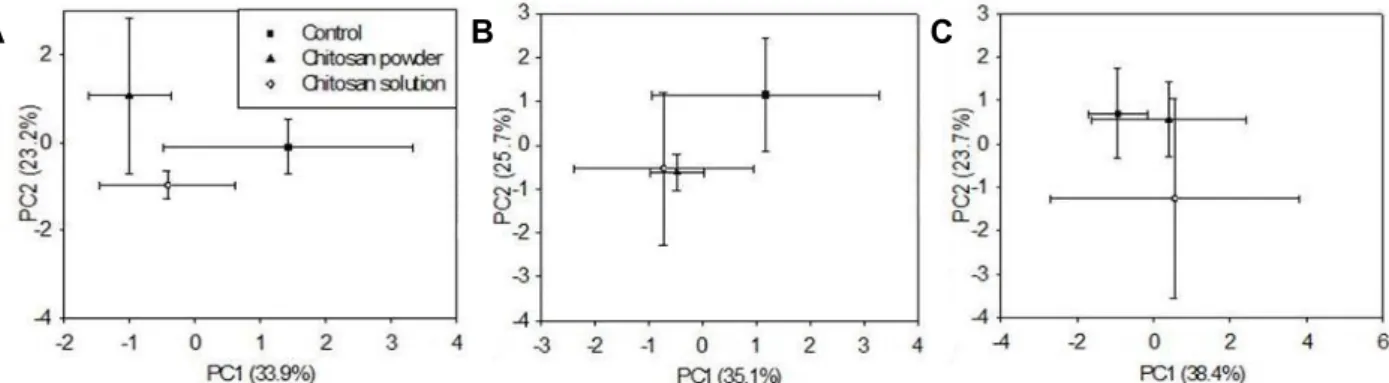
Fig. 1. Ordinate plot of principal component analysis of phospholipid fatty acids extracted from the soils amended with chitosan powder and solution in a cucumber greenhouse. Error bars indicate standard deviation. A, samples 90 days samples after chitosan application; B, samples 160 days samples after chitosan application; C, 200 days samples after chitosan application. Sampling date was 90 days after amending the soils with chitosan powder. Chitosan powder was sprayed 2 days before transplanting of cucumber seedlings and chitosan solution was irrigated four times at every 10 days after transplanting.
일(2009년 3월 18일)에 오이 뿌리 부근에 표토를 제거하고 토양을 반복당 10포기에서 토양을 채취하여 실내에서 균일 하게 혼입은 후 2mm채에 통과된 토양을 -80°C의 저온에 보관하면서 분석용으로 사용하였다.
오이 생육조사를 위한 키토산 처리(토양처리와 관주처리) 는 위와 같은 방법으로 동일한 양을 사용하였으며, 관주 + 엽면시비 처리구에 처리는 키토산 용액을 관주 후 바로 동일 키토산 용액으로 지상부에 엽면 살포하였다. 생육조사는 4회 관주가 끝난 20일 후(오이정식 60일)에 조사를 하였다.
토양화학성은 농촌진흥청 기준에 의해 토양의 표토를 제 거하고 처리구당 10포기의 오이 근권 부근 토양을 채취하여 음건 후 0.5mm채를 통과한 것을 분석용 샘플로 사용하였다.
토양분석방법은 농촌진흥청 토양화학분석법에 준하여 분석하 였다. pH와 EC는 토양과 물을 1:5로 하여 전극으로 측정하였 고, 토양유기물은 Tyurin법, 양이온치환용량은 Ammonium actete법, 유효태 인산은 Lancaster법으로 분석하였다. 치환 성 K, Ca, Mg은 1 N ammonium acetate (pH 7.0)로 침출한 후 ICP-OES (Inductively coupled plasma emission spectro- meter, Optima3000 SC, Perkin Elmer)을 사용하여 분석하였다.
토양 미생물 조사
토양미생물을 분석하기 위하여 인지질지방산(PLFA, phospolipid fatty acid)을 분석하였다(Peacock et al., 2001).
냉동건조 보관한 토양시료 5g에 chloroform(4mL), methanol (8mL), buffer solution(3.2mL, pH 7.4)을 혼합하여 지질을 추출한 후 silicic acid column으로 neutral, glyco 및 phospho- lipid로 분리하여, MIDI Sherlock Microbial Identification System(MIDI Inc. Newark, DE)으로 지방산을 정성 및 정량 을 하였다. 전체 PLFA 중에서 주요 지표 지방산은 Li et al.
(2006)의 방법에 따른 지방산 분석 지표들을 이용하여 지방
산을 분류하였다. 각 인지질지방산의 값은 각 시료에서 총 인지질 지방산의 백분율로 환산하여 계산하였다. 단 불포화 지방산은 16:1 ω5c, 17:1 ω8c, 18:1 ω7c, 포화지방산은 14:00, 15:00, 16:00, 17:00, 18:00, 20:00을 지표지방산으로 사용하였다. 그램 음성균의 지표 지방산은 18:1 ω7c, 19:0cy ω8c, 17:1 ω8c, 그램 양성균은 i14:0, i15:0, a15:0, i16:0, i17:0, a17:0, 세균은 그램 음성균과 양성균을 모두 이용하였 다. 곰팡이는 18:2 ω6,9c, 방선균은 10Me16:0, 10Me17:0, TBSA10Me18:0, 균근균은 16:1 ω5c을 이용하였다.
결과 및 고찰
토양 미생물 군락에 미치는 효과
오이재배 시설하우스에서 가을철에 키토산 분말처리 후 90일, 160일, 200일에 토양을 채취하여 인지질지방산을 분 석한 결과 각각 42, 46, 32개의 지방산이 확인되었다. 키토 산을 토양에 처리 후 시기별로 채취한 토양에서 직접 추출 한 인지질지방산 성적을 다변량 통계 분석법 중의 하나인 주요인분석으로 통계처리하였다. 주요인분석에서는 수많은 변수를 그와 동일하거나 더 작은 개수의 변수인 주요인(PC) 으로 바꾸어 준다 . 여기에서 PC1이 총 변이 중에서 가장 많 은 변이를 포함하고 있고 그 이후로 점점 작은 변이를 포함 하고 있기 때문에 대체로 PC1, PC2에 대한 처리간 차이를 분석한다. 각 주요인의 변이에 관여하는 지방산의 기여도는 주요인과 지방산에 따라서 차이가 있다.
토양 미생물상의 분석을 위하여 키토산을 처리 후 90일에
토양에서 추출한 인지질지방산을 주요인분석 결과(Fig. 1),
PC1이 총 변이의 33.9% 그리고 PC2가 총 변이의 23.2%을
설명할 수 있었다. PC1과 PC2에 대하여 처리간 미생물 군
락의 차이를 보면 키토산 처리구의 미생물상은 대조구의 미
생물 그룹과는 차이가 나타난 것을 보여주고 있다(Fig. 1A).
키토산 분말 처리구는 PC1에 관여하는 미생물 그룹에 대하 여 키토산을 처리하지 않은 대조구에 미생물 그룹과는 완전 히 구분된 것을 볼 수 있었고, 키토산용액 처리구도 키토산 분말 처리구와 유사하게 PC1과 PC2에 대하여 무처리 대조 구에 관여하는 미생물과는 뚜렷한 차이를 보이고 있음을 알 수 있다. 키토산 처리 후 160일에 조사한 토양에서도 PC1에 관여하는 미생물 그룹의 차이를 보여주는 총 변이는 35.1%
와 PC2는 25.7%로 무처리 대조구의 미생물 그룹과는 뚜렷 한 차이를 보이고 있다(Fig. 1B). 키토산 분말 처리구는 PC2 에 관여하는 미생물 그룹은 완전히 구분되었지만 키토산용 액 처리구는 PC1과 PC2 모두에 대하여 뚜렷한 미생물 그룹 의 차이를 볼 수 없었다. 키토산 처리 후 200일에 조사한 토양에서는 PC1이 총 변이가 38.4%과 PC2는 23.7%을 보 여 주었다(Fig. 1C). PC1과 PC2에 주로 관여하는 미생물 그 룹에서 대조구의 미생물 그룹과의 뚜렷하게 구분되지 않았다.
본 시험에서는 키토산을 토양에 처리 후 토양미생물에 변 화를 주는 기간이 얼마나 되는지 알기 위하여 같은 양의 키 토산 분말과 키토산 용액을 처리 후 일정한 기간별로 토양 에 전체 미생물상 변화를 조사해본 결과, 키토산 분말 처리 는 1회 처리로 5kg·10a
-1을 처리하고 90일부터 미생물 상에 변화가 나타나서 160일까지 키토산의 효과가 지속되는 것 으로 조사되었다. 키토산 용액 처리는 토양 처리한 키토산 분말과 같은 양을 처리하기 위해서 오이 정식 10일 후부터 10일 간격 4회 처리(정식 후 50일까지 처리) 후 조사한 결 과, 키토산 분말을 1회 처리한 것과 유사한 160일까지 미생 물 상에 효과를 미친 것으로 조사되었고, 200일 조사에서는 키토산 분말 처리와 유사하게 미생물 상에 미치는 효과는 관찰되지 않았다.
키토산을 토양에 처리할 때는 키토산 분말을 직접 토양에 시비하거나, 키토산 용액으로 여러 번 나누어서 시비하여도 시비방법에 따른 토양미생물(곰팡이, 세균 및 방선균)에 미 치는 차이는 통계적으로 유의성이 없었다. 이는 키토산이 토양 미생물의 속이나 종간 밀도에 미치는 효과는 크지 않 았을 뿐만 아니라 일정시기까지 효과가 있음을 예시하는 것 으로 생각된다. 그러나 곰팡이류 중에는 균근(VAM)에 대한 효과는 키토산 분말을 처리한 후 160일 조사에서 유의성 있 는 증가를 보이는 것은 키토산 분말이 토양 유기물 함량을 증가시키거나 무기 질소를 감소시킬 수 있음을 보여준다 (Nilsson et al., 2007; Vaidya et al., 2008). 콩 재배 토양에 키토산을 근권에 3번을 처리 후 토양미생물상을 조사한 결 과 전체 세균수가 가장 크게 증가한 반면, 곰팡이 증가는 가 장 적었으나 식물병원균에 길항작용을 하는 세균과 곰팡이
의 수는 크게 증가하였다(Pastucha, 2005). 선행시험에서 키 토산 분말의 적정 시비량을 조사하기 위하여 토양에 키토산 분말을 5kg·10a
-1, 10kg·10a
-1및 20kg·10a
-1를 시용한 결과 미생물 상에 미치는 효과가 통계적인 유의성이 없는 것으로 조사되었다(자료 미제시). 하지만 키토산 분말 처리 효과 중 에서 균근의 비율을 높이는 것으로 조사되었지만 , 키토산 용 액은 균근에 대한 효과가 나타나지 않은 것은 키토산 용액에 포함된 목초액과 현미식초 등이 균근 증가에 역효과를 가져 올 수 있는지 여부는 추가 시험이 필요할 것으로 보인다.
미생물 지표 지방산에 미치는 효과
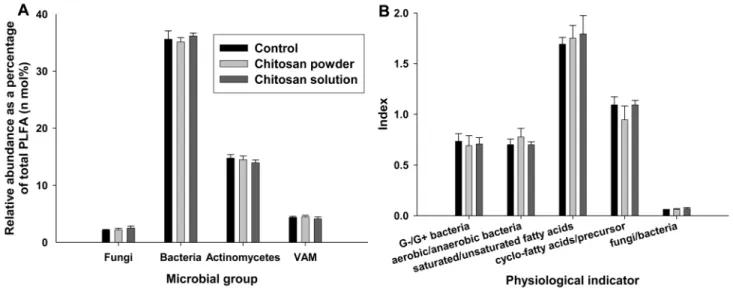
키토산 분말과 키토산 용액을 토양에 처리 후 90일에 토 양 미생물 종류별 군락을 비교한 결과(Fig. 2), 토양 미생물 종류별 유의성의 차이는 없었다 (Fig. 2A). 그러나 토양 미생 물종류별 군락에 대한 생리학적 지표 조사에서 곰팡이/세균 비율은 키토산 용액 처리구에서 통계적으로 유의성 있게 증 가하는 것을 볼 수 있었다 (Fig. 2B).
키토산 처리 후 160일에 미생물 군락은 Fig. 3과 같이 토 양세균과 곰팡이 군락에는 영향이 없었으나, 균근(VAM)은 키토산 분말 처리구에서 유의성 있게 증가하였다(Fig. 3A).
미생물의 생리학적 지표조사 결과는 그램 음성균/그램 양성 균의 비율이 키토산 용액 처리구에서 증가하였고, cyclo-지 방산/전구체의 비율은 대조구가 키토산 분말 처리구보다 높 았다. 곰팡이/세균 비율은 키토산 처리구 모두가 통계적으 로 유의성 있게 높았다(Fig. 3B).
키토산 처리 후 200일에는(Fig. 4), 미생물 군락별로는 처 리 간 차이가 없었고(Fig. 4A), 생리적인 지표분석에서는 통 계적으로 유의성의 차이를 보였다(Fig. 4B). 호기성균/혐기 성균의 비율이 키토산 분말 처리구가 키토산용액 처리구보 다 높았고, 포화지방산/불포화지방산 비율은 키토산용액 처 리구가 키토산분말 처리구보다 높았다(Fig. 4B).
키토산처리에 의한 토양 미생물의 생리적 지표에 미치는
키토산의 영향은 처리 160일 이후에 나타나기 시작하여 200
일까지 지속되었다. 그램 음성균/그램 양성균 비율에 양향
을 미치는 다당체인 키토산의 지속적인 분해에 의한 탄소원
인 영양분이 풍부한 조건에서 나타나는데(Griffiths et al.,
1998), 키토산 처리 후 160일 조사에서 키토산 용액 처리구
가 가장 높은 것은 그램 음성균은 양분이 충분한 토양에서
활성이 높기 때문에 키토산 용액 처리구에서 높은 그램 음
성균 비율은 키토산 용액에 포함된 탄수화물의 함량이 높은
키토산올리고당이나 목초액과 현미식초 등도 토양에 양분
의 유효도를 높이는데 기여한 것으로 보인다. 호기성균/혐
기성균의 비율은 키토산 처리 후 200일 조사에서 키토산 분
Fig. 2. Relative abundance of soil microbial groups and physiological indicators analyzed by phospholipid fatty acids in the soils amended with chitosan powder and solution in a cucumber greenhouse. Sampling date was 90 days after amending the soils with chitosan powder. A and B mean microbial group and physiological indicator of microbes, respectively. Chitosan powder was sprayed 2 days before transplanting of cucumber seedlings and chitosan solution was irrigated four times at every 10 days after transplanting. Error bars indicate standard deviation and different bars indicate significant difference at P = 0.10 level according to LSD test.
Fig. 3. Relative abundance of soil microbial groups and physiological indicators analyzed by phospholipid fatty acids in the soils amended with chitosan powder and solution in a cucumber greenhouse. Sampling date was 160 days after amending the soils with chitosan powder. A and B mean microbial group and physiological indicator of microbes, respectively. Chitosan powder was sprayed 2 days before transplanting of cucumber seedlings and chitosan solution was irrigated four times at every 10 days after transplanting. Error bars indicate standard deviation and different bars indicates significant difference at P = 0.10 level according to LSD test.
말 처리구가 키토산 용액 처리구보다 높은 것은 키토산 분 말 처리로 토양입단 형성 등의 호기조건이 영향을 미친 것 으로 생각된다(자료 미제시).
포화지방산/불포화지방산 비율의 증가는 탄소원 부족 등 의 스트레스를 반영하는데(Pinkart et al., 2002), 이 비율이 키토산 처리 후 200일 조사에서 키토산 용액 처리구가 키토 산 분말 처리구보다 높은 것은 키토산 용액은 10일 간격 4회 를 관주처리는 관행하우스 재배에서 일정한 기간에 관수를
하는 날짜와 겹치지 않은 일에 키토산 용액을 관주를 함으
로써 수분이 토양 미생물 군락에 대한 스트레스를 증가시키
는 요인으로 작용한 것으로 본다. 이는 키토산 분말 처리구
에서 호기성 미생물 비율이 높은 앞의 결과와도 상관이 있
어 보인다. 그러나 유의성은 없지만 키토산 분말 처리구에
서 대조구보다 낮은 포화지방산 비율은 키토산 자체는 토양
미생물 군락 스트레스에 영향을 주지 않음을 의미한다. 따
라서 키토산 용액에 의한 스트레스는 키토산 용액에 포함된
Fig. 4. Relative abundance of soil microbial groups and physiological indicators analyzed by phospholipid fatty acids in soils amended with chitosan powder and solution in a cucumber greenhouse. Sampling date was 200 days after amending the soils with chitosan powder. A and B mean microbial group and physiological indicator of microbes, respectively. Chitosan powder was sprayed 2 days before transplanting of cucumber seedlings and chitosan solution was irrigated four times at every 10 days after transplanting.
Error bars indicate standard deviation and different bars indicates significant difference at P = 0.10 level according to LSD test.
Table 1. Chemical properties of the soil at 200days after applied with chitosan powder.
pH (1:5)
EC (ds ‧ m-1)
CEC (cmolc‧kg-1)
OM (g ‧ kg-1)
Ex.-cations (cmol+++‧kg-1)
K Ca Mg
Soil applicationz 5.6 0.58 13.99 24 0.40 6.32 2.20
Drenchingy 5.5 0.50 12.81 23 0.31 4.86 1.68
Control 5.5 0.57 11.76 24 0.39 5.16 1.74
zDirectly applied the soil with chitosan powder.
yDrench thoroughly the soil with chitosan solution.
키토산 올리고당이나 목초액에 의한 효과로 추정된다.
Cyclo-지방산/전구체의 비율이 높은 것은 탄소원과 통기 부족 등의 스트레스 조건에서 증가하는데(Bossio and Scow, 1998; Fierer et al., 2003), 본 시험에서 cyclo-지방산/전구체 의 비율이 키토산 처리 후 160일 조사에서 키토산 분말 처리 구가 무처리구보다 유의성 있게 낮았다는 것도 키토산 처리 가 토양 미생물 군락에 대한 스트레스를 줄여주는 환경을 조성하는 것으로 볼 수 있다. 본 실험에서 조사된 바는 아니 지만, 키토산 분말이 입단형성 촉진 미생물 군락조성 또는 탄소원으로서 역할도 가능한 것으로 보인다(자료 미제시).
곰팡이/세균 비율이 높은 것은 탄소와 질소 등의 양분이 부족하거나 비옥도가 낮은 현상의 지표가 될 수 있는데 (Boyle et al., 2008), 키토산 처리 후 90일 조사에서 무처리 구에 비하여 키토산액 처리구에서 유의성 있게 높고 160일 경과한 후에는 무처리구에 비하여 키토산 처리구 모두가 증 가한 것은 키토산이 곰팡이 생육을 증가시키고 그 속도는 키토산 용액이 빠르며, 지속효과는 처리 후 160일까지 지속 됨을 보여주었다.
토양화학성 및 오이생육 효과
키토산분말과 키토산용액을 처리 후 200일에 토양화학성 은 조사한 결과(Table 1), 토양화학성에는 통계적인 유의성 의 차이가 없었다. 이는 키토산을 시비 후 토양미생물 함량 조사에 동일하게 조사한 것이 토양화학성에 대한 함량의 차 이에서 유의성의 차이가 나타나지 않을 수도 있다고 생각한 다. 하지만 CEC는 통계적인 유의차이는 없어도 대조구에 비해 높았고, 양이온인 Ca과 Mg의 함량도 높아 향후 시기 별 토양물리성과 토양화학성을 조사하여 연작장해와 관련 된 연구도 필요 할 것으로 생각된다. 키토산은 다당체인 물 질로 토양에서 미생물의 주요 영양원으로 이용되는 물질이 지만 토양에 질소와 유기물을 공급 함과 동시에 토양미생물 의 활성을 증가시켜 토양화학성의 유효도에 직·간접적으로 기여함으로 작물생육의 증진에 영향을 미친 것으로 생각된 다(Transmo et al., 1993).
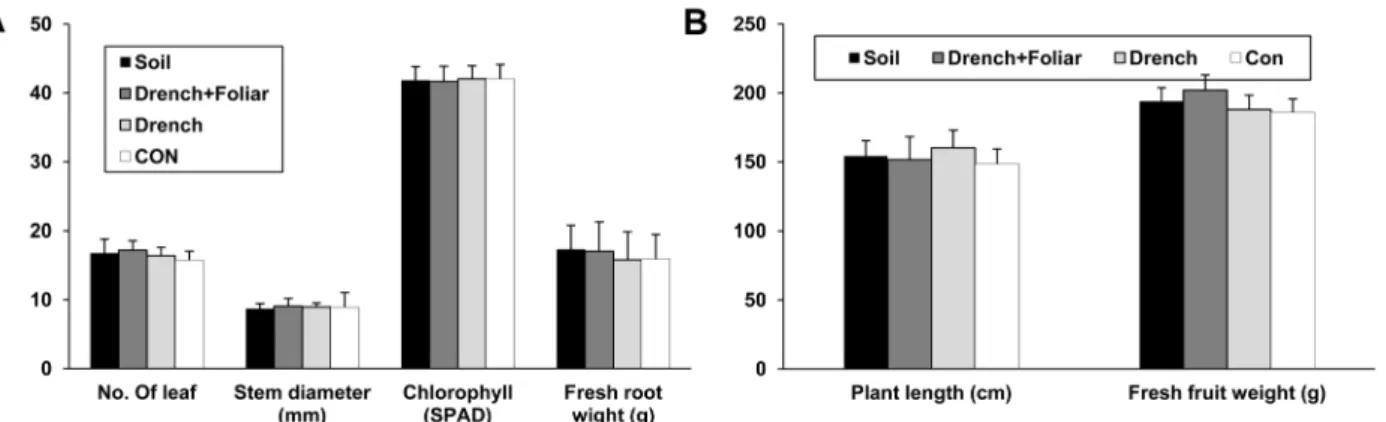
오이에 대한 생육효과는 키토산 처리 후 60일에 조사한
결과(Fig. 5), 오이 생육효과인 초장과 잎 수에서는 통계적
인 유의성의 차이가 있었으나 , 오이 잎에 엽록소 함량, 뿌리
Fig. 5. Effect of chitosan application on cucumber growth. Soil: soil application with chitosan powder, Drench + foliar: irrigation after 100X (100 mL·10 L-1) dilution with chitosan solution + foliar spray, Drench: irrigation after 100X (100 mL·10 L-1) dilution with chitosan solution. Date (mean ± S.E) of the parameters were collected at 60 days after amending the soils with chitosan powder. A and B mean plants growth and fresh fruit weight of cucumber, respectively Chitosan powder was sprayed 2 days before transplanting of cucumber seedlings and chitosan solution was irrigated four times at every 10 days from 10 days after transplanting.
생체 중, 줄기직경 및 개당 생체 중에서는 유의성의 차이가 없었다(Figs. 5A and 5B). 오이 초장은 키토산의 모든 처리 구에서 초장이 신장 되는 효과가 나타났으나 그 중에서도 관주 처리구가 가장 좋은 효과를 보였다. 오이 잎 수는 키토 산을 처리한 모든 구에서 잎 수가 증가하였으나, 그 중에서 도 토양관주 + 엽면시비구에서 가장 좋은 효과가 나타났다.
통계적으로 유의성이 나타나지 않은 오이 개당 생체중과 뿌 리 생체 중은 키토산을 처리한 구에서 뿌리 생체중이 높았 고 같은 시기에 수확한 오이 개당 무개도 증가하는 것으로 보아 키토산 처리에 미생물활성의 증가로 인한 토양화학성 의 유효도 증가와 광합성효율이 높은 결과인 것으로 생각한 다(Chibu and Shiayama, 2001). 그러나 오이의 개당 생체 중이나 수량에 미치는 영향은 구명하기 위해서는 본 시험과 같이 정식 후에 시비 보다는 오이 착과가 시작되는 시기에 키토산을 처리하면 효과가 있지 않을까 생각하므로 추후 생 육과 수량에 미치는 종합적인 시험이 필요할 것으로 본다.
생육 시험은 서로 다른 하우스에서 각각 실시하였으나 유사 한 결과를 보였다.
키토산은 여러 종류의 식물에서 초장, 잎 수 뿌리생육 을 증진시키고(Lee et al., 2009; Walker et al., 2004, Wanichpongpan et al., 2001), 엽록소 증대와 광합성을 증가 시키고(Chibu and Shiayama, 2001). 개화시기를 앞당기고 생산량을 증대시키는 효과가 있다(Transmo et al., 1993). 딸 기에 키토산을 엽면 시비한 결과, 잎 수, 과일 생체 중, 수확 량이 증가하였다 (Abdel-Mawgoud et al., 2010; Lee et al., 2001). 오이에 키토산을 엽면 살포한 결과 초장, 잎수, 엽중 및 수확량이 증가하였으며(Lee et al., 2001), 토마토는 지상 부의 생육증진 효과(Chang, 2009)와 수확량이 20% 이상 증 가되었다(Walker et al., 2004). 배추 생육기에 키토산을 엽
면살포하면 생육이 증진되고 수량이 증가하였으며(Oh et al., 2000), 마늘과 양파에서도 키토산 사용으로 수량이 증가하 였고(Park et al., 2000), 양배추도 생육이 크게 증진된다 (Hirano, 1990). 화훼류에서도 용담과에 속하는 절화용 초롱 꽃의 생육기에 키토산 1%를 토양에 처리하면 생육이 증진 되고 개화가 15일 빨라지고 묘의 생육을 증진시키는 효과가 있다(Ohta et al., 1999). 거베라를 비롯한 다양한 식물에도 키토산을 살포하면 뿌리, 초장, 잎을 증진시키는 효과가 있 다(Wanichpongpan et al., 2001). 키토산의 생리작용으로는 식물의 기공개폐에 관여하여 건조기에 키토산의 처리로 잎 의 수분 증산을 조절하여 가뭄 피해를 감소시키고, 건조 피 해로부터 회복 율이 증대된다(Boonlertnirum, 2007). 고추에 서는 수분 이용률이 26-48% 정도의 감소시키는 효과가 있 으나 고추의 생체중과 수량에는 차이가 없으며 자스몬 산의 활성도 증진시킨다(Bittelli, 2001).
이와 같이 키토산을 토양에 처리하면 토양 미생물상에 변 화를 줄뿐만 아니라 작물생육에 유용한 미생물군락이 증가 한다. 키토산은 분말을 토양에 처리하거나 물에 희석하여 관주 하여도 좋다. 각 미생물군락에 대한 키토산의 영향은 키토산 분말은 균근에 미치는 영향이 크고, 토양미생물의 생리적 지표에 미치는 키토산의 영향은 처리 160일 이후에 나타나기 시작하여 200일까지 지속되는 것으로 조사되었다.
오이 생육 증진에는 키토산을 관주하고 엽면시비하는 것이 효과적이다.
초 록
오이시설하우스 토양에 키토산의 분말과 액상을 처리하
여 90일, 160일 및 200일이 경과한 후에 인지질지방산을 추
출하여 토양 미생물상 구성 및 토양 미생물의 생리적 지표 를 분석하였다. 확인된 총지방산을 주요인 분석으로 분석한 결과 키토산 처리 후 90일에 키토산 분말 처리구는 PC(주요 인)1 대하여 키토산을 처리하지 않은 대조구와 완전히 구분 되었고, 키토산 용액 처리구는 PC2 모두에 대하여 대조구와 뚜렷이 구분되었다. 키토산 분말 처리 후 160일에 대조구와 비교하여 키토산 분말 처리구는 PC2에 대하여 완전히 구분 되었지만 키토산 용액 처리구는 PC1과 PC2 모두에 대하여 뚜렷이 구분되지 못하였다. 키토산 처리 후 200일에는 PC1 과 PC2 모두에 대하여 처리 간 차이가 없었다. 지표 지방산 을 이용한 미생물군과 생리적 지표의 차이를 보면, 키토산 을 토양에 처리한 후 90일에는 토양미생물군에 미치는 효과 가 나타나지 않았지만, 곰팡이/세균 비율은 키토산 용액 처 리구에서 유의성 있게 증가하였다. 키토산 처리 후 160일은 균근이 키토산 분말 처리구에서 증가하였다. 세균은 그램 음성균/그램 양성균 비율이 키토산 용액 처리구에서 증가하 였고, cyclo-지방산/전구체 비율은 대조구가 키토산 분말 처 리구보다 높았다. 곰팡이/세균 비율은 키토산 처리구 모두 가 통계적으로 유의성 있게 높았다. 키토산 처리 후 200일 조사에서 호기성균/혐기성균 세균의 비율이 키토산 분말 처 리구가 키토산 용액 처리구보다 높았고, 포화지방산/불포화 지방산 비율은 키토산 용액 처리구가 키토산 분말 처리구보 다 통계적으로 유의성 있게 높았다. 키토산은 처리 후 160일 까지 토양 미생물상을 변화시켰으며 분말에서 효과가 컸다.
미생물 생리적 지표에 미치는 키토산의 영향은 처리 160일 이후에 나타나기 시작하여 200일까지 나타났다.
추가 주요어 : 미생물 그룹, 인지질지방산, 주요인
인용문헌
Abdel-Mawgoud, A.M.R., A.S Tantawy, M.A El-Nemr, and Y.N.
Sassine. 2010. Growth and yield responses of strawberry plants to chitosan application. European J. Scientific Res. p. 161-168.
Badawy, M.E.I. 2010. Structure and antimicrobial activity relationship of quaternary N-Alkyl chitosan derivatives against some plant pathogens. J. Appl. Polymer Sci. 117:960-969.
Barber, M.S., R.E. Bertram, and J.P. Ride. 1989. Chitin oligosaccharides elicit lignification in wounded wheat leaves.
Physiol. Mol. Plant Pathol. 34:3-12.
Bell, A.A., J.C. Hubbard, and L. Liu. 1998. Effects of chitin and chitosan on the incidence and severity of fusarium yellows of celery. Plant Dis. 82:322-328
Bengamou, N. and G. Theriault. 1992. Treatment with chitosan enhances resistance of tomato plants to the crown and root rot pathogen Fusarium oxysporum sp. radicislycopersici.
Physiol. Mol. Plant Pathol. 41:33-52.
Benhamou N., J.W. Kloepper, and S. Tuzun. 1994. Induction of systemic resistance to Fusarium wilt of tomato plants by seed treatment with chitosan. Phytopathology 84:1432-1444.
Bhaskara Reddy, M.V., J. Arul, P. Angers, and L. Couture. 1999.
Chitosan treatment of wheat seeds induces resistance to Fusarium graminearum and improves seed quality. J. Agric.
Food Chem. 47:1208-1216.
Bittelli, M., M. Flury, G. Campbell, and E. Nichils. 2001.
Reduction of transpiretion through foliar application of chitosan.
Agricultural Forest Meteorol. 107:167-175.
Bossio, D.A. and K.M. Scow. 1998. Impacts of carbon and flooding on soil microbial communities: Phospholipid fatty acid profiles and substrate utilization patterns. Microbial Ecol.
35:265-278.
Boonlertnirun, S., E. Sarobol, S. Meechoui, and I. Sooksathan.
2007. Drought recovery and grain yield rotential of rice after chitosan application. Kasetsart J. Nat. Sci. 41:1-6.
Boyle, S.A., R.R. Yarwood, P.J. Bottomley, and D.D. Myrold.
2008. Bacterial and fungal contributions to soil nitrogen cycling under Douglass fir and red alder at two sites in Oregon.
Soil Bio. Biochem. 40:443-451.
Chang, T.H. 2009. Disease control efficacy of chitosan pre- parations against tomato leaf blight. Res. Plant Dis. 15:248-253.
Chibu, H. and H. Shibayama, 2001. Effects of chitosan appli- cations on the growth of several crops, p. 235-239. In: T.
Uragami, K. Kurita, and T. Fukamizo (eds.). Chitin and chitosan in life science. Yamaguchi Inc., New York, USA.
Choi, S.J. 2007. Influence of chitosan treatment on the disease incidence and quality deterioration of postharvest grape. Kor.
J. Hort. Sci. Technol. 25:63-66.
El Ghaouth, A.J., A.R. Ponnampalam, and M. Boulet. 1991.
Chitosan coating effect on storability and quality of fresh strawberries. J. Food Sci. 56:1618-1620.
Fierer, N., J.P. Schimel, and P.A. Holden. 2003. Variations in microbial community composition through two soil depth profiles. Soil Biol. Biochem. 35:167-176.
Griffiths, B.S., K. Ritz, N. Ebblewhite, and G. Dobson. 1999.
Soil microbial community structure: Effects of substrate loading rates. Soil Biol. Biochem. 31:145-153.
Hirano, S., T. Yamamoto, M. Hayashi, T. Nishida, and H. Inui.
1990. Chitinase activity in seeds coated with chitosan derivatives.
Agri. Biol. Chem. 54:2719-2720.
Hitomi, A., M. Yuya, A. Sributta, H. Takashi, S. Kosuke, and O. Katsumi. 2006 Growth promotion by some chitosans and effects of chitosan on the soil microorganism in Eustoma grandiflorum (Raf.) Shinn. Bull. Fac. Life Env. Sci. Shimane Univ. 11:43-48.
Jayaraj, J., M. Rahman, A. Wan, and Z.K. Punja. 2009. Enhanced resistance to foliar fungal pathogens in carrot by application of elicitors. Ann. Appl. Biol. 155:71-80.
Kendra, D.F. and I.A. Hadwiger. 1984. Characterization of the smallest chitosan oligomer that is maximally antifungal to Fusarium solani and elicits oisatin fomation in Pisum sativum.
Experimental Mycol. 8:276-281.
Lee, J.Y., S.J. Chang, Y.T. Chi, and H.K. Kim. 2001. Effects of chitosan hydrolysates on the vegetative grow and fruit yield of cucumber. Agr. Sci. Technol. 36:109-120.
Lee, H.J., K.C. Kim, J.H. Lim, C.K. Park, and Y.S. Hwang. 2001.
Influence of High Molecular Weight Chitosan Sprays on Quality of Harvested Strawberries. Kor. J. Hort. Sci. Technol.
19:55-55.
Lee, J.S., M.J. Im, J.Y. Lee, Y. Choi, Y.H. Baek, J. Baik, and M. Chiang. 2009. Effect of growth condition and chitosan treatment on the growth of some species of herbs. Kor. J.
Hort. Sci. Technol. 27:178-178.
Li, W.H., C.B. Zhang, H.B. Jiang, G.R. Xin, and Z.Y. Yang.
2006. Changes in soil Microbial community associated with invasion of the exotic weed, Mikania micrantha H.B.K. Plant Soil 281:309-324.
Nilsson, L.O., E. Baath, U. Falkengren-Grerup, and H. Wallander.
2007. Growth of ectomycorrhizal mycelia and composition of soil microbial communities in oak forest soils along a nitrogen deposition gradient. Oecologia 153:375-384.
Oh, S.H., K.W. Seo, D.S. Choi, K.S. Han, and W.G. Choi. 2000.
Application effect of chitosan fertilizer on the growth of cabbage and GABA contents in the chiness cabbage. J. Kor.
Soc. Agri. Chem. Biotechnol. 43:34-38.
Ohta, K., S. Morisita, K. Suda, N. Kobayashi, and T. Hosoki.
2004. Effects of chitosan soil mixture treatment in seedling stage on the growth and flowering of several ornamental plants.
J. Japan. Soc. Hort. Sci. 73:66-68.
Park, J.H. and B.W. Kim. 2000. Effect of chitosan and woody charred materials treatment on the growth and yield of garlic (Allium sativum L.) and onion (Allium cepa L.). Res. Natural Resources 3:1-7.
Pastucha, A. 2005. The effect of chitosan on the formation of microorganism communities in the rhizosphere soil of soybean. Acta Sci. Pol. Hortorum Cultus 4(2):69-77.
Peacock, A.D., M.D. Mullen, D.B. Ringelberg, D.D. Tyler, D.B.
Hedrick, P.M, Gale, and D.C. White. 2001. Soil microbial community responses to dairy manure or ammonium nitrate
applications. Soil Biol. Biochem. 33:1011-1019.
Pinkart, H.C., D.B. Ringelberg, Y.M. Piceno, S.J. Macnaughton, and D.C. White. 2002. Biochemical approaches to biomass measurements and community structure analysis, p. 101-113.
In: C.J. Hurst and R.L. Crawford (eds.). Manual of environ- mental microbiology. ASM Press, Washington, DC.
Teichgraber, P., L. Popper, and I. Knorr. 1991. Chitosan as an elicitor for the production of chitynase, an antifungal enzyme from soybean seeds. Agrofood industry Hi-tech. p. 11-14.
Transmo A., O. Skaugrud, and G.E. Harman. 1993. Chitosan induces resistance in crop plants their fungal pathogens.
Phytopathology 46:411-414.
Vaidya, G.S., K. Shrestha, B.R. Khadge, N.C. Johnson, and H.
Wallander. 2008. Organic matter stimulates bacteria and arbuscular mycorrhizal fungi in Bauhinia purpurea and Leucaena diversifolia plantations on eroded slopes in Nepal.
Restoration Ecol. 16:79-87.
Vasiukova N.I., S.V. Zinoveva, L.I. Ilinskaia, E.A. Perekhod, N.G.
Chalenko, G.I. Gerasimova, A.V. Ilina, P. Varlamov, and K.
Zeretskovskaia. 2001. Modulation of plant disease by water soluble chitosan. Prikladnaia Biokhimiiai Mikrobiologiia.
37:115-122.
Walker, R., S. Morris, P. Brown, and A. Gracie. 2004. Evaluation of potential for chitosan to enhance plant defense. Rural Industries Research and Development Corporation, Kingston, Australia.
Wanichpongpan, P., K. Suriyachan, and S. Chandrkrachang. 2001.
Effects of chitosan on the growth of Gerbera flower plant (Gerbera jamesonii), p. 198-201. In: T. Uragami, K. Kurita, and T. Fukamizo (eds.). Chitin and Chitosan in Life Science.
Yamaguchi Inc., New York, USA.
Yoo, Y.K., H.J. Park, S.W. Kang, and H.K. Kim. 1999. Effect of chitosan and sucrose on the cut rose ‘Cardinal’. Kor. J.
Hort. Sci. Technol. 17:482-485.