• 검색 결과가 없습니다.

Effect of Fluoride Conversion Coating on the Corrosion Resistance and Adhesion of E-painted AZ31 Magnesium Alloy

N/A
N/A
Protected

Academic year: 2021

Share "Effect of Fluoride Conversion Coating on the Corrosion Resistance and Adhesion of E-painted AZ31 Magnesium Alloy"

Copied!
6
0
0

로드 중.... (전체 텍스트 보기)

전체 글

(1)

한국표면공학회지 J. Korean Inst. Surf. Eng.

Vol. 49, No. 5, 2016.

http://dx.doi.org/10.5695/JKISE.2016.49.5.395

<연구논문>

ISSN 1225-8024(Print) ISSN 2288-8403(Online)

Effect of Fluoride Conversion Coating on the Corrosion Resistance and Adhesion of E-painted AZ31 Magnesium Alloy

Basit Raza Fazal

a,b

, Sungmo Moon

a,b,*

a

Surface Technology Division, Korea Institute of Materials Science, 797 Changwon-daero, Seongsan-gu, Changwon, Gyeongnam 51508, Korea

b
Advanced Materials Engineering, Korea University of Science and Technology, 217 Gajeong-ro, Yuseong- gu, Daejeon 34113, Korea

(Received August 23, 2016 ; revised October 4, 2016 ; accepted October 14, 2016)

Abstract

This article reports improved corrosion resistance and adhesion of electro-paint (E-paint) with fluoride con- version coating (FCC) on AZ31 Mg alloy for the first time. These improvements were observed in comparison to chemically polished samples with no chemical conversion coating and samples with cerium conversion coatings (CeCC). FCCs were prepared in a hydrofluoric acid (HF) solution for four different times; 10, 30, 60, and 120 s. The colour of the samples changed from light gold to brown with increasing immersion time, indicating the formation of thicker FCC coatings with increasing immersion time. The adhesion of the E- paint on FCC-coated AZ31 Mg alloy was tested after 500 h of immersion in deionized (DI) water. Salt spray test (SST) results revealed delamination of E-paint on the chemically polished sample, severe blistering on the samples with CeCC, but no delamination and no blistering on the samples with FCC.

Keywords : Fluoride conversion coating, AZ31 Mg alloy, Corrosion resistance, Adhesion of E-paint, Salt spray test

1. Introduction

The attractive combination of low density, high specific strength, excellent castability, and good mechanical and damping characteristics have resulted in an increase in the use of magnesium and its alloys in many industries. However, magnesium is intrin- sically highly reactive and its alloys usually have relatively poor corrosion resistance, which is one of the main obstacles to the application of magnesium alloys in practical environment [1-3].

Chemical conversion coating is a widely used surface modification technique that produces a superficial metal oxide or metal salt layer on the Mg alloy surface which typically serves as a primer for organic paint coatings. The most widely used conversion

coating is produced by chromating processes.

However, these processes contain high concentration of acid or alkali, and chromate which is carcinogenic and toxic in nature. The research for alternative non- toxic conversion coatings showed that cerium chemical conversion coatings were effective for magnesium and its alloys, but there is little literature on the comparison of corrosion resistance of E-paint with CeCC (cerium conversion coating) and FCC (fluoride conversion coating).

Fluoride conversion coating is presently limited for improving the corrosion resistance of Mg alloys in body fluids [2,4-10] and no studies have been reported on the E-painting of AZ31 Mg alloy with FCC. Two main methods have been reported to produce MgF

2

protective coating on pure Mg and Mg alloy substrates so far [7]. The conventional method is to use hydrofluoric acid to fabricate the MgF

2

coating directly. The other method is to use a sodium hydroxide solution to establish a Mg(OH)

2

layer and then convert it into a MgF

2

coating, which

* Corresponding Author :Sungmo Moon

Surface Technology Division, Korea Institute of Materials Science

Tel : +82-55-280-3549 ; Fax: +82-55-280-3570

E-mail : [email protected]

(2)

is thicker compared to the coating formed by immersing directly into HF. Mg matrix in Mg alloy is not severely attacked in the hydrogen fluoride (HF) bath because of the formation of chemically inert inorganic MgF

2

layer but HF dissolves the primary alloying elements, aluminium and zinc. If the surface impurities or nobler alloying elements are present on the alloy surface, they usually result in the formation of micro-galvanic cells on the specimen surface and reduce the corrosion resistance of the subsequently applied E-paint layer, leading to blistering and/or delamination of E-paint. On the other hand, a FCC layer formed on AZ31 Mg alloy prior to E-painting is expected to provide corrosion inhibition by passivating the underlying metal or by inhibiting the rate of oxygen reduction reaction at surface impurities.

The aim of this study was to investigate the adhesion of E-paint layer with underlying fluoride conversion coating layer, and the corrosion resistance of the E-paint layer. The AZ31 Mg alloy was treated by immersing the chemically polished AZ31 Mg alloy samples into 1 M HF bath for various times, and changes in colour, adhesion of E-paint before and after 500 h of immersion in deionized (DI) water and corrosion resistance of E-painted AZ31 Mg alloy were examined as a function of FCC treatment time.

The adhesion and corrosion resistance of E-painted samples with CeCC were also compared with that of E-painted samples with FCC.

2. Experimental 2.1. Sample preparation

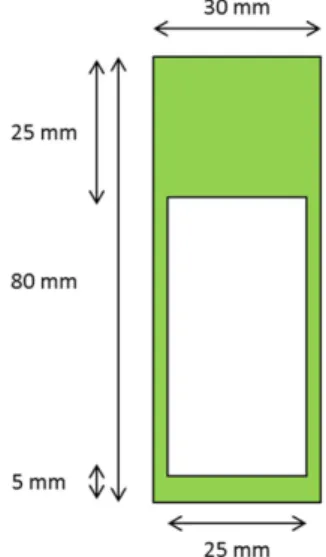
AZ31 Mg alloy plate (wt.%, Al 2.94, Zn 0.8, Mn 0.3, Si < 0.1, Fe < 0.005, Cu < 0.05, Ni < 0.005, and Mg balance) fabricated by POSCO was cut into 80mm x 30mm x 1mm sized samples. The samples were abraded using a blade and then they were masked using a tape as shown in Fig. 1, leaving an area of 50 mm × 25 mm for the following conversion coating and E-painting.

2.2. Chemical conversion coatings & E-painting The tape-masked AZ31 Mg alloy samples were degreased for about 10 min in 1 M NaOH and then for about 5 min in acetone. The samples were then chemically polished in a specially designed solution [11].

Cerium conversion coatings were obtained by immersing the chemically polished samples in 500 ml of 0.025M Ce(NO

3

)

3

.6H

2

O solution for only 30 s as

longer treatment time produce thicker cerium conversion coatings that exhibit poor adhesion with E-paint . Fluoride conversion coatings were prepared by immersing the chemically polished samples in 500 ml of 1 M HF solution for 10, 30, 60, and 120 s.

After the CeCC and FCC treatments, the samples were rinsed with tap water and dried in air.

The cathodic E-painting solution used was a commercial KED#2000P GRAY epoxy type electro- coat paint solution (Noroo, Korea). Temperature of the E-painting solution was maintained at 30 ± 1

o

C.

The deposition of E-paint was performed using a DC power-supply model N5771A (Agilent, United States) controlled by a LabVIEW computer-controlled program (National Instrument, United States) for 5 min. The E-paint deposition was conducted initially at a constant current density of 1 mA/cm

2

until reaching the voltage of 180 V, and then at the constant voltage of 180 V for the remaining time. After the deposition, the samples were rinsed with DI water to wash out the loosely bonded E-paint particles from the surface and then cured for 20 min at 150

o

C.

2.2. Property evaluation

The adhesion of E-paint was tested according to ASTM D3359 [12]. The corrosion resistance of E- painted AZ31 Mg alloy was evaluated by salt spray test (SST) according to ASTM B0117 [13]. An optical microscope (OM, Hirox, Japan) was used to observe the surface morphologies of the samples after adhesion test. The surface appearance of the samples after salt-spray tests was recorded using a digital camera.

Fig. 1. Dimensions of the AZ31 Mg alloy sample used

for chemical conversion coating and E-painting.

(3)

3. Results

Figure 2 presents digital photographs after 150 h and 350 h of SST. It can be seen from Fig. 2(a) that delamination and formation of solid corrosion products at the intersection of scratched lines occurred on chemically polished surfaces. Fig. 2(b) shows severe blistering and delamination over the entire surface, representing poor corrosion resistance and low adhesion of E-paint with CeCC. The reason for such severe blistering and delamination could be ascribed to the absorption of moisture through the E- paint and corrosion reactions at the sites where nobler impurity particles might be present. Fig. 2(c) shows no blistering or delamination problems for E- painted AZ31 Mg alloy with FCC, suggesting highly

improved corrosion resistance of E-painted alloy by employing a FCC layer. The highly improved corrosion resistance could be ascribed to a compact and thin conversion coating obtained after FCC treatment which prevents the accumulation of electrolyte during SST and thus results in better adhesion with E-paint during immersion in deionized water. Passivation of magnesium and dissolution of cathodic surface impurities in HF solution could be another reason for improved corrosion resistance after FCC treatment.

Cerium conversion coating has been explored as a promising alternative for chromate conversion coatings but no published literature has studied the adhesion and corrosion resistance of E-paint with CeCC. In this work, an initial comparison was made between E-painted AZ31 Mg alloy samples pre- treated with CeCC and FCC. Based on the results of experiments, further research was carried out with FCC.

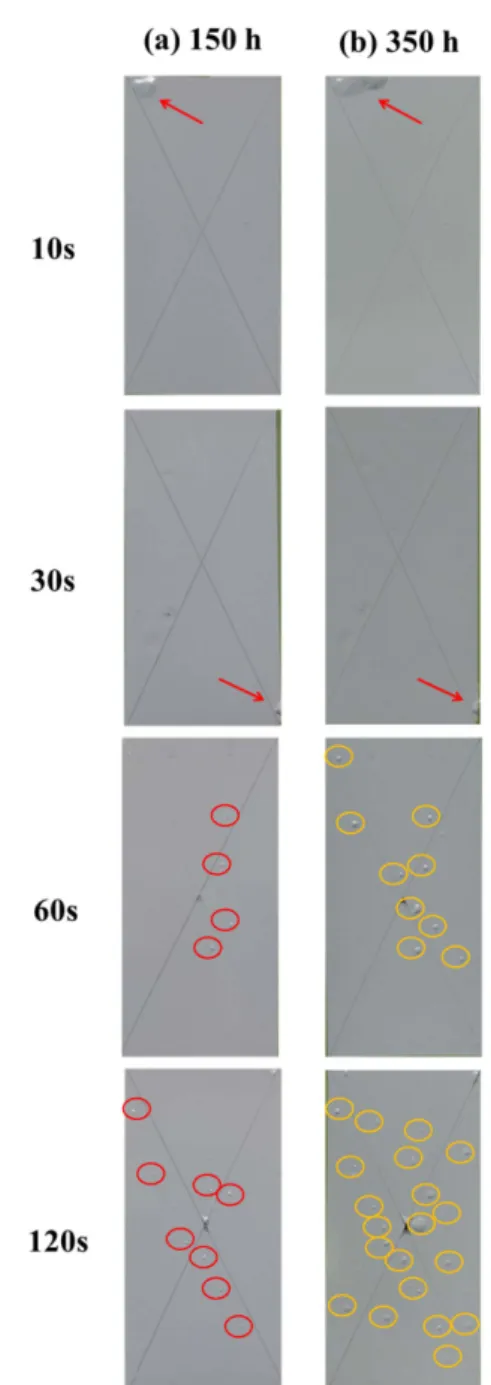
Figure 3 shows corrosion of E-painted AZ31 Mg alloy samples with FCC layers formed for different FCC treatment times, after 150 and 350 h of SST. It can be seen from Fig. 3 that after only 150 h of SST blisters were formed on AZ31 Mg alloy samples with FCC layers formed for 60 & 120 s while blisters or any delamination were not observed even after 350 h of SST on the E-painted AZ31 Mg alloy samples treated for 10 & 30 s in 1 M HF solution, as shown in Fig. 3(b).

The formation of blisters on the 60 & 120 s FCC- treated samples seems to be related with the thickness or porosity of FCC layer. Fig. 4 depicts the changes in surface colours of AZ31 Mg alloy from light gold to brown and lowered brightness of the surface with FCC treatment time. From the changes in surface colour and brightness, it can be readily inferred that the thickness or porosity of FCC layer increases with FCC treatment time. Thus, the blistering observed on the 60 & 120 s FCC-treated samples in Fig. 4 can be explained by the presence of thicker FCC layer which absorb more electrolyte and accelerates corrosion reactions at cathodic impurities present on the alloy surface.

It can also be seen from Fig. 3 that only one blister was formed for the 10 & 30 s FCC-treated samples after 150 h of SST at the alloy/tape interface regions, as indicated by red arrows. On the other hand, several blisters were formed on the 60 & 120 s FCC- treated samples after 150 h of SST, as indicated by red circles, and the number of blisters significantly Fig. 2. Digital photographs of the chemically polished

AZ31 Mg alloy surface with (a) no chemical conversion

coating; (b) CeCC; and (c) FCC, after SST for 150 and

350 h.

(4)

increased after 350 h of SST as marked by orange circles.

Figure 5 shows optical micrographs of E-painted AZ31 Mg alloy samples after the tape peel test to investigate the adhesion of E-paint with FCC formed for different treatment times. It can be seen from Fig. 5(a) that all fluoride conversion coated AZ31 Mg alloy samples, irrespective of the conversion coating time, exhibited good adhesion with E-paint.

Fig. 5(b) shows the optical micrographs after the tape peel test of E-painted AZ31 Mg alloy samples immersed for 500 h at 40

o

C in DI water. Fig. 5(b)

shows that small parts of E-paint at the intersections of the scratched lines were detached by the tape for AZ31 Mg alloy samples that were FCC-treated for 10 & 30 s, but large number of partial delamination occurring along the scratched lines was observed on the AZ31 Mg alloy samples that were FCC-treated for 60 & 120 s, as marked by red boxes.

4. Discussion

Traditional method for preparing fluoride conversion Fig. 3. Digital photographs of chemically polished AZ31

Mg alloy sample surfaces for each FCC treatment time of 10, 30, 60 and 120 s in 1 M HF solution after SST for (a) 150 and (b) 350 h.

Fig. 4. Changes in colour of AZ31 Mg alloy with FCC treatment time in 1 M HF solution.

Fig. 5. Optical microscopy images after tape peel test of cured E-paint on AZ31 Mg alloy samples, for each FCC treatment time of 10, 30, 60 and 120 s, in 1 M HF solution, tested (a) before immersion in DI water;

and (b) 500 h immersion at 40

o

C in DI water.

(5)

coating on magnesium and its alloys is to immerse the sample in an aqueous solution of HF for a time period that can vary from a few minutes to days. It is generally assumed that the coating is formed by the reaction of magnesium with HF, as shown in eq. 1.

Fluoride conversion coatings were formed a function of treatment time, acid concentration, and substrate pre-treatment [7-9]. Coating properties such as thickness and porosity can change significantly depending on these parameters [10].

Mg(s) + 2HF (aq)

→ MgF

2

(s) + H

2

(g), ΔG

o

= −476.6 kJ/mol (1) In the case studies of [7,9] it was shown that the fluoride conversion coating on Mg alloys can contain considerable amount of hydroxide and oxides.

Generally, lower acid concentrations lead to greater amount of hydroxides/oxides formed on the metal surface. Magnesium hydroxide can be formed by the reaction of Mg metal with water (eq. 2), which is the main reaction in the aqueous corrosion of magnesium.

By comparing eq.1 and eq.2 it can be seen that both reactions have a similar thermodynamic tendency to take place. The rate of each process will depend on the HF concentration.

Mg(s) + 2H

2

O(l)

→ Mg(OH)

2

(s) + H

2

(g), ΔG

o

= −359.3 kJ/mol (2) According to the studies in literature, the quantity of hydroxides in the coating has considerable negative effect on the protective properties of MgF

2

layer [9].

Mg(OH)

2

is not stable in the acidic solution. Thus, magnesium hydroxide is converted into magnesium fluoride in a concentrated HF solution according to eq. 3.

Mg(OH)

2

(s) + 2HF(aq)

→ MgF

2

(s) + 2H

2

O(l), ΔG

o

= −117.3 kJ/mol (3) The surface morphology and chemical composition studies [10,14] have shown that a compact, dense and smooth coating is obtained after FCC, which contain some irregular pores associated with hydrogen evolution which are gradually filled by MgF

2

and MgO particles. The MgF

2

film grows in thickness with immersion time, but the growth rate is slowed down as immersion continues [14] which is an indicator of the barrier effect of MgF

2

. The

presence of irregular pores associated with hydrogen evolution and thickening of MgF

2

layer seem to result in the changes of colours of the specimen surface in Fig. 3. The presence of irregular pores in thick MgF

2

film after longer FCC treatment can result in the formation of blisters on the E-painted AZ31 Mg alloy surface, as can be seen in Fig. 2.

Literature has reported the deposition of different polymer coatings on HF-treated magnesium samples and showed that those coatings on HF-treated magnesium substrates have much better corrosion protective property in body fluids than those on the substrates with other kinds of pre-treatment [3,5,15- 16]. The authors [3,5,15-16] reported superior corrosion performance of polymer coatings on HF-treated Mg sample to polymer coatings on the ground, as- received, or acid-etched surfaces (acetic and nitric acids) in electrochemical and immersion tests.

However, no such film can protect the substrate in chloride-containing solutions as defects in magnesium fluoride film allow diffusion of chloride ions which react with Mg substrate and break the passive film.

5. Conclusion

In this research work, the corrosion resistance and

adhesion of E-paint with fluoride conversion coating

(FCC) on chemically polished AZ31 Mg alloy is

reported for the first time. It was found that E-paint

showed better corrosion resistance and adhesion on

the fluoride conversion coated surface than the

chemically polished and cerium conversion coated

surfaces. Corrosion resistance and adhesion of E-

painted AZ31 Mg alloy were then further investigated

as a function of FCC treatment time. The colour of

the samples changed from light gold to bronze with

increasing treatment time in 1 M HF solution,

indicating thicker FCC formation with prolonged

treatment time. The corrosion resistance and

adhesion of E-paint appeared to decrease with

increasing FCC treatment time. The number of

blisters formed on the FCC-treated samples increased

with increasing FCC treatment time, which is

attributed to the corrosion reaction at the cathodic

impurities remaining on the surface. The corrosion

reaction seems to be accelerated by the presence of

thicker FCC layer by absorbing more electrolyte and

accumulating more aggressive ions.

(6)

Acknowledgement

This research was financially supported by a research grant from the general research program from Korea Institute of Materials Science (PNK4652).

References

[1] S. Verdier, N. van der Laak, S. Delalande, J. Metson, F. Dalard, The surface reactivity of a magnesium–

aluminium alloy in acidic fluoride solutions studied by electrochemical techniques and XPS, Appl. Surf.

Sci. 235 (2004) 513-524.

[2] H. R. Bakhsheshi-Rad, M. H. Idris, M. R. A.

Kadir, M. Daroonparvar, Effect of fluoride treatment on corrosion behavior of Mg–Ca binary alloy for implant application, Trans. Nonferrous Met. Soc.

China. 23 (2013) 699-710.

[3] T. F. da Conceicao, N. Scharnagl, C. Blawert, W.

Dietzel, K. U. Kainer, Surface modification of magnesium alloy AZ31 by hydrofluoric acid treatment and its effect on the corrosion behaviour, Thin Solid Films. 518 (2010) 5209-5218.

[4] T. F. da Conceição, N. Scharnagl, W. Dietzel, K.

U. Kainer, Controlled degradation of a magnesium alloy in simulated body fluid using hydrofluoric acid treatment followed by polyacrylonitrile coating, Corros. Sci. 62 (2012) 83-89.

[5] T.F. da Conceicao, N. Scharnagl, W. Dietzel, K.U.

Kainer, Corrosion protection of magnesium AZ31 alloy using poly(ether imide) [PEI] coatings prepared by the dip coating method: Influence of solvent and substrate pre-treatment, Corros. Sci.

53 (2011) 338-346.

[6] G. T. Bayer, M. Zamanzadeh, Failure analysis of paints and coatings, Publ. Internally Matco Assoc.

SURFACE PREPARATION AND COATING APPLI- CATION PRACTICES. 331 (2004) 1-37.

[7] Y. Zheng, Magnesium Alloys as Degradable Bio-

materials, CRC Press, (2015).

[8] T. S. N. S. Narayanan, I. S. Park, M. H. Lee, Surface Modification of Magnesium and its Alloys for Biomedical Applications: Modification and Coating Techniques, Elsevier, (2015).

[9] P. Y. Casanova, K. J. Jaimes, N. J. Parada, C.

A. Hernández-Barrios, M. Aparicio, F. Viejo, A.

E. Coy, Synthesis and evaluation of MgF

2

coatings by chemical conversion on magnesium alloys for producing biodegradable orthopedic implants of temporary use, J. Phys. Conf. Ser. 466 (2013) 12003 1-4.

[10] X. -Y. Ye, M. -F. Chen, C. You, D. -B. Liu, The influence of HF treatment on corrosion resistance and in vitro biocompatibility of Mg-Zn-Zr alloy, Front. Mater. Sci. China. 4 (2010) 132-138.

[11] B. R. Fazal, S. Moon, Acid Pickling/polishing of AZ31 Magnesium Alloy, J. Korean Inst. Surf. Eng.

49 (2016) 231-237.

[12] ASTM standard D3359-02, ASTM International 06.01 (2004) 1-8.

[13] ASTM standard B117-03, ASTM International 03.02 (2004) 1–12.

[14] T. Yan, L. Tan, B. Zhang, K. Yang, Fluoride Conversion Coating on Biodegradable AZ31B Mag- nesium Alloy, J. Mater. Sci. Technol. 30 (2014) 666-674.

[15] T. F. da Conceição, N. Scharnagl, W. Dietzel, K. U.

Kainer, Controlled degradation of a magnesium alloy in simulated body fluid using hydrofluoric acid treatment followed by polyacrylonitrile coating, Corros. Sci. 62 (2012) 83-89.

[16] T. F. da Conceicao, N. Scharnagl, W. Dietzel, D.

Hoeche, K. U. Kainer, Study on the interface of PVDF coatings and HF-treated AZ31 magnesium alloy: Determination of interfacial interactions and reactions with self-healing properties, Corros. Sci.

53 (2011) 712-719.

수치

Fig. 1. Dimensions of the AZ31 Mg alloy sample used for chemical conversion coating and E-painting.
Figure 2 presents digital photographs after 150 h and 350 h of SST. It can be seen from Fig
Fig. 4. Changes in colour of AZ31 Mg alloy with FCC treatment time in 1 M HF solution.

참조

관련 문서