Received: July 24, 2013; Accepted: September 27, 2013 Corresponding author : Sung Bum Hur
Tel: +82 (51) 629-5911 e-mail: [email protected] 1225-3480/24487
This is an Open Access article distributed under the terms of the Creative Commons Attribution Non-Commercial License with permits unrestricted non-commercial use, distribution, and reproducibility in any medium, provided the original work is properly cited.
북방전복 종묘생산을 위한 농축 규조류
Caloneis schroederi
와Rhaphoneis
sp.의 효과김승헌, 김미정
2, 박세진
1, 허성범
2해림수산, 1부산광역시청 수산진흥과, 2부경대학교 해양바이오신소재학과
Effect of the concentrated-diatom of Caloneis schroederi and Rhaphoneis sp. for seedling production of Haliotis discus hannai
Seung-Hyern Kim, Mi Jeong Kim
2, Se Jin Park
1and Sung Bum Hur
2 Haelim Fishery, Yeosu 556-833, Korea1Busan Metropolitan City, Fisheries Promotion Division, Busan 611-735, Korea
2Department of Marine Bio-materials and Aquaculture, Pukyong National University, Busan 608-737, Korea
ABSTRACT
Even though seedling production of Haliotis discus hannai has fully developed, the culture of benthic diatom as a live food for larvae is still a barrier to solve in commercial hatchery. The farmer depends on mixed microalgae which are non-selectively attached on the plate by flowing of natural seawater. The adequate diatom on the plate for the larvae in terms of quality and quantity is always significant bottleneck in the hatchery. In this study, two benthic diatom species, Caloneis schroederi and Rhaphoneis sp. were separately cultured in mass and inoculated to four tons' settlement tank of the larvae. And the larvae and the spats were cultured for nineteen and nine weeks, respectively. The result on seedling production of H. discus hannai with this method was compared to that of the farmer's traditional method as a control. With regard to variation of species composition of benthic diatom on the plate, C. schroederi and Rhaphoneis sp. were dominant for first three weeks after inoculation. But the diverse diatoms mainly, Navicula, Amphora, Cylindrotheca, Licmophora, Pleurosigma began to attache on the plate from the 4th week. The larvae attached 2.5 times more in C. schroederi tank than in the control tank. The final total biomass of the seeds in Rhaphoneis sp. tank was 3.2 times more than that of the control tank. The retared-spats in the seedling production also showed significantly higher growth and survival in the spat fed Rhaphoneis sp. or
C. schroederi than those in the control group. We suggest that C. schroederi is proper for settlement of the larvaeand Rhaphoneis sp. is appropriate for the growth of the larvae and spats in the commercial hatchery of H. discus
hannai.Key words : Haliotis discus hannai, seedling production, concentrated-diatom, Caloneis schroederi, Rhaphoneis sp.
서 론
북방전복은 산업적으로 가장 널리 양식되는 대표적인 전복
종이지만, 종묘생산시 먹이생물인 부착 규조류의 효율적 대량 배양은 여전히 문제점으로 남아 있다. 북방전복 유생은 난황을 흡수한 후, 기질에 부착하여 먹이를 먹기 시작하는 시기부터 각장이 약 3 mm되는 시기까지 기질에 부착한 규조류를 주로 먹이로 섭취한다. 따라서 기질에 부착된 규조류의 질과 양은 유생의 부착률, 변태율, 생존율 및 성장률에 큰 영향을 준다 (Lucas et al., 1979; Woollacott et al., 1989; Maldonado and Young, 1999). 특히 규조류가 고밀도로 부착했을 경우, 자체 무게로 인하여 유생과 함께 동시에 탈락되는 문제점 때문 에 규조류의 성장을 조절해야하는 어려움도 있다 (Norman- Boudreau et al., 1986; Ko and Hur, 2011).
북방전복 유생 및 치패에 대한 다양한 미세조류의 먹이효율 에 관한 연구 결과는 많이 보고된 바 있으나 (Kawamura et al., 1995; Han and Hur, 2000a; Gordon et al., 2006;
Xing et al., 2008) 대부분이 실험실 규모의 연구결과이다. 따 라서 현재 상업적인 종묘생산 방법은 전 세계적으로 여과해수 를 3-4주간 유수시키며 부착기질인 파판에 자연적으로 발생 부착시킨 규조류에 의존하고 있다 (Kikuchi, 1965; Seki, 1980; Ebert and Houk, 1984; Han and Hur, 2000a, b).
그러나 이 방법도 유생에게 적합한 최적 규조류를 선택적으로 파판에 부착시킬 수 없는 문제점이 있다. 또 부화장이 위치한 연안 환경의 특성, 특히 수온과 영양염에 따라 파판에 부착하 는 규조류의 다양성과 부착량은 큰 차이를 보이므로 기존의 방 법은 북방전복 종묘의 대량생산을 제한하고 있다. 따라서 북방 전복 유생에 최적의 규조류를 대량배양한 후 규조류만을 파판 에 우점적으로 부착시켜 유생을 사육하면 이러한 문제점을 해 결할 수 있을 것이다. 또 이들 규조류를 농축하여 북방전복 부 화장에 접종용 규조류로 공급하면 종묘생산은 더욱 효과적일 것이다. 이러한 목적을 위해서는 일차적으로 대량배양과 수확 이 용이하고 질적으로 먹이효율이 높은 부착성 규조류의 개발 이 필요하다 (Park, 2005).
C. schroederi는 28℃의 고온에서도 배양이 용이하고 세포 가 크고 부착력과 배양 생체량도 높고 (Ko and Hur, 2011), Rhaphoneis sp.에 비하여 세포의 크기가 약 2배 이상 커서 대량배양 후 침전시켜서 수확하기에 효과적이다 (Park, 2005). 따라서 본 연구에서는 실험실 규모의 연구에서 북방전 복 유생과 치패에게 적합한 먹이생물로 보고된 Rhaphoneis sp. (Ko and Hur, 2011; Park and Hur, 2013) 와 대량배 양과 수확이 용이한 C. schroederi를 대상으로 실험하였다. 이 들 2종의 규조류를 실내에서 대량배양하여 농축시킨 후 상업 적 규모의 북방전복 종묘 배양장의 파판에 접종하여 이들 종만 파판에 우점적으로 부착시킨 후 기존의 유수식으로 자연 부착 시킨 대조구 실험구와의 북방전복 종묘생산의 효과를 비교하 였다.
재료 및 방법
1. 규조류의 배양
실험에 사용한 2종의 규조류 (C. schroederi, KMMCC-900 (21.0 ± 2.5 μm) 와 Rhaphoneis sp., KMMCC-628 (8.8 ± 1.7 μm) 는 부경대학교 한국해양미세 조류은행 (KMMCC) 에서 분양받아 배양하였다. 배양은 f/2 배지 (Guillard and Ryther, 1962) 를 이용하여 20℃, 33 psu, 조도 20 μmol m-2s-1 연속조명으로 20 L 용기에서 통 기배양하였다. 배양된 규조류는 공기를 중단하고 24시간 정체 한 후 싸이폰을 이용하여 바닥에 침전된 규조류를 수확하여 1
L로 농축하였다.
전남 여수시 해림수산 전복종묘배양장의 4톤 FRP 수조 (5
× 1 × 0.8 m3) 에 3톤의 여과해수와 평판 플라스틱 파판 (30
× 33 cm2) 680장을 넣고 f/2배지의 농도로 조성한 후 농축된 규조류를 접종하였다. 초기 접종밀도는 각 종의 크기를 고려하 여 C. schroederi는 6 × 10⁴ cells/mL, Rhaphoneis sp.는 9
× 104 cells/mL 로 접종하였고 지수식으로 10일간 통기배양 하며 파판에 부착시켰다. 대조구는 현장의 양식어민들이 하는 방법대로 농축 규조류의 접종없이 3주간 여과해수만을 유수 (15 L/분) 하여 자연적으로 다양한 규조류가 부착하게 하였다.
규조류 배양시 현장의 평균 수온은 14-15℃, 염분 33-34 psu 의 범위였다. 규조류 배양은 2 반복으로 실시하였다.
2. 북방전복 종묘생산 1) 규조류 종조성의 변화
수조별로 파판에 부착한 규조류 출현종은 19주까지, 부착한 규조류의 부착 밀도 (세포수/cm2) 는 14주까지 매주 1회 조사 하였다. 매주 각 수조의 주수구, 중앙 및 배수구 주위에서 무작 위로 각각 파판 1장을 취하여 붓을 사용하여 부착한 규조류를 탈락시켜 수확하였다. 수확된 규조류는 100 mL로 농축한 후 이 중 1 mL를 취하여 파판에 부착한 규조류의 종 조성과 밀도 를 조사하였다. 또 부착된 규조류 가운데 본 실험의 대상종으 로 농축 접종하여 배양한 C. schroederi와 Rhaphoneis sp.의 우점률 (우점률 (%) = 파판에 부착한 대상 규조류의 개체수 / 파판에 부착한 총 규조류의 개체수 × 100) 을 조사하였다 (Ko and Hur, 2011).
2) 유생사육
대조구를 제외한 C. schroederi와 Rhaphoneis sp. 실험구 수조는 유생을 넣기 전 남아있는 f/2 배지의 성분을 제거하기 위해서 분당 15 L의 여과해수를 24시간 유수하였다. 북방전복 유생은 해림수산 부화장에서 수정 후 120 시간 지난 veliger 유생을 파판당 250마리 밀도로 수조당 17만 마리 수용하였다.
유생 사육 기간은 총 19주로 실험은 2반복 실시하였다. 유생의 부착률은 접종 후 4주 동안 매주 수조의 주수구, 중앙, 배수구 주위에서 무작위로 각각 파판 3장씩 총 9장을 취하여 부착한 유생을 계수하였다. 사육 19주째에는 각 수조내의 모든 치패를 수확하여 총개체수와 총중량을 구하고, 이중 무작위로 100개 체를 선택하여 각장은 디지털캘리퍼스를 이용하여 10 μm 단 위로, 전중은 전자저울로 mg단위로 계측하였다. 또 수용한 총 veliger 유생수에 대한 최종 생존율을 구하였다.
한편 유생의 성장에 따라 각 규조류의 부착량이 급격히 감소 하는 문제를 대비하여 유생사육 4주, 7주, 9주, 11주의 조사 직후 처음 접종 밀도의 50%에 해당하는 농축 C. schroederi
Species Culture weeks
1 2 3 4 5 6 7 8 9 10 11 12 13 14 19
Caloneis schroederi + + + + + + + + + + + + + + +
Achnanthes spp. + + + +
Amphiprora spp. + + + + + + +
Amphora spp. + + + + + + + + + + + + + +
Bacillaria sp. + + + + + + +
Climacosphenia sp. + + + + + +
Cocconeis spp. + + +
Cylindrotheca closterium. + + + + + + + + + + + + + + +
Diploneis sp. + + + +
Fragilaria sp. + + + +
Frustulia sp. +
Gomphonema sp. + + + + + +
Licmophora spp. + + + + + + + + + + + + + + +
Melosira sp. + + + + + + +
Navicula cancellata + + + + + + + + + + +
Navicula distans + +
Navicula incerta + + + + + + + + + + + +
Navicula spp. + + + + + + + + + + + + +
Nitzschia dissipata + + +
Nitzschia pungens + + + + + +
Nitzschia spp. + + + +
Pleurosigma spp. + + + + + + + + + + + +
Rhizosolemia stolterfothii +
Rhodomonas sp. +
Stauroneis sp. +
Striatella sp. +
Thalassiosira sp. + + + Table 1. Occurrence of microalgal species on the plates which were initially inoculated with Caloneis
schroederi for seeding production of Haliotis discus hannai 와 Rhaphoneis sp.를 추가 접종하고 24시간 지수식으로 유지
하여 파판에 부착하게 한 후 다시 동일한 방법으로 유수하며 유생을 사육하였다. 또 5주째에는 사육 수조의 바닥에 쌓인 찌 꺼기를 청소하고 100% 환수하였다. 그 외 모든 유생 사육방법 은 양식어민이 수행하는 현장의 방법에 따랐다.
3. 성장이 늦은 소형 북방전복 치패의 사육 실험
앞의 유생 사육 실험에서 성장이 늦은 소형 치패를 대상으로 사육 실험을 하였다. 4톤 수조에 3톤의 여과해수를 채우고 수 조당 앞에서와 동일한 파판 450장을 넣고 규조류를 배양하였 다. 대조구는 3주간 자연해수를 유수시켰고 실험구는 농축한 C. schroederi와 Rhaphoneis sp.를 접종하여 배양하였다. 규 조류 배양은 앞의 방법과 동일하였다.
각 실험구와 대조구에서 규조류가 배양된 부착 파판 150장 을 4톤 수조 (3톤 여과해수) 에 넣고 성장이 늦은 소형 치패 (8.2 ± 2.1 mm, 60 ± 10.2 mg) 4,500 마리를 수용하였다.
치패 성장에 따른 먹이부족을 해결하기 위하여 3주와 6주째 동일한 방법으로 규조류가 부착된 파판을 150장씩 더 넣어주
어 파판당 10개체의 치패 밀도를 기준으로 하였다. 사육 9주째 모든 치패를 수확하여 치패의 총 중량과 총 개체수를 조사하여 생존율을 구하고, 이중 무작위로 100개체를 택하여 평균 각장 과 전중을 조사하였다. 실험은 2반복 실시하였고 기타 실험방 법은 유생사육에서와 동일하였다.
4. 통계처리
모든 실험 결과는 One-way ANOVA test를 실시하였으며, 평균간의 유의성 (P < 0.05) 은 Duncan multiple test (Duncan, 1955) 로 검정하였다. 통계 분석은 SPSS program (ver 17.0) 을 사용하여 분석하였다.
결 과
1. 규조류의 종조성 변화유생 사육 19주까지의 각 실험구에서 파판에 부착된 규조류 출현종의 분포는 Table 1, 2, 3과 같다. 또 14주까지 파판에 부착된 규조류의 밀도 변화는 Fig. 1과 같다. C. schroederi 실험구에서는 Rhaphoneis sp.나 대조구에 비하여 더 다양한
Species Culture weeks
1 2 3 4 5 6 7 8 9 10 11 12 13 14 19
Achnanthes spp. + + + + + +
Amphiprora spp. + + + + + + + +
Amphora spp. + + + + + + + + + + + +
Bacillaria sp. + + + + + + + + + + +
Climacosphenia sp. + + + + + +
Cocconeis spp. + + +
Cylindrotheca closterium + + + + + + + + + + + + + +
Diploneis sp. +
Fragilia sp. + + + + +
Gomphonema sp. + + +
Grammatophora sp. + +
Hantzschia amphioxys + Leptocylindrus sp. +
Licmophora spp. + + + + + + + + + + + + + +
Navicula cancellata + + + + + + + + + + + +
Navicula incerta + + + + + + + + + + +
Navicula spp. + + + + + + + + + + + + + + +
Nitzschia dissipata + + +
Nitzschia pungens + +
Nitzschia spp. + + + +
Pleurosigma spp. + + + + + + + + + + + + + +
Stauroneis sp. +
Table 3. Occurrence of microalgal species on the plates which were cultured by flowing natural seawater for seeding production of Haliotis discus hannai
Species Culture weeks
1 2 3 4 5 6 7 8 9 10 11 12 13 14 19
Rhaphoneis sp. + + + + + + + + + + + + + + +
Achnanthes spp. + + + +
Amphiprora spp. + + + + +
Amphora spp. + + + + + + + + + + + + + +
Bacillaria sp. + + + + + + + + + + + +
Climacosphenia sp. + + + + + + + + + +
Cocconeis spp. + + + + + +
Cylindrotheca closterium + + + + + + + + + + + + + + +
Diploneis sp. + +
Fragilria sp. + + + + +
Gomphonema sp. + + +
Grammatophora sp. +
Licmophora spp. + + + + + + + + + + + + + + +
Navicula annexa +
Navicula cancellata + + + + + + + + + + +
Navicula incerta + + + + + + + + + + + +
Navicula spp. + + + + + + + + + + + + + +
Nitzschia dissipata + +
Nitzschia pungens + + + +
Nitzschia spp. + + + + +
Orthodon sp. +
Pleurosigma spp. + + + + + + + + + + + +
Triceratium sp. +
Table 2. Occurrence of microalgal species on the plates which were initially inoculated with Rhaphoneis sp. for seeding production of Haliotis discus hannai
Fig.1. Density of microalgal species attached on the plates for seedling production of Haliotis discus hannai for fourteen weeks (□: total benthic diatom, ■: C.
scheroederi or Rhaphoneis sp.).
규조류가 부착하였다. Cylindrotheca와 Licmophora는 전주 에 걸쳐 출현하였고 그 외 Amphora, Navicula, Pleurosigma 등이 널리 분포하였다. C. schroederi 실험구에 서 유생 사육 전 C. schroederi 밀도는 22.4 × 10⁴ cells/cm2 로 가장 높았다. 유생을 사육한 후 1주째 밀도는 9.7 × 10⁴ cells/cm2로 약 43% 감소하였다. 2주째부터는 파판에 출현하 는 생물종이 다양해지기 시작하나 3주까지는 비교적 C.
schroederi가 우점적이었다. 그러나 4주째부터 6주째까지는 Navicula 가 우점하였다. 5주째 수조 바닥 청소 후에는 밀도 가 감소하여 7주째는 0.3×10⁴ cells/cm2로 전 실험기간 중 가 장 낮은 밀도를 보였다. C. schroederi를 재접종한 1주일 후인
5, 8, 10, 12주째에는 파판에 부착이 회복되는 경향을 보이나 1주 후가 되면 대체로 감소하는 경향을 보였다. C. schroederi 는 14주까지 다른 출현종에 비하여 비교적 우점적인 양상을 보였다.
Rhaphoneis sp. 실험구에서도 C. schroederi 실험구에서 와 유사한 규조류 출현분포를 보였다. 유생 사육 전 Rhaphoneis sp. 밀도가 1.5 × 10⁴ cells/cm2로 C.
schroederi 실험구보다 낮은 부착 밀도를 보였다. 유생 사육 후 1주일째는 Rhaphoneis sp.는 1.4 × 10⁴ cells/cm2로 유생 을 사육하기 전보다 소량 감소하였고, 4주째는 Navicula가 2.7 × 10⁴ cells/cm2로 가장 우점적으로 나타났다. C.
schroederi 실험구에서와 같이 5주째 청소 후 부착 밀도는 크 게 감소하기 시작하여 7주째 0.4 × 10⁴ cells/cm2로 전 실험기 간 중 가장 낮았다. Rhaphoneis sp.의 경우도 재접종 후에는 부착이 회복되는 경향을 보이다가 그 다음주가 되면 다시 감소 하는 경향을 보였다. 13주째까지 Rhaphoneis sp.는 비교적 우점적으로 출현하였고 그 외에는 Fragilaria가 매우 우점적 으로 출현하였다.
자연 해수를 흘려준 대조구에서는 Cylindrotheca, Licmophora, Navicula, Pleurosigma는 항상 출현하였고 그 외에도 Amphora, Amphiprora, Bacillaris 등이 널리 출 현하였다. 유생 사육 전 부착 규조류의 밀도는 0.3 × 10⁴ cells/cm2로 다른 실험구보다 크게 낮았다. 유생 사육을 시작 한 지 2주째 4.8 × 10⁴ cells/cm2의 가장 높은 부착 밀도를 보 였고 이 중 Navicula가 3.7 × 10⁴ cells/cm2로 가장 우점적이 었다. 이 후 14주째까지 주로 Navicula, Bacillaris, Cylindrotheca, Cocconeis, Licmophora 등이 주로 우점하 였다.
2. 유생의 부착률, 성장 및 생존율
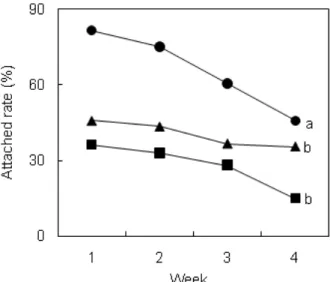
유생 접종 후 4주동안 유생의 부착률을 조사한 결과는 Fig. 2와 같다. 부착률은 1주일째가 가장 높았고 2주째부터 는 계속해서 감소하는 경향을 보였다. 1주째 C. schroederi는 파판당 204 개체가 부착하여 82%의 부착률로 대조구에 비하 여 2.2배 높은 결과를 보였다. 4주째도 C. schroederi와 Rhaphoneis sp.는 각각 46%와 36%로 대조구 15%보다 유 의하게 높은 부착률을 보였다 (P < 0.05). C. schroederi는 1 주 이후 부착률이 급속히 감소하는 반면 Rhaphoneis sp.는 감소율이 낮았다.
유생 사육 19주째 최종적으로 각 실험구 수조에서 생산된 북방전복 치패를 모두 수확한 결과는 Table 4와 같다.
Rhaphoneis sp.의 실험구에서 평균 각장과 전중은 12.9 mm 와 0.25 g으로 유의하게 가장 컸고 대조구는 9.8 mm와 0.10 g으로 가장 낮았다 (P < 0.05). C. schroederi는 Rhaphoneis
Fig. 2. Attachment (%) of Haliotis discus hannai larvae on the plastic plates during first four weeks (●: Caloneis schroederi, ▲: Rhaphoneis sp., ■: control). Different letter in final attachment (%) on fourth week means significantly difference at the level of 5%.
Diet Total biomass (g) Total number (inds.) Shell length (mm) Total weight (g) Survival (%) Caloneis schroederi 2,800 ± 1,272b 13,344 ± 5,935b 11.7 ± 3.1b 0.20 ± 0.16b 7.8 ± 3.5b
Rhaphoneis sp. 4,600 ± 1,697a 17,201 ± 6,235a 12.9 ± 3.9a 0.25 ± 0.13a 10.1 ± 3.7a Control 1,450 ± 71c 14,275 ± 849b 9.8 ± 2.3c 0.10 ± 0.07c 8.3 ± 0.5b Different letters in the same column mean significantly difference at the level of 5%.
Initial total number of veliger larvae were 170,000 individuals.
Table 4. Seedling production and growth of Haliotis discus hannai larvae reared from veliger larvae for nineteen weeks in four ton culture tank
Diet Total biomass (g) Total number (inds.) Shell length (mm) Total weight (g) Survival (%) Caloneis schroederi 548 ± 49b 3,033 ± 233a 12.38 ± 2.16ab 0.19 ± 0.10ab 67.4 ± 6.1a
Rhaphoneis sp. 688 ± 162a 3,129 ± 735a 12.77 ± 3.37a 0.22 ± 0.19a 69.5 ± 16.3a Control 429 ± 77c 2,684 ± 479b 11.70 ± 2.43b 0.16 ± 0.12b 59.6 ± 10.7b Different letters in the same column mean significantly difference at the level of 5%.
Initial total biomass, total number, shell lengths and total weight of the spats were 70 g, 4,500 inds., 8.2 ± 2.1 mm, and 60 ± 10.2 mg, respectively.
Table 5. Final production and growth of the retarded-spats of Haliotis discus hannai reared for nine weeks in four ton culture tank
sp.에 비하여 낮은 성장을 보였으나 대조구보다는 높은 결과를 보였다. 치패의 생존율은 Rhaphoneis sp. 실험구에서 10.1%
로 유의하게 높았으나 C. schroederi와 대조구에서는 7.8%와
8.3%로 서로 유의한 차이를 보이지 않았다. 치패의 총 생체량 은 Rhaphoneis sp.에서 4,600 g으로 가장 높았고 C.
schroederi는 2,800 g으로 Rhaphoneis sp. 보다 낮았으나 대조구 1,450 g보다는 높은 결과를 보였다 (P < 0.05).
3. 성장이 늦은 북방전복 치패의 성장과 생존율
종묘생산 과정에서 성장이 늦은 소형치패 (8.6 ± 2.1 mm, 60 ± 10.2 mg) 를 대상으로 수조당 4,500 개체를 수용하여 9 주간 먹이별로 사육한 결과는 Table 5와 같다. 평균 각장과 전 중은 Rhaphoneis sp.에서 12.8 mm와 0.22 g으로 대조구 11.7 mm와 0.16 g보다 유의하게 높았으나 C. schroederi와 는 유의한 차이는 없었다 (P < 0.05). 치패의 생존율은 Rhaphoneis sp.와 C. schroederi에서 각각 69.5%와 67.4%
로 유의한 차이가 없었지만 대조구 59.6%보다는 유의하게 높 았다. 치패의 총 생체량은 Rhaphoneis sp.에서 688 g으로 C.
schroederi의 548 g보다 유의하게 높았으며 대조구는 429 g 으로 가장 낮았다 (P < 0.05).
고 찰
북방전복 종묘생산 기술은 널리 보급되었으나 먹이생물로 활용되는 부착 미세조류의 질적ㆍ양적 확보는 여전히 큰 어려 움으로 남아 있다. 자연 상태에서의 전복 유생은 주로 산호말 (coralline red algae) 에 부착하나 전복 배양장에서는 산호말
의 배양이 어려워 전복 종묘생산에 활용되지는 못하고 있다 (Daume, 2006). 또 배양이 용이한 담녹조류 Tetraselmis helgolandica나 녹조류 Ulvella lens는 유생의 부착률에서는 효과가 있으나 영양가가 낮아 유생의 성장에는 효과적으로 이 용되지 못하고 있다 (Uki and Kikuchi, 1979; Seki, 1997;
Pang et al., 2006; Ko and Hur, 2011).
북방전복 유생 사육을 위한 실험실 규모의 소규모 배양 실험 결과를 보면 우상목 (Pennales) 부착성 규조류 가운데 Achnanthes, Caloneis, Cocconeis, Navicula, Nitzschia, Rhaphoneis 등이 우수한 먹이효율을 보인다 (Kawamura et al., 1995; Gordon et al., 2006; Roberts and Watts, 2010; Park and Hur, 2013). Rhaphoneis sp.는 C.
schroederi와 C. californica에 비하여 유생 부착률과 변태율, 생존율에서 높은 것으로 알려져 있다 (Han and Hur, 2000a;
Xing et al., 2008; Ko and Hur, 2011). 북방전복 종묘생산 을 위한 부착 규조류의 적정배양수온은 16-21℃ 범위가 좋고, 북방전복 치패의 사육을 위한 최적 수온은 20℃ 전후이다 (Ito et al., 1987). 본 연구에서 북방전복 유생 사육 기간의 수온은 16.1-22.7℃, 염분은 31.5-33.5 psu 범위였으며 해수의 수질 환경은 부착 규조류의 배양과 북방전복 유생 사육에 큰 저해영 향이 없었던 것으로 판단된다.
Suzuki et al. (1987) 과 Ioriya and Suzuki (1987) 는 11.2 mm의 북방전복 치패 사육 실험에서 파판의 규조류 군집 의 변동이 실험 초기에는 Navicula, Nitzschia와 Bacillaris 등이 우점하였으나, 실험 후기에는 이들이 격감하고, 부착력이 높은 Achnanthes나 Cocconeis 등이 출현하기 시작하여, 실 험이 끝날 무렵이 되면 이들의 개체수가 크게 증가하였다고 하 였다. 본 연구에서도 0.3-0.4 mm의 북방전복 유생이 파판에 부착 후 먹이를 본격적으로 섭취하기 시작한 3주째부터는 C.
scheroederi나 Rhaphoneis sp. 외에 다른 규조류의 출현이 대량 발생하였다. 대조구를 포함한 전 실험구에서 Navicula의 출현이 가장 두드러졌고, 이 밖에도 Cylindrotheca, Bacillaria 등이 전 기간에 걸쳐 출현하였다. Cocconeis는 실 험 후반기인 12주째부터 출현하기 시작하였다.
본 조사에서 유생의 부착률은 1주일만에 C. schroederi 실 험구에서는 82%, Rhaphoneis sp.는 55%로 대조구의 36%보 다 월등히 높아 Han and Hur (2000a), Ko and Hur (2011), Park and Hur (2013) 등의 결과와 일치하였다. 또 4 주째까지 계속해서 C. scheroederi와 Rhaphoneis sp. 실험구 의 부착률은 대조구에 비하여 높았다. 본 연구에서 유생 사육 초기에는 C. scheroederi가 Rhaphoneis sp.보다 월등히 높은 부착률을 보였으나 1주 이후 C. scheroederi는 부착률이 급격 하게 감소한 반면 Rhaphoneis sp.는 감소폭이 낮았던 점을 볼 때, 부착률의 관점에서는 C. scheroederi가 Rhaphoneis sp.보
다 더 우수하지만 유생이 성장하는 과정에서는 Rhaphoneis sp.의 먹이효율이 더 좋은 것으로 판단된다.
규조류 세포자체의 분비물은 부착초기 북방전복 유생의 영 양공급원이며 (Kawamura and Takami, 1995), bacteria 역시 초기 유생의 먹이 또는 소화 효율에 영향을 줄 수 있다 (Daume, 2006). 그러나 각장 800 μm 이상의 북방전복은 더 이상 규조류 세포막 자체에서 분비되는 점액질을 먹이로 이용 하지 않고 치설로 세포벽을 직접 부수어 규조류 세포내용물을 섭취한다 (Takami et al., 1997). 각장이 약 800 μm에 도달 한 북방전복 유생은 Cocconeis scutellum에서, 각장 1,500-2,000 μm의 유생은 Achnanthes longipes에서 먹이 효율이 높게 나타났다 (Kawamura et al., 1995; Takami et al., 1997).
본 연구에서도 C. scheroederi와 Rhaphoneis sp.의 세포 에서 분비되는 점액질 또는 박테리아는 북방전복 초기 유생의 부착기질과 먹이생물로서 이용되고, C. scheroederi의 점액질 은 Rhaphoneis sp.의 점액질보다 초기 유생에 더 적합한 부 착기질 또는 먹이로 작용하였기 때문으로 판단된다. 또 유생이 성장해감에 따라 Rhaphoneis sp.가 C. scheroederi보다 더 좋았던 것은 Rhaphoneis sp.의 영양가 특히, HUFA 가 높기 때문으로 해석할 수 있다 (Park, 2005). 이와 같이 북방전복 유생은 성장단계에 따라서 각 부착 규조류의 먹이효율이 다를 수 있다 (Kawamura et al., 1995; Park and Hur, 2013).
본 연구에서 C. scheroederi를 배양하여 파판에 우점적으로 부착시켜서 북방전복을 사육하면 기존의 방법보다 약 2.5배 높 은 부착률이 가능하고, Rhaphoneis sp.를 배양하여 북방전복 의 유생을 사육하면 기존의 양식 어민들의 방법보다 총 중량이 약 3.2배 높은 종묘를 생산할 수 있을 것으로 기대된다.
북방전복 종묘는 같은 시기에 채묘하여 생산된 것일지라도 치패의 밀도, 먹이의 질과 양에 따라 치패의 성장은 큰 차이를 보이며 효율적인 종묘생산을 위해서는 성장이 늦은 소형 치패 를 분리하여 성장을 회복시킬 필요가 있다. Uki and Kikuchi (1979) 는 약 10 mm 북방전복 치패를 대상으로 6종의 규조 류를 먹이로 사육한 결과 담녹조류 Tetraselmis sp. 보다 Navicula sp., Nitzschia sp.를 먹은 치패의 일간 성장량이 10배 이상 높았다고 하였다. Han and Hur (2000b) 은 성장 이 늦은 4.3 mm의 북방전복 치패의 경우, C. scheroederi에 서 성장이 가장 좋았고 Nitzschia sp.에서 성장이 가장 늦었 다고 보고하였다.
일반적으로 북방전복 종묘배양장에서는 각장이 10 mm 정 도 되면 파래와 미역같은 해조류를 먹이로 이용한다 (Han and Hur, 2000b, Simental and Sánchez-Saavedra, 2003). Han and Hur (2000b) 은 춘계산으로 개체군에서 비 교적 성장이 느린 약 7.6 mm의 북방전복 치패를 대상으로 해
조류 중 가장 성장이 좋다고 알려진 미역 (Undaria pinnatifida) 과 C. schroederi를 공급하며 성장을 비교한 결 과 C. schroederi는 미역에 비하여 치패의 일간 성장량이 1.8 배 더 높았다고 보고하였다.
본 실험에서 종묘생산과정에서 성장이 느렸던 소형 치패 (8.2 mm) 를 대상으로 성장회복실험을 한 결과, Rhaphoneis sp.는 기존의 대조구보다 1.6배, C. scheroederi보다는 1.3배 높은 성장을 보여 성장이 늦은 소형 치패의 성장 회복을 위해 서도 양호한 먹이효율을 보였다. 이러한 결과를 종합해 볼 때 자연해수를 흘려 무작위로 규조류를 파판에 부착시키는 기존 의 방법보다는 먹이효율이 좋은 규조류를 따로 배양해서 우점 적으로 파판에 부착시켜 종묘생산을 하는 것이 더 효과적임을 알 수 있었다. 특히 C. scheroederi은 유생의 부착과 초기유생 사육에, Rhaphoneis sp.는 후기 유생 사육과 성장이 늦은 소 형 치패의 성장 회복에 최적의 규조류로 판단된다.
사 사
이 논문은 부경대학교 자율창의학술연구비 (2013년 : 0314) 에 의하여 연구되었음.
REFERENCES
Daume, S. (2006) The roles of bacteria and microalgae in abalone Aquaculture: A review. Journal of Shellfish Research, 25(1): 151-157.
Duncan, D.B. (1955) Multiple-range and multiple F test.
Biometrics, 11: 1-42.
Ebert, E. and Houk, J. (1984) Elements and innovations in the cultivation of red abalone, Haliotis refescens.
Aquaculture, 39: 375-392.
Gordon, N., Neori, A., Shpigel, M., Lee, J. and Harpaz, S. (2006) Effect of diatom diets on growth and survival of the abalone Haliotis discus hannai post larvae. Aquaculture, 252: 225-233.
Guillard, R.R.L. and Ryther, J.H. (1962) Studies of marine plankton diatoms. Ⅰ. Cyclotella nana Hustedt, and Detonula confervacea Cleve. Canadian Journal of Microbiology, 8: 229-239.
Han, H.K. and Hur, S.B. (2000)a. Dietary value of benthic diatoms for newly settled abalone, Haliotis discus hannai Ino. Journal of Aquaculture, 13:
153-161.
Han, H.K. and Hur, S.B. (2000)b. Dietary values of benthic diatoms for growth recovery of the retarded spat of abalone, Haliotis discus hannai Ino. Journal of Aquaculture, 13: 163-168.
Ioriya, T. and Suzuki, H. (1987) Changes of diatom community on plastic plates used for rearing of abalone Norditis discus. Suisanjoshoku, 35(2): 91-98.
Ito, S., Kobayakawa, A. and Tan, Y. (1987) Upper limitation of suitable temperature for rearing larvae
and post settlement juveniles of the abalone Haliotis discus hannai. Suisanzoshoku, 35(3): 171-174.
Kawamura, T., Saido, T., Takami, H. and Yamashita, Y.
(1995) Dietary value of benthic diatoms for the growth of post-larval abalone Haliotis discus hannai.
Journal of Experimental Marine Biology and Ecology, 194: 189-199.
Kawamura, T. and Takami, H. (1995) Analysis of feeding and growth rate of newly metamorphosed abalone, Haliotis discus hannai fed on four species of benthic diatoms. Fisheries Sciences, 61: 357-358.
Kikuchi, S. (1965) Study of the culture of abalone, Haliotis discus hannai Ino. Papers presented at the Peking Syposium, Agricultural Science Ⅱ. Science and Technical Association of People's Republic of China, Peking, pp. 861-878.
Ko, S.K. and Hur, S.B. (2011) Effects of microalgal species on the settlement and survival of Haliotis discus hannai larvae. Fisheries Aquatic Sciences, 14(4): 339-345.
Lucas, M.I., Walker, G., Holland, D.L. and Crisp, D.J.
(1979) An energy budget for the free-swimming and metamorphosis larvae of Balanus balanoides (Crustacea: Cirripedia). Marine Biology, 55: 221-229.
Maldonado, M. and Young, C.M. (1999) Effects of the duration of larval life on postlarval stages of the demosponge Sigmadocia caerurlea. Journal of Experimental Marine Biology and Ecology, 232: 9-21.
Norman-Boudreau, K., Burns, D., Cooke, C.A. and Austin, A. (1986) A simple technique for detection of feeding in newly metamorphosed abalone.
Aquaculture, 51: 313-317.
Pang, S.J., Zang, Z.H. Bao, Y. and Gao, S.Q. (2006) Settling abalone veliger larvae in a free-swimming microalgal culture. Aquaculture, 258: 327-336.
Park, S.J. (2005) Dietary value and cultural environment of benthic diatom for seeding production of abalone Haliotis discus hannai. M.S. Thesis, Pukyong National University, Korea. 57 pp.
Park, S.J. and Hur, S.B. (2013) Dietary Value of three benthic diatom species on Haliotis discus hannai Larvae. Korean Journal of Malacology, 29(2): 91-96.
Roberts, R.D. and Watts, E. (2010) Settlement of Haliotis austrralis larvae : role of cues and orientation of the substratum. Journal of Shellfish Research, 29: 663-670.
Seki, T. (1980) An advanced biological engineering system for abalone seed production. In: International Symposium on Coastal Pacific Marine Life. Western Washington University, Bellingham, pp. 45-54.
Seki, T. (1997). Biological studies on the seed production of the northern Japanese abalone. Bulletin of Tohoku Regional Fisheries Research Laboratory, 59: 1-71.
Simental, J.A. and Sánchez-Saavedra, M.P. (2003) The effect of agricultural fertilizer on growth rate of benthic diatoms. Aquacultural Engineering, 27:
265-272.
Suzuki, H., Ioriya, T., Seki, T. and Aruga, Y. (1987)
Changes of algal community on the plastic plates used for rearing the abalone Haliotis discus hannai.
Nippon Suisan Gakkaishi, 53(12): 2163-2167.
Takami, H., Kawamura, T. and Yamashita, Y. (1997) Survival and growth rates of post-larval abalone Haliotis discus hannai fed conspecific trail mucus and/or benthic diatom Cocconeis scutellum var.
parva. Aquaculture, 152: 129-138.
Uki, N. and Kikuchi, S. (1979). Food value of six benthic microalgae on growth of juvenile abalone Haliotis discus hannai Ino. Tohoku Regional
Fisheries Research Laboratory, 40: 47-52.
Wollacott, R.M., Pechenik, J.A. and Imbalzano, K.M.
(1989) Effects of duration of larval swimming period on early colony development in Bugula stolonifera (Bryozoa: Cheilostomata). Marine Biology, 102: 57-63.
Xing, R.L., Wang, C.H., Cao, X. and Chang, Y. (2008) Settlement, growth and survival of abalone, Haliotis discus hannai, in response to eight monospecific benthic diatoms. Journal Applied Phycology, 20:
47-53.