Effects of Acai Berry Ethanolic Extracts on Production of Nitric Oxide and Activity of Angiotensin Converting Enzyme Related to Blood Circulation
Hyang Nam
1, Su-Gyeong Lee
1, Deok Won Kim
2, Joo Wan Kim
3, Ki Young Kim
3, Sung Goo Kim
3, Moon-Moo Kim
1and Kyung Tae Chung
2*
1
Department of Chemistry,
2Department of Clinical Laboratory Science, Dong-Eui University, Busan 614-714, Korea
3
Bioport Korea Ltd, Busan 619-912, Korea
Received May 19, 2013 /Revised June 21, 2013 /Accepted June 21, 2013
The aim of this study is to develop a supplementary therapeutic agent capable of promoting vascular circulation. The effects of Acai berry ethanolic extracts (ABEE) on activity of angiotensin converting enzyme from rabbit lung, production of nitro oxide in both murine macrophage cells and vascular endothelial cells as well as antioxidant effects were investigated in this study. First of all, it was ob- served the direct effects of ABEE on reducing power and antioxidant effect lipid peroxidation. In addi- tion, ABEE showed a protective effect on DNA oxidation induced by hydroxyl radical. Furthermore, ABEE at 0.01% exerted approximately 50% inhibition on activity of angiotensin converting enzyme.
ABEE increased the production of nitric oxide in endothelial cells, but decreased the induction of ni- tric oxide stimulated by lipopolysaccharide in microphage. The expression levels of superoxide dis- mutase (SOD)-2 and -3 were enhanced by ABEE treatment, however, the expression level of SOD-1 remained constant. Moreover, the expression level of nitric oxide synthases-1 (NOS-1), a constitutive enzyme, was increased by ABEE, but that of NOS-2, a inducible enzyme, was constant. It was also found that the level of Nrf-2, a transcription factor of SOD, was increased by ABEE. Therefore, these results demonstrate that ABEE could promote blood circulation via above actions, suggesting that may be helpful for health of blood vessel.
Key words : Acai berry, blood circulation, angiotensin converting enzyme, nitric oxide, Nrf-2
*Corresponding author
*Tel:+82-51-890-2681, Fax:+82-51-890-2622
*E-mail : [email protected]
This is an Open-Access article distributed under the terms of the Creative Commons Attribution Non-Commercial License (http://creativecommons.org/licenses/by-nc/3.0) which permits unrestricted non-commercial use, distribution, and reproduction in any medium, provided the original work is properly cited.
ISSN (Online) 2287-3406 Journal of Life Science 2013 Vol. 23. No. 6. 743~750 DOI : http://dx.doi.org/10.5352/JLS.2013.23.6.743
서 론
최근에 생명공학 기술의 발달과 더불어 다양한 천연물로부 터 유래한 생리 활성 물질이 질병의 예방 및 신체 건강에 도움 을 줄 수 있다는 증거가 생화학 시험 및 임상시험에서 누적되 고 있다. 특히 식물로부터 유래한 기능성 성분이 혈액순환 장 애, 고혈압, 고지혈증, 동맥경화, 뇌졸중, 중풍, 심장질환 등과 같은 여러 가지 병리학적 질환의 신호전달에 영향을 주는 것 으로 밝혀져 있다[14]. 그 중에서 proanthocyanidin 및 antho- cyanin과 같은 flavonoid 성분이 항산화 효능 뿐만 아니라 혈 액순환과 같은 다양한 신진대사의 활성화에 효능이 있는 것으 로 보고되고 있다[25]. 이와 같이, 혈액순환 뿐만 아니라 복합 적인 질환의 효능을 나타내는 약용식물로 알려진 아사이베리 (Acai berry, Euterpe oleracea)는 아사이 야자나무의 열매이다.
아사이베리는 포도 정도 크기의 작은 둥근 베리의 일종으로서
성숙 전에는 녹색을 띠지만 다 익은 후에는 짙은 보라색을 나타내는 열매이다[21]. 서식지는 중앙 아메리카 및 남아메리 카에 자생하며 아마존 일대 및 늪지대와 범람지대에서도 현재 자생하고 있다[23]. 아사이베리는 남미 아마존강 지역에 서식 하여 식품 첨가물로서 뿐만 아니라 민간약재로도 오랫동안 사용되어 왔다[22]. 최근 이 열매의 생화학적 연구결과 다양한 천연물질이 함유되어 있는 것으로 나타났으며, 대표적으로 잘 알려진 물질은 anthocyanin, proanthocyanidins과 다른 종류 의 flavonoid가 있다[16]. 아사이베리의 열매 껍질에는 또한 4%의 단백질과 12%의 지질 성분을 포함하고 있으며 다른 영 양소로는 비타민 A, C, E 및 칼슘, 인산, 철, 티아민, 폴리페놀, anthocyanin 등이 포함된 것으로도 알려져 있다[24].
신체 내에서 nitric oxide (NO)는 두 가지 측면으로 작용하
는데 긍정적인 측면에서는 세포내 신호전달 및 면역계에 중요
한 역할을 담당하나, 과량 생성될 경우 세포손상 및 염증을
비롯한 뇌막염, 알츠하이머, 파킨슨 병과 같은 퇴행성 질환의
원인이 되기도 한다[26]. 혈압의 조절에 매우 중요한 역할을
하는 rennin-angiotensin system은 고혈압이 발생되는 기전인
데, angiotensin converting enzyme (ACE)은 angiotensin I에
서 angiotensin II를 합성하는 마지막 단계에 관여하는 효소이
다[27]. Angiotensin II는 A-II수용체와 결합하여 동맥과 소동
맥을 수축시키고 부신 피질을 흥분시켜 알도스테론의 유리를
촉진시켜 결과적으로 혈압의 증가를 가져온다[8]. 따라서 ACE 저해물질은 ACE의 활성을 억제함으로써 고혈압을 직접 적으로 억제할 수 있다[1].
따라서 본 연구에서는 다양한 생리활성물질을 함유한 ABEE로부터 혈액순환 촉진효과에 대해 알아보고자 ABEE의 항산화 효능뿐만 아니라 대식세포와 혈관내피세포를 이용하 여 고혈압에 관여하는 ACE효소와 NO 생성 및 관련 효소의 발현에 대하여 조사하였다.
재료 및 방법
재료 및 시료의 제조
세포 배양을 위한 Dulbecco’s Modified Eagle’s Medium (DMEM), Trypsin-EDTA, penicillin/streptomycin/ampho- tericin (각각 10,000 U/ml, 100 μg/ml 및 2,500 μg/ml), fetal bovine serum (FBS) 시약은 Gibco BRL, Life Technologies (USA)로부터 구입하였다. RAW 264.7과 EA-HY-926 cell line 은 ATCC (American Type Culture Collection, USA)로부터 구입하였다. MTT reagent, gelatin, agarose와 기타 시약은 Sigma (USA)로부터 구입하였다.
시료의 제조
ABEE를 다음과 같은 방법으로 추출하였다. 먼저, 아사이베 리를 흐르는 물에 깨끗이 세척한 다음 자연 건조한다. 세척·건 조된 아사이베리를 믹서기로 분쇄한 후에 주정을 1:10의 중량
%비로 혼합하여 상온에서 2일 추출하였으며, 이를 3회 반복한 후에 추출액을 모아 50℃에서 감압 농축하고 남아 있는 여액 을 동결건조하여 분말 형태의 ABEE를 얻었다. 분말형태의 ABEE를 시험농도로 희석하여 본 연구에 사용하였다.
세포배양
RAW 264.7과 EA-HY-926 세포는 5% CO
2및 37℃에서 95%
이상의 습도를 유지한 배양기에서 5% fetal bovine serum, 2 mM glutamine과 penicillin-streptomycin (각각 10,000 U/ml, 100 μg/ml)을 포함하는 DMEM 배지에서 배양하였다.
환원력 assay
Oyaizu [19]의 방법에 따라 측정하였다. 시료 1 ml에 pH 6.6의 200 mM 인산완충액및 1%의 potassium ferricyanide를 각 1 ml씩 차례로 가하여 교반한 후 50℃의 수욕상에서 20분 동안 반응시켰다. 여기에 10% TCA (trichloroacetic acid)용액 을 1 ml 가하여 13,500 ×g에서 15분 동안 원심분리하여 상등액 1 ml에 증류수 및 ferrous chloride 각 1 ml을 혼합한 후 700 nm에서 흡광도를 측정하였다. 시료의 환원력은 시료 첨가군 과 대조군의 흡광도 비를 %값으로 환산하였다. 양성 대조군으 로는 0.001%의 vitamin C를 사용하였다.
In vitro 지질과산화에 대한 항산화 활성
ABEE를 0.000625, 0.00125, 0.0025, 0.005, 0.01%의 농도로 linolenic acid emulsion과 혼합한 후에 0.8 mM H
2O
2및 1.6 mM FeSO
4를 혼합한 용액을 5 시간 동안 반응 후 0.4% TBA를 첨가하고 95℃에서 2시간 동안 반응시킨 다음 실온에서 10분 동안 반응시켰다. 그 다음 15:1 비율의 n-butanol : pyridine 용액을 500 μl 첨가하고 1,000 ×g에서 10분 동안 원심분리한 후 상등액을 532 nm에서 흡광도를 측정하여 지질과산화 정도 는 시료 첨가 전후의 흡광도 비를 %값으로 환산하여 나타내었 다. 양성대조군으로는 0.1%의 vitamin E를 사용하였다.
DNA oxidation 측정
Genomic DNA는 약간 변형된 표준 과정에 따라 EA-HY-926 세포로부터 추출하였다[20]. Fenton반응에 의하 여 발생된 hydroxyl radical에 노출된 DNA 산화는 기존에 실 험된 방법에 따라 수행되었다. 먼저 100 μl의 DNA 용액에 시 험농도의 ABEE, 200 μM FeSO
4, 1 mM H
2O
2및 50 μg/ml genomic DNA를 첨가하였다. 반응 혼합물을 30분 동안 상온 에서 반응시킨 후 10 mM EDTA를 첨가하여 반응을 종결시켰 다. 1 μg의 DNA를 포함하는 20 μl의 반응혼합물을 1% agar- ose gel에서 100 V로 30분 동안 전기영동 하였다. Gel은 1 mg/ml ethidium bromide로 염색하여 물로 세척하여 UV로 LAS3000
®image analyzer (Fujifilm Life Science, Tokyo, Japan)를 이용하여 관찰하였다.
MTT assay
Hansen [11]의 방법에 따라 RAW 264.7 세포와 EA-HY-926 세포에 대한 ABEE의 세포독성을 MTT (3-(4,5-dimethyl-2-yl)- 2,5-diphenyl tetrazolium bromide)를 이용하여 측정하였다.
Nitrite 활성 측정
RAW 264.7 세포와 EA-HY-926 세포로부터 생성된 NO (nitric oxide) 라디칼의 양은 Griess 시약을 이용하여 세포 배 양액 중에 존재하는 NO
2-의 형태로서 측정하였다. RAW 264.7 세포와 EA-HY-926 세포를 DMEM 배지를 이용하여 1×10
5cells/well로 조절한 후 24 well plate에 접종하고 37℃, 5%
CO
2의 습윤 배양기에서 배양하였다. 세포에 ABEE 0.000625, 0.00125, 0.0025, 0.005, 0.01% 농도를 전처리하고 1시간 후 1 μ g/ml의 LPS를 처리하여 72 시간 배양하였다. 세포 배양 상등 액과 동량의 Griess 시약을 혼합하여 96 well plate에서 10분 동안 반응시킨 후 540 nm에서 흡광도를 측정하고 대조군 (control) 값을 100% 기준으로 하여 비교군의 값을 환산하였 다.
Angiotensin I Converting Enzyme (ACE) 저해 활성측정
ACE 활성은 0.3 M NaOH을 포함한 0.1 M 붕산나트륨완
충액(sodium borate buffer, pH 8.3)에 토끼 허파조직으로부 터 제조한 아세톤분말(rabbit lung acetone powder, Sigma, USA)을 1 g/10 ml (w/v)의 농도로 4℃에서 2시간 동안 추 출한 후, 원심분리(4℃, 4,000 rpm, 40 min)하여 ACE 조효소 액을 얻었다. ACE 저해활성은 시험농도(0.00625, 0.0125, 0.025, 0.05, 0.1%)의 ABEE의 및 양성대조군(0.1%의 capto- pril)에 각각 0.1 M 붕산 나트륨완충액(pH 8.3) 100 μl와 ACE 조효소액 50 μl를 가한 다음, 37℃에서 5분 동안 예비반 응을 시킨 후, 0.3 M NaOH이 포함된 0.1 M 붕산나트륨완충 액(pH 8.3) 5 ml에 hippuryl-histidyl-leucine (HHL) 25 mg을 첨가하여 만든 기질 50 μl를 가하여 37℃에서 30분간 반응을 시켰다. 1 N HCl 250 μl를 첨가하여 반응을 정지시킨 후, 아 세트산 에틸(ethyl acetate) 1.5 ml를 가해 15초 동안 교반한 다음, 원심분리(4℃, 3,000 rpm, 5 min)하여 상등액 1 ml을 얻었다. 이 상등액을 완전히 건조시켜 증류수 3 ml 를 넣어 교반한 후 분광광도계로 228 nm에서 흡광도를 측정하였다.
음성 대조군으로는 증류수 50 μl를 사용하였으며, 양성 대조 군으로는 captopril 0.1%를 사용하여 ABEE와 그 활성을 비 교하였다. ACE 효소활성은 시료 첨가 전후의 흡광도 비를
%값으로 환산하였다.
Extraction of nuclear proteins과 Western blot analysis
RAW 264.7와 EA-HY-926 세포에 용출완충용액(50 mM Tris-HCl, pH 7.5, 0.4% Nonidet P-40, 120 mM NaCl, 1.5 mM MgCl
2, 2 mM phenyl methyl sulfonyl fluoride, 80 µg/ml leupeptin, 3 mM NaF과 1 mM DTT)을 첨가하여 4℃에서 30 분 동안 처리하였다. 세포 핵 단백질을 추출하기 위하여 세포 에 ABEE을 적절하게 처리한 후 제조업체의 지침에 따라 추출 kit (Sigma, USA)를 사용하여 핵 단백질을 추출하였다. 10 μg 의 세포 및 핵 용출액을 각각 10% Tris-HCl gel에서 전기영동 후 단백질을 전기적으로 nitrocellulose membrane으로 전이 시켰다. 그 다음 10% skim milk를 nitrocellulose membrane에 전처리 하고 목적단백질에 대한 1차 항체(anti-Nrf-2, anti- NF-kB, anti-NOS-1, anti-NOS-2, anti-SOD-1, anti-SOD-2, anti-SOD-3, anti-beta-actin)를 처리한 다음 2차 항체를 처리 후, chemiluminescent ECL kit (Amersham Pharmacia Biotech)를 사용하여 목적단백질을 검출하였다. Western blot 의 결과는 LAS 3000
®image analyzer (Fujifilm Life Science, Tokyo, Japan)를 이용하여 관찰하였다.
통계처리
각 실험은 3회 이상 반복실험을 통하여 그 결과를 얻어 각각 의 시료농도에 대해 평균±표준편차로 나타내었다. 각 시료 농 도군에 대한 유의검정은 대조군과 비교하여 Student’s t test 한 후 *p<0.05, **p<0.01, ***p<0.001 값을 통계적으로 유의성
있는 결과로 간주하였다.
결 과
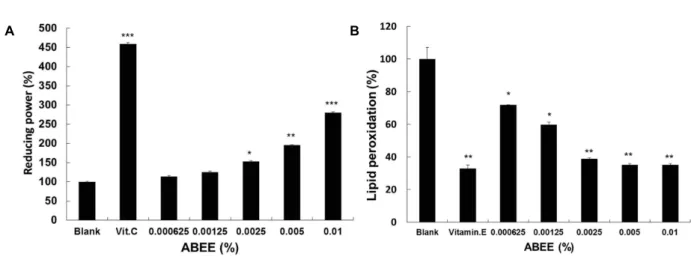
ABEE의 환원력과 지질과산화에 대한 항산화 효과 환원력을 알아본 Fig. 1A에서는 ABEE의 농도에 의존하여 환원력이 증가 하는 것을 관찰할 수 있었다. 또한 지질과산화 억제효과를 알아본 Fig. 1B에서는 양성 대조군으로 알려진 Vitamin E가 0.01%에서 63%의 지질과산화 억제효과를 보여 주었으며, ABEE는 0.0025% 이상의 농도에서 대조군과 비교하 여 유의적인 억제효과를 확인 할 수 있었다.
Hydroxyl radical에 의한 DNA damage에 대한 ABEE 의 보호 효과
EA-HY-926 세포로부터 분리한 genomic DNA를 이용하여 Fenton 반응에 의하여 발생된 hydroxyl radical에 의한 DNA 의 산화적 손상에 대한 ABEE의 항산화 효과를 조사하였다.
Fig. 2에서 나타난 것과 같이 Fenton 반응에 의하여 발생된 hydroxyl radical이 ABEE 0.05% 이상에서 농도 의존적으로 억제되는 것이 확인되었다. 대조군(control) 에서는 공시험군 (blank)에 비하여 Fig. 2에서 DNA가 hydroxyl radical에 노출 되면서 산화에 의해 DNA가 분해되는 것이 관찰되었다. 반면, ABEE를 0.000625, 0.00125, 0.0025, 0.005, 0.01%의 농도 별로 처리한 군은 ABEE가 hydroxyl radical에 의한 genomic DNA 의 산화적 손상이 억제하였다.
세포 성장에 대한 ABEE의 효과
ABEE가 세포독성에 미치는 농도를 조사하기 위하여 MTT assay를 수행 하였다. RAW 264.7와 EA-HY-926 세포에 대한 ABEE의 세포독성을 측정한 결과, Fig. 3 (A) RAW 264.7, (B) EA-HY-926 세포에서 보는 바와 같이 ABEE 0.01% 이하의 농 도에서 대조군과 비교 하였을 때 어떠한 독성효과도 없는 것 으로 나타났다.
Nitric oxide (NO) 생성에 대한 ABEE의 효과
EA-HY-926 세포로부터 생성되는 NO와 LPS (lipopolysac-
charide)에 의해 RAW 264.7 세포에서 생성되는 NO에 대한
ABEE의 억제효과를 세포배양액으로부터 Griess assay 방법
으로 측정하였다. ABEE는 0.000625, 0.00125, 0.0025, 0.005,
0.01% 의 처리 농도로 세포에 처리 하였다. ABEE로 0.01%를
처리한 세포군에서 NO의 생성 함량은 공시험군과 비교 했을
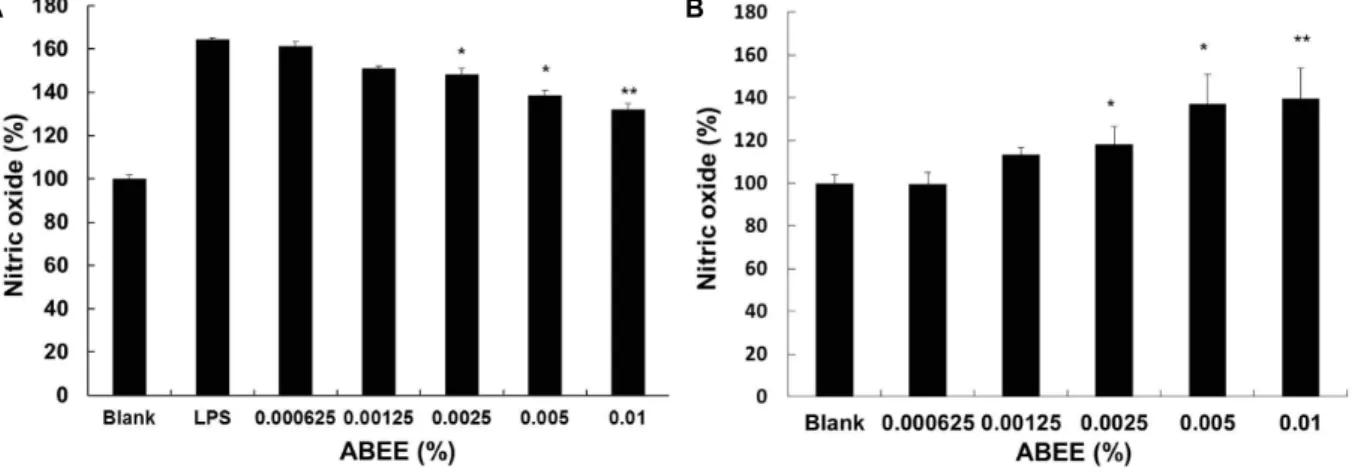
때 약 40% 증가 되었다. Fig. 4A에서 나타난 것과 같이, ABEE
는 0.0025% 이상의 농도에서 혈관내피세포에서 농도에 따라
NO 생성을 증가 시켰다. Fig. 4B에서 보는 바와 같이 아사이베
리 EtOH 추출물을 처리한 group과 LPS를 처리한 세포군과
비교 했을 때 0.000625% 이상의 농도에서 NO 생성이 유의적
A B
Fig. 1. Antioxidant effects of ABEE in vitro . (A) The reducing power of ABEE. Vitamin C at 0.001% was used as a positive control in this experiment. (B) The effect of ABEE on lipid peroxidation induced by fenton reaction. Vitamin E at 0.01% was used as a positive control. Data are given as means of values ± S.D. from three independent experiments compared with control (* p <0.05, ** p <0.01, *** p <0.001).
Fig. 2. Protective effect of ABEE on DNA oxidative damage in- duced by hydroxyl radical. Genomic DNA purified from EA-HY-926 cells was pre-treated with ABEE for 1 h ex- posed to •OH using Fenton reaction. After 30 min, re- action mixture containing about 1 μg of DNA was elec- trophorased on a 1% agarose gel for 30 min at 100 V and visualized by UV light after stained with 1 mg/ml ethidium bromide. Data are given as means of values
± S.D. from three independent experiments compared with control (* p <0.05, ** p <0.01, *** p <0.001).
으로 억제 되는 것으로 나타났다.
ACE 활성에 대한 ABEE의 효과
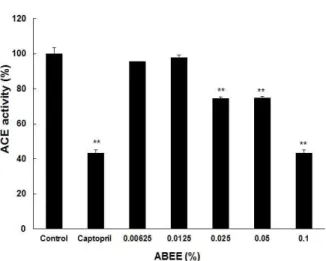
혈관 수축 작용을 나타내는 angiotensin II를 생성하는 원인 이 되는 ACE의 작용을 억제하는지 알아보기 위해 실험을 한 결과 Fig. 5에서 보는 바와 같이 ABEE의 농도에 의존하여 ACE의 활성을 억제하는 것으로 나타났다. 특히, 양성대조군 으로는 사용된 항고혈압제인 captopril은 0.1% 농도에서 대조
군에 비해 56%의 저해활성을 보였으며, ABEE는 0.01%의 농 도에서 ACE의 활성을 57% 억제하는 것으로 나타났다.
EA-HY-926세포에서 항산화 및 NO와 관련된 단백질의 발현에 대한 ABEE의 효과
ABEE의 NO 및 항산화 효과에 관여하는 단백질 발현을 조 사하기 위하여 NOS-1 (nitric oxide synthase-1)와 NOS-2 (nitric oxide synthase-2), SOD-1 (superoxide dismutase-1), SOD-2 (superoxide dismutase-2), SOD-3 (superoxide dis- mutase-3) 단백질 발현을 조사하였다. ABEE이 처리된 혈관내 피세포인 EA-HY-926에서 SOD-2의 발현수준은 0.00125% 이 상의 농도에서 증가하였고 SOD-3와 NOS-1의 발현수준은 0.0025% 이상의 농도에서 유의적으로 증가하지만, SOD-1과 NOS-2의 발현수준에는 시험농도에서 변화가 없었다(Fig. 6).
핵추출 단백질 중 전사인자인 Nrf-2 (nuclear factor erythroid 2-related factor 2)와 NF-kB (nuclear factor kappa-light-chain- enhancer of activated B cells) 단백질의 발현에 대한 결과는 Fig. 7에서 나타내었다. ABEE를 0.00125% 농도 처리된 혈관내 피세포에서 SOD의 전사인자인 Nrf-2는 유의적으로 증가된 것으로 나타난 반면에, NF-kB의 발현수준에는 변화가 없었다.
고 찰
생물이 호흡을 통해 얻은 산소가 에너지를 만드는 과정에
서 일부는 물로 환원되지 않고 불안전한 환원이 일어나 활성
산소가 되는데[3] 특히, 자외선의 노출로 활성산소종인 ROS
의 반응성이 많이 나타나, 생성된 ·O
2및 ·OH 등의 라디칼로
부터 유도된 광산화적 손상을 받게 되면 항산화 방어망이 위
태롭게 된다[7, 10]. ABEE의 유해 활성 산소종 소거능력을 측
정하여 본 결과, 환원력과 지질과산화의 억제효과를 보였다.
A B
Fig. 3. Viability of RAW 264.7 and EA-HY-926 cells treated with ABEE. The cells were treated with ABEE at 0.000625, 0.00125, 0.0025, 0.005 and 0.01%. and cell viability was determined by MTT assay after 24 hr. (A) RAW 264.7, (B) EA-HY-926 cells.
Data are given as means of values ± S.D. from three independent experiments. Level of significance was identified statistically using Student’s t test.
A B
Fig. 4. Effect of ABEE on production of nitric oxide in RAW 264.7 and EA-HY-926 cell line. RAW 264.7 (A) and EA-HY-926 (B) cells cultured in phenol red and serum-free media were pretreated with different concentrations of ABEE for 1 hr, and only RAW 264.7 cells were stimulated with a 1 µg/ml of LPS for 48 hr. Conditioned medium was mixed with an equal amount of the Griess reagent and the absorbance, measured at 550 nm, represented the amount of NO
2-(stable oxidation product of NO) in the medium. The values obtained were compared with those of st andard concentrations of sodium nitrite dissolved in Dulbecco's modified Eagle's minimal essential medium (DMEM), and the concentrations of nitrite in conditioned media of sample-treated cells were calculated. Data are given as means of values±S.D. from three independent experiments (* p <0.05, ** p <0.01).
반면 DNA 보호 효과를 알아본 실험에서는 ABEE가 hydrox- yl radical의 산화적 스트레스로부터 DNA 보호 효과가 뛰어 난 것으로 확인 되었다. 만병의 근원이라고 할 수 있는 ROS 역시 스트레스에 의해 생성이 촉진된다. 고혈압 역시 뇌졸중 과 동맥경화의 원인이 되는 뇌 혈관질환으로서 angiotensinⅡ 에 의해 유도된다. AngiotensinⅡ는 renine에 의해 분해된 angiotensineⅠ이 angiotensinⅠ converting enzyme (ACE)에 의해 전환되는 고혈압 유발 효소로 알려져 있다[9]. 이 angio- tensinⅡ는 동맥혈관을 수축시키고 혈관을 확장시키는 효소 인 bradykinin을 분해함으로써 혈압을 상승시킨다[18].
ABEE의 ACE 저해활성 실험에서 ABEE에 의하여 ACE 저해
활성이 높아지는 것으로 보아 angiotensin I이 angiotensin II
로 합성되지 못하게 하여 체내의 혈압을 감소시킬 것으로 보
인다. 이미 알려진 고혈압 치료제는 주성분이 합성 약물들로
인한 부작용이 나타날 가능성이 있기 때문에, 이러한 문제점
을 통해 ACE 저해활성을 가진 물질들은 천연물로부터 검색
하는 연구가 다양하게 이루어지고 있으며 ACE 활성을 저해
하는 약물들을 대체 할 수 있을 것으로 기대 된다[29]. Nrf2는
bZIP의 멤버로 ARE가 DNA binding site로 AT II가 Nrf2와
결합되어 angiotensin II를 억제하게 되며, Nrf2는 세포질
Fig. 5. Inhibition effect of ABEE on activity of angiotensin con- verting enzyme of derived from rabbit lung. The in- hibitory effect of ABEE an using rabbit lung powder in this experiment was determined inhibition of ACE activity. Captopril with antihypertensive effect was used as a positive control. Data are given as means of values
± S.D. from three independent experiments (* p <0.05, **
p <0.01).
Fig . 6. Effect of ABEE on protein expressions of SOD-1, -2, -3 and NOS-1,-2 in EA-HY-926 cells. The cells were treat- ed with ABEE at 0.000625, 0.00125, 0.0025, 0.005 and 0.01%. Western blot analyses of cell lysates were per- formed using antibodies as indicated. The expression level of ß-actin was used as a control for normalization of target proteins.
의 Keap과 결합하고, AT II가 핵 안으로 들어가 ATF3와 결합 된다. ATF3가 Nrf2와 결합이 되어 angiotensin II를 감소시킨 다. 이는 ARE가 발현되면 binding site에 있는 SOD 항산화 유전자가 발동하게 되어 Nrf2의 항산화 target 유전자의 발현 을 억제시킴으로서 ROS의 수준을 증가시키고 NF-κB signal- ing을 통해 SOD를 감소시켜 산화 스트레스를 유도한다[12].
염증성 매개체중 NO는 과다 생성되면, 활성산소와 결합하여, 과산화질소 등의 또 다른 독성 유리기 물질을 만들어내고, 이 들은 거의 모든 체내기관에 해로운 영향을 미친다[15].
Fig. 7. Effect of ABEE on protein expressions of Nrf-2 and NF-kB in EA-HY-926 cells. After the cells were treated with ABEE, nuclear proteins were extracted, and west- ern blot analyses were performed using antibodies as indicated. The expression level of ß-actin was used as a control for normalization of target proteins.
LPS에 의해 RAW 264.7과 EA-HY-926 세포로부터 생성되는 NO에 대한 ABEE의 억제효과를 알아본 결과 ABEE가 NO를 억제하는 것이 관찰되었고, 이는 NO의 과발현에 의한 신경 세포의 손상을 보호해 준다는 것을 알 수 있었다. 특히, EA-HY-926 cell에 ABEE를 처리 했을 때 NO radical이 생성 되는 것으로 보아 혈관확장에 큰 역할을 한다고 볼 수 있다.
또한 inducible nitric oxide synthase (iNOS)에 의한 NO의 생
산은 동맥경화증, 관절염, 알츠하이머, 암과 같은 여러 질병을
유발하는 것으로 알려져 있는데[2], NO는 염증 반응 시 대식
세포 및 다른 면역 세포들의 면역반응으로 인해 다량 생성되
며, 이때 ROS도 같이 생성된다[5, 6]. NO와 항산화 효소와
관련된 단백질의 발현을 확인하기 위하여 SOD-1, SOD-2,
SOD-3, NOS-1, NOS-2, Nrf-2, NF-kB의 발현 정도를 western
blot을 수행하여 알아보았는데 SOD-2, SOD-3, NOS-1, Nrf-2
의 발현은 ABEE의 농도에 의존하여 증가하였으나, NF-kB의
발현은 감소하였고 SOD-1, NOS-2의 발현에는 변화가 없었
다. 이러한 연구결과들을 기존의 연구보고와 더불어 연관 지
어 기술해 보면 다음과 같이 설명될 수 있다. 아사이베리, 적
색 포도, 블루베리, 자두, 체리, 딸기와 같은 대표적인 과일이
적색 또는 자주색을 띠는 이유는 anthocyanin 때문인데, an-
thocyanin은 강력한 항산화 물질로 혈전이 생기는 것을 억제
해 심장질환과 뇌졸중 위험을 줄여 준다고 보고 되고 있다
[28]. 적포도주를 즐겨 마시는 프랑스인들이 다른 나라 사람
들에 비해 심장질환이 적게 발병하는 것은 바로 적포도주 속
에 anthocyanin에 기인된 것으로 밝혀져 있다[13]. 최근 an-
thocyanin 성분이 아스피린보다 10배나 강한 소염작용을 한
다는 연구결과도 보고 되었다[30]. 수용성 색소인 anthocya-
nin은 요즘 질병과 노화의 원인으로 지목되고 있는 활성산소
를 효과적으로 중화시키는 작용이 뛰어난 것으로 알려져 있
다[20]. 이전의 연구 결과에서 주성분은 anthocyanin (ACNs)
중 proanthocyanidins (Pac) 및 기타 플라보노이드의 주요
phytochemicals인 것을 발견 했다[4]. 항산화 기능이 높은 an-
tocyanin과 콜레스테롤의 길항제인 beta-sitosterol 성분이 높
아, 심혈관 개선, 대사증진, 면역 증진 등과 같은 기능성 연구
가 다수 보고되어 있다[17]. 그러므로 본 결과들은 ABEE가 ACE의 활성을 억제하여 고혈압을 예방하고 NO생성을 억제 시켜 항산화 관련 단백질의 발현을 감소시켜 ROS로 부터 신 경세포의 손상을 보호하여 고혈압치료의 주성분으로서 잠재 적인 가능성이 기대된다.
감사의 글
이 논문은 2012년 (재)부산테크노파크 산학공동기술혁신사 업의 지원을 받아 수행된 연구입니다.
References