Investigation of the Gene Encoding Isotocin and its Expression in Cinnamon Clownfish, Amphiprion melanopus
Gyeong Eon Noh
1, Mi-Jin Choi
2, Byung Hwa Min
3, Sum Rho
4and Jong-Myoung Kim
2*
1Genetic & Breeding Research Center, National Institute of Fisheries Science, Geoje 53334, Korea
2Department of Fishery Biology, Pukyong National University, Busan 48513, Korea
3Aquaculture Industry Division, National Institute of Fisheries Science, Busan 46083, Korea
4Corea Cheju Origin Rho’s Aquariums, Jeju 63364, Korea
Received January 6, 2016 /Revised January 19, 2016 /Accepted January 25, 2016
Isotocin (IT), a nonapeptide homolog of oxytocin in mammals, has been suggested to be involved in physiological processes including social behaviors, stress responses, and osmoregulation in teleost fish.
To study its structure and function, the gene encoding the IT precursor was cloned from the genomic DNA and brain cDNA of the cinnamon clownfish, Amphiprion melanopus. The IT precursor gene con- sists of three exons separated by two introns, and encodes an open reading frame of 156 amino acid (aa) residues, comprising a putative signal peptide of 19 aa, a mature IT protein of 9 aa, a proteolytic processing site of 3 aa, and 125 aa of neurophysin. Tissue-specific analysis of the IT precursor tran- script indicated its expression in the brain and gonads of A. melanopus. To examine its osmoregulatory effects, the salinity of the seawater (34 ppt) used for rearing A. melanopus was lowered to 15 ppt.
Histological analysis of the gills indicated the apparent disappearance of an apical crypt on the surface of the gill lamella of A. melanopus, as pavement cells covered the surface upon acclimation to the low- er salinity. The level of Na
+/K
+-ATPase activity in the gills was increased during the initial stage of acclimation, followed by a decrease to its normal level, suggesting its involvement in osmoregulation and homeostasis. The only slight increase in the level of IT precursor transcript in the A. melanopus brain upon low-salinity acclimation suggested that IT played a minor role, if any, in the process of osmoregulation.
Key words :
Arginine vasotocin, cinnamon clownfish, isotocin, osmoregulation
*Corresponding author
*Tel : +82-51-629-5919, Fax : +82-51-629-5908
*E-mail : [email protected]
This is an Open-Access article distributed under the terms of the Creative Commons Attribution Non-Commercial License (http://creativecommons.org/licenses/by-nc/3.0) which permits unrestricted non-commercial use, distribution, and reproduction in any medium, provided the original work is properly cited.
Journal of Life Science 2016 Vol. 26. No. 2. 164~173 DOI : http://dx.doi.org/10.5352/JLS.2016.26.2.164
Introduction
In the marine ornamental industry, the importance of or- namental fish has increased due to their vivid and some- times exquisite phenotypes, which are attractive to consum- ers [21]. However, the growth of this industry was limited by inadequate capturing techniques that damaged ecosys- tems and the overexploitation of marine resources [33]. To maintain growth in the market of marine ornamentals and to meet increasing demand, more efficient production tech- niques are needed for breeding and culturing marine orna- mental fish. It is thus important to understand the physiol- ogy of ornamental fish, which might help to improve the
efficiency of culture systems as the development and growth of fish are affected by environmental factors [2].
Attempts have been made to produce several marine or- namental species using aquaculture systems. The cinnamon clownfish Amphiprion melanopus is a representative species of the marine ornamental fish trade. It is found in lagoons and outer reefs in the Great Barrier Reef of Australia, Indonesia, and the Solomon Islands [3]. Since tropical marine habitats are often inundated with freshwater from seasonal rainfall, clownfish may have evolved the ability to survive low-salinity conditions. Assuming that water salinity influ- ences the development and growth of fish [7, 29], ideal growth of marine fish would occur under optimal salinity.
However, the growth of marine fish at lower salinities seems
to be advantageous as many marine fish exhibit better
growth and feeding efficiency under conditions of inter-
mediate salinity similar to those of brackish water, i.e., 8-20
ppt [9, 10, 14]. This might be due to reduced osmotic stress
and disease associated with parasites that prefer higher
salinity. It could also be cost-effective to maintain fish in
a hatchery using artificial saltwater.
The social behaviors and sex determination of clownfish are also of interest for understanding their development and growth. Clownfish are protandric hermaphrodites, changing sex from male to female at a later stage of the life cycle and often living in groups. Social hierarchies of clownfish units consisting of a female, a male, and several subadults and/or juveniles seem to be maintained by a disparity in the sizes of members in the pecking order and their behav- iors [20, 35]. Differences in aggressive behavior and sound production observed in the size- and sex-based hierarchic society may even affect the survival rate of the group.
Therefore, understanding the social-unit-associated physiol- ogy of clownfish is not only important for improving their production yield but also for studying their social behavior.
The development and growth of fish are affected by envi- ronmental factors such as temperature, salinity, and photo- period. Various peptides are involved in signaling pathways important for such responses to the environment [5, 13, 17].
The hormone prolactin (PRL) has been shown to be essential for osmoregulation and growth in fish, but arginine vaso- tocin and isotocin (IT) were also suggested to be involved in various biological processes ranging from social behavior to osmoregulation [6, 22, 25]. To determine the optimal growth conditions for this marine organism, it is important to understand the mechanisms associated with its osmor- egulation and social behaviors affecting growth and survival. In this study, we identified the gene encoding IT, one of the signaling molecules associated with social behav- ior and osmoregulation in clownfish, and examined its tis- sue-specific expression pattern as well as its level in the brain upon a change in salinity.
Materials and Methods
Materials
Cinnamon clownfish A. melanopus were obtained from a marine ornamental fish breeding company, Corea Cheju Origin Rho’s Aquariums (CCORA, Jeju, Korea). Formula- one marine pellet was obtained for feeding from Ocean Nutrition (Newark, CA, USA). Chemicals used for experi- ments including TRI reagent, Tris.Cl and 2-phenoxyethanol were obtained from Sigma-Aldrich (St Louis, MO, USA).
RNase-free DNase I and ImProm-II
TMReverse Transcriptase were obtained from Promega (Madison, WI, USA). AccuPrep®
Genomic DNA extraction Kit was obtained from Bioneer
(Daejeon, Korea). Reagents used for plasmid DNA isolation and gel extraction were obtained from NucleoGen (Daejeon, Korea). Topcloner
TMTA kit and RNase Inhibitor were ob- tained from Enzynomics (Daejeon, Korea) for cloning. Kit used for 5’-/3’- rapid amplification of cDNA ends (RACE) was obtained from Clontech (Palo Alto, CA, USA).
Fish and sampling
Thirty cinnamon clownfish (67.3±7.9 mm total length, 7.3±2.5 g body weight) divide into six groups were accli- mated in 120 l circular tank with a recirculating system (34 ppt, 13L:11D, 26.5±1.0℃) for 5 days [23]. Fish were fed com- mercial feed Formula-one marine pellet. In order to examine the effect of low salinity, salinity of the seawater (34 ppt) was shifted to 15 ppt by adding freshwater. Five fish were sampled with different intervals for 0, 4, 8, 24, 48, and 144 hr of adaptation to 15 ppt salinity. Fish were collected upon anesthetized with 200 ppm 2-phenoxyethanol and then kil- led by spinal transection for the collection of the brain.
Cloning and characterization of the IT gene in cinnamon clownfish
Genomic DNA was extracted from the whole blood of cinnamon clownfish using the AccuPrep® Genomic DNA Extraction Kit (Bioneer Inc., Daejeon, South Korea). To ob- tain the DNA fragments encoding IT in the clownfish, de- generate primers were designed from the conserved regions of the IT gene identified in other teleost fish. The primers used for polymerase chain reaction (PCR) amplification and DNA walking were as follows: ITDegF (5'-tggagcctctgtgtccg- tgtgcct), ITDegR (5'-gagaactacctgctcaccccctg), DW-IT F1 (5'- tgcttcggccccagtatctgctgt), DW-IT F2 (5'-gctccccagaaacagctc- actgtgt), DW-ITR1 & 5r-IT (5'-tgcatctatgatggacctcttcccacc), DW-ITR2 (5'-ggacagttggagatgtaacaggctgag), CFITF1 (5'-at- gaccggagctgctgtgccc), and CFITR1 (5'-tggtggattcggtgagga- gaagt), where Deg refers to a degenerate primer, DW refers to a DNA walking primer, and F and R indicate the forward and reverse directions of the IT gene.
PCR was carried out in a 20 μl mixture containing ge-
nomic DNA (0.05 μg/μl) or cDNA templates, ITDegF and
ITDegR primers (1 μM), and 1× HiQ-PCR Mix. Amplification
was carried out with an initial denaturation step at 94°C
for 4 min, followed by 30 cycles of denaturation at 94°C for
60 s, annealing at 60°C for 30 s, and extension at 72°C for
60 s, followed by a final extension at 72°C for 5 min. DNA
walking was performed according to the manufacturer’s in-
structions using DW primers to obtain the regions corre- sponding to the 5'- and 3'-ends of the IT gene. The PCR products were electrophoresed on an agarose gel, purified using a gel extraction kit, and subcloned into the Topcloner
TMTA kit for sequencing analysis. Total RNA was extracted from each tissue using TRI Reagent, followed by treatment with DNase I for 30 min at 37°C. cDNAs encoding fragments of the IT gene were amplified based on the resulting ge- nomic DNA sequence, and then 5'/3'-rapid amplification of cDNA ends was performed in accordance with the manu- facturer’s instructions.
Expression of IT mRNA by reverse transcription (RT)-PCR
Total RNA was extracted from the brain of A. melanopus (n=4) using TRI Reagent and treated with DNase I for 30 min at 37°C. First-strand cDNA was synthesized in a 20 μl reaction containing 0.5 μg total RNA and 0.5 μM dT
15, ImProm-II
TMReverse Transcriptase, 6 mM MgCl
2, 0.5 mM dNTPs, and 20 units RNase inhibitor. RT-PCR was carried out using cDNA templates and primers CFITF1 and CFITR1 at 94°C for 4 min, followed by 20 cycles of denaturation at 94°C for 30 s, annealing at 60°C for 30 s, and extension at 72°C for 50 s, and a final polymerization step at 72°C for 5 min. PCR products were resolved by electrophoresis on a 2% agarose gel, followed by staining with ethidium bro- mide and quantification using the Gel Doc System/Station (Bio-rad, Hercules, CA, USA). The levels of β-actin mRNA were evaluated as a control. The expression level of IT mRNAs was normalized with respect to the level of β-actin transcript as described [23]. The amplified fragments of IT and β-actin were 471 and 392 bp, respectively.
Histological analysis of the gills using electron microscopy
To examine the effect of salinity changes in fish, the struc- ture of the gills, which are important for absorbing the sur- rounding water, was analyzed by transmission electron microscopy. The gills were treated with 2.5% glutaraldehyde at 4℃ for 2 hr, washed with 1× phosphate-buffered saline (PBS) for 10 min, and then fixed in 1% osmium tetroxide at 4℃ for 2 hr. Specimens were washed with 1× PBS and then dehydrated using stepwise treatments with ethanol from 50% to 100% for 15 min, followed by treatment with a mixture of propylene oxide and Epon 812. Specimens were cut into 0.5 µm-thick sections, stained with toluidine blue,
and then cut into 70 nm-thick slices. The transmission elec- tron micrograph was analyzed upon double staining with uranyl acetate and lead citrate.
Na
+/K
+-ATPase (NKA) activity analysis
The activity of NKA was analyzed by a slightly modified version of a previously reported protocol [15]. Four gill fila- ments separated from the gill arch were stored in 100 μl ice-cold SEI buffer (150 mM sucrose, 10 mM EDTA, 50 mM imidazole, pH 7.3) at -80°C until analysis. Frozen gill fila- ments were slowly thawed and homogenized in 25 μl SEID (0.5 g deoxycholate/100 ml SEI) for 10 s. Upon centrifugation at 5,000× g for 30 s, the supernatant was subjected to NKA activity analysis by measuring the inorganic phosphate concentration.
Sequencing and phylogenetic analysis
The identified sequence was subjected to homology analy- sis with other vertebrate orthologs and paralogs from the National Center for Biotechnology Information database (http://www.ncbi.nlm.nih.gov). Multiple sequence align- ments were generated by ClustalW [30]. Phylogenetic tree was constructed using Molecular Evolutionary Genetics Analysis (ver. 6.06) program and the neighbor-joining meth- od with 1,000 bootstrap replicates.
Statistical analysis
Data were analyzed using SPSS statistical package (ver.
20; SPSS Inc., Chicago, IL, USA). One-way ANOVA followed by a post hoc multiple comparison tests (Tukey’s test) was used to compare differences in the groups.
Results and Discussion
Gene structure and amino acid sequence of IT precursor
To explore the structure and functional role of IT, the gene
encoding its precursor in cinnamon clownfish was amplified
by PCR using oligonucleotide primers corresponding to the
conserved regions of this gene [34]. The sequence of the
full-length IT gene and its neighboring regions was obtained
by DNA walking, as described previously [23], using ge-
nomic DNA isolated from clownfish muscle and cDNA pre-
pared from RNA isolated from the brain. A comparison of
the sequences obtained from the cDNA and genomic DNA
templates indicated that the gene encoding the IT precursor
A
B
Fig. 1. (A) Structure of the gene encoding isotocin in Amphiprion melanopus. Exons and introns are represented by dark boxes and lines, respectively. The arrow indicates the positions corresponding to the primers used for polymerase chain reaction amplifica- tion using degenerate primers and DNA walking. (B) Nucleotide sequence of the isotocin gene. Coding regions are shown as lower-case letters and non-coding regions as upper-case ones. The corresponding amino acid sequences are indicated in bold. The regions corresponding to the signal peptide sequence, mature isotocin, proteolytic processing site, and neurophysin are marked by shaded boxes.
consists of three exons of 120 bp, 205 bp, and 146 bp, sepa- rated by two introns of 321 bp and 491 bp (Fig. 1A). The IT cDNA (GenBank accession no. HQ441173.1) contains a single open reading frame (ORF) of 471 bp together with 5'- and 3'-untranslated regions of 57 bp and 266 bp, respectively. The IT precursor encodes an ORF of 156 amino acids (aa), comprising a 19-aa signal peptide, 9 aa of IT, and 125 aa of neurophysin (Fig. 1B). It also contains the gly- cine-lysine-arginine sequence, which is the signal for proteo- lytic processing and carboxyl-terminal amidation between the hormone and neurophysin. The latter is believed to act as a carrier protein involved in the transport of the hormone from the hypothalamus. The structure and sequence of the clownfish IT gene were found to be similar to those of IT genes previously identified in other teleosts [1, 32, 34]. The calculated molecular mass of the mature peptide is 16.3 kDa, with a theoretical pI of 4.94. Amino acid sequence compar- ison of the A. melanopus IT precursor with those of other teleosts using ClustalW (Fig. 2) indicated high amino acid
identities (62-88%). The highest (88%) amino acid identity was to that of the Chinese wrasse Halichoeres tenuispinis (ADB28875), followed by 85% to that of the European flounder Platichthys flesus (BAA98141), 79% to the pufferfish
Takifugu rubripes (AAC60289), and 73% to both the chum sal-mon Oncorhynchus keta (BAD12146) and the cherry salmon
Oncorhynchus masou (BAA01738). It also showed 65% sim-ilarity to the gene encoding the arginine vasotocin (AVT) precursor [24] of A. melanopus (AEB00559). The phylogenetic tree also indicated similarity between cinnamon clownfish and other teleosts, but a distant separation from non-teleost ITs (Fig. 3).
Tissue-specific expression of IT precursor
To examine the tissue-specific expression profiles of the
IT precursor, various tissues including the brain, muscle,
gills, gonads, heart, intestines, liver, muscle, and stomach
were dissected from adult clownfish. RNA was isolated from
each tissue and used for cDNA synthesis using oligo-dT
Fig. 2. Alignment of the isotocin amino acid sequences in Amphiprion melanopus with those in other teleosts. Compared with the other isotocin sequences, the highest identity (88%) was with that from the Chinese wrasse Halichoeres tenuispinis (ADB28875), followed by 85% with the European flounder Platichthys flesus (BAA98141), 79% with the pufferfish Takifugu rubripes (AAC60289), 73% with both the chum salmon Oncorhynchus keta (BAD12146) and the cherry salmon Oncorhynchus masou (BAA01738), and 65% similarity with the gene encoding the arginine vasotocin precursor of A. melanopus (AEB00559), aligned using ClustalW. Identical amino acids among proteins are indicated by asterisks.
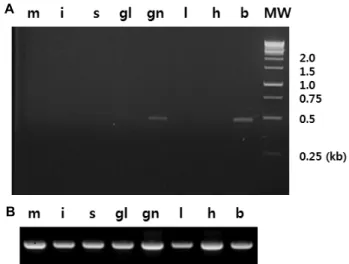
primers. RT-PCR analysis indicated that the IT precursor was expressed mainly in the brain, with lower expression in the gonads (Fig. 4). This is consistent with a previous find- ing of the expression of the nonapeptide in the brain and ovaries of an ostariophysian catfish [1]. Detection of the IT-specific transcript in the gonads reflected its expression
in the ovaries, as the largest clownfish in the social group, probably a female, was used for RNA isolation.
Histological observation of gill lamellae using trans- mission electron microscopy
The gills are a major organ that absorbs the surrounding
Ci.clownIT Se.clownIT Gi.SeabreamIT
Eu.FlounderIT RicefishIT WrasseIT
PufferfishIT Ma.SalmonIT
At.SalmonIT ZebrafishIT
CarpIT RatOT HumanOT 100
100 100 73
91
100 46
49 85
40
0.05
Fig. 3. Construction of the neighbor-joining tree based on the coding regions of the isotocin gene in teleosts and mammals. Bootstrap values are indicated for each node.
Taxonomic groups are indicated on the right. Sequences of isotocin in Amphiprion melanopus (HQ441173.1) were compared with those of other teleosts including the Chinese wrasse Halichoeres tenuispinis (ADB28875), the European flounder Platichthys flesus, (BAA98141), the pufferfish Takifugu rubripes (AAC60289), the chum sal- mon Oncorhynchus keta (BAD12146), and the cherry sal- mon Oncorhynchus masou (BAA01738). Isotocin se- quences from Papio hamadryas (ADG56475) and Homo sa- piens (AAH88370) were included as outgroups, together with a gene encoding the arginine vasotocin precursor of A. melanopus (AEB00559).
A
B
Fig. 4. Tissue-specific distributions of the transcripts encoding the isotocin precursor in the cinnamon clownfish Amphiprion melanopus. Reverse transcription polymerase chain reaction (RT-PCR) was carried out using primers specific to the isotocin precursor (CFITF1 and CFITR1 : A) and β-actin (B). Total RNA isolated from muscle (m), intestines (j), stomach (s), gills (gl), gonads (gn), liv- er (l), heart (h), and brain (b) was used for cDNA syn- thesis, followed by polymerase chain reaction amplifica- tion. Lane MW includes molecular weight markers with the sizes (in kb) indicated on the right.
A B
Fig. 5. Transmission electron micrographs of gill lamella of Amphiprion melanopus reared in seawater (A) and after transfer to 15-ppt salinity (B). AC: apical crypt, P: pave- ment cell, L: lamella, M: mitochondrion, N: nucleus.
Bar: 2 μm.
water and plays an important role in osmoregulation, to- gether with the kidneys and intestines, by adjusting ionic and osmotic balances between the body fluid and external environment. Fish gill epithelium comprises several types of cells, including pavement cells occupying more than 90%
of the gill surface, tubular systems, accessory cells, and mi- tochondrion-rich cells (MRCs). MRCs, also known as chlor- ide cells, are interspersed along the pavement cells in the epithelium and actively involved in ion transport by NKA in the membrane. The surface structure of the gill lamella seems to be characterized by the presence of apical pores or crypts, depending on the salinity conditions of the sur- rounding water [4, 11]. To examine the physiological changes associated with osmoregulation, the salinity of the seawater (34 ppt) used for rearing clownfish was shifted to 15 ppt, which is similar to that of brackish water, but has no effect on the consumption of feed or the survival of clownfish [23]. Electron microscopic analysis of the gills
showed a difference in the shape of the apical surface of
clownfish depending on the level of salinity to which they
were exposed (Fig. 5). However, the concave shape of the
apical crypt was transformed to a flattened surface at 15 ppt
salinity, reflecting an acute change in salinity resulting in
transformation of the apical membrane of the gills during
exposure to low-salinity water. This is consistent with the
morphological change in the gills observed in euryhaline
fish adapting to low salinity [12], with a change from a con-
cave to a convex surface exhibited in the apical region of
SW 4 hr 8 hr 24 hr 48 hr 144 hr
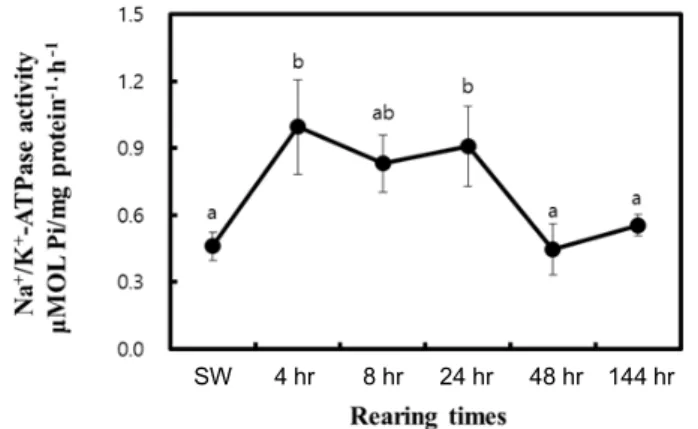
Fig. 6. Analysis of Na+/K+-ATPase activity in the gills of Amphiprion melanopus after transfer to 15-ppt salinity.
Values are mean ± S.E. (n=6) and different letters in- dicate significant differences (p<0.05).
MRCs in the killifish Fundulus heteroclitus. These morpho- logical transformations of gill epithelium are likely to main- tain the ion concentration in the body via NKA [27, 28].
Gill NKA activity of cinnamon clownfish adapting to 15-ppt salinity
Gill NKA plays an important role in osmoregulation by coupling the exchange of two extracellular K
+ions and three intracellular Na
+ions to the hydrolysis of ATP. While an increase in gill NKA activity was observed in milkfish, killi- fish, and striped bass [26, 31], other fish species including tilapia, eel, and salmon showed an alternative NKA re- sponse, namely, an increase in hyperosmotic medium [8, 16, 18]. This difference appears to be caused by the dependence of H
+-ATPase or Na
+/H
+-exchanger on the NKA isoforms of fish adapting to the fluctuating salinity. The analysis of NKA activity in the gills of clownfish indicated its increase 4 and 24 hr after the shift to 15 ppt, but a return to its origi- nal level as its exposure continued for 48 and 144 hr (Fig.
6). These changes in the initial stage of adaptation, followed by a return to its original level, suggesting homeostasis, are consistent with previous findings regarding the recovery of osmolality in clownfish upon hypo-osmotic shock [23].
Expression of IT in cinnamon clownfish upon acclimation to low salinity
IT has been suggested to play a central role in regulating social behavior and to have peripheral effects on stress re- sponses and osmoregulation [25]. To explore its possible in- volvement in osmoregulation in clownfish, the levels of the IT precursor transcript were analyzed in cinnamon clown-
fish reared in seawater after a salinity shift to 15 ppt.
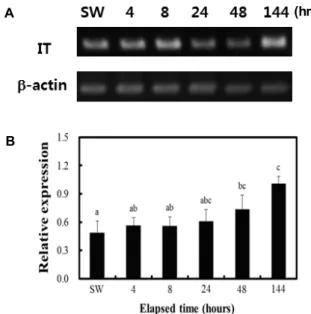
Specifically, fish collected after 0, 4, 8, 24, 48, and 144 hr of acclimation were subjected to this analysis. The levels of IT transcripts among RNA isolated from the brain analyzed by RT-PCR (Fig. 7) increased slightly until 144 hr of acclimation. This contrasts with the results showing similar changes in the intracellular levels of PRL and Na
+/K
+- ATPase, which play major roles in the adaptation to lower salinity. This difference in the pattern of changes in IT levels from that of PRL suggested a limited role of IT, if any, in low-salinity-mediated, short-term osmoregulation in clown- fish.
Functional implications of IT based on expression analysis
Cinnamon clownfish is a representative species in the ma- rine ornamental fish trade. To develop an efficient culturing system for cinnamon clownfish, more information about the physiological factors affecting its growth is needed. This in- cludes data on sexual characteristics such as protandric her- maphroditism, the social unit and its hierarchy, and clown- fish growth under a wide salinity range. To survive in differ- ent salinity environments, such as in tropical habitats sub- jected to a range of salinities, fish need to maintain constant osmolality by releasing and/or absorbing ions from the sur- rounding water [19]. Among the several hormones involved in osmoregulation, PRL is a well-known example affecting growth rate and osmoregulation. Our previous study also confirmed its role in osmoregulation and homeostasis in A.
melanopus [23]. Neurophyseal hormones, AVT and IT, were
also suggested to have effects on stress responses and os- moregulation, in addition to a central effect on the regulation of social behaviors. While substantial attention has been fo- cused on examining the roles of AVT in regulating social and reproductive behaviors, relatively little was known about the role of IT.
To explore the structure and functional role of IT, the gene
encoding its precursor in cinnamon clownfish was
evaluated. This gene consists of three exons, separated by
two introns, similar to that of other teleosts, as well as to
the structure of the gene encoding AVT [24]. Tissue-specific
analysis of IT transcripts among RNA isolated from various
tissues indicated that the IT precursor is primarily expressed
in the brain, with a lower level in the gonads. This is con-
sistent with a previous finding showing expression of the
nonapeptide in the brain and ovaries of an ostariophysian
A
B
(hr)
Fig. 7. Analysis of isotocin precursor mRNA level in Amphip- rion melanopus after exposure to 15-ppt salinity. (A) Total RNA prepared from the brain tissue of A. melanopus ac- climated to 15-ppt salinity for the indicated time was used for generating cDNA by reverse transcription.
Polymerase chain reaction was carried out using primers specific to isotocin and β-actin genes, respectively. (B) The expression level of isotocin precursor mRNA was normalized using the level of β-actin transcript as a control. Each value represents the mean ± S.E. (n=4), and the same letters indicate no significant difference (p>0.05).
catfish [32].
To explore the possible role of IT in the salinity-associated phenotype of clownfish, the levels of the IT transcript in the brain were analyzed upon exposure of cinnamon clownfish to lower-salinity water. Only a slight difference in its level was noted upon short-term acclimation to 15 ppt (Fig. 7).
This contrasts with a previous analysis showing a clear in- crease in the level of PRL during the early stage, followed by a decrease as acclimation extended to 144 hr, coinciding with an opposite pattern of changes in the plasma levels of Na
+, Cl
-, and osmolality. A correlation between the in- duction of the PRL transcript and osmolality changes in- dicates that PRL is strongly involved during the early stage of adaptation to low salinity in cinnamon clownfish.
However, a slight increase in the level of the transcript en- coding the IT precursor in the brain, together with its incon- sistent changes compared with an ion-pumping enzyme, suggests that IT may not play a major role in osmoregulation upon exposure to low salinity. It should also be stressed that the possibility of IT having a functional role in osmor-
egulation at the post-transcriptional and post-translational processing levels should not be ruled out, as the level of IT gene expression was only examined at the transcriptional level.
The results showing the expression of IT in the brain and gonads suggested its functional involvement in these behav- iors and sex-related phenotypes. This might be associated with social behaviors linked to the sex-dependent hierarchy in this species. A typical clownfish social unit consists of one mature female, one mature male, and often a few adoles- cents, with a size-based dominance hierarchy from the larg- est to the smallest. Behavioral patterns ranging from ag- gressive behavior by dominant individuals to appeasing be- havior by smaller ones were observed in a social unit of clownfish. This suggests that the dominance in a social unit affects the development and growth of the subordinate members. The social unit in clownfish seems to be main- tained by a signaling system of molecules such as IT, which mediate or influence the size- and sex-dependent hier- archical system. Further study will be needed to explore the functional role of IT in the social behavior- and sex-related phenotypes of clownfish.
In summary, in this study, the gene encoding the IT pre- cursor in cinnamon clownfish was characterized. It consists of three exons and two introns, encoding an ORF with a putative signal peptide of 19 aa, 9 aa of mature IT, a 3-aa signal cleavage site, and 125 aa of neurophysin. The IT tran- script was detected in the brain and gonads of adult clownfish. Cinnamon clownfish is capable of living at salin- ities as low as 10 ppt and grows more rapidly at 25 ppt.
This information will be useful for further studies examining the role of IT in the regulation of social behaviors and sex-dependent phenotypes.
Acknowledgements
This work was supported by a Research Grant of PKNU (2013). Rho was supported by grant from Korea Institute of Marine Science & Technology Promotion. Choi was sup- ported by the project ‘Innovative marine production technol- ogy driven by LED-ICT convergence photo-biology’, Ministry of Oceans and Fisheries, Korea.
References
1. Banerjee, P., Chaube, R. and Joy, K. P. 2015. Molecular clon-
ing, sequencing and tissue expression of vasotocin and iso- tocin precursor genes from Ostariophysian catfishes : phy- logeny and evolutionary considerations in teleosts. Front.
Neurosci. 9, 166.
2. Bœuf, G. and Payan, P. 2001. How should salinity influence fish growth? Comp. Biochem. Physiol. C 130, 411-423.
3. Cowen, R. K. 2002. Larval dispersal and retention and con- sequences for population connectivity, pp. 149-169. In: Sale, P. F. (eds.), Coral Reef Fishes: Dynamics and Diversity in a Complex Ecosystem. New York: Academic Press.
4. Evans, D. H., Piermarini, P. M. and Potts, W. T. W. 1999.
Ionic transport in the fish gill epithelium. J. Exp. Zool. 283, 641-652.
5. Godwin, J. and Thompson, R. 2012. Nonapeptides and so- cial behavior in fishes. Horm. Behav. 61, 230-238.
6. Gozdowska, M., Kleszczyńska, A., Sokołowska, E. and Kulczykowska, E. 2006. Arginine vasotocin (AVT) and iso- tocin (IT) in fish brain: Diurnal and seasonal variations.
Comp. Biochem. Physiol. B Biochem. Mol. Biol. 143, 330-334.
7. Hart, P. R. and Purser, G. J. 1995. Effects of salinity and temperature on eggs and yolk sac larvae of the greenback flounder Rhombosolea tapirina Günther, 1862. Aquaculture 136, 221-230.
8. Hirose, S., Kaneko, T., Naito, N. and Takei, Y. 2003. Molecular biology of major components of chloride cells. Comp. Biochem.
Physiol. B 136, 593-620.
9. Hoff, F. H. 1996. Conditioning, spawning and rearing of fish with emphasis on marine clownfish. Dade City, FL:
Aquaculture Consultants Inc.
10. Imsland, A. K., Gústavsson, A., Gunnarsson, S., Foss, A., Árnason, J., Arnarson, I., Jónsson, A. F., Smáradóttir, H. and Thorarensen, H. 2008. Effects of reduced salinities on growth, feed conversion efficiency and blood physiology of juvenile Altantic halibut Hippoglossus hippoglossus L..
Aquaculture 274, 254-259.
11. Karnaky, K. J. 1986. Structure and function of the chloride cell of Fundulus heteroclitus and other teleosts. Am. Zool. 26, 209-224.
12. Katoh, F. and Kaneko, T. 2003. Short-term transformation and long-term replacement of branchial chloride cells in killifish transferred from seawater to freshwater, revealed by morphofunctional observations and a newly established
"time-differential double fluorescent staining" technique. J.
Exp. Biol. 206, 4113-4123.
13. Kulczykowska, E. 2007. Arginine vasotocin and isotocin: to- wards their role in fish osmoregulation. pp. 151-176. In:
Baldisserotto, B., Mancero Romero, J. M., Kapoor, B. G.
(eds.) Fish Osmoregulation. Science Publisher, Enfield, N.H 14. Laiz-Carrión, R., Sangiao-Alvarellos, S., Guzmán, J. M., Martín del Río, M. P., Soengas, J. L. and Mancera, J. M.
2005. Growth performance of gilthead sea bream Sparus aur- ata in different osmotic conditions: Implications for osmor- egulation and energy metabolism. Aquaculture 250, 849-861.
15. Lin, C. H., Tsai, R. S. and Lee, T. H. 2004. Expression and distribution of Na, K-ATPase in gill and kidney of the spot- ted green pufferfish, Tetraodon nigroviridis, in response to
salinity challenge. Comp. Biochem. Physiol. 138, 287-295.
16. Lin, Y. M., Chen, C. N., Yoshinaga, T., Tsai, S. C., Shen, I. D. and Lee, T. H. 2006. Short-term effects of hyposmotic shock on Na+/K+-ATPase expression in gills of the euryha- line milkfish, Chanos chanos. Comp. Biochem. Physiol. A 143, 406-415.
17. Manzon, L. A. 2002. The role of prolactin in fish osmor- egulation: a review. Gen. Comp. Endocrinol. 125, 291-310.
18. Marshall, W. S., Lynch, E. M. and Cozzi, R. R. F. 2002.
Redistribution of immunofluorescence of CFTR anion chan- nel and NKCC cotransporter in chloride cells during adap- tation of the killifish Fundulus heteroclitus to seawater. J. Exp.
Biol. 205, 1265-1273.
19. McCormick, S. D. 2001. Endocrine control of osmoregulation in fish. Am. Zool. 282, 290-300.
20. Michael, S. W. 2008. Damselfishes & Anemonefishes. New Jersey: T.F.H. Publications Inc.
21. Moorhead, J. A. and Zeng, C. 2000. Development of captive breeding techniques for marine ornamental fish: a Review.
Rev. Fish Sci. 18, 315-343.
22. Motohashi, E., Hasegawa, S., Mishiro, K. and Ando, H. 2009.
Osmoregulatory responses of expression of vasotocin, iso- tocin, prolactin and growth hormone genes following hypo- osmotic challenge in a stenohaline marine teleost, tiger puff- er (Takifugu rubripes). Comp. Biochem. Physiol. A Mol. Integr.
Physiol. 154, 353-359.
23. Noh, G. E., Rho, S., Chang, Y. J., Min, B. H. and Kim, J.
M. 2013. Gene encoding prolactin in cinnamon clownfish Amphiprion melanopus and its expression upon acclimation to low salinities. Aquat. Biosys. 9, 1-9.
24. Park, M. S., Kim, N. N., Shin, H. S., Min, B. H., Kil, G.
S., Cho, S. H. and Choi, C. Y. 2012. Hypoosmotic shock adaptation by prolactin involves upregulation of arginine vasotocin and osmotic stress transcription factor 1 mRNA in the cinnamon clownfish Amphiprion melanopus. Anim.
Cells Syst. 16, 391-399.
25. O'Connell, L. A., Matthews, B. J. and Hofmann, H. A. 2012.
Isotocin regulates paternal care in a monogamous cichlid fish. Horm. Behav. 61, 725-733.
26. Scott, G. R., Richards, J. G., Forbush, B., Isenring, P. and Schulte, P. M. 2004. Changes in gene expression in gills of the euryhaline killifish Fundulus heteroclitus after abrupt sal- inity transfer. Am. J. Physiol. Cell. Physiol. 287, C300-C309.
27. Shikano, T. and Fujio, Y. 1998. Immunolocalization of Na+/
K+-ATPase in branchial epithelium of chum salmon fry dur- ing seawater and freshwater acclimation. J. Exp. Biol. 201, 3031-3040.
28. Shikano, T. and Fujio, Y. 1998. Relationships of salinity toler- ance to immunolocalization of Na+, K+-ATPase in the gill epithelium during seawater and freshwater adaptation of the guppy, Poecilia reticulata. Zool. Sci. 15, 35-41.
29. Specker, J. L., Schreiber, A. M., McArdle, M. E., Poholek, A., Henderson, J. and Bengtson, D. A. 1999. Metamorphosis in summer flounder: effects of acclimation to low and high salinities. Aquaculture 176, 145-154.
30. Thompson, J. D., Higgins, D. G. and Gibson, T. J. 1994.
초록:Cinnamon clownfish Amphiprion melnaopus 의 이소토신 유전자 구조와 삼투압 조절이 미 치는 영향
노경언
1․최미진
2․민병화
3․노 섬
4․김종명
2*
(1국립수산과학원 육종연구센터, 2부경대학교 수산생물학과, 3국립수산과학원 양식관리과, 4한국해수관상어센터)
Isotocin (IT)은 포유류의 oxytocin과 유사한 호르몬으로 어류의 행동 조절과 스트레스에 대한 반응, 그리고 삼 투압 조절에 이르기까지 다양한 생리반응에 관여한다고 추정된다. 해수 관상어인 cinnamon clownfish의 IT 유전 자 구조와 기능을 연구하기 위하여 genomic DNA와 뇌의 cDNA 주형으로부터 유전자를 확보하였다. 세 개의 exon과 156개의 아미노산을 표지하는 ORF로 이루어진 IT 전구물질 유전자는 19개 아미노산으로 이루어진 신호 부위, 9개 아미노산 호르몬 부위, 3개 아미노산의 효소 조절 부위, 그리고 125개 아미노산의 neurophysin 호르몬 부위로 구성되었다. 조직별 RT-PCR 분석결과는 IT 전구물질 유전자가 뇌와 생식소에서 발현됨을 보여준다. 해수 (34 ppt) 적응 개체의 아가미에서는 염류세포 바깥 표면에 apical crypt가 보이는데 비하여, 15 ppt로 낮춘 저염분
적응 개체의 아가미는 표면이 pavement cell로 덮여있는 평평한 구조를 보여준다. 아가미 세포의 Na
+/K
+-ATPase
활성은 저염분 순응 초기에 증가하다 시간이 지날수록 정상 수준을 회복하는 양상을 보여주는데, 이는 prolactin 과 같이 저염분 초기순응 및 항상성 유지에 관여함을 의미한다. 하지만 저염분 순응 시 미량 증가하는 IT 전구체 mRNA는 초기 삼투조절에 미치는 역할이 미미함을 보여준다.
Clustal W: improving the sensitivity of progressive multiple sequence alignment through sequence weighting, position specific gap penalties and weight matrix choice. Nucleic Acids Res. 22, 4673-4680.
31. Tipsmark, C. K., Madsen, S. S. and Borski, R. J. 2004. Effect of salinity on expression of branchial ion transporters in striped bass (Morone saxatilis). J. Exp. Zool. A Comp. Exp. Biol.
301, 979-991.
32. Urano, A., Kubokawa, K., Suzuki, M. and Ando, H. 1996.
Comparative aspects of neurohypophyseal hormone genes.
The peptidergic neuron; Krisch, B. and Mentlein, R. (eds) 211-219.
33. Wabnitz, C., Taylor, M., Green, E. and Razak, T. 2003. From ocean to aquarium : The global trade in marine ornamental species. In. Cambridge, UK: UNEP-WCMC; 6-54.
34. Warne, J. M., Hyodo, S., Harding, K. and Balment, R. J. 2000.
Cloning of pro-vasotocin and pro-isotocin cDNAs from the flounder Platichthys flesus; levels of hypothalamic mRNA following acute osmotic challenge. Gen. Comp. Endocrinol.
119, 77-84.
35. Wilkerson, J. D. 2001. Clownfish: A guide their captive care, breeding & natural history. New Jersey: T.F.H. Publications Inc..