J Kor Soc Fish Technol, 51 (3), 355―369, 2015 http://dx.doi.org/10.3796/KSFT.2015.51.3.355
<Original Article>
러시아측 동해 북서부 해역과 한국측 동해 남서부 해역 트롤 조사에 어획된 어류의 종조성 및 양적변동
손명호⋅윤상철
1*⋅이성일
2⋅윤병선⋅차형기
2⋅김종빈
3⋅Pavel Kalchugin
4⋅Sergey Solomatov
4국립수산과학원 동해수산연구소,
1국립수산과학원 독도수산연구센터,
2국립수산과학원 자원관리과,
3
국립수산과학원 아열대연구센터,
4러시아 태평양수산과학연구소
Variations in species composition of fishes caught by trawl survey in the northwestern East Sea of Russian EEZ and southwestern East Sea of Korean EEZ
Myoung Ho S OHN , Sang Chul Y OON
1*, Sung Il L EE
2, Byung Sun Y OON , Hyung Kee C HA
2, Jong Bin K IM
3, Pavel Kalchugin
4, Sergey Solomatov
4Fisheries Resources and Environment Division, East Sea Fisheries Research Institute, National Fisheries Research and Development Institute, Gangnung 210 – 861, Korea
1
Dokdo Fisheries Research Center, National Fisheries Research and Development Institute, Pohang 791 – 802, Korea
2
Fisheries Resources Management Division, National Fisheries Research and Development Institute, Busan, 619 – 705, Korea
3
Subtropical Fisheries Research Center, National Fisheries Research and Development Institute, Jeju, 690 – 192, Korea
4
Pacific Fisheries Research Center (TINRO Center), Shevchenko alley 4, Vladivostok, 690050 Russia
To examine species composition, abundance and biomass of fishes in the northwestern East Sea of Russian EEZ, trawl survey were conducted at 31 sampling stations from 2006 to 2008. Also, trawl survey were conducted at 21 sampling stations in the southwestern East Sea of Korean EEZ from 2006 to 2008. A total of 67 fishes were collected in the northwestern East Sea of Russian EEZ, a total of 39 fishes were collected in the southwestern East Sea of Korean EEZ. Among them, a total of 53 fishes were collected in the northwestern East Sea of Russian EEZ only, and a total of 25 fishes were collected in the southwestern East Sea of Korean EEZ only. Mean abundance per area which caught by trawl survey in the northwestern East Sea ranged from a high of 116,478 inds./km
2in 2008 to a low of 19,737 inds./km
2in 2006. And mean abundance per area in the southwestern East Sea ranged from a high of 89,129 inds./km
2in 2006 to a low of 8,234 inds./km
2in 2008.
Mean biomass per area which caught by trawl survey in the northwestern East Sea ranged from a high of 11,333 kg/km
2in 2008 to a low of 2,439 kg/km
2in 2006. And mean biomass per area in the southwestern East Sea ranged from a high of 6,273 kg/km
2in 2006 to a low of 1,062 kg/km
2in 2008. Cluster analysis, based on a Bray–Curtis similarity matrix of fourth root transformed data of number of species and individuals per area, showed division into three different groups by depth in the northwestern and southwestern East Sea.
Keywords: Northwestern East Sea, Southwestern East Sea, Trawl survey, Species composition, Community structure
*Corresponding author: [email protected], Tel: 82–54–724–1010, Fax: 82–54–724–1088
서 론
우리나라 동해는 한반도, 일본열도, 러시아로 둘러싸 인 반폐쇄해 (Semi–enclosed sea)로서 타타르 (Tartar), 소야 (Soya), 쓰가루 (Tsugaru) 및 대한 (Korea)해협에 의해 인근 바다와 분리되어 있다. 동해는 면적이 1,070×103 km
2이고 (Preller and Hogan, 1998) 최고 수 심은 3,700 m, 평균수심은 1,350 m이다 (Terazaki, 1999). 동해는 대마난류와 리만한류가 만나 생산력이 높고, 서식하는 생물도 다양해서 약 350–400여종의 어 류가 서식하고 있다고 알려져 있으며, 깊은 바다에 서 식하는 몇 종을 제외하고 대부분이 연안과 대륙사면 사 이를 이동하면서 서식하고, 계절적으로는 남북회유를 하는 어종이 많다 (Kim and Kang, 1998).
우리나라 동해 수산자원의 종조성 및 양적변동에 관 해 기 연구된 결과를 살펴보면, 영일만 저어류 종조성 의 계절 변동 (Lee, 1999), 동해 중부 연안에서 자망과 정치망에 어획된 어류 종조성의 계절변동 연구 (Ryu et al., 2005), 동해 심해 트롤 어획물의 어획실태와 종조성 (Park et al., 2007), 동해 트롤 조사에서 어획된 저서생 물의 종조성 및 양적변동 (Yoon et al., 2008) 등이 있다.
러시아측 동해에서 어류 종조성에 관한 연구를 살펴 보면, 1995년과 2001년 가을 동해의 어류플랑크톤의 종 조성과 분포에 관한 연구 (Davydova, 2006), 동해 피터 대제만의 어류상 (Izmyatinskii, 2006), 북서부 동해의 어 류상과 종풍도 (Volvenko and Kafunov, 2006), 트롤 조 사에 의한 북부 동해에서의 등가시치과 (Zoarcidae) 어 류의 종조성과 분포 (Balanov and Solomatov, 2008), 러 시아측 동해의 따뜻한 계절 동안의 시공간적 어류 생체 량의 변화 (Izmyatinskii, 2012) 등이 있다.
이처럼 한국측 동해와 러시아측 동해의 어류 종조성 과 양적 현황에 대한 개별적 결과만이 존재할 뿐, 동 시 기에 한국측 동해와 러시아측 동해의 종조성과 양적 현 황을 비교한 결과는 전무하다. 따라서, 본 연구는 한국 측 동해와 러시아측 동해에서 같은 시기에 수행된 트롤 조사결과를 비교함으로써 환동해의 포괄적인 자원 관 리의 기초자료로 활용하기 위한 과학적 근거자료를 제 공하고자 한다.
재료 및 방법
러시아측 동해 북서부 트롤 조사는 2006년부터 2008
년까지 매년 8월에 러시아 블라디보스톡 연안과 근해 에서 러시아 TINRO연구소 소속 시험조사선 MRS–
5005호 (146.3톤)를 이용하여 2006년에 7개 정점, 2007 년과 2008년에는 각각 12개 정점에서 정점당 1회씩 트 롤 조사를 수행하였다 (Fig. 1). 조사에 사용된 트롤 그 물의 망길이는 23.2m, 망구폭은 13.0m였고, 끝자루 망 목은 10mm, 조사수심은 7~75 m (평균 33 m)였고, 예 망거리는 370~1,589 m (평균 1,238 m)였으며, 예망속 도는 2.3~2.7 k’t (평균 2.5k’t)이었다. 어획된 개체는 종 별로 개체수 및 중량을 측정하였고, 주요종에 대해서는 체장조성 조사를 실시하였다. 한국측 동해 남서부 트롤 조사는 2006년부터 2008년까지 매년 8월에 한국 동해 안 주요 7개 정점에서 정점당 1회씩 실시되었다 (Fig.
2). 조사에 사용된 시험조사선은 국립수산과학원 소속 탐구 5호 (262톤)로 조사에 사용된 트롤 그물의 망고는 8.8 m, 망구폭은 10.6 m였으며, 끝자루 망목은 10mm 이었다. 조사수심은 117~352 m (평균 189 m)였고, 예 망거리는 1,300~3,200 m (평균 2,267 m)였으며, 예망속 도는 2.7~3.4 k’t (평균 3.2 k’t)였다. 어획된 개체는 종 별로 개체수 및 중량을 측정하였고, 주요종에 대해서는 체장조성 조사를 실시하였다. 어획된 어류 분류는 Chyung (1977), Choi et al. (2002), Kim et al. (2005), NFRDI (2004)을, 새우류 및 게류는 Kim (1973, 1977) 과 NFRDI (2001)을, 연체동물은 Min et al. (2004)을 참고하여 실시하였다.
면적당 개체수 (inds./km
2)와 면적당 생체량 (kg/km
2) 은 식(1)과 같이 소해면적법을 사용하여 추정하였는데, 어획효율(q)을 기존 문헌 (Prodo, 1990)을 참고하여 0.5 로 설정하였다.
면적당 개체수(생체량) = or × 식(1)
여기서, N은 어획개체수, B는 어획생체량, SA (Swept Area)는 소해면적, q는 어획효율이다.
생물군집 구조를 파악하기 위하여 각각의 정점에서
출현한 종수 및 개체수 자료를 이용하여 종풍부도지수
(Margalef, 1963), 종다양도지수 (Pielou, 1977)와 종우
점도지수 (Simpson, 1949)를 구하였다. 러시아 북서부
동해와 한국의 남서부 동해에서 채집된 어류군집의 정
점별·년도별 유사성을 파악하기 위하여 출현한 어류의
종수 (Cij)와 개체수 (Si,Sj)를 바탕으로 하는 Bray–
curtis 유사도지수 (BC; Bray and Curtis, 1957)를 사용 하여 유사도를 백분율 (%)로 나타내었으며, 유사도분석 에서 종수와 개체수 사이의 자료간 편중을 피하기 위하 여 fourth root로 자료를 변환하여 사용하였다. 각각의 정점별·년도별로 분석된 유사도를 바탕으로 정점별·
년도별 유사성의 차이를 분석하기 위하여 수지도 (dendrogram)를 작성하여 집괴분석 (cluster analysis)을 실시하였으며, 그룹간 연결 방식에는 complete linkage 방식을 사용하였으며, 이들의 분석에는 PRIMER V5.0 을 사용하여 실시하였다 (Clarke and Warwick, 2001).
Fig. 1. Map showing the trawl survey stations in the northwestern East Sea (NWES) of Russian EEZ and the southwestern East Sea (SWES) from
2006 to 2008. Circles (St. 1–7), triangles (St. 8–19) and squares (St. 20–31) indicate trawl survey stations in the northwestern East Sea of Russian
EEZ in 2006, 2007 and 2008, respectively. Circles (St.1–7), triangles (St.8–14) and squares (St.15–21) indicate trawl survey stations in the southwestern
East Sea of Korean EEZ in 2006, 2007 and 2008, respectively.
결과 및 고찰
출현종
조사기간 중 러시아측 동해 북서부에서는 총 67종의 어류가 출현하였는데, 2006년에는 41종, 2007년에는 47종, 2008년에는 46종으로 2007년에 가장 많은 어류 가 출현하였으나, 출현종수에 있어 전체적으로 큰 차이 를 나타내지는 않았다 (Fig. 2). 같은 기간 한국측 동해 남서부에서는 39종의 어류가 출현하였는데, 2006년에 는 25종, 2007년에는 31종, 2008년에는 22종으로 러시 아측 동해 북서부와 마찬가지로 2007년에 가장 많은 어류가 출현하였고, 2008년에는 큰 폭으로 줄어든 경향 을 보였다. 이중 러시아측 동해 북서부에서만 출현한 종은 53종이었고, 한국측 동해 남서부에서만 출현한 종 은 25종, 두 해역에서 모두 출현한 종은 14종으로 나타 났다. 따라서, 두 해역에서 동시에 출현한 14종은 동해 전체에 서식하고 있을 가능성이 매우 높은 것으로 판단 된다.
Fig. 2. Number of species caught by trawl in the northwestern East Sea of Russian EEZ and in the southwestern East Sea(SWES) of Korean EEZ from 2006 to 2008.
이 중 도루묵 (Arctoscopus japonicus), 용가자미 (Cleisthenes pinetorum), 장어베도라치 (Lumpenus
sagitta)는 3개년간 러시아측 동해 북서부와 한국측 동해 남서부에 모두 출현함으로써 동해 전체에 서식하고 있을 가능성이 매우 높은 어종으로 여겨지며, 이 외에 도 2년 동안 양쪽 해역에서 출현한 기름가자미 (Glyptocephalus stelleri), 홍가자미 (Hippoglossoides
dubius), 청어 (Clupea pallasii)등도 동해 전체에 서식할가능성이 매우 높은 것으로 분석되었다 (Table 1).
러시아측 동해 북서부에서 출현한 어종수는 67종, 한
국측 동해 남서부에서 출현한 어종수는 39종으로 러시 아측 동해 북서부에서 훨씬 더 많은 어종이 어획되었는 데, 이는 러시아측 동해의 조사 정점이 한국측 동해 정 점에 비해 얕은 연안역 (평균 14–72m)에 속해있고, 보 다 더 많은 정점에서 조사가 수행된 것에 기인한다. 동 해 연안이 동해 근해나 심해역보다 더 많은 어류의 출 현어종수를 보이는 것은 Yoon et al. (2008)에서도 제시 된 바 있고, 2008–2009년간 수행된 동해 울진바다목장 의 트롤 조사결과 (Yoon et al., 2011)에서도 어류는 총 76종이 출현하여 본 연구에서 조사된 출현 어종수보다 훨씬 더 많은 어종수를 나타냈다.
면적당 개체수
조사기간 중 러시아측 동해 북서부에서는 평균 64,608 개체/km
2가 채집되었는데, 연도별로는 2006년 에 19,737 개체/km
2, 2007년 57,609 개체/km
2, 2008년 116,478 개체/km
2로 2008년에 큰 폭으로 증가하였다 (Table 2).
빨간대구 (Eleginus gracilis)가 33,156 개체/km
2로 전 체 평균 면적당 개체수의 51.3%를 차지하여 가장 우점 하였고, 다음으로 대황어 (Tribolodon brandti) 4,792 개 체/km
2(7.4%), 날빙어 (Hypomesus japonicus) 3,852 개 체/km
2(6.0%), 호수가자미 (Liopsetta pinnifasciata) 3,342 개체/km
2(5.2%), Gymnocanthus detrisus 2,073 개 체/km
2(3.2%)의 순이었다. 이 5종은 전체 개체수의 73.1%를 차지하여 나머지 62종의 개체수 비율은 26.9%에 불과하였다 (Table 3).
조사기간 중 한국측 동해 남서부에서는 평균 46,403 개체/km
2가 채집되었는데, 연도별로는 2006년에 89,129 개체/km
2, 2007년 41,847 개체/km
2, 2008년 8,234 개체 /km
2로 2008년에 큰 폭으로 감소하여 러시아측 동해 북 서부와는 정반대의 경향을 보였다 (Table 4).
줄가시횟대 (Icelus cataphractus)가 20,315 개체/km
2로 전체 평균 면적당 개체수의 43.8%를 차지하여 가장 우점하였고, 다음으로 고무꺽정이 (Dasycottus setiger) 11,696 개체/km
2(25.2%), 청어 (C. pallasii) 5,642 개체 /km
2(12.2%), 도루묵 (A. japonicus) 2,472 개체 /km
2(5.3%), 청자갈치 (Allolepis hollandi) 1,617 개체 /km
2(3.5%)의 순이었다. 이 5종은 전체 개체수의 90.0%
를 차지하여 나머지 34종의 개체수 비율은 10.0%에 불
과하였다 (Table 5).
Scientific name Korean name NWES SWES
2006 2007 2008 2006 2007 2008
Acanthogobius flavimanus 문절망둑 +
Acantholumpenus mackayi – + + +
Acanthopsetta nadeshnyi 가시가자미 + +
Agonomalus jordani 고양이줄고기 + +
Alcichthys alcicornis 빨간횟대 +
Alcichthys elongatus 빨간횟대 + + +
Allolepis hollandi 청자갈치 + + +
Arctoscopus japonicus 도루묵 + + + + + +
Artediellus dydymovi – + +
Ascoldia variegata 얼룩괴도라치 +
Blepsias cirrhosus 날개횟대 +
Brachyopsis segaliensis – +
Careproctus rastrinus 분홍꼼치 + +
Chirolophis japonicus 괴도라치 +
Cleisthenes pinetorum 용가자미 + + + + + +
Clupanodon punctatus 전어 +
Clupea pallasii 청어 + + + + +
Coelorinchus multispinulosus 줄비늘치 +
Cottiusculus gonez 꼬마횟대 + + +
Crystallias matsushimae 물미거지 +
Dasycottus setiger 고무꺽정이 + + +
Davidojordania lacertina – +
Eleginus gracilis 빨간대구 + + +
Engraulis japonicus 멸치 + + +
Enophrys diceraus 뿔횟대 + +
Eumicrotremus birulai 우릉성치 + + +
Eumicrotremus pacificus 골린어 + +
Gadus macrocephalus 대구 + + +
Glyptocephalus stelleri 기름가자미 + + + + +
Gymnocanthus detrisus – + +
Gymnocanthus herzensteini 대구횟대 + + + +
Gymnocanthus intermedius 가시횟대 +
Gymnocanthus pistilliger 밑횟대 + + +
Helicolenus hilgendorfi 홍감펭 +
Hemilepidotus gilberti 동갈횟대 + +
Hemitripterus villosus 삼세기 + + + +
Hexagrammos octogrammus 줄노래미 + +
Hexagrammos stelleri 쥐노래미 + + +
Hippoglossoides dubius 홍가자미 + + + +
Hypomesus japonicus 날빙어 +
Hypsagonus quadricornis 뿔줄고기 +
Icelus cataphractus 줄가시횟대 + + + +
Kareius bicoloratus 돌가자미 +
Limanda aspera 각시가자미 + + +
Limanda herzensteini 참가자미 + + +
Table 1. Occurrence species list of trawl survey in the northwestern East Sea of Russian EEZ and southwestern East Sea of Korean EEZ from 2006
to 2008
Scientific name Korean name NWES SWES
2006 2007 2008 2006 2007 2008
Limanda punctatissima 층거리가자미 + + +
Limanda yokohamae 문치가자미 + + +
Liopsetta pinnifasciata 호수가자미 + +
Liparis ochotensis 미거지 + +
Liparis tanakai 꼼치 + +
Liparis tessellatus 물메기 + + +
Lophius litulon 황아귀 + +
Lumpenella longirostris 가시베도라치 + +
Lumpenus sagitta 장어베도라치 + + + + + +
Lycodes nakamurai 먹갈치 + + +
Lycodes tanakai 벌레문치 + +
Malacocottus gibber 주먹물수배기 + + +
Maurolicus japonicus 앨퉁이 + + +
Mugil soiuy – +
Myoxocephalus brandti – + + +
Myoxocephalus jaok 올꺽정이 + + +
Myoxocephalus polyacanthocephalus 살꺽정이 + + +
Myoxocephalus stelleri 개구리꺽정이 + +
Oncorhynchus masu 참송어 +
Opisthocentrus ocellatus 참육점날개 + + +
Osmerus mordax dentex 바다빙어 +
Pallasina barbata 갈키고기 + +
Petroschmidtia toyamensis 칠성갈치 + + +
Pholidapus dybowskii – +
Pholis pictus – +
Platichthys stellatus 강도다리 + + +
Pleurogrammus azonus 임연수어 + + +
Podothecus gilberti 길줄고기 + +
Podothecus sturioides 말락줄고기 + +
Podothecus thompsoni 실줄고기 + +
Sarritor leptorhynchus 긴코줄고기 + +
Sebastes minor 좀볼락 + + +
Sebastes owstoni 황볼락 + +
Sebastes schlegeli 조피볼락 +
Sebastes steindachneri 노랑볼락 +
Sebastes taczanowskii 탁자볼락 +
Sebastiscus tertius 붉은쏨뱅이 + +
Stichaeus grigorjewi 장갱이 + + +
Stichaeus nozawae – + +
Stichaeus ochriamkini – +
Theragra chalcogramma 명태 + + +
Tilesina gibbosa 흑줄고기 + +
Trachipterus ishikawae 투라치 +
Trachurus japonicus 전갱이 +
Tribolodon brandti 대황어 + +
Triglops jordani 졸단횟대 + +
Zenopsis nebulosa 민달고기 +
Scientific name 2006 2007 2008 Mean Abun.
(inds./km
2) Biom.
(kg./km
2) Abun.
(inds./km
2) Biom.
(kg./km
2) Abun.
(inds./km
2) Biom.
(kg./km
2) Abun.
(inds./km
2) Biom.
(kg./km
2)
Acanthogobius flavimanus – – – – 16 0 5 0
Acantholumpenus mackayi 43 0 102 20 59 10 68 10
Acanthopsetta nadeshnyi 3902 127 638 23 – – 1513 50
Agonomalus jordani 14 0 17 2 – – 10 1
Alcichthys elongatus 100 34 85 28 8 0 64 21
Arctoscopus japonicus 14 0 95 1 125 2 78 1
Artediellus dydymovi 14 0 22 0 – – 12 0
Ascoldia variegata – – – – 35 7 12 2
Blepsias cirrhosus – – – – 35 1 12 0
Brachyopsis segaliensis – – – – 16 1 5 0
Chirolophis japonicus – – – – 66 10 22 3
Cleisthenes herzensteini 157 34 3222 170 858 121 1412 109
Clupanodon punctatus – – – – 187 16 62 5
Clupea pallasii – – 42 4 2756 25 933 10
Cottiusculus gonez 142 1 50 0 8 0 67 0
Davidojordania lacertina – – 8 0 – – 3 0
Eleginus gracilis 527 14 35600 2473 63340 3892 33156 2126
Engraulis japonicus – – 18 1 16 0 11 0
Enophrys diceraus 285 54 593 160 – – 293 71
Eumicrotremus pacificus 28 0 34 0 – – 21 0
Glyptocephalus stelleri 812 99 1497 196 – – 770 98
Gymnocanthus detrisus 5924 292 294 19 – – 2073 104
Gymnocanthus herzensteini 470 82 883 105 – – 451 62
Gymnocanthus intermedius 14 2 – – – – 5 1
Gymnocanthus pistilliger 2022 101 409 40 123 9 852 50
Hemilepidotus gilberti 128 11 50 0 – – 60 4
Hemitripterus villosus 100 195 740 592 216 136 352 307
Hexagrammos octogrammus – – 35 3 574 37 203 13
Hexagrammos stelleri 142 8 2008 381 1279 286 1143 225
Hippoglossoides dubius 983 111 780 180 – – 587 97
Hypomesus japonicus – – – – 11556 231 3852 77
Icelus cataphractus 157 9 – – – – 52 3
Kareius bicoloratus – – 18 27 – – 6 9
Limanda aspera 399 41 634 93 132 16 389 50
Limanda herzensteini 812 209 2923 708 478 103 1404 340
Limanda punctatissima 43 8 2116 83 562 74 907 55
Limanda yokohamae 28 11 1315 519 2835 694 1393 408
Liopsetta pinnifasciata – – 241 120 9785 1165 3342 388
Liparis ochotensis 28 35 – – 35 1 21 12
Lumpenus sagitta 85 21 17 1 159 4 87 8
Mugil soiuy – – – – 369 243 123 81
Myoxocephalus brandti 171 150 51 37 2290 739 837 309
Myoxocephalus jaok 755 544 1018 677 2752 905 1508 709
Myoxocephalus polyacanthocephalus 14 14 8 10 – – 8 8
Myoxocephalus stelleri – – 46 47 198 127 81 58
Oncorhynchus masu – – – – 25 18 8 6
Opisthocentrus ocellatus 14 0 18 0 35 0 22 0
Table 2. Mean abundance and mean biomass of fishes collected by trawl survey in the northwestern East Sea from 2006 to 2008
Scientific name
2006 2007 2008 Mean
Abun.
(inds./km
2) Biom.
(kg./km
2) Abun.
(inds./km
2) Biom.
(kg./km
2) Abun.
(inds./km
2) Biom.
(kg./km
2) Abun.
(inds./km
2) Biom.
(kg./km
2)
Osmerus mordax dentex – – – – 822 57 274 19
Pallasina barbata – – 51 0 35 0 29 0
Pholidapus dybowskii – – – – 113 35 38 12
Pholis pictus – – 35 0 – – 12 0
Platichthys stellatus 14 26 63 51 125 66 68 47
Pleurogrammus azonus 128 54 280 130 98 31 169 72
Podothecus gilberti 285 22 17 2 – – 101 8
Podothecus sturioides – – – – 8 0 3 0
Podothecus thompsoni 85 3 8 1 – – 31 1
Sebastes minor 128 1 – – 374 10 167 4
Sebastes schlegeli – – – – 25 12 8 4
Sebastes steindachneri – – 122 3 – – 41 1
Sebastes taczanowskii – – – – 16 0 5 0
Stichaeus grigorjewi 57 12 17 1 97 36 57 16
Stichaeus nozawae 85 8 109 8 – – 65 5
Stichaeus ochriamkini – – – – 8 0 3 0
Theragra chalcogramma 100 97 17 1 8 0 42 33
Tilesina gibbosa 14 1 – – 8 0 8 0
Tribolodon brandti – – 563 29 13813 2212 4792 747
Triglops jordani 513 10 696 9 – – 406 6
Total 19737 2439 57609 6837 116478 11333 64608 6870
Scientific name
2006 2007 2008 Mean
Abun.
(inds./km
2) Biom.
(kg./km
2) Abun.
(inds./km
2) Biom.
(kg./km
2) Abun.
(inds./km
2) Biom.
(kg./km
2) Abun.
(inds./km
2) Biom.
(kg./km
2)
Alcichthys alcicornis – – – – 5 0 2 0
Allolepis hollandi 3047 353 1355 114 450 563 1617 173
Arctoscopus japonicus 2842 156 3502 141 1071 42 2472 113
Careproctus rastrinus – – 36 8 22 10 16 6
Cleisthenes pinetorum 110 17 110 14 283 34 168 22
Clupea pallasii 9437 132 3407 248 4083 611 5642 330
Coelorinchus multispinulosus – – 9 0 – – 3 0
Crystallias matsushimae – – 37 4 – – 12 1
Dasycottus setiger 11717 2051 23023 3331 348 46 11696 1809
Table 3. Mean abundance of dominant species in northwestern East Sea of Russian EEZ from 2006 to 2008
Ranking Scientific name Mean abundance (inds./km
2) Proportion (%)
1 Eleginus gracilis 33,156 51.3
2 Tribolodon brandti 4,792 7.4
3 Hypomesus japonicus 3,852 6.0
4 Liopsetta pinnifasciata 3,342 5.2
5 Gymnocanthus detrisus 2,073 3.2
Subtotal 47,214 73.1
Other 17,394 26.9
Total 64,608 100.0
Table 4. Mean abundance and mean biomass of fishes collected by trawl survey in the southwestern East Sea of Korean EEZ from 2006 to 2008
Scientific name
2006 2007 2008 Mean
Abun.
(inds./km
2) Biom.
(kg./km
2) Abun.
(inds./km
2) Biom.
(kg./km
2) Abun.
(inds./km
2) Biom.
(kg./km
2) Abun.
(inds./km
2) Biom.
(kg./km
2)
Engraulis japonicus – – 9 0 – – 3 0
Eumicrotremus birulai 228 25 129 22 33 7 130 18
Gadus macrocephalus 755 238 330 258 – – 362 165
Gadus macrocephalus – – – – 8 3 3 1
Glyptocephalus stelleri 885 111 2025 275 743 76 1218 154
Gymnocanthus herzensteini 10 0 – – 5 1 5 0
Helicolenus hilgendorfi – – 84 8 – – 28 3
Hemitripterus villosus – – 9 2 – – 3 1
Hippoglossoides dubius 549 66 152 21 – – 234 29
Hypsagonus quadricornis 166 2 – – – – 55 1
Icelus cataphractus 56872 2522 4056 213 16 0 20315 912
Liparis tanakai 112 55 25 7 – – 46 21
Liparis tessellatus 54 2 666 16 758 45 493 21
Lophius litulon 19 15 – – 9 3 9 6
Lumpenella longirostris 73 3 10 0 – – 28 1
Lumpenus sagitta 73 0 268 4 37 1 126 2
Lycodes nakamurai 142 15 83 11 146 50 123 25
Lycodes tanakai 188 22 383 80 – – 190 34
Malacocottus gibber 1110 330 464 187 56 26 543 181
Maurolicus japonicus 135 0 1190 2 62 0 462 1
Myoxocephalus polyacanthocephalus – – 28 3 – – 9 1
Petroschmidtia toyamensis 158 104 187 94 11 6 119 68
Podothecus sturioides – – 21 1 – 1 7 0
Sarritor leptorhynchus – – 197 4 29 – 75 1
Sebastes minor 342 51 – – – 2 114 17
Sebastes owstoni – – 35 2 26 – 20 2
Sebastiscus tertius 85 4 9 0 45 32 1
Trachipterus ishikawae – – – – 33 – 11 15
Trachurus japonicus 19 0 – – – – 6 0
Zenopsis nebulosa – – 9 1 – – 3 0
Total 89129 6273 41847 5070 8234 1062 46403 4135
Table 5. Mean abundance of dominant species in southwestern East Sea of Korean EEZ from 2006 to 2008
Ranking Scientific name Mean abundance (inds./km
2)
Proportion (%)
1 Icelus cataphractus 20,315 43.8
2 Dasycottus setiger 11,696 25.2
3 Clupea pallasii 5,642 12.2
4 Arctoscopus japonicus 2,472 5.3
5 Allolepis hollandi 1,617 3.5
Subtotal 41,742 90.0
Other 4,662 10.0
Total 46,403 100.0
면적당 생체량
조사기간 중 러시아측 동해 북서부에서는 평균 6,870 kg/km
2가 어획되었는데, 연도별로는 2006년에 2,439 kg/km
2, 2007년 6,837 kg/km
2, 2008년 11,333 kg/km
2로 2008년에 큰 폭으로 증가하였다 (Table 2).
빨간대구 (E. gracilis)가 2,126 kg/km
2로 전체 평균
면적당 생체량의 31.0%를 차지하여 가장 우점하였고,
다음으로 대황어 (T. brandti) 747 kg/km
2(10.9%), 올꺽
정이 (Myoxocephalus jaok) 709 kg/km
2(10.3%), 문치
가자미 (Limanda yokohamae) 408 kg/km
2(5.9%), 호수
가자미 (L. pinnifasciata) 388 kg/km
2(5.7%)의 순이었
으며, 이 5종은 전체 면적당 생체량의 63.7%를 차지하 였다. 빨간대구와 대황어는 러시아측 동해 북서부에서 면적당 개체수와 면적당 생체량에서 가장 우점한 종으 로 나타났다 (Table 6).
조사기간 중 한국측 동해 남서부에서는 평균 4,135 kg/km
2가 채집되었는데, 연도별로는 2006년에 6,273 kg/km
2, 2007년 5,070 kg/km
2, 2008년 1,062 kg/km
2로 2008년에 큰 폭으로 감소하여 면적당 개체수의 경향과 동일하였다 (Table 4).
고무꺽정이 (D. setiger)가 1,809 kg/km
2로 전체 평균 면적당 생체량의 43.8%를 차지하여 가장 우점하였고, 다음으로 줄가시횟대 (I. cataphractus) 912 kg/km
2(22.0%), 청어 (C. pallasii) 330 kg/km
2(8.0%), 주먹물 수배기 (Malacocottus gibber) 181 kg/km
2(4.4%), 청자 갈치 (A. hollandi) 173 kg/km
2(4.2%)의 순이었다. 이 5 종은 전체 개체수의 82.4%를 차지하였다. 면적당 개체 수에서는 줄가시횟대, 고무꺽정이의 순이었으나, 면적 당 생체량에서는 고무꺽정이, 줄가시횟대의 순으로 우 점하는 것으로 나타났다 (Table 7).
Table 6. Mean biomass of dominant species in northwestern East Sea of Russian EEZ from 2006 to 2008
Ranking Scientific name Mean biomass
(kg./km
2) Proportion (%)
1 Eleginus gracilis 2,126 31.0
2 Tribolodon brandti 747 10.9
3 Myoxocephalus jaok 709 10.3
4 Limanda yokohamae 408 5.9
5 Liopsetta pinnifasciata 388 5.7
Subtotal 4,378 63.7
Other 2,492 36.3
Total 6,870 100.0
Table 7. Mean biomass of dominant species in southwestern East Sea from of Korean EEZ 2006 to 2008
Ranking Scientific name Mean biomass
(kg/km
2) Proportion (%)
1 Dasycottus setiger 1,809 43.8
2 Icelus cataphractus 912 22.0
3 Clupea pallasii 330 8.0
4 Malacocottus gibber 181 4.4
5 Allolepis hollandi 173 4.2
Subtotal 3,405 82.4
Other 730 17.6
Total 4,135 100.0
Fig. 3. Length frequency distribution of major species by trawl survey in the northwestern East Sea of Russian EEZ and southwestern East Sea of Korean EEZ from 2006 to 2008.
주요 종의 체장조성
러시아측 동해 북서부와 한국측 동해 남서부에 모두
출현한 주요 종의 체장조성을 살펴보면, 러시아측 동해
북서부의 청어의 체장범위는 9.0–26.0 cm (평균 13.8
cm)였고, 한국측 동해 남서부의 청어 (C. pallasii)의 체 장범위는 6.4–28.6 cm (평균 20.1 cm)로 동해 남서부 청어의 평균 체장이 약 6 cm 컸다 (Fig. 3(A)). 러시아 측 동해 북서부의 기름가자미 (G. stelleri)의 체장범위 는 12.0–46.0 cm (평균 24.3 cm)였고, 한국측 동해 남서 부 기름가자미의 체장범위는 8.2–39.0 cm (평균 24.0 cm)로 기름가자미의 평균체장과 체장분포는 두 해역 간에 유사하였다 (Fig. 3(B)). 러시아측 동해 북서부의 용가자미 (C. pinetorum)의 체장범위는 12.0–40.0 cm (평균 23.0 cm)였고, 한국측 동해 남서부의 용가자미의 체장범위는 14.0–36.6 cm (평균 22.8 cm)로 기름가자미 와 마찬가지로 두 해역간 평균체장과 체장분포는 유사 하였다 (Fig. 3(C)). 러시아측 동해 북서부의 도루묵 (A.
japonicus)의 체장범위는 7.0–18.0 cm (평균 12.6 cm)였
고, 한국측 동해 남서부의 기름가자미의 체장범위는 7.4–29.8 cm (평균 16.5 cm)로 러시아측 동해 북서부 도루묵에 비해 한국측 동해 남서부 도루묵의 평균 체장 이 약 4 cm 컸다 (Fig. 3(D)).
군집구조
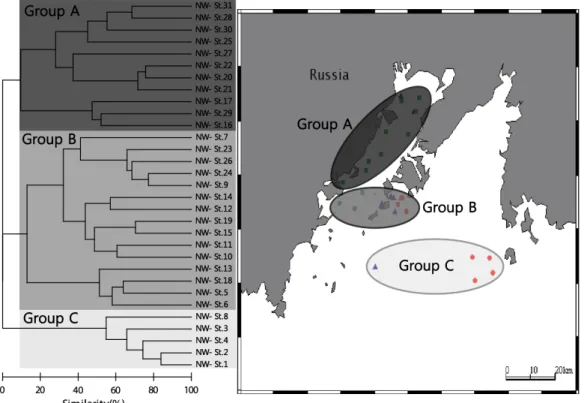
조사기간 동안 출현한 어류의 종수와 개체수를 바탕 으로 정점별 어류군집의 유사도를 구하고 집괴분석을 실시하여 어류군집의 유사성을 분석한 결과 러시아측 동해 북서부의 군집구조는 크게 세 그룹으로 분석되었 다 (Fig. 4). A그룹은 블라디보스톡 내만지역으로 평균 14 m의 수심을 나타냈고, B그룹은 블라디보스톡 근해 로 평균 수심은 26 m, C그룹은 블라디보스톡 외해지역 으로 수심이 가장 깊은 정점들로 평균 72 m의 수심을 나타냈다.
한국측 동해 남서부의 어류군집 또한 크게 세 그룹으 로 분리되었다 (Fig. 5). Ⅰ그룹은 동해 중부해역에 위 치한 정점들로 평균 수심이 130 m였고, Ⅱ그룹은 다른 정점들에 비해 깊은 수심에서 조사가 이루어진 정점들 로 평균 수심 328 m을 보였으며, Ⅲ그룹은 가장 남쪽 에 위치한 그룹으로 평균 137 m의 수심을 나타냈다. 따 라서, 러시아측 동해 북서부와 한국측 동해 남서부 해 역의 군집구조는 수심과 해역에 따라 어류군집이 확연 히 분리되고, 두 해역 모두 3개의 군집으로 구분되는 특성을 지니고 있었다.
러시아측 동해 북서부와 한국측 동해 남서부에서 채 집된 정점별 어류군집이 각각 3개의 그룹을 형성하는
데 기여하는 각각의 종기여도를 분석하기 위해 Simper (Similarity Percentage) 분석을 실시한 결과 러시아측 동해 북서부의 그룹 A에서는 G. detrisus와 가시가자미 (Acanthopsetta nadeshnyi)의 종기여도가 각각 41.38%
와 33.53%로 가장 크게 나타나 그룹 A의 특성을 나타 내었고, 그룹 B에서는 참가자미 (Limanda herzensteini) 와 빨간대구 (E. gracilis)가 각각 24.43%와 24.08%로 종기여도가 가장 높은 것으로 나타났고 다음으로 용가 자미 (C. herzensteini), 올꺽정이 (M. jaok)와 쥐노래미 (Hexagrammos stelleri)가 각각 9.91%, 9.35%와 8.83%
로 높게 나타났다. 그룹 C에서는 대황어 (T. brandti)와 호수가자미 (L. pinnifasciata)가 각각 58.08%와 22.86%
로 나타났다 (Table 8).
한국측 동해 남서부의 그룹 Ⅰ에서는 기름가자미 (G.
stelleri)와 도루묵 (A. japonicus)의 종기여도가 각각
23.54%와 22.57%로 가장 높았고, 다음으로 고무꺽정이 (D. setiger)와 물메기 (Liparis tessellatus)가 각각 18.91%와 18.59%로 높은 기여도를 보였다. 그룹 Ⅱ에 서는 청자갈치 (A. hollandi)와 고무꺽정이 (D. setiger) 가 각각 48.77%와 26.51%의 높은 종기여도를 보였고, 그 룹 Ⅲ에서는 청어 (C. pallasii)와 도루묵 (A. japonicus)가 각각 35.22%와 25.73%로 높게 나타났고, 다음으로 기름 가자미 (G. stelleri)와 고무꺽정이 (D. setiger)가 각각 15.03%와 9.64%의 종기여도를 보였다 (Table 9).
본 연구에서 살펴본 러시아측 동해 북서부의 트롤 조 사를 위한 한국 과학자의 참여는 러시아측에서 2006–
2008년간 매 8월의 한정된 해역에 대한 조사만을 허용 하여 타 시기와 타 해역에 대한 자료를 수집하지 못하 였다. 따라서, 러시아측 동해 북서부와 한국측 동해 남 서부 해역에서 타 시기와 본 연구에서 고려한 조사해역 외 해역의 조사 결과를 포함한 자료분석이 수반되어야 만 시공간적으로 포괄적인 환동해의 종조성 및 양적 변 동이 규명될 수 있을 것이고, 또한 러시아측의 협조로 체장 자료의 추가적인 자료 제공 등이 이뤄진다면 양적 인 변동 외에도 질적인 자원상태의 추가 분석을 통해 환동해 자원 관리의 기초자료로 활용 가능할 것으로 여 겨진다.
허나 본 연구는 러시아측 동해 북서부 어류상에 대한
최초의 한국 내 보고이며, 러시아측 동해 북서부 해역
과 한국측 동해 남서부 해역의 어류상을 양적·질적으로
비교한 최초의 연구결과라는데 그 의의를 둘 수 있다.
Fig. 4. Dendrogram and schematic representation of space distribution based on Bray–Curtis similarity matrix of fourth root transformed data of species number and abundance in the northwestern East Sea of Russian EEZ from 2006 to 2008.
Fig. 5. Dendrogram and schematic representation of space distribution based on Bray–Curtis similarity matrix of fourth root transformed data of species
number and abundance in the sorthwestern East Sea of Korean EEZ from 2006 to 2008.
Table 8. Species contributions to similarity in the Group by trawl survey in the northwestern East Sea of Russian EEZ from 2006 to 2008
Specie name Mean individual (Contribution %)
Group A Group B Group C
Eleginus gracilis 8,840 (0) 53,740 (24.08) 30,969 (6.03)
Gymnocanthus detrisus 8,998 (41.38) 0 (0) 0 (0)
Acanthopsetta nadeshnyi 6,912 (33.53) 27 (0) 0 (0)
Limanda herzensteini 0 (0) 2,992 (24.43) 146 (0.09)
Gymnocanthus pistilliger 2,731 (7.88) 380 (0.50) 107 (0.03)
Cleisthenes herzensteini 0 (0) 3,337 (9.91) 0 (0)
Tribolodon brandti 0 (0) 70 (0.01) 15,586 (58.08)
Liopsetta pinnifasciata 0 (0) 52 (0.01) 10,864 (22.86)
Hypomesus japonicus 0 (0) 0 (0) 12,607 (2.36)
Cumulation contribution 82.79 58.94 89.45
Table 9. Species contributions to similarity in the Group by trawl survey in the southwestern East Sea of Korean EEZ from 2006 to 2008
Species name Mean individual (Contribution %)
Group Ⅰ Group Ⅱ Group Ⅲ
Dasycottus setiger 24,425 (18.91) 4,449 (26.51) 3,918 (9.64)
Icelus cataphractus 27,581 (7.26) 48 (0) 0 (0)
Allolepis hollandi 0 (0) 5,661 (48.77) 0 (0)
Arctoscopus japonicus 3,848 (22.57) 831 (1.42) 2,688 (25.73)
Clupea pallasii 9,549 (1.82) 24 (0) 6,990 (35.22)
Maurolicus japonicus 0 (0) 0 (0) 1,617 (5.69)
Liparis tessellatus 1,293 (18.59) 0 (0) 0 (0)
Glyptocephalus stelleri 1,668 (23.54) 343 (3.41) 1,694 (15.03)
Malacocottus gibber 0 (0) 1,901 (8.57) 0 (0)
Gadus macrocephalus 143 (0.18) 698 (1.45) 384 (2.99)
Cumulation contribution 92.87 90.13 94.30
결 론
본 연구는 2006년부터 2008년까지 매년 8월에 러시 아측 동해 북서부와 한국측 동해 남서부의 트롤 조사에 서 어획된 어류의 종조성과 양적변동을 분석한 결과로 써, 러시아측 동해 북서부에서는 총 67종의 어류가 출 현하였고, 같은 기간 한국측 동해 남서부에서는 39종의 어류가 출현하였다. 이중 러시아측 동해 북서부에만 출 현한 종은 53종이었고, 한국측 동해 남서부에만 출현한 종은 25종, 러시아측 동해 북서부와 한국측 동해 남서 부에 모두 출현한 종은 14종으로 나타나, 이 14종은 동 해 전체에 서식하고 있을 가능성이 매우 높은 것으로
판단된다.
조사기간 중 러시아측 동해 북서부에서는 평균 64,608 개체/km
2가 채집되었는데, 연도별로는 2006년 에 19,737 개체/km
2, 2007년 57,609 개체/km
2, 2008년 116,478 개체/km
2로 2008년에 큰 폭으로 증가하였고, 같은 시기에 한국측 동해 남서부에서는 평균 46,403 개 체/km
2가 채집되었는데, 연도별로는 2006년에 89,129 개체/km
2, 2007년 41,847 개체/km
2, 2008년 8,234 개체 /km
2로 2008년에 큰 폭으로 감소하여 러시아측 동해 북서부와는 정반대의 경향을 보였다.
조사기간 중 러시아측 동해 북서부에서는 평균 6,870
kg/km
2가 어획되었는데, 연도별로는 2006년에 2,439 kg/km
2, 2007년 6,837 kg/km
2, 2008년 11,333 kg/km
2로 2008년에 큰 폭으로 증가하였으며, 같은 시기에 한국측 동해 남서부에서는 평균 4,135 kg/km
2가 채집되었는데, 연도별로는 2006년에 6,273 kg/km
2, 2007년 5,070 kg/km
2, 2008년 1,062 kg/km
2로 2008년에 큰 폭으로 감 소하여 면적당 개체수의 경향과 동일하였다.
러시아측 동해 북서부에서 면적당 개체수의 우점종은 빨간대구, 대황어, 날빙어, 호수가자미, Gymnocanthus
detrisus의 순이었고, 면적당 생체량의 우점종은 빨간대구, 대황어, 올꺽정이, 문치가자미, 호수가자미의 순으 로 우점하였다. 한국측 동해 남서부에서 면적당 개체수 의 우점종은 줄가시횟대, 고무꺽정이, 청어, 도루묵, 청 자갈치의 순이었으며, 면적당 생체량의 우점종은 고무 꺽정이, 줄가시횟대, 청어, 주먹물수배기, 청자갈치의 순으로 우점하였다.
러시아측 동해 북서부의 군집구조는 수심에 따라 서 식하는 어종에서 차이를 보여 크게 세 그룹으로 분석되 었고, 한국측 동해 남서부의 어류 군집 또한 수심과 해 역에 따라 서식하는 어종에서 차이를 보여 크게 세 그 룹으로 분석되었다.
본 연구는 한국측 동해 남서부와 러시아측 동해 북서 부 해역에서 같은 시기에 수행된 트롤 조사결과를 비교 함으로써 환동해의 포괄적인 자원 관리의 기초자료로 활용하기 위한 과학적 근거자료를 제공하고자 하였다.
또한, 본 연구는 러시아측 동해 북서부 어류상에 대한 최초의 한국 내 보고이며, 러시아측 동해 북서부 해역 과 한국측 동해 남서부 해역의 어류상을 양적·질적으로 비교한 최초의 연구결과라는데 그 의의를 둘 수 있다.
사 사
이 논문은 2015년도 국립수산과학원 수산과학연구사 업 (R2015028)의 지원으로 수행된 연구이며 연구비 지 원에 감사드립니다.
References