DOI 10.17480/psk.2015.59.6.245
메르스 감염에서 리바비린과 인터페론 사용에 대한 임상 문헌 고찰
임 미 선# 영남대학교 약학대학
(Received August 1, 2015; Revised October 1, 2015; Accepted November 9, 2015)
Ribavirin and Interferon Treatment for MERS-CoV Infection: A Clinical Literature Review
Mi-sun Lim#
College of Pharmacy, Yeungnam University, Gyeongbuk 712-749, Korea
Abstract — Middle East respiratory syndrome - coronavirus infection has posed substantial threat to public health with extremely high mortality rate in 2015. Although there are no approved novel medications for coronavirus, several antiviral agents such as ribavirin and interferon have been tried to MERS patients according to the in-vitro inhibitory effect, ther- apeutic effect on the animal model and experience from the severe acute respiratory syndrome - coronavirus infection. The aim of this study is to evaluate the clinical evidence of the antiviral treatment for MERS-CoV infection. After systematically searching the medical literature databases, I found five studies described the clinical efficacy of antiviral treatment on MERS patients. All of them were about the combination therapy of ribavirin and interferon (IFN). Two of them were retrospective cohort studies with quality of evidence (QOE) II and the others were observational study and case reports with QOE III.
As a result of critical appraisal, it is concluded that none of those studies represented confirmatory clinical evidence of the efficacy of ribavirin and interferon combination therapy on MERS patients. Although Omrani et al. represented that ribavirin and IFN treatment had significantly improved survival at 14 days, it was not enough time to conclude the effect.
Keywords □ MERS-CoV, treatment, interferon, ribavirin
Coronavirus는 경증 내지 중등도의 상기도 감염을 일으키는 흔한 바이러스로 알려져 있다. 그러나 2002~2003년도에 severe acute respiratory syndrome-coronavirus(SARS-CoV)에 의한 호 흡기 감염의 유행으로 전세계 30개국 이상에서 800명 이상이 사 망한 사건에 이어 2012년도에 처음 발견되어 중동을 중심으로 유행이 시작된 Middle East respiratory syndrome-coronavirus (MERS-CoV)는 2015년 국내에까지 상륙하여 빠른 속도로 확산 되면서 심각한 공중보건학적 문제를 야기했다.1)
2012년 Saudi Arabia에서 신종 coronavirus에 의한 심각한 폐 렴 환자가 발생하면서 발견된 MERS-CoV는 2013년도에 혈액투 석실과 중환자실을 중심으로 기저질환이 있는 환자들 사이에 감
염이 확산되면서 치사율이 65%까지 보고되기도 했다.2) MERS- CoV에 의한 감염은 평균 5.2일(2~13일)의 잠복기를 거쳐 초기 에 발열, 오한, 기침 등의 비특이적인 호흡기 증상이 시작되고 이 후 흉부 X-ray 검사상 폐침윤을 동반하는 심한 폐렴으로 진행되 는 양상을 보인다. 오심, 구토, 설사 등 소화기계 증상을 호소하 는 경우도 상당수 있으며 이러한 임상증상들은 SARS-CoV 감염 의 경우와 유사한 양상을 보인다.2,3) MERS-CoV 유행 초기에는 기저질환이 있는 성인의 경우에 한해 감염으로 인한 이환율을 높 이는 것으로 알려졌으나, 소아에서의 감염과 사망이 보고되었고 기저질환이 없는 성인에서도 사망에 이르는 심각한 케이스가 보 고됨에 따라 적극적인 감염확산 방지와 예방 및 치료가 필요한 상황이다.3,4)
신종 바이러스의 출현과 빠른 감염의 확산은 공중 보건학적으 로 심각한 위협이 되는 상황이다. 그러나 이에 대처할 수 있는 치료약물 및 백신을 개발하고 임상시험을 거쳐 유효성과 안정성 을 입증하여 허가를 받기까지에는 상당한 시간과 비용이 필요하 기 때문에 유행하는 시점에서 즉각적인 대처가 어렵다. 이러한
#
Corresponding Author Mi-sun Lim
College of Pharmacy, Yeungnam University, 280 Daehak-ro, Gyeong- san, Gyeongbuk 712-749, Korea
Tel.: 053-810-2823 Fax.: 053-810-4654 E-mail: [email protected]
Short Report
종설경우 기존의 antiviral agents, corticosteroids, immunomodulating agents 등을 시도해 볼 수 있고, 이미 감염에서 회복된 환자의 혈청(convalescent plasma)이나 immunoglobulin을 이용한 치료 등을 고려해볼 수 있다.3,5)기존에 허가된 약물들은 인체에서 안 전성 정보를 충분히 확보하였으므로 신약을 개발하는 과정에서 약물의 안전성 확인을 위해 소요되는 시간 및 비용을 대폭 줄일 수 있기 때문에 인체에 빠른 적용이 가능하다. MERS-CoV 감염 의 경우 이전의 SARS-CoV 감염시의 치료경험과 in vitro 상의 약효 검색 결과를 근거로 interferon(IFN), ribavirin 등이 치료에 시도되고 있다.5-7)대한감염학회/대한화학요법학회에서는 MERS- CoV 감염이 확진된 환자에게는 조기에 ribavirin+IFN-α2a+
lopinavir/ritonavir 병합요법을 적극적으로 시행할 것을 권고하고 있다.8)
본 연구에서는 MERS-CoV 감염 치료를 위해 선택할 수 있는 항바이러스제 치료와 그에 대해 현재까지 발표된 임상적 근거를 체계적으로 고찰하여 제시함으로 MERS-CoV 감염에서 항바이 러스제 치료의 효과에 대한 근거를 확인하고자 한다.
연구방법
MERS-CoV 감염 환자를 대상으로 경험적 항바이러스제 사용 의 효과에 대해 임상적으로 검증한 논문을 PubMed, Science Direct, Korean medical database에서 검색하였다. 검색어로는
“MERS-CoV”, “treatment”, “human study”, “antiviral agent”,
“interferon”, “ribavirin”, “lopinavir”, “ritonavir” 등을 사용하였 다. 검색한 논문에서 연구방법, 치료약물의 용법 및 용량, 치료 시작 시점 및 치료기간, 연구대상자 수와 기저질환 여부, 사망률 또는 생존률을 포함한 치료효과와 이상반응 등 안전성의 측면에 대한 정보를 추출하여 면밀히 평가하였다. 연구내용의 근거 수 준(Quality of Evidence, QOE)은 아래에 제시된 US Preventive Services Task Force scoring system을 사용하여 평가하였다.9) QOE I: Evidence obtained from at least one properly designed randomized controlled trial.
QOE II-1: Evidence obtained from well-designed controlled trials without randomization.
QOE II-2: Evidence obtained from well-designed cohort or case-control analytic studies, preferably from more than one center or research group.
QOE II-3: Evidence obtained from multiple time series with or without the intervention. Dramatic results in uncontrolled experiments could also be regarded as this type of evidence.
QOE III: Opinions of respected authorities, based on clinical experience, descriptive studies, or reports of expert
committees.
연구결과
MERS-CoV에 대해 2015년 9월 2일까지 발표된 논문은 총 621 건이며 이 중 “antiviral agent”, “interferon”, “ribavirin, “lopinavir”,
“ritonavir”를 포함한 논문은 426건이었다. 이 중 in vitro study, animal study, review 논문 등을 제외하고 MERS human patients를 대상으로 시행된 controlled clinical trial, cohort study, observational study, case-control study, case series, case report만을 추출한 결과 총 5편의 논문이 최종 선정되었다.
그 중 2편은 QOE II 수준의 retrospective cohort study였고 3 편은 QOE III 수준의 observational study와 case report였다.
QOE I 수준의 연구 결과는 한 편도 없었다. 각 논문에서 추출한 주요 정보는 Table I에서 제시하였다.
Shalhoub 등은 2014년 4월부터 6월 사이에 단일 의료기관 (Jeddah, Saudi Arabia)에 입원한 32명의 MERS-CoV 감염 확진 자를 대상으로 확진 시점에서 −1~1 day(median: 1 day)부터 ribavirin과 INF(IFN-α2a or IFN-β1a) 병용요법으로 치료한 결 과 69%(22/32)의 사망률을 보고하였다. IFN-α2a 병용시 사망률 은 85%(11/13)였고 IFN-β1a 병용시 사망률은 64%(7/11)로 나타 났으며 두 치료군간 사망률의 통계적인 차이는 없었다.10) 현재 전세계 MERS-CoV 감염 사망률인 38.1%(588/1545)와 비교할 때(2015년 9월 2일 기준) 본 연구에서의 69%(22/32)의 사망률은 현저히 높은 수치라 할 수 있다.15) 투석을 받는 환자와 만성신질 환 환자에서는 사망률이 100%(각각 8/8, 14/14)로 보고되었으며 동반질환이 없는 의료인에서의 감염의 경우는 사망한 케이스가 없었다(0%, 0/6). 또한 IFN-α2a 병용군에서 생존자 2명 중 1명 이 의료인이었으며, IFN-β1a 병용군에서 생존자 4명은 모두 의 료인인 것으로 보고되었다. 50세 이상의 연령, 당뇨, 산소치료, creatinine 수치(1.24 mg/dl 초과), INF-α 사용, IFN-β 사용을 공 변량으로 하여 odd ratio(OR) 분석결과 50세 이상의 연령(OR=
26.1, 95% CI: 3.58~190.76, p=0.001)과 당뇨(OR=15.74, 95%
CI: 2.46~100.67, p=0.004)만이 사망률에 통계적으로 유의한 risk factor로 분석되었다.10)
Omrani 등은 2012년 10월부터 2014년 5월 사이 단일 의료기 관(Riyadh, Saudi Arabia)에서 침습적 또는 비침습적 인공환기가 필요할 정도로 심한 폐렴증세를 동반한 MERS-CoV 감염을 확 진 받은 환자를 대상으로, 진단 시점에서 0~8 day(median: 3 day)부터 ribavirin과 INF-α2a 병용요법을 시행한 20명의 환자와 항바이러스제 치료를 받지 않은 24명의 환자의 임상 결과를 후 향적으로 비교하였다.11) 14일째 생존율은 치료군에서 70%(14/
20), 비교군에서 29%(7/24)로 유의한 통계적 차이가 있었다(p=
0.004). 그러나 28일째 생존율은 치료군에서 30%(6/20), 비교군
에서 17%(4/24)였고 두 군간에 유의한 통계적 차이는 없었다(p=
0.054).11)약물 이상반응으로 인한 치료 중단은 없었고 치료군과 대조군 사이에 통계적으로 유의한 차이를 보인 임상검사 소견으 로는 hemoglobin의 감소가 유일했다. 이는 ribavirin에 의한 약 물 이상반응으로 잘 알려진 anemia 발생으로 인한 것이나 수혈을 받을 정도의 심한 케이스의 발생은 두 군간에 차이가 없었다.11) 무작위배정에 의한 비교가 아니므로 selection bias나 confounding factor를 배제할 수 없는 한계가 있지만 두 군 사이에 임상 특성 이나 추가적인 치료 여부(침습적 인공환기, ECMO[extracorporeal membrane oxygenation] 치료, 투석치료, 혈압상승제 사용, corticosteroid 사용, 사용한 항생제의 개수 등)에서 두 군간에 통 계적 차이는 없었다.11)본 논문에서는 14일째 생존율에서 치료 군의 생존율이 통계적으로 유의하게 높았고, 28일째 생존율에서 통계적으로 유의한 차이는 없으나 치료군의 생존율이 높았으며 p=0.054로 유의수준에 근접한 점은 연구대상자수가 증가할 경 우 유의한 통계적으로 유의한 차이를 보일 가능성이 있기 때문 에 IFN, ribavirin 병용요법의 효과를 긍정적으로 시사해주는 연 구결과라고 제시하고 있다. 그러나 치료군에서 생존율이 14일째
70%(14/20)에서 28일째 30%(6/20)로 40%나 급감하였고, Al- Tawfiq 등이 보고한 5명의 case에서 ribavirin과 IFN-α2b 병용요 법을 시행하였으나 5명 모두 입원 시점으로부터 32~52일이 지 난 시점에 사망한 것을 통해 본 연구결과만으로는 MERS-CoV 감염에서 IFN, ribavirin 병용요법의 효과를 확증할 수 없으며 추후 잘 설계된 randomized controlled trial을 통한 검증이 필요 하다.12)
Al-Tawfiq 등은 MERS-CoV 감염을 확진 받고, 입원 후 10~
22 day(median: 19 day)부터 ribavirin과 IFN-α2b 병용요법을 시 작한 5명의 case를 보고하였다.12)사망률은 100%(5/5)로 보고되 었으나 5명의 환자 모두 만성신질환 환자였고 그 중 4명은 혈액 투석을 받는 환자였다. 또한 항바이러스제 치료가 입원 후 상당 히 경과된(median: 19) 시점에서 시작되었고 모든 환자들이 이 미 인공호흡기에 의존하고 있는 상황이었다는 사실을 통해 심한 동반질환이 있는 MERS-CoV 감염환자에서 지연된 ribavirin과 IFN 치료는 효과를 기대하기 힘들다는 사실을 확인할 수 있다.12) Khalid 등은 기저질환이 없는 의료진 확진자와 밀접접촉자인 배우자에게 ribavirin과 IFN-α2b 병용 치료 및 예방 요법을 시행
Table I − Summary of the studies about the ribavirin and IFN treatment for human MERS-CoV patients
Type of study Regimen Patients
# Outcomes Reference
# Retrospective
cohort study (QOE II)
Regimen 1: IFN-α2a+ribavirin Regimen 2: IFN-β1a+ribavirin Time to treatment (d): a median of 1 following diagnosis
32
Overall
IFN-α2a+Ribavirin IFN- β1a+Ribavirin Others*
Patients on hemodialysis Chronic renal impairment patients Health care workers with no risk factors
Mortality rate 69% (22/32) 85% (11/13) 64% (7/11) 50% (4/8) 100% (8/8) 100% (14/14) 0% (0/6)
10
Retrospective cohort study (QOE II)
IFN- α2a+ribavirin
Time to treatment (d): a median of 3 (range 0~8) after diagnosis.
20
14-day 28-day
Survival Mortality Survival Mortality
Treatment group 70% (14/20) 30% (6/20) 30% (6/20) 70% (14/20)
Comparator group 29% (7/24) 71% (17/24) 17% (4/24) 83% (20/24)
p value 0.004 0.054
11
Observational study (QOE III)
IFN-α2b+ribavirin
Time to treatment (d): a median of 19 (range 10~22) after admission.
5 Mortality rate: 100% (5/5)
Time to expire (d): a median of 35 (range 32~52) after admission 12
Case report (QOE III)
IFN-α2b+ribavirin
Time to treatment (d): before diagnosis
2 Mortality rate 0% (0/2) 13
Case series (QOE III)
IFN- α2b+ribavirin 6 Mortality rate
Time to diagnosis (d) Time to treatment (d) Renal failure
Hemodynamic instability Comorbid conditions
50% (3/6) Survived cases 12~18
12~19 All (+) All (+) All (+)
Expired cases 1~2
1~2 All (−) All (−) All (−)
14
*Received only ribavirin (3 cases), switched INF-α2a to INF-β1a (4 cases) and received INF-α2a<48 h (1 case)
하여 회복한 2 case를 보고하였다.13) Case 1의 경우 발열과 호 흡곤란으로 입원하여 ribavirin과 IFN-α2b 병용치료를 시작하였 고 72시간 뒤에 MERS-CoV 감염이 확진되었으며, 3일째 호흡 부전 및 흉부 X-ray 소견의 악화로 비침습적 인공환기 및 methylprednisolone 치료를 시작했다.13) 4일째 흉부 X-ray 소견 이 회복되고 비침습적 인공환기를 중단하였으며 6일째 열이 떨 어지고 18일째 완전히 회복하여 퇴원하였다.13) Case 2의 경우 case 1의 밀접 접촉자로 예방적 목적의 ribavirin과 IFN-α2b 병 용 치료를 2주간 시행하였으며 가벼운 발열성 호흡기 감염 증상 을 경험하고 회복하였으나 수차례의 MERS-CoV 검사에서 음성 반응이 나왔다.13) Case 1의 경우 기저질환이 없는 환자인 점, ribavirin과 IFN-α2b 치료 시작 후 3일째 증상의 악화와 methylprednisolone 치료 후 회복된 점 등으로 ribavirin과 IFN- α2b 병용 요법이 MERS-CoV 감염 치료에 직접적인 효과를 보 인 것으로 보기는 어렵다.
Khalid 등은 6명의 MERS-CoV 확진자에서 ribavirin과 IFN- α2b 병용요법의 결과를 보고하였다.14)사망률은 50%(3/6)로 보 고되었으며 생존자 3명은 모두 진단 및 치료시작 시점이 증상발 현 또는 접촉 후 1~2일 이내로 빨랐으나, 사망한 3명의 경우 증 상 발현 후 이미 12~19일이 지난 시점에 진단 및 치료시작을 한 점이 보고되었다.14)이는 감염 초기 ribavirin과 IFN-α2b 병 용요법이 환자의 예후에 긍정적 영향을 줄 수 있는 근거의 실마 리가 될 수 있다. 그러나 생존자 3명의 경우 모두 기저질환이 없 는 환자였고 사망자 3명은 모두 혈액투석을 받는 신부전 환자였 다는 사실을 통해 이 연구 결과만으로 ribavirin과 IFN-α2b 병용 요법의 효과를 증명하기는 어렵다.14) Al-Tawfiq 등의 연구결과와 마찬가지로 기저질환이 있는 MERS-CoV 감염환자에서 지연된 ribavirin과 IFN 치료는 효과를 기대하기 힘들다는 사실을 확인 할 수 있다.12,14)
고 찰
2015년 5월 20일 국내 MERS-CoV 감염 첫 확진자가 나온 이
래 9월 2일 현재 국내 확진자는 186명이며 사망자는 36명으로, 확진자 1195명, 사망자 510명이 보고된 Saudi Arabia에 이어 MERS-CoV 감염 확진자수 및 사망자수 2위의 국가가 되었다.15,16) 초기 대응의 문제로 감염 확산이 빠르게 진행되면서 국가적으로 심각한 위협을 초래하였으나 2015년 9월 2일 현재 국내 MERS- CoV 감염 사망률은 19.4%(36/186)로 Saudi Arabia의 42.7%
(510/1195)에 비해 낮으며 7월 4일 이후 신규 확진자가 상당기 간 발생하지 않고 있어 유행종식을 기대하는 상황이다.15-17) 현 재MERS-CoV 감염에 대해효과가 검증되어 허가된 약물이나 백신이 없는 상황이나,대한감염학회와 대한화학요법학회에서는 MERS 항바이러스제 치료지침(2015년 6월 12일 발표)에서 높은 사망률과 이환률을 고려하여 확진자와 증상이 있는 감염의심환 자에게 조기에 항바이러스제 치료(ribavirin+IFN-α2a+lopinavir/
ritonavir 병용요법)를 할 것을 권고하였다.8)
효과가 검증된 치료제가 없는 상황에서 높은 치사율을 보이는 MERS-CoV 감염에 대응하기 위해서 기존 SARS-CoV 유행 시 시도되었던 약물의 임상 경험이나 in vitro 상에서 MERS-CoV 억제력을 보이는 약물 검색 및 동물 실험을 통한 효과 검증 등의 방법으로 효과를 기대할 수 있는 약물들을 찾는 시도가 이루어졌
다.7,18-21) SARS-CoV 감염이 유행했을 때 시도되었던 대표적인
약물에는 ribavirin, lopinavir/ritonavir, IFN α, corticosteroid, intravenous immunoglobulin(IVIG), convalescent plasma 등이 있고 이들 약물 사용의 임상적 효과와 안전성을 확인하기 위한 연구결과들이 다수 발표되었다.7,21)그러나 SARS-CoV 감염은 2003년도에 급격히 확산되다가 2004년도 이후 유행이 종식되었 기 때문에 잘 설계된 randomize controlled trial에 의한 QOE I level의연구결과들이 거의 없고, 시도된 약물들 가운데 결정적인 임상적 근거가 확인된 약물은 없다.21,22)
In vitro 상에서 MERS-CoV를 억제하는 약물에 대한 검색을 통해 INF-α, INF-β, ribavirin, mycophenolic acid, cyclosporine A 등이 확인되었고, 이 중 ribavirin과 IFN-α2b 병용요법이 MERS-CoV에 감염시킨 rhesus macaque에서 viral replication을 감소시키고 임상증상을 호전시킨 다는 것이 발표되었다.19-20,23,24)
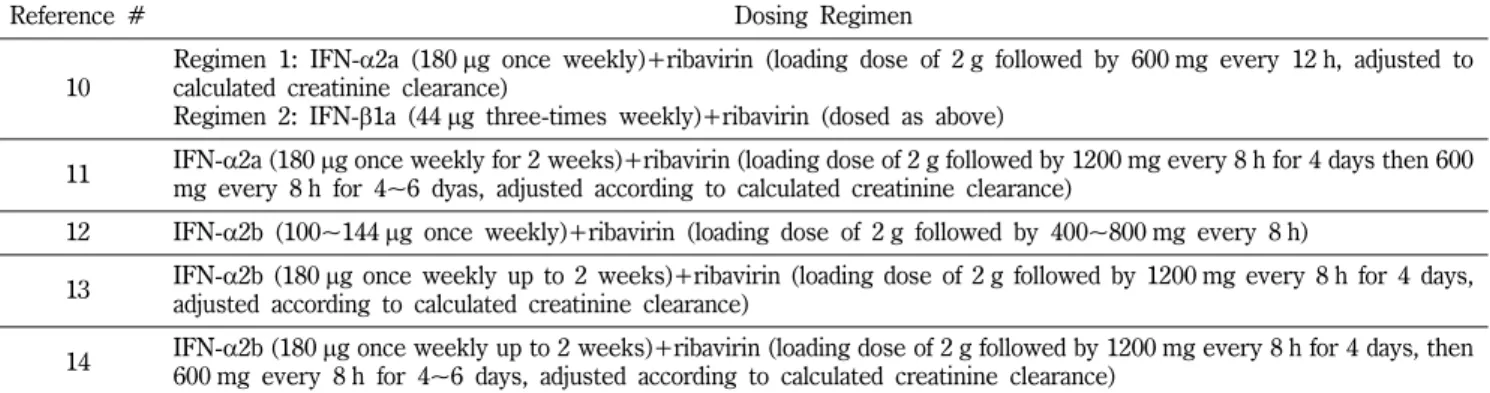
Table II − Dosing regimen of the studies about the ribavirin and IFN treatment for human MERS-CoV patients
Reference # Dosing Regimen
10
Regimen 1: IFN-α2a (180 μg once weekly)+ribavirin (loading dose of 2 g followed by 600 mg every 12 h, adjusted to calculated creatinine clearance)
Regimen 2: IFN-β1a (44 μg three-times weekly)+ribavirin (dosed as above)
11 IFN-α2a (180 μg once weekly for 2 weeks)+ribavirin (loading dose of 2 g followed by 1200 mg every 8 h for 4 days then 600 mg every 8 h for 4~6 dyas, adjusted according to calculated creatinine clearance)
12 IFN-α2b (100~144 μg once weekly)+ribavirin (loading dose of 2 g followed by 400~800 mg every 8 h)
13 IFN-α2b (180 μg once weekly up to 2 weeks)+ribavirin (loading dose of 2 g followed by 1200 mg every 8 h for 4 days, adjusted according to calculated creatinine clearance)
14 IFN-α2b (180 μg once weekly up to 2 weeks)+ribavirin (loading dose of 2 g followed by 1200 mg every 8 h for 4 days, then
600 mg every 8 h for 4~6 days, adjusted according to calculated creatinine clearance)
Ribavirin과 IFN-α2b 병용요법은 만성 C형 간염의 치료를 위해 이미 사용하고 있는 조합으로 인체에서의 안전성 정보가 어느 정 도 확보되어 있으며, 임상적 근거는 부족하지만 SARS-CoV 유 행시에 사용 경험이 있고, in vitro 상에서 MERS-CoV 억제 효 과가 검증되었을 뿐만 아니라 in vivo study에서 유일하게 효과 가 확인된 약물이었기에 MERS-CoV 유행 초기 Saudi Arabia에 서 MERS-CoV 감염의 치료에 적용하게 되었다.5,11,19,20,23,24)
본 논문에서는 MERS-CoV 감염 환자를 대상으로 경험적 항 바이러스제 사용의 효과에 대해 임상적으로 검증한 논문을 검색 하여 체계적으로 고찰하였다. 검색결과 QOE II level의 연구결 과 2건과, QOE III level의 연구결과가 3건만 찾을 수 있었다.
모든 연구에서 ribavirin과 IFN의 병용요법이 시도되었으나, 이 치료법이 MERS-CoV 감염에서 생존률을 증가시키는 효과가 있 음을 뒷받침하는 결정적인 근거를 제시하는 연구결과는 한 건도 없었다. Omrani 등은 심한 폐렴증세를 동반한 MERS-CoV 감염 확진자를 대상으로 ribavirin과 INF-α2a 병용요법을 시행한 경우 치료 14일째 생존율이 비치료군에 비해 통계적으로 유의하게 증 가하는 긍적적 근거를 제시했으나, 28일째 생존율에서는 두 군 간에 유의한 통계적 차이를 보이지 않았다. 또한 치료군에서 생 존율이 14일째 70%(14/20)에서 28일째 30%(6/20)로 40%나 급 감하였으며, Al-Tawfiq 등이 보고한 5명의 case에서 ribavirin과 IFN-α2b 병용요법을 시행하였으나 5명 모두 입원 시점으로부터 32~52일이 지난 시점에 사망한 점 등을 통해 본 연구결과만으 로는 MERS-CoV 감염에서 IFN, ribavirin 병용요법의 효과를 확 증할 수 없다.11,12)
한편 5편의 논문은 현재 MERS-CoV 감염환자 발생 1위 국가 인 Saudi Arabia에서 발표된 연구결과이다. 현재 우리나라의 MERS-CoV 감염 사망률이 19.4%(36/186)로 Saudi Arabia의 42.7%(510/1195)에 비해 낮은 것이 확진자와 증상이 있는 감염 의심 환자에게 조기에 ribavirin+interferon-α2a+lopinavir/
ritonavir 병용요법을 적극적으로 시행한 것과 연관이 있는지 아 니면 기저질환이 있는 환자에서의 감염비율 등 다른 요소와 연 관이 있는 것인지에 대한 연구결과를 기대해 볼 수 있겠다.15-17) 최근에MERS-CoV에 감염시켜 심한 폐렴을 유발시킨 common marmoset에서 lopinavir/ritonavir의 효과를 검증한 논문이 발표 됨에 따라 Saudi Arabia에서 주로 사용한 ribavirin+IFN 병용요 법에 비해 국내에서 lopinavir/ritonavir를 추가한 요법을 시행한 것이 생존율 증가에 영향을 미쳤을 가능성이 있을 수 있다.25)
SARS-CoV 감염은 2002~2003년 단기 유행 이후 현재까지 보 고되지 않고 있지만 2004~2005년에 human coronavirus NL63 과 HKU1이 보고되었고 2012년 MERS-CoV가 출현하여 전세계 적인 위협이 됨에 따라 앞으로도 변종 coronavirus의 출현으로 인한 심각한 호흡기감염질환의 유행이 반복되는 상황을 배제할 수 없다.1,26) MERS-CoV는 여전히 전세계적으로 산발적인 발생
양상을 보이고 있지만 전파 경로, 병태 생리, 숙주의 감수성 인 자, 병독성, 숙주의 기저면역기전 등이 충분히 밝혀지지 않고 있 기 때문에 치료제와 백신을 개발하는데 한계점이 있다. 아직까 지 광범위한 지역사회 감염을 일으키지는 않아 세계적 대유행 (pandemic)을 일으킬 위험성은 낮지만 coronavirus가 유전적 변 이 발생율이 높음을 고려할 때 인체간 전염력이 증강된 변종 발 생의 가능성을 염두하고 적극적인 치료제 및 백신의 개발이 필 요하다.27)그러나MERS-CoV의 산발적인 발생양상은 잘 설계된 randomize controlled trial을 통해 치료의 임상적 근거를 확인하 는데 사실상 한계점으로 작용한다. 국내에서의 MERS-CoV 유행 확산은 국가적으로 상당한 경제적 손실 등의 문제를 발생시켰지 만, 광범위한 후향적 관찰 연구와 잘 매치된 case-control 연구 등을 통해서 MERS-CoV 치료의 임상적 근거를 추가적으로 획 득하여 제공하는 기회가 될 수 있을 것이다.
References
1) Al-Tawfiq, J. A., Zumla, A., Gautret, P., Gray, G. C., Hui, D.S., Al-Rabeeah, A. A. and Memish, Z. A. : Surveillance for emerging respiratory viruses. Lancet Infect. Dis. 14, 992 (2014).
2) Assiri, A., McGeer, A., Perl, T. M., Price, C. S., Al Rabeeah, A. A., Cummings, D. A., Alabdullatif, Z. N., Assad, M., Almulhim, A., Makhdoom, H., Madani, H., Alhakeem, R., Al-Tawfiq, J. A., Cotton, M., Watson, S. J., Kellam, P., Zumla, A. I. and Memish, Z. A. : KSA MERS-CoV Investigation Team.: Hospital outbreak of Middle East respiratory syndrome coronavirus. N. Engl. J. Med. 369, 407 (2013).
3) Assiri, A., Al-Tawfiq, J. A., Al-Rabeeah, A. A., Al-Rabiah, F. A., Al-Hajjar, S., Al-Barrak, A., Flemban, H., Al-Nassir, W. N., Balkhy, H. H., Al-Hakeem, R. F., Makhdoom, H. Q., Zumla, A. I. and Memish, Z. A. : Epidemiological, demographic, and clinical characteristics of 47 cases of Middle East respiratory syndrome coronavirus disease from Saudi Arabia: a descriptive study. Lancet Infect. Dis. 13, 752 (2013).
4) Memish, Z. A., Al-Tawfiq, J. A., Assiri, A., AlRabiah, F. A., Al Hajjar, S., Albarrak, A., Flemban, H., Alhakeem, R. F., Makhdoom, H. Q., Alsubaie, S. and Al-Rabeeah, A. A. : Middle East respiratory syndrome coronavirus disease in children.
Pediatr. Infect. Dis. J. 33, 904 (2014).
5) Zumla, A., Memish, Z. A., Maeurer, M., Bates, M., Mwaba, P., Al-Tawfiq, J. A., Denning, D. W., Hayden, F. G. and Hui, D. S. : Emerging novel and antimicrobial-resistant respiratory tract infections: new drug development and therapeutic options. Lancet Infect. Dis. 14, 1136 (2014).
6) Coleman, C. M. and Frieman, M. B. : Treating MERS-CoV during an outbreak. Lancet Infect. Dis. 14, 1030 (2014).
7) Momattin, H., Mohammed, K., Zumla, A., Memish, Z. A. and Al-Tawfiq, J. A. : Therapeutic options for Middle East respiratory syndrome coronavirus (MERS-CoV)--possible lessons from a systematic review of SARS-CoV therapy. Int. J.
Infect. Dis. 17, e792 (2013).
8) 대한감염학회/대한화학요법학회: MERS 항바이러스제 치료지침, version 1.1. Available at http://www.ksid.or.kr/mail/file/
MERS02.pdf (accessed on July 27, 2015).
9) U.S. Preventive Services Task Force: Guide to clinical preventive services: report of the U.S. Preventive Services Task Force 1st ed., DIANE Publ. Co., Pennsylvania, p. 263 (1989).
10) Shalhoub, S., Farahat, F., Al-Jiffri, A., Simhairi, R., Shamma, O., Siddiqi, N. and Mushtaq, A. : IFN-α2a or IFN-β1a in combination with ribavirin to treat Middle East respiratory syndrome coronavirus pneumonia: a retrospective study. J.
Antimicrob. Chemother. 70, 2129 (2015).
11) Omrani, A. S., Saad, M. M., Baig, K., Bahloul, A., Abdul-Matin, M., Alaidaroos, A. Y., Almakhlafi, G. A., Albarrak, M. M., Memish, Z. A. and Albarrak, A. M. : Ribavirin and interferon alfa-2a for severe Middle East respiratory syndrome coronavirus infection: a retrospective cohort study. Lancet Infect. Dis. 14, 1090 (2014).
12) Al-Tawfiq, J. A., Momattin, H., Dib, J. and Memish, Z. A. : Ribavirin and interferon therapy in patients infected with the Middle East respiratory syndrome coronavirus: an observational study. Int. J. Infect. Dis. 20, 42 (2014).
13) Khalid, M., Al Rabiah, F., Khan, B., Al Mobeireek, A., Butt, T. S. and Al Mutairy, E. : Ribavirin and interferon-α2b as primary and preventive treatment for Middle East respiratory syndrome coronavirus: a preliminary report of two cases.
Antivir. Ther. 20, 87 (2015).
14) Khalid, M., Khan, B., Al Rabiah, F., Alismaili, R., Saleemi, S., Rehan-Khaliq, A. M., Weheba, I., Al Abdely, H., Halim, M., Nadri, Q. J., Al Dalaan, A. M., Zeitouni, M., Butt, T, and Al Mutairy, E. : Middle Eastern Respiratory Syndrome Corona Virus (MERS CoV): case reports from a tertiary care hospital in Saudi Arabia. Ann. Saudi. Med. 34, 396 (2014).
15) European Centre for Disease Prevention and Control.
Epidemiological update: Middle East respiratory syndrome coronavirus (MERS-CoV) Available at http://ecdc.europa.eu/
en/press/news/Pages/News.aspx (accessed on September 2, 2015).
16) Korea Centers for Disease Control and Prevention. Middle East respiratory syndrome information. Available at http://
www.mers.go.kr/mers/html/jsp/main.jsp (accessed on September 2, 2015).
17) 최재욱, 김경희, 조용민, 김상후 : 한국 메르스 감염의 역학현황 과 공중보건학적 대응조치 방향. 대한의사협회지 58, 487
(2015).
18) de Wilde, A. H., Jochmans, D., Posthuma, C. C., Zevenhoven- Dobbe, J. C., van Nieuwkoop, S., Bestebroer, T. M., van den Hoogen, B. G., Neyts, J. and Snijder, E. J. : Screening of an FDA-approved compound library identifies four small- molecule inhibitors of Middle East respiratory syndrome coronavirus replication in cell culture. Antimicrob. Agents Chemother. 58, 4875 (2014).
19) Falzarano, D., de Wit, E., Martellaro, C., Callison, J., Munster, V. J. and Feldmann, H. : Inhibition of novel β coronavirus replication by a combination of interferon-α2b and ribavirin.
Sci. Rep. 3, 1686 (2013).
20) Falzarano, D., de Wit, E., Rasmussen, A. L., Feldmann, F., Okumura, A., Scott, D. P., Brining, D., Bushmaker, T., Martellaro, C., Baseler, L., Benecke, A. G., Katze, M. G., Munster, V. J. and Feldmann, H. : Treatment with interferon- α2b and ribavirin improves outcome in MERS-CoV-infected rhesus macaques. Nat. Med. 19, 1313 (2013).
21) Stockman, L. J., Bellamy, R. and Garner, P. : SARS: systematic review of treatment effects. PLoS Med. 3, e343 (2006).
22) Centers for Disease Control and Prevention. Severe Acute Respiratory Syndrome (SARS). Available at http://
www.cdc.gov/sars/ (accessed on July 27, 2015).
23) de Wilde, A. H., Raj, V. S., Oudshoorn, D., Bestebroer, T. M., van Nieuwkoop, S., Limpens, R. W., Posthuma, C. C., van der Meer, Y., Bárcena, M. and Haagmans, B. L., Snijder, E. J. and van den Hoogen, B. G. : MERS-coronavirus replication induces severe in vitro cytopathology and is strongly inhibited by cyclosporin A or interferon-? treatment. J. Gen. Virol. 94, 1749 (2013).
24) Hart, B. J., Dyall, J., Postnikova, E., Zhou, H., Kindrachuk, J., Johnson, R. F., Olinger, G. G. Jr., Frieman, M. B., Holbrook, M. R., Jahrling, P. B. and Hensley, L. : Interferon-β and mycophenolic acid are potent inhibitors of Middle East respiratory syndrome coronavirus in cell-based assays. J. Gen.
Virol. 95, 571 (2015).
25) Chan, J. F., Yao, Y., Yeung, M. L., Deng, W., Bao, L., Jia, L., Li, F., Xiao, C., Gao, H., Yu, P., Cai, J. P., Chu, H., Zhou, J., Chen, H., Qin, C. and Yuen, K. Y. : Treatment with lopinavir/ritonavir or interferon-β1b improves outcome of MERS-CoV infection in a non-human primate model of common marmoset. J. Infect.
Dis. in press (2015).
26) To, K. K., Hung, I. F., Chan, J. F. and Yuen, K. Y. : From SARS coronavirus to novel animal and human coronaviruses. J.
Thorac. Dis. 5, S103 (2013).
27) Zumla, A., Hui, D. S. and Perlman, S. : Middle East respiratory syndrome. Lancet. doi:10.1016/S0140-6736(15)60454-8 (2015).