http://dx.doi.org/10.7841/ksbbj.2015.30.1.33 ISSN 1225-7117 / eISSN 2288-8268
탄소원으로서 입국을 이용한 유산균 발효
박석균1, 옥승호1, 김진만2*
Lactic Acid Fermentation with Rice Koji as a Carbon Source
Suk-Gyun Park1, Seung-Ho Ohk1, and Jin-Man Kim2*
Received: 27 December 2014 / Accepted: 25 February 2015
© 2015 The Korean Society for Biotechnology and Bioengineering
Abstract: Recently, several health benefits of rice wine, makgeolli, were known due to the interest on the traditional Korean liquor and the researches on the rice wine are increas- ing. Organic acids produced during the process of rice wine fermentation play important roles in the taste and flavor. In this study, we have examined the optimal conditions for lac- tic acid production in rice koji as a carbon source. Skim milk was also used as a supplementary ingredient for the optimiza- tion of lactic acid fermentation. Bacterial growth of Lactoba- cillus sakei was monitored under this condition. The pH, acidity of the culture and the ethanol tolerance of this bacte- rium were also tested. Through these experiments, we were able to optimize the growth condition of lactic acid bacteria by the addition of skim milk. This was also able to affect the change of pH, acidity, sugar concentration and alcohol toler- ance, which might contribute to the improvement of the qual- ity of rice wine. The optimal condition for the growth was 2 days with 10% (w/v) of skim milk concentration. With these results, it was confirmed that rice koji was an effective car- bon source for the growth of lactic acid bacteria.
Keywords: Rice koji, Carbon source, Lactic acid, Lactobacil- lus sakei
1. INTRODUCTION
Rice wine is traditional “just fitter” liquor in Korea [1]. Recently, rice wine have receiving attention as a dietary health supple- ments food known to be beneficial for blood circulation, cons- tipation, and anti-cancer effect [2,3]. Therefore, rice wine is becoming a popular alcoholic beverage to elder and youth in domestic as well as in overseas [2,3]. Main ingredient of rice wine is the cereal, with yeast as a leavening agent [4]. As well as the yeast, lactic acid bacteria affect the taste of the rice wine during the fermentation process [5]. The fermentation process of rice wine is generally composed of sequential growth of mold, yeast and lactic acid bacteria. Among them, lactic acid bacteria play important roles in quality of rice wine. The lactic acid bacteria are lowering the pH of the culture, which pre- vents contamination of bacteria in early stage of the fermenta- tion process [6]. These lactic acid bacteria also give significant impacts on the flavor of the rice wine, and eliminate the fatigue substances in the body to promote metabolism [7].
Usually, about 0.8% of lactic acid was contained in the rice wine [7]. A group of lactic acid bacteria might increase the fermentation efficiency of yeast. However, the optimal condi- tion for lactic acid bacteria in rice wine fermentation was not determined yet.
On the other hand, rice koji refers to a pure culture which
1전남대학교 치과대학 구강미생물학교실
1Department of Oral Microbiology, Chonnam National University, Gwangju, 500-757, Korea
2전남대학교 생명산업공학과
2Department of Biotechnology, CNU Brewing Science and Technol- ogy Institute, Chonnam National University, Yeosu 550-749, Korea Tel: +82-61-659-7304, Fax: +82-
e-mail: [email protected]
연구논문
2. MATERIALS AND METHOD
2.1. Culture of Lactobacillus sakei
Lactobacilli MRS broth was used for the cultivation of Lacto- bacillus sakei (KCCM 40264). An aliquot of L. sakei was ino- culated in 15 mL of Lactobacilli MRS broth and incubated for 24 h at 30
oC. This seed culture was then transferred into rice koji containing 1%, 10%, 50%, or 100% of skim milk and incu- bation at 30
oC for 48 h. Bacterial cell growth was measured by streak plated method. Serially diluted bacterial cultures were plated onto Lactobacilli MRS agar and incubated at 30
oC for 24 h. The total cell number was obtained by multiplying the number of colonies formed to the dilution folds.
Sugar concentration of the medium was measured with the saccharometer (PAL-1, Atago Co., Fukui, Japan) and by oBx.
2.2. Assays of acidity and pH measurement
Acid production of the bacteria was monitored by measuring the pH. After centrifugation of the culture broth, the pH of the culture was measured with a pH meter (EcoMet P25, Istek Co., Seoul, Korea). A clear supernatant was also used for the assays of acidity. The amount of 0.1 N NaOH was measured to change the color of supernatant containing an aliquot of 1% (w/v) phe- nolphthalein. Lactic acid content was showed by adequate amo- unt of NaOH added to the supernatant.
2.3. Determination of ethanol tolerance
To determine the ethanol tolerance, the lactic acid bacteria was cultivated in the broth containing 0%, 5%, 10%, or 15% of etha- nol and incubated at 30
oC for 2 days. The bacterial cell growth was measured with the spectrophotometer (U-2800, Hitachi Co., Ltd., Tokyo, Japan) at 660 nm.
2.4. Statistical analysis
All tests and analyses were repeated at least three times. The results are expressed as means±SD. A one way analysis of va- riance (ANOVA) and Duncan test were used for multiple com-
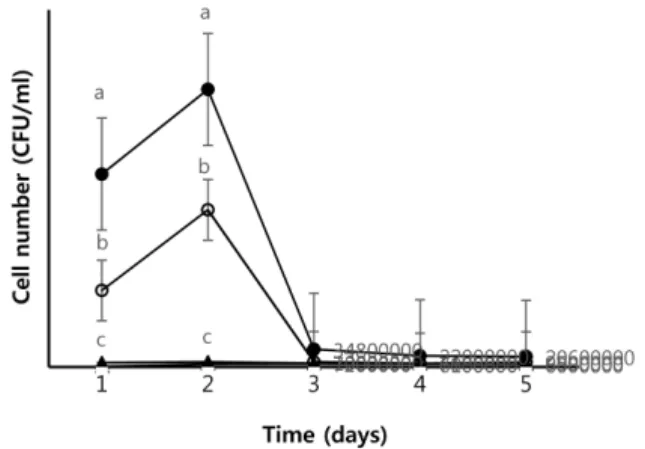
series of concentrations of skim milk. After 2 days incubation at 30
oC, it was confirmed that the addition of skim milk effec- tively enhanced the bacterial growth (Fig. 1). When zero to 1%
(w/v) of skim milk was added the bacterial growth was signi- ficantly retarded. With 5% (w/v) or 10% (w/v), it showed com- parably high growth rate and increased cell number after incu- bation for 48 h. However, the bacterial cell numbers showed sudden decrease after 2 days. Therefore, it was confirmed that the optimal condition for the growth was 2 days with 10% (w/
v) of skim milk concentration.
During the growth of lactic acid bacteria, the sugar concen- tration in rice koji was also monitored (Fig. 2). As the lactic acid bacteria grew sugar concentration in rice koji was increased.
This result might support that lactic acid bacteria in rice koji might have positive effect in further alcohol fermentation.
3.2. Acid production and pH of the culture
Acid production and the pH is one of the important factors in the quality of rice wine. Lowering the pH not only enhances the refreshing flavor of the rice wine but also prevents the conta-
Fig. 1. Bacterial growth of L. sakei in rice koji with the supplement of skim milk. Various concentrations of skim milk were added to rice koji. Bacterial cell growth was described by CFU/mL. Error bars represent the standard deviations. Difference letters superscripts in the same incubation time indicate significant difference (p≤0.05).
Symbols: △, 0% of skim milk; ▲, 1%; ○, 5%; ●, 10%.
mination of unnecessary bacteria [7]. However, excessive acid production, on the other hand, might result a strong sour flavor that impairs the taste of rice wine. The pH of the culture sho- wed the lowest value when no skim milk was added (Fig. 3).
However, it is said that the optimal pH of the rice wine is bet- ween 4 and 5. As depicted in Fig. 3, these pH ranges were ob- tained when 5% (w/v) or 10% (w/v) of skim milk was added.
However, the pH of culture decreased below 4 after incubation for 24 h.
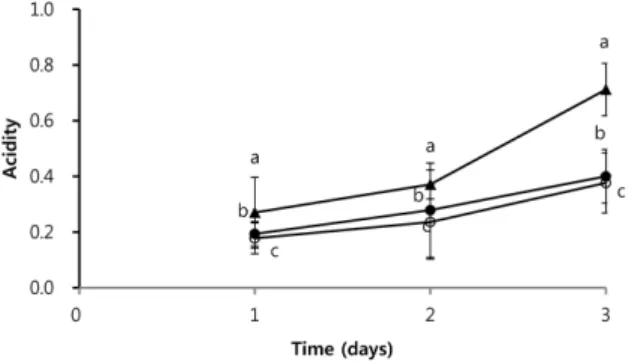
The decrease of pH in the culture is mainly due to the pro- duction of acids by the lactic acid bacteria. Therefore, the amo- unt of acids produced during the culture was monitored. Over the incubation periods, acidity of the culture was gradually
increased till 3 days. However, the acid production was not pro- portional to the skim milk concentration. The acidity showed the highest value with 1% of skim milk at 3 days (Fig. 4).
3.3. Ethanol tolerance
Acid production is important because it might have influence to the flavor of rice wine. However, it is also important that the lactic acid bacteria might also be present during the alcohol fermentation step. Therefore, alcohol tolerance was monitored in the presence of 10% (w/v) skim milk.
The bacterial growth was slowly retarded with the increase of the ethanol concentration (Fig. 5). There was no significant difference of bacterial growth between 5% (v/v) and 10% (v/v)
Fig. 2. Changes of sugar concentration in rice koji during the cultiva-tion of L. sakei. L. sakei was inoculated and cultured on rice koji supplemented with various concentrations of skim milk. Error bars represent the standard deviations. Difference letters superscripts in the same incubation time indicate significant difference (p≤0.05).
Symbols: △, 0% of skim milk; ▲, 1%; ○, 5%; ●, 10%.
Fig. 3. Changes of pH in rice koji during the cultivation of L. sakei.
L. sakei was inoculated and cultured on rice koji supplemented with various concentrations of skim milk. Error bars represent the standard deviations. Difference letters superscripts in the same incu- bation time indicate significant difference (p≤0.05).
Fig. 4. Acidity change of L. sakei culture. The amount of 0.1 N NaOH was measured to change the color of supernatant containing an aliquot of 1% phenolphthalein. Error bars represent the standard deviations. Difference letters superscripts in the same incubation time indicate significant difference (p≤0.05). Symbols: ○, 1% of skim milk; ●, 5%.▲, 10%.
Fig. 5. Determination of ethanol tolerance. L. sakei was cultivated in the broth containing 0%, 5%, 10%, and 15% of ethanol, respec- tively and incubated at 30oC for 2 days. The bacterial cell growth was measured with the spectrophotometer at 660 nm. Error bars represent the standard deviations. Difference letters superscripts in the same ethanol concentrations indicate significant difference (p≤ 0.05). Symbols: ◇, 24 h; , 48 h; △, 72 h.
bacteria. Among them lactic acid bacteria play an important role in the taste and flavor of rice wine [5]. Moreover, lactic acid bacteria in the alcohol fermentation process is lowering the pH of the culture and prevent its contamination from bac- teria in the early process of fermentation [6]. It also has been reported that lactic acid in rice wine might be able to eliminate the fatigue substances in the body to promote metabolism [7].
Lactic acid bacteria are having a variety of configurations of nutritional requirements such as amino acids, peptides, vita- mins and several mineral components depending on the species [9]. There were several reports about the facilitated the growth of lactic acid bacteria with the addition of vegetable extracts [10,11]. In this paper, we want to promote the growth of lactic acid bacteria supplemented with skim milk instead of vegeta- ble extracts.
Skim milk contains a large amount of non-fat-solids in it, which might be able to accelerate the growth of lactic acid bac- teria[12]. In this report, we have find out that higher concen- tration of skim milk was able to promote the growth of lactic acid bacteria (Fig. 1). More precisely, the highest growth of the lactic acid bacteria was shown in 10% (w/v) of skim milk. The addition of skim milk also influenced the acidity, sugar con- centration and ethanol tolerance of the bacteria.
On the other hand, even the bacterial growth was not signi- ficantly detected with 0% or 1% of skim milk, sugar concen- trations were slowly increased as the incubation time increased (Fig. 2). This might be the release of sugar from the rice koji.
These results imply that the supplementation of skim milk might improve the taste and flavor of rice wine through the promotion of the growth of lactic acid bacteria.
The change of pH and acidity in the rice wine is important. It is well known that the change of pH might deteriorate the fer- mentation process of rice wine. Therefore, it is an important indicator for alcohol fermentation [13]. The change of pH is due to a series of organic acids produced during the fermenta- tion process (Fig. 3) [14,15]. In this experiment the pH change came from the growth of the lactic acid bacteria. Therefore it might be the result of lactic acid production by the bacteria.
However, the pH of the culture went a little higher with the
fermentation process. It is well known that these acids affect the taste of the rice wine [18]. In this study, we measured the total acidity of the culture with the addition of 10% (w/v) of skim milk (Fig. 4). Total acidity of the culture was gradually increased throughout the culture time. In general, with compa- rably low acid content makes rough taste and higher content of acid makes sour taste [13].
Sugars used as substrates for microbial fermentation are im- portant in the production of ethanol and might influence on the creation of scent and sweetness [19,20]. So, sugar concentration is also an important factor of the texture of the rice wine. The change of sugar concentration was also examined in this study with the addition of skim milk. Soluble solid concentration was increased with a higher concentration of skim milk. This result implies that the addition of skim milk might enhance the sac- charification of rice koji. This result showed skim milk was able to affect the increase of sugar concentration. As the incu- bation time flows the sugar concentration might be decreased since sugars were used as a substrate of microbes [21,22].
Finally, alcohol concentration is also one of the most import- ant elements in the fermentation of all alcohol drinks and that affects the quality of the rice wine [23,24]. Generally, during the fermentation process of rice wine with traditional yeasts, the growth of lactic acid bacteria is rapidly decreased with the increase of alcohol concentration because lactic acid bacteria are difficult to grow in more than 5% (v/v) of alcohol [25,26].
In this study, the number of lactic acid bacteria also decreased rapidly with 10% (v/v) of alcohol concentration (Fig. 5). How- ever, L. sakei used in this study was able to survive even at 15% (v/v) of alcohol concentration (data not shown). This result showed that alcohol tolerance of L. sakei was enough to alcohol fermentation up to the concentration of 15% (v/v) of ethanol.
5. CONCLUSION
Based on these results, we were able to optimize the growth
conditions of lactic acid bacteria by the addition of skim milk.
The optimal condition for the growth was 2 days with 10% (w/
v) of skim milk concentration. This was also able to affect the change of pH, acidity, sugar concentration and alcohol toler- ance, which might contribute to the improvement of the quality of rice wine. With these results, it was confirmed that rice koji was an effective carbon source for the growth of lactic acid bacteria.
ACKNOWLEDGEMENTS
This research was financially supported by Chonnam National University, 2012.
REFERENCES
1. Lee, C. H. (1993) The history of Korean wines. BioIndustry 6: 58- 68.
2. Lee, D. H., W. J. Park, J. C. Lee, D. H. Lee, and J. S, Lee (2005) Manufacture and physiological functionality of Korean traditional wine by using gugija (Lycii fructus). Korean J. Food Sci. Technol.
37: 789-794.
3. Lee. H. S., C. S. Park, and J. Y. Choi (2010) Quality characteris- tics of the mashes of Takju, prepared using different yeasts.
Korean J. Food Sci. Technol. 42: 56-62.
4. Yu, T. S., H. Y. Kim., J. Hong, H. P. Ha, T. Y. Kim, and L. W. Yoon (1996) Bibliographical study on microorganism of Nuruk. J. Kor- ean Soc. Food Nutr. 25: 170-179.
5. Cho, J. S. (1994) Today and the future of Korean wine studies.
Wine Industry 4: 25.
6. Balajee, S. A., A. M. Borman, M. E. Brandt, J. Cano, M. Cuenca- Estrella, E. Dannaoui, J. Guarro, G. Haase, C. C. Kibbler, W. Meyer, K. O’DonnellK, C. A. Petti, J. L. Rodriguez-Tudela, D. Sutton, A.
Velegraki, and B. L. Wickes (2009) Sequence-based identification of Aspergillus, Fusarium, and Mucorales species in the clinical mycology laboratory: Where are we and where should we go from here? J. Clin. Microbiol. 47: 877-884.
7. Song, J. C., H. J. Park, and W. C. Shin (1997) Changes of Takju qualities by addition of cyclodextrin during the brewing and aging.
Korean J. Food. Sci. Technol. 29: 895-900.
8. Lee, S. B. K. H. Ko, J. Y. Yang, and S. H. Oh (2001) pp. 205-218.
Food Fermentation. Hyoil Publishing.
9. Kim, H. S. and S. E. Gilliland (1983) Lactobacillus acidophillus as a dietary adjunct for milk to aid lactose in humans. J. Dairy Sci.
66: 959-966.
10. Kulp, W. L. (1927) Scientific apparatus and laboratory methods an agar medium for plating L. acidophillus and L. bulgaricus. Sci- ence 66: 512-513.
11. Kuiken, K. A., W. H. Norman, C. M. Lyman, F. Hale, and L. Blot- ter (1943) The microbiological determination of amino acid. J.
Biol. Chem. 151: 615-625.
12. Koroleva, N. S. and N. A. Bavina (1970) Effect of conditions of kefir fungus cultivation on the microflora and biochemical charac- teristics of kefir starters. Proceedings of 8th International Dairy Congress, No. 1E, Sydney.
13. Jeong, J. W., K. J. Park, M. H. Kim and D. S. Kim (2006) Quality characteristics of Takju fermentation by addition of chestnut peel powder. Korean J. Food Preserv. 13: 329-336.
14. Lee, T. J., D. Y. Hwang, C. Y. Lee, and H. J. Son (2009) Changes in yeast cell number, total acid and organic acid during production and distribution processes of Makgeolli, traditional alcohol of Korea. Korean J. Microbiol. 45: 391-396.
15. Song, J. C., H. J. Park, and W. C. Shin (1997) Change of Takju qualities by addition of cyclodextrin during the brewing and aging.
Korean J. Food Sci. Technol. 29: 895-900.
16. Kim, J. Y. and Y. H. Yi (2008) pH, acidity, color, reducing sugar, total sugar, alcohol and organoleptic characteristics of puffed rice powder added wheat flour Takju during fermentation. Food Eng.
Prog. 12: 71-77.
17. Lee, D. H., J. H. Kim, and J. S. Lee (2009) Effect of pears on the quality and physiological functionality of Makgeoly. Korean J.
Food Nutr. 22: 606-611.
18. Song, J. C., H. J. Park, and W. C., Shin (2006) Suppression of solid matters precipitation of Takju and its quality improvement by car- rageenan. Korean J. Food Nutr. 19: 288-295.
19. Han, E. H., T. S. Lee, B. S. Noh, and D. S. Lee (1997) Quality characteristics in mash of Takju prepared by using different Nuruk during fermentation. Korean J. Food Sci. Technol. 29: 555-562.
20. Lee, J. S., T. S. Lee, J. Y. Choi, and D. S. Lee (1996) Volatile fla- vor components in mash of nonglutinous rice Takju during fer- mention. Agr. Chem. Biotechnol. 39: 249-254.
21. Park, C. S. and T. S. Lee (2002) Quality characteristics of Takju prepared by wheat flour Nuruks. Korean J. Food Sci. Technol. 34:
296-302.
22. Lee, J. S., T. S. Lee, B. S. Noh, and S. O. Park (1996) Characteris- tics of mash of Takju prepared by different raw materials. Korean J. Food Sci. Technol. 28: 330-336.
23. Park, C. S (2002) Quality characteristics of Takju prepared by what flour Nuruks. Korean J. Food Sci. Technol. 34: 296-302.
24. Song, J. C. and H. J. Park (2003) Takju brewing using the uncoo- ked germinated brown rice at second stage mash. J. Korean Soc.
Food Sci. Nutr. 32: 847-854.
25. Bae, K., K. S. Shin, H. Ryu, C. Kwon, and H. Sohn (2007) Identi- fication and fermentation characteristics of lactic acid bacteria iso- lated from the fermentation broth of Korean traditional liquor, andong-soju. Korean J. Microbiol. Biotechnol. 35: 310-315.
26. Seo, M., J. Lee, B. H. Ahn, and S. K. Cha (2005) The changes of microflora during the fermentation of takju and yakju. Korean J.
Food. Sci. Technol. 37: 61-66.