Research Article
Effects of Lactic Acid Bacteria Inoculants on Fermentation of Low Moisture Fresh Rice Straw Silage at Different Storage Periods
Palaniselvam Kuppusamy, Ilavenil Soundharrajan, Hyung Soo Park, Ji Hea Kim, Won Ho Kim, Jeong Sung Jung and Ki Choon Choi*
Grassland and Forage Division, National Institute of Animal Science, Rural Development Administration, Seonghwan-eup, Cheonan 31000, Republic of Korea
ABSTRACT
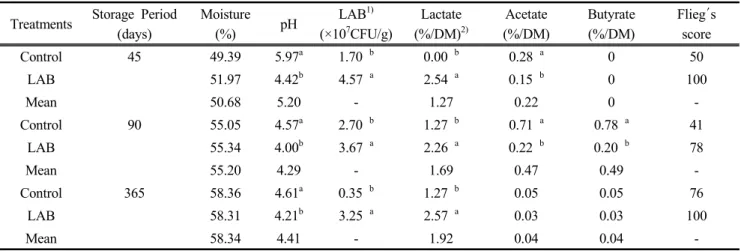
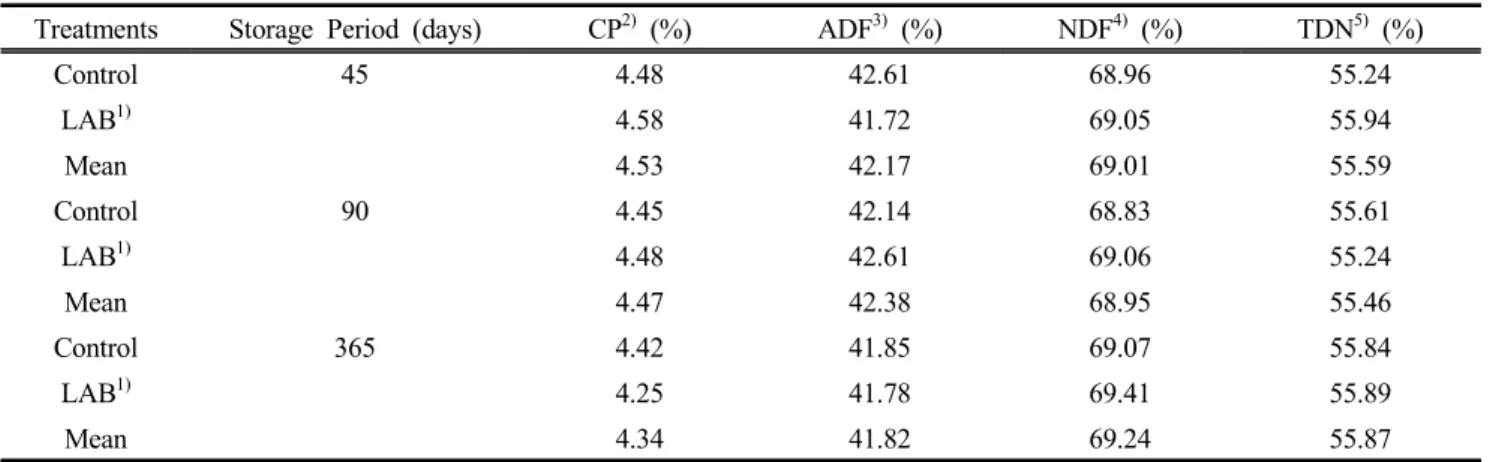
The purpose of this study was to analyze the effectiveness of different storage periods of lactic acid bacteria (LAB)-fermented low moisture fresh rice straw silage. The low moisture fresh rice straw sample was inculcated with LAB and stored for different storage periods such as 45, 90, and 365 days, respectively. The low moisture fresh rice straw (LMFRS) silage inoculated with LAB exhibited reduction in pH throughout the fermentation as compared with the control (P<0.05). The lactic acid content was increased at the late fermentation period (90 and 365 days, respectively) in LAB inoculated LMFRS silage as compared with the control (P<0.05). In contrast, the acetic acid and butyric acid concentrations were slightly reduced in the LAB inoculated LMFRS silage sample at 90 and 365 days fermentation, respectively. Meanwhile, the non-inoculated LMFRS silage showed higher amounts of acetic acid and butyric acid at an extended fermentation with low bacterial population as compared with the LAB inoculated LMFRS silage. However, lactic acid concentration was slightly high in the non-inoculated LMFRS silage at early 45 days fermentation. Additionally, the nutrient profile such as crude protein (CP), acid detergent fibre (ADF), neutral detergent fibre (NDF), and total digestibility nutrients (TDN) were not significantly different in control and LAB inculcated samples during all fermentation. Though, the microbial population was greater in the LAB inoculated LMFRS silage as compared with the control. However, the massive population was noted in the LAB inoculated LMFRS silage during all fermentation. It indicates that the inoculated LAB is the main reason for increasing fermentation quality in the sample through pH reduction by organic acids production. Overall results suggest that the LAB inoculums are the effective strain that could be a suitable for LMFRS silage fermentation at prolonged days.
(Key words: LAB, Fresh rice straw, Low moisture, Fermentation, Storage period, Silage quality)
Ⅰ. INTRODUCTION
Rice cultivation produces large quantity of fibrous crop residues of which only 25% utilized for renewable energy by industrial and domestic purposes in Japan (Cai et al., 2003). In especially Southeast Asia among many developing countries, the rice straw is using as a feed ingredient for the ruminants (Stundtol and Owen, 1984; Kim et al., 2004; Choi et al., 2015). However, due to its low nutritional value and high level of lignin and silica, there is limitation to its digestibility and feed value (Oladosu et al., 2016). Presently, to improving the rice straw quality various additives were used that increases crude protein (CP) content and fermentation quality. Though, the palatability of rice straw for ruminants is low due to the less dry matter content, hollow stems and small amount of epiphytic lactic acid bacteria (Li et al., 2010). However, it is
difficult to make good silage from fresh rice straw due to low water soluble carbohydrate (WSC) content at fibrous stems, and less proliferation of epiphytic lactic acid bacteria (LAB) in rice straw crop residue (Kim et al., 2017).
LAB strains are the most common biological additives used to efficiently ferment forage crops with enhanced their nutritional quality (Hu et al., 2015; Dogi et al. 2015; Wu et al., 2014;
Valan Arasu et al., 2014; Valan Arasu et al., 2013). The homofermentative LAB strains such as Lactobacillus plantarum,
Enterococcus faecium, and Pediococcus spp. are enhance thelactic acid fermentation with feed value of silage (Muck et al., 1991; Ahn et al., 2007; Srigopalram et al., 2017). Inoculation of LAB can helps decrease pH faster, lower the final pH value, increase lactic acid content, and decrease NH
3-N in low moisture fresh rice straw (LMFRS) silage (Kim et al., 2004).
Forages for ruminant are preserved for storage in the form
*Corresponding author: Ki Choon Choi, Grassland and Forage Division, National Institute of Animal Science, Rural Development Administration, Seonghwan-eup, Cheonan 31000, Republic of Korea. Tel: +82-41-580-6755. Fax: +82-41-580-6779. E-mail: [email protected]
of hay, haylage (low moisture silage), or silage. In general, silage has a moisture content of more than 40 %. However, haylage has a moisture content of between 35 to 60 % (wet haylage containing between 50 and 60%, dry halyage containing between 35 and 50%). Recently, Korean livestock farmers are highly interesting in halyage manufacture, even though they were used high moisture silage as forage for ruminants.
Therefore, the objective of this study was to investigate the fermentation characteristic of LAB-inoculated LMFRS silage and their chemical profile at different storage period was evaluated.
Ⅱ. MATERIALS AND METHODS
1. Sample collection and preparation of LMFRS silage Rice was grown and harvested at the ripening stage in National Institute of Animal Science, Grassland farm, Seonghwan-eup, Korea in November 2018. Further, low moisture fresh rice straw dried at field for 6 hrs to make moisture between 50-60%
and chopped into small pieces approximately 1-1.5cm. Then, the low moisture fresh rice straw were prepared for silage including control (without LAB), and LAB inoculants (Top haylage private limited, Jungnong Bio Inc, South Korea). The LAB inoculants was dissolved in sterile deionized water and sprayed onto LMFRS sample (2g/1 ton of forage material) and then mixed thoroughly by automated machine. Control was sprayed with deionized water at an equivalent rate. After that, 200g of low moisture fresh rice straw mixture was vacuum-packed in 28×36cm polyethylene bags with 3 replicates for each treatment, and stored at ambient temperature for different incubation time (45, 90 and 365 days) (Choi et al., 2015, Srigopalram et al., 2015).
2. Fermentation characteristics and chemical composition of LMFRS silage samples
The silage cover was opened after respective incubation period (45, 90 and 365d) completion and immediately measured the pH and organic acids concentrations of rice straw samples. 10g rice straw sample was blended with 90 ml of sterile deionized water, and kept at shaker in 80 rpm for 6 hrs at 4°C. Further, the homogenate was filtered through whatman no.1 filter paper.
The filtrate was used to determined pH using a glass electrode
pH meter (WTW Inolab pH 7110 Xylem Analytics Inc., Germany).
In addition, the filtrate was serially diluted and used for microbial colony counting by automatic quantum total cell staining kit (Quantom Tx Microbial cell counter, Logos biosystems, Korea).
10µl of serially diluted silage sample was mixed with 1µl cell staining dye (membrane permeable fluorescent dye that can stain only bacterial nucleic acids in live cells) and 1µl of cell staining enhancer and then incubated for 30 min for enhancing the fluorescence staining. Then, add 8µl cell loading buffer I and mix well without bubbles. Further, the mixture (6µl) was load into a Quantum M50 cell counting slides. The slides carefully centrifuge at 300RCF for 10min in a Quantum centrifuge and count the sample slides with a Quantom Tx with the light intensity level. For assessment of organic acid concentrations, the filtrate (5 ml) was centrifugation at 10,000 ×g, for 15 min at 4°C. The supernatant was analyzed for lactic acid (LA), acetic acid (AA) and butyric acid (BA) in the LMFRS silage. The concentrations of LA, AA and BA were determined by high performance liquid chromatography–diode array detector (C18 column, Agilent HPLC 1100, column temperature at 35°C; mobile phase 0.1mM phosphoric acid solution; flow rate 0.7ml/ min; DAD detector 240 nm; 10 μl sample volume) (Marsili et al., 1981). And then, Silage grade was calculated by methods of Saricicek et al.
(2016).
All the silage samples were analyzed for their chemical composition. LMFRS silage samples were dried at 60°C for 5 days and then ground using cyclone mill to pass through a 1 mm screen for nutritive value analyses. Acid detergent fibre (ADF) and neutral detergent fiber (NDF) determined according to the methods of Van Soest et al. (1991) and total digestible nutrients (TDN) were calculated according to following equation (TDN=88.9-(ADF%*0.79). Crude protein (CP) was determined according to the method previously published by Association of Official Analytical Chemists (AOAC, 1990).
3. Statistical analyses
The obtained silage results were evaluated by t-test analysis
using SPSS software, ver.12.0 (VA, USA) and significant was
set at p value less than 0.05. All these analyses were performed
triplicate.
Ⅲ. RESULTS AND DISCUSSION
1. The nutritional quality of LMFRS silage among different storage periods
The present study, LAB-inoculated LMFRS silage had relatively higher lactic acid content (p<0.05) in all fermentation (storage) period compared with non-inoculated LMFRS silage except 45 days fermentation period. The acetic acid (AA) concentration decreased significantly (p<0.05) except for 365 days in LAB- inoculated LMFRS silage, while butyric acid (BA) concentration two fold increased in LAB-inoculated LMFRS silage sample at 90 days incubation period and later slowly decreased the production (365 days). LAB-inoculated LMFRS silage steadily increase lactic acid concentration in all storage period compared with control as shown on data of LMFRS silage stored for one year. The low pH value in LAB-inoculated silage prevents the undesirable microorganism growth such as yeast, molds etc.
This result in agreement with that reported rice straw fermented with fermented juice of lactic acid bacteria increased the crude protein content of LMFRS silage (Sulistyo et al., 2019). Table 1 shows the nutrient profile and microbial population in LAB- inoculated and non-inoculated LMFRS silage at different storage period. The massive microbial population was noticed in LAB-inoculated silage than control sample, due to that the fast reduction of pH and higher amount of organic acid production in the LAB-inoculated silage.
2. The fermentation quality of LMFRS silage among different storage periods
In addition, there were no significant difference was observed in the CP, ADF, NDF and TDN profile (Table 2). Table 2 shows the chemical composition of LAB-inoculated and non-inoculated LMFRS silage at different storage period. Both LAB-inoculated and control had the almost similar CP, ADF and TDN values while control has lowest CP and NDF, but there was no significant difference in the nutrient profile of LAB-inoculated LMFRS silage and control. Similarly, Ki et al. (2017) reported LMFRS silage contained the lowest CP, NFC, and TDN, but the highest ADF, indicating that it is least nutritious among the tested forages.
The inoculation of Lactobacillus (L. plantarum and S. bovis) in LMFRS silage improved the silage quality (e.g high CP content) and fermentation characteristic (e.g. increase in production of lactic acid and acetic acid) in the silage. In addition, analysis of rumen microbial community showed significant increases population of cellulolytic bacterial protozoa, methanogens and archaea among the LAB treatments as compared with control (Oskoueian et al., 2019). Li et al. (2017) studied the rice straw silages ensiled alone and mixed-material silages (PR (paddy rice straw) + SP (sweet potato vines), UR (upland rice straw) + SP) showed higher fermentation quality with lower propionic acid content, NH3-N ratio of total N, and higher concentrations of lactic acid and acetic acid. The ensiling would be an effective way of utilization of rice straw and sweet potato vines to
Treatments Storage Period (days)
Moisture
(%) pH LAB
1)(×10
7CFU/g)
Lactate (%/DM)
2)Acetate (%/DM)
Butyrate (%/DM)
Flieg′s score
Control 45 49.39 5.97
a1.70
b0.00
b0.28
a0 50
LAB 51.97 4.42
b4.57
a2.54
a0.15
b0 100
Mean 50.68 5.20 - 1.27 0.22 0 -
Control 90 55.05 4.57
a2.70
b1.27
b0.71
a0.78
a41
LAB 55.34 4.00
b3.67
a2.26
a0.22
b0.20
b78
Mean 55.20 4.29 - 1.69 0.47 0.49 -
Control 365 58.36 4.61
a0.35
b1.27
b0.05 0.05 76
LAB 58.31 4.21
b3.25
a2.57
a0.03 0.03 100
Mean 58.34 4.41 - 1.92 0.04 0.04 -
1) LAB: Lactic acid bacteria (Top silage inoculants), 2)DM: Dry matter content
a,b Means followed by different lowercase letters in the same column differ (p<0.05).
Table 1. Fermentation characteristics and microbial population in LAB-inoculated LMFRS silage at different storage periods
improve rice straw fermentation quality with low water soluble carbohydrate content.
In addition, Mbiriri et al. (2012) reported the rice straw silage (RSS) maintained higher pH values than the other forage sources (IRG and corn silage). A declining pH trend with increased time of incubation, in agreement with literature, was observed for all forage sources. Lee et al. (2018) studied among five strains Lactobacillus plantarum CMRT, L. Leuconostoc
mesenteroides M17, L. sakei C11, M5, SP2) M17 strain is asuitable substitute for to generate high quality rice straw silage based on odor, pH, CP, total organic acid, and feed value of the fermented rice straw silage. Also, Santoso et al. (2014) carried out the study addition of LAB inoculant in silage increased lactic acid concentration, in vitro digestibility and fermentation quality of rice straw silage. Furthermore, Zhang et al. (2010) compared with whole-plant rice straw silage (WRS), chopped rice straw silage (CRS) that WRS dramatically reduced pH and increased the contents of lactic acid and total organic acids.
The CP, NDF and ADF content of CRS was 13.4, 5.9 and 10.2% lower than in WRS, respectively.
Ⅳ. CONCLUSION
Overall, using of LAB inoculums on fermentation period 90 and 365 days could increased fermentation quality of LMFRS silage including decreased of pH value, increased lactic acid content and microbial population. Prolonging the fermentation
period from 90 to 365 days did not show any differences or advanced increases of CP, ADF NDF, TDN and dry matter content. Hence, the LMFRS silage inoculated with LAB has longer incubation period potent lactic acid production than shorter fermentation time and it is good strategy for ensiling of LMFRS. Also we should consider the LAB application and rice varieties of the crop residues and other factors (moisture, WSC content and temperature) may influence the LMFRS fermentation. Finally, LAB inoculums could improve the silage fermentation of LMFRS though they even contain low fermentable WSC and dry matter content.
Ⅴ. ACKNOWLEDGEMENTS
This work was carried out with the support of "Cooperative Research Program for Agriculture Science & Technology Development (Project title: Development of Quality Improvement and Standardization Technique for Low Moisture Storage Forage; Project No. "PJ01091601" Rural Development Administration.
Republic of Korea. This study was supported by Postdoctoral Fellowship Program of (National Institute of Animal Science), Rural Development Administration, Republic of Korea.
Treatments Storage Period (days) CP
2)(%) ADF
3)(%) NDF
4)(%) TDN
5)(%)
Control 45 4.48 42.61 68.96 55.24
LAB
1)4.58 41.72 69.05 55.94
Mean 4.53 42.17 69.01 55.59
Control 90 4.45 42.14 68.83 55.61
LAB
1)4.48 42.61 69.06 55.24
Mean 4.47 42.38 68.95 55.46
Control 365 4.42 41.85 69.07 55.84
LAB
1)4.25 41.78 69.41 55.89
Mean 4.34 41.82 69.24 55.87
1) Lactic acid bacteria (Top silage inoculants), 2) CP: crude Protein,3) ADF: Acid Detergent Fibre; 4) NDF: Neutral Detergent Fibre; 5) TDN:
Total Digestible Nutrients.
Table 2. Chemical composition of LMFRS silage at different storage periods
Ⅵ. REFERENCES
Ahn, J.H. 2007. Effects of supplementing organic citrus in making rice straw silage. Korean Journal Of Organic Agriculture. 15:309-318.
AOAC. 1990. Official methods of analysis (15th Ed.). Association of Official Analytical Chemists. Arlington, Virginia, USA. p. 1-1298.
Cai, Y., Fujita, Y., Murai, M., Ogawa, M., and Yoshida, N. 2003.
Application of Lactic acid bacteria (Lactobacillus plantarum Chikuso-1) for silage preparation. Grassland Science. 49:477-485.
Choi, K.C., Ilavenil, S., Arasu, M.V., Park, H.S. and Kim, W.H. 2015.
Effect of addition of chlorella and lactic acid bacteria on nutritive value and fermentation quality of fresh rice straw silage. Journal of the Korean Society of Grassland and Forage Science. 35:159-165.
Choi, K.C., Ilavenil, S., Valan Arasu, M., Park, H.S. and Kim, W.H.
2015. Effect of addition of lactic acid bacteria on fermentation quality of rye silage. Journal of the Korean Society of Grassland and Forage Science. 35:277-282.
Dogi, C.A., Pellegrino, M., Poloni, V., Poloni, L., Pereyra, C.M., Sanabria, A., Pianzzola, M.J., Dalcero, A. and Cavaglieri, L. 2015.
Efficacy of corn silage inoculants on the fermentation quality under farm conditions and their influence on Aspergillus parasitucus, A.
flavus and A. fumigatus determined by q-PCR. Food Additives &
Contaminats: Part A: Chemistry, Analysis Control Expo Risk Assess.
32:229-235.
Hu, X., Hao, W., Wang, H., Ning, T., Zheng, M. and Xu, C. 2015.
Fermentation characteristics and lactic Acid bacteria succession of total mixed ration silages formulated with peach pomace. Asian- Australas Journal of Animal Science. 28:502-510.
Ki, K.S., Park, S.B., Lim, D.H. and Seo, S. 2017. Evaluation of the nutritional value of locally produced forage in Korea using chemical analysis and in vitro ruminal fermentation. Asian-Australasian Journal of Animal Sciences. 30:355-362.
Kim, J.G., Ham, J.S., Li, Y.W., Park, H.S., Huh, C.-S. and Park, B.-C.
2017. Development of a new lactic acid bacterial inoculant for fresh rice straw silage. Asian-Australasian Journal of Animal Sciences.
30:950-956.
Kim, S.R., Kim, G.S., Woo, J.H., Lee, J.W. and Sung, K.II. 2004.
Chemical composition and fermentation characteristics of storage sections of the round bale silage of fresh rice straw at Yonchon of Gyeonggi-do. Journal of the Korean Society of Grassland and Forage Science. 24:254-260.
Lee, I.-S., Lee, S.-Y., Choi, M.-K., Kang, C.-H. and Kim, J.-M. 2018.
Evaluation of the fermentation ability of lactic acid bacteria to manufacture highest quality rice straw silage. Korean Journal of Crop Science. 63:106-111.
Li, J., Shen, Y., and Cai, Y. 2010. Improvement of fermentation quality of rice straw silage by application of a bacterial inoculant and
glucose. Asian-Australasian Journal of Animal Sciences. 23:901-906.
Li, P., Ji, S., Wang, Q., Qin, M., Hou, C. and Shen, Y. 2017. Adding sweet potato vines improve the quality of rice straw silage. Animal Science Journal. 88:625-632.
Marsili, R.T., Ostapenko, H., Simmons, R.E. and Green, D.E. 1981.
High performance liquid chromatographic determination of organic acids in dairy products. Journal of Food Science. 46:52-57.
Mbiriri, D.T., Oh, S.-J., Lee, A.-R., Chae, J.-I., Choi, C.-W. and Choi, N.-J. 2012. In vitro rumen fermentation patterns of environment friendly whole crop barley, Italian ryegrass and rice straw silages.
Korean Journal of Organic Agriculture. 20:221-230.
Muck, R.R. and Bolsen, K.K. 1991. Silage preservation and silage additives. pp. 105-125. In Bolsen, K.K., Baylor, J.E. and McCullough, M.E. (eds) Hay and Silage Management in North America. National Feed Ingredients Association, West Des Moines, Iowa, USA.
Oladosu, Y., Rafii, M.Y., Abdullah, N., Magaji, U., Hussin, G., Ramli, A. and Miah, G. 2016. Fermentation quality and additives: A case of rice straw silage. BioMed Research International. 7985167:1-14.
Oskoueian, E., Jafari, S., Noura, R., Jahromi, M.F., Meng G.Y. and Ebrahimi, M. 2019. Application of different types of Lactic Acid Bacteria inoculant on ensiled rice straw; effects on silage quality, rumen fermentation, methane production and microbial population.
BioRxiv preprint first posted online doi: http://dx.doi.org/10.1101/612556.
Pangastuti, A., Setyaningsih, R. and Widyawati, S.D. 2019. Dynamics of the bacterial community in fermentation process of rice straw as animal feed. IOP Conference Series: Earth and Environmental Science.
292:012026.
Santoso, B., Tj Hariadi, B., Sabariah, V. and Sraun, T. 2014. Fermentation quality and in vitro nutrient digestibility of fresh rice straw-based silage treated with Lactic Acid Bacteria. Media Peternakan. 37:115-120.
Saricicek, B.Z., Yoldirimi, B., Kocabasi, Z. and Demiri, E.O. 2016. The effects of storage time on nutrient composition and silage quality parameters of corn silage made in plastic mini silo in laboratory conditions. Igdir University Journal of the Institute of Science and Technology. 6:177-183.
Srigopalram, S., Ilavenil, S., Vijayakumar, M., Park, H.S., Lee, K.D. and Choi, K.C. 2015. Addition of novel Lactobacillus plantarum KCC-10 and KCC-19 to improve fermentation quality and characterization of Italian ryegrass silage. Journal of the Korean Society of Grassland and Forage Science. 35:195-200.
Srigopalram, S., Kuppusamy, P., Ilavenil, S., Park, H.-S., Kim J.H., Yoon, Y. H., Kim, Y. J., Jung, J.S. and Choi, K.-C. 2017. Effect of Addition of Lactic Acid Bacteria on Fermentation Quality of Miscanthus sinnensis. Journal of the Korean Society of Grassland and Forage Science. 37:140-144.
Stundtol, F. and Owen, E. 1984. Straw and Other Fibrous By-products as Feed. Elsevier.
Valan Arasu, M., Jung, M.W., Ilavenil, S., Jane, M., Kim, D.H., Lee, K.D., Park, H.S., Huh, T.Y., Choi, G.J., Lim, Y.C., Al-Dhabi, N.A.
and Choi, K.C. 2013. Isolation and characterization of antifungal compound from Lactobacillus plantarum KCC-10 from forage silage with potential beneficial properties. Journal of Applied Microbiology. 115:1172-1185.
Valan Arasu, M., Jung, M.W., Kim, D.H., Ilavenil S., Lee, K.D., Choi, G.J., Al-Dhabi, N.A. and Choi, K.C. 2014. Isolation and characterization of Lactobacillus plantarum KCC-19 from crimson silage. Journal of Pure and Applied Microbiology. 8:3575-3587.
Van Soest, P.J., Robertson, J.B. and Lewis, B.A. 1991. Methods for dietary fiber, neutral detergent fiber, and non-starch polysaccharides
in relation to animal nutrition. Journal of Dairy Science. 74:3583-3597.
Wu, J.J., Du, R.P., Gao, M., Sui, Y.Q., Xiu, L. and Wang, X. 2014.
Naturally occurring lactic Acid bacteria isolated from tomato pomace silage. Asian-Australas Journal of Animal Science. 27:648-657.
Zhang, Y.G., Xin, H.S. and Hua, J.L. 2010. Effects of treating whole- plant or chopped rice straw silage with different levels of lactic acid bacteria on silage fermentation and nutritive value for lactating Holsteins. Asian-Australasian Journal of Animal Sciences. 23:1601- 1607.
(Received : August 6, 2019 | Revised : September 16, 2019 | Accepted : September 16, 2019)