Research Article
Effects of Lactic Acid Bacteria Inoculant on Fermentation Quality and in vitro Rumen Fermentation of Total Mixed Ration
Yeon Jae Choi and Sang Suk Lee*
Department of Animal Science and Technology, Sunchon National University, Suncheon 57922, Republic of Korea
ABSTRACT
Fermented total mixed ration (TMR) is a novel feed for ruminants in South Korea. The purpose of this study was to evaluate the effects of lactic acid bacteria (LAB) on the quality of TMR and in vitro ruminal fermentation. Strains of three LAB spp. (Lactobacillus plantarum, L. brevis, L. mucosae) were used in fermentation of TMR. Inoculations with the three LAB spp. lowered pH and increased concentrations of lactic acid, acetic acid, and total organic acid compared to non-LAB inoculated control (only addition of an equivalent amount of water) (p<0.05). Bacterial composition indicated that aerobic bacteria and LAB were higher. However, E. coli were lower in the fermented TMR than those in the control treatment (p<0.05). Among the treatments, L. brevis treatment had the highest concentration of total organic acid without fungus detection. Gas production, pH, and ammonia-nitrogen during ruminal in vitro incubation did not differ throughout incubation. However, ruminal total VFA concentration was higher (p<0.05) in the LAB spp.
treatments than the control treatment at 48 hours. Overall, the use of L. brevis as an inoculant for fermentation of high moisture.
TMR could inhibit fungi growth and promote lactic fermentation, and enhance digestion in the rumen.
(Key words: In vitro fermentation, Lactic acid bacteria, Total mixed ration)
Ⅰ. INTRODUCTION
Total mixed ration (TMR) has been widely used for lactating cow feeding and balanced with feed ingredients such as forages, grains, proteins, minerals, vitamin, and additives to meet the livestock’s nutritional requirements. Total mixed ration has limitations to be used in some farms due to the requirement for labor forces and equipment. In South Korea, fermented TMR has been increasingly used for beef cattle, goat, and pig feeds (Lee et al., 2009; Cha et al., 2018). However, fermented TMR enhances preference through changes in smell and flavor, and provides stable and nutritionally balanced feed (Nishino et al., 2003; Yuan et al., 2015). In South Korea, because imported hay is used for most forage, it has a low water content, which leads to separation of forages and concentrated feed, and so water is added when making TMR. For that reason, TMR has an around 40% water content, which becomes a risk factor for spoilage either due to the state of the ingredients or due to mold and/or aerobic bacteria.
Inoculation of lactic acid bacteria (LAB) aims to induce dominance of the inoculated strain over the native bacterial population and to suppress the growth of undesirable microorganisms
(Wilkinson et al., 2003; Saarisalo et al., 2007). Lactobacillus spp. can be used for TMR, which can improve the fermentation of TMR through lowering pH, increasing lactic acid content, and improving Frieg’s mark and V-score (Cao et al., 2010).
Also, inoculation with lactic fermenting microorganisms can prevent a decrease of nutrient content in TMR, compared to non-treated control during TMR production (Ki et al., 2007).
According to a report by Shioya (2008), lactic acid bacteria dominant in TMR leads to low pH, high lactic acid, but low butyric acid content. It also results in an increase in dry matter (DM) intake, crude protein (CP), ether extract (EE), neutral detergent fiber (aNDF) digestion rate, and gross digestible energy compared to non-fermented TMR. Feeding with fermented TMR is effective at reducing nutritional loss because it improves digestion rate (Yang et al., 2010).
Lactobacillus spp. are subgrouped by their carbohydrate fermentation profiles, namely, obligate homo-fermentative, facultative hetero-fermentative, and obligate hetero-fermentative. Hetero- fermentative Lactobacillus produces lactate, acetate, and propionate to inhibit pathogenic bacteria and fungi. It has been reported to be excellent for silage stability and to increase silage digestibility of livestock (Nsereko et al. 2008). Therefore, the fermentation
*Corresponding author: Sang-Suk Lee, Sunchon National University, Suncheon 57922, Korea.
Tel: +82-61-750-3237, E-mail: [email protected]
characteristics of TMR and its in vitro ruminal fermentation characteristics were evaluated using three LAB species.
Ⅱ. MATERIALS AND METHODS
1. Isolation, identification and metabolite production of microbes
Two animal samples, including Korean native cattle feces and Korean native goat rumen fluid were collected for isolation of LAB from Sunchon National University animal farm. Each sample was pre-cultivated at 37°C for 30 min in an incubator in a sterile tube containing 50 ml of 0.85% saline.
The sample was 10-fold serially diluted in 0.85% saline, and 0.1 ml of the sample was spread on LAMVAB medium plate (Hartemink et al., 1997) and incubated at 37°C for 48h. After incubation, greenish colonies and yellow around randomly picked from the plates and transferred to MRS agar (Merck, Germany). Isolated microorganisms were genetically characterized and identified by amplifying the 16S rRNA gene sequences of using primers 27F (5’-AGA GTT TGA TCC TGG CTC AG-3’) and 1492R (5’-GGT TAC CTT GTT ACG ACT T-3’).
PCR products were purified by using a QIAquick PCR Purification Kit (Qiagen, USA). Purified PCR products of 16S rDNA were sent to Macrogen (Macrogen, Korea) for DNA sequencing. Sequenced fragments were assembled using the SeqMan program (DNA Star, USA). The gene sequences were then compared with 16S RNA gene sequences available in EzTaxon and NCBI-BLAST programs. Isolates were re-cultivated in broth medium at 39°C for 24 h in a shaking incubator at 120 g. One ml sample of each culture was then transferred to respective Eppendorf tubes and immediately centrifuged at 16 609 g for 10 min at 4°C in a Micro 17TR centrifuge (Hanil Science Industrial Co. Ltd, Korea). The resulting supernatants were filtered through 0.2-㎛ Millipore filters, transferred to clear vials and sealed with screw caps for determination of VFA concentrations. Standards with R
2= 0.999 were prepared prior to sample analysis. Volatile fatty acid concentrations were measured via high-performance liquid chromatography (HPLC) using a device (Agilent Technologies 1200 series) with a UV detector set at 210 and 220 nm. A MetaCarb 87H (Varian, USA) column was used in the determination of fermentation
products, and a 0.0085 N H2SO4 buffer was applied to the column at a rate of 0.6 ml min
-1(Tabaru et al. 1988). The VFA concentration in mmol l
-1was calculated in ppm divided by the molecular weight.
2. Fermentation of TMR
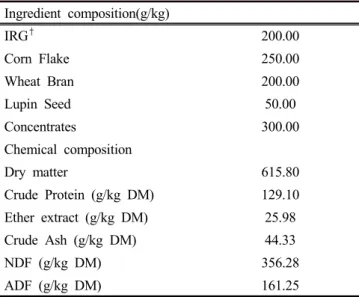
Total mixed ration (TMR) was balanced using Italian ryegrass (IRG), corn flake (Corn), wheat bran (WB), lupin seed (LS), and concentrated feed (CF). The proportions of IRG, Corn, WB, LS, and CF were fixed at 200, 250, 200, 50 and 300 g/kg TMR dry matter (DM), respectively. TMR was prepared as follows: IRG, Corn, WB, LS, and CF were mixed and added to 10% LAB culture (1x10
8cfu/mL), and 30% distilled water.
This TMR was then adjusted with water to a moisture content of 385g/kg. TMR mixtures were put in a plastic box and mixed to get a uniform distribution of each ingredient, and then packed into zipper bags (30cm diameter x 35cm height, Clean wrap, Korea). There were 3 replications for each treatment.
The TMRs were treated with no lactobacillus inoculation (control), L. plantarum (T1), L. brevis RNAL14 (T2), L. mucosae 521129 (T3). Silage bags were incubated 37°C for 7 days.
3. Fermentation quality analysis
Fermentation qualities were determined by measuring pH, organic acid, chemical composition and microbial count of the TMR 5.0g fresh sample was homogenized used a reciprocating shaker for 30min with 45mL of sterilized distilled water. The pH was measured with a Pinnacle series M530p meter (Schott instruments, Germany). After centrifugation (16,609 × g, 10 min, 4°C), the supernatant was analyzed for organic acid concentrations. The supernatant was passed through a 0.2 µm millipore filter under pressure and then injected into a High- performance liquid chromatography (Agilent Technologies 1200 series) system to determine organic acid concentrations.
HPLC with a UV detector set at 210 nm and 220 nm. A
MetaCarb 87H (Varian, Germany) column was used in the
determination of fermentation products with application of
0.0085 N H
2SO
4buffer at a rate of 0.6 mL/min (Tabaru et al.,
1988). The organic acid concentration in mM was calculated
in ppm divided by the molecular weight. Fermented feed was
analyzed for DM and CP according to the AOAC (1990). The
microbiological assay of the TMR was performed by the serial
dilution and agar plate count method. Total aerobic bacteria were enumerated using tryptic soy agar (Difco, USA). LAB was enumerated using 0.04% bromocresol purple (Sigma, USA) with Lactobacilli MRS agar (Difco). Mold growth was measured using yeast extract glucose chloramphenicol agar (Merck, USA).
Coliforms were enumerated using MacConkey agar (Difco, USA).
4. In vitro rumen fermentation
Ruminal contents were obtained from three 48-month-old rumen-cannulated Holstein Friesian cow with body weights of 600 kg ± 47 kg that had been fed twice a day with concentrate feed (NongHyup Co, Korea) and rice straw at a 2:8 ratio.
Rumen fluid collection was made by hand, after which the contents were squeezed and strained through four layers of cheesecloth. Ruminal fluid was pooled in prewarmed amber bottles covered with foil, sealed, and immediately transported to the laboratory; the temperature was maintained at 39°C. Buffer solution was prepared according to the procedure described by Asanuma et al, (1999) with the following composition in mg/L:
dipotassium phosphate (K
2HPO
4), 450; monopotassium phosphate (KH
2PO
4), 450; magnesium sulfate heptahydrate (MgSO
4·7H
2O), 190; calcium chloride dehydrate (CaCl
2·2H
2O), 120; sodium chloride (NaCl), 900; cysteine hydrochloride (C
3H
7NO
2S·HCl), 600; ammonium sulfate ((NH
4)
2SO
4), 900; trypticase peptone (BBL, USA), 1000; and yeast extract (Difco, USA), 1000. The
prepared medium was then autoclaved at 121°C for 15 min and maintained in a 39°C water bath and flushed with N
2. The pH of the buffer was adjusted to 6.9 using 10 N NaOH, after which the particle-free rumen fluid was added. Next, 100 mL of buffered rumen fluid was anaerobically transferred to each of the serum bottles containing the 1% DM of distinct TMR.
The bottles were subsequently sealed with rubber septum stoppers and aluminum caps and incubated at 39°C for 48 h in an HB-201SF shaking incubator (Hanbaek Scientific, Korea) at 100 rpm. Experimental treatments were replicated three times for each incubation period.
5. Parameters for analysis of in vitro rumen fermentation At the end of each incubation period, parameters were measured in each of the serum bottles. The pH was measured with a Pinnacle series M530p meter (Schott Instruments, Germany) immediately after uncapping each bottle. Total gas was determined using a press and sensor machine (EA-6 Laurel Electronics, USA). Briefly, a needle channel connected to the machine was extended into the sealed fermentation bottle to measure the accumulated gas pressure in the headspace of the bottle. A gas flow regulator was subsequently opened, allowing the gas to flow inside a syringe barrel. The plunger was pulled gradually until the pressure reading in the machine display reached zero and the volume of gas trapped inside the barrel was recorded as the total gas produced in ml. Additionally, 1.0 ml of fermenta from each of the serum bottles were immediately centrifuged at 16,609 × g for 10 min at 4°C using a Micro 17TR centrifuge (Hanil Science Industrial Co. Ltd., Korea). The supernatant and the pellet were separated and kept in 1.5 mL Eppendorf tubes and then frozen at -80°C until ammonia-nitrogen (NH
3-N), VFA, and molecular analyses. The NH
3-N concentration was measured according to the methods developed by Chaney and Marbach (1962) using a Libra S22 spectrophotometer (Biochrom Ltd., England) at an absorbance of 630 nm. For determination of VFA concentrations, samples in eppendorf tubes were thawed at room temperature, after which they were filtered through 0.2 µm millipore filters for determination of VFA concentrations.
Standards with R
2= 0.999 were prepared prior to sample analysis.
VFA concentrations were measured using high-performance liquid chromatography (Agilent Technologies 1200 series) with a UV detector set at 210 nm and 220 nm. A MetaCarb 87H (Varian, Germany) column was used in the determination of fermentation Ingredient composition(g/kg)
IRG
†200.00
Corn Flake 250.00
Wheat Bran 200.00
Lupin Seed 50.00
Concentrates 300.00
Chemical composition
Dry matter 615.80
Crude Protein (g/kg DM) 129.10
Ether extract (g/kg DM) 25.98
Crude Ash (g/kg DM) 44.33
NDF (g/kg DM) 356.28
ADF (g/kg DM) 161.25
†IRG: Italian ryegrass, NDF: neutral detergent fiber, ADF: acid detergent fiber, DM: dry matter
Table 1. Composition of feed ingredient and chemical composition of total mixed rations
products with application of 0.0085 N H
2SO
4buffer at a rate of 0.6 ml/min (Tabaru et al., 1988). The VFA concentration in mM was calculated in ppm divided by the molecular weight.
6. Statistical analysis
Data were analyzed by analysis of variance using the general linear model (GLM) for randomized complete block design.
All treatments were conducted in triplicate and Duncan’s multiple range test (DMRT) was used to identify differences between specific treatments. A P value < 0.05 indicate statistical significance.
All analyses were carried out using Statistical Analysis Systems (SAS, 2004).
Ⅲ. RESULTS
1. Isolation and identification of LAB
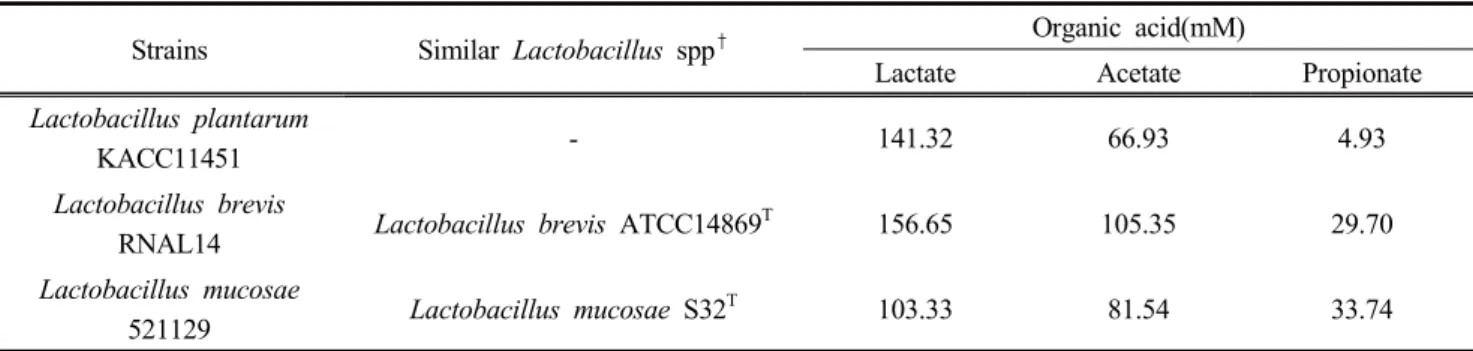
A total of 50 bacterial strains were isolated from rumen fluid of Korean native goat and from feces of Korean native cattle. Subsequently, 16s rRNA sequencing and phylogenetic analyses demonstrated that L. mucosae 521129 was 99.92%
similar to L. mucosae S32, L. brevis RNAL14 was 99.86%
similar to L. brevis ATCC14869. The metabolite production profiles of isolates after batch cultivation and 24 h of continuous culturing are summarized in Table 3. L. brevis had concentration of lactate and acetate of 156.65 mM and 105.35 mM, respectively while L. mucosae had propionate concentration of 33.74 mM.
2. Fermentation quality
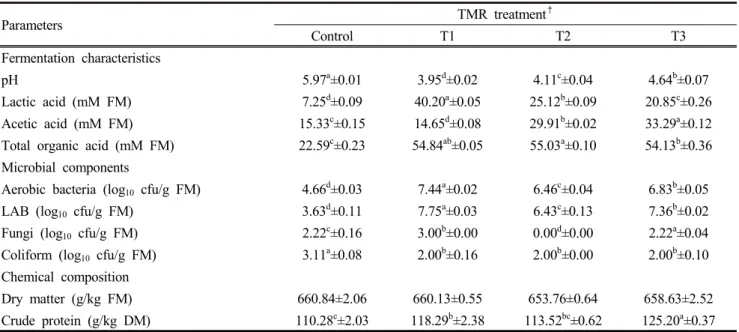
Fermentation characteristics, microbial components and chemical composition of TMR after 7 days of ensiling are presented in Table 3. The pH value, lactic, and acetic concentrations of fermented TMR ranged from 3.95~5.97, 7.25~40.20 mM, and 14.65~33.29 mM, respectively. pH was lowest (p<0.05) in the T1 (3.95). Meanwhile, lactic acid concentration was highest (p<0.05) in the T1 (40.20mM). The acetic acid concentration was highest (p<0.05) in the T3 (33.29 mM). Additionally, the population of aerobic bacteria and LAB was highest (p<0.05) in the T1 (7.44 and 7.75 log
10cfu/g) while fungi was highest in T3 (2.22 log
10cfu/g) but not detected in T2. The DM and CP content of fermented TMR ranged from 653.76 g/kg ~ 660.84 g/kg and 110.28 g/kg ~ 125.20 g/kg, respectively. Additives had no effect on DM content (p>0.05), but the TMR with L.
mucosae contained significantly highest of crude protein content (p<0.05).
3. Rumen fermentation in vitro parameters
The effects of fermentation TMR on rumen fermentation parameters in vitro are presented in Table 4 and 5. The total gas production and ammonia-nitrogen concentration, for all treatments, increased along with the duration of the incubation time while pH values declined. Total gas production was highest (p<0.05) in T3 at 6 h of incubation, but no significant difference in pH was detected (p<0.05). The pH value was lower (p<0.05) in control than the treatment groups at 3 h of incubation. Ammonia nitrogen (NH
3-N) concentration was significantly higher (p<0.05) in control than the treatment groups at 0 h of incubation but there was no significant difference in
Strains Similar Lactobacillus spp
†Organic acid(mM)
Lactate Acetate Propionate
Lactobacillus plantarum
KACC11451 - 141.32 66.93 4.93
Lactobacillus brevis
RNAL14 Lactobacillus brevis ATCC14869
T156.65 105.35 29.70
Lactobacillus mucosae
521129 Lactobacillus mucosae S32
T103.33 81.54 33.74
†Similarity was determined when similarity percentage was greater than 99%
Table 2. Similarity of bacteria strains isolated from rumen fluid of native Korean goats or feces of native Korean cattle with
Lactobacillus
spp. Determined using 16S rRNA sequence analysis and their organic acid productionParameters TMR treatment
†Control T1 T2 T3
Fermentation characteristics
pH 5.97
a±0.01 3.95
d±0.02 4.11
c±0.04 4.64
b±0.07
Lactic acid (mM FM) 7.25
d±0.09 40.20
a±0.05 25.12
b±0.09 20.85
c±0.26
Acetic acid (mM FM) 15.33
c±0.15 14.65
d±0.08 29.91
b±0.02 33.29
a±0.12
Total organic acid (mM FM) 22.59
c±0.23 54.84
ab±0.05 55.03
a±0.10 54.13
b±0.36 Microbial components
Aerobic bacteria (log
10cfu/g FM) 4.66
d±0.03 7.44
a±0.02 6.46
c±0.04 6.83
b±0.05
LAB (log
10cfu/g FM) 3.63
d±0.11 7.75
a±0.03 6.43
c±0.13 7.36
b±0.02
Fungi (log
10cfu/g FM) 2.22
c±0.16 3.00
b±0.00 0.00
d±0.00 2.22
a±0.04 Coliform (log
10cfu/g FM) 3.11
a±0.08 2.00
b±0.16 2.00
b±0.00 2.00
b±0.10 Chemical composition
Dry matter (g/kg FM) 660.84±2.06 660.13±0.55 653.76±0.64 658.63±2.52
Crude protein (g/kg DM) 110.28
c±2.03 118.29
b±2.38 113.52
bc±0.62 125.20
a±0.37
†Control: without microbes, T1: L.plantarum KACC11451, T2: L.brevis RNAL14, T3: L.mucosae 521129, FM: Fresh matter, DM: Dry matter.
a,b,c,dMeans with different superscripts within the row column differ significantly (p < 0.05).
Table 3. Fermentation characteristics of TMRs treated with lactic acid fermenting bacteria after 7 days of fermentation period
Time(h) Treatments
Control T1 T2 T3
Total gas production (mL)
3 20.67±0.93 20.03±0.75 18.00±1.04 19.67±1.42
6 30.17
b±0.83 32.83
ab±2.20 29.73
b±0.93 36.00
a±1.32
12 48.67±4.26 47.33±6.36 51.50±2.02 50.67±2.33
24 69.67±2.85 66.33±5.81 62.67±2.33 63.67±1.20
48 85.67±0.33 86.33±0.66 87.00±1.53 86.67±1.20
pH
0 6.70
a±0.05 6.47
b±0.05 6.48
b±0.03 6.53
b±0.02
3 5.98±0.04 6.01±0.01 6.01±0.01 6.04±0.02
6 5.59±0.02 5.56±0.04 5.60±0.02 5.51±0.02
12 5.26±0.01 5.25±0.01 5.23±0.01 5.26±0.00
24 5.20±0.03 5.19±0.03 5.18±0.02 5.23±0.00
48 5.13±0.02 5.08±0.01 5.08±0.03 5.08±0.02
Ammonia-nitrogen concentration (mM)
0 6.39
c±0.25 7.44
ab±0.08 7.96
a±0.20 6.80
bc±0.23
3 6.86±0.00 8.76±0.44 9.59±0.65 8.46±1.37
6 7.73±0.23 9.01±0.00 9.22±1.12 8.89±0.88
12 8.95±0.13 8.72±0.08 9.17±0.00 9.33±0.03
24 12.62±0.50 13.11±1.07 12.73±0.92 13.11±1.30
48 13.11±0.63 13.36±1.43 15.00±0.03 15.49±1.83
a,b,cMeans with different superscripts in the same column differ significantly (p < 0.05).
Control: without microbes, T1: L.plantarum KACC11451, T2: L.brevis RNAL14, T3: L.mucosae 521129
Table 4. Total gas production, pH, and ammonia-nitrogen production of
in vitro
rumen fermentation using fermented total mixed ration (FTMR)NH
3-N at an early stage of incubation. The pH did not differ until 48 h, however, the pH of Lactobacillus treated TMR began to low after 48 h incubation compared to that of the control.
Total gas production and NH
3-N also did not differ among
treatments at 48 h. Similar to pH, NH
3-N in the Lactobacillus treated TMRs became higher than that in the control after 48 h.
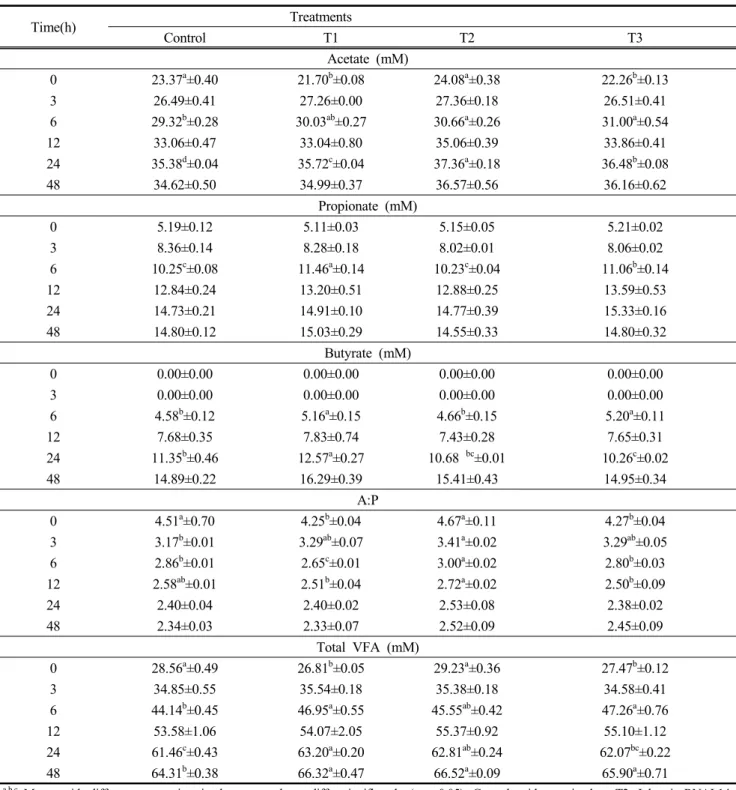
Table 5 shows the volatile fatty acid (VFA) production of in vitro rumen fermentation. The total VFA concentration, for
Time(h) Treatments
Control T1 T2 T3
Acetate (mM)
0 23.37
a±0.40 21.70
b±0.08 24.08
a±0.38 22.26
b±0.13
3 26.49±0.41 27.26±0.00 27.36±0.18 26.51±0.41
6 29.32
b±0.28 30.03
ab±0.27 30.66
a±0.26 31.00
a±0.54
12 33.06±0.47 33.04±0.80 35.06±0.39 33.86±0.41
24 35.38
d±0.04 35.72
c±0.04 37.36
a±0.18 36.48
b±0.08
48 34.62±0.50 34.99±0.37 36.57±0.56 36.16±0.62
Propionate (mM)
0 5.19±0.12 5.11±0.03 5.15±0.05 5.21±0.02
3 8.36±0.14 8.28±0.18 8.02±0.01 8.06±0.02
6 10.25
c±0.08 11.46
a±0.14 10.23
c±0.04 11.06
b±0.14
12 12.84±0.24 13.20±0.51 12.88±0.25 13.59±0.53
24 14.73±0.21 14.91±0.10 14.77±0.39 15.33±0.16
48 14.80±0.12 15.03±0.29 14.55±0.33 14.80±0.32
Butyrate (mM)
0 0.00±0.00 0.00±0.00 0.00±0.00 0.00±0.00
3 0.00±0.00 0.00±0.00 0.00±0.00 0.00±0.00
6 4.58
b±0.12 5.16
a±0.15 4.66
b±0.15 5.20
a±0.11
12 7.68±0.35 7.83±0.74 7.43±0.28 7.65±0.31
24 11.35
b±0.46 12.57
a±0.27 10.68
bc±0.01 10.26
c±0.02
48 14.89±0.22 16.29±0.39 15.41±0.43 14.95±0.34
A:P
0 4.51
a±0.70 4.25
b±0.04 4.67
a±0.11 4.27
b±0.04
3 3.17
b±0.01 3.29
ab±0.07 3.41
a±0.02 3.29
ab±0.05
6 2.86
b±0.01 2.65
c±0.01 3.00
a±0.02 2.80
b±0.03
12 2.58
ab±0.01 2.51
b±0.04 2.72
a±0.02 2.50
b±0.09
24 2.40±0.04 2.40±0.02 2.53±0.08 2.38±0.02
48 2.34±0.03 2.33±0.07 2.52±0.09 2.45±0.09
Total VFA (mM)
0 28.56
a±0.49 26.81
b±0.05 29.23
a±0.36 27.47
b±0.12
3 34.85±0.55 35.54±0.18 35.38±0.18 34.58±0.41
6 44.14
b±0.45 46.95
a±0.55 45.55
ab±0.42 47.26
a±0.76
12 53.58±1.06 54.07±2.05 55.37±0.92 55.10±1.12
24 61.46
c±0.43 63.20
a±0.20 62.81
ab±0.24 62.07
bc±0.22
48 64.31
b±0.38 66.32
a±0.47 66.52
a±0.09 65.90
a±0.71
a,b,c Means with different superscripts in the same column differ significantly (p < 0.05). Control: without microbes, T2: L.brevis RNAL14, T3: L.mucosae 521129
Table 5. Volatile fatty acid production of in vitro rumen fermentation using fermented total mixed ration (FTMR)
all treatments, increased with increasing incubation time. Acetate concentration was highest (p<0.05) in the control (23.37mM) and T2 (24.08mM) at 0 h incubation. In addition, acetate concentration was higher (p<0.05) in the control than the treatment group after 6 and 24 h of incubation. Propionate concentration was highest (p<0.05) in the T1 (11.46 mM) at 6 h incubation. Also, butyrate concentration was highest (p<0.05) in T1 at 6 h and 12 h incubation. AP ratio was highest (p<0.05) in the control and T2 at 0 h incubation. In addition, the AP ratio was highest (p<0.05) in T2 at 3, 6, and 12 h incubation. At 0 h, the total VFA concentration was highest (p<0.05) in the control (28.56 mM) and T2 (29.23 mM).
Additionally, total VFA concentration was higher (p<0.05) in the control than the treatment group after 6, 12, 24, and 48 h of incubation. Overall, we found no differences in acetate and butyrate concentration after 48 h of incubation. However, a tendency towards higher acetate and butyrate concentration in treatment groups compared to the control were observed after 48 h. Nevertheless, at 48 h of incubation, total VFA concentration was higher (p<0.05) in the treatment groups than the control.
Especially, total VFA concentration differed significantly among the treatments with the highest value observed in the T2 treatment.
Ⅳ. DISCUSSION
Three LAB (L. plantarum, L. brevis, and L. mucosae) were used as TMR fermention starter in this study. L. plantarum is often used to secure desirable lactic acid fermentation (Weinberg and Muck, 1996) while L. mucosae increased propionate and total VFA concentrations in the fermentation of brewers grains and the in vitro rumen fermentation (Mamuad et al., 2017, Soriano et al., 2014). Inoculation of LAB spp. in TMR could lower pH and increase the concentrations of lactic acid, acetic acid, and total organic acid compared to non inoculated control TMR (p<0.05). In addition to the increased acidity and VFA concentration, the numbers of aerobic bacteria and LAB were higher, but E. coli counts were lower compared to the control group (p<0.05). Notably, the L. plantarum treatment, which had the lowest pH, highest lactic acid content and the highest numbers of aerobic bacteria and LAB, also showed the highest numbers of fungi. Fungi are sensitive to products of fermentation
such as lactic acid and acetic acid (Bonestroo et al., 1993).
Hetero-fermentative LAB produces acetic acid and propionic acid, and lactic acid causes the main decrease in pH (Eklund, 1989). Propionic acid, in particular, shows characteristic inhibition of fungal growth (Woolford, 1984). Furthermore, this is consistent with a report by Voulgari et al, (2010), in which an anti-fungal test using ATCC14917, which is the same strain as the L.
plantarum KACC11454 used in the T1 treatment. In contrast, the L. brevis treatment had the highest concentration of total organic acid and fungus was not detected, while the L. mucosae treatment had high acetic acid contents and also showed the highest crude protein content.
In fermentation by ruminal microorganisms, gas production and pH value is an important index to measure fermentative characteristics (Lee et al., 2013). In 6 hours of fermentation, the L. mucosae treatment had the highest of total gas production (p<0.05), had the lowest pH, but this was not statistically significant (p>0.05), and showed the highest concentration of total VFA (p<0.05). Although there was no statistically significant difference in total gas produced and pH in the LAB-treated group after 48 hours of fermentation, LAB fermentation of TMR feed is considered to increase ruminal fermentation, since the total volatile fatty acids produced were high (p<0.05).
The fermented TMR feed added with LAB briefly showed a lower pH than the control group at 0 hours, due to the abundant production of lactic acid and acetic acid, but the pH became similar level to the control by 3 hours of fermentation.
The concentration of ammonia nitrogen was higher in the
LAB-treated group at 0 h fermentation (p<0.05) and it was
maintained with higher trend level throughout the whole
fermentation period, even though this was not statistically
significant (p>0.05). Fermented TMR feed with added LAB
contains a high level of crude proteins compared to the
control, which suggests that more active proteolysis by ruminal
microorganisms could have occurred. Also, like a previous
report by Stiles et al, (1970), the concentration of ammonium
nitrogen was confirmed to be at an appropriate level. Ultimately,
fermented TMR feed with added LAB increased the production
of total volatile fatty acids compared to fermented TMR with
only water added. There was no great difference between
strains of LAB.
Ⅴ. CONCLUSION
The use of LAB, especially L. brevis as an inoculant for fermentation of high moisture TMR could inhibit fungi growth and promote lactic fermentation, and enhance digestion in the rumen.
Ⅵ. ACKNOWLEDGMENTS
This study was supported by Cooperative Research Program for Agriculture Science and Technology Development (Project No. PJ013609), Rural Development Administration, Republic of Korea.
Ⅶ. REFERENCES
AOAC (Association of official analytical chemists). 1990. Official methods of analysis. Assoc Anal Chem.
Asanuma, N., Iwamoto, M. and Hino, T. 1999. Effect of the addition of fumarate on methane production by ruminal microorganisms in vitro. Journal of Dairy Science. 82:780-787.
Bonestroo, M., De Wit, J., Kusters, B. and Rombouts, F. 1993. Inhibition of the growth of yeasts in fermented salads. International Journal of Food Microbiology. 17:311-320.
Cao, Y., Takahashi, T., Horiguchi, K., Yoshida, N. and Cai, Y. 2010.
Methane emissions from sheep fed fermented or non-fermented total mixed ration containing whole-crop rice and rice bran. Animal Feed Science and Technology. 157:72-78.
Cha, J., Ali, M., Hong, Y., Yu, B., Lee, S., Hoon, S. and Kim, H. 2018.
Development of a pelletizing system of fermented TMR for pig feeding. Journal of Biosystems Engineering. 43:119-127.
Chaney, A.L., and Marbach, E.P. 1962. Modified reagents for determination of urea and ammonia. Clinical Chemistry. 8:130-132.
Eklund, T. 1989. Organic acids and esters. In: Mechanisms of action of food preservation procedures (Ed. In G. W. Gould). Elsevier Applied Science: New York, NY, USA. pp. 161-200.
Han, S., Kim, S. and Shin, H. 2005. UASB treatment of wastewater with VFA and alcohol generated during hydrogen fermentation of food waste. Process Biochemistry. 40:2897-2905.
Hartemink, R, Domenech, V.R., and Rombouts, F.M. 1997. LAMVAB - A new selective medium for the isolation of lactobacilli from faeces. Journal of Microbiological Methods. 29:77-84.
Ki, K., Kim, H., Lee, H., Lee, W., Baek, K., Kim, S., Lim, K., Jeo, J.
and Kim, Y. 2007. Effects of increasing moisture content with or without supplementing inoculant (
Lactobacillus plantarum
) in TMR on its feed value. Journal of The Korean Society of Grassland Science. 27:197-208.Lee, K., Kim, K., Baek, Y., Ok, J., Seol, Y., Han, K., Park, K., Ryu, H., Lee, S. and Jeon, C. 2013. Effects of mustard seeds and powder on in vitro ruminal fermentation characteristics and methane production. Journal of Animal Science and Technology. 55:25-32.
Lee, S., Shin, N., Jung, H., Moon, Y., Lee, S. and Lee, S. 2009. Effects of supplemental synbiotics composed of anaerobic bacteria, yeast and mold on the change of chemical composition and fermentation characteristics of total mixed ration for cattle. Journal of Life Sciences. 19:241-248.
Mamuad, L.L., Kim, S.H., Choi, Y.J., Soriano, A.P., Cho, K.K., Lee, K., Bae, G.S. and Lee, S.S. 2017. Increased propionate concentration in
Lactobacillus mucosae
fermented wet brewers grains and duringin vitro
rumen fermentation. Journal of Applied Microbiology. 123:29-40.Nsereko, V., Smiley, B., Rutherford, W., Spielbauer, A., Forrester, K., Hettinger, G., and Harman, B. 2008. Influence of inoculating forage with lactic acid bacterial strains that produce ferulate esterase on ensilage and ruminal degradation of fiber. Animal Feed Science and Technology. 145:122-135.
Nishino, N., Harada H. and Sakaguchi, E. 2003. Evaluation of fermentation and aerobic stability of wet brewers' grains ensiled alone or in combination with various feeds as a total mixed ration. Journal of the Science of Food and Agriculture. 83:557-563.
Saarisalo, E., Skyttä, E., Haikara, A., Jalava, T. and Jaakkola, S. 2007.
Screening and selection of lactic acid bacteria strains suitable for ensiling grass. Journal of Applied Microbiology. 102:327-336.
SAS (Statistical Analysis System) institute inc. 2004. Version 9.1. SAS institute inc. Cary, NC, USA.
Shioya, S. 2008. Future prospects of TMR center based on self- supplying feed. Japanese Society of Grassland Science. 54:178-181.
Soriano, A.P., Mamuad, L.L., Kim, S.H., Choi, Y.J., Jeong, C.D., Bae, G.S., Chang, M.B. and Lee, S.S. 2014. Effect of
Lactobacillus mucosae
onin vitro
rumen fermentation characteristics of dried brewers’ grain, methane production and bacterial diversity.Asian-Australasian Journal of Animal Sciences. 27:1562-1570.
Stiles, D.A., Bartley, E.E., Meyer, R.M.., Deyoe, C.W. and Pfost, H.B.
1970. Effect of an expansion-processed mixture of grain and urea on rumen metabolism in cattle and on urea toxicity. Journal of Dairy Science. 53:1436-1447.
Tabaru, H., Kadota, E., Yamada, H., Sasaki, N. and Takeuchi, A. 1988.
Determination of volatile fatty acids and lactic acid in bovine plasma and ruminal fluid by high performance liquid chromatography.
Japanese Journal of Veterinary Research. 50:1124-1126.
Voulgari, K., Hatzikamari, M., Delepoglou, A., Georgakopoulos, P., Litopoulou-Tzanetaki, E. and Tzanetakis, N. 2010. Antifungal
activity of non-starter lactic acid bacteria isolates from dairy products. Food Control. 21:136-142.
Weinberg, Z.G. and Muck, R.E. 1996. New trends and opportunities in the development and use of inoculants for silage. FEMS Microbiology Reviews. 19:53-68.
Wilkinson, J.M., Bolsen, K.K. and Lin, C.J. 2003. History of silage, In:
silage science and technology, Agron. Monogr. 42. ASA, CSSA, and SSSA, Madison, WI, USA. pp. 1-30.
Woolford, M. 1984. The Antimicrobial spectra of organic compounds with respect to their potential as hay preservatives. Grass and
Forage Science. 39:75-79.
Yang, J., Cao, Y., Cai, Y. and Terada, F. 2010. Natural populations of lactic acid bacteria isolated from vegetable residues and silage fermentation. Journal of Dairy Science. 93:3136-3145.
Yuan, X., Guo, G., Wen, A., Desta, S., Wang, J., Wang, Y. and Shao, T. 2015. The effect of different additives on the fermentation quality, in vitro digestibility and aerobic stability of a total mixed ration silage. Animal Feed Science and Technology. 207:41-50.
(Received : March 5, 2019 | Revised : September 10, 2019 | Accepted : September 16, 2019)