http://dx.doi.org/10.12925/jkocs.2014.31.4.653
C57BL/6 마우스에서 천연 식물성추출물(아벨모)의 발모효능 및 작용 메카니즘
박상오1․박병성2✝․노가영3
1강원대학교 동물자원공동연구소, 2동물응용과학부, 3NJY 생명공학 (2014년 11월 18일 접수; 2014년 12월 17일 수정; 2014년 12월 26일 채택)
Effect of natural plant extract (Abelmo) on action mechanism and hair growth activities in C57BL/6 mice
Sang-Oh Park1․Byung-Sung Park2✝․Ga-Yeong Noh3
1Institute of Animal Resources, 2Devision of Applied Animal Science, Kangwon National University, Chuncheon, Gangwondo, 200-701, Republic of Korea, 3NJY Life Science
(Received November 18, 2014; Revised December 17, 2014; Accepted December 26, 2014)
Abstract : This study was determined the hair growth effect and mode of action of a complex extract (abelmo), extracted from various natural plants including Acorus calamus var. angustatus. 30 six-week old C57BL/6 mice were randomly assigned into three treatment groups with ten mice per treatment group repeatedly. The treatment group is a control group, and was classified into saline-applied, minoxidil 5%-applied, and abelmo-applied groups. Hair growth started from the abelmo-applied and minoxidil 5% -applied groups on the 9th day, compared to the saline-applied group. Hair growth rate was 17.06% and 19.15% in those two groups, respectively, and the abelmo-applied group's hair growth rate was higher. The density, length and thickness of hair were significantly higher in the order of abelmo-applied group, minoxidil 5%-applied group and saline-applied group on the 9th day, and hair root was strongly maintained in the abelmo-applied group. The density, length and thickness of hair in the abelmo-applied group were significantly higher by 599.8, 122.2 and 181.8% on the 9th day compared to the saline-applied group, and 166.7, 171.4 and 200.2% on the 12th day, and 136.6, 216.9 and 180.7%, respectively on the 15th day. As for hair follicle and the length of hair shaft from the dosal skin histopathology manifestation, the abelmo-applied group was more excellent than the saline-applied group and minoxidil 5%-applied group. This result actually confirmed the fact that abelmo promotes hair growth and strongly maintains hair root simultaneously.
Keywords : Abelmo, hair growth rate, density, length, thickness, skin, histopathology.
✝Corresponding author
(E-mail: [email protected])
1. 서 론
모발은 피부의 구성분으로써 진피의 모낭에서 성장하여 신체를 보호하는 기능을 수행한다[1].
인간은 모발을 자라게 하는 작은 조직인 모낭이 10만개 정도 있으며 이 모낭들은 한 번 손상되어 기능이 정지되면 다시는 재생이 불가능한 것으로 알려졌다. 생성된 모낭으로부터 자라난 모발은 성 장기(anagen), 퇴행기(catagen), 휴지기(telogen), 탈락기(exogen) 등 4 단계의 모주기를 거치면서 성장과 탈모를 거듭한다. 성장기의 피부 중 진피 의 유두층에서는 모낭이 성장하며[2-3] 퇴행기는 진피의 두께가 감소함으로써 모낭은 표피와 근접 하게 되고 모낭 안에 존재하는 모유두세포가 탈 락하여 새로운 모발 성장주기를 이루게 된다. 탈 모는 정상적으로 모발이 자라지 못하여 머리카락 이 쉽게 빠지고 가늘어지며 성장기가 짧아짐과 동시에 휴지기가 길어지는 현상이다. 탈모는 노화 현상으로 알려져 왔으나 유전적 요인, 스트레스, 식생활 식습관 등 다양한 요인이 작용하여 나타 난다[4]. 탈모를 예방할 수 있는 방법은 모낭 주 위의 혈류를 좋게 하여 모근에 필요한 영양분을 공급하여 머리카락을 나게 하는 것과 탈모된 모 낭주위에 임파구가 많이 모여 있는 것을 이용해 면역기능을 높여서 낭을 활성화 시켜주는 것이다 [5-6]. 남성 탈모의 약 80%를 차지하는 탈모는 테스토스테론 수용체의 돌연변이가 원인으로써 알려졌으나 스트레스 역시 흰 머리와 탈모에 중 요한 영향을 미치는 요소이다[7]. 전립선 비대증 치료제로 사용하던 피나스테리드, 고혈압 치료제 로 사용하던 미녹시딜(로게인)이 현재 탈모 치료 제로 사용하고 있다. 여성 탈모는 남성에 비해 유병률이 낮지만 미국의 경우 3,000만 명의 여성 들이 고통을 겪고 있다[8]. 현재 우리나라의 탈모 연령대는 점점 낮아지고 있으며 20-30대의 젊은 층 뿐만 아니라 10대 청소년들도 탈모로 고민하 는 경우가 많다.
조선시대부터 창포물에 머리를 감으면 머리카 락이 윤기가 나며 잘 빠지지 않기 때문에 단오날 에 창포물로 머리를 감는 풍습이 전해지고 있다.
상백피, 감초, 솔잎, 고삼, 천궁, 당귀 등은 탈모 와 흰머리 방지, 염증치료, 혈액순환 개선, 두피 개선 효과를 갖는 것으로 보고되었다[9-10]. 창 포(Acorus calamus Linn.)는 sweet flag 또는 Bacha로써 알려져 있으며 창포추출물인 정유의 주성분은 asarone이다. 창포는 탈모치료 및 항균
[11], 피부상처 치료제[12-14] 항균활성[15-16].
항산화[17]효과가 보고되었다. 창포 추출물을 이 용한 미용 향장용 조성물, 두피 전용 비누 및 세 정제 에 관한 보고가 있다[18]. 상백피(Mori Cortex Radicis)의 주성분은 α-Amyrin, kaempferol, morin, quericetin, umbelliferone으 로써 탈모증에 대한 모발성장 효과[19-20], 미백 및 보습원료[21], 면역조절[22], 항알레르기[23]효 능이 알려졌다. 감초(Glycyrrhiza uralensis)의 flavonoids 주성분은 liquiritigenin, liquiritin, licuraside, glycyrrhizin이며[24], 항염증[25]효과 가 알려져 있다. 솔잎(Pinus densiflora) 추출물의 주성분은 cumaric acid, terpen, polyphenolic tannin, proanthocyanidie으로써 탈모예방, 피부 조직 개선 및 미백, 고혈압, 당뇨병, 항암, 항균 [26, 27]효능이 알려졌다. 고삼(Sophora Angustifolia)은 여러 종류의 알칼로이드와 플라
보노이드가 함유되어 있으며 주성분으로
d-matrine, d-oxymatrine이 확인되었고 발모, 피 부 노화방지, 스켄케어[28], 항염증[25]효능이 보 고되었다. 천궁(Ligusticum chuanxiong Hort)은
휘발성 정유와 alkaloid인
dl-tetrahydropalmatine, protopine, ferulic acid, ligustilide, butylidenpthalide [29]를 함유하며 피부미백[30], 항균 및 항산화[31, 29]효능이 보 고돠었다. 당귀(Angelica gigas)의 주성분은 decursin, decursinol, nodakenin 등의 coumarin 유도체와 α-pinene, limonene, β-eudesmol, elemol 등의 정유로써 두피건강[10]및 항염증효 능이 알려졌다. 천연 식물성추출물인 아벨모는 아 사쿠린 100(asacurin 100)을 함유하고 있으며 본 연구는 아벨모의 발모효능 및 그 작용 메카니즘 을 조사하였다.
2. 실 험
2.1. 천연 식물성추출물(아벨모)의 조제
창포, 상백피, 감초, 솔잎, 고삼, 천궁, 당귀를 (주)NJY 생명공학에서 제시한 비율로써 혼합하여 환류 추출시스템에서 열수 추출(1:10 w/v)하였 다. 또한, 상기 열거한 7가지의 천연식물을 열수 추출과 동일한 방법으로 혼합한 후 순수 에탄올 (1:10 w/v)에서 3시간씩 3회 반복하여 환류 추 출시스템으로써 추출하였다. 각각의 추출물을 여 과지(Whatman No. 2)를 이용하여 여과한 후 회
전감압식 농축기(EYELA, Rikakiki Co., Tokyo, Japan)로써 감압 농축하였다. 농축 후 발모효능을 지닌 아벨모(열수추출물 수율 7.5%, 에탄올 추출 물 수율 5.1%)를 얻었다. 각각의 아벨모를 GC/MSD(Gas chromatograph/Mass selective detector, Agilent 7890A, 5975C, Agilent Technologies, USA)로써 성분분석[32]을 실시한 결과, 주성분이 asarone 80%, cumaric acid 18%, 기타 2%로 구성되었음을 확인하였고 그 물질을 아사쿠린 100(asacurin 100)으로 명명하 였다.
2.2. 실험동물 및 실험설계
동물실험은 유럽 위원회 가이드라인
(EECDirective of 1986; 86/609/EEC)에 따라서 수행하였으며 강원대학교 동물실험윤리위원회 (IACUC)의 승인(KW-141027-1)을 얻었다.
C57BL/6 마우스 수컷 6주령 30마리를 대한바이 오링크(충북 음성)로부터 구입하였다. 일주일 동 안 사육환경에 적응시킨 후 등 피부의 털을 완전 제모하였으며 천연 식물성추출물(아벨모, NJY 생 명공학의 배합비를 준수하여 혼합 후 크림형태로 제조하였음)을 도포하였다. 3처리구, 3반복으로써 반복 케이지 당 10마리씩 완전임의 배치하였다.
처리구는 대조군으로써 생리식염수, 아벨모, 미녹 시딜 5% 도포군으로 구분하였다. 실험식이는 미 국의 AIN-93에서 제시한 마우스의 영양소 요구 량에 따라서 조제 후 펠렛팅하였으며 조단백질, 총에너지함량을 동일하게 조절하였다. 실험식이의 조성은 카제인(casein-vitamin free) 20%, 옥수수 전분 39.75%, 말토덱스트린 13.20%, 설탕 10.00%, 대두박 7.00%, 분말 셀루로오스 5.00%, AIN 93G 미네랄 혼합제 3.50%, AIN 93G 비타 민 혼합제 1.00%, L-시스틴 0.30%, choline bitartrate 0.25%, t-butylhydroquinone 0.0014%
로써 배합하였다[33]. 실험동물 사육실 온도 22±2℃, 상대습도 55±5%, 12간 조명주기로 조 절하였으며 물과 실험식이는 자유롭게 섭취할 수 있도록 하였다.
2.3. 아벨모의 도포
등 피부의 색이 핑크색을 보이는 모발의 휴지 기에 도달한 7주령 마우스에게 졸레틸(Virbac, Paris, France)과 럼푼(Bayer korea Co. Seoul, Korea)을 8:2로 혼합한 다음 10배 희석하여 복 강주사로 마취(10 µL/체중 100 g)하였다. 제모기
로써 등 피부의 털을 1차 제거한 다음 제모크림 (니크린, 일동제약)을 이용하여 완전하게 제모를 하였다. 제모 직후부터 아벨모를 비롯한 각각의 시험물질을 1일 2회로 나누어 발모 종료 시까지 계속하여 등 피부의 제모부위를 완전히 덮을 수 있도록 도포하였다. 세 개의 시험처리군 가운데 아벨모 도포군에서 도포 후 9일째 최초 발모가 확인되었기 때문에 이 시점을 기준으로 하여 발 모와 관련된 모든 항목을 측정하였다.
2.4. 발모면적 및 외모
아벨모를 도포한 이후 9, 12, 15, 18일째에 상 기 기술한 방법으로 동물을 마취시킨 후 발모의 정도를 육안으로 평가하여 점수를 부여하였다. 발 모면적은 제모부위에 대한 발모면적으로써 백분 율로 나타냈으며 디지털카메라로써 사진을 촬영 하여 외모를 관찰하였다.
2.5. 모발의 밀도, 길이 및 두께 측정
아벨모를 도포한 이후 9, 12, 15, 18일째에 고 해상도 모발분석 시스템(Hair & Sclap Microscope System, SIF-1, Korea)을 이용하여 300 배율의 현미경 스코프로써 모발의 밀도, 두 께 및 길이를 측정하였다. 모발의 밀도는 0.6 mm2 당 모발의 수를 측정하였으며 길이 및 두께 는 기기에 입력된 프로그램으로써 측정하였다.
2.6. 피부조직 병리학 관찰
아벨모를 도포한 이후 9일째의 피부조직을 채 취하여 10% 중성포르말린으로 고정하였다. 관찰 하고자 하는 부위를 삭정(trimming)하여 일반적 인 조직 처리과정(탈수, 투명화, 파라핀 침투과 정)을 거쳐 파라핀으로 포맷하였다. 포맷된 파라
핀 블럭을 마이크로톰마이크로톰(HM-315
model, Microm Co., Germany)을 이용하여 3-5 µm의 조직절편을 만들고 헤마톡실린과 에오신 (hematoxylin and eosin, H&E)염색을 실시하였 다. 염색된 조직을 광학현미경(light microscope CX41, Olympus, Tokyo, Japan)으로 검경하였으 며 관찰되는 모낭을 발육단계별로 각각 숫자를 세어서 백분율로 나타냈다.
2.7. 통계분석
분석된 자료는 SAS program을 이용하여 통계 처리 하였으며 각 처리구의 평균과 표준오차를 구하고 분산분석을 실시한 다음 Duncan's
multiple range test에 의하여95% 수준에서 유의 성 (p<0.05)을 검정하였다[34].
3. 결과 및 고찰
3.1. 발모면적 및 외모
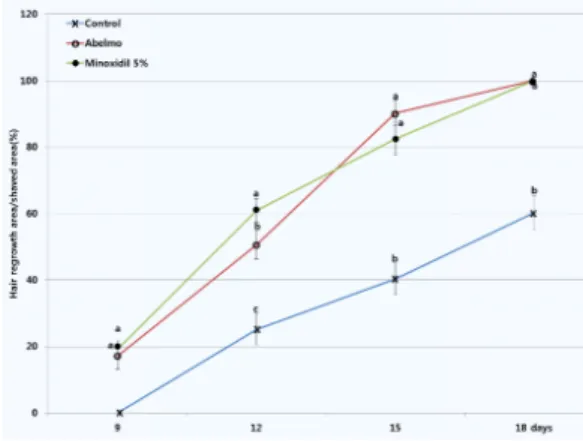
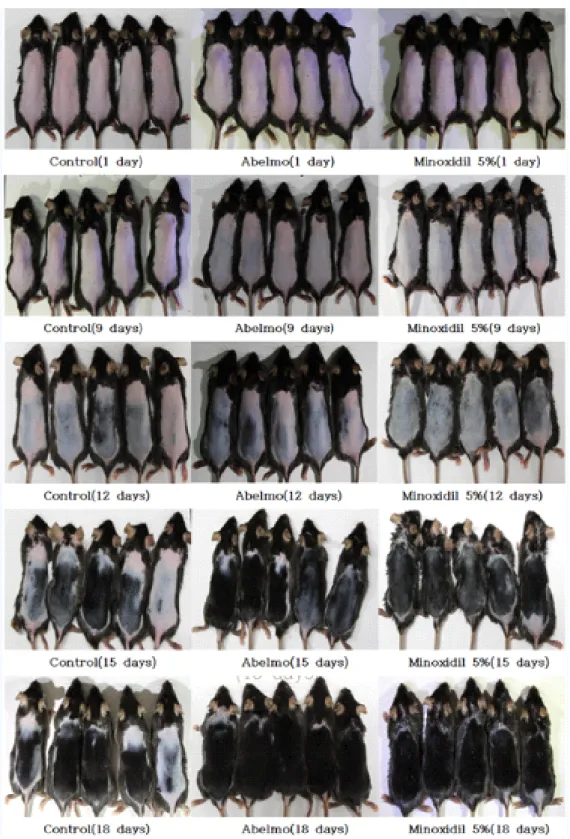
발모상태를 육안으로 관찰한 결과는 Fig. 1, Fig. 2, Fig. 3과 같다. 아벨모를 도포한 이후 9일 째에 최초 발모가 시작되었으며 발모율 17.06%
를 나타냈다. 미녹시딜 5% 도포군은 9일째에 발 모율 19.15%를 나타냈으나 생리식염수를 도포한 대조군은 제모된 상태의 분홍색 피부를 유지하였 고 발모가 확인되지 않았다. 아벨모와 미녹시딜 5% 도포군은 12일째에 각각 50.67, 60.92%, 15 일째에 각각 90.25, 92.47% 발모가 되었으며 18 일째에 도달해서는 100% 가까운 발모가 완성됨 을 확인하였다. 대조군은 생리식염수를 도포한 이 후 13일째부터 최초로 발모가 시작되었으며 12, 15, 18일째 각각 25.17, 40.25, 60.28% 발모를 확인하였으나 아벨모와 미녹시딜이 완전히 발모 가 종료된 18일째에 도달해서도 발모가 완성되지 는 않았다 (p<0.05). 모든 처리군은 발모가 시작 되면서 등 피부가 핑크 빛에서 회색으로 변하기 시작했고 털이 자라나면서 검은색을 유지하였다.
미녹시딜 5% 도포군은 도포 10일째부터 피부가 쭈그러들어 위축되면서 목 부위까지 염증 소견을 보이는 부작용을 확인하였다. 본 결과는 아벨모와 미녹시딜이 유사한 발모촉진 효능을 가지고 있으
Fig. 1. Effect of abelmo on hair regrowth area to shaved area in C57BL/6 mice. Bars represent standard deviation of means (n=10). a,b,cp<0.05.
나 미녹시딜은 부작용이 있음을 보여준다. [35]은 모발이 성장기로 접어들면서 등 피부는 회색 또 는 검정색으로 바뀐다고 하였으며 미녹시딜 5%
를 도포한 동물에서 아벨모와 비슷하게 털이 자 랐지만 시간이 경과함에 따라 탈모현상이 나타나 고 피부 각질이 형성되었다고 하여 본 결과와 경 향을 같이한다.
3.2. 모발의 밀도, 길이 및 두께
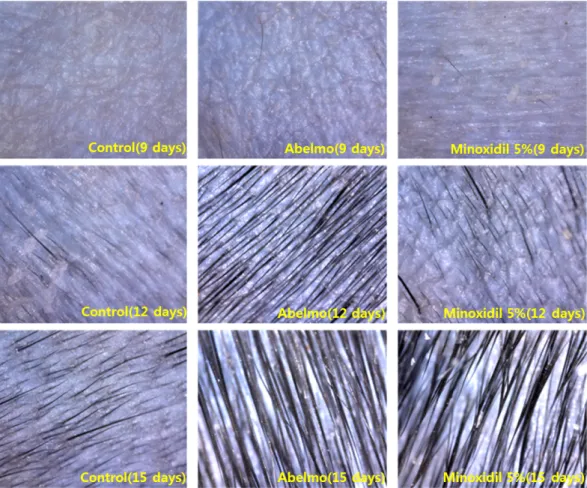
아벨모 도포 후 9일째부터 털이 나오는 것을 확인할 수 있었다(Table. 1, Fig. 4). 발모가 시작 된 9일째 모발의 밀도, 길이 및 두께는 아벨모, 미녹시딜 5%, 생리식염수 도포군 순서대로 유의 하게 높았다. 모발의 밀도는 대조군과 비교할 때 아벨모 도포군에서 9, 12, 15일째 각각 599.8, 166.7, 136.6% 높았으며 미녹시딜 5% 도포군은 9일째는 차이가 없었고 12, 15일째 각각 366.1, 132.9% 유의하게 높았다 (p<0.05). 모발의 길이 는 대조군과 비교할 때 아벨모 도포군에서 9, 12, 15일째 각각 122.2, 171.4, 116.9% 높았으며 미녹시딜 5% 도포군은 9, 12, 15일째 각각 116.7, 152.4, 121.9% 유의하게 높았다. 모발의 두께는 대조군과 비교할 때 아벨모 도포군은 9, 12, 15일째 각각 181.8, 200.2, 180.7% 높았으며 미녹시딜 5% 도포군은 9, 12, 15일째 각각 101.1, 120, 199.8% 유의하게 높았다. 한편, 12 일째 자라난 털을 핀셋으로 당겨서 뽑았을 때 대 조군과 미녹시딜 5% 도포군은 쉽게 뽑혔으나 아 벨모 도포군은 거의 뽑히지 않았기 때문에 아벨 모는 모근을 강하게 유지해준다는 점을 확인할 수 있었다. 성장기의 피부는 진피층과 피하조직층 이 발달하며 진피의 유두층에서 모낭이 성장하고 [36-37] 퇴화기 피부는 진피의 두께가 감소하여 모낭은 표피와 근접하게 되며 모낭 안의 모유두 세포가 모낭을 재생하고 모낭 형성을 촉진하는 것으로 알려졌다[38-39]. 모발의 성장기간 동안 에 모낭의 길이가 충분히 길어지지 않아서 탈모 가 일어난다. 성장하는 모발의 두께는 모낭의 길 이로 결정되기 때문에 모발의 성장초기 부터 중 기까지 자라나는 모낭의 길이는 정상 모발 주기 에서 매우 중요하다[3].
3.3. 피부조직 병리학 및 모낭 발육단계 아벨모를 도포한 이후 모낭 발육단계 및 피부 조직의 병리학적 소견은 Fig. 5, Fig. 6과 같다.
털의 발육단계는 성장기, 퇴행기 및 휴식기로 나
Fig. 2. Effect of abelmo on hair regrowth promoting in C57BL/6 mice.
Fig. 4. Changes of hair regrowth promoting in male C57BL/6 mice applied with abelmo.
Fig. 3. Appearance of dosal skin by minoxidil 5% in male C57BL/6 mice.
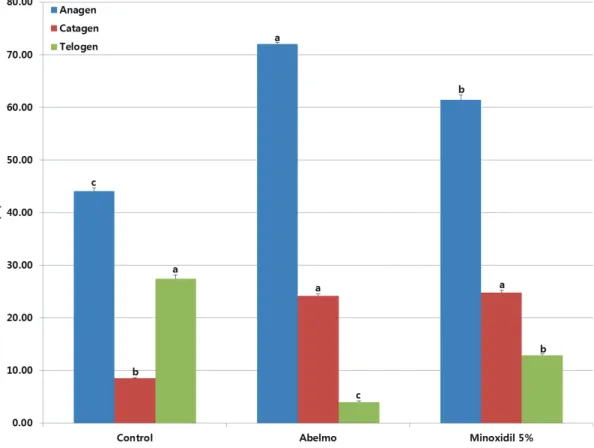
누어져 있으며 등의 피부에서 관찰된 모든 모낭 의 발육단계를 구별하여 나타냈다. 아벨모 도포군 에서 최초 발모가 시작된 9일째 마우스의 등 피
부에서 측정된 모낭의 발육단계는 성장기와 퇴행 기는 아벨모, 미녹시딜 5% 도포군, 대조군 순서 로 높았으며 휴지기는 대조군, 미녹시딜 5%, 아 벨모 도포군 순서로 높았다. 대조군과 비교할 때 아벨모, 미녹시딜 5% 도포군에서 성장기는 각각 163.2, 139.7%, 퇴행기는 각각 285.7, 290.8%
높았으나 이와 반대로 휴지기는 각각 85,50, 53.20% 유의하게 낮았다 (p<0.05). 털(hair shaft)은 모낭 가운데 사다리 모양으로 보이며 아 벨모 도포군이 미녹시딜 5% 도포군, 대조군에 비 해서 성장기에 도달한 모낭 수가 많고 퇴행기의 모낭수가 적으며 모낭의 길고 크기가 증가하는 것을 볼 수 있다. 진피의 유두층에서 성장한 모 낭은 퇴행기를 지나면서 표피와 근접하게 되고 모낭 안에 존재하는 모유두세포가 새로운 모발 성장주기를 이룬다. 모유두세포의 모발 성장조절
Fig. 5. Changes of the cycles of hair follicle growth in male C57BL/6 mice after 9 days applied with abelmo. Bars represent standard deviation of means (n=10). a,b,cp<0.05.
Control Abelmo Minoxidil 5%
Density
9 days 0.1±0.02c 0.6±0.05a 0.4±0.02b 12 days 9.6±0.55c 16.0±0.80a 14.0±0.78b 15 days 16.4±0.58b 22.4±0.82a 21.8±0.87a Length
9 days 0.01±0.001b 0.02±0.004a 0.02±0.001a 12 days 0.21±0.03b 0.36±0.01a 0.32±0.01a 15 days 0.83±0.03b 0.97±0.02a 1.01±0.02a Thickness
9 days 0.002±0.0002b 0.004±0.0003a 0.004±0.0002a 12 days 0.01±0.0007b 0.02±0.002a 0.02±0.002a 15 days 0.01±0.002b 0.02±0.001a 0.02±0.002a Mean values±standard deviation (n=10). a,b.cP<0.05.
Table 1. Hair density, length and thickness in male C57BL/6 mice applied with abelmo (μm)
Fig. 6. Skin photomicrographs on the hair follicles growth in male C57BL/6 mice after 9 days applied with abelmo.
은 모유두의 크기가 연관하는 것으로 밝혀졌다.
모낭주기와 관련해서는 퇴행기에 위축되어 있던 모유두세포가 비대하면서 상피세포의 증식으로 큰 모구부를 형성하여 모발 성장을 일으키는 것 으로 알려졌다[2-4].
4. 결 론
본 결과는 창포(Acorus calamus var.
angustatus)를 비롯한 여러 가지 천연 식물성추출 물(아벨모)이 모낭의 성장을 자극하여 발모를 촉 진함과 동시에 모근을 강하게 유지시켜준다는 점 을 나타낸다.
감사의 글
본 연구는 2014년도 (주)NJY 생명공학 용역연 구비로 연구하였으며 2014년도 강원대학교 Post-Doc. 지원으로 연구되었음.
References
1. M. S. Roberts and K. A. Walters, The relationship between structure and barrier function in skin. dermal absorption and toxicity assessment, Marcel Dek-ker Inc, New York, pp. 1-42 (2008).
2. B. O. Botchkarev and J. Kishimoto, Molecular control of epithelial mesenchymal interactions during hair follicle cycling, J. Invest. Dermatol. Symp.
Proc, 8, 46-53 (2003).
3. G. Cotsarelis and S. E. Millar, Towards a molecular understanding of hair loss and its treatment, Trends Mol. Med, 7, 293-301 (2001).
4. M. R. Seven, H. Bori, V. D. V. Carina, E.
Stefan, F. Kerstin, A. M. Ian, S. S. Kurt and P. Ralf, A comprehensive guide for the accurate classification of murine hair follicles in distinct hair cycle stages, J.
Invest. Dermatol, 117, 3-15 (2001).
5. D. V. Mater, F. T. Kolligs A. A. Dlugosz and E. R. Fearon, Transient activation of β-catenin signaling in cutaneous keratinocytes is sufficient to trigger the active growth phase of the hair cycle in mice, Genes Dev, 10, 1219–1224 (2003).
6. S. Müller-Röver, B. Handjiski and C. van der Veen, S. Eichmüller, K. Foitzik, I. A.
McKay, K. S. Stenn, R. Paus, A comprehensive guide for the accurate classification of murine hair follicles in distinct hair cycle stages, J. Invest.
Dermatol, 117, 3-15 (2001).
7. L. A. Garza, Y. Liu and Z. Yang, G.
Cotsarelis, Prostaglandin D2 ihibits hair gowth and is elevated in bald scalp of man with adrogenetic aopecia, Sci. Tans.
Med, 4, 126-134 (2012).
8. L. A. Garza, C. C. Yang, J. W. Tobias and G. Cotsarelis, Bald scalp in men with androgenetic alopecia retains hair follicle stem cells but lacks CD200-rich and CD34-positive hair follicle progenitor cells, J. Clin. Invest, 121, 613–622 (2011).
9. K. S. Kim, Research trends relevant with hair growth promotion and scalp condition improvement by applying natural extracts, Kor. J. Aesthet. Cosmetol, 12, 17-24 (2014).
10. J. Y. Lee, K. R. Im T. K. Jung, M. H.
Lee and K. S. Yoon, Medicinal herbal complex extract with potential for hair growth – promoting activity, J. Soc.
Cosmet, 38, 277-287 (2012).
11. J. Radušienėa, A Judžentienėa. and D.
Pečiulytėa, V. Janulis, Essential oil composition and antimicrobial assay of Acorus calamus leaves from different wild populations, Plant Genetic Resources:
Characterization and Utilization, 5, 37-44 (2007).
12. G. B. Shi, B. Wang Q. Wu, T. C. Wang, C. L. Wang, X. H. Sun, W. T. Zong, M.
Yan, Q. C. Zhao, Y. F. Chen, and W.
Zhang, Evaluation of the wound-healing activity and anti-inflammatory activity of
aqueous extracts from Acorus calamus L., J. Pharm. Sci, 27, 91-95 (2014).
13. J. Pattanaik, Y. Kumar and R. S. Khatri, A herbal tonic for central nervous system, Acorus calamus Linn, J. Sci. Innov. Res, 2, 950-954 (2013).
14. V. K. Raina, S. K. Srivastava and K. V.
Syamasunder, Essential oil composition of Acorus calamus L. from the lower region of the Himalayas, Flavour. Frag. J, 18, 18-20 (2002).
15. A. S. Rani, M. Satyakala, V. S. Devi and U. S. Murty, Evaluation of antibacterial activity of rhizome extracts of Acorus Calamus Linn., J. Sci. Indust. Res, 62, 623-633 (2003).
16. L. J. McGaw, A. K. Jäager and J. van Staden, Isolation of β-asarone, an antibacterial and anthelmintic compound, from Acorus calamus in South Africa, South African J. Bot, 68, 31-35 (2002).
17. R. Kumari, S. Singh and S. B. Agrawal, Response of ultraviolet-B induced antioxidant defense system in a medicinal plant Acorus calamus, J. Environ. Biol, 31, 907-911 (2010).
18. S. H. Kwon, Cosmetic compositions, soap for body, soap for scalp and shampoo for scalp using an extract of a sweet flag, Korean Patent 10-2011-0012601 (2011).
19. H. S. Lee, S. J. Yoon, Y. K. Moon and J.
Y. Moon, Hair growth effects of Mori Cortex Radicis mixture on the hair of rat, Korean Society of Sericultural Science, 42, 83-85 (2000).
20. H. S. Lee and J. Y. Moon, Hair growth effect of Mori Cortex Radicis extract on Cytarabine-induced alopecia, Yakhak Hoeji, 44, 66-70 (2000).
21. K. R. Kim, A composition for method shampoo and rince comprisingmulberry, mulberry leaves or mori radicis cortex, Korean Patent 10-2006-0059233 (2006).
22. H. J. Im, H. J. Lee and S. J. Jeong, Cortex Mori Radicis extract exerts antiasthmatic effects via enhancement of
CD4+CD25+Foxp3+ regulatory T cells and inhibition of Th2 cytokines in a mouse asthma model, Journal of ethnopharmacology, 138, 40-46 (2011).
23. H. J. Kim, H. J. Lee S. J. Jeong, H. J.
Lee, S. H. Kim and E. J. Park, Cortex Mori Radicis extract exerts antiasthmatic effects via enhancement of CD4(+)CD25(+)Foxp3(+) regulatory T cells and inhibition of Th2 cytokines in a mouse asthma model, J. Ethnopharmacol, 138, 40-46 (2011).
24. B. Fu, H. Li, X. Wang, S. C. Frank and S. Cui, Isolation and identification of flavonoids in Licorice and a study of their inhibitory effects on tyrosinase, J. Agric.
Food Chem, 53, 7408–7414 (2005).
25. M. H. Han, M. H. Lee, S. H. Hong, M.
H. Song and H. J. Hwang, Comparison of anti-inflammatory activities among ethanol extracts of Sophora flavescens, Glycyrrhiza uralensis and Dictamnus dasycarpus, and their mixtures in RAW 246.7 murine macrophages, Journal of Life Sci, 24, 329-335) (2014).
26. D. S. Kim, A study on the efficacy of the coumarine derivatives with anti-inflammatory activity in the trifoliate orange extract, J. of Korean Oil Chemists' Soc., 29, 610-617 (2012).
27. E. M. Choi, Antinociceptive and antiinflammatory activities of pine (Pinus densiflora) pollen extrac, Phytother. Res, 21, 471-475 (2007).
28. S. L. Hwang, Does not cause any side effects and has superior hair growth-promoting effects, US Patent 20050053572 A1 (2005).
29. X. Ran, L. Ma, C. Peng, H. Zhang and L. P. Qin, Ligusticum chuanxiong Hort: a review of chemistry and pharmacology, Pharm. Biol, 49, 1180- 1189 (2011).
30. K. Lee, J. Lee, J. Jeong and Y. Lee, Cosmetic composition for skin whitening comprising senkyunolide a as active ingredient, US Patent 20040081631 A1
(2004).
31. Y. Y. Heo and B. J. Ha, Effect of Ligusticum chuanxiong Hort extracta on the bioactivity in high fat-diet fed obese rats, Journal of Food Hygiene and Safety, 26, 370-376 (2014).
32. T. A. Pang, T. S. Lee, K. J. Ham, I. H.
Bu, Y. M. Kim, H. C. Rhee, J. S. Choi, H. Y, A study on the content changes of α-asarone and ℬ-asarone in Acorus gramineus according to its parts, extraction solvent, and fermentation, The Korea Journal of Herbology, 23, 149-157 (2008).
33. S. O. Park and B. S. Park, Extracts of housefly maggot reduces blood cholesterol in hypercholesterolemic rats, J. Korean Oil Chemists' Soc, 31, 101-112 (2014).
34. SAS, SAS/STAT User's Guide, Statistics, SAS Inst. Inc., Cary, NC (2004).
35. M. Kawano, J. Han, M. E. Kchouk, H.
Isoda. Hair growth regulation by the extract of aromatic plant Erica multiflora.
J. Nat. Med., 63, 335-339 (2009).
36. L. Alonso, H. Okada, H. A. Pasolli, A.
Wakeham, A. I. You-Ten. T. W. Mak.
Fuchs E: Sgk3 links growth factor signaling to maintenance of progenitor cells in the hair follicle, J Cell Biol., 170, 559-570. (2005).
37. C. Mou, B. Jackson, P. Schneider, P. A.
Overbeek, D. J. Headon: Generation of the primary hair follicle pattern, Proc Natl Acad Sci. 103, 9075-9080. (2006).
38. C. A. Jahoda, J. Whitehouse, A. J.
Reynolds and N. Hole, Hair follicle dermal cells differentiate into adipogenic and osteogenic lineages, Exp. Dermatol, 12, 849-859 (2003).
39. V. A. Randall, N. A. Hibberts, M. J.
Thornton, A. E. Merrick, K. Hamada, S.
Kato, T. J. Jenner, H. Oliveira and A. G.
Messenger, Do androgens influence hair growth by altering the paracrine factors secreted by dermal papilla cells?, Eur. J.
Dermatol, 11, 315-324 (2001).