Comparative Analysis of Detection Methods for Food-borne Pathogens in Fresh-cut Agricultural Materials
Hye-Jeong Jang1,2, Hye-Jeong Kim2, Ji-in Park2, Sun-Nyoung Yu1, Bo-Bae Park1, Gang-Ja Ha2, Soon-Cheol Ahn1* and Dong-Seob Kim3*
1Department of Microbiology & Immunology, Pusan National University School of Medicine, Yangsan 50612, Korea
2Division of Infectious Disease Research, Gyeongsangnam-do Provincial Government Health & Environment Institute, Jinju 52732, Korea
3Department of Food Science& Technology, College of National Resources & Life Science, Pusan National University, Miryang 50463, Korea Received October 23, 2020 /Revised January 19, 2021 /Accepted January 22, 2021
The consumption of fresh-cut agricultural materials is increasing due to increased public interest in health and the increase of single-person households. Most fresh-cut agricultural materials can be eaten without heating, thus easily exposing the consumer to food-borne pathogens. As a result, food-borne diseases are increasing worldwide. In the analysis of food-borne pathogens, it is important to detect the strains, but this is time consuming and laborious. Alternative detection methods that have been introduced, include polymerase chain reaction-denaturing gradient gel electrophoresis (PCR-DGGE), which is performed without prior culturing. Samples of fresh-cut agricultural materials, such as vege- tables, were analyzed by the culture-based method. In 129 samples, non-pathogenic Escherichia coli (3.9%), Bacillus cereus (31.8%), Clostridium perfringens (5.4%), Yersinia enterocolitica (0.8%), and enter- ohemorrhagic E. coli (0.8%) were detected. Eight samples contaminated with bacteria were randomly selected, further analyzed by PCR-DGGE, and compared with the culture-based method. Two cases detected non-pathogenic E. coli by PCR-DGGE only, despite a lack of detection by the culture method.
It was supposed there was possibility of sample loss during its 10-fold dilution for appropriate cultivation. In the detection of high-risk food-borne pathogens, it was found that the detection limit was lower in PCR-DGGE than in the culture-based method (10 CFU/g). This suggests that PCR-DGGE can be alternatively used to detect strains. On the other hand, low-risk food-borne pathogens seem to have higher detection limits in PCR-DGGE. Consequentially, this study contributes to the improve- ment of food-borne pathogen detection and the prevention of its related-diseases in fresh-cut agricul- tural materials.
Key words : Culture-based method, enterohemorrhagic Escherichia coli, food-borne pathogens, fresh- cut agricultural materials, PCR-DGGE
*Corresponding authors
*Tel : +82-51-510-8092, Fax : +82-55-382-8090
*E-mail : [email protected] (Soon-Cheol Ahn)
*Tel : +82,55-350-5356 Fax : +82-55-350-5359
*E-mail : [email protected] (Dong-Seob Kim)
This is an Open-Access article distributed under the terms of the Creative Commons Attribution Non-Commercial License (http://creativecommons.org/licenses/by-nc/3.0) which permits unrestricted non-commercial use, distribution, and reproduction in any medium, provided the original work is properly cited.
Introduction
The consumption of vegetables is increasing due to the improvement of dietary life and increased interest in health according to the development of the food industry. In addi- tion, the trend of the food industry pursuing simplicity and small packaging has been formed due to the social struc- tural change of increasing single-person households and ac- cordingly demand for fresh-cut agricultural materials is in-
creasing [13, 14]. Agricultural materials are classified into three categories as agricultural products, fresh-cut agricul- tural foods and fresh-cut agricultural products. Agricultural products that have not been processed in raw are necessary to trim before cooking. Fresh-cut agricultural foods and fresh-cut agricultural products are those that have been sim- ply processed of agricultural products. Fresh-cut agricul- tural foods are defined in the Food Sanitation Act, which are managed by microbiological standards [16]. On the oth- er hand, fresh-cut agricultural products are clearly similar to fresh-cut agricultural foods but are not managed, because of no microbiological standards under the Agricultural Products Quality Control Act. In Korea, fresh-cut agricul- tural products market grew by more than 30% annually and entered the markets of 1 trillion won in 2015, fresh-cut agricultural foods market grew 51.1% in the last 5 years [11].
Since these foods and products are often consumed di- rectly without heating as lettuces and perilla leaves, salads, etc, it is easily exposed to food-borne pathogens so that out- breaks of food-borne disease caused from contaminated fruits and vegetables are increasing worldwide. Especially in 2018, large-scale food-borne diseases occurred twice in the United States due to Romaine lettuce contaminated with en- terohemorrhagic Escherichia coli, resulting in 5 and 62 deaths and 96 and 25 hospitalization, respectively [3]. In the United States in 2016-2018, mediated foods of agricultural products to cause food-borne diseases were identified as sprouts, fro- zen vegetables, packaged salads, leafy vegetables and ro- maine lettuce. E. coli O157:H7, Salmonella spp., and Listeria monocytogenes were the causative pathogens of these food-borne diseases [2]. All of these causative pathogens are high-risk food-borne pathogens. These pathogens account for a high proportion of food-borne pathogens related to ag- ricultural materials worldwide, but it is worth noting that there are no microbiological standards for fresh-cut agricul- tural products in Korea. The high-risk food-borne pathogens detected in agricultural products in Korea were found to be Campylobacter jejuni and L. monocytogenes reported by Bae et al. [1] and Salmonella spp. by Hong et al. [5].
Since the concerns of food-borne pathogens are increas- ing, now it is time to suggest efficient detection methods together with microbiological management and counter- measures for the rapidly growing market in fresh-cut agri- cultural foods and products. For microbiological manage- ment and prevention of food-borne disease, it is important to analyze contamination of bacteria quickly and accurately.
Thus, simple and rapid techniques have been developed to- ward microbiological methods. However, agricultural mate- rials diverse in surface area, surface properties, and its pH make it difficult to analyze with uniform microbiological methods [7, 8]. In the analysis of food-borne pathogens, the culture process is popular, but the detection of strains takes more time relatively and requires a lot of effort [6]. So some methods comparable to culture-based methods without the culture process can be applied, such as the PCR-DGGE method.
Therefore, fresh-cut agricultural materials in markets were purchased in form of vegetables to analyze food-borne pathogens. In this study, it was intended to provide basic data for microbiological risk assessment and improvement of detection methods for food-borne pathogens. In addition, it aimed to recognize the risk of food-borne diseases related
to fresh-cut agricultural foods and products and to provide a basis for preparing regulation of microbiological standards.
Materials and Methods
Sample collection
From February to August 2019, 26 fresh-cut agricultural foods and 103 fresh-cut agricultural products as vegetables from marts in Gyeongsangnam-do, Korea were collected and used as experimental samples.
Food-borne pathogens analyses by culture-based method
After taking 25 g of the sample into a sterile sample bag (TEMPO SACS, BioMerieux, Craponne, France), 225 ml of each enrichment broth was added and mixed. All samples were cultured according to each condition [15]. Genomic DNA was extracted by the boiling method [4]. Screening test was performed for eight species of food-borne pathogens (Bacillus cereus, Clostridium perfringens, Staphylococcus aureus, Escherichia coli, Salmonella spp., Listeria monocytogenes, Campy- lobacter jejuni/coli, Yersinia enterocolitica) [15]. Powerchek 20 pathogen Multiplex Real-time PCR kit (Kogenebiotech, Seoul, Korea) was used for real-time PCR. When each ampli- fication was observed at a Ct value of 33 or less, their se- lective culture and isolation of strains were performed ac- cording to the microbiological test methods [16]. Identifica- tion was performed using an automated microbiological identification instrument (VITEK 2 compact, BioMerieux).
Sampling and genomic DNA extraction
PCR-DGGE was conducted using the randomly selected vegetables contaminated with food-borne pathogens. These 8 samples belonged to herbs, packaged salads, packaged sprout vegetables, and asparagus. One sample was fresh-cut agricultural food and seven were fresh-cut agricultural prod- ucts.
Genomic DNA was extracted from vegetable samples us- ing Genomic DNA extraction kit (FastDNA spin kit for soil, MP Biomedicals, Irvine, CA, USA). 500 mg of the sample was prepared, placed in a tube with beads, and homogen- ized with homogenizer (Precellys® 24, Bertin Technologies, Siège, France) for 40 seconds after adding 978 μl of sodium phosphate buffer and 122 μl of MT buffer, according to the manufacturer's method. Artificial markers for PCR-DGGE were made with 4 food-borne pathogens (E. coli, B. cereus,
Table 1. List of primers for PCR-DGGE
Primer Sequence (5' → 3') Remark
Bact_011F Bact_1492R Bact_011F (GC) Bact_0536R
AGA GTT TGA TCC TGG CTC AG ACG GCT ACC TTG TTA CGA CTT
(GC-clamp)3 AGA CTT TGA TCC TGG CTC AG GW1A TTA CCG CGG CK2G CTG
1st PCR 1st PCR
2nd PCR for DGGE 2nd PCR for DGGE W1 is A or T, K2 is G or T, (GC-clamp)3 is CGC CCG CCG CGC GCG GCG GGC GGG GCG GGG GCA CGG GGG.
Table 2. Distribution of non-pathogenic Escherichia coli in agricultural materials (unit: CFU/g)
Class n2 Mean Range 5-10 10-102 102-103
Fresh-cut agricultural foods (n1=26) Fresh-cut agricultural products (n1=103)
0 5
0 179
0 5-700
0 2
0 1
0 2 n1, Number of samples
n2, Number of positive samples
C. perfringens, Y. enterocolitica) isolated and identified from the vegetables. Colonies were collected, put into sterile wa- ter, heated at 105℃ for 20 minutes, and centrifuged for 5 minutes at 13,000 rpm. Finally, the supernatants were used as genomic DNA of artificial markers.
PCR of 16s rDNA and PCR for DGGE
PCR for PCR-DGGE was performed as followed. PCR Premix (Takara Bio, Shiga, Japan) was used for PCR with a total volume of 20 μl, including 10x Taq buffer 2 μl, dNTP 1.6 μl, DW 12.3 μl, template DNA 2 μl, 20 pmol of each pri- mer and 1 unit of Taq polymerase. And the primers for PCR were used as shown in Table 1. The denaturation temper- ature conditions for 1st PCR were repeated for 30 cycles of 3 cycles of denaturation at 95℃ for 10 minutes and [denatu- ration at 95℃ for 30 seconds, annealing at 55℃ for 30 sec- onds, extension at 72℃ for 1 minute], followed by an ex- tension reaction at 72℃ for 10 minutes. PCR products were confirmed by using automatic electrophoresis (DE/QIAxcel Advanced System, Qiagen). Subsequently, touchdown PCR for 2nd PCR was performed 20 cycles of denaturation at 95℃
for 10 minutes, [denaturation at 95℃ for 30 seconds, anneal- ing at 65℃ for 30 seconds, extension at 75℃ for 30 seconds]
and the annealing temperature was decreased by 0.5 every cycle until the touchdown temperature of 55℃ reached.
Then additional 15 cycles were performed at an annealing temperature of 55℃. Finally, the reaction was extended for 10 minutes at 75℃.
DGGE analysis
DGGE was performed using the DCode system (Bio-Rad,
Hercules, CA, USA), and the dimension of the gel was 16 cm × 15 cm × 1 mm. The denaturation gradient gel was made of 8% polyacrylamide gel consisting of a denaturant gradient of 30-50%. The electrophoresis was performed with a constant voltage of 70 V at 65℃ for about 13 hr [20 mM in 0.5X TAE bufferTris base, 10 mM acetic acid, 0.5 mM EDTA (pH 8.0)]. After electrophoresis, the gels were stained with ethidium bromide solution (10 μg/ml in DW) for 30 minutes, washed with DW, and observed under UV illumi- nation.
Results
Food-borne pathogens detection by culture-based methods
Using 129 vegetables of agricultural materials, quantita- tive analyses were performed for non-pathogenic Escherichia coli was detected in 5 samples (3.9%), all of which were fresh-cut agricultural products (Table 2). The average num- ber of non-pathogenic E. coli in fresh-cut agricultural prod- ucts was 179 CFU/g (range: 5 to 700 CFU/g).
In analysis of low-risk food-borne pathogens, Bacillus cer- eus was detected in 41 samples (31.8%) at high level of de- tection rate (Table 3). The average in fresh-cut agricultural foods was 73 CFU/g (range: 20 to 100 CFU/g), while fresh-cut agricultural products was 940 CFU/g (range: 10 to 22,000 CFU/g). Although not high levels (3.1% of 129 total samples, 9.8% of 41 samples detected with B. cereus), four samples exceeded the 1,000 CFU/g, showing a unit of micro- biological standard for managing fresh-cut agricultural foods under the Food Sanitation Act. But all of the four sam-
Table 3. Distribution of Bacillus cereus in agricultural materials (unit: CFU/g)
Class n2 Mean Range 10-102 102-103 103-104 >104
Fresh-cut agricultural foods (n1=26) Fresh-cut agricultural products (n1=103)
3 38
73 940
20-100 10-22,000
1 15
2 19
0 3
0 1 n1, Number of samples
n2, Number of positive samples
Table 4. Distribution of Clostridium perfringens in agricultural materials (unit: CFU/g)
Class n2 Mean Range 5-10 10-102
Fresh-cut agricultural foods (n1=26) Fresh-cut agricultural products (n1=103)
0 7
0 23
0 10-65
0 4
0 3 n1, Number of samples
n2, Number of positive samples
Fig. 1. Detection of food-borne pathogens by PCR-DGGE. DGGE of PCR products was performed on the 30% to 50% dena- turing gradient gel. Lane A, B, C, D and M indicated the artificial marker made from isolated strains. Lane A:
Clostridium perfringens, Lane B: Bacillus cereus, Lane C:
Escherichia coli, Lane D: Yersinia enterocolitica, Lane M:
markers (A+B+C+D), Lane 1-8: vegetable samples.
ples belonged to fresh-cut agricultural products regulated by Agricultural Product Quality Control Act with no micro- biological standard. Microbiological risk assessment studies report that the minimum amount of B. cereus infection dur- ing eating of vegetables is 105 to 107 CFU/g [17]. Table 4 showed the quantitative analysis of Clostridium perfringens detected in this study. C. perfringens was detected in 7 sam- ples (5.4%) belonging to fresh-cut agricultural products. The average value was a low level of 23 CFU/g (range: 10 to 65 CFU/g) belonging to fresh-cut agricultural products. It has been reported that food-borne disease by C. perfringens requires a high level of bacteria to show symptoms (106-107 CFU/g) [9]. In case of fresh-cut agricultural foods, Food Sanitation Act restricts the numbers to 100 CFU/g or less of C. perfringens. On the other hand, Staphylococcus aureus was not detected in any samples both of fresh-cut agricul- tural foods and fresh-cut agricultural products (data not shown).
In analysis of high-risk food-borne pathogens, Salmonella spp., Listeria monocytogenes, and Campylobacter jejuni/coli were not detected in any samples of agricultural materials (data not shown). However Yersinia enterocolitica was detected in 1 sample (0.8%) of fresh-cut agricultural products, packaged salads, and enterohemorrhagic Escherichia coli was detected in 1 sample (0.8%) of fresh-cut agricultural products, par- snips. Fresh-cut agricultural products detected with Y. enter- ocolitica were packaged and sold with washing recom- mendation labeled on the pack. But it is likely to be over- looked due to immediate eating without any handling. It suggested that extra cares should be taken even if storing at refrigerated temperatures. Isolate of enterohemorrhagic E.
coli from parsnips had VT1 toxin gene but its serotype was
not O157:H7.
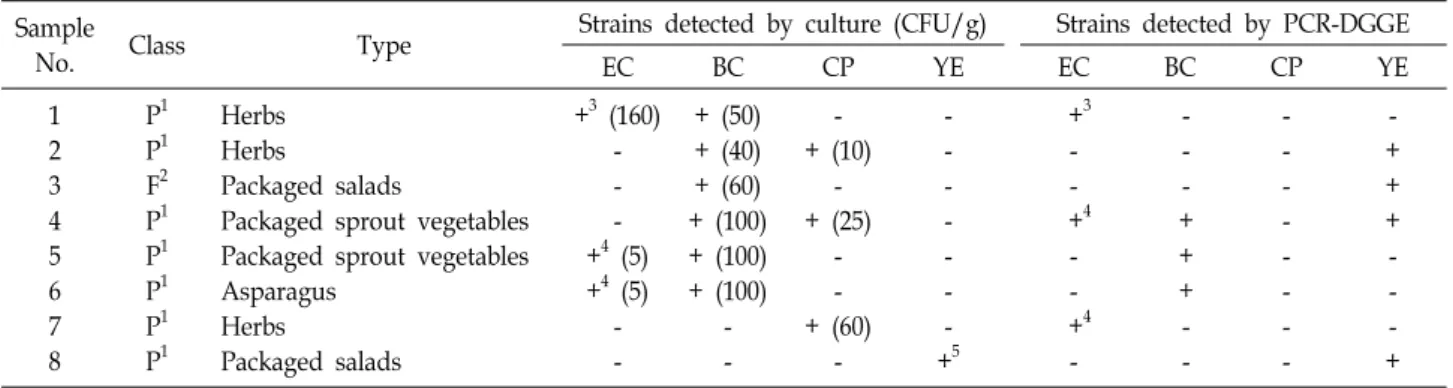
Food-borne pathogens detection by PCR-DGGE Randomly selected eight samples contaminated with bac- teria by culture-based method were further analyzed by PCR-DGGE. Table 5 showed sample types and their food-borne pathogens detection by culture-based method.
Enterohemorrhagic E. coli was detected in sample No. 1 by both culture-based method (160 CFU/g) and PCR-DGGE (Fig. 1). But non-pathogenic E. coli was not in PCR-DGGE of sample No. 5 and sample No. 6 that were detected by the culture method at 5 CFU/g (Fig. 1). It seemed that it was difficult to detect non-pathogenic E. coli due to the low level of bacteria. The detection limit of E. coli in the PCR- DGGE has been reported to be 10 CFU/g [10, 12]. On the other hand, the strain was recognized in PCR-DGGE of sam- ple No. 4 and sample No. 7, even though no detection by the culture method (Fig. 1). In the quantitative culture meth-
Table 5. Comparison of strains detected by culture-based method and PCR-DGGE Sample
No. Class Type Strains detected by culture (CFU/g) Strains detected by PCR-DGGE
EC BC CP YE EC BC CP YE
1 2 3 4 5 6 7 8
P1 P1 F2 P1 P1 P1 P1 P1
Herbs Herbs
Packaged salads
Packaged sprout vegetables Packaged sprout vegetables Asparagus
Herbs
Packaged salads
+3 (160) - - - +4 (5) +4 (5)
- -
+ (50) + (40) + (60) + (100) + (100) + (100)
- -
- + (10)
- + (25)
- - + (60)
-
- - - - - - - +5
+3 - - +4
- - +4
-
- - - + + + - -
- - - - - - - -
- + + + - - - + EC, Escherichia coli, BC, Bacillus cereus, CP, Clostridium perfringens, YE, Yersinia enterocolitica
1, Fresh-cut agricultural products 2, Fresh-cut agricultural foods 3, Enterohemorrhagic Escherichia coli 4, Non-pathogenic Escherichia coli
5, Yersinia enterocolitica was not quantitatively analyzed
od, samples were diluted by 10-fold stepwise without direct enrichment and possibility of loss occurred during the dilu- tion process.
Among the 6 samples contaminated with B. cereus, PCR- DGGE detected it in three samples (No. 4~6) at 100 CFU/g or more (Fig. 1). But samples (No. 1~3) at 40~60 CFU/g were not detected in PCR-DGGE analysis (Fig. 1). The detection limit of B. cereus in PCR-DGGE was reported to be 1,000 CFU/g [10, 12]. Our results showed a similar pattern to those of previous studies [10, 12].
In three samples at 10~60 CFU/g of C. perfringens, the strain was not detected in PCR-DGGE (Fig. 1). It was re- ported that the detection limit of C. perfringens in PCR-DGGE is 1,000 CFU/g [10, 12] and therefore it was not detected by PCR-DGGE in three C. perfringens positive samples.
Y. enterocolitica was recognized in PCR-DGGE of sample No. 8 contaminated with Y. enterocolitica. But Y. enterocolitica was detected in PCR-DGGE of sample No. 2, No. 3 and No.
4, even though no detection in the culture method (Fig. 1), which were packaged salads, packaged sprout vegetables, and herbs. It seemed that it was difficult to identify a low level of bacteria by culture-based method.
Discussion
The consumption of fresh-cut agricultural foods and products is increasing and food-borne diseases are increas- ing worldwide. The purpose of this study was to investigate the contamination level of fresh-cut agricultural materials distributed in Korea and provide data for microbiological
risk assessment and microbiological standard setting. Also, we tried to contribute to the improvement of the food-borne pathogen detection method by comparing the culture-based method and PCR-DGGE.
PCR-DGGE was conducted on randomly selected eight vegetables contaminated with many food-borne pathogens detected by the culture method. These vegetables belonged to herbs, packaged salads, packaged sprout vegetables, and asparagus, which can be eaten immediately without heating.
There was some difference in the bacterial species detected by between the culture-based method and PCR-DGGE (Table 5). Enterohemorrhagic Escherichia coli was detected by both detection methods in one sample. Non-pathogenic E.
coli was in two samples, which not detected by culture. It suggested that the strain at level of 160 CFU/g quantita- tively in the culture method is possible to detect in PCR- DGGE [10, 12]. It seemed that it is easier to detect the species by PCR-DGGE than by the culture method. Bacillus cereus was identified by PCR-DGGE only in three samples detected at 100CFU/g or more. Clostridium perfringens were detected at 10~60 CFU/g in the culture-based method, but did not in PCR-DGGE. In prior studies, the detection limit of PCR-DGGE was reported to be 1,000 CFU/g of C. perfringens and 1,000 CFU/g of B. cereus [10, 12]. This study showed a similar pattern to the detection limit of previous studies.
On the other hand, although Yersinia enterocolitica was not detected in the culture method, three sample cases were rec- ognized in PCR-DGGE only.
As such, in the culture-based method, detection of strains takes more time relatively as 5-7 days and requires a lot
of effort but PCR-DGGE is possible within 3-4 days. Also, In the case of high-risk food-borne pathogens, the detection limit was lower in the PCR-DGGE method (10 CFU/g) than in the culture-based method, meaning easier detection.
Based on the detection limit of PCR-DGGE, it was expected that it can be used to identify the species of high-risk food- borne pathogens with a low detection limit. Therefore, it suggested that PCR-DGGE can be used as an alternative method for detecting harmful microorganisms in vegetables.
High-risk food-borne pathogens can cause food-borne dis- eases even in low levels of bacteria (10 CFU/g or less) and may cause death, complications, and sequelae when in- fected, so special attention is required. It is necessary to rec- ognize the possibility of contamination of vegetables caused by high-risk food-borne pathogens. It was also suggested that sufficient washing recommendations and hygiene man- agement should be done. This study will contribute to the improvement of food-borne pathogen detection methods and the prevention of food-borne disease outbreaks caused by fresh-cut agricultural materials.
Acknowledgment
This work was supported by a 2-year Research Grant of Pusan National University.
The Conflict of Interest Statement
The authors declare that they have no conflicts of interest with the contents of this article.
References
1. Bae, Y. M., Hong, Y. J., Kang, D. H., Heu, S. and Lee, S. Y. 2017. Microbial and pathogenic contamination of ready-to-eat fresh vegetables in Korea. Kor. J. Food Sci.
Technol. 49, 599-604.
2. Centers for Disease Control and Prevention. June 11, 2020.
List of slected multistate food-borne outbreaks inves- tigations. https://www.cdc.gov/foodsafety/outbreaks/ mul
tistae-outbreaks/outbreaks-list.html.
3. Centers for Disease Control and Pevention. June 11, 2020.
Multistate outbreak of E. coli O157:H7 infections linked to romain lettuce. https://www.cdc.gov/ecoli/2018-outbreaks.
html.
4. De Medici, D., Croci, L., Delibato, E., Di Pasquale, S., Filetici, E. and Toti, L. 2003. Evaluation of DNA extraction methods for use in combination with SYBR green I re- al-time PCR to detect Salmonella enterica serotype enteritidis in poultry. J. Appl. Environ. Microbiol. 69, 3456-3461.
5. Hong, C. K., Seo, Y. H., Choi, C. M., Hwang, I. S. and Kim, M. S. 2012. Microbial quality of fresh vegetables and fruits in Seoul, Korea. Kor. J. Food Hyg. Safety 27, 24-29.
6. Jo, Y. M., Oh, H. M., Yoon, Y., Lee, S. Y., Ha, J. H., Kim, W. I., Kim, H. Y., Han, S. H. and Kim, S. R. 2017.
Enrichiment broth for the detection of Campylobacter jejuni and Campylobacter coli in fresh produce and poultry. Kor.
J. Food Prot. 80, 1842-1850.
7. Kim, H. J., Kim, Y. S., Chung, M. S., Oh, D. H., Bahk, G.
J., Chun, H. S. and Ha, S. D. 2010. Trends in rapid detection methods for food-borne pathogenic microorganisms by us- ing new technologies. Kor. J. Food Hyg. Safety 25, 376-387.
8. Kim, S. R., Roh, E., Kim, W. I., Hwang, I., Kim, H. and Ryu, K. 2019. Trends in smart detection methods of food borne pathogens in fresh produce. Kor. J. Safe Food 14, 10- 16.
9. Korea Center for Disease Control. 2018. Epidemiological in- vestigation guideline for water & food-borne diseases.
10. Korea Food Research Institute. 2005. Study on detection and control technologies for food spoilage microorganisms in refrigerated fresh-cut vegetable products.
11. Korea Fresh-cut Association. June 11, 2020. http://www.
Kfreshcut.com/html/ kfresh.html.
12. Kwon, O. Y. and Son, S. M. 2011. The rapid detection of pathogens in organically grown vegetables using PCR- DGGE. Kor. J. Food Engineering Progress 15, 370-375.
13. Lee, K. I., Kim, S. H., Heo, S. Y. and Chio, J. H. Korea Rural Economic Institue. 2018. Agrifood consumption activ- ity report.
14. Ministry of Agriculture, Food and Rural Affairs, Korea.
2018. 2018~2022 Agriculture, rural and food industry devel- opment plan. 10-13.
15. Ministry of Food and Drug Safety, Korea. 2018. Test meth- od to investigate the cause of food poisoning.
16. Ministry of Food and Drug Safety, Korea. 2019. Food code.
17. Ministry of Food and Drug Safety, Korea. 2019. Microbial Risk Assessment Guidelines.
초록:신선 농산물내 식중독균 검출 방법의 비교 분석
장혜정1,2․김혜정2․박지인2․유선녕1․박보배1․하강자2․안순철1*․김동섭3*
(1부산대학교 의과대학 미생물학 및 면역학 교실, 2경상남도 보건환경연구원, 3부산대학교 생명자원과학대학 식품
공학과)
건강에 대한 관심 증대와 1인 가구 증가라는 사회구조적인 변화로 이용하기 편리한 농산물에 대한 소비가 증가 하고 있다. 대부분의 신선 농산물은 가열하지 않고 섭취하는 경우가 많기 때문에 식품 매개 병원체에 쉽게 노출될 수 있어 세계적으로 과채류가 원인인 식중독 사고의 보고가 증가하고 있다. 이에 본 연구에서는 신선 농산물의 미생물학적 품질을 평가하고 식중독균 검출 방법을 비교 분석하고자 하였다. 신선 농산물 중 채소류 129건을 구입 하여 배양기반 방법으로 식중독균을 분석한 결과, non-pathogenic Escherichia coli (3.9%), Bacillus cereus (31.8%), Clostridium perfringens (5.4%), Yersinia enterocolitica (0.8%), enterohemorrhagic E. coli (0.8%)가 검출되었다. 이러 한 식중독균의 분석에는 증균 배양과정이 중요하게 작용을 하며 균주의 순수 분리 및 확인 동정에까지 상대적으 로 많은 시간과 노력이 요구된다. 따라서 증균 배양의 과정 없이 식중독균을 신속하게 검출 할 수 있는 PCR- DGGE를 수행하여 배양 기반의 분석법과 비교하였다. 비병원성 대장균은 배양 기반 방법에서 검출되지 않았음에 도 PCR-DGGE에서는 검출된 경우가 2건이 있었다. 본 연구에서 사용한 대장균 정량 분석방법은 시료를 10배 희 석한 후 배양하는 과정에서 시료의 손실 가능성과 검출 한계가 높은 단점으로 PCR-DGGE가 균종의 확인에 더욱 용이할 것으로 보였다. 저위해성 식중독균은 배양 기반 방법보다 PCR-DGGE에서 검출 한계가 높은 것으로 보였 다. 고위해성 식중독균은 배양 기반 방법보다 PCR-DGGE (10 CFU/g)에서 검출 한계가 낮아 균종 확인과 검출에 용이하다고 판단되었고 이를 통해 채소류에서 고위해성 식중독균의 잠재적 위험성을 확인하였다. 본 연구의 결과 는 신선 농산물의 미생물 위해 평가와 기준 설정을 위한 기초 자료로 활용될 수 있으며 신선 농산물 관련 식중독 균 검출 방법의 개선과 식중독 발생 예방에 기여할 것으로 기대한다.