• 검색 결과가 없습니다.

Factors Affecting Awareness of Long Term Care Insurance: An Exploratory Study

N/A
N/A
Protected

Academic year: 2021

Share "Factors Affecting Awareness of Long Term Care Insurance: An Exploratory Study"

Copied!
8
0
0

로드 중.... (전체 텍스트 보기)

전체 글

(1)

Factors Affecting Awareness of Long Term Care Insurance:

An Exploratory Study

Seojin Won 1 , Hyemee Kim 2*

1

Professor, Department of Social Welfare, Daegu Cyber University

2

Professor, Department of Social Welfare, Incheon National University

노인장기요양보험인지도에 영향을 미치는 요인에 대한 탐색적 연구

원서진 1 , 김혜미 2*

1

대구사이버대학교 사회복지학과 교수,

2

인천대학교 사회복지학과 교수

Abstract This is an exploratory study examining factors associated with awareness of the National Long Term Care Insurance in Korea. The researchers also examined the differences in factors based on their age, between the middle-aged group(45-64 years of age) and the elderly group(65 years and older). The 6th wave of Korean Longitudinal Study of Ageing(KLoSA) was used for secondary data analysis. Results indicated that for the middle-aged, gender, volunteer participation, ADL, IADL, and depression were related to their awareness of the long term care insurance. However, for the elderly, social capital factors were significantly related to their awareness of the insurance. Age and depression were also significant factors associated with the awareness level of the long term care insurance among the elderly. Based on the findings, implications for social welfare policy are discussed.

Key Words : Long Term Care Insurance, service awareness, elderly, social capital, health

요 약 본 논문은 노인장기요양보험 인지도에 영향을 미치는 요인을 알아보고 연령집단에 따른 차이점을 분석하고자 한 탐색적 연구이다. 이를 위해 연구대상을 45세에서 64세 이상의 중장년 집단과 65세 이상의 노인 집단으로 구분하 여, 인구사회학적 특징, 조사자의 사회관계망 요인, 건강요인이 노인장기요양보험 인지도에 미치는 영향을 파악하고자 하였으며, 고령화연구패널조사의 6차 조사자료를 토대로 2차자료 분석을 하였다. 연구결과를 보면, 45-64세 중장년 집단의 경우 성별, 자원봉사활동, ADL, IADL, 우울이 인지도에 영향을 미치는 것으로 나타났다. 이와 반면에 65세 이상 노인 집단에서는 나이와 우울 외에 종교모임, 친목목임, 여가활동, 동창회모임, 자원봉사활동, NGO활동과 같은 사회관계망 관련 요인들이 노인장기요양보험의 인지도에 영향을 주었다. 연구결과를 토대로 노인장기요양보험 인지도 향상방안에 대한 정책적 함의를 제시하였다.

주제어 : 노인장기요양보험, 서비스인지도, 노인, 사회적 자본, 건강

*Corresponding Author : Hyemee Kim([email protected]) Received June 28, 2019

Accepted September 20, 2019

Revised August 17, 2019

Published September 28, 2019

(2)

1. Introduction

Since the National Long Term Care Insurance[LTCI]

was implemented in 2008, we have experienced a rapid expansion of the LTC services and the service providers. Compared to 2012, the number of community-based LTC service centers increased by 32.4% and nursing facilities by 19.9% in 2016[1]. Approximately 20,000 facilities provided LTC services nationwide in 2016. Among them, 14,211 facilities provided in-home care services and 5,187 facilities were nursing homes. With this rapid increase of LTC facilities, the number of elderly using the services also increased. Since 2008, 2,091,399 people have applied for the LTC services[2].

With the increase in services, many studies have addressed issues regarding the LTC services.

However, most studies are focused on exploring limitations and ways to improve the current LTCI system[3-5]. Other studies have also examined the quality of services. For example, Choe’s study(2010) reviewed foreign countries’ quality assurance policies and interviewed the related personnels such as staff members at Ministry of Health and Welfare and National Health Insurance Service[6]. Several studies examined ways to improve the quality of the LTC services[7-9]. Another main stream of long term care studies focus on careworkers. Chang(2009) argued for the education and management needs for careworkers[10], and Jo's study(2007) suggested ways to improve knowledge of careworkers[11].

Despite studies that have accumulated over the years on the LTC and the services, studies conducted from the perspectives of potential users remain rather limited. Among a handful of studies, Kim, Kwon, and Kim’s study(2013) examined the relationship of LTC utilization and health care utilization among the service users[12]. Another study, examined the awareness of LTCI and life after-retirement plans among those under the ages of 65 years[13]. They

reported that individuals who had higher income and education were more likely to be knowledgeable about the LTCI, and that those with better awareness on the insurance were more likely to be prepared for after-retirement life. With an exception of these studies, studies examining the awareness of the LTCI remain scarce, and we do not have clear understanding of the factors that are associated with potential users’ awareness of the insurance. In particular, the potential role of social capital and health related factors in facilitating the awareness and leading to the actual service use behavior has been overlooked in previous studies.

Awareness of services is an important factor leading to service utilization behavior[14], and gaining an understanding of how to increase public’s awareness of social insurance program such as the LTC remains a critical issue for researchers and practitioners in the field of gerontology. With a lack of studies examining the topic, this study aims to fill the gap in literature by examining factors associated with awareness of the LTC among both the potential future user group, the middle-aged people(ages between 45 to 64 years) and the elderly people(65 years and above). In doing so, the results may provide an empirical ground for more concrete practice implications.

2. Method

2.1 Sample

The researchers used the 6th wave of Korean

Longitudinal Study of Ageing(KLoSA) collected by

the Korea Labor Institute for the secondary data

analyses. KLoSA is one of the publically open

data that is currently used by many social science

researchers to investigate diverse characteristics

of Korean seniors[15]. The sample of KLoSA is

people who are 45 years and older living in

Korea, excluding those residing in Jeju island.

(3)

The sampling frame is based on the National Census 2005, and by employing probability-based stratified sampling methods, 1,000 sampling districts were created[16]. A total of 10,254 people participated in the first survey through computer-assisted, face-to-face interview. In this paper, the 6th wave gathered in 2016 was used. The 6th wave data include information of 7,893 respondents(79.6%

respondence rate) out of 9,913(8,993 original members and 920 newly recruited members).

Excluding missing and incomplete data, the original sample for this study was 2,906 middle-aged people aged between 45 and 64 years old and 4,584 elderly people aged over 65 years old. Because researchers used the weight variable for the analysis, the final population was 6,311,641 middle-aged people and 7,384,659 elderly people.

2.2 Measures

2.2.1 Dependent Variable

The dependent variable, awareness of the National LTCI, was measured through a question,

“Do you know about the National LTC services?".

A binary variable indicating 1(yes) and 0(no) was used for analysis.

2.2.2 Independent Variables

The demographic variables included in the research model are gender, age, religion, and area of residence. Gender was coded zero for male and one for female. Age was treated as a continuous variable ranging from 45 years old to 108 years old. Religion was recoded into a dichotomous variable with one indicating having religion and zero indicating no religion. As for area of residence, those in rural areas were coded as one and those residing in urban areas were given a score of zero.

Income and work status were also included as economic factors. Income was measured by asking the annual household income including

earned income, income from pensions both public and private, income from properties, and others. Work status was measured by asking whether they are in the workforce, and the responses were coded into one(working) and zero(not working).

Social capital was measured by asking respondents how much they participate in religious gatherings, social gatherings, leisure activities, alumni gathering, volunteer participation, and non government organizations activities. They were asked to rate the frequency of participation on a 10-point Likert scale ranging from zero(rarely) to ten(almost everyday).

For health-related factors, self-rated health, ADL(Activities of Daily Living), IADL(Instrumental Activities of Daily Living), disability status, and depression were included. Self-rated health was measured by asking the respondents to rate their health status on a five-point scale ranging from one(very poor) to five(very good). ADL and IADL were measured with scales each consisted of seven and ten questions. ADL questionnaires ask whether the respondents need help in activities such as using toilet, preparing meals, changing clothes, and bathing. IADL measures the degree of respondents’ need in activities such as buying goods, using telephone, and using transportation services. Respondents were asked to rate their responses on a three-point likert scale ranging from zero(no help needed at all) to two(full help needed). The revised and summated total score of each scale was used for analyses. The Cronbach alpha for ADL was .985 for the middle-aged and .971 for the elderly. The Cronbach alpha for IADL was .923 for the middle-aged and .964 for the elderly.

Higher scores on ADL and IADL indicate more help needed for daily living activities. Disability status was measured by asking whether they have disability of any kind, and those with disability were coded one and those without disability were coded zero. Depression was measured using the CES-D scale, consisted of ten items.

Respondents were asked to rate how often they

(4)

experience the statements such as “I felt sad last week.” on a 4-point Likert scale ranging from one(rarely) to four(almost everyday). The Cronbach alpha for depression was .745 for the middle-aged and .841 for the elderly.

2.3 Analyses

The researchers used SPSS 18.0 for data recoding and Stata 15.0 for descriptive statistics and logistic regression analyses. First, for descriptive statistics of key variables, we showed frequencies and percent for dichotomous variables and the mean scores and standard deviation for continuous variables. Also, to compare means between middle-aged people and elderly people, we used t-test and chi-square statistics. Then, we conducted logistic regression analyses to examine factors affecting awareness of the national long term care insurance.

3. Results

3.1 Descriptive analysis

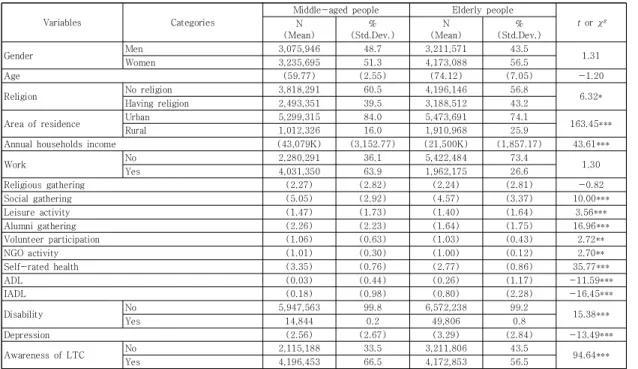
Table 1 shows general characteristics of the respondents according to the age group.

Statistically significant age group differences were present in religion and area of residence. In specific, more older individuals reported of having religion(39.5% vs. 43.2%, χ²= 6.32, p <.05 ) than the middle-aged. Also, in the sample, while over 84 percent of the middle-aged people lived in the urban area, 74.1% of the elderly people lived in the urban area( χ²= 163.45, p <.001). Among the economic and social capital factors, there was a significant income gap between younger and older populations. Compared to the middle-aged individuals in the study, the elderly reportedly had much less income, almost a half of what the younger age group reported. In addition, the proportion of those at workforce was also much lower among the elderly(63.9% vs.

26.6%). Participations in various meetings and activities were also different between the age groups that the middle aged group had more

Variables Categories

Middle-aged people Elderly people

t or χ² N

(Mean)

% (Std.Dev.)

N (Mean)

% (Std.Dev.)

Gender Men 3,075,946 48.7 3,211,571 43.5

Women 3,235,695 51.3 4,173,088 56.5 1.31

Age (59.77) (2.55) (74.12) (7.05) -1.20

Religion No religion 3,818,291 60.5 4,196,146 56.8

6.32*

Having religion 2,493,351 39.5 3,188,512 43.2

Area of residence Urban 5,299,315 84.0 5,473,691 74.1

163.45***

Rural 1,012,326 16.0 1,910,968 25.9

Annual households income (43,079K) (3,152.77) (21,500K) (1,857.17) 43.61***

Work No 2,280,291 36.1 5,422,484 73.4

Yes 4,031,350 63.9 1,962,175 26.6 1.30

Religious gathering (2.27) (2.82) (2.24) (2.81) -0.82

Social gathering (5.05) (2.92) (4.57) (3.37) 10.00***

Leisure activity (1.47) (1.73) (1.40) (1.64) 3.56***

Alumni gathering (2.26) (2.23) (1.64) (1.75) 16.96***

Volunteer participation (1.06) (0.63) (1.03) (0.43) 2.72**

NGO activity (1.01) (0.30) (1.00) (0.12) 2.70**

Self-rated health (3.35) (0.76) (2.77) (0.86) 35.77***

ADL (0.03) (0.44) (0.26) (1.17) -11.59***

IADL (0.18) (0.98) (0.80) (2.28) -16.45***

Disability No 5,947,563 99.8 6,572,238 99.2

15.38***

Yes 14,844 0.2 49,806 0.8

Depression (2.56) (2.67) (3.29) (2.84) -13.49***

Awareness of LTC No 2,115,188 33.5 3,211,806 43.5

94.64***

Yes 4,196,453 66.5 4,172,853 56.5

*p<.05, **p<.01, ***p<.001

Table 1. Demographic characteristics of the sample

(5)

frequent involvement in social gatherings.

Significant differences between the age groups were also found in all the health indicators. The elderly reported of poorer self-rated health than the middle-aged group. Also, the elderly tended to be more dependent for daily living activities and depressed as well as having some kind of disability. Finally, while the National LTCI has been in place for over ten years, 33.5% of the middle-aged and 43.5% of the elderly reported of having no knowledge of the insurance.

3.2 Logistic regression analyses on factors related to awareness of long term care insurance

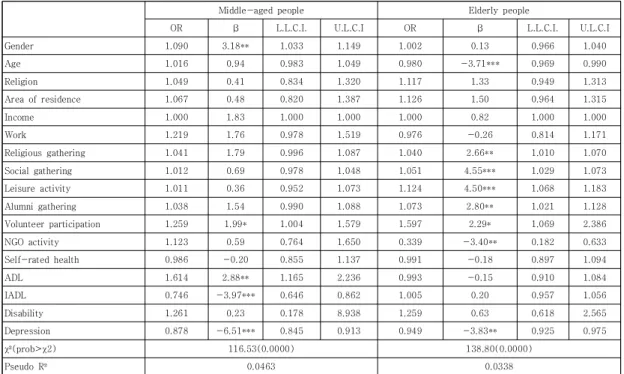
Table 2 shows the result of logistic regression analyses of factors associated with the awareness of the LTCI. For the middle-aged, gender(OR=1.090, p <.01), volunteer participation(OR=1.259, p <.05), ADL(OR=1.614, p <.01), IADL(OR=0.746, p <.001), and depression(OR=0.878, p <.001) were significantly

associated with the awareness of the LTCI. More specifically, women who participated in volunteer activities more frequently, and had good ADL score were more likely to be aware of the LTCI.

On the other hand, IADL and depression were negatively associated with the awareness that those who had higher IADL and depression levels were less likely to be aware of the insurance.

For the elderly, age (OR=0.980, p <.001), participation in religious gatherings(OR=1.040, p <.01), social gatherings(OR=1.051, p <.001), leisure activity(OR=1.124, p <.001), alumni gathering(OR=1.073, p <.01), volunteer participation(OR=1.597, p <.05), NGO activity(OR=0.339, p <.01), and depression(OR=0.949, p <.01) were significantly associated with the awareness of the LTCI. In other words, the younger individuals who are more involved with various social activities were more likely to be aware of the LTCI. Also, those who were less depressed were also aware of the LTCI.

Middle-aged people Elderly people

OR β L.L.C.I. U.L.C.I OR β L.L.C.I. U.L.C.I

Gender 1.090 3.18** 1.033 1.149 1.002 0.13 0.966 1.040

Age 1.016 0.94 0.983 1.049 0.980 -3.71*** 0.969 0.990

Religion 1.049 0.41 0.834 1.320 1.117 1.33 0.949 1.313

Area of residence 1.067 0.48 0.820 1.387 1.126 1.50 0.964 1.315

Income 1.000 1.83 1.000 1.000 1.000 0.82 1.000 1.000

Work 1.219 1.76 0.978 1.519 0.976 -0.26 0.814 1.171

Religious gathering 1.041 1.79 0.996 1.087 1.040 2.66** 1.010 1.070

Social gathering 1.012 0.69 0.978 1.048 1.051 4.55*** 1.029 1.073

Leisure activity 1.011 0.36 0.952 1.073 1.124 4.50*** 1.068 1.183

Alumni gathering 1.038 1.54 0.990 1.088 1.073 2.80** 1.021 1.128

Volunteer participation 1.259 1.99* 1.004 1.579 1.597 2.29* 1.069 2.386

NGO activity 1.123 0.59 0.764 1.650 0.339 -3.40** 0.182 0.633

Self-rated health 0.986 -0.20 0.855 1.137 0.991 -0.18 0.897 1.094

ADL 1.614 2.88** 1.165 2.236 0.993 -0.15 0.910 1.084

IADL 0.746 -3.97*** 0.646 0.862 1.005 0.20 0.957 1.056

Disability 1.261 0.23 0.178 8.938 1.259 0.63 0.618 2.565

Depression 0.878 -6.51*** 0.845 0.913 0.949 -3.83** 0.925 0.975

χ²(prob>χ2) 116.53(0.0000) 138.80(0.0000)

Pseudo R² 0.0463 0.0338

*p<.05, **p<.01, ***p<.001

Table 2. Logistic regression results

(6)

4. Discussion

This study was conducted with an aim to identify factors associated with awareness of the National LTCI in Korea. As awareness of services is a crucial factor leading to potential service utilization behavior[17], it is imperative to gain an understanding of how people become aware of or unaware of existing social services.

The results show that different factors were associated with the likelihood of being aware of the LTCI by the age group. For example, in the middle-aged group, women who actively participated in volunteer work were more likely to be aware of the insurance than their counterparts. However, the effect of ADL and IADL differed in its direction that those with better ADL and lower IADL were more likely to be aware of the insurance. We need to further investigate such reverse direction of ADL and IADL. It may be possible that as IADL is a more sensitive tool to screen early stage of dementia and cognitive disability[18], the middle-aged potentially at such risks may be more aware of services for future utilization. Lastly, less depressed individuals were more likely to be aware of the insurance.

Analyses on the elderly group yielded different results. For this population, age and social capital factors were significantly related to their awareness of the insurance. Among the group, those who participated in various social activities were more likely to be aware of the insurance, and less depressed elderly were also more likely to be aware of the insurance.

The results also show that a higher proportion of the middle-aged group were more aware of the insurance than in the elderly group. One may assume that older adults may be more likely to be aware of the social security programs, including the LTCI as the insurance specifically pertains to those 65 years of age and older.

However, the finding indicates that it is not necessarily the case, calling for a need to better

disseminate information about the needed insurances and programs. The higher proportion of the middle-aged group being aware of the insurance may also be explained by a possibility that they are what is often referred to as

‘sandwich generation’[19]. The sandwich generation refers to the generation who carry the caring responsibilities for both their children and the ageing parents. The term is often used to refer to women simultaneously balancing multiple roles, and it is the role that requires many middle-aged women to be knowledgeable of available social service and relevant policies and programs to care for their both elderly parents and the children. Yang(2011), for instance, stated awareness of LTCI among adult child is related to the level of care for older parents[20]. In addition, as people with dementia have increased rapidly in Korean society during last few decades, these middle-aged women often become primary caregivers who are actively seeking for formal services for their parents. Park and Shin(2018) in their study of the middle-aged female caregivers also argued for the need to alleviate their care burden, and called for affordable and reliable public services[21]. As the finding of this study also shows that women are more likely to be aware of the insurance, it is likely that the potential caring burden of the middle-aged women may motivate them to seek relevant information, hence their awareness level may be higher.

The finding that less depressed individuals

were more likely to be aware of the insurance in

both age groups also indicates a need for better

prevention and intervention plans for the

depressed. The findings show that depressed

individuals not only lack social capitals, but they

also lack information and knowledge about

available resources. Individuals suffering from

depression are not only considered at risk for

other health-related problems[22], but also at

risk for being excluded from the resources, and

the finding points to better identification,

(7)

screening, and intervention with those battling with depression.

While it has been over a decade since the National LTCI was implemented, the finding of this study shows that more than 30% of the middle-aged still do not know of the insurance.

To better increase awareness of the insurance among the elderly and also the middle-aged group, future studies should further examine the route through which one gains knowledge of the insurance. Currently, the National Health Insurance Service and Ministry of Health and Welfare jointly disseminate the information via on-line advertisement as well as distribution of brochures in social welfare agencies, community centers, and public health centers. Local governments and health agencies with a joint effort of National Health Insurance Service are also actively involved in both on-line and off-line advertisement. Despite such effort, it remains unknown how one gains knowledge of the insurance, and whether on-line advertisement is an effective measure for the older population as elderly may not be familiar with utilizing and/or accessing the on-line services. Furthermore, those living alone may not have an adequate access to available resources within their communities, resulting in limited knowledge of needed services. The government should utilize both formal and informal infrastructure to spread information about the LTCI, and it is also suggested that policy advertisement to be in place via public, government side as well as private sector[23].

As the finding of this study shows the importance of social engagement in obtaining knowledge of the insurance, specifically for the older group, the focus of intervention with the elderly should be on building and strengthening their social network. Social capital is an important factor affecting the quality of life in many ways across all age groups[24]. The finding of this study provides another empirical evidence highlighting the importance of social capital as it

is identified as a critical factor affecting the likelihood of gaining awareness of the insurance.

Despite important implications the study provides in regards to the National LTCI in Korea, limitations of the study should also be acknowledged. First, factors potentially affecting the awareness of the insurance were omitted due to the limitation of using the secondary data. For example, information on previous use of LTCI for spouse or family member can significantly affect their awareness status. In addition, being aware of the insurance and the services may be different as it is possible for individuals to be aware of service providing agencies yet not be aware of the policies or insurance programs that support the services. Thus, future studies should distinguish the awareness of the insurance and the actual service providing agencies and/or services to gain clearer understanding. In addition, we need to further examine the possible differences in factors leading to LTCI awareness by the elderly’s age group. For example, the young-old(65-74 years of age) and the old-old(75 years and older) exhibit many differences in health status and social resources[25], potentially leading to different awareness levels. Lastly, due to its cross-sectional design, caution is needed in interpretation of the results. To better investigate the causal relations between the independent variables and the dependent variable, longitudinal analyses should be conducted.

REFERENCES

[1] National Health Insurance Service. (2017). Long Term Care Insurance Statistics in 2016.

[2] National Health Insurance Service. (2019). Statistics of Long Term Care Consumers [Online].

www.longtermcare.or.kr

[3] J. Seok. (2010). The Improvement of Long-term Care Insurance from the Perspective of Service Providers.

Health and Welfare Policy Forum, 168 , 34-44.

[4] J. Lee & J. Seomun. (2009). A Study on Problems and

(8)

Improvement of Home-help Services of Long-term Care Insurance. Journal of the Korean Gerontological Society, 29(1), 149-175.

[5] D. Sunwoo. (2010). An Improvement Plan for the Government Policy on Long-term Care Insurance.

Health and Welfare Policy Forum, 168 , 16-24.

[6] E. Choe. (2010). A Study on Strategic Proposal for Improving of Service Quality Management System of Long-term Care. Journal of the Korean Gerontological Society, 30(2), 401-419.

[7] H. Kwon. (2014). The Impact of the Marketization on the Long-term Care Provision in Terms of Service Quality. Social Welfare Policy, 41(1) , 289-313.

[8] K. Um. (2008). Strategic Proposal for the Improvement of Service Quality of Long-term Care Insurance in Korea. Health and Welfare Policy Forum, 142, 38-46.

[9] J. Kim. (2008). Proposal for the Improvement of Service Quality of Long-term Care Insurance in Korea. Journal of Far East Social Welfare, 4, 49-83.

[10] W. Chang. (2009). The Study of Care-giver’s Education and Management of Long-term Care Insurance.

Journal of Welfare for the Aged, 43, 263-286.

[11] C. Jo. (2007). Ensuring Professional Skills among Careworkers in the Long Term Care Insurance.

Korean Journal of Research in Gerontology, 16, 9-40.

[12] M. Kim, S. Kwon, & H. Kim. (2013). The Effect of Long-term Care Utilization on Health Care Utilization of the Elderly. Korean Health Economic Review, 19(3), 1-22.

[13] H. Kwon, H. Shin, & J. Kim. (2012). The Relationship between the Recognition on Long-term Care Insurance and the Old Life Preparation for People under 65. Health and Social Welfare Review, 32(4), 219-248.

[14] R. M. Andersen. (1995). Revisiting the Behavioral Model and Access to Medical Care: Does It Matter?

Journal of Health and Social Behavior, 36(1), 1-10.

[15] Korea Employment Information Service. (2019a).

Korea Longitudinal Study of Ageing: 2019 User’s Guide.

[16] Korea Employment Information Service. (2019b).

Korea Longitudinal Study of Ageing [Online].

survey.keis.or.kr

[17] B. D. Shon. (2014). Factors Associated with Cognition and Utilization of Multicultural Family Support Centers among Foreign Spouses of Multicultural Families. Health and Social Welfare Review, 34(4) , 354-384.

[18] Y. Yang, et al. (2012). Activities of Daily Living and Dementia. Dementia and Neurocognitve Disorders, 11, 29-37.

[19] K. Evans, J. Millsteed, J. E. Richmond, M. Falkner, T.

Falkner, & J. Sonya. (2016). Working Sandwich Generation Women Utilize Strategies Within and Between Roles to Achieve Role Balance. PLoS One,

11(6), 1-23.

[20] S. Yang. (2011). The Relations of the Long-term Care Insurance Awareness and the Aged Parent-supporting.

Journal of Digital Convergence, 9(5) , 45-54.

[21] J. Park, & S, Shin. (2018). The Qualitative Analysis on Experiences of Caregiving Middle-aged Woman’s Biological Parents. Journal of the Korea Contents Association, 18(12) , 611-623.

[22] M. J. Park. (2015). Suicidal Ideation and Affecting Factors According to Sex in Elderly by Using Korea Health Panel Data 2010. J ournal of the Korean Data Analysis Society, 17(2B) , 1087-1099.

[23] Ministry of Culture, Sports, and Tourism. (2014).

Policy Advertisement Manual.

[24] K. Kim, S. Lee, H. Youn, & G. Kwon. (2015). The Effects of Social Capital of Old-old Elderly of More Than 70 Year Old on Their Health Related Quality of Life. Journal of Korea Academy Industrial Cooperation Society, 16(6), 3889-3901.

[25] B, Negarten, J. Moorn, & L. Low. (1995). Age Constraints and Adult Socialization. American Journal of Sociology, 70, 710-717.

원 서 진(Seojin Won) [정회원]

․ 2002년 2월 : 서울대학교 사회복지학 과(문학사)

․ 2004년 5월 : 미국 Columbia Univ., Social Work(M.S)

․ 2009년 12월 : 미국 Ohio State Univ., Social Work(Ph.D)

․ 2010년 3월 ~ 현재 : 대구사이버대학 교 사회복지학과 부교수

․ 관심분야 : 노인복지, 정신건강

․ E-Mail : [email protected]

김 혜 미(Hyemee Kim) [정회원]

․ 2001년 12월 : 미국 Univ. of Connecticut, Sociology(B.A)

․ 2004년 5월 : 미국 Columbia Univ., Social Work(M.S)

․ 2012년 2월 : 서울대학교 사회복지학 과(Ph.D)

․ 2012년 9월 ~ 현재 : 인천대학교 사 회복지학과 부교수

․ 관심분야 : 다문화복지, 정신건강

․ E-Mail : [email protected]

수치

Table  1  shows  general  characteristics  of  the  respondents  according  to  the  age  group
Table  2  shows  the  result  of  logistic  regression  analyses  of  factors  associated  with  the  awareness  of  the  LTCI

참조

관련 문서

• MACCS 코드를 사용하여 거주성과 관련된 국내 중장기 주민보호조치 기준을 평가 &amp; 해외 기준을 조사하여 결과를 비교. • 국내 주민보호조치 기준을 반영한 모든

Income security, health and medical care, welfare measures through long-term care and assisted living facilities, social participation by working are the key elements and all

Pusposes: This study is to identify relations between knowledge, awareness and practice on nosocomial infection of operating room nurses and affecting factors

The first public medical insurance act enacted in 1963 and according to the Amendment in 1976 became the health care insurance compulsorily.. The national

This study was conducted to investigate the effects of the long-term treatments of N, P, K fertilizers on fruits quality and yield, tree nutrition and

The Long-term Traffic Safety Im- pact of a Pilot Alcohol Abuse Treatment as an Alternative to License Suspensions: Volume 2 of An Evaluation of the California

Abstract: This study aimed to review the oral hygiene status, oral care guidelines, and outcomes of oral care in intensive care unit (ICU) patients from a dental

This study was designed to determine the effect of long- term acid suppression with tegoprazan 25 mg or lansoprazole 15 mg on the maintenance of endoscopic remission