Comparison and Validation of Genetic Diversity and Population Structure Using Monomorphic SNP Data of the Korean Native Black Goat and Crossbred Goat
Kwan-Woo Kim1, Jinwook Lee1, Eun-Do Lee1, Sung-Soo Lee1, You-Lim Choi2, Hyun-Tae Lim3,4, Yousam Kim5 and Sang-Hoon Lee1*
1Animal Genetics Resources Research Center, National Institute of Animal Science, RDA, Hamyang 50000, Korea
2Animal Genetics & Breeding Division, National Institute of Animal Science, RDA, Cheonan 31000, Korea
3Department of animal science, Gyeongsang National University, Jinju 52828, Korea
4Institute of Agriculture and Life Science, Gyeongsang National University, Jinju 52828, Korea
5TNT Research Co., Ltd., Anyang-si, Gyeonggi-do 14059, Korea
Received September 16, 2020 /Revised November 17, 2020 /Accepted November 18, 2020
This study was conducted to analyze the genetic diversity and relationships that discriminate between Korean native black goat populations (Dangjin, Jangsu, Tongyoung, and Gyeongsang National Univer- sity strains) and crossbred goats. Monomorphic single nucleotide polymorphisms (SNPs) in each strain were collected, and 133 common SNPs were selected for analysis. These 133 monomorphic SNPs showed differences in the genetic structure of the Korean native black goat and crossbred goats, and results from the principal component analysis (PCA) showed that the two can be clearly separated.
Furthermore, analysis of the validation population comprising 70 individuals (Korean native black goats, n = 24; crossbred goats, n = 46) with the reference population showed that Korean native black goat strains and the reference population have the same genetic structure, and the crossbred goats shared only part of the genetic structure with the reference population. The result of the PCA analysis showed that the Korean native black goat strains form one population, whereas the foreign strains form another population which is more widely dispersed than the Korean native black goat strains.
Thus, the results from this study can be used as baseline data for the conservation of genetic resources of Korean native black goat communities through utilization of monomorphic SNPs and for the in- troduction of exotic species for further improvement in genetic diversity. This study can also help re- duce unnecessary inbreeding and gene flow between native strains.
Key words : Genetic diversity, genetic structure, goat, monomorphic SNP
*Corresponding author
*Tel : +82-55-960-3540, Fax : +82-55-960-3590
*E-mail : [email protected]
This is an Open-Access article distributed under the terms of the Creative Commons Attribution Non-Commercial License (http://creativecommons.org/licenses/by-nc/3.0) which permits unrestricted non-commercial use, distribution, and reproduction in any medium, provided the original work is properly cited.
서 론
염소는 전 세계에 가장 널리 분포되어 있는 가축 중의 하나 이며 고유한 형태학적 특성, 생산적 특성 및 기후 환경에 대한 적응 특성 등 다양하고 중요한 유전적 변이들이 있다[15]. 또한 전 세계에 약 570 여 종으로 1 억 마리 이상 사육되고 있으며 품종은 유용종, 육용종, 난용종, 모용종 및 겸용종으로 그 이용 되는 목적에 따라 5 가지로 분류된다. 그 분포는 아시아에 57.4%, 아프리카에 37.0%, 아메리카에 3.5%, 유럽에 1.6%, 그리 고 오세아니아에 0.4%가 분포되어 있다고 보고되고 있다[5].
국내 염소사육은 약 2000년 전으로 추정되며, 기원은 불분 명하지만 중국 또는 몽골을 거쳐 유입된 것으로 추정된다[7,
9]. 우리나라의 재래흑염소는 4계통(당진, 장수, 통영, 경상대) 이 보존되고 있으며 국제식량농업기구의 가축다양성정보시 스템(Domestic Animal Diversity Information System)에 품 종으로 등록되어 있다.
그러나 1963년부터 해외에서 유산양 품종인 Saanen이 도입 과 1990년 이후 육용종 염소 품종들이 도입되어 농가에 보급 된 이후 육량 증대를 위한 무분별한 교배로 순수한 혈통의 재래흑염소가 급격히 감소하여 멸종의 위기에 직면하게 되었 다[4, 10]. 따라서 주로 외관적인 특성에 따라 분류하고 있는 재래흑염소의 보다 명확한 계통 분류기준을 확립하여야 할 필요성이 있다.
해외의 경우 유전체 분석을 통해 염소 품종의 기원, 유전적 특성, 품종 간의 관계 및 각 품종에 대한 교잡 여부 등에 관한 연구결과들이 보고되고 있다. 스페인산 염소 7 품종에서 DNA chip을 이용한 유전체 분석한 결과 이들의 진화적 기원은 유럽 품종(Saanen, Carpathina)과 북아프리카 품종(Tunisian, Djal- lonke and Sahel)의 교잡종에서 유래된 것으로 보고하였다 [11]. 또한 중밀도 SNP (Single Nucleotide polymorphism) chip을 이용한 연구에서 네덜란드의 6 개 염소 품종들(Boer,
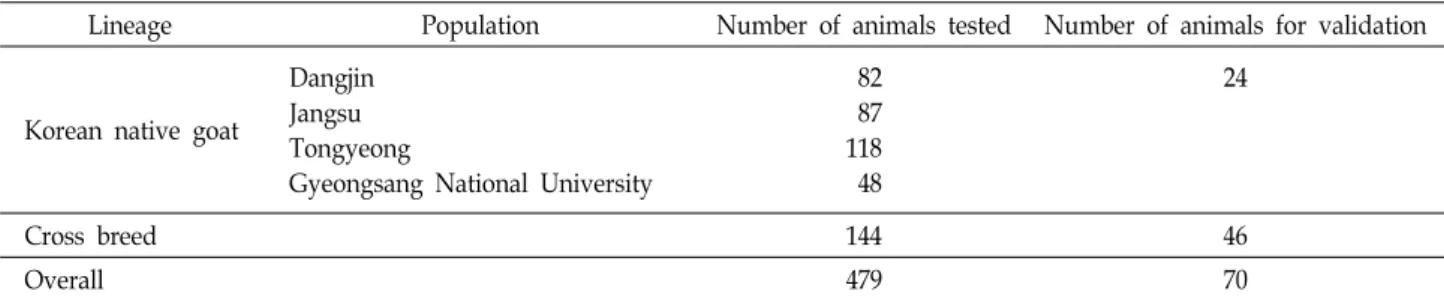
Table 1. Information of the goat populations used in this study
Lineage Population Number of animals tested Number of animals for validation
Korean native goat
Dangjin Jangsu Tongyeong
Gyeongsang National University
82 87 118 48
24
Cross breed 144 46
Overall 479 70
Karamojong, Kigezi, Mubende, Small East African, Sebei)은 공통조상에서 기원한 후 지리적 분화가 진행된 것으로 판단하 였으며, 지리적 분화는 유전적 다양성 유지와 교잡종 생산에 도 기여하는 것으로 보고하였다[12].
국내에서도 증폭절편길이다형성(amplified fragment length polymorphism, AFLP) DNA marker를 이용한 AFLP- poly- merase chain reaction (PCR) 기법을 사용하여 재래흑염소 고 기를 감별하는 방법이 보고(Chung, 2002)된 바 있으나, 재래흑 염소의 계통을 명확히 식별하지는 못하는 실정이다. 또한 지 금까지 유전적 다양성과 개체군 간의 측정에 있어 SNP 기술의 중요성이 보고[6, 8]된 바 있지만, 아직 재래흑염소에 관한 연 구는 미미한 실정이다.
따라서 본 연구는 우리나라 고유의 재래흑염소와 외래교잡 종 염소를 명확히 식별할 수 있는 방법을 개발하고자 DNA chip을 이용한 유전체 분석을 통해 염소의 품종 또는 계통에 따라 차이를 나타내는 계통-특이적인 SNP 마커를 발굴하고 이들 SNP 마커를 사용하여 우리나라에서 사육되고 있는 염소 의 품종 또는 계통과 외래 교잡종 염소를 명확히 식별할 수 있는 기술을 개발하기 위해 실시하였다.
재료 및 방법
공시동물
연구에 이용한 동물은 농촌진흥청 국립축산과학원 가축유 전자원센터에서 유전자원으로 수집 보존하고 있는 재래흑염 소 4 계통(당진, 장수, 통영, 경상대) 354 두와 교잡종 염소 152 두를 분석에 이용하였다. 본 실험은 농촌진흥청 국립축산과학 원의 동물실험계획서에 의거 동물보호법 및 국립축산과학원 동물시험윤리위원회에서 승인된 동물실험방법(승인번호: 2019- 320)에 따라 수행되었다. DNA는 사육중인 염소의 경정맥에서 전혈을 수집하고, MagMAXTM DNA Multi-Sample Ultra 2.0 Kit(Thermo Fisher Scientific, Waltham, Massachusetts, USA) 로 공급자의 매뉴얼에 따라 분리하였으며, SNP chip 분석에 이용하였다.
SNP Chip data
유전체 정보 수집을 위하여 GoatSNP50K chip (Illumina,
inc., San Diego, CA)을 이용하여 506 두의 유전체 정보를 수집 하였다(Table 1). 또한, SNP 정보를 활용한 계통 판별을 위해 검증집단(validation population) 70 두의 유전체 정보를 수집 하였다.
SNP 선발
Illumina GoatSNP50K chip을 통해 수집된 50,618 개의 SNP 중 국내 재래흑염소 집단과 해외 교잡종 염소 집단에 존재하는 monomorphic SNP를 선발하여 분석에 이용하였다(Supple- ment S1).
유전적 구조 차이 및 PCA
국내 재래흑염소 집단과 해외 교잡종 염소 집단의 유전적 구조 차이 분석을 위해 STRUCTURE software [1]를 이용하여 각 클러스터에 대한 집단의 실제 분포를 추정하였으며, 두 집 단의 Clustering을 통한 유전적 상관관계를 조사하기 위해 PLINK version 1.90[3, 14]을 이용하여 주성분분석(principal components analysis, PCA)을 수행하였다.
결과 및 고찰
SNP 선발
해외 교잡종 염소 집단(cross breed, CB)는 총 50,618 개 SNP 중 418 개의 monomorphic SNP가 발견되었으며, 국내 재래흑염소 4 개 집단(당진, 통영, 장수, 경상대 계통)에서는 1,421 개의 monomorphic SNP가 발견되었다. 이 중 해외 교잡 종 염소 집단과 국내 재래흑염소 집단에 공통적으로 나타나는 133 개의 monomorphic SNP를 분석에 이용하였다(Table 1).
유전적 구조차이 분석결과
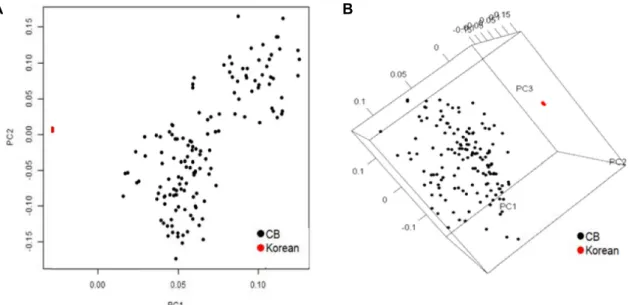
국내 재래흑염소와 해외에서 도입된 교잡 집단의 유전적 구조 차이를 133 개의 SNP 자료를 이용하여 분석한 결과, 2 개의 집단에 대해 K(그룹) 값을 2로 설정하는 경우 3 개의 그룹 값에 비해 더 정확하게 국내 재래흑염소 집단과 해외 교잡종 염소 집단 구분되었다(Fig. 1). PCA 분석결과 국내 재래흑염소 계통들의 경우 하나의 군집을 형성하는 것으로 나타났으며, 해외 교잡종 염소 집단의 경우 군집을 이루지 못하고 넓게
A
B
K=2
K=3
Fig. 1. Genetic structure plots of Korean native goats (Korean) and crossbred (CB) populations based on the genotype differences of 133 monomorphic single nucleotide poly- morphism markers found in this study.
A B
Fig. 2. The results of principal component analysis (PCA) showing the genetic relationship between Korean native black goat and cross breed using single nucleotide polymorphisms. A, 2D analysis; B, 3D analysis.
A
B
C
K=2, reference population=2, validation population=2
K=3, reference population=2, validation population=2
K=4, reference population=2, validation population=2
Fig. 3. Genetic structure resulting from the validation analysis using 133 single nucleotide polymorphisms. CB, cross- breed; ECB, expected crossbreed; KOR, Korean Native Goat; EKOR, expected Korean Native Goat.
퍼지는 것으로 나타났다(Fig. 2). Monomorphic SNP 133 개를 활용해 집단 간의 구분이 가능한 것으로 나타났으며, 이는 초 위성체 마커(microsatelite maker)의 활용을 통한 재래흑염소 집단과 외래 품종 집단(Saanen, Toggenburg, Boer)과의 유전 적 구조적인 차이를 나타내는 연구 결과와 일치하였으며[13, 16], 중국에서 6 개 염소 집단에 대해 SNP 정보의 활용을 통한 유전적 구조 비교 연구에서 SNP 정보를 활용한 구분이 가능하 다는 연구결과와 유사하였다[2].
검증분석(Validation test)
SNP 정보를 바탕으로 분석된 참조집단과 검증집단의 유전 적 구조 차이는 Fig. 3에 나타내었다. 참조집단으로 사용할 국 내 재래흑엽소 계통(KOR, Korean native goat)과 해외 교잡종 (CB, crossbreed goat)의 2개 집단의 유전체 정보를 바탕으로, 재래흑염소 계통으로 예측되는 예측 재래흑염소(EKOR, ex- pected Korean native goat) 실험집단(test population) 1개와
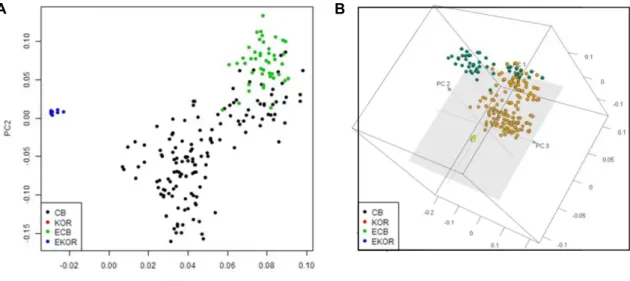
해외 교잡 품종으로 추정되는 예측 해외 교잡종(ECB, expected crossbreed Goat) 실험집단 1개에 대하여 유전적 구조의 유사 성을 비교하였다. 유전적 구조를 나누는 기준인 K의 값을 2에 서 4까지로 변형하여 유전적 구조의 차이를 확인하였으며, K 값의 증가와 관계없이 국내 재래흑염소 계통(KOR, Korean Native Goat)과 예측 국내 재래흑염소 계통(EKOR, expected Korean Native Goat)은 동일한 유전적 구조를 나타냈으며, 해 외 교잡종 염소(CB, Crossbreed Goat)의 경우 다양한 유전적 구성을 나타냈으며, 예측 해외 교잡종 염소(ECB, Expected Crossbreed Goat)는 참조집단(CB)과 일정 부분 유전적 구성을
A B
Fig. 4. Principal component analysis (PCA) of the validation analysis using 133 SNPs: (A) 2D analysis, (B) 3D analysis.
공유하는 것으로 나타났다. 또한, 유전적 상관을 위한 2D, 3D PCA 결과는 Fig. 4에 나타냈으며, 국내 재래흑염소 계통과 예측 국내 재래흑염소 계통은 하나의 군집으로 형성되었으나, 해외 교잡종 염소와 예측 해외 교잡종 염소는 서로 혼재되어 하나의 군집으로 나타났으나, 국내 재래흑염소 계통의 군집에 비해 PC1에서는 0.00에서 0.10까지, PC2에서는 -0.15에서 0.10 까지로 넓게 퍼져 있는 것으로 나타났다. 또한, 3D PCA에서도 동일한 현상을 나타내는 것으로 확인되었다. 이러한 결과는 해외 교잡종의 경우 다양한 유전자원의 결합으로 구성되었기 때문에 국내 재래 흑염소 집단에 비해 군집 형성이 되지 않는 것으로 사료된다.
본 연구는 기존 연구[13, 16]에서 활용된 초위성체 마커를 활용한 계통 구분이 아닌 SNP 패널의 정보 활용한 국내 재래 흑염소 계통과 해외 교잡종 염소의 구분을 위한 연구를 수행 하였다. 본 연구 결과는 두 집단에서 공통적으로 나타나는 monomorphic SNP 133 개를 활용하는 경우 두 집단의 뚜렷한 구분이 가능한 것으로 나타났다. 또한, 더 정확한 국내 재래흑 염소 계통의 판별을 위해 다양한 집단과의 유전적 구분 검증 에 대한 추가적인 연구가 필요할 것으로 사료된다. 따라서, 본 연구 결과는 국내 재래흑염소 집단의 유전적 특성을 보존 하는 네 필요한 기초자료로 활용이 가능하며, 추후 유전적 다 양성을 고려한 개량을 위해 외래종 도입에 대한 기초자료의 활용과 추가적인 국내 재래흑염소 계통의 유전적 다양성 분석 으로 집단 간 불필요한 근친교배와 유전자 흐름을 줄이는데 도움이 될 것으로 사료된다.
감사의 글
본 논문은 농촌진흥청 연구사업(PJ01431501)의 지원과 국 립축산과학원 전문연구원 과정 지원 사업에 의해 수행된 것입 니다.
The Conflict of Interest Statement
The authors declare that they have no conflicts of interest with the contents of this article.
References
1. Alexander, D. H., Novembre, J. and Lange, K. 2009. Fast model-based estimation of ancestry in unrelated individuals.
Genome Res. 19, 1655-1664.
2. Berihulay H., Li, Y., Liu, X., Gebreselassie G., Islam, R. and Liu, W. 2019. Genetic diversity and population structure in multiple Chinese goat populations using a SNP panel. Anim.
Genet. 50, 242-249.
3. Chang, C. C., Chow, C. C., Tellier, L. C., Vattikuti, S., Purcell, S. M. and Lee, J. J. 2015. Second-generation PLINK: rising to the challenge of larger and richer datasets. GigaScienc 4, 7.
4. Chung, E. R. 2002. Identification of Korean native goat meat using amplified fragment length polymorphism (AFLP) DNA markers. Kor. Food Sci. Anim. Resour. 22, 301-309.
5. FAO-Faoestat. 2017. Food and Agriculture Organization of the United Nations. Available from: http://www.fao.org/
faostat/en/#data. [Accessed: October 09, 2017]
6. Grasso, A. N., Goldberg, V., Navajas, E. A., Iriarte, W., Gim- eno, D., Aguilar, I., Medrano, J. F., Rincon, G. and Ciappesoni, G. 2014. Genomic variation and population structure de- tected by single nucleotide polymorphism arrays in Corrie- dale, Merino and Creole sheep. Genet. Mol. Biol. 37, 389-395.
7. Kang, M. H. 1967. Studies on the origin of Korean native goat. Kor. J. Anim. Sci. 9, 5-10.
8. Kijas, J. W., Lenstra, J. A., Hayes, B., Boitard, S., Neto, L.
R. P., San Cristobal, M., Servin, B., Mcculloch, R., Whan, V. and Gietzen, K. 2012. Genome-wide analysis of the world’s sheep breeds reveals high levels of historic mixture and strong recent selection. PLoS Biol. 10, E1001258.
초록:재래흑염소와 교잡종 염소의 Monomorphic SNP 분석을 통한 유전적 다양성과 집단구조의 비교 및 검증
김관우1․이진욱1․이은도1․이성수1․최유림2․임현태3,4․김유삼5․이상훈1*
(1농촌진흥청 국립축산과학원 가축유전자원센터, 2농촌진흥청 국립축산과학원 가축개량평가과, 3경상대학교 농업
생명과학대학 축산학과, 4경상대학교 농업생명과학연구원, 5티엔티리써치)
본 연구는 우리나라 고유의 재래흑염소 집단인 당진, 장수, 통영 및 경상대 계통과 교잡종 염소 계통 또는 해외 품종의 개체 식별을 위한 유전적 다양성과 관계 조사 및 검증을 위해 수행하였다. 각 염소 집단에 존재하는 Monomorphic SNP를 수집한 이후 공통적으로 존재하는 SNP 133개를 선발하여 분석에 이용하였다. Monomorphic SNP 133개를 통한 재래흑염소와 교잡종 염소의 유전적 구조 차이를 나타냈으며, 주성분 분석 결과 재래흑염소와 교잡종 염소가 명확히 구분되는 것으로 나타났다. 또한, 참조집단 이외의 70두(Native Korean goat = 24, Cross breed = 46)로 구성된 검증집단을 분석한 결과 국내 재래흑염소 계통의 참조집단과 동일한 유전적 구조를 나타냈 으며, 교잡종 염소의 경우 참조집단의 일부 유전적 구성을 공유하는 것으로 나타났다. 국내 재래흑염소의 경우는 하나의 군집을 형성한 반면 해외 품종 및 교잡종 계통의 경우 재래흑염소 계통에 비해 넓게 퍼져 군집을 형성하는 것으로 나타났다. 따라서, 본 연구 결과는 국내 재래흑염소 유전자원 집단을 보존을 위한 기초자료로 활용하고 추후 유전적 다양성을 고려한 염소의 개량을 위한 기초자료로 유용하게 활용 할 수 있을 것으로 판단된다.
9. Kim, J. H., Cho, C. Y., Choi, S. B., Cho, Y. M., Yeon, S.
H. and Yang, B. S. 2011. mtDNA diversity and phylogenetic analysis of Korean native goats. J. Life Sci. 21, 1329-1335.
10. Lee, S. H., Lee, J., Jeon, D., Lee, S. S., Kim, S., Kim, K. W., 2019. Morphological characteristics and growth perform- ance of Korean native black goats. J. Korea Acad. Industr.
Coop. Soc. 20, 149-155.
11. Manunza, A., Noce, A., Serradilla, J. M., Goyache, F., Martí- nez, A. and Capote, J. 2016. A genome-wide perspective about the diversity and demographic history of seven Spanish goat breeds. Genet. Sel. Evol. 2016, 48-52. pmid:27455838 12. Onzima, R. B., Upadhyay, M. R., Mukiibi, R., Kanis, E.,
Groenen, M. A. M. and Crooijmans, R. 2018. Genome-wide population structure and admixture analysis reveals weak differentiation among Ugandan goat breeds. Anim. Genet.
49, 59-70.
13. Park, B. K., Kim, Y. S., Seong, J. and Kong, H. S. 2019.
Analysis of genetic diversity and relationships of Korean native black goat using microsatellite markers. J. Anim.
Reprod. Biotechnol. 34, 183-189.
14. Purcell, S., Neale, B., Todd-Brown, K., Thomas, L., Ferreira, M., Bender, D., Maller, J., Sklar, P., de Bakker, P., Daly, M.
and Sham, P. 2007. PLINK: a tool set for whole-genome as- sociation and population-based linkage analyses. Am. J.
Hum. Genet. 81, 559-575.
15. Shrestha, J. N. B. and Fahmy M. H. 2005. Breeding goats for meat production: A review. 1. Genetics resources, man- agement and breed evaluation. Small Rumin. Res. 58, 93-106.
16. Suh, S., Cho, C. Y., Byun, M. J, Choi, S. B., Kim, Y. S. and Kim, M. J. 2014. Establishment of a microsatellite marker set for individual identification in goat. J. Agric. Life Sci. 48, 157-164.