Print ISSN: 2288-4637 / Online ISSN 2288-4645 doi:10.13106/jafeb.2021.vol8.no4.0145
Critical Factors Affecting the Choice of Logistics Service Provider:
An Empirical Study in Vietnam *
The Tuan TRAN
1, Quang Hung DO
2Received: November 30, 2020 Revised: February 20, 2021 Accepted: March 02, 2021
Abstract
The trend of globalization leads an increased need for international freight transportation and accelerates the development of the international logistics industry. The objective of this paper is to identify the critical factors that affect the choice of logistics service provider (LSP). The data sample was collected through a questionnaire, responded by 218 companies that outsource logistics services. The analysis uses descriptive statistics; exploratory factor analysis (EFA) and regression analysis were conducted with SPSS. The role of capabilities, customer service, and company reputation were evaluated and tested. Our findings show that capabilities and customer service have a considerable impact on the choice of LSP. The findings also indicate that company reputation do not have significant impact on the choice of LSP. They also showed that the capabilities is the variable that has the most significant effect on the choice of LSP. An implication of this study is that the competition should not only focus on pricing, but should be extended to improving enterprises capabilities, i.e., upgrading human resources, modernizing the modes of transportation, expanding business geographically and developing new technologies. Our study provides LSP managers with insights into how to meet customer expectations in the competitive logistics service sector.
Keywords: Logistics Service Provider, Capabilities, Customer Service, Company Reputation, Customers’ Choice JEL Classification Code: C12, L87, R41
outsourcing helps a company to improve the quality of its products by focusing more on the business; outsourcing also reduces expenses like labor and transportation costs (Abdul, Memon, & Shuaib, 2020). Logistics makes the business processes more efficient and cost-effective since it plays a supportive role to primary functions of business operation including marketing and manufacturing. It was proved that a decrease of 1% of logistics costs equivalent to an increase in sales of the company by almost 10% (Zhatkanbaev, Mukhtar, &
Suyunchaliyeva, 2015). In order to increase the competitiveness, many logistics providers offer a variety of services. As a result, the selection of a suitable logistics provider that fits the needs of the company is not an easy task. The complexity of this task increases as the number of selection criteria increases.
Vietnam has experienced strong growth in trade in recent years, which will support ongoing development and expansion of its logistics. The logistics industry is one of the fastest growing industries in Vietnam, estimated to grow at a pace faster than the GDP growth rate. Currently, the logistics service accounts for 15–20% of GDP in Vietnam. However, it is shown that the main services Vietnamese logistics providers offer customers are basic services, or provide single services. Along with the development of Vietnamese
*
Acknowledgements:
This research is funded by University of Transport Technology and Ministry of Transport Technology under the project with grant number DT214030.
1
First Author. Lecturer, Faculty of Transport Economics, University of Transport Technology, Vietnam. Email: [email protected]
2
Corresponding Author. Senior Lecturer, Faculty of Information Technology, University of Transport Technology, Vietnam [Postal Address: No 54, Trieu Khuc, Thanh Xuan Nam, Hanoi 100000, Vietnam]. Email: [email protected]
© Copyright: The Author(s)
This is an Open Access article distributed under the terms of the Creative Commons Attribution Non-Commercial License (https://creativecommons.org/licenses/by-nc/4.0/) which permits unrestricted non-commercial use, distribution, and reproduction in any medium, provided the original work is properly cited.
1. Introduction
The outsourcing of logistics activities to logistics service providers has now become popular. Therefore, the logistics industry, as an integral part of the business environments, has attracted a lot of attention from academia and practitioners.
There are many reasons for a company to outsource its logistics
because they focus on their company’s many businesses or
they want to improve the quality of their business. Logistics
logistics businesses, enterprises need to have solutions to upgrade service quality so they can better qualify for the customers’ choice distinction.
It is indicated that users are generally satisfied with their choice of logistics provider when they derive much benefit from services offered by them. Understanding the critical factors that affect the choice of logistics provider from the user’s perspective is crucial to increase competitive advantage over other competitors. A few studies were conducted in developing economies like Vietnam, which investigated critical factors that influence logistics customers’ intention and choice. Thus, in this study, we conceptualize a construct on influential factors contributing toward the choice of LSP in the context of Vietnam. In the following section, we summarize the relevant literature and conceptualize the factors that influence the LSP choice. We develop a set of hypotheses to test our theory, explain the research method, and test the hypotheses in a survey-based study. Finally, we present the results, conclusions and limitations of this study.
2. Literature Review
2.1. The Research Framework
The decision on using the services is based on the customers’ perception. It is shown that factors influencing the logistics service provider (LSP) choice from customers’
perception are formed by past experiences and word-of- mouth communication (Taghizadeh, Taghipourian, &
Khazaei, 2013). Identifying the factors that are important in a choice of a LSP brings various benefits such as understanding the expectations of the customers and improving the perceived value of the service offering. Our study focuses on a customer’s choice between competing logistics providers.
The logistics service provider selection criteria have been widely discussed in the literature (Chin, Bae, & Kim, 2007;
Jharkharia & Shankar, 2007). These criteria are as follows:
Service capabilities are defined as the ability of logistics service providers to create and deploy resources to satisfy the logistics needs of their customers in pursuit of better service performance (Lai, 2004). Global and domestic markets for logistics services are continuously changing, so it is important that LSPs must develop their capabilities. LSP capabilities have impact on the choice of LSP as they control all activities upstream and downstream along the supply chain (Chen, Fung, & Yuen, 2019). Customers consider their purchases in its complexity and the logistic services should strive to meet with customers’ preferences as much as possible. Services of LSPs must bring great benefit to their clients. Therefore, the service components are related to customer choices and the willingness to pay.
The prior and experiential knowledge can affect partner selection decisions. Various studies have indicated that firm
reputation influences many customer responses, including product and service choice, overall attitudes, purchase intentions, and trust. It was found that firm reputation has a direct positive relationship with repurchase intention and word of mouth. Customers certainly maintain very different expectations about the level of service provided by firms with excellent reputations for service versus those with average reputations (Nikbin, Ismail, Marimuthu, &
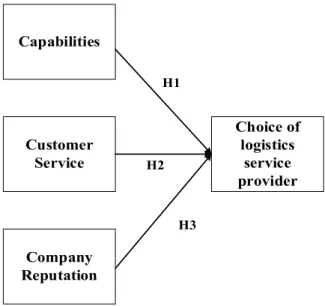
Abu-Jarad, 2011). The research framework is depicted in Figure 1. The hypotheses proposed in this study concerning the factors that affect the choice of LSP are as follows:
H1: Capabilities have a positive impact on the choice of LSP.
H2: Customer services have a positive impact on the choice of LSP.
H3: Company reputation has a positive impact on the choice of LSP.
2.2. Capabilities
The capabilities were measured using the following six items:
Quality of personnel: The service quality of personnel has a significant influence on customer satisfaction. The right personnel who pay attention to customers and put themselves in the position and circumstances of the customer could bring customer satisfaction. It has been indicated that the presence of personnel, etiquette, and the attitude of workers toward customers has been able to influence customer satisfaction.
The greatest the results shown by the staff, the higher the customer’s satisfaction (Masudin, Safitri, Restuputri, Wardana, & Amallynda, 2020). It was indicated that the
Capabilities
Customer Service
Company Reputation
Choice of logistics
service provider H1
H2
H3
Figure 1: The Research Framework
shortage of competent employees as well as managers in the Vietnamese logistic enterprises highly increases the awareness of the importance of human resource management, so that the employees who are competent in the logistics industry are always interested and treated well by the enterprise (Hoa, Ngan, Quang, Thanh, & Quyen, 2020).
Geographic coverage/international scope: A wide geographic coverage indicates that the liner network or container terminal portfolio covers many different geographical areas, but also that the distribution of capacity across those areas is in line with global demand for container transportation (Parola & Veenstra, 2008).
Multi-modal transportation capabilities: Multi-modal transportation is a logistics practice in which a set of goods have to be transported to different places, with a combination of at least two modes of transport, without a change of container for the goods.
Ability to provide EDI: The EDI technology is essential in the logistics industry. It makes the relations between the parties in the chain more efficient. The electronic exchange of data facilitates the sending and receiving of all types of documents in commercial transactions in a safe, fast, and fluid manner and with full integration into the internal management systems of customers, suppliers and any partner involved in the production processes whether they are commercial or administrative.
2.3. Customer Service
The customer service was identified through the following items:
Rate and price level: Costs in logistics can be said to be inclusive of two costs termed as direct and indirect transport cost. Direct transport costs include freight charges and insurance, which is customarily added to the freight charge. Indirect transport user costs include holding cost for the goods in transit, inventory cost due to buffering the variability of delivery dates, preparation costs associated with shipment size (full container load vs. partial loads).
Pick-up and/or delivery cargo reliability: This can be measured by arrival, loading, and departure events, since all three relate to the perceived service quality by the customers, competitors, and other stakeholders. If these events are “on- time”, the reliably is executed.
Punctual time performance: Punctuality is one of the basic parameters of the assessment of the efficiency of logistics system operation (Tubis & Gruszczyk, 2015). Punctuality is defined as a feature involving reaching, passing or leaving a pre-set point on the line (a stop) by the vehicle at the time specified in the published timetable within specified tolerance limits.
Third-party logistics (3PL) service provision ability:
The provision of a single or multiple logistics services by
a vendor on a contractual basis. The 3PL as the outsourcing of logistics can be considered as a range of logistics services such as transportation, warehousing, inventory management, distribution, and other value-added services such as pick- and–pack, assembly, repairs, and re-conditioning (Asthana, Bhat, & Singh, 2015).
Logistics tracking (availability of tracking information):
Logistics tracking is related to the methods and systems used for tracking tracking parcels and containers throughout their movement and storage in major logistic hubs and campuses.
Problem-solving ability: It was indicated that teamwork, problem solving, listening, and communicating topped the list of highly important skills for logistics managers (Goffnett, Williams, Gibson, & Garver, 2016).
2.4. Company Reputation
The company reputation was assessed by the following items:
Reputation in the logistics services market: Opinion of the public regarding the firm’s image, services reputation and satisfaction level (Rajesh, Pugazhendhi, Ganesh, &
Muralidharan, 2011).
Prior relationships with the logistics company: A prior relationship as well as a common logistics background or common regional or local knowledge were favored characteristics. The long-term relationship plays an important role in forming capacity and improving disaster preparedness for all partners by nurturing sound relationships and defining the respective roles and responsibilities (Haksöz, Seshadri,
& Iyer, 2011).
Financial stability: A stable financial system is capable of efficiently allocating resources, assessing and managing financial risk. A customer will need to find a company with financial stability, with excellent products and good business support.
3. Research Method
The data were collected through a questionnaire, which included three major parts: (1) the basic information on enterprises, (2) the respondent’s perception on the importance of factors guiding the logistics service provider’s choice, and (3) the overall assessment on satisfaction degree and willingness to continue using services of the provider.
The first part consisted of questions on the type of business ownership, the number of operations per year and the main area of operation. In part two, close-ended questions using 5-point Likert scales were utilized to explore the respondents’ satisfaction degree. The final part focused on the overall assessment on customers’ satisfaction degree.
In the second part, 13 items were used to measure the
factors’ importance. Of these, three items were used for
measuring the capabilities; six items for measuring the customer service, and three items for estimating the company’s reputation. These items were adapted from previous studies (Gammelgaard & Larson, 2001; Lai & Cheng, 2004). The authors selected and modified these items after discussions with local academics and practitioners in logistics who are familiar with the context of Vietnam. The questionnaire was developed in Vietnamese language, then distributed through an electronic survey system (Google Form). The study sample included 218 companies that used services of logistics providers from different sectors and regions.
The data were analyzed with the statistical software SPSS. In order to answer the research questions, descriptive statistics were performed. Exploratory factor analysis (EFA) was conducted to test the validity and reliability of the scales.
The regression analysis was also conducted to investigate the effect of the factor considered herein.
4. Results and Discussion 4.1. Descriptive Statistics
Among 218 companies, 33.9% are state-owned enterprises and 13.8% are foreign-invested enterprises; the number of companies with over 10 years in operation is 125, accounting for 57.3%. The major geographic operation area (43.6%) is in Red River Delta.
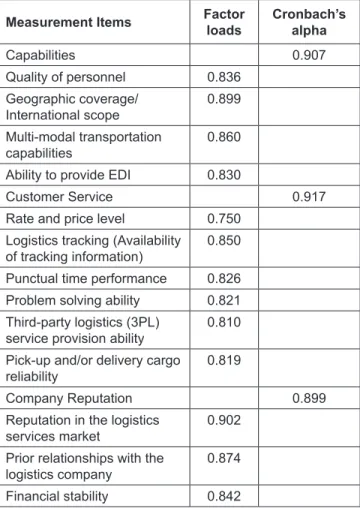
4.2. Testing the Validity and Reliability of Scales The respondents reported the importance of factors that affect their choice of logistics provider by rating 13 statements on the 5-point Likert scale. Exploratory factor analysis (EFA) was performed. Reliability analysis is established by testing whether the items grouped under a factor are internally consistent and stable. Cronbach’s alpha was utilized to analyze the reliability of the instruments. It is widely accepted that reliability over 0.80 is very good; reliability in the range of 0.60 and 0.80 is acceptable; and reliability less than 0.60 is considered poor (Sekaran & Bougie, 2016). Table 1 summarizes the factor analysis performed and also shows the factor loads of the questionnaire items and the Cronbach’s alpha coefficients of the variables. Cronbach’s alpha values ranged from 0.899 to 0.917, indicating that the factor had a high reliability.
4.3. Correlations
The correlation coefficient was estimated to test relationships between variables. As shown in Table 2, strong positive correlations can be found among variables. The relationship between capabilities and company reputation is the strongest (r = 0.928, p < 0.01); while the weakest
relationship is between customer service and company reputation (r = 0.871, p < 0.01).
4.4. Hypothesis Testing
A regression analysis was performed to determine the effect of capabilities, customer service, and company reputation variables on the choice of LSP. Table 3 presents Table 1: Factor Analysis Results and Cronbach’s
Alpha Coefficients
Measurement Items Factor
loads Cronbach’s alpha
Capabilities 0.907
Quality of personnel 0.836
Geographic coverage/
International scope 0.899
Multi-modal transportation
capabilities 0.860
Ability to provide EDI 0.830
Customer Service 0.917
Rate and price level 0.750
Logistics tracking (Availability
of tracking information) 0.850 Punctual time performance 0.826 Problem solving ability 0.821 Third-party logistics (3PL)
service provision ability 0.810 Pick-up and/or delivery cargo
reliability 0.819
Company Reputation 0.899
Reputation in the logistics
services market 0.902
Prior relationships with the
logistics company 0.874
Financial stability 0.842
Table 2: Pearson Correlations Between Key Variables Capabilities Customer
Service Company Reputation
Capabilities 1
Customer
Service 0.887
**1
Company
Reputation 0.928
**0.871
**1
**