원예과학기술지 16(4):520-524. 1998
Effect of Thidiazuron on Callus and Multiple Shoot Formation in Shoot-tip Culture of Hibiscus syriacus L. ‘Honghwarang'
Kim, Eun Kyoung
1*․Yoo, Yong Kweon
2․Kim, Ki Sun
11
Dept. of Horticulture, Seoul National University, Suwon 441-744, Korea
2
Dept. of Horticultural Breeding, Mokpo National University, Muan 534-729, Korea
*corresponding author
ABSTRACT This study was carried out to investigate the effect of thidiazuron(TDZ) on callus and shoot primordia formation, to determine the most optimum multiple shoot induction medium, and to obtain the plantlets on solid medium via shoot organogenesis. TDZ 0.01 mg/L in MS medium was most effective on callus formation, and BA 0.1 mg/L was most effective on shoot growth, while TDZ 0.01 mg/L was most effective on callus formation. TDZ 0.001 mg/L was most effective in shoot primordia formation. Shoot tips were cultured with TDZ 0.01 mg/L for 8 weeks and induced callus was transferred to regeneration medium containing TDZ 0.001 mg/L. After 4 weeks induced shoot primordia were resubcultured at growth regulator-free medium for 4 weeks. The induced multiple shoots rooted more efficiently at NAA 1.0, 5.0 mg/L, or IBA 5.0 mg/L.
Additional key words: mass production, rooting, shoot primordia
Introduction
Hibiscus syriacus L. is a very important
woody plant as a national flower in Korea.It can be propagated by cutting and seed- ling. Since it is a heterozygous plant, it is difficult to maintain its inherent charac- teristics by seed propagation. Thus, H.
syriacus has been commonly propagated
by cutting. However, if enough stock plants for cutting cannot be obtained and stock plants are infected by virus, propa- gation by cutting is difficult. Tissue cul- ture is a way to overcome these difficul- ties, and to improve the plants quality, and furthermore to establish the mass production system.Recently, thidiazuron(TDZ), a cytokinin- like compounds of non-purine structure, has been used in tissue culture research.
Many investigators have reported that TDZ has a high cytokinin activity at low concentration(Huetteman and Preece, 1993; Kerns and Meyer, 1987; Russel and McCown, 1987; Singh and Bhatia, 1988).
Especially, in woody plant, it was very efficient in micropropagation of many recalcitrant woody species. Micropropaga- tion of woody plant has been dramatically advanced with the introduction of TDZ as a plant growth regulator in tissue culture.
In Hibiscus syriacus, Yoo et al.(1996a) reported that the adventitious buds and multiple shoots were obtained from MS medium containing 0.5 mg/L TDZ. But,
induced shoots did not elongate further.
This was the first attempt to induce many in vitro organogenic plants through callus culture.
Generally, explants of some woody species have naturally strong monopodial growth habits and may not branch in vitro sufficiently when using more common amino purine cytokinins. But, TDZ offers an alternative that frequently enhances shoot proliferation of these species(Huet- teman and Preece, 1993; Kerns and Meyer, 1986; Preece and Huetteman, 1987;
Singh and Bhatia,1988).
The objectives of this study were to investigate the effect of TDZ on callus and shoot formation in solid medium, to deter- mine the most optimum multiple shoot induction medium, and finally to obtain whole plantlets on solid medium via shoot and root organogenesis.
Materials and Methods
Plant materials
Hibiscus syriacus L. ‘Honghwarang' was
used in this study. It had been grown at the campus of College of Agriculture &Life Sciences, Seoul National University.
Shoots about 10-20 mm length with 3-4 true leaves were taken. Leaves were removed, and then surface of shoots were sterilized by immersion in 70% ethanol for 15 sec, washed in sterile distilled water and 2.0% sodium hypochlorite solution for 20 min with 0.1% Tween 20, and then
rinsed 3-5 times in sterilized water. Shoot apex tissue was obtained under dissecting microscope on air laminar flow bench and was placed upon MS medium.
Callus and shoot formation MS basal medium was used for callus and shoot regeneration. Explants were cultured on MS medium containing vari- ous concentrations of BAP, kinetin, TDZ supplemented with 30 g/L of sucrose. The pH was adjusted to 5.8 prior to addition of 8 g/L agar. It was autoclaved at 121℃ and 1.5 kg/cm2 pressure for 15 min. Approxi- mately 25 mL of media were then dis- pensed into a 100 mL Erlenmeyer flask which was then covered with a double layer of aluminium foil.
TDZ, BAP, and kinetin was added to the medium at concentrations of 0.0, 0.01, 0.1, 0.5, 1.0, 2.0 mg/L and with in com- bination of TDZ 0, 0.0001, 0.001, 0.01, 0.1, 1.0 mg/L, and BAP 0, 0.1 mg/L. The culture condition was maintained at 25℃, 16 hr photoperiod, and 2,000 lux. Each experiment was repeated four times. After 8 weeks of cultures, diameter of callus, percentage of callus formation, number of shoots, and length of shoot were mea- sured.
Multiple shoot formation
Shoot-tips were cultured at the MS basal medium supplemented with 0.01 and 0.001 mg/L TDZ, and 3% sucrose, solidi- fied with 0.8% agar. The culture condition was the same as that of callus and shoot formation. After 8 weeks of culture, mor- phogenic responses of explants were very various. Thus, these were classified into 3 stages. Stage 1 referred to the stage when only callus was formed, whereas stage 2 and stage 3 to when shoot primordia and shoot were formed, respectively.
At each stage, callus, shoot primordia, and shoots, cultured at TDZ 0.01 mg/L, were subcultured in the medium contain- ing 0.0, 0.01, or 0.001 mg/L TDZ. Also, those cultured at 0.001 mg/L TDZ were subcultured in the medium containing 0.0, 0.001, or 0.0001 mg/L TDZ. After 4 weeks of subculture, those were secondarily sub- cultured. At the secondary subculture, callus growth, shoot number, and shoot length were measured.
Rooting experiment
Treatment (mg/L)
Callus formation(%)
Callus diameter(mm)
Shoot length(mm)
No. of shootsy TDZ 0
TDZ 0.0001 TDZ 0.001
TDZ 0.01
TDZ 0.1
TDZ 1.0
+ BA 0.0 + BA 0.1 + BA 0.0 + BA 0.1 + BA 0.0 + BA 0.1 + BA 0.0 + BA 0.1 + BA 0.0 + BA 0.1 + BA 0.0 + BA 0.1
0.0 bz 100.0 a 0.0 b 100.0 a 100.0 a 100.0 a 100.0 a 100.0 a 0.0 b 0.0 b 0.0 b 0.0 b
0.0 c 16.1 a 0.0 c 0.0 c 15.9 a 17.8 a 18.2 a 8.4 b 0.0 c 0.0 c 0.0 c 0.0 c
11.4 a 4.3 b 11.9 a 10.5 a 14.0 a 9.5 a 2.6 b 0.0 b 0.0 b 0.0 b 0.0 b 0.0 b
+ + + + +++
+++
++++
- - - - -
zMean separation within columns by Duncan's multiple range test at 5% level.
y-: none; +: 1~2; ++: 3~5; +++: 5~10; ++++: more than 10 shoots.
Table 2. Effects of TDZ and BA on callus and shoot formation from shoot-tip of Hibiscus syriacus L. ‘Honghwarang' after 8 weeks at solid media.
Treatment (mg/L)
Callus formation(%)
Callus diameter(mm)
Shoot length(mm)
No. of shoots Control
TDZ
BAP kinetin
0.01
0.1 0.5 1.0 2.0 0.01
0.1 0.5 1.0 2.0 0.01
0.1 0.5 1.0 2.0
0.0 bz 100.0 a 0.0 b 0.0 b 0.0 b 0.0 b 8.3 b 75.0 a 75.0 a 33.3 b 0.0 b 0.0 b 0.0 b 0.0 b 0.0 b 33.3 b
0.0 c 12.1 a 0.0 c 0.0 c 0.0 c 0.0 c 0.8 bc
3.3 b 2.8 bc 0.9 bc 0.0 c 0.0 c 0.0 c 0.0 c 0.0 c 3.0 bc
8.6 bc 1.5 e 0.0 e 0.0 e 0.0 e 0.0 e 12.8 b 18.5 a 9.7 bc 5.1 cde
2.7 de 9.4 bc 9.3 bc 13.2 ba 9.0 bc 7.7 bcd
1.0 b 2.9 a 0.0 b 0.0 b 0.0 b 0.0 b 0.9 b 1.0 b 1.0 b 0.8 b 1.0 b 0.9 b 0.8 b 1.0 b 0.8 b 0.6 b
zMean separation within columns by Duncan's multiple range test at 5% level.
Table 1. Effects of TDZ, BAP, and kinetin on callus and shoot formation in shoot-tip
culture of Hibiscus syriacus L. ‘Honghwarang' after 8 weeks at solid media.Fig. 1. Effects of TDZ, kinetin, or BAP on callus and shoot
formation from shoot-tip explants of Hibiscus syriacus L.‘Honghwarang' at 8 weeks after culture.
Microshoots with 2-3 leaves were used to examine rooting ability. MS basal media were used for rooting induction.
NAA or IBA 0, 0.1, 1.0, 5.0 mg/L were treated in media, and rooting ability was evaluated after 8 weeks or 4 weeks of culture, respectively.
Acclimatization of plantlets The regenerated plantlets in solid medi- um were transplanted into small plastic pots containing 100 mL of sphagnum peat moss 1: perlite 1, and kept in a inter- mittent mist chamber for 4 weeks.
Results and Discussion
Effects of plant growth regula- tors on callus and shoot formation
Effects of TDZ, BAP, and kinetin on callus and shoot formation in shoot-tip culture is shown in Table 1 and Fig. 1.
TDZ 0.01 mg/L was most effective on callus and shoot formation,
whereas BAP and kinetin was more effective in shoot growth. Treatment of 0.01 mg/L TDZ increased the callus formation rate up to 100%. But callus and shoot formation were completely re- pressed at concen- trations over 0.01 mg/L TDZ. Treat- ments of 0.1 to 0.5 mg/L BAP some-
what stimulated the callus formation, and 0.1 mg/L BAP was most effective on shoot growth. When 0.1 mg/L BAP was treated, shoot length was longest, with shoot length 18.5 mm. Color of callus which was formed at TDZ 0.01 mg/L was dark green, and many shoot primordia were formed from this green callus (Fig. 1).
Effect of combination treatment of TDZ and BAP on callus and shoot growth is shown in Table 2. TDZ 0.0001 mg/L without BA was not effective on callus formation, but addition of BAP 0.1 mg/L showed high callus formation rate of 100%
and diameter of 17.8mm. In shoot-tip culture of Hibiscus syriacus L. ‘Honghwa- rang’, addition of BAP to TDZ-containing medium had no significant effect on callus and shoot formation. TDZ has been used to obtain the adventitious shoot in some woody plants including Rhododendron (Preece and Huetteman, 1991) and elm (Bolyard et al., 1992), however, shoots induced on TDZ-containing medium were smaller than shoots from BAP-containing medium (van Nieuwkerk et al., 1986). In
Hibiscus syriacus L. ‘Honghwarang’, treat-
ment of TDZ 0.01 mg/L produced more shoots than the other treatments, and shoot growth was better at TDZ 0.001mg/L without BA.
Induction of multiple shoot forma- tion
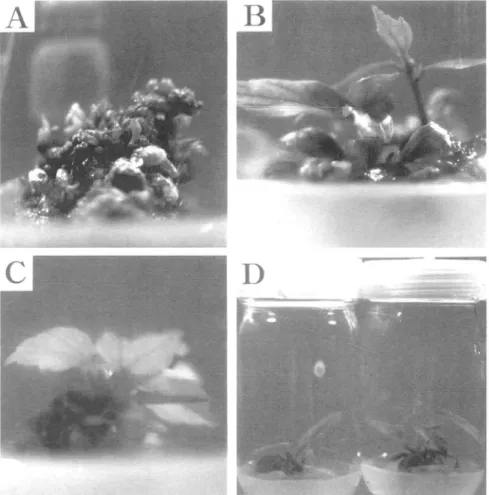
Callus, shoot primordia, and shoot induced at 0.01 and 0.001 mg/L TDZ were subcultured for two times at lower concentration of TDZ for multiple shoot induction. When callus induced at TDZ 0.01 mg/L was transferred to MS medium with 0.001 mg/L TDZ (subculture 1), many shoot primordia were formed on callus
Fig. 2. Process of shoot development from a shoot-tip explants of Hibiscus syriacus L.
‘Honghwarang' at TDZ 0.01 mg/L. (A) Multiple shoot bud formed during the first subculture at TDZ 0.001 mg/L from callus induced at TDZ 0.01 mg/L. (B) Subsequently well developed multiple shoot during secondary subculture without TDZ.
(C) Multiple shoots formed developed continuously through the secondary subculture without TDZ. (D) Development of shoots from separated multiple shoot.
Original callus induction medium
(mg/L)
Stagez Subculture 1 TDZ(mg/L)
Callus growthy
Callus colorx
No. of shootw
Shoot lengthv TDZ 0.01
TDZ 0.001
S 1
S 2 S 3 S 1 S 2
S 3
0 0.001
0.01 0.001
0 0.0001
0.001 0 0.0001
0.001 0
- ++++
++++
++++
- + + - + + -
B DG DG G
- G DG
- G G -
- ++++
++++
++++
+ +++
++++
++
++++
++++
+ - - - + ++++
- - + + +++
++++
ZS 1: stage when only callus was formed.
S 2: stage when shoot primordia were formed.
S 3: stage when shoots were developed on callus surface.
y-: none ; +: low; ++: medium; +++: high; ++++: very high.
xDG: dark green; G: green; B: browning.
w-: none; +: 1~2; ++: 3~5; +++: 5~10; ++++: more than 10 shoots.
v-: none; +: 1~2; ++: 3~5; +++: 5~10; ++++: more than 10mm.
Table 3. Effect of TDZ on callus and shoot growth from each stage of Hibiscus syriacus
L. ‘Honghwarang' after 4 weeks of subculture 1.surface (Table 3, Fig. 2A). Subsequently, when they were transferred at secondary growth regulator-free medium(subculture 2)(Fig. 2B), these shoot primordia were developed the most into multiple shoots.
However, when they were transferred to
secondary medium containing TDZ 0.001 mg/L, callus growth and shoot primordia formation were promoted while shoot growth were inhibited (Table 3). When shoot primordia formed on callus surface at 0.01 mg/L TDZ were transferred to
primary medium containing 0.001 mg/L TDZ, callus growth and shoot primordia formation were stimulated. Subsequently, subculture at growth regulator-free media promoted the induction of multiple shoots.
A few shoots at TDZ 0.01 mg/L were developed well, when they were trans- ferred to growth regulator-free media (Fig.
2C, D). When callus induced at TDZ 0.01 mg/L was transferred subsequently to MS medium containing TDZ 0.01 mg/L during primary and secondary subculture, callus growth and shoot primordia formation were stimulated, while shoot growth was greatly suppressed. If callus had been directly transferred to growth regulator- free medium without lowering concentra- tion of TDZ according to developmental stage, callus tissues would have turned to be browning and died after all.
For mass production of H. syriacus L.
‘Honghwarang' in vitro, shoot-tip was cul- tured at 0.01 mg/L TDZ for proliferation and induction of callus. And, the medium containing TDZ 0.001 mg/L as a primary medium can be used to maximize the shoot primordia formation from these callus. And then, when these shoot primordia were transferred to secondary growth regulator-free medium, the most shoots could be produced (Table 3, 4). TDZ has been reported to lead to the formation of many short shoots in vitro in several woody species including Hibiscus rosa-
sinensis L. (Preece and Huetteman, 1987),
‘Gala' apple (van Nieuwkerk et al., 1986), muscadine grape (Gray and Benton, 1991), and Populus (Russell and McCown, 1986).
The problem of shoot elongation can be overcome by transferring cultured shoot to a secondary medium often lacking TDZ or with a different balance of plant growth regulators (Huetteman and Preece, 1993).
Use of primary and secondary medium has been successful in multiple shoot development in pear (Singha and Bhatia, 1988), Populus (Russell and McCown, 1986). A primary medium can be used to maximize shoot proliferation, and then, the shoot or bud masses can be trans- ferred to secondary medium with other combinations of plant growth regulators.
These were consistent with our results.
Rooting
Multiple shoots on callus masses should be excised for multiplication. It is very important how to efficiently excise and
Original callus induction medium
(mg/L)
Stagez
Sub.1 TDZ (mg/L)
Sub.2 TDZ (mg/L)
Callus growthy
Callus colorx
No. of shootsw
Shoot lengthv TDZ 0.01
TDZ 0.001 S1
S2 S3 S1
S2
S3
0.001 0.01 0 0.001 0 0.0001 0.001 0.0001 0.001
0 0
0 0.001 0.01 - 0 0.001 0 0 0.0001 0 0.001 0.0001 0 0.0001 0.001 0 0
++
++++
++++
- ++
++
- + + + ++
- - - - - -
G DG DG B G G - G DG G DG - - - - -
+++
++++
++++
- ++++
++++
+++
++
+++
++
++++
++++
++++
++++
++++
++
+
++++
+ - - +++
++
++++
+++
+++
+++
- +++
++++
+++
+++
++
++++
zSee Table 3.
y-: none; +: low; ++: medium; +++: high; ++++: very high.
xDG: dark green; G: green; B: browning.
w-: none; +: 1~2; ++: 3~5; +++: 6~10; ++++: more than 10 shoots.
v-: none; +: 1~2; ++: 3~5; +++: 5~10; ++++: more than 10mm.
Table 4. Effect of TDZ on callus and shoot growth from each stage of Hibiscus syriacus
L. ‘Honghwarang' after 4 weeks of subculture 2.Concentration of NAA (mg/L)
Rooting (%)
No. of roots per shoot
0.0 0.1 1.0 5.0
12.5 25.0 37.5 37.5
1.0 4.0 7.3 5.0
Table 5. Effect of NAA on rooting from microshoot of Hibiscus syriacus L. ‘Honghwarang' at 8 weeks after treatment.
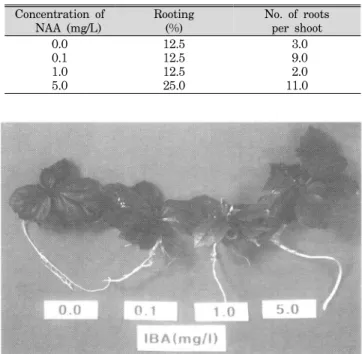
Concentration of NAA (mg/L)
Rooting (%)
No. of roots per shoot
0.0 0.1 1.0 5.0
12.5 12.5 12.5 25.0
3.0 9.0 2.0 11.0
Table 6. Effect of IBA on rooting from microshoot of Hibiscus syriacus L. ‘Honghwarang' at 4 weeks after treatment.
Fig. 4. Effect of IBA on rooting of Hibiscus syriacus L. ‘Hong-
hwarang' at 8 weeks after transferring into rooting media.Fig. 3. Effect of NAA on rooting of Hibiscus syriacus L. ‘Hong-
hwarang' at 8 weeks after transferring into rooting media.whether excised shoot has root or not.
There is a necessity to investigate opti- mum rooting condition for more efficient and rapid mass production. Table 5, 6 showed that shoots rooted in all treat- ment. Especially, 1.0 mg/L or 5.0 mg/L NAA was effective in rooting (Fig. 3). Also, shoots were rooted more efficiently in MS medium supplemented with IBA 5.0 mg/L (Table 6, Fig. 4). Rooted shoot was accli- matized for 4 weeks in growth chamber
under high relative humidity and devel- oped into the whole plantlets. Rooting may be difficult because of a ‘carry-over' effect of cytokinins in the shoot proliferation medium (Huetteman and Preece, 1993).
This could be a great concern using a cytokinin as potent as TDZ. The reduced rooting capacity may be attribute to high cytokinin activity.
Consequently, in order to obtain multiple shoot, callus was induced in TDZ 0.01 mg/L
medium for about 8 weeks and then after transferring to TDZ 0.001 mg/L many shoot primordia were obtained. These were trans- ferred to growth regulator-free medium for 4 weeks, resulting multiple shoot induction and development. And then, developed multiple shoots were rooted in medium containing NAA 1.0 mg/L or IBA 5.0 mg/L
Literature Cited
Bolyard, M.G., C. Srinivasan, J. Cheng, and M. Sticklen. 1992. Shoot regenera- tion from leaf explants of American and Chinese Elm. HortScience 26(12):1554- 1555.
Gray, D.J. and C.M. Benton. 1991. In vitro micropropagation and plant establish- ment of muscadine grape cultivars (Vitis
rotundifolia). Plant Cell Tiss. Org. Cult.
27:7-14.
Huetteman, C.A. and J.E. Preece. 1993.
Thidiazuron: a potent cytokinin for woody plant tissue culture. Plant Cell Tiss. Org. Cult. 33:105-119.
Kerns, H.R. and M. Meyer. 1986. Tissue culture propagation of Acer × freemanii using thidiazuron to stimulate shoot tip proliferation. HortScience 21:1209-1210.
Preece, J.E. and C.A. Huetteman. 1987.
The influence of thidiazuron on in vitro cultures of woody plants. HortScience 22:1071.
Preece, J.E. and C.A. Huetteman. 1991.
Micro and cutting propagation of Silver Maple I. Results with adult and juvenile propagules. J. Amer. Soc. Hort. Sci. 116:
142-148.
Russel, J.A., and M. McCown. 1987. Thidi- azuron stimulated shoot differentiation from protoplast-derived callus of Pop-
ulus. Plant Tiss. Cell Cul. p.49 (Abst.).
Singh, S. and S.K. Bhatia. 1988. Shoot proliferation of pear cultures on medium containing thidiazuron and benzylamino purine. HortScience 23:803.
van Nieuwkerk, J.P., R.H. Zimmerman, and I. Fordham. 1986. Thidiazuron stim- ulation of apple shoot proliferation in vitro. HortScience 21:516-518.
Yoo, E.H., Y.K. Yoo, and K.S. Kim. 1996a.
Effects of growth regulators, sucrose, light, and medium on callus and shoot formation in shoot-tip culture of Hibis-
cus syriacus L. ‘Honghwarang'. J. Kor.
Soc. Hort. Sci. 37(2):317-323.
Yoo, E.H., Y.K. Yoo, and K.S. Kim. 1996b.
Induction of shoot primordia of Hibis-
cus syriacus L. ‘Honghwarang' by sus-
pension cultures. J. Kor. Soc. Hort. Sci.37(4):607-610.
Thidiazuron이 무궁화 ‘홍화랑’ 품종 의 정단배양으로부터 Callus형성과 Multiple Shoot형성에 미치는 효과
김은경
1*․유용권
2․김기선
11서울大學校 園藝學科, 2木浦大學校 園藝育種學科
초 록
본 실험은 무궁화 ‘홍화랑’ 품종의 기내 대량 생산 체계를 구체적으로 확립하기 위한 연구로 서 고체배지 또는 액체배지에서 thidiazuron (TDZ)이 캘루스 형성과 신초의 재분화에 미치 는 효과 및 가장 적합한 multiple shoot 형성 을 위한 배지의 조건을 유도하여 기내 식물체 대량생산 체계를 확립하기 위해 실시하였다. 고
체배지에서의 캘루스 형성에 있어서는 TDZ 0.01 mg/L에서 가장 효과적으로 나타났으며, 반면 신초의 생장에 있어서는 BA 0.1 mg/L에 서 가장 좋게 나타났다. 전반적으로 TDZ 0.01 mg/L에서는 캘루스의 형성이 가장 좋았고, TDZ 0.001 mg/L과 BA 0.1 mg/L의 혼용처리 구에서는 약간의 신초원기가 형성되었다. 신초 의 형성은 TDZ 0.001 mg/L에서 가장 잘 되었 다. 대량의 multiple shoot를 유도하기 위해서 1단계는 TDZ 0.01 mg/L에서 8주간 캘루스의 형성을 유도한 후, 2단계에서 형성된 캘루스를 TDZ 0.001 mg/L에서 4주간 배양하여 많은 신 초원기를 형성시켰다. 3단계는 형성된 신초원기 들을 growth regulator-free 배지에 4주간 계 대배양하여 multiple shoot 유도 및 발달시켰 다. 발근은 MS 기본 배지에 NAA 1.0, 5.0 mg/L와 IBA 5.0 mg/L의 농도에서 효과적이었 다.
추가 주요어 : 대량생산, 발근, 신초원기