| Abstract |
Purpose: This study aimed to investigate the correlation between trunk stabilization muscle activation and the parameters of gait analysis in healthy individuals.
Methods: Thirty healthy adults (15 male, 15 female) with no history of lower back pain (LBP) or current musculoskeletal and neurological injuries were studied. Trunk stabilization muscle activation (e.g., external oblique, internal oblique, transverse abdominis, erector spinae) were assessed using surface electromyography. To analyze gait, we measured temporal parameters (e.g., gait velocity, single support phase, double support phase, swing phase, and stance phase) and a spatial parameter (e.g., H-H base of support).
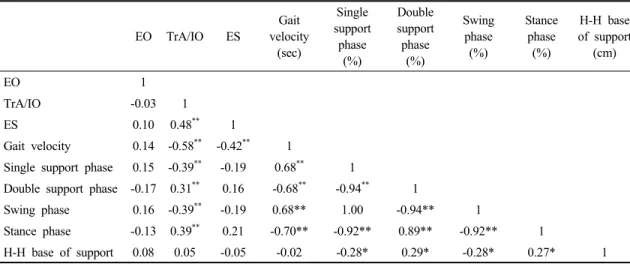
Results: A statistically significant correlation was found between the internal oblique, transverse abdominis, and erector spinae muscle activity and gait velocity, single support phase, double support phase, swing phase, and stance phase. No statistically significant correlation was found between the external oblique muscle activity and the gait velocity, single support phase, double support phase, swing phase, and stance phase. No statistically significant correlation was found between the external oblique, internal oblique, transverse abdominis, and erector spinae muscle activity and the spatial parameter.
Conclusion: This study demonstrated that a relationship exists between trunk stabilization muscle activation and temporal parameter (i.e., gait velocity, single support phase, double support phase, swing phase, and stance phase) during gait analysis.
Therefore, the trunk’s stabilizer muscles play an important role in the gait of healthy individuals.
Key Words: Muscle activity, Trunk stabilization muscle, Gait parameter
†Corresponding Author : Ju-Hyeon Jung ([email protected])
Original Article Open Access
몸통 안정화 근육과 보행요소의 상관관계
채정병⋅정주현
1†1)마산대학교 물리치료과,
1김해대학교 물리치료과
Correlation between Trunk Stabilization Muscle Activation and Gait Parameters
Jung-Byung Chae⋅Ju-Hyeon Jung
1†Department of Physical Therapy, Masan University
1