356
Open Access
Intermediate and Long-Term Results of Transcatheter Closure of Patent Foramen Ovale Using the Amplatzer Patent Foramen Ovale Occluder: One Case of Pulmonary Embolism Irrespective of Patent Foramen Ovale Closure
Ju Hee Yoon, MD, Joon Sik Kim, MD, Dae Hyung Lee, MD, Eun Jung Shim, MD, So Yeon Lee, MD, Ki Sik Min, MD, Do Jun Cho, MD, and Hye Ran Lee, MD Department of Pediatrics, College of Medicine, Hallym University, Anyang, Korea ABSTRACT
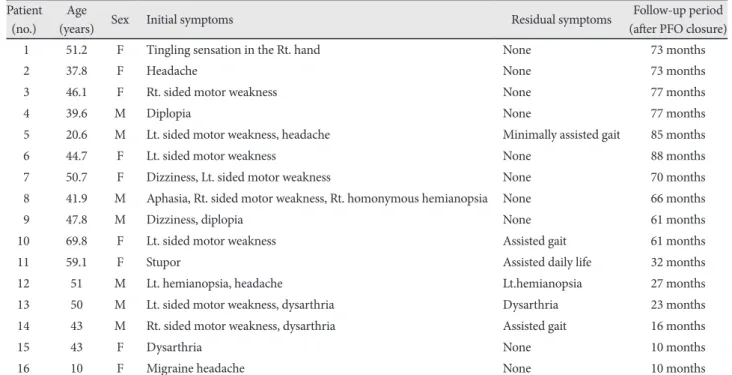
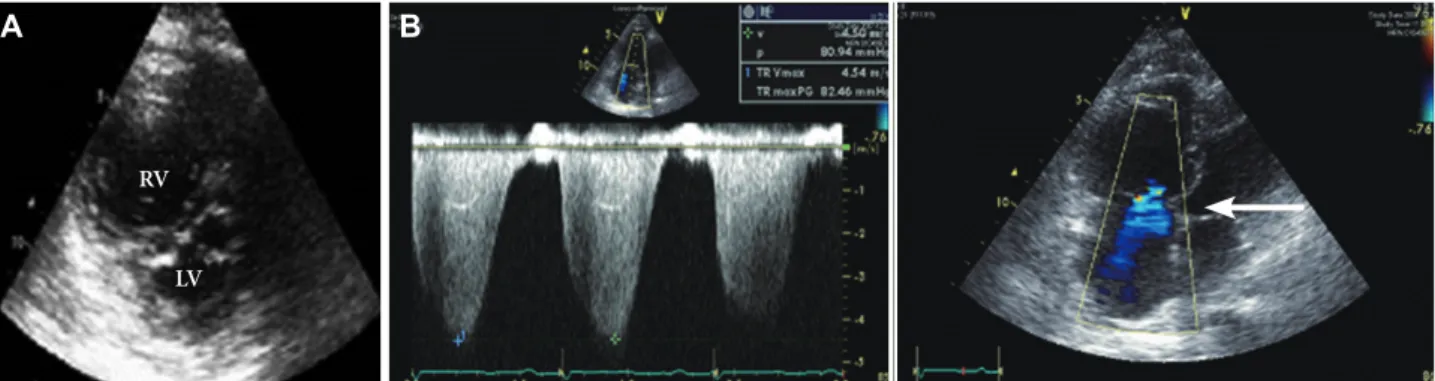
Background and Objectives: Patent foramen ovale (PFO) has been implicated in the pathogenesis of cryptogenic stroke or transient ischemic attack (TIA) due to paradoxical embolism, and in the pathogenesis of migraine. This paper reports the intermediate and long-term results of transcatheter closure of PFO associated with cerebrovascular accidents (CVAs), TIAs and migraine, using the Amplatzer PFO occluder. This paper also reports a case of pulmonary embolism which developed in one patient after PFO closure. Subjects and Methods: From January 2003 to May 2010, 16 patients with PFO (seven males and nine females) with a history of at least one episode of cryptogenic stroke/TIA, CVA, or migraine and who underwent per- cutaneous transcatheter closure of PFO using the Amplatzer occluder. All the procedures were performed under general anesthesia and were assisted by transesophageal echocardiography. Results: The device was implanted without any signifi- cant complications in all the patients, and the PFOs were effectively closed. At an average follow-up period of 54 months, the 15 patients with TIA/CVA had no recurrence of any thromboembolic event. The symptoms in one patient with migraine sub- sided after occlusion of the PFO. In this study, pulmonary embolism occurred five months after PFO closure in one patient, but the cause of pulmonary embolism was not identified. However, it is believed that the pulmonary embolism occurred with- out stroke recurrence because occlusion of the PFO was performed when the patient had a stroke event. Conclusion: It can be concluded that according to the intermediate and long-term follow-up results, transcatheter PFO closure is an effective and safe therapeutic modality in the prevention of thromboembolic events, especially in the patients with cryptogenic st- roke/TIA, and PFO closure is helpful in the treatment of migraine. However, this study involved a small number of patients and also the follow-up period was not long enough. Hence, randomized, controlled trials are necessary to determine if this ap- proach is preferable to medical therapy for the prevention of recurrent stroke or as primary treatment for patients with mi- graine headache. (Korean Circ J 2011;41:356-362)
KEY WORDS: Patent foramen ovale; Stroke; Transient ischemic attack; Migraine; Pulmonary embolism.
Received: July 16, 2010 / Revision Received: October 5, 2010 / Accepted: October 27, 2010
Correspondence: Do Jun Cho, MD, Department of Pediatrics, College of Medicine, Hallym University, 896 Pyeongchon-dong, Dongan-gu, Anyang 431- 070, Korea
Tel: 82-31-380-3730, Fax: 82-31-380-4118, E-mail: [email protected]
• The authors have no financial conflicts of interest.
cc