119
Open Access
The Impact of Smoking on Post-Clopidogrel Platelet Reactivity in Patients With Acute Myocardial Infarction
Jung-Hyun Cho, MD1, Young-Hoon Jeong, MD1, Yeon-Jeong Ahn, MD1, Min-Kyung Kang, MD1, Jin-Sin Koh, MD1, In-Suk Kim, MD2, Yongwhi Park, MD1, Seok-Jae Hwang, MD1, Choong Hwan Kwak, MD1 and Jin-Yong Hwang, MD1
1Division of Cardiology, Departments of Internal Medicine and 2Laboratory Medicine, Gyeongsang National University Hospital, Jinju, Korea
ABSTRACT
Background and Objectives: Smoking increases inhibition of clopidogrel-induced platelet reactivity in patients undergoing elective coronary stenting. However, an association between pre-admission smoking (PS) and post-clo- pidogrel platelet reactivity in patients with acute myocardial infarction (AMI) has not been determined. Subjects and Methods: Study cohorts were recruited from a pool of patients at our hospital who were undergoing coro- nary stenting for AMI (n=134). Immediately after arrival at the emergency room (ER), all patients received a 600 mg loading dose of clopidogrel followed by a maintenance dose of 75 mg/day. Platelet aggregation was measured with light transmittance aggregometry (LTA) after addition of 5 or 20 μmol/L adenosine diphosphate (ADP).
Results: Maximal platelet aggregation (Aggmax) was lower in PS patients after 5 μmol/L ADP (43.6±15.7% vs.
48.4±12.5%, p=0.096) and 20 μmol/L ADP stimuli (56.2±15.6% vs. 61.3±11.6%, p=0.073) compared with non-smoking (NS) patients. However, there were no differences in 5 μmol/L (42.6±16.3% vs. 43.8±15.6%, p=0.776) and 20 μmol/L ADP-induced Aggmax (54.8±14.3% vs. 56.5±15.9%, p=0.692) between PS patients
<0.5 pack/day and ≥0.5 pack/day. Although more PS patients met the criteria for low post-clopidogrel platelet reactivity (LPPR) (≤37%; the lowest quartile of 5 μmol/L ADP-induced Aggmax) than NS patients (30.9% vs.
13.5%, p=0.048), advancing age was the only independent predictor of LPPR {odds ratio (OR) 0.960, 95%
confidence interval (CI) 0.929 to 0.993, p=0.019}. Conclusion: PS is significantly not associated with decreased residual platelet reactivity in AMI patients. (Korean Circ J 2010;40:119-124)
KEY WORDS:Smoking; Post-clopidogrel platelet reactivity; Acute myocardial infarction.
Introduction
Clopidogrel is metabolized into an active metabolite by 2 consecutive steps involving cytochrome P450 (CYP), and inhibits platelet aggregation through an irreversi- ble blockade of adenosine diphosphate (ADP) P2Y12 receptors.1) Therefore, various factors that interfere with
CYP activity can reduce antiplatelet responses to clopi- dogrel.2-5) On the contrary, cigarette smoking, an in- ducer of CYP1A2 activity, can increase concentrations of the active metabolite of clopidogrel.6) Recently, Bli- den et al.7) reported that smoking, in a dose-related manner, increases platelet inhibition by clopidogrel com- pared with non-smoking (NS). An analysis of patients on chronic clopidogrel therapy (n=120) showed signi- ficantly lower platelet aggregation in patients currently smoking ≥0.5 pack/day compared with patients of NS and currently smoking <0.5 pack/day (p<0.05). The study of Bliden used the results of platelet aggregation in the setting of elective coronary stenting.
However, acute myocardial infarction (AMI) is asso- ciated with enhanced platelet reactivity, and the impact of pre-admission smoking (PS) on post-clopidogrel pla- telet reactivity in AMI patients can be different from platelet reactivity in patients on chronic clopidogrel th-
Received: June 2, 2009
Revision Received: September 7, 2009 Accepted: September 8, 2009
Correspondence: Young-Hoon Jeong, MD,Division of Cardiology, Depart- ment of Internal Medicine, Gyeongsang National University Hospital, 90 Chiram-dong, Jinju 660-702, Korea
Tel: 82-55-750-8851, Fax: 82-55-758-9122 E-mail: [email protected]
○ cc This is an Open Access article distributed under the terms of the Creative Commons Attribution Non-Commercial License (http://creativecommons.
org/licenses/by-nc/3.0) which permits unrestricted non-commercial use, distribution, and reproduction in any medium, provided the original work is properly cited.
erapy. In addition, there is no clear data for the role of smoking on clopidogrel-induced platelet inhibition in AMI patients.8)9) Accordingly, the aim of the present study was to determine if there is an association between smoking and clopidogrel-induced platelet inhibition in AMI patients.
Subjects and Methods
Subjects
Subjects were prospectively recruited from the popu- lation of patients who underwent, between October 2007 and May 2008, coronary stenting for AMI in the De- partment of Cardiology of the Gyeongsang National University Hospital. Consecutive patients admitted for AMI were enrolled if they were ≥18 years of age and had undergone uneventful coronary stenting. AMI was defined as clinical symptoms compatible with acute myo- cardial ischemia within 12 hours before admission with a subsequently documented increase in markers of AMI. ST-segment elevation myocardial infarction (ST- EMI) patients were treated with primary stenting less than 12 hours after the onset of pain; non-STEMI (NS- TEMI) patients received coronary stenting within 24 hours after admission. Exclusion criteria were a history of active bleeding and bleeding diatheses, oral anticoa- gulation therapy with warfarin, contraindications to an- tiplatelet therapy, left ventricular ejection fraction <30%, leukocyte count <3,000/mm3 and/or a platelet count
<100,000/mm3, aspartate aminotransferase or alanine aminotransferase levels ≥3 times upper normal, serum creatinine level ≥2.5 mg/dL, and non-cardiac disease with a life expectancy <1 year. The Institutional Review Board approved the study protocol, and the patients provided written informed consent for participation.
Study design
Immediately after emergency room (ER) arrival, all patients received a 600 mg loading dose of clopidogrel followed by a maintenance dose of 75 mg/day. Low- molecular-weight heparin (enoxaparin) or unfractionat- ed heparin was used at the physician’s discretion before the procedure, and tirofiban, which has a short half-life, was administered if needed. Pre-discharge post-clopi- dogrel platelet reactivity was assessed 1) 3 or more days after coronary stenting not treated with tirofiban or 2) 5 or more days after the procedure in patients treated with tirofiban.
Platelet function assays and definition
Platelet aggregation was assessed with light transmit- tance aggregometry (LTA) according to standard proto- cols.10) The results of LTA were validated in our labora- tory and reported.11) Blood samples were drawn though a 21-gauge needle into vacutainer tubes containing 0.5
mL sodium citrate 3.2% (Becton-Dickinson, San Jose, CA, USA) and processed within 60 minutes. Platelet- rich plasma (PRP) was obtained as a supernatant fluid after centrifuging blood at 120 g for 10 minutes. The remaining blood was further centrifuged at 1,200 g for 10 minutes to prepare platelet-poor plasma (PPP). PRP was adjusted to platelet counts of 250,000/μL by add- ing PPP as needed. Platelet aggregation was assessed at 37℃ using an AggRAM aggregometer (Helena Labo- ratories Corp., Beaumont, TX, USA). Light transmis- sion was adjusted to 0% with PRP and to 100% with PPP for each measurement. Platelet functions were meas- ured after addition of 5 or 20 μmol/L ADP, and curves were recorded for 10 minutes. Platelet aggregation was measured at peak (Aggmax) and at 5 minutes (Agglate) by la- boratory personnel blinded to the study protocol. Aggmax
is considered to reflect the activity of both P2Y1 and P2Y12 ADP receptors, whereas Agglate may be more re- flective of P2Y12 receptor activity.
We defined the criteria for low post-clopidogrel pla- telet reactivity (LPPR) as the lowest quartile of 5 μmol/L ADP-induced platelet reactivity (Aggmax ≤37%).7) Statistical analysis
Continuous variables are presented as means±SD.
They were compared using Student’s unpaired t-tests or Mann-Whitney U-tests. Categorical variables are pre- sented as numbers or percentages and were compared using the chi-square tests or Fisher’s exact tests (if an ex- pected frequency was <5). Platelet function measure- ments of the 3 groups were analyzed by one-way ana- lysis of variance (ANOVA) on ranks. To determine pre- dictors of LPPR, multivariate regression analyses were performed using the dependent variables that exhibit- ed at least a modest effect (p<0.20). A p<0.05 was con- sidered to indicate a significant difference. Statistical analyses were performed using Statistical Package for the Social Sciences (SPSS) version 13 (SPSS Inc., Chicago, IL, USA).
Results
Baseline characteristics
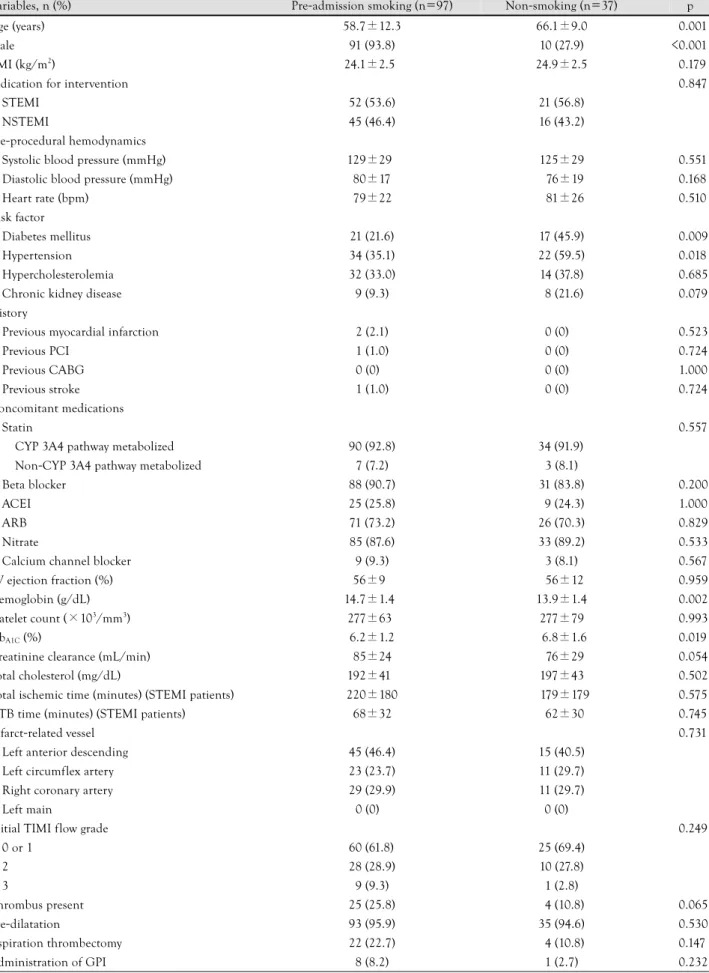
We identified 134 AMI patients (73 STEMI and 61 NSTEMI patients) who underwent uneventful coronary stenting. The 134 included 97 PS patients (smoking wi- thin 2 weeks of the procedure and 37 NS patients (no smoking within 1 year of the Procedure). The PS patients were younger, more often men, and less likely to have diabetes, hypertension or anemia than the NS patients (Table 1).
Platelet function assays
There was no difference between STEMI and NS- TEMI patients with regard to post-clopidogrel platelet
Table 1. Clinical and procedural characteristics
Variables, n (%) Pre-admission smoking (n=97) Non-smoking (n=37) p
Age (years) 58.7±12.3 66.1±9.0 <0.001
Male 91 (93.8) 10 (27.9) <0.001
BMI (kg/m2) 24.1±2.5 24.9±2.5 <0.179
Indication for intervention <0.847
STEMI 52 (53.6) 21 (56.8)
NSTEMI 45 (46.4) 16 (43.2)
Pre-procedural hemodynamics
Systolic blood pressure (mmHg) 129±29 125±29 <0.551
Diastolic blood pressure (mmHg) 80±17 76±19 <0.168
Heart rate (bpm) 79±22 81±26 <0.510
Risk factor
Diabetes mellitus 21 (21.6) 17 (45.9) <0.009
Hypertension 34 (35.1) 22 (59.5) <0.018
Hypercholesterolemia 32 (33.0) 14 (37.8) <0.685
Chronic kidney disease 9 (9.3) 8 (21.6) <0.079
History
Previous myocardial infarction 2 (2.1) 0 (0) <0.523
Previous PCI 1 (1.0) 0 (0) <0.724
Previous CABG 0 (0) 0 (0) <1.000
Previous stroke 1 (1.0) 0 (0) <0.724
Concomitant medications
Statin <0.557
CYP 3A4 pathway metabolized 90 (92.8) 34 (91.9)
Non-CYP 3A4 pathway metabolized 7 (7.2) 3 (8.1)
Beta blocker 88 (90.7) 31 (83.8) <0.200
ACEI 25 (25.8) 9 (24.3) <1.000
ARB 71 (73.2) 26 (70.3) <0.829
Nitrate 85 (87.6) 33 (89.2) <0.533
Calcium channel blocker 9 (9.3) 3 (8.1) <0.567
LV ejection fraction (%) 56±9 56±12 <0.959
Hemoglobin (g/dL) 14.7±1.4 13.9±1.4 <0.002
Platelet count (×103/mm3) 277±63 277±79 <0.993
HbA1C (%) 6.2±1.2 6.8±1.6 <0.019
Creatinine clearance (mL/min) 85±24 76±29 <0.054
Total cholesterol (mg/dL) 192±41 197±43 <0.502
Total ischemic time (minutes) (STEMI patients) 220±180 179±179 <0.575
DTB time (minutes) (STEMI patients) 68±32 62±30 <0.745
Infarct-related vessel <0.731
Left anterior descending 45 (46.4) 15 (40.5)
Left circumflex artery 23 (23.7) 11 (29.7)
Right coronary artery 29 (29.9) 11 (29.7)
Left main 0 (0) 0 (0)
Initial TIMI flow grade <0.249
0 or 1 60 (61.8) 25 (69.4)
2 28 (28.9) 10 (27.8)
3 9 (9.3) 1 (2.8)
Thrombus present 25 (25.8) 4 (10.8) <0.065
Pre-dilatation 93 (95.9) 35 (94.6) <0.530
Aspiration thrombectomy 22 (22.7) 4 (10.8) <0.147
Administration of GPI 8 (8.2) 1 (2.7) <0.232
reactivity (data not shown). When platelet reactivity was compared according to clinical risk factors, there were no significant differences in terms of the presence of di- abetes mellitus, hypertension and hypercholesterole- mia, except for higher values in patients with chronic kidney disease (5 μmol/L ADP-induced Aggmax; 52.6
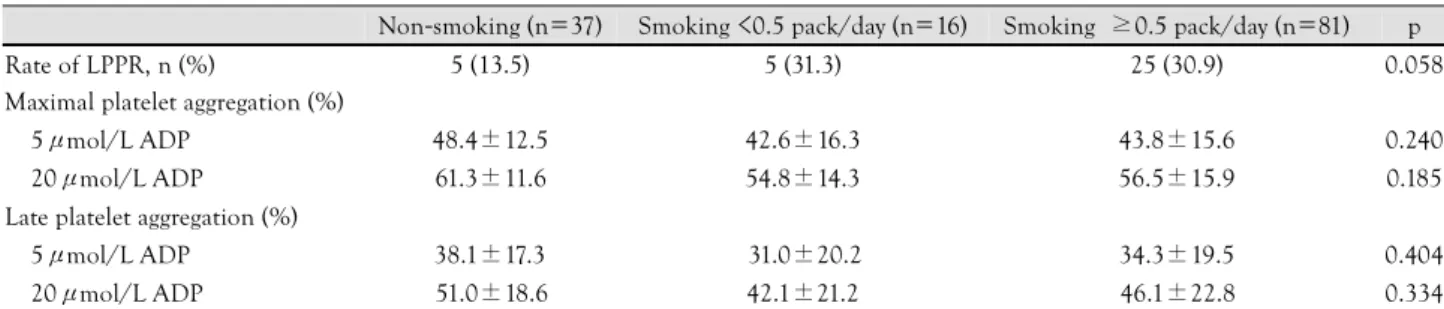
±11.0% vs. 43.8±15.2%, p=0.023 and 20 μmol/L ADP-induced Aggmax; 63.6±10.4% vs. 56.7±15.1%, p=0.074). The PS patients showed a trend toward lower Aggmax after 5 μmol/L (43.6±15.7% vs. 48.4±12.5%, p=0.096) and 20 μmol/L ADP stimuli (56.2±15.6%
vs. 61.3±11.6%, p=0.073) compared with NS patients (Table 2). However, Agglate did not differ between PS and NS patients (5 μmol/L ADP: 33.8±19.5% vs.
38.1±17.3%, p=0.234 and 20 μmol/L ADP: 45.5±
22.5% vs. 51.0±18.6%, p=0.187). In contrast to the results of Bliden et al.,7) our results did not show sig- nificant differences in 5 μmol/L (Aggmax: p=0.776 and Agglate: p=0.540) and 20 μmol/L ADP-induced plate- let aggregation (Aggmax: p=0.692 and Agglate: p=0.517) between PS patients <0.5 pack/day and ≥0.5 pack/
day (Table 2).
Predictor of low post-clopidogrel platelet reactivity More PS patients met the criteria for LPPR than NS patients (30.9% vs. 13.5%, p=0.048). To identify sig- nificant predictors of LPPR, a logistic regression analy- sis was used to evaluate the impact of the same analytic variables as Bliden et al.7) evaluated (age, body mass in- dex, diabetes, history of myocardial infarction, hyper- tension, smoking status, and use of calcium antagonists, angiotensin-converting enzyme inhibitors, beta blockers, and statins). Age was the only variable that was inverse-
ly correlated with LPPR {odds ratio (OR) 0.904, 95%
confidence interval (CI) 0.845 to 0.968, p=0.004}. In another model of multivariate analyses including vari- ables with p<0.2 in univariate analyses for differences between LPPR vs. non-LPPR groups, age was also the only independent predictor of LPPR (OR 0.960, 95%
CI 0.929 to 0.993, p=0.019) (Table 3).
Discussion
Our study showed that smoking before admission is not significantly associated with decreased residual pla- telet reacti-vity in AMI patients. In addition, we could not find a dose-related relationship between smoking and postclopidogrel residual platelet reactivity.
Clopidogrel is a prodrug and can be converted to its active metabolite by CYP isoenzymes. Of these, CYP iso- enzyme 1A2 is activated by the polycyclic aromatic hy-
Table 1. Continued
Variables, n (%) Pre-admission smoking (n=97) Non-smoking (n=37) p
Stent diameter (mm) 3.1±0.7 3.0±0.8 <0.421
Stents per patient 1.5±0.8 1.7±0.9 <0.200
Total stent length (mm) 35.9±20.7 41.7±25.8 <0.183
Final TIMI flow grade 3 97 (100) 36 (97.3) <0.276
BMI: body mass index, STEMI: ST-elevation myocardial infarction, NSTEMI: non-ST-elevation myocardial infarction, PCI: percutaneous coronary intervention, CABG: coronary artery bypass grafting, CYP 3A4: cytochrome P450 3A4 isoenzyme, ACEI: angiotensin-converting enzyme inhibitor, ARB: angiotensin receptor blocker, LV: left ventricular, Hb: hemoglobin, DTB: door-to-balloon, TIMI: thrombolysis in myocardial infarction, GPI: glycoprotein IIb/IIIa inhibitor
Table 2. The rate of LPPR and platelet reactivity according to smoking status
Non-smoking (n=37) Smoking <0.5 pack/day (n=16) Smoking ≥0.5 pack/day (n=81) p
Rate of LPPR, n (%) 5 (13.5) 5 (31.3) 25 (30.9) 0.058
Maximal platelet aggregation (%)
5μmol/L ADP 48.4±12.5 42.6±16.3 43.8±15.6 0.240
20μmol/L ADP 61.3±11.6 54.8±14.3 56.5±15.9 0.185
Late platelet aggregation (%)
5μmol/L ADP 38.1±17.3 31.0±20.2 34.3±19.5 0.404
20μmol/L ADP 51.0±18.6 42.1±21.2 46.1±22.8 0.334
Low post-clopidogrel platelet reactivity indicates the lowest quartile of 5μmol/L ADP-induced maximal platelet aggregation (≤37%). LPPR:
low post-clopidogrel platelet reactivity, ADP: adenosine diphosphate
Table 3. Multivariate analysis of predictors for LPPR
Variables p OR 95% CI
Age 0.019 0.960 0.929-0.993
Male 0.932 1.073 0.216-5.319
Pre-admission smoking 0.245 1.916 0.640-5.747 Hemoglobin 0.384 1.179 0.813-1.710 Beta blocker 0.192 2.882 0.588-14.085 Glycoprotein IIb/IIIa inhibitor 0.476 0.586 0.135-2.547 Presence of thrombus 0.845 0.902 0.321-2.535 Stents per patient 0.102 1.555 0.916-2.646 Low post-clopidogrel platelet reactivity indicates the lowest quartile of 5μmol/L ADP-induced maximal platelet aggregation (≤37%).
LPPR: low post-clopidogrel platelet reactivity, OR: odds ratio, CI:
confidence interval
drocarbons in cigarette smoke and induced by plasma ni- cotine.6)12) Therefore, cigarette smoking induces CYP1A2 activity and contributes to the increased metabolite of clopidogrel in a dose-related manner.13) Interestingly, some reports suggested that smoking might have a good effect on short-term clinical outcomes after coronary stenting.14)15)
However, this suggestion is in opposition to com- mon knowledge of smoking’s harmfulness. Most epi- demiologic studies have strongly supported the conclu- sion that smoking increases the incidence of fatal co- ronary artery diseases (CAD), especially AMI.16-20) The magnitude of the risk has been linearly related to the number of cigarettes smoked, with even low levels of smoking being associated with a considerable risk of AMI. Increased risk of CAD due to smoking is associ- ated not only with vasomotor dysfunction but also with inflammatory reactions. Thrombosis due to smoking has been associated with alterations in platelet func- tion, antithrombotic/prothrombotic factors, and fibri- nolytic factors.21-23) Cigarette smoking induces hyper- aggregability, decreases the availability of platelet-de- rived nitric oxide (NO), and decreases platelet sensitivity to exogenous NO. Alterations in tissue factors and a con- sequent increase in thrombotic potential have also been documented. Furthermore, higher fibrinogen, higher red blood cell counts, higher hematocrits, and higher blood viscosity potentiate the prothrombotic process as- sociated with exposure to smoke. Decreased plasma tis- sue plasminogen activator activity was observed in smo- kers. Therefore, smoking is associated with dysfunc- tional thrombotic mechanisms that promote the initia- tion and/or propagation of thrombus formation. Com- pared to chronic CAD, these effects of smoking may play a greater role in the setting of AMI.
Although we could ascertain that smoking may en- hance clopidogrel-induced platelet inhibition in AMI patients, the association seems weaker than the associ- ation between and elective coronary stenting. In addi- tion, we did not observe a relationship between the number of cigarettes and post-clopidogrel platelet re- activity. Enhanced platelet reactivity may be a main fea- ture in the early phase of AMI24) and correlate with the amount of smoking. Because CYP is associated with conversion to the active metabolite of clopidogrel, the activity of CYP subtypes may be related to the amount of the active form of clopidogrel. CYP2C19 contributes to both of the two sequential oxidative metabolic steps of clopidogrel activation. The polymorphism of this subtype can induce loss-of-function to a considerable extent.25)26) Because CYP1A2 affects only the first oxida- tive step of clopidogrel, induction of CYP1A2 by smok- ing may have a relatively weak impact on clopidogrel activation.25)26) Furthermore, we assessed residual pla- telet reactivity at least 3 days after emergency stenting,
which may be related to a decrease in smoking-induc- ed CYP1A2 activity. This can explain why smoking did not achieve significant suppression of enhanced plate- let hyperaggregability in this study.
In the present study, advancing age predicted higher post-clopidogrel platelet reactivity in AMI patients. Like diabetes mellitus, advancing age shows higher pre-treat- ment platelet reactivity,27) which is related to high re- sidual platelet reactivity. Geisler et al.28)29) also found that patients aged 65 years or older had significantly increased residual platelet aggregation at least 6 hours after clopidogrel loading.
A study of the PREDICT score demonstrated that various clinical factors influence residual platelet re- activity (acute coronary syndrome, age >65 years, dia- betes mellitus, renal failure, and reduced left ventricu- lar function).28)29) Because the PS patients showed lower prevalence of clinical risk factors in this study, a lower platelet reactivity in PS patients might not be expl- ained by the effect of smoking alone. However, the presence of diabetes mellitus and hypertension did not induce increased residual platelet reactivity in this study, which may be related to the fact that we only enrolled AMI patients and we enrolled a small number of subjects.
Limitations
Our study has several limitations. First, the number of study subjects was relatively small. Because there were differences in clinical risk factors between PS and NS patients, a decreased trend towards maximal platelet reactivity in PS patients could not be explained by the effect of smoking alone. Second, the study group was heterogeneous: it contained both STEMI and NSTE- MI patients. However, there was no difference in pla- telet reactivity between these groups. Finally, the time point of platelet function measurements can be criti- cized. Although post-clopidogrel platelet reactivity may change dynamically during the early phase of AMI, Ma- tetzky et al.9) showed that there may be no significant changes of post-clopidogrel platelet reactivity from days 3 to 5 in AMI patients after coronary stenting. Because we assessed platelet reactivity from 3 to 5 days after co- ronary stenting, our patients’ results may principally re- flect pre-discharge residual platelet reactivity.
Conclusions
Smoking before admission is not significantly asso- ciated with decreased residual platelet reactivity in AMI patients. In addition, PS of ≥0.5 pack/day can not in- duce a significant reduction in post-clopidogrel plate- let reactivity compared with NS.
Acknowledgments
This study was partly supported by grants from the Research Found- ation of Gyeongsang National University Hospital.
REFERENCES
1) Hollopeter G, Jantzen HM, Vincent D, et al. Identification of the platelet ADP receptor targeted by antithrombotic drugs. Nature 2001;409:202-7.
2) Siller-Matula JM, Lang I, Christ G, Jilma B. Calcium-channel blockers reduce the antiplatelet effect of clopidogrel. J Am Coll Cardiol 2008;52:1557-63.
3) Gilard M, Arnaud B, Cornily JC, et al. Influence of omeprazole on the antiplatelet action of clopidogrel associated with aspirin:
the randomized, double-blind OCLA (Omeprazole CLopidogrel Aspirin) study. J Am Coll Cardiol 2008;51:256-60.
4) Trenk D, Hochholzer W, Fromm MF, et al. Cytochrome P450 2C19 681G>A polymorphism and high on-clopidogrel platelet reactivity associated with adverse 1-year clinical outcome of elec- tive percutaneous coronary intervention with drug-eluting or bare- metal stents. J Am Coll Cardiol 2008;51:1925-34.
5) Lau WC, Waskell LA, Watkins PB, et al. Atorvastatin reduces the ability of clopidogrel to inhibit platelet aggregation: a new drug- drug interaction. Circulation 2003;107:32-7.
6) Zevin S, Benowitz NL. Drug interactions with tobacco smoking:
an update. Clin Pharmacokinet 1999;36:425-38.
7) Bliden KP, Dichiara J, Lawal L, et al. The association of ciga- rette smoking with enhanced platelet inhibition by clopidogrel. J Am Coll Cardiol 2008;52:531-3.
8) Buonamici P, Marcucci R, Migliorini A, et al. Impact of platelet reactivity after clopidogrel administration on drug-eluting stent thrombosis. J Am Coll Cardiol 2007;49:2312-7.
9) Matetzky S, Shenkman B, Guetta V, et al. Clopidogrel resistance is associated with increased risk of recurrent atherothrombotic events in patients with acute myocardial infarction. Circulation 2004;109:3171-5.
10) Jeong YH, Lee SW, Choi BR, et al. Randomized comparison of adjunctive cilostazol versus high maintenance-dose clopidogrel in patients with high post-treatment platelet reactivity. J Am Coll Cardiol 2009;53:1101-9.
11) Jeong YH, Kim IS, Choi BR, Kwak CH, Hwang JY. The optimal threshold of high post-treatment platelet reactivity could be de- fined by a point-of-care VerifyNow P2Y12 assay. Eur Heart J 2008;
29:2186-7.
12) Iba MM, Fung J, Pak YW, et al. Dose-dependent up-regulation of rat pulmonary, renal, and hepatic cytochrome P-450 (CYP) 1A expression by nicotine feeding. Drug Metab Dispos 1999;27:
977-82.
13) Tantcheva-Poor I, Zaigler M, Rietbrock S, Fuhr U. Estimation of cytochrome P-450 CYP1A2 activity in 863 healthy Caucasians using a saliva-based caffeine test. Pharmacogenetics 1999;9:
131-44.
14) Berger JS, Bhatt DL, Steinhubl SR, et al. Smoking, clopidogrel,
and mortality in patients with established cardiovascular disease.
Circulation 2009;120:2337-44.
15) Desai NR, Mega JL, Jiang S, Cannon CP, Sabatine MS. Interac- tion between cigarette smoking and clinical benefit of clopido- grel. J Am Coll Cardiol 2009;53:1273-8.
16) Teo KK, Ounpuu S, Hawken S, et al. Tobacco use and risk of myocardial infarction in 52 countries in the INTERHEART study:
a case-control study. Lancet 2006;368:647-58.
17) Ambrose JA, Barua RS. The pathophysiology of cigarette smok- ing and cardiovascular disease: an update. J Am Coll Cardiol 2004;43:1731-7.
18) Cho JY, Jeong MH, Ahn YK, et al. Predictive factors of major adverse cardiac events and clinical outcomes of acute myocar- dial infarction in young Korean patients. Korean Circ J 2008;
38:161-9.
19) Lim SY, Jeong MH, Yang BR, et al. Long-term clinical outcomes after primary percutaneous coronary intervention in patients with acute myocardial infarction older than 75 years. Korean Circ J 2005;35:613-9.
20) Cho JY, Jeong MH, Choi OJ, et al. Predictive factors after per- cutaneous coronary intervention in young patients with acute myocardial infarction. Korean Circ J 2007;37:373-9.
21) Fusegawa Y, Goto S, Handa S, Kawada T, Ando Y. Platelet spon- taneous aggregation in platelet-rich plasma is increased in habi- tual smokers. Thromb Res 1999;93:271-8.
22) Ichiki K, Ikeda H, Haramaki N, Ueno T, Imaizumi T. Long-term smoking impairs platelet-derived nitric oxide release. Circula- tion 1996;94:3109-14.
23) Sawada M, Kishi Y, Numano F, Isobe M. Smokers lack morning increase in platelet sensitivity to nitric oxide. J Cardiovasc Phar- macol 2002;40:571-6.
24) Luscher TF, Steffel J, Eberli FR, et al. Drug-eluting stent and coronary thrombosis: biological mechanisms and clinical impli- cations. Circulation 2007;115:1051-8.
25) Mega JL, Close SL, Wiviott SD, et al. Cytochrome p-450 poly- morphisms and response to clopidogrel. N Engl J Med 2009;
360:354-62.
26) Freedman JE, Hylek EM. Clopidogrel, genetics, and drug res- ponsiveness. N Engl J Med 2009;360:411-3.
27) Gurbel PA, Tantry US. Drug insight: clopidogrel nonresponsi- veness. Nat Clin Prac Cardiovasc Med 2006;3:387-95.
28) Geisler T, Grass D, Bigalke B, et al. The Residual Platelet Agg- regation after Deployment of Intracoronary Stent (PREDICT) score. J Thromb Haemost 2008;6:54-61.
29) Geisler T, Schaeffeler E, Dippon J, et al. CYP2C19 and non- genetic factors predict poor responsiveness to clopidogrel load- ing dose after coronary stent implantation. Pharmacogenomics 2008;9:1251-9.