• 검색 결과가 없습니다.

The Short-term Effect of Atorvastatin on Flow-Mediated Vasodilation, Pulse Wave Velocity and Carotid Intima-Media Thickness in Patients With Moderate Cholesterolemia

N/A
N/A
Protected

Academic year: 2022

Share "The Short-term Effect of Atorvastatin on Flow-Mediated Vasodilation, Pulse Wave Velocity and Carotid Intima-Media Thickness in Patients With Moderate Cholesterolemia "

Copied!
8
0
0

로드 중.... (전체 텍스트 보기)

전체 글

(1)

144

The Short-term Effect of Atorvastatin on Flow-Mediated Vasodilation, Pulse Wave Velocity and Carotid Intima-Media Thickness in Patients With Moderate Cholesterolemia

Young-Soo Lee, MD and Kee-Sik Kim, MD

Division of Cardiology, College of Medicine, Catholic University of Daegu, Daegu, Korea ABSTRACT

Background and Objectives : The mechanism for the improved endothelial function after treatment with statins has been shown to be the increased bioavailability of nitric oxide, which is independent of the cholesterol-lowering effects of statin therapy. The aim of this study was to evaluate the short-term effect on flow-mediated vasodilation (FMD), the pulse wave velocity (PWV) and the carotid intima-media thickness (IMT) of statin treatment, as based on the dose and duration of therapy. Subjects and Methods : We enrolled 51 patients with moderate choleste- rolemia (total cholesterol: 200-250 mg/dL). The patients were randomly divided into two groups according to the dose of atorvastatin (10 mg: 27 patients, 40 mg: 24 patients). We measured the FMD of the brachial artery, the carotid-radial PWV, the IMT of both common carotid arteries, the lipid profile and the serum C-reactive protein (CRP) at baseline, one week and eight weeks after statin treatment. Results : The total cholesterol and low density lipoprotein (LDL) cholesterol levels in both groups were significantly decreased one week and eight weeks later.

However, a difference between the groups was only noted at eight weeks. The FMD for both groups was signifi- cantly increased at one and eight weeks; however, the difference was not significantly different between the two groups. The carotid-radial PWV of the 40 mg group was decreased at one and eight weeks, and the change of the PWV at eight weeks was significantly different between the two groups. However, the change in the PWV was not correlated with a change in the LDL-cholesterol. Conclusion : Early improvement of the FMD and PWV following statin treatment might be related to the dose and duration of statin therapy and these effects of statin treatment may be independent of lipid lowering. (Korean Circ J 2008;38:144-151)

KEY WORDS: Atherosclerosis; Hydroxymethylglutaryl coenzyme A reductase inhibitors.

Introduction

The endothelium is the major regulator of vascular homeostasis and it maintains a balance between vaso- dilation and vasoconstriction, and inhibition and stimu- lation of smooth muscle cell proliferation and migration, as well as thrombogenesis and fibrinolysis. Endothelial dysfunction occurs when this balance is upset, causing damage to the arterial wall. Endothelial dysfunction is considered an early marker for atherosclerosis. 1) Flow- mediated dilation (FMD) of the brachial artery, the in- tima-media thickness (IMT) of the carotid artery and

the pulse wave velocity (PWV) have all been shown to be good surrogate markers of clinical atherosclerosis. 2 - 5)

Statins inhibit hepatic 3-hydroxy 3-methylglutaryl coenzyme A (HMG-CoA) reductase, which is respon- sible for the reduction of circulating low density lipo- protein (LDL) cholesterol beginning one to two weeks after starting therapy. 6) In addition, statins inhibit the HMG-CoA reductase that is within endothelial cells, vascular smooth muscle cells and inflammatory cells within hours after the administration of statins. 7)

Several studies have reported that the early improve- ment of endothelial function after treatment with a variety of statins occurs independently of a decrease in LDL. 8)9) However, there is limited information on the effect of the dose of statins on endothelial function.

Therefore, the present study investigated the short-term effect on the FMD, PWV and IMT based on the dose and duration of statin treatment in patients with mo- derate cholesterolemia.

Received: April 9, 2007

Revision Received: October 25, 2007 Accepted: October 30, 2007

Correspondence: Kee-Sik Kim, MD, Division of Cardiology, College of Medi- cine, Catholic University of Daegu, 3056-6 Daemyeong 4-dong, Nam-gu, Daegu 705-718, Korea

Tel: 82-53-650-3010, Fax: 82-53-621-3166

E-mail: kks7379@ cu.ac.kr

(2)

Subjects and Methods

Patient population

We enrolled 51 patients with moderate cholesterole- mia (total cholesterol 200-250 mg/dL) between January 2005 and November 2005. Their mean age was 60.0±

8.4 years; 41% of the enrolled patients were male. The patients were randomly divided into two groups accor- ding to the dose of atorvastatin they received: 10 mg for 27 patients and 40 mg for 24 patients. The patients with hypertension and diabetes were included as being in a state to tolerate statin medication.

The exclusion criteria included patients with renal dysfunction (serum creatinine >150% of the upper nor- mal limit), hepatic dysfunction (aspartate and alanine aminotransferate >200% of the upper normal limit), overt proteinuria, a clinically significant cardiovascular disease or any sign of peripheral artery disease, cardiac pathology (uncontrolled arrhythmias, atrial fibrillation and documented ischemic heart disease), and acute in- flammatory reaction.

This study was reviewed and approved by our ethical committee; written informed consent was obtained from all individuals before enrollment into the study.

Study design

All the patients underwent evaluation of the FMD of the brachial artery, the carotid-radial PWV and the IMT of both common carotid arteries, as well as bio- chemical testing that included lipid profiles for the efficacy of lipid-lowering, C-reactive protein (CRP) for the assessment of inflammation, the hepatic and renal function and muscle enzyme evaluation for adverse events at baseline, one week and at eight weeks after treatment with atorvastatin.

Biochemical tests

At study baseline, venous blood samples were obtained from the patient’s antecubital veins, and these patients had fasted overnight. The lipid serum levels, liver enzyme levels and muscle enzyme levels such as creatine kinase (CK) and lactic dehydrogenase (LDH) were measured by routine methods. CRP measurements were performed by the Nephelometer (Dade Behring Inc, Newark, DE, USA) method.

Measurement of carotid-radial pulse wave velocity After the blood pressure was measured, the PWV measurement was performed in a controlled environ- ment. The carotid-radial PWV was determined by using an automatic device, the Sphygmocor apparatus (AT- CORMedical, Sydney, Australia), between the carotid artery and radial artery. As we reported previously, 10) measurement was carried out at 20 cardiac cycles; when the difference of the consecutive means during repeated

measures was less than 0.5 m/s, then the mean data was used for the final analysis.

Measurement of carotid intima-media thickness B-mode ultrasound measurements were performed with a 10-MHz linear-array transducer that was con- nected to a Vivid 7 echocardiograph (General Electronics Corp., Horten, Norway). The patients were examined in the supine position. The operator directed the sound beam perpendicular to the arterial surface of the far wall of the common carotid artery (CCA) to obtain two pa- rallel echogenic lines, which corresponded to the blood- intima and media-adventitia interfaces. The right and left CCA IMT were measured at least 10 mm proximal to the bifurcation. The values of the maximum and mean IMT were automatically calculated using the programmed software (M’ATH, METRIS Co., Argenteuil, France).

The presence of a plaque was evaluated in the carotid artery. The plaque was defined as a distinct area, with an IMT exceeding twice that of the neighboring sites, so an IMT >1.3 mm was consequently not included in the calculation of the carotid IMT. 11)

Measurement of flow-mediated dilation

FMD was assessed by 2-dimensional ultrasonography (Vivid 7, General Electronics Corp., Horten, Norway) of the brachial artery by a modification of the method of Corretti et al. 12) Measurements were performed on the left arm with the subjects in the supine position after a 10- to 20-minute rest in a quiet dark room at a temperature of 22°C. The brachial artery was scanned longitudinally, just above the antecubital crease, using a 10-MHz probe. The diameter of the brachial artery was measured at the R wave of the electrocardiogram, and at the interface between the media and adventitia of the anterior and posterior wall. Hyperemia was in- duced by inflation of a pneumatic cuff to 230 to 250 mmHg for four minutes on the most proximal part of the upper arm; the maximum arterial diameter was then measured 45-60 seconds after sudden deflation of the cuff. The maximum diameter during hyperemia com- pared with the baseline diameter was used for analysis.

We measured each diameter three times during two beat, and the mean data was used for final analysis. Measu- rement was done by an independent observer who re- mained blinded to the medication of the study. FMD was defined as the percent increase in arterial diameter during hyperemia, i.e., 100×[(diameter after hyperemia- baseline diameter)/baseline diameter].

Statistical analysis

The SPSS 12.0 (SPSS inc., Chicago, Illinois) statistical

software package was used for all calculations. Data are

presented as means±standard deviations (SDs) for con-

tinuous variables and as percentages for the categorical

(3)

data. Differences between the treatment groups for the lipid profiles and other biochemical parameters, along with each of the parameters of endothelial function, were analyzed by the unpaired Student t-test and by the paired Student t-test before (baseline) and after (one week or eight weeks) treatment. Linear correlation an- alysis (Pearson) was used to test correlations between changes in the carotid-radial PWV and FMD, and ch- ange in the LDL-cholesterol after therapy. Categorical data and proportions were analyzed using the Chi-square test. A p<0.05 was regarded as statistically significant.

Results

Demographic characteristics

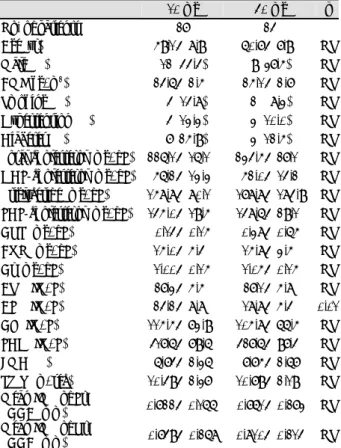
Table 1 presents the demographic characteristics of the study population. There were no differences in age or gender between the groups. In addition, there were no differences in the cardiovascular risk factors such as obesity and a history of smoking, hypertension and di- abetes between the groups. Other biochemical parame- ters, including the lipid profiles, CRP, blood urea nitro- gen (BUN), creatinine (Cr), aspartate aminotransferase (AST), LDH and CK, were not different on comparisons

between the groups. However, the alanine aminotrans- ferase (ALT) level in the 10 mg group was increased compared with that of the 40 mg group. In addition, the carotid-radial PWV, FMD and carotid IMT were not significantly different on comparisons between the two groups.

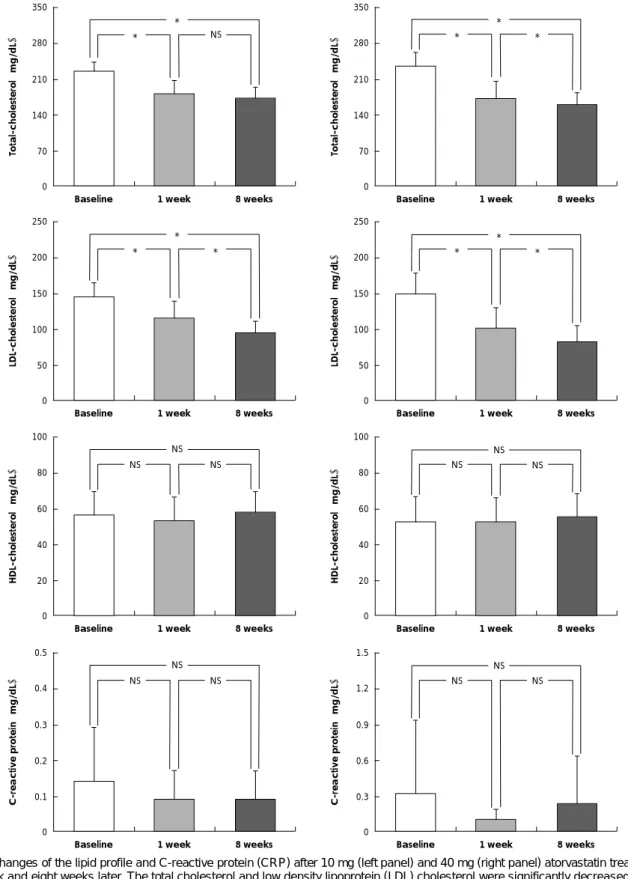
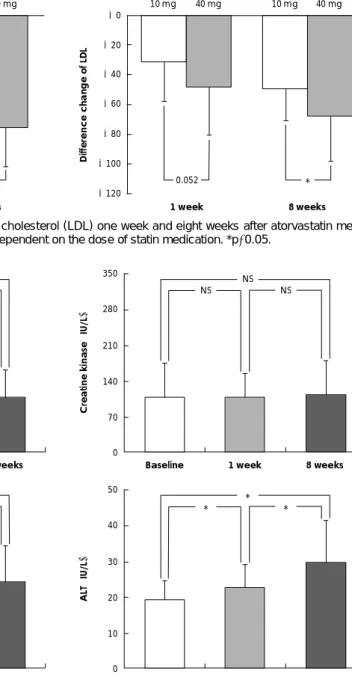
Change of lipid profiles and C-reactive protein Total cholesterol, LDL-cholesterol and triglycerides were significantly decreased after statin therapy in both groups. The decreases were statistically significant after one week and the lowest concentrations were reached after eight weeks in both groups (Fig. 1); the differences of the changes in the 40 mg group were significantly higher than those in the 10 mg group (Fig. 2). However, the changes in the HDL-cholesterol and CRP were not statistically different after statin therapy (Fig. 1).

Change of parameters for assessment of adverse events

All of the biochemical parameters that were studied, including CK, BUN, Cr and AST, were unchanged after statin therapy. However, in the 40 mg group, the ALT was significantly increased over time, although no pa- tient exhibited clinically relevant increases (≥3×upper limit of normal) (Fig. 3).

Change of flow-mediated dilation, pulse wave ve- locity and intima-media thickness

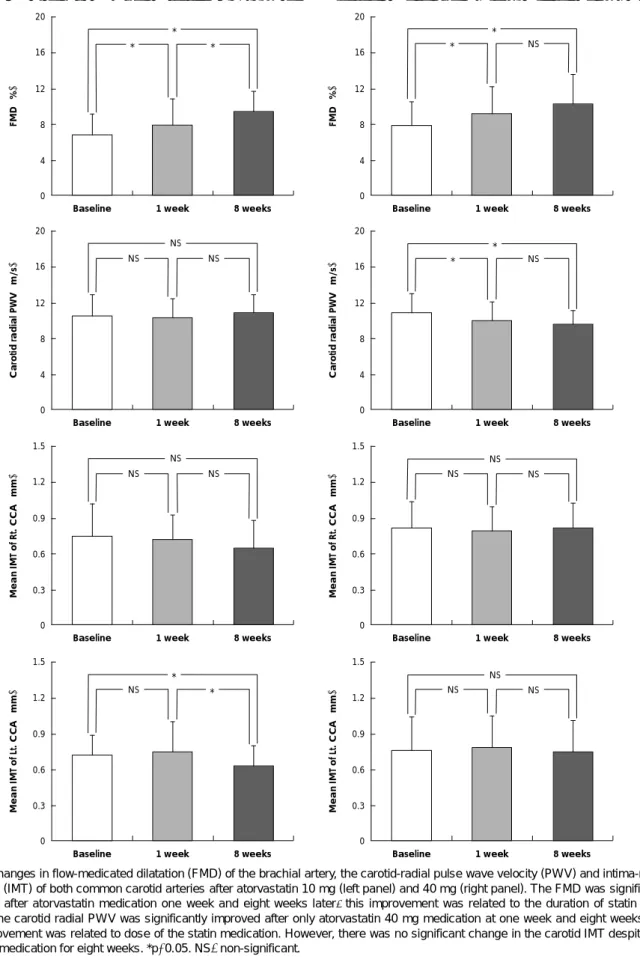
The FMD was significantly increased after a fixed dose of 10 mg or 40 mg atorvastatin at one week and eight weeks of treatment. The carotid-radial PWV was significantly improved only in the 40 mg group at one week and eight weeks. The carotid IMT was unchanged after statin therapy in both groups (Fig. 4). Although the difference in the change of the FMD was not sig- nificant in the 10 mg and 40 mg groups, the difference of the change of the carotid-radial PWV in the 40 mg group was higher compared to that in the 10 mg group (Fig. 5). In addition, there was no significant correlation between the difference of the change in the carotid-ra- dial PWV and FMD and the LDL-cholesterol (Fig. 6).

Discussion

This study was the first to evaluate the effect of statin treatment on the FMD, IMT and PWV according to the dose and duration of treatment in patients with moderate cholesterol levels. The results of the present study demonstrated that improvement of FMD was related to the duration of statin treatment, and impro- vement of the carotid-radial PWV was related to the dose of statin treatment. The difference in the effects of statin treatment on the FMD of the brachial artery and the carotid-radial PWV can be explained by the

Table 1. Basic demographic characteristics

10 mg 40 mg p

No. of patients 27 24

Age (yr) 59.1±8.9 60.7±7.9 NS

Male (%) 12 (44.4) 9 (37.5) NS

BMI (kg/m

2

) 24.6±2.5 25.1±2.7 NS

Smoking (%) 04 (14.8) 2 (08.3) NS

Hypertension (%) 04 (13.3) 3 (10.0) NS

Diabetes (%) 07 (25.9) 3 (12.5) NS

Total cholesterol (mg/dL) 226.1±16.1 234.5±27.1 NS HDL-cholesterol (mg/dL) 56.2±13.3 52.0±14.2 NS Triglyceride (mg/dL) 158.8±80.1 178.8±184.9 NS LDL-cholesterol (mg/dL) 145.0±19.5 148.6±29.1 NS

CRP (mg/dL) 0.14±0.15 0.38±0.65 NS

BUN (mg/dL) 15.0±5.4 15.8±3.5 NS

Cr (mg/dL) 1.00±0.15 1.05±0.15 NS

AST (IU/L) 27.3±5.5 27.1±5.8 NS

ALT (IU/L) 24.2±8.8 18.8±5.4 0.01

CK (IU/L) 115.5±73.9 105.8±66.5 NS

LDH (IU/L) 417.6±79.6 427.6±97.4 NS

FMD (%) 6.74±2.36 7.75±2.67 NS

PWV (m/sec) 10.49±2.37 10.79±2.19 NS

Mean IMT of Lt.

CCA (mm) 0.722±0.166 0.761±0.273 NS Mean IMT of Rt.

CCA (mm) 0.749±0.268 0.810±0.214 NS BMI: body mass index, HDL/LDL: high/low density lipoprotein, CRP: C-reactive protein, BUN: blood urea nitrogen, Cr: creati- nine, AST/ALT: aspartate/alanine aminotransferase, CK: creatine kinase, LDH: lactic dehydrogenase, FMD: flow-mediated dilation, PWV: pulse wave velocity, IMT: intima-media thickness, CCA:

common carotid artery, NS: non-significant

(4)

different characteristics of atherosclerosis, as well as the different sites of the artery that was assessed for the degree of atherosclerosis.

The reports on the relationship between lipid changes and the dose and duration of statin treatment have

been inconsistent. Edwards et al. 13) reported that there was at best only a weak relationship between the statin dose and cholesterol reduction in a dose-specific meta- analysis of lipid changes following statin treatment. By contrast, Saito et al. 14) reported that rosuvastatin pro-

350 280

210 140 70 0

To ta l- c hol es te ro l ( mg /d L)

*

* NS

Baseline 1 week 8 weeks

350 280

210 140 70 0

To ta l- c hol es te ro l ( mg /d L)

*

*

Baseline 1 week 8 weeks

*

250 200 150 100 50 0

LD L-cho le st er ol ( mg /d L)

*

*

Baseline 1 week 8 weeks

250 200 150 100 50 0

LD L-cho le st er ol ( mg /d L)

*

*

Baseline 1 week 8 weeks

*

*

100 80 60 40 20 0

H D L- c hol es te ro l ( mg /d L)

NS NS

Baseline 1 week 8 weeks

100 80 60 40 20 0

H D L- c hol es te ro l ( mg /d L)

NS NS

Baseline 1 week 8 weeks NS

NS

0.5 0.4 0.3 0.2 0.1 0

C- re a c tive p ro te in ( mg /d L)

NS NS

Baseline 1 week 8 weeks

1.5 1.2 0.9 0.6 0.3 0

C- re a c tive p ro te in ( mg /d L)

NS NS

Baseline 1 week 8 weeks NS

NS

Fig. 1. Changes of the lipid profile and C-reactive protein (CRP) after 10 mg (left panel) and 40 mg (right panel) atorvastatin treatment at

one week and eight weeks later. The total cholesterol and low density lipoprotein (LDL) cholesterol were significantly decreased after 10

mg and 40 mg treatment, but not the high density lipoprotein (HDL) cholesterol and CRP. *p<0.05. NS: non-significant.

(5)

duced good dose-related reductions in LDL-cholesterol.

In terms of the duration of statin treatment, atorvas- tatin 80 mg lowered the LDL-cholesterol level at 30 days, with significant benefit observed by four months in the Pravastatin and atorvastatin evaluation and in- fection therapy-thrombolysis in myocardial infarction 22 study. 15) However, these early reported benefits with undergoing statin therapy are not consistent with the results of the Aggrastat to Zocor trial of statin therapy, which showed no significant difference in efficacy by four months. 16) Our findings showed that the effects of statin treatment to lower LDL and total cholesterol were dependent on the dose and duration of statin treatment

(Fig. 2). However, these findings might have been due to the short term duration of statin treatment, which was a potential limitation in our study.

Several studies have demonstrated a lipid-indepen- dent early effect of statin treatment on endothelial function in a variety of clinical settings. Some investi- gators have reported that the short-term lipid-lowering effects of statins were able to improve endothelial func- tion after three days in patients with high cholesterol by decreasing oxidative stress. 17)18) Furthermore, Omori et al. 19) reported that a single-dose of cerivastatin in- creased the FMD at three hours, and this returned to baseline six hours later. A number of mechanisms have

-0 -25

-50 -75 -100 -125

D iff er ence ch a ng e o f T C

*

1 week 8 weeks

* 10 mg 40 mg 10 mg 40 mg

-0 -20 -40 -60 -80 -100 -120

D iff er ence ch a ng e o f L D L

0.052

1 week 8 weeks

* 10 mg 40 mg 10 mg 40 mg

Fig. 2. Change of total cholesterol (TC) and low density cholesterol (LDL) one week and eight weeks after atorvastatin medication. The TC and LDL were significantly decreased and this was dependent on the dose of statin medication. *p<0.05.

Fig. 3. Changes of creatine kinase (CK) and alanine aminotransferase (ALT) after treatment with atorvastatin 10 mg (left panel) and 40 mg (right panel). In the 40 mg treatment group, the ALT was significantly increased over time, although none of the patients exhibited a clinical relevant increase at eight weeks. *p<0.05. NS: non-significant.

350 280

210 140 70 0

C re a tine k ina se ( IU /L

)

NS NS

Baseline 1 week 8 weeks NS

350 280

210 140 70 0

C re a tine k ina se ( IU /L

)

NS NS

Baseline 1 week 8 weeks NS

50 40 30 20 10 0

ALT ( IU /L

)

NS NS

Baseline 1 week 8 weeks NS

50 40 30 20 10 0

ALT ( IU /L

)

* *

Baseline 1 week 8 weeks

*

(6)

been proposed to explain these effects. One important pathway appears to be the effects of statins on nitric oxide (NO) production by the increased availability of

endothelial NO synthase. 20) Cerivastatin has shown a time- and concentration-dependent effect on NO re- lease from endothelial cells in experimental models.

Fig. 4. Changes in flow-medicated dilatation (FMD) of the brachial artery, the carotid-radial pulse wave velocity (PWV) and intima-media thickness (IMT) of both common carotid arteries after atorvastatin 10 mg (left panel) and 40 mg (right panel). The FMD was significantly improved after atorvastatin medication one week and eight weeks later; this improvement was related to the duration of statin medi- cation. The carotid radial PWV was significantly improved after only atorvastatin 40 mg medication at one week and eight weeks, and this improvement was related to dose of the statin medication. However, there was no significant change in the carotid IMT despite ato- rvastatin medication for eight weeks. *p<0.05. NS: non-significant.

Baseline 1 week 8 weeks Baseline 1 week 8 weeks 20

16

12 8 4 0

C a ro tid r a di al P W V

(m/s)

NS NS

20 16

12 8 4 0

C a ro tid r a di al P W V

(m/s)

*

* NS

NS

Baseline 1 week 8 weeks Baseline 1 week 8 weeks 1.5

1.2

0.9 0.6 0.3 0

M e a n I M T o f R t. C C A ( mm

)

NS NS

1.5 1.2

0.9 0.6 0.3 0

M e a n I M T o f R t. C C A ( mm

)

NS

NS NS

NS

Baseline 1 week 8 weeks Baseline 1 week 8 weeks 1.5

1.2 0.9 0.6 0.3 0

M e a n I M T o f L t. C C A ( mm

)

* NS

1.5 1.2 0.9 0.6 0.3 0

M e a n I M T o f L t. C C A ( mm

)

NS

NS NS

* 20

16

12 8 4 0

FM D ( %

)

*

*

Baseline 1 week 8 weeks

20 16

12 8 4 0

FM D ( %

)

*

*

Baseline 1 week 8 weeks

* NS

(7)

The initial release of NO has been reported to occur within three minutes and this was dependent on the concentration, similar to that observed for the typical NO synthase activators (calcium ionophore and acetyl- choline). 21) In the present study, a fixed dose of atorva- statin at 10 mg or 40 mg resulted in significant im- provement in the FMD at one and eight weeks. This finding suggests that the improvement of FMD might be related to the duration of statin treatment.

Another important consideration is that NO may play a role in regulating arterial stiffness. 22) Matsuo et al. 23) reported that the ankle-brachial PWV was markedly improved after short duration (four weeks) of ceriva- statin treatment. The change in arterial stiffness foll- owing treatment with simvastatin may be greater in the peripheral arteries than in the central arteries. 24) The preferential improvement in peripheral arterial stiff- ness suggests that statin treatment reduced vascular smooth muscle tone rather than altering the properties of the extracellular matrix. In our study, only the ator- vastatin 40 mg treatment group showed an improved carotid-radial PWV at both one and eight weeks. This

finding suggests that improvement of arterial stiffness might be related to the dose of statin treatment. In addi- tion in the 40 mg group, a majority of the improvement observed in the FMD and carotid-radial PWV after eight weeks was also observed after one week. Therefore, these findings suggest that most of the improvements in the FMD and carotid-radial PWV occur early after the start of statin treatment.

Measuring the carotid IMT quantitatively assesses the arterial morphology, which may partially consist of intimal lesions and medial hypertrophy. 25) Statins have been shown to delay the progression or even cause re- gression of the carotid IMT. In a carotid injury experi- mental animal model, statin administration for two weeks decreased intimal thickening and smooth muscle cell proliferation. 26) In human studies, a reduction in the IMT was shown as early as six months after the onset of statin treatment, and aggressive statin treatment (e.g. atorvastatin 80 mg/day) resulted in a -0.063 mm/

year reduction in the annual progression of carotid atherosclerosis. 27)28) In our study, we did not observed a change in the carotid IMT because of the low dose

Fig. 5. Changes of flow-mediated dilatation (FMD) in the brachial artery and carotid radial pulse wave velocity (PWV) one week and eight weeks after atorvastatin treatment. Improvement of the FMD was related to the duration of statin treatment; however, improvement of the carotid radial PWV was related to the statin dose eight weeks later. *p<0.05. NS: non-significant.

7 6 5 4 3 2 1 0

D iff er ence ch a ng e o f F M D ( %

)

NS

10 mg 40 mg 10 mg 40 mg 1 wk 8 wk

NS 3

2 1 0 -1 -2 -3 -4

D iff er ence ch a ng e o f P W V ( m/s

)

10 mg 40 mg 10 mg 40 mg 1 wk 8 wk

NS *

Fig. 6. Relationship between the change of low density lipoprotein (LDL) cholesterol and the change of the carotid radial pulse wave ve- locity (PWV) and flow-mediated dilatation (FMD) 8 weeks later. The changes of PWV and FMD were not related to those of LDL-cholesterol.

Consequently, our findings suggested that the improvements of FMD and PWV were independent of the lipid lowering effect of statin.

4.0 2.0 0.0 -2.0 -4.0 -6.0 -8.0

D iff er ence ch a ng e o f P W V ( m/s

)

-120 -100 -80 -60 -40 -20 0 20 Difference changes of LDL-cholesterol (mg/dL)

10

5

0

-5

D iff er ence ch a ng e o f F M D ( %

)

-120 -100 -80 -60 -40 -20 0 20 Difference changes of LDL-cholesterol (mg/dL)

p=0.364 p=0.174

(8)

and short term duration of statin treatment.

The limitations of this study include: First, because of the small number of patients and short duration of statin treatment in our analysis, the relationship bet- ween statin therapy and the reduction of CRP and the changes of the IMT may not have been observed. Large- scale, long-term follow-up studies are required in the future. Second, we cannot completely rule out the po- ssibility that a change in blood pressure affected the results of the post-treatment PWV. It may have been better to measure the stiffness parameter β, 29) which is a blood pressure-independent index of arterial stiff- ness, to avoid such a problem.

In conclusion, the present results suggest that im- provement of the FMD of the brachial artery and the carotid-radial PWV following statin treatment might be related to the dose and duration of statin therapy.

Such an effect of statin therapy may be independent of lipid lowering.

Acknowledgments

This study was supported by a 2004 scientific research grant of The Korean Society of Circulation.

REFERENCES

1) Lüscher TF, Barton M. Biology of the endothelium. Clin Cardiol 1997;20 ( Suppl II ) :II3-10.

2) Simon A, Gariepy J, Chironi G, Megnien JL, Levenson J. Inti- ma-media thickness: a new tool for diagnosis and treatment of cardiovascular risk. J Hypertens 2002;20:159-69.

3) Lee YS, Kim SK, Nam CW, et al. Clinical implication of caro- tid-radial pulse wave velocity for patients with coronary artery disease. Korean Circ J 2006;36:565-72.

4) O’Rourke MF, Mancia G. Arterial stiffness. J Hypertens 1999;

17:1-4.

5) Park KR, Kim KY, Yoon SM, Bae JH, Seong IW. Correlation between intima-media thickness in carotid artery and the extent of coronary atherosclerosis. Korean Circ J 2003;33:401-8.

6) Ray KK, Cannon CP. Intensive statin therapy in acute coronary syndromes: clinical benefits and vascular biology. Curr Opin Li- pidol 2004;15:637-43.

7) Inoue I, Goto S, Mizotani K, et al. Lipophilic HMG-CoA reduc- tase inhibitor has an anti-inflammatory effect: reduction of MRNA levels for interleukin-1β, interleukin-6, cyclooxygenase -2, and p22phox by regulation of peroxisome proliferator-activated re- ceptor ( PPARα ) in primary endothelial cells. Life Sci 2000;67:

863-76.

8) Laufs U, Wassmann S, Hilgers S, Ribaudo N, Bohm M, Nick- enig G. Rapid effects on vascular function after initiation and withdrawal of atorvastatin in healthy, normocholesterolemic men.

Am J Cardiol 2001;88:1306-7.

9) Taneva E, Borucki K, Wiens L, et al. Early effects on endothelial function of atorvastatin 40 mg twice daily and its withdrawal.

Am J Cardiol 2006;97:1002-6.

10) Lee YS, Kim KS, Hyun DW, et al. The change of arterial stiff- ness according to dialysis in patients with end-stage renal dise- ase. Korean Circ J 2004;34:865-73.

11) Kablak-Ziembicka A, Tracz W, Przewlocki T, Pieniazek P, Soko- lowski A, Konieczynska M. Association of increased carotid intima-media thickness with the extent of coronary artery disease.

Heart 2004;90:1286-90.

12) Corretti MC, Anderson TJ, Benjamin EJ, et al. Guidelines for the ultrasound assessment of endothelial-dependent flow-mediated vasodilation of the brachial artery: report of the International Brachial Artery Reactivity Task Force. J Am Coll Cardiol 2002;

39:257-65.

13) Edwards JE, Moore RA. Statins in hypercholesterolaemia: a dose-specific meta-analysis of lipid changes in randomised, dou- ble blind trials. BMC Fam Pract 2003;4:18.

14) Saito Y, Goto Y, Dane A, Strutt K, Raza A. Randomized dose- response study of rosuvasatin in Japanese patients with hyper- cholesterolemia. J Atheroscler Thromb 2003;10:329-36.

15) Cannon CP, Braunwald E, McCabe CH, et al. Intensive versus moderate lipid lowering with statins after acute coronary syn- dromes. N Engl J Med 2004;350:1495-504.

16) de Lemos JA, Blazing MA, Wiviott SD, et al. Early intensive vs a delayed conservative simvastatin strategy in patients with acute coronary syndromes: phase Z of the A to Z trial. JAMA 2004;

292:1307-16.

17) Tsunekawa T, Hayashi T, Kano H, et al. Cerivastatin, a hydroxy- methylglutaryl coenzyme a reductase inhibitor, improves endo- thelial function in elderly diabetic patients within 3 days. Circu- lation 2001;104:376- 9.

18) John S, Schneider MP, Delles C, Jacobi J, Schmieder RE. Lipid- independent effects of statins on endothelial function and bio- availability of nitric oxide in hypercholesterolemic patients. Am Heart J 2005;149:473.

19) Omori H, Nagashima H, Tsurumi Y, et al. Direct in vivo evidence of a vascular statin: a single dose cerivastatin increases vas- cular endothelial responsiveness in healthy normocholesterolemic patients. Br J Pharmacol 2002;54:395-9.

20) John S, Schlaich M, Langenfeld M, et al. Increased bioav- ailability of nitric oxide after lipid-lowering therapy in hypercho- lesterolemic patients: a randomized, placebo-controlled, double- blind study. Circulation 1998;98:211-6.

21) Kalinowski L, Dobrucki LW, Brovkovych V, Malinski T. Incre- ased nitric oxide bioavailability in endothelial cells contributes to the pleiotropic effect of cerivastatin. Circulation 2002;105:

933-8.

22) Wilkinson IB, Qasem A, McEniery CM, Webb DJ, Avolio AP, Cockcroft JR. Nitric oxide regulates local arterial distensibility in vivo. Circulation 2002;105:213-7.

23) Matsuo T, Iwade K, Hirata N, et al. Improvement of arterial stiff- ness by the antioxidant and anti-inflammatory effects of short- term statin therapy in patients with hypercholesterolemia. Heart Vessels 2005;20:8-12.

24) Shige H, Dart A, Nestel P. Simvastatin improves arterial com- pliance in the lower limb but not in the aorta. Athersoclesosis 2001;155:245-50.

25) Simon A, Gariepy J, Chironi G, Megnien JL, Levenson J. Intima- media thickness: a new tool for diagnosis and treatment of car- diovascular risk. J Hypertens 2002;20:159-69.

26) Igarashi M, Takeda Y, Mori S, et al. Suppression of neointimal thickening by a newly developed HMG-CoA reductase inhibitor, BAYw6228, and its inhibitory effect on vascular smooth muscle cell growth. Br J Pharmacol 1997;120:1172-8.

27) Reid JA, Wolsley C, Lau LL, et al. The effect of pravastatin on intima media thickness of the carotid artery in patients with normal cholesterol. Eur J Vasc Endovasc Surg 2005;30:464-8.

28) Taylor AJ, Kent SM, Flaherty PJ, et al. A randomized trial comparing the effects of atorvastatin and pravastatin on carotid intima medial thickness ( ARBITER: Arterial Biology for the Investigation of the Treatment Effects of Reducing Cholesterol ) . Circulation 2002;106:2055-60.

29) Kawasaki T, Sasayama S, Yagi S, Asakawa T, Kirai T. Non-in-

vasive assessment of the age related changes in stiffness of major

branches of the human arteries. Cardiovasc Res 1987;21:678-87.

수치

Table 1 presents the demographic characteristics of  the study population. There were no differences in age  or gender between the groups
Fig. 1. Changes of the lipid profile and C-reactive protein (CRP) after 10 mg (left panel) and 40 mg (right panel) atorvastatin treatment at  one week and eight weeks later
Fig. 2. Change of total cholesterol (TC) and low density cholesterol (LDL) one week and eight weeks after atorvastatin medication
Fig. 4. Changes in flow-medicated dilatation (FMD) of the brachial artery, the carotid-radial pulse wave velocity (PWV) and intima-media  thickness (IMT) of both common carotid arteries after atorvastatin 10 mg (left panel) and 40 mg (right panel)
+2

참조

관련 문서