• 검색 결과가 없습니다.

An extremely rare elderly case of proximal epithelioid sarcoma of the vulva: case report with a review of literatures

N/A
N/A
Protected

Academic year: 2022

Share "An extremely rare elderly case of proximal epithelioid sarcoma of the vulva: case report with a review of literatures"

Copied!
5
0
0

로드 중.... (전체 텍스트 보기)

전체 글

(1)

Introduction

Vulvar cancer is the fourth most common gynecologic ma- lignancy, accounting for 5% of all cancers of the female genital tract [1,2]. Of the diverse histological types of vulvar cancer, squamous cell carcinoma is the most common (95%), followed by melanoma, sarcoma, and basalioma [3]. The incidence of primary sarcoma of the vulva is estimated to be approximately 1.5–5% of all vulvar malignancies. Primary sarcoma of the vulva frequently affects the labia majora, Bar- tholin gland, clitoris, and labium minus [4].

Epithelioid sarcoma (ES) is a malignant soft tissue tumor that can be classified into proximal and distal types. Proximal PES occurs in the trunk and pubic regions, and distal PES occurs in the upper and lower limbs. Of the cases, proximal epithelioid sarcoma (PES) of the vulva is an extremely rare entity, and its occurrence has been described in a paucity of literature [5-7].

We experienced an extremely rare case of PES of the vulva in a 77-year-old woman. Herein, we report our case with a literature review.

Case report

In July 2016, a 77-year-old woman visited our clinic with a chief complaint of asymptomatic mass over the right vulva.

On history taking, the patient had no underlying diseases other than hypertension and diabetes mellitus. She had an obstetrical history of 6-0-8(0/8)-4(3/1). Grossly, she had a mass measuring 3×2 cm in size on the skin over the right lower labia, which was suggestive of Bartholin’s cyst in the

An extremely rare elderly case of proximal epithelioid sarcoma of the vulva: case report with a review of literatures

Si Eun Jeon, MD 1* , Jina Lee, MD 1* , Hee Jung Jung, MD 1 , Beob-Jong Kim, MD 1 , Sang-Young Ryu, MD, PhD 1 , Sang-Il Park, MD 2 , Hye-Sil Seol, MD 3 , Won-Il Jang, MD 4 , Moon-Hong Kim, MD, PhD 1

Department of Obstetrics and Gynecology,

1

Korea Institute of Radiological and Medical Sciences, Seoul;

2

Dongnam Institute of Radiological and Medical Sciences, Busan; Departments of

3

Pathology and

4

Radiation Oncology, Korea Institute of Radiological and Medical Sciences, Seoul, Korea

We experienced an extremely rare case of proximal epithelioid sarcoma (PES) of the vulva in a 77-year-old woman.

After history taking and physical examination, the patient was tentatively diagnosed as having Bartholin’s cyst in the right labium. Based on histopathological and immunohistochemical (IHC) findings, however, a final diagnosis of PES of the vulva was made. After receiving CyberKnife treatment, the patient survived but with recurrent episodes and poor prognosis. In conclusion, our case indicates that patients with PES of the vulva should be appropriately managed with radiotherapy after a differential diagnosis based on histopathological and IHC findings.

Keywords: Vulva; Vulvar neoplasms; Sarcoma; Immunohistochemistry; Diagnosis, differential

Received: 2020.03.19. Revised: 2020.05.21. Accepted: 2020.05.25.

Corresponding author: Moon-Hong Kim, MD, PhD

Department of Obstetrics and Gynecology, Korea Institute of Radiological and Medical Sciences, 75 Nowon-ro, Nowon-gu, Seoul 01812, Korea

E-mail: [email protected]

https://orcid.org/0000-0001-9456-8147

* These authors contributed equally to this work.

Articles published in Obstet Gynecol Sci are open-access, distributed under the terms of the Creative Commons Attribution Non-Commercial License (http://creativecommons.

org/licenses/by-nc/3.0/) which permits unrestricted non-commercial use, distribution, and reproduction in any medium, provided the original work is properly cited.

Copyright © 2020 Korean Society of Obstetrics and Gynecology https://doi.org/10.5468/ogs.20076

pISSN 2287-8572 · eISSN 2287-8580

(2)

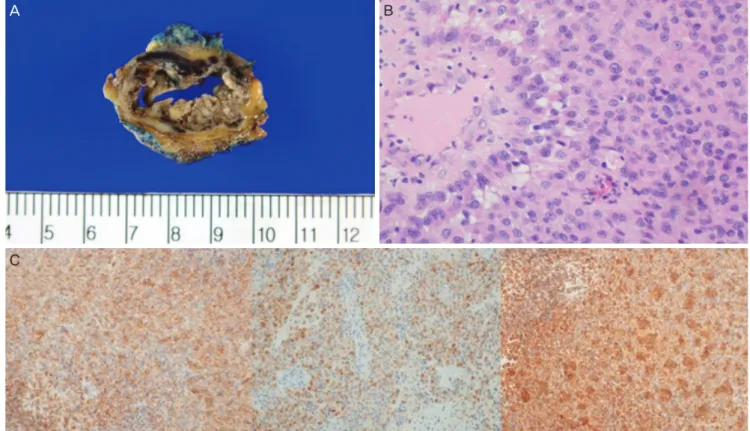
right labium (Fig. 1A). Therefore, she underwent a Bartholin gland cystectomy. An intraoperative frozen biopsy showed positive findings of malignancy. Moreover, histopathological examinations revealed a poorly differentiated malignant neo- plasm with a plump cytoplasm and eccentric nuclei, which was suggestive of PES of the vulva (Fig. 1B). In addition, immunohistochemistry (IHC) was positive for CD34, pan- cytokeratin (CK-PAN), and vimentin (VT; Fig. 1C).

After the operation, the patient had an enlargement of the right external iliac and inguinal lymph nodes on magnetic resonance imaging (MRI) and positron emission tomogra- phy-computed tomography (PET/CT). In August 2016, she underwent a reoperation for excision of the right inguinal lymph node and a laparoscopic excision of the right pelvic lymph node. An intraoperative frozen biopsy confirmed the malignancy in the right pelvic and inguinal lymph nodes. On the basis of the histopathological examination finding, the patient was diagnosed as having a proximal metastatic ES of the vulva. Of the seven lymph nodes, two were involved in

the metastasis.

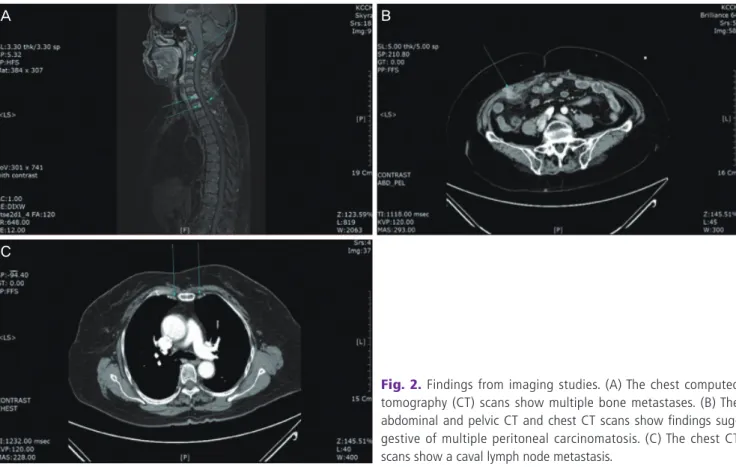
After the postoperative recovery period between Septem- ber 23 and October 31, 2016, the patient received radiother- apy at a dose of 46.8 Gy/26 Fx to the vulva and pelvic and inguinal lymph nodes. During the course of the radiotherapy, she developed severe skin desquamation. Thus, she com- pleted only 26 of the 28 treatment cycles of radiotherapy. In August 2017, she had a recurrence with a bone metastasis on her chest CT scans at a follow-up visit. Therefore, she underwent further examination with MRI and PET/CT, which revealed multiple bone metastases (Fig. 2, upper panel).

Therefore, she additionally received palliative radiotherapy to the C2 spine at a dose of 30 Gy/4 Fx and C5-T2 spine at a dose of 30 Gy/10Fx between September 18 and 29, 2017.

In December 2017, the multiple bone metastases showed increases in size and number on the follow-up MRI scans.

Therefore, the patient received CyberKnife treatment to the T8 and T12 spinal cord segments at doses of 36 Gy/4 Fx and 36 Gy/4 Fx, respectively, between January 9 and 18,

Fig. 1. Gross, histopathological, and immunohistochemical findings. (A) Shown is the gross finding of a mass of 3×2 cm in size in the skin over the right lower labia, which is suggestive of Bartholin’s cyst in the right labium. (B) The histopathological examination result shows a poorly differentiated malignant neoplasm with a plump cytoplasm and eccentric nuclei. (C) From left to right are the positive immunohis- tochemical findings for CD34, pan-cytokeratin, and vimentin.

A

C

B

(3)

2018. Thereafter, the patient was followed up using imag- ing modalities at 3-month intervals. Eight months later, she underwent abdominal and pelvic CT (APCT) and chest CT, which revealed findings suggestive of multiple peritoneal car- cinomatosis (Fig. 2, middle panel). In addition, she presented with lymphadenopathy and caval lymph node metastasis (Fig. 2, lower panel). Therefore, she received CyberKnife treatment to the pericaval lymph node at a dose of 4,800 Gy/4 Fx between October 10 and 26, 2018. Meanwhile, she complained of dyspnea, for which she underwent chest posteroanterior radiography, which revealed a small amount of pleural effusion in both lungs. The fluid cytology findings were negative for malignancy, so the patient received only conservative management with chest tube insertion for chest pleural effusion drainage. Subsequently, on APCT and chest CT, the peritoneal carcinomatosis and lymphadenopathy had aggravated, accompanied by a new bone metastasis. The pa- tient was therefore recommended to undergo chemotherapy, but she and her caregivers refused the treatment because of her old age and poor systemic condition. For >3 years after disease onset, she survived while receiving supportive care.

The patient was followed up until May 23, 2019.

Discussion

ES is a soft tissue malignancy. The first case of PES of the vulva was described by Pier et al. in 1972 [8]. It often affects the labia majora of young women, and its differential diag- noses include Bartholin’s cyst, lipoma, and genital warts [7,9].

Its benign appearance as an asymptomatic subcutaneous nodule poses diagnostic and therapeutic dilemmas for clini- cians [8-10]. On histopathological examination, PES of the vulva can be observed as plump spindle cells or large polygo- nal cells with a deeply acidophilic cytoplasm, which resemble epithelioid or squamous cells. Therefore, it can be diagnosed using IHC [6]. Our case showed high IHC positivity rates for CD34, CK-PAN, and VT, which is in agreement with the re- sults of the previous studies in this series [11,12].

No treatment guidelines have been established for PES of the vulva [5]. However, surgical excision with a wide margin of >2 cm remains the mainstay of treatment. A strong corre-

Fig. 2. Findings from imaging studies. (A) The chest computed tomography (CT) scans show multiple bone metastases. (B) The abdominal and pelvic CT and chest CT scans show findings sug- gestive of multiple peritoneal carcinomatosis. (C) The chest CT scans show a caval lymph node metastasis.

A

C

B

(4)

lation was found between inadequate margins and increased risk of local recurrence. Poor prognosis is associated with the presence of lymphatic metastasis. Adjuvant radiotherapy is recommended for high-grade tumors or cases with inad- equate surgical margins [13]. We did not perform chemo- therapy for our case, in accordance with previous studies that showed that the treatment effects of postoperative che- motherapy are still controversial [7,11-14]. Argenta et al. [13]

performed adjuvant chemotherapy for 7 of 31 patients with vulva ES or malignant rhabdoid tumor and reported that of the 7 patients, 3 were disease-free at 8, 11, and 21 months but the remaining 4 died of disseminated disease within 8 months of diagnosis.

PES of the vulva is an extremely rare entity, with only 29 cases described in the English literature. According to the previous studies in this series, the median age of onset was 36.4 years; most of the cases occurred during the early post- menopausal period except, while some cases occurred in young women [7].

In the present case, active radiotherapy using the Cy- berKnife treatment for the metastatic site was effective in prolonging survival. A poor prognosis is indicated in PES of the vulva. Patients with PES of the vulva are vulnerable to lo- cal recurrence despite the presence of negative surgical mar- gins, and up to 60% of them experience a distant metastasis [15-18]. According to Hasegawa et al. [16], the tumor-relat- ed mortality rate was 65% in 20 cases of PES of the vulva, which was lower than the metastasis rate (75%). Moreover, Ulbright et al. [19] reported 100% mortality due to distant metastasis in patients with local recurrence.

In conclusion, our case indicates that patients with PES of the vulva should be appropriately managed with radiother- apy after a differential diagnosis on the basis of histopatho- logical and IHC findings.

Conflict of interest

No potential conflict of interest relevant to this article was reported.

Ethical approval

The study was approved by the institutional review board of

the Korea Institute of Radiological and Medical Sciences (KI- RAMS 2020-02-006) and conducted in accordance with the principles of the Declaration of Helsinki.

Patient consent

The institutional review board waived the need for patient consent under the restriction that no identifiable personal information is revealed in the process.

References

1. Siegel R, Naishadham D, Jemal A. Cancer statistics, 2013. CA Cancer J Clin 2013;63:11-30.

2. Hunter DJ. Carcinoma of the vulva: a review of 361 pa- tients. Gynecol Oncol 1975;3:117-23.

3. Günther V, Alkatout I, Lez C, Altarac S, Fures R, Cupic H, et al. Malignant melanoma of the urethra: a rare histo- logic subdivision of vulvar cancer with a poor prognosis.

Case Rep Obstet Gynecol 2012;2012:385175.

4. Ulutin HC, Zellars RC, Frassica D. Soft tissue sarcoma of the vulva: a clinical study. Int J Gynecol Cancer 2003;13:528-31.

5. Iavazzo C, Gkegkes ID, Vrachnis N. Dilemmas in the management of patients with vulval epithelioid sarcoma:

a literature review. Eur J Obstet Gynecol Reprod Biol 2014;176:1-4.

6. Kim HJ, Kim MH, Kwon J, Kim JY, Park K, Ro JY. Proxi- mal-type epithelioid sarcoma of the vulva with INI1 diag- nostic utility. Ann Diagn Pathol 2012;16:411-5.

7. Patrizi L, Corrado G, Saltari M, Perracchio L, Scelzo C, Piccione E, et al. Vulvar “proximal-type” epithelioid sarcoma: report of a case and review of the literature.

Diagn Pathol 2013;8:122.

8. Piver MS, Tsukada Y, Barlow J. Epithelioid sarcoma of the vulva. Obstet Gynecol 1972;40:839-42.

9. Rodrigues AI, Lopes HI, Lima O, Marta S. Proximal-type epithelioid sarcoma-unusual presentation: unilateral vul- var mass. BMJ Case Rep 2015;2015:bcr2014208488.

10. Moore RG, Steinhoff MM, Granai CO, DeMars LR. Vul- var epithelioid sarcoma in pregnancy. Gynecol Oncol 2002;85:218-22.

11. Rego JL, Cintra GF, Netto AK, Abrahão-Machado LF, Tsu-

(5)

noda A. Extremely rare case of vulvar myxoid epithelioid sarcoma. Case Rep Obstet Gynecol 2015;2015:971217.

12. Kim JH, Choi YS, Lee TS. A case of epithelioid sarcoma arising in the vulva. J Gynecol Oncol 2008;19:202-4.

13. Argenta PA, Thomas S, Chura JC. Proximal-type epitheli- oid sarcoma vs. malignant rhabdoid tumor of the vulva:

a case report, review of the literature, and an argument for consolidation. Gynecol Oncol 2007;107:130-5.

14. Coates SJ, Ogunrinade O, Lee HJ, Desman G. Epidermo- tropic metastatic epithelioid sarcoma: a potential diag- nostic pitfall. J Cutan Pathol 2014;41:672-6.

15. Chase DR, Enzinger FM. Epithelioid sarcoma. Diagnosis, prognostic indicators, and treatment. Am J Surg Pathol 1985;9:241-63.

16. Hasegawa T, Matsuno Y, Shimoda T, Umeda T, Yo- koyama R, Hirohashi S. Proximal-type epithelioid sar- coma: a clinicopathologic study of 20 cases. Mod Pathol 2001;14:655-63.

17. Evans HL, Baer SC. Epithelioid sarcoma: a clinicopatho- logic and prognostic study of 26 cases. Semin Diagn Pathol 1993;10:286-91.

18. Halling AC, Wollan PC, Pritchard DJ, Vlasak R, Nasci- mento AG. Epithelioid sarcoma: a clinicopathologic re- view of 55 cases. Mayo Clin Proc 1996;71:636-42.

19. Ulbright TM, Brokaw SA, Stehman FB, Roth LM. Epithe-

lioid sarcoma of the vulva. Evidence suggesting a more

aggressive behavior than extra-genital epithelioid sar-

coma. Cancer 1983;52:1462-9.

수치

Fig. 1. Gross, histopathological, and immunohistochemical findings. (A) Shown is the gross finding of a mass of 3×2 cm in size in the skin  over the right lower labia, which is suggestive of Bartholin’s cyst in the right labium
Fig. 2. Findings from imaging studies. (A) The chest computed  tomography (CT) scans show multiple bone metastases

참조

관련 문서

This case illustrates the imaging appearances of isolated myeloid sarcoma that initially manifested as gastric submucosal wall thickening and discusses the differential diagnosis,

The mean size of 8 pancreatic lipomas confirmed with surgery was 10.5 cm and the locations of the tumor were as follows: 6 cases in the head of the pancreas; 1 case in the body

We report a rare case of a 6-month-old infant with a mature cystic teratoma of the third ventricle with a review of literatures.. Key Words Teratoma; Third

Sinonasal Undifferentiated Carcinoma of Sphenoid Sinus Invading Cavernous Sinus and Optic Nerve: A Case Report and Review of Literature.. Taejung Park, MD, Taeyoung Jung,

A Case Report of Injection Laryngoplasty Who have Difficulty in Neck Extension Using, an I-Gel Laryngeal Mask Airway.. Kwang-Hee Jo, MD 1 , Chan-Min Jung, MD 1 , Chul-Ho Jang, MD,

Diagnosis of Acute Global Myocarditis Using Cardiac MRI with Quantitative T1 and T2 Mapping: Case Report and Literature Review.. Chul Hwan Park, MD 1 , Eui-Young Choi, MD, PhD 2

Diffuse Ependymal Dysembryoplastic Neuroepithelial Tumor Causing Spinal Drop Metastases: A Case Report.. Seul Kee Kim, MD 1 , Min Young Jeong, MD 1 , Tae Young Jung, MD 2 , Heoung

Administration Progression and Adverse Event Report of Er-Xian Decoction for Menopausal Hot Flushes: Case Report and Review of Literature.. Bo-min Kim 1 ,