
Microwave Assisted Extraction, Optimization using Central Composite Design, Quantitative Estimation of Arjunic Acid and Arjunolic Acid using HPTLC and Evaluation of Radical Scavenging Potential of Stem Bark of Terminalia arjuna
9
0
0
전체 글
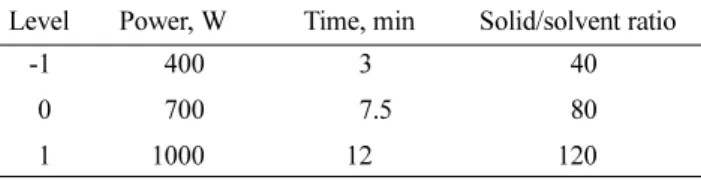
(2) 76. Passiora incarnata and Passiora caerulea.16-17 The extraction of plant material had been the ancient processing technique to get biological effects from them. Further, the extraction has also been the main factor that effects the isolation of the bioactive compounds from the crude drug. The extraction method used in common includes the classical soxhlet extraction, room temperature extraction, decoction and the novel methods of extraction like microwave assisted extraction, ultrasound assisted extraction, supercritical fluid extraction etc.18-25 The novel methods of extraction have advantages over the classical methods of extractions in terms of the extraction efficiency, extraction time, solvent consumption, higher percentage yield of marker compounds etc. The microwave assisted extraction technique has recently gained importance due to its thermal effects which enables it to get more penetrated inside the plant cells and cause better extraction.26-28 Several researchers including our team have reported the extraction and estimation of different bioactive plant material using microwave assisted extraction technique.29-32 Free radicals have recently gained attention of many researchers due to its major effects on different body parts. The free radicals present in our body may oxidize the biomolecules present in different sites of our body and may lead to various complications like cardiac problems, cancer, arteriosclerosis, skin irritations, inflammatory disorders etc.33-35 The antioxidant compounds may cause the deactivation of the free radicals present and inhibits the effect by donation of hydrogen.36-37 The synthetic antioxidants butylated hydroxyanisole (BHA) and butylated hydroxytoluene (BHT) have been used in food products to prevent the oxidation of lipids while the chemical antioxidants in use have also been reported to cause toxic and carcinogenic effects in the body.38-39 Hence, the need of better antioxidants fostered the researchers to search them from natural sources so that the minimal side effects shall be there. Due to this the bioactive markers obtained from different plant materials which are responsible for the antioxidant effects have been on target. The bioactive markers viz. lycopene from tomato fruit,40 polyphenols from different plants etc. have been reported for their antioxidant effects in the literature.41 Terminalia arjuna plant has been associated with various biological activities viz. cardiotonic, antiulcer, antidiabetic, hypolipidemic, anti-inflammatory, wound healing, antioxidant and immunomodulatory etc.42-45 The antioxidant effect of Terminalia arjuna has been associated with the phenolic constituents of the plant46 and among them the arjunic acid and the arjunolic acid have been reported for major antioxidant effect.47-50 Hence, the authors have. Natural Product Sciences. planned to explore the effect of novel extraction method, MAE to enhance the yield of the marker compounds arjunic acid and arjunolic acid in Terminalia arjuna stem bark via estimation of marker compounds with HPTLC and compared the results of antioxidant efficiency of different extracts with different yield of the marker compounds.. Experimental Materials and methods − The stem bark of Terminalia arjuna was procured from the local market in Khari Baoli, New Delhi, India. The identification of the plant material was made by CSIR-NISCAIR, New Delhi vide. Ref. No. NISCAIR/RHMD/Consult/2014/2551/130. The air dried stem bark was placed in laboratory until no weight variation was observed. The dried stem bark was powdered coarsely with help of a laboratory grinder. All the chemicals used during the study were of analytical grade, the marker compounds arjunic acid and arjunolic acid were purchased from Fluka and Sigma Aldrich respectively and were of highest purity available. Microwave assisted extraction was done on Sineo Microwave UWave1000 instrument. High Performance Thin Layer Chromatography (HPTLC) was performed on CAMAG system using WINCATS version 1.4.1. Absorbance study of free radical scavenging activity of the extracts was carried on Shimadzu double beam UV-Visible spectrophotometer. Experimental design and statistical analysis − Onface central composite design (CCD), a method of response surface methodology was used for the determination of the optimum conditions of microwave assisted extraction. JMP 12.1.0 software was used to carry out the statistical analysis and design of experiments (DOE). Based on the preliminary experiments, the power, time and solid/ solvent ratio were selected as the independent variables to carry out the extraction using microwave. The response variables to get the results were percentage yield of arjunolic acid and arjunic acid in stem bark of Terminalia arjuna for the selected conditions/parameters of experiment. The values of power, time and solid/solvent ratio were 400 W, 700 W and 1000 W; 3 min, 7 min and 12 min; 1:4, 1:8 and 1:12 respectively in microwave assisted extraction (Table 1). The temperature was kept constant at 55oC and solvent used was ethanol for all the experiments performed and the complete design consisted of 16 combinations of different selected parameters for microwave assisted extraction of stem bark of Terminalia arjuna (Table 2). HPTLC Estimation − High performance thin layer.
(3) Vol. 23, No. 2, 2017. 77. Table 1. Factors and levels for central composite design Level. Power, W. Time, min. Solid/solvent ratio. -1. 400. 53. 40. 0. 700. 57.5. 80. 1. 1000. 12. 120. Table 2. Assigned parameters for microwave assisted extraction in central composite design Power (X1). Time (X2). Solvent (X3). Batch1.. S.No.. 1000. 12. 12. Batch2.. 700. Batch3. Batch4.. 57.5. 4. 700. 57.5. 12. 400. 12. 4. Batch5.. 400. 53. 12. Batch6.. 400. 53. 4. Batch7.. 700. 53. 8. Batch8.. 700. 57.5. 8. Batch9.. 700. 12. 8. Batch10.. 1000. 53. 12. Batch11.. 1000. 12. 4. 57.5. 8. 53. 4. Batch12.. 400. Batch13.. 1000. Batch14.. 700. 57.5. Batch15.. 400. 12. Batch16.. 1000. 57.5. 8 12 8. chromatography technique (HPTLC) was used for the quantitative determination of arjunolic acid and arjunic acid in stem bark extracts of Terminalia arjuna. The precoated silica gel aluminum plate 60F254 plates were spotted with a Camag microlitre syringe having 4 µl of extract’s solution. The solution of different extracts was filtered by 0.22 µm membrane filter and was stored at 4oC. The pre-saturated CAMAG twin trough glass tank, having toluene: acetic acid: ethyl acetate (5: 5: 0.5) as mobile phase at (23 ± 2oC) and 55 ± 5% RH was used for the development of the TLC.51 The Camag TLC scanner III densitometer having deuterium as source lamp was used for scanning of dried TLC plates at an absorbance of 366 nm. The solutions of arjunolic acid and arjunic acid having concentration, 100 µg/ml in ethanol were standardized, using eight point calibration curve. The volume of 2 - 16 µl of arjunic and arjunolic acids were applied on TLC plate having corresponding concentration of 200 1600 ng respectively. The area under the peaks of the obtained chromatogram was quantitatively estimated and standard equations were derived.. Validation of design − The unique feature of DOE (design of experiments) was to derive the optimum conditions of the selected parameters to get the maximum percentage yield of marker compounds arjunic acid and arjunolic acid in the given extract. Hence, the validation of design to get optimized batch was performed on JMP Software 12.1.0. The desirability factor was maximized to get the values of selected parameters. The parameters thus obtained were checked experimentally and the results obtained were compared with the proposed percentage yield values of the software. Antioxidant evaluation using DPPH method − Free radical scavenging activity of different extracts was determined spectrophotometrically using DPPH method. The DPPH (1,1-diphenyl-2-picrylhydrazyl) is a stable radical because of the paramagnetism conferred by its odd electron present on the nitrogen atom. When the DPPH reacts with antioxidant constituents of the extracts having ability to donate hydrogen, it gets reduced. The deep violet color of DPPH bleaches to yellow due to the reduction effect, which shows a significant absorption decrease at 517 nm.52-53 Fifty milliliters of various concentrations of the extracts were dissolved in methanol and this was added to 5 ml of a 0.004% methanol solution of DPPH. After a 30 minutes reaction time in dark at room temperature, the absorbance was read against a blank at 517 nm. Free radical DPPH inhibition as a percentage (IC5o) was calculated as follows: A. –A Acontrol. control sample - × 100 %Inhibition = --------------------------------------. Where, Acontrol = Absorbance of the control reaction; Asample = Absorbance of the sample. Result and Discussion Optimization of design − The response surface plots and the contour plots obtained according to the percentage yield of arjunic acid and arjunolic acid in accordance with the values of power, time and solid/solvent ratio have been shown in Fig. 1 and 2.. The CCD design model applied was significant as P < 0.05 and R2 is 0.95 (arjunic acid) and 0.99 (arjunolic acid). The magnitudes of selected parameters involved to carry out the experiments have been represented in equations below: Y = β0 + Σ βi xi + Σ βii xi2 + Σ βij xi xj. Equation 1. Y = 0.938 + 0.215 X1 + 0.024 X2 + 0.12 X3 – 0.0063 X1X2 + 0.038 X1X3 − 0.108 X2X3 + 0.056 X12 – 0.038 X22 + 0.167 X32 + 0.011 X1X2X3 Equation 2.
(4) Natural Product Sciences. 78. Fig. 1. Response Surface Plots and Contour plots for the effect of different parameters on percentage yield of arjunic acid in Terminalia arjuna stem bark extracts.. Y = 1.233 + 0.86 X1 − 0.08 X2 + 0.43 X3 – 0.004 X1X2 + 0.003 X1X3 − 0.103 X2X3 + 0.02 X12 – 0.01 X22 + 0.005 X32 + 0.025 X1X2X3 Equation 3 The surface and contour plots for the response of percentage yield of arjunic acid suggested that the three factors power, time and solid/solvent ratio have positive individual effect however the effect of time is very less. (Equation 2) while the combination of power, time and solid/solvent ratio showed that the effect of power versus solid/solvent ratio have positive effect on percentage yield whereas the power versus time and time versus solid/ solvent ratio have negative effect on the percentage yield of arjunic acid. Hence, more the power and solid/solvent ratio more will be the percentage yield of arjunic acid while the time has no significance in enhancing the yield.
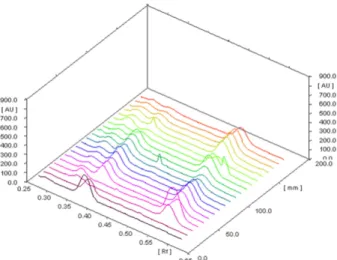
(5) Vol. 23, No. 2, 2017. 79. Fig. 2. Response Surface Plots and Contour plots for the effect of selected parameters on percentage yield of arjunolic acid in Terminalia arjuna stem bark extracts.. of marker compound. Similar, results for the marker arjunolic acid were observed as the percentage yield of arjunolic acid also enhanced with the increase in value of power and solid/solvent ratio while the effect of time is negligible (Equation 3). HPTLC Analysis − The HPTLC analysis of stem bark. extract of Terminalia arjuna was done for the quantitative estimation of arjunic acid and arjunolic acid in the different extract solutions obtained. The standard equations for the different concentrations of arjunic acid and arjunolic acid were obtained from the plot of area under peaks versus the concentration of corresponding acid.
(6) 80. Fig. 3. Standard peak of Arjunic Acid.. Natural Product Sciences. Fig. 6. Area under the peak diagram of different concentrations of standard arjunolic acid and arjunic acid.. Fig. 4. Standard peak of Arjunolic Acid. Fig. 7. Area under the peak diagram of different extracts obtained for the marker estimation.. Fig. 5. HPTLC chromatogram for different concentrations of standard arjunic acid and arjunolic acid at 366 nm.. (Equation 4 and 5). The HPTLC peak of the standard marker compounds arjunic acid and arjunolic acid at 366 nm have been shown in Fig. 3 and 4.. The HPTLC chromatograms of the different concentrations of arjunic acid and arjunolic acid have been shown in Fig. 5. at 366 nm. The area under the peaks obtained via densitometric method for the different concentrations of marker compounds has been shown in Fig. 6.. The area under the. Fig. 8. Percentage yield of marker compounds obtained through HPTLC.. peak diagram for all the experimental batches corresponding to the quantity of arjunic acid and arjunolic acid has been shown on Fig. 7. and Fig. 8. y = 0.188x − 310.5 (R2 = 0.963). Equation 4. y = 0.207x − 457.4 (R2 = 0.981). Equation 5.
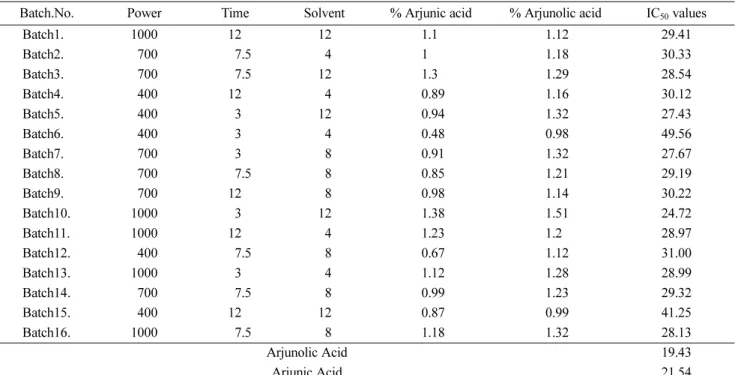
(7) Vol. 23, No. 2, 2017. 81. Table 3. Percentage yield of marker compounds arjunic acid and arjunolic acid, the IC50 value of different batches using DPPH method Batch.No.. Power. Time. Batch1. Batch2. Batch3. Batch4. Batch5. Batch6. Batch7. Batch8. Batch9. Batch10. Batch11. Batch12. Batch13. Batch14. Batch15. Batch16.. 1000 700 700 400 400 400 700 700 700 1000 1000 400 1000 700 400 1000. 12 57.5 57.5 12 53 53 53 57.5 12 53 12 57.5 53 57.5 12 57.5. Solvent. 12 4 12 4 12 4 8 8 8 12 4 8 4 8 12 8 Arjunolic Acid Arjunic Acid Ascorbic Acid (Standard). Fig. 9. IC50 values of the test batches, the marker compounds and standard ascorbic acid.. Validation of design − The validation of central composite design applied to carry out the microwave assisted extraction effectively was validated using the JMP software by generation of output grid table. The combination of three parameters viz. power, time and solid/solvent ratio suggested for percentage yield of arjunic acid were 1000 W power, 3 minutes time and 1:120 ratio of solid: solvent to get the percentage yield of 1.42%. The suggested parameters were tested for the validation of results and the percentage yield was found to be 1.38 % which confirms the validation of design to get maximum optimized yield. The combination of three parameters viz. power, time and solid/solvent ratio suggested for percentage yield of arjunolic acid were 1000 W. % Arjunic acid. % Arjunolic acid. IC50 values. 1.1 1 1.3 0.89 0.94 0.48 0.91 0.85 0.98 1.38 1.23 0.67 1.12 0.99 0.87 1.18. 1.12 1.18 1.29 1.16 1.32 0.98 1.32 1.21 1.14 1.51 1.2 1.12 1.28 1.23 0.99 1.32. 29.41 30.33 28.54 30.12 27.43 49.56 27.67 29.19 30.22 24.72 28.97 31.00 28.99 29.32 41.25 28.13 19.43 21.54 29.83. power, 3 minutes time and 1:120 ratio of solid: solvent to get the percentage yield of 1.52%. The suggested parameters were tested for the validation of results and the percentage yield was found to be 1.51% which confirms the validation of design to get maximum optimized yield. Radical Scavenging Activity − The marker compounds arjunic acid and arjunolic acid as well as the microwave assisted extracts were evaluated for the free radical scavenging activity using DPPH method. The results of IC50 values obtained have been shown in Table 3. The microwave assisted extraction has variable results of IC50 among the different experimental batches probably with the change in the values of parameters (Power, time and solid/solvent ratio). The standard ascorbic acid having the IC50 value of 29.83 was used to compare the results of all given batches. The batches 1, 3, 5, 7, 8, 11, 13, 14 and 16 showed better free radical scavenging activity as compared to standard ascorbic acid, the batches 2, 4, 6, 9, 12 and 15 showed poor free radical scavenging activity. The optimized batch (10th batch), arjunic acid and arjunolic acid showed best results (IC50 values 23.38, 24.72, 21.54 and 19.43 respectively) for free radical scavenging activity as compared with the standard ascorbic acid (IC50 value 29.83). The results obtained and presented in Table 3 suggested that the yield of marker compounds arjunic acid and arjunolic acid has been the key factor for possessing of free radical scavenging activity by the.
(8) Natural Product Sciences. 82. different extracts as with the increase in the yield of marker compounds the activity also enhanced significantly. The results of the antioxidant activity of the trial batches, marker compounds and the standard ascorbic acid have been shown in Fig. 9.. Chromatography-Mass Spectroscopy), GC-MS (Gas Chromatography-Mass Spectroscopy), CCD (Central Composite Design).. Conclusion. (1) Sasidharan, S.; Chen, Y.; Saravanan, D.; Sundram, K. M.; Latha, L. Y. Afr. J. Tradit. Complement Altern. Med. 2011, 8, 1-4. (2) Rufino, M. S. M.; Alves, R. E.; de Brito, E. S.; Pérez-Jiménez, J.; Saura-Calixto, F.; Mancini-Filho, J. Food Chem. 2010, 121, 996-1002. (3) Bandaranayake, W. M. Wetl. Ecol. Manag. 2002, 10, 421-452. (4) Vlachojannis, J.; Magora, F.; Chrubasik, S. Phytother. Res. 2011, 25, 1102-1104. (5) Staba, E. J.; Chung, A. C. Phytochemistry 1981, 20, 2495-2498. (6) Aslam, J.; Mujib, A.; Nasim, S. A.; Sharma, M. P. Sci. Hortic. 2009, 119, 325-329. (7) Xie, P.; Chen, S.; Liang, Y. Z.; Wang, X.; Tian, R.; Upton, R. J. Chromatogr. A. 2006, 1112, 171-180. (8) Pozharitskaya, O. N.; Ivanova, S. A.; Shikov, A. N.; Makarov, V. G. J. Sep. Sci. 2007, 30, 1250-1254. (9) Pirisi, F. M.; Cabras, P.; Cao, C. F.; Migliorini, M.; Muggelli, M. J. Agric. Food Chem. 2000, 48, 1191-1196. (10) de la Torre-Carbot, K.; Jauregui, O.; Gimeno, E.; Castellote, A. I.; Lamuela-Raventós, R. M.; López-Sabater, M. C. J. Agric. Food Chem. 2005, 53, 4331-4340. (11) Daferera, D. J.; Ziogas, B. N.; Polissiou, M. G. J. Agric. Food Chem. 2000, 48, 2576-2581. (12) Akowuah, G. A.; Zhari, I.; Norhayati, I.; Mariam, A. J. Food Compos. Anal. 2006, 19, 118-126. (13) Mallavadhani, U. V.; Sahu, G.; Muralidhar, J. Pharm. Biol. 2002, 40, 508-511. (14) Khatoon, S.; Srivastava, M.; Rawat, A.; Mehrotra, S. JPC-J. Planar Chromatogr. Mod. TLC. 2005, 18, 364-367. (15) Kumar, A.; Lakshman, K.; Jayaveera, K. N.; Tripathi, S. M.; Satish, K. V. Jordan J. Pharm. Sci. 2010, 3, 63-68. (16) Pereira, C. A.; Yariwake, J. H.; Lanças, F. M.; Wauters, J. N.; Tits, M.; Angenot. L. Phytochem. Anal. 2004, 15, 241-248. (17) Mehta, M.; Kaur, N.; Bhutani, K. K. Phytochem. Anal. 2001, 12, 91-95. (18) Hawthorne, S. B.; Grabanski, C. B.; Martin, E.; Miller, D. J. J. Chromatogr. A. 2000, 892, 421-433. (19) De Castro, M. D. L.; Garcýa-Ayuso, L. E. Anal. Chim. Acta 1998, 369, 1-10. (20) Huddleston, J. G.; Willauer, H. D.; Swatloski, R. P.; Visser, A. E.; Rogers, R. D. Chem. Commun. 1998, 16, 1765-1766. (21) Khan, M. K.; Abert-Vian, M.; Fabiano-Tixier, A. S.; Dangles, O.; Chemat, F. Food Chem. 2010, 119, 851-858. (22) Dai, J.; Mumper, R. J. Molecules 2010, 15, 7313-7352. (23) Núñez Sellés, A. J.; Vélez Castro, H. T.; Agüero-Agüero, J.; González-González, J.; Naddeo, F.; De Simone, F.; Rastrelli, L. J. Agric. Food Chem. 2002, 50, 762-766. (24) Pourmortazavi, S. M.; Hajimirsadeghi, S. S. J. Chromatogr. A 2007, 1163, 2-24. (25) Routray, W.; Orsat, V. Food Bioprocess Technol. 2012, 5, 409-424. (26) Kaufmann, B.; Christen, P. Phytochem. Anal. 2002, 13, 105-113. (27) Lu, Y.; Ma, W.; Hu, R.; Dai, X.; Pan, Y. J. Chromatogr. A 2008, 1208, 42-46. (28) Spigno, G.; De Faveri, D. M. J. Food Eng. 2009, 93, 210-217. (29) Devgan, M.; Nanda, A.; Ansari, S. H. Pak. J. Pharm. Sci. 2013, 26, 973-976. (30) Devgun, M.; Nanda, A. R. U. N.; Ansari, S. H. Acta Pol. Pharm. 2012, 69, 475-485.. The Terminalia arjuna stem bark was extracted using microwave assisted extraction technique and the percentage yield of the marker compounds arjunic acid and arjunolic acid was quantitatively estimated using the HPTLC method of estimation. The design of experiments was applied to get the optimum yield of the marker compounds for which the central composite design was used and the suggested combination of parameters were evaluated for the free radical scavenging activity for the extracts obtained thereof. The marker compounds arjunic and arjunolic acid taken were also evaluated for their free radical scavenging effect using the DPPH method of estimation. The values of parameters for optimized batch of microwave assisted extraction as suggested by the JMP software were 1000 W (power), 3 minutes (time) and 1/ 120 (solid/solvent ratio) to get the proposed percentage yield of 1.42% and 1.52% respectively. The crossvalidation of the suggested parameters was done and the percentage yield thus obtained for arjunic acid and arjunolic acid was 1.38% and 1.51% respectively. The surface plots and the contour plots along with the quadratic equations derived for the design applied suggested that the power and solid/solvent ratio have positive effect on percentage yield of marker compounds while the effect of time is negligible. The DPPH assay of the different batches of microwave assisted extraction and marker compounds taken suggested that the marker compounds arjunic acid and the arjunolic acid were responsible for the free radical scavenging activity as the batch having the maximum percentage yield of the marker compounds showed best free radical scavenging effect as compared to standard ascorbic acid. The IC50 value of the optimized batch was found to be 24.72 while that of the ascorbic acid was 29.83. Hence, the yield of arjunic acid and arjunolic acid has direct correlation with the free radical scavenging activity of stem bark extract of Terminalia arjuna and shall serve as active lead molecules for future research in free radical scavenger search studies. List of Abbreviations MAE (Microwave Assisted Extraction), HPTLC (High Performance Thin Layer Chromatography), HPLC (High Performance Liquid Chromatography), LC-MS (Liquid. References.
(9) Vol. 23, No. 2, 2017 (31) Devgun, M.; Nanda, A.; Ansari, S. H; Swamy, S. K. Res. J. Pharm. Technol. 2010, 3, 644-649. (32) Valko, M.; Jomova, K.; Rhodes, C. J.; Kuèa, K.; Musílek, K. Arch. Toxicol. 2016, 90, 1-37. (33) Przyklenk, K.; Kloner, R. A. Circ. Res. 1989, 64, 86-96. (34) Prasad, K.; Kalra, J. Am. Heart J. 1993, 125, 958-973. (35) Puthur, J. T. South Indian J. Biol. Sci. 2016, 2, 14-17. (36) Galano, A.; Mazzone, G.; Alvarez-Diduk, R.; Marino, T.; AlvarezIdaboy, J. R.; Russo, N. Annu. Rev. Food Sci. Technol. 2016, 7, 335-352. (37) Fang, Y.; Luo, Y.; Yu, P. J. Renew. Sust. Energ. 2016, 8, 033103. (38) Choi, S.; Kim, J. M.; Shin, G. H.; Jung, T. D.; Oh, J. W.; Choi, S. H.; Cho, B. Y.; Lee, J. H.; Lee, O. H. FASEB J. 2016, 30, 1174-1175. (39) Martinez-Valverde, I.; Perago, M. J.; Provan, G.; Chesson, A. J. Sci. Food Agr. 2002, 82, 323-330. (40) Duthie, G. G.; Duthie, S. J.; Kyle, J. A. Nut. Res. Rev. 2000, 13, 79106. (41) Halder, S.; Bharal, N.; Mediratta, P. K.; Kaur, I.; Sharma, K. K. Indian. J. Exp. Biol. 2009, 47, 577-583. (42) Chaudhari, M. Mengi, S. Phytother. Res., 2006, 20, 799-805. (43) Chatha, S. A. S.; Hussain, A. I.; Asad, R.; Majeed, M.; Aslam, N. J. Food Process Technol. 2014, 5, 298. (44) Bachaya, H. A.; Iqbal, Z.; Khan, M. N.; Jabbar, A.; Gilani, A. H.; Din, I. U. Int. J. Agric. Biol. 2009, 11, 273-278.. 83 (45) Sultana, B.; Anwar, F.; Przybylski, R. Food Chem. 2007, 104, 1106-1114. (46) Manna, P.; Sinha, M.; Sil, P. C. Arch. Toxicol. 2008, 82, 137-149. (47) Elsherbiny, N. M.; Eladl, M. A.; Al-Gayyar, M. M. H. Cytokine. 2016, 77, 26-34. (48) Sumitra, M.; Manikandan, P.; Kumar, D. A.; Arutselvan, N.; Balakrishna, K.; Manohar, B. M.; Puvanakrishnan, R. Mol. Cell. Biochem. 2001, 224, 135-142. (49) Sun, F. Y.; Chen, X. P.; Wang, J. H.; Qin, H. L.; Yang, S. R.; Du, G. H. Am. J. Chin. Med. 2008, 36, 197-207. (50) Pharmacopoeia of India. Herbs and Herbal Monographs: Indian Pharmacopoeial Commission; Ministry of Health and Family Welfare: India, 2010, pp 8-9. (51) Bondet, V.; Brand-Williams, W.; Berset, C. LWT-Food Sci. Tech. 1997, 30, 609-615. (52) Novilla, A.; Nawawi, A.; Sugihartina, G.; Widowati, W. Cukurova Med. J. 2014, 39, 224-233.. Received September 22, 2016 Revised November 8, 2016 Accepted November 18, 2016.
(10)
수치
관련 문서
Before identifying the anthocyanins of berries, experiments were conducted using different extracts, under 0.2% HCl-methanol extraction conditions, and as a
The proposal of the cell theory as the birth of contemporary cell biology Microscopic studies of plant tissues by Schleiden and of animal tissues by Microscopic studies of
웹 표준을 지원하는 플랫폼에서 큰 수정없이 실행 가능함 패키징을 통해 다양한 기기를 위한 앱을 작성할 수 있음 네이티브 앱과
_____ culture appears to be attractive (도시의) to the
이하선의 실질 속에서 하악경의 후내측에서 나와 하악지의 내측면을 따라 앞으로 간다. (귀밑샘 부위에서 갈라져 나와
It considers the energy use of the different components that are involved in the distribution and viewing of video content: data centres and content delivery networks
After first field tests, we expect electric passenger drones or eVTOL aircraft (short for electric vertical take-off and landing) to start providing commercial mobility
1 John Owen, Justification by Faith Alone, in The Works of John Owen, ed. John Bolt, trans. Scott Clark, "Do This and Live: Christ's Active Obedience as the
