• 검색 결과가 없습니다.

2-(4-Hydroxyphenyl)-5-(3-Hydroxypropenyl)-7-Methoxybenzofuran, a Novel Ailanthoidol Derivative, Exerts Anti-Inflammatory Effect through Downregulation of Mitogen-Activated Protein Kinase in Lipopolysaccharide-Treated RAW 264.7 Cells

N/A
N/A
Protected

Academic year: 2022

Share "2-(4-Hydroxyphenyl)-5-(3-Hydroxypropenyl)-7-Methoxybenzofuran, a Novel Ailanthoidol Derivative, Exerts Anti-Inflammatory Effect through Downregulation of Mitogen-Activated Protein Kinase in Lipopolysaccharide-Treated RAW 264.7 Cells"

Copied!
6
0
0

로드 중.... (전체 텍스트 보기)

전체 글

(1)

217 http://dx.doi.org/10.4196/kjpp.2013.17.3.217

ABBREVIATIONS: AP-1, activator protein-1; COX-2, cyclooxygenase- 2; ERK, extracellular signal-related kinase; GAPDH, glyceraldehyde 3-phosphate dehydrogenase; IL-1β, interleukin-1β; IL-6, interleu- kin-6; iNOS, nitric oxide synthase; JNK, C-jun N-terminal kinase;

LPS, lipopolysacharide; TLR-4, Toll-like receptor-4; MAPK, mitogen- activated protein kinase; NF-κB, nuclear factor-kappa B; NO, nitric oxide; PARP, poly ADP-ribose polymerase.

Received March 5, 2013, Revised April 17, 2013, Accepted May 2, 2013

Corresponding to: Jin-Kyung Kim, Department of Biomedical Science, College of Natural Science, Catholic University of Daegu, 330 Geumrak-ri, Gyeoungsan 700-712, Korea. (Tel) 82-53-850-3774, (Fax) 82-53-850-3774, (E-mail) [email protected]

This is an Open Access article distributed under the terms of the Creative Commons Attribution Non-Commercial License (http://

creativecommons.org/licenses/by-nc/3.0) which permits unrestricted non-commercial use, distribution, and reproduction in any medium, provided the original work is properly cited.

2-(4-Hydroxyphenyl)-5-(3-Hydroxypropenyl)-7-Methoxybenzofuran, a Novel Ailanthoidol Derivative, Exerts Anti-Inflammatory Effect through Downregulation of Mitogen-Activated Protein Kinase in Lipopolysaccharide-Treated RAW 264.7 Cells

Hyeon Jin Kim

1

, Jong-Gab Jun

2

, and Jin-Kyung Kim

1

1

Department of Biomedical Science, College of Natural Science, Catholic University of Daegu, Gyeongsan 700-712,

2

Department of Chemistry and Institute of Natural Medicine, Hallym University, Chuncheon 200-702, Korea

W e reported that ailanthoidol, a neolignan from Zanthoxylum ailanthoides and Salvia miltiorrhiza Bunge, inhibited inflammatory reactions by macrophages and protected mice from endotoxin shock.

W e examined the anti-inflammatory activity of six synthetic ailanthoidol derivatives (compounds 1-6).

Among them, compound 4, 2-(4-hydroxyphenyl)-5-(3-hydroxypropenyl)-7-methoxybenzofuran, had the lowest IC

50

value concerning nitric oxide (NO) release from lipopolysaccharide (LPS)-stimulated RAW 264.7 cells. Compound 4 suppressed the generation of prostaglandin (PG) E

2

and the expression of inducible NO synthase and cyclooxygenase (COX)-2 induced by LPS, and inhibited the release of LPS-induced pro-inflammatory cytokines from RAW 264.7 cells. The underlying mechanism of com- pound 4 on anti-inflammatory action was correlated with the down-regulation of mitogen-activated protein kinase and activator protein-1 activation. Compound 4 is potentially an effective functional chemical candidate for the prevention of inflammatory diseases.

Key Words: Ailanthoidol derivatives, AP-1, Cytokines, Inflammation, Macrophage

INTRODUCTION

Developing anti-inflammatory agents from natural or synthetic products is prudent because the inflammatory re- sponse is involved in various conditions including cancer, obesity, aging, atherosclerosis and neurodegeneration [1,2].

An uncontrolled and prolonged inflammatory reaction may underlie the pathogenesis of chronic diseases [1]. We re- cently reported the prowess of ailanthoidol, a benzofur- an-type neolignan containing alcoholic and phenolic hy- droxyl groups, in curtailing various inflammatory reactions in vitro and in vivo [3]. Ailanthoidol also exhibits several pharmacological effects that include inhibition of tumor promotion induced by 12-O-tetradecanoyl-phorbol-13-ace- tate [4], and prohibiting copper ion-mediated oxidation of low-density lipoprotein [5] and antimicrobial activity [6].

Various organic synthesis methods of ailanthoidol have been reported [3,7,8].

Inflammation is a protective effort by an organism to

eradicate injurious stimuli and initiate healing. An inflam-

matory reaction directs immune system components to the

site of injury or infection, and is manifest by increased

blood supply and vascular permeability, which allows che-

motactic peptides, neutrophils and mononuclear cells to

leave the intravascular compartment [9]. Various infecting

agents, such as bacteria and pro-inflammatory cytokines,

can activate macrophages, which are critical immune cells

to regulate innate immunity, through certain receptors

[10]. The interaction of Toll-like receptor (TLR)-4 with the

ligand, lipopolysaccharide (LPS), induces an intracellular

signaling cascade that activates the mitogen-activated pro-

tein kinase (MAPK) family, extracellular signal-related kin-

ase (ERK), p38, C-jun N-terminal kinase (JNK) and adap-

tor molecules, and ends in the activation of key pro-in-

flammatory transcription factors, such as activator protein

(AP)-1 and nuclear factor-kappa B (NF-κB) [10,11]. Even-

tually, these signaling events lead to the transcriptional ac-

tivation of macrophages and subsequent expression of

pro-inflammatory genes including inducible nitric oxide

synthase (iNOS), cyclooxygenase (COX)-2 and various cyto-

(2)

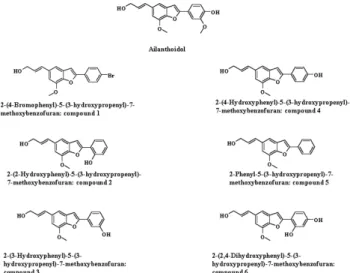
Fig. 1. Chemical structure of ailanthoidol and its derivatives, compounds 1-6.

kines [10-12].

During our on-going screening program designed to iden- tify the anti-inflammatory potential of natural and syn- thetic compounds, we have prepared several ailanthoidol derivatives (compounds 1∼6). Our previous report demon- strated that ailanthoidol has anti-inflammatory activities due to the inhibition of iNOS and COX-2 expression and impairment of the release of various inflammatory cyto- kines [3]. To evaluate whether ailanthoidol derivatives reg- ulate the inflammatory response, we presently investigated the anti-inflammatory effects of these derivatives using LPS-induced inflammatory responses.

METHODS Chemicals and reagents

Ailanthoidol and its derivatives (Fig. 1) were synthesized using Sonogashira coupling, iodine induced cyclization and Wittig reaction as previously reported [13]. LPS derived from Escherichia coli, dimethylsulfoxide (DMSO) and anti- β-actin antibody were obtained from Sigma-Aldrich (St Louis, MO, USA). Dulbecco’s modified Eagle’s medium (DMEM), fetal bovine serum (FBS), penicillin and strepto- mycin were obtained from Hyclone (Logan, UT, USA). Cell Titer 96 Aqueous One Solution and Griess reagent system were purchased from Promega (Madison, MI, USA). Prosta- glandin (PG) E

2

enzyme-linked immunosorbent assay (ELISA) kits were obtained from ENZO Life Sciences (Far- mingdale, NY, USA). Interleukin (IL)-1β and IL-6 ELISA kits were purchased from eBioscience (San Diego, CA, USA). Anti-iNOS, anti-COX-2, anti-inhibitor of NF-κB (IκB- α), anti-phospho-ERK1/2, anti-ERK1/2, anti-phospho-JNK, anti-JNK, anti-phospho-p38, anti-p38, anti-phospho- c-Jun, anti-c-Jun and anti-poly ADP-ribose polymerase (PARP) antibody were obtained from Cell Signaling Technology (Danvers, MA, USA).

Cell culture and cell viability assay

RAW264.7 murine macrophages obtained from the Korean

Cell Bank (Seoul, Korea) were cultured in DMEM contain- ing 10% FBS, 100 U/ml penicillin and 100 μg/ml strepto- mycin at 37ºC in 5% CO

2

. The effects of various ailanthoidol derivatives on cell viability were tested using the CellTiter 96

AQ

ueous

One Solution Assay of cell proliferation.

RAW264.7 cells were plated at a density of 2×10

4

cells in a 96-well flat-bottom plate and ailanthoidol derivatives were added to each plate at the indicated concentrations.

After a 24 h incubation period, the number of viable cells was counted according to the manufacturer's instructions.

The optical densities at 490 nm were measured using a mi- croplate reader (Tecan, San Jose, CA, USA).

Measurement of nitrite, PGE

2

and cytokines

The amount of nitrite, PGE

2

, IL-1β and IL-6 produced by mouse macrophages was measured in RAW264.7 cell culture supernatant. RAW264.7 cells were plated at a den- sity of 2.5×10

5

cells in a 48-well cell culture plate with 500 μl of culture medium and incubated for 12 h. They were then treated with indicated concentrations of ailanthoidol derivatives plus LPS (100 ng/ml) and incubated for another 24 h. The amount of nitrite was measured using the Griess reagent system according to the manufacturer’s instruc- tions. PGE

2

, IL-1β and IL-6 were measured using ELISA according to the manufacturer’s instructions.

Quantitative real-time reverse-transcription polyme- rase chain reaction (qRT-PCR)

Total RNA was isolated from RAW264.7 cells using Trizol Reagent (Invitrogen, Carlsbad, CA, USA). DNA was elimi- nated from total RNA using RNA Qualified RNase-Free DNase (Promega) and cDNA was synthesized by GoScript

TM

Reverse Transcription System (Promega). qRT-PCR assay was carried out with LightCycler (Roche Diagnostics, Basel, Switzerland) using LightCycler FastStart DNA Master SYBR Green I (Roche Diagnostics). All the experiments were repeated twice and in triplicate each time. Transcripts of glyceraldehyde 3-phosphate dehydrogenase (GAPDH), as a housekeeping gene, were quantified as endogenous RNA of reference to normalize each sample. Relative quantities were estimated by the delta-delta-Ct method. The results were normalized as relative expression in which the aver- age value of the iNOS, COX-2, IL-1β and IL-6 mRNA was divided by the average value of GAPDH mRNA. The primer used in this study were murine iNOS: F 5’-CCT CCT CCA CCC TAC CAA GT-3’, R 5’-CAC CCA AAG TGC TTC AGT CA-3’; murine COX-2: F 5’-AAG ACT TGC CAG GCT GAA CT-3’, R 5’-CTT CTG CAG TCC AGG TTC AA-3’; murine IL-1β: F 5’-TTC TCC ACA GCC ACA ATG AG-3’, R 5’-ACG GAC CCC AAA AGA TGA AG-3; murine IL-6: F 5’-CAT CCA GTT GCC TTC TTG GGA-3’, R 5’-CCA GTT TGG TAG CAT CCA TC-3’; GAPDH: F 5’-TCT TGC TCA GTG TCC TTG C-3’, R 5’-CTT TGT CAA GCT CAT TTC CTG G-3’.

Western blotting analysis

Whole cell lysates and nuclear protein were extracted us-

ing PRO-PREP Protein Extraction Solution (iNtRON Bio-

technology, Seongnam-Si, Korea) and a Nuclear extraction

kit (Millipore, Billerica, MA, USA) according to the manu-

facturer’s instructions. Whole cell lysates and nuclear pro-

tein (30 μg protein/lane) were separated by 10% sodium

dodecyl sulfate-polyacrylamide gel electrophoresis (SDS-

(3)

Compound % Inhibition at various concentration (μmol/l) IC

50

(μmol/l)

0 1 5 10 20 50

Ailanthoidol 0±0.4 0±0.8 49.8±1.2 67.1±1.5 82.2±1.6 95.1±1.2 5.08

2-(4-Bromophenyl)-5-(3-hydroxypropenyl)-7-

methoxybenzofuran: Compound 1 0±0.4 1.3±1.6 10.3±2.1 22.9±0.8 39.5±1.7 63.4±0.9 24.4 2-(4-Chlorophenyl)-5-(3-hydroxypropenyl)-7-

methoxybenzofuran: Compound 2 0±0.4 2.8±0.8 6.8±1.4 23.6±2.8 47.8±0.4 95.4±2.6 31.9 2-(4-Iodophenyl)-5-(3-hydroxypropenyl)-7-

methoxybenzofuran: Compound 3 0±0.4 0±2.1 2.3±2.8 4.1±2.1 15.8±3.7 41.3±2.0 35.4 2-(4-Hydroxyphenyl)-5-(3-hydroxypropenyl)-7-

methoxybenzofuran: Compound 4 0±0.4 6.4±0.3 53.5±1.5 76.7±0.4 90.8±0.3 95.3±0.6 4.38 2-Phenyl-5-(3-hydroxypropenyl)-7-methoxybenzofuran:

Compound 5 0±0.4 0±0.8 10.8±0.9 20.8±0.6 58.7±0.9 82.2±0.8 15.2

2-(2,4-Dihydroxyphenyl)-5-(3-hydroxypropenyl)-7-

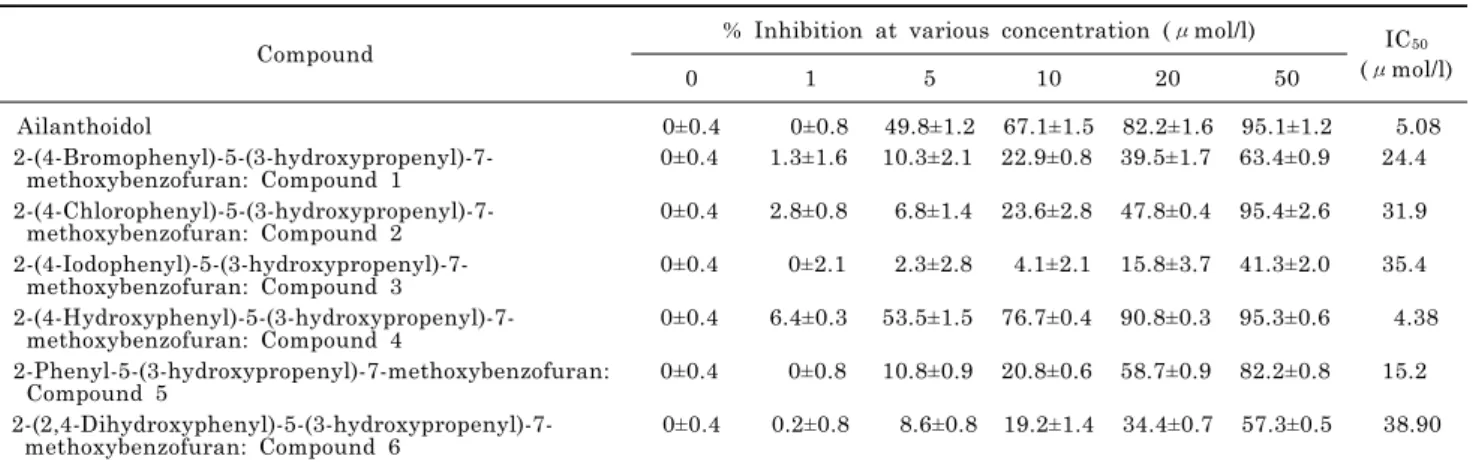
methoxybenzofuran: Compound 6 0±0.4 0.2±0.8 8.6±0.8 19.2±1.4 34.4±0.7 57.3±0.5 38.90 RAW264.7 cells were cultured with 0∼50 μM compounds in the presence or absence of LPS (100 ng/ml) for 24 h and NO was quantified as indicated in Materials and Methods. Results are expressed as mean±SEM from three independent experiments.

Table 1. The IC

50

value of ailanthoidol derivatives, compound 1∼6 on NO release in LPS-stimulated RAW264.7 cells

Fig. 2. Effects of compound 4 on murine macrophage viability.

RAW264.7 cells were treated with indicated concentrations of compound 4 for 24 h, and proliferation was determined. The results are reported as mean±SEM of three independent experiments in triplicate.

PAGE). The separated proteins were electrophoretically transferred onto nitrocellulose membranes. Immunoreac- tive bands were detected by incubating the samples with horseradish peroxidase (HRP)-conjugated secondary anti- bodies and visualized using a WEST-ZOL plus Western Blot Detection System (iNtRON Biotechnology) and Davinch- Chemi CAS-400SM Western Imaging System (Davinch-K, Seoul, Korea). The density of bands was assessed by Total Lab software (Davinch-K).

Statistical analysis

The data are depicted as the mean±SEM. The values were evaluated by one-way analysis of variance (ANOVA) with Bonferroni multiple comparison post tests using the GraphPad Prism 4.0 software (GraphPad Software Inc., San Diego, CA). A p-value<0.05 was considered to be stat- istically significant.

RESULTS Compound screening

To examine the potential anti-inflammatory activity of the ailanthoidol derivatives, we used murine macrophage RAW264.7 cells, which are an established excellent model for anti-inflammatory drug screening. We first assayed the ability of the ailanthoidol derivatives, compounds 1∼6 (Fig.

1), to decrease NO release after LPS stimulation because LPS induces iNOS and then NO release. RAW264.7 cells were incubated with LPS and a range of concentrations (1∼

50 μM) of ailanthoidol derivatives for 24 h. Then, culture media were harvested and nitrite levels were measured. All derivatives were able to inhibit NO production. Compound 4 was most potent, with an IC

50

of 4.38 μM (Table 1).

Compound 4 inhibits NO and PGE

2

release

Since compound 4 displayed the lowest IC

50

on the in- hibition of NO release, this compound was selected for fur- ther investigation. To rule out that the inhibitory effect on NO release was due to cytotoxicity, cell viability was

analyzed. Compound 4 displayed no toxic effects at concen- trations of 10 μM (Fig. 2). We used up to 10 μM compound 4 for the remaining experiments.

The next experiment determined the effect of compound 4 on the LPS-induced release of the inflammatory media- tors, NO and PGE

2

, by RAW264.7 cells. As shown in Fig.

3A and 3B, compound 4 inhibited LPS-induced NO and PGE

2

production in a dose-dependent manner. The nitrite concentration in LPS-stimulated cells and in those exposed to 10 μM compound 4 was 42.5±1.8 μM and 9.9±0.2 μM, respectively. The inhibitory effects of compound 4 on PGE

2

production in LPS-exposed cells were similar to their effects on NO production (Fig. 3B). The PGE

2

concentration in LPS-stimulated cells and in those exposed to 10 μM com- pound 4 was 1.85±0.16 ng/ml and 0.19±0.04 ng/ml, res- pectively.

To determine the mechanism by which compound 4 re-

duced LPS-induced NO and PGE

2

production, the effect of

compound 4 on iNOS and COX-2 protein expression in

RAW264.7 cells was studied using Western blot analysis,

since those enzymes catalyze the reaction for NO and PGE

2

,

respectively. Consistent with the findings related to NO

and PGE

2

releases, the protein expression of iNOS and

COX-2 induced by LPS in RAW264.7 cells were also re-

duced by compound 4 treatment (Fig. 3C and 3D).

(4)

Fig. 4. Effects of compound 4 on LPS-induced inflammatory cytokine production in murine macrophages. RAW264.7 cells were treated with 0∼10 μM of compound 4 in the presence of 100 ng/ml LPS or with LPS alone for 24 h. The cell culture media were then collected, and the amount of (A) IL-1β and (B) IL-6 released was measured. The results are reported as mean±SEM of three independent experiments in triplicate. Statistical significance is based on the difference when compared with LPS-stimulated cells (**p<0.01, ***p<0.001).

Fig. 3. Effects of compound 4 on LPS-induced NO and PGE

2

release.

RAW264.7 cells were treated with 0∼10 μM of compound in the presence of 100 ng/ml of LPS or with LPS alone for 24 h, and (A) NO and (B) PGE

2

release was determined. The results are reported as mean±SEM of three independent experiments in triplicate.

Statistical significance is based on the difference when compared with LPS-stimulated cells (**p<0.01, ***p<0.001). Thirty micro- grams of protein obtained from each cell lysate was resolved by 10% SDS-PAGE for (C) iNOS and (D) COX-2 determination. β- actin expression is shown as a loading control. The bands were quantified using image analysis software and their relative intensity was expressed as fold against the image of the LPS- stimulated RAW264.7 cells.

mRNA iNOS COX-2

(relative expression) IL-1β IL-6

Vehicle ND ND ND ND

LPS 1.00±0.00 1.00±0.00 1.00±0.00 1.00±0.00

LPS+1 μM 0.51±0.25 0.18±0.03*** 0.14±0.12*** 0.65±0.37

LPS+5 μM 0.37±0.21* 0.15±0.05*** 0.13±0.13*** 0.27±0.11***

LPS+10 μM 0.21±0.11** 0.12±0.01*** 0.10±0.09*** 0.04±0.05***

RAW264.7 cells were cultured with 0∼10 μM compound 4 in the presence or absence of LPS (100 ng/ml) for 6 h and gene expression was quantified by real-time RT-PCR as indicated in Materials and Methods. Statistical significance is based on the difference when compared with LPS-Stimulated cells (*p<0.05, **p<0.01, ***p<0.001).

ND, not detected.

Table 2. Effects of compound 4 on LPS-induced mRNA expression of iNOS, COX-2, IL-1β and IL-6 in RAW264.7 cells Compound 4 blocks the release of pro-inflammatory

cytokines

We next examined if compound 4 reduced the release of pro-inflammatory cytokines in LPS-stimulated RAW264.7 cells. Although the concentrations of IL-1β and IL-6 were not detected in vehicle-treated RAW264.7 cells, LPS treat- ment elevated the levels of IL-1β (55.26±3.90 pg/ml) and IL-6 (3.05±0.14 ng/ml) in LPS-treated RAW264.7 cells.

Compound 4 induced marked suppression of the increases induced by LPS in these cytokines (Fig. 4). LPS-treated RAW264.7 cells exposed to compound 4 at concentrations of 1, 5 and 10 μM displayed a dose-dependent inhibited production of IL-1β (13.2±8.6%, 27.3±16.1% and 51.5±

12.5%, respectively) and IL-6 production (0%, 58.4±6.0%

and 83.8±1.6%, respectively). These results indicate that compound 4 suppressed various inflammatory mediators

including NO and PGE

2

, as well as pro-inflammatory cyto- kines, such as IL-1β and IL-6.

Compound 4 suppresses the mRNA expression of iNOS, COX-2, IL-1 β and IL-6

Since compound 4 suppressed the protein levels of iNOS, COX-2 and pro-inflammatory cytokines in LPS-stimulated RAW264.7 cells, qRT-PCR was used to assess the effects of compound 4 on LPS-induced gene expression of iNOS, COX-2, IL-1β and IL-6 in RAW264.7 cells. Upon LPS treat- ment, the mRNA expressions of these four genes were markedly augmented. The concentration response for in- hibition of iNOS, COX-2, IL-1β and IL-6 mRNA ex- pressions is shown in Table 2. The effect of compound 4 on mRNA expression of iNOS and COX-2, as well as IL-1β and IL-6, was coincident with protein expression and secre- tion in supernatants.

Compound 4-reduced inflammatory mediator release is regulated by MAPK and AP-1

To ascertain the effect of compound 4 on the pathways

involved in regulating the expressions of iNOS, COX-2 and

pro-inflammatory cytokines, degradation of IκB-α, an im-

portant biochemical event for the nuclear translocation of

NF-κB, and phosphorylation of MAPK molecules were ana-

lyzed by Western blotting. Phosphorylation of JNK was in-

(5)

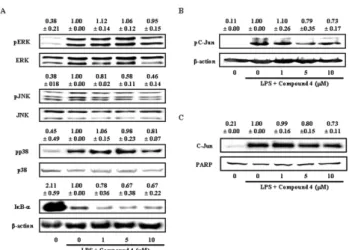
Fig. 5. Effect of compound 4 on LPS-induced MAPK and AP-1 activation. RAW264.7 cells were plated in 100 mm-diameter dishes.

After 12 h of seeding, cells were treated with different doses of compound 4 for 1 h, followed by stimulation with 500 ng/ml of LPS for 30 min. Cell lysates (30 μg protein) were prepared and sub- jected to Western blot analysis by using antibodies specific for (A) IκB-α, phosphorylated forms of ERK1/2, JNK, p38 MAPK and (B) phosphorylated forms of c-Jun. Equivalent loading of cell lysates was determined by reprobing the blots with anti-β-actin, total ERK1/2, JNK or p38 MAPK antibody. (C) Nuclear protein (30 μg protein) was prepared and subjected to Western blot analysis by using antibodies specific for c-Jun and equivalent loading of nuclear protein was determined by reprobing the blots with anti-PARP. The bands were quantified using image analysis software and their relative intensity was expressed as fold against the image of the LPS-stimulated RAW264.7 cells.

hibited by compound 4 treatment, where inhibitory action was dose-dependent on JNK phosphorylation (Fig. 5A).

However, the effect of compound 4 on the phosphorylation of ERK and p38 was not significant. In addition, as shown in Fig. 4A, compound 4 had no effect of the degradation of IκB-α induced by LPS stimulation. These results in- dicate that compound 4 mediated inhibition of pro-in- flammatory mediators and cytokines probably occurred via inhibition of JNK signal transduction pathways.

One of the functions of the JNK is the post-translational regulation of AP-1 transcription factors. AP-1 is a dimeric transcription factor composed of proteins with basic leucine zipper domains needed for dimer formation and DNA bind- ing [14]. The major subfamilies that form AP-1 are Jun and Fos. Since the Jun family is activated through the phos- phorylation by JNKs, we examined the phosphorylation and nuclear translocation of c-Jun after treatment with compound 4. As shown in Fig. 5B and 5C, compound 4 in- hibited the phosphorylation and nuclear translocation of c-Jun induced by LPS stimulation. These results indicate that compound 4 reduced the expression of various in- flammatory mediators via inhibition of MAPK (JNK) and AP-1 (c-Jun).

DISCUSSION

Since inflammatory reactions cause various diseases, the discovery of effective and economical new drugs that will control inflammation is important [15]. The discovery of new drugs from natural products including plants and ma-

rine products has become a focus of research [2,16-18].

Despite these efforts, several limitations still exist. For ex- ample, the active components extracted from natural sour- ces are present in low quantity and their extraction can be complex. To overcome these problems, the use of syn- thetically manufactured compounds has been explored, based on information gained from active compounds iso- lated from natural products [13,19-21]. Ailanthoidol is a bi- oactive component isolated from Zanthoxylum ailanthoides and Salvia miltiorrhiza Bunge [2,13]. Our and other groups developed effective and simple methods to synthesis ailan- thoidol [7,8,13], in light of the demonstrations that ailan- thoidol has estrogenic [22], antitumor [4] and anti-inflam- matory actions [3]. In addition, we constructed several ai- lanthoidol derivatives to investigate various pharmaco- logical functions [13].

In the present study, we evaluated the anti-inflammatory activities of six ailanthoidol derivatives, compounds 1-6.

Among these derivatives, compound 4 significantly in- hibited NO release from RAW264.7 cells. Compound 4 also markedly inhibited LPS-induced production of NO and PGE

2

through the down-regulation of expression of COX-2 and iNOS in macrophages, respectively, suppressed the ex- pressions of IL-1β and IL-6 at the mRNA and protein lev- els in macrophages and suppressed LPS-dependent activa- tion of AP-1, but not NF-κB. The results are the first to demonstrate that compound 4 inhibits the inflammatory re- sponse in macrophages.

Our previous results showed that ailanthoidol signifi- cantly suppresses LPS-induced NF-κB activation, but not AP-1 [3]. In the same study, ailanthoidol was demonstrated capable of inhibiting the LPS-induced degradation of IκB and nuclear translocation of NF-κB. In addition, the DNA binding activity of NF-κB can be blocked by ailanthoidol in LPS-stimulated RAW264.7 cells [3]. Interestingly, com- pound 4 could not block NF-κB signaling pathway, al- though its structure is very similar to ailanthoidol. Instead of the NF-κB signaling pathway, phosphorylation of JNK as well as c-Jun was inhibited by compound 4. Although these structural analogs differ at only one position, their effect on NF-κB and AP-1 signaling are quite different.

Further studies will be needed to demonstrate the relation- ship between the structural specifications of ailanthoidol derivatives and their anti-inflammatory molecular mecha- nism.

The present results provide some preliminary but useful insights into the molecular mechanisms of compound 4.

Compound 4 did not affect the degradation of IκB-α, but suppressed the phosphorylation of JNK and c-Jun, as well as nuclear translocation of c-Jun, which were induced by LPS stimulation. To the end of the signaling generated by LPS in macrophages, the activation of transcription factors results in the production of both pro- and anti-inflam- matory mediators. The binding of LPS to TLR-4 leads to activation of transcription factor NF-κB and AP-1, which regulate innate immune responses [23]. Activation of NF-κB and AP-1 induces the expression of several inflammatory mediators such as iNOS, COX-2, IL-1β and IL-6, along with many other genes [24,25]. AP-1 is composed of pro- teins belonging to the Jun and Fos families, and c-Jun and c-Fos are immediate-early genes [14,26]. MAPK signaling pathways regulate AP-1 activity by increasing transcription and the phosphorylation of AP-1 proteins.

These results suggest that the inhibitions of NO, PGE

2

and pro-inflammatory cytokines in compound 4 treated

(6)

RAW264.7 cells are caused by the down-regulation of AP-1 transcription factors through the inhibition of the MAPK signaling pathway. A further challenge is to delineate in vivo actions of compound 4 to provide a better under- standing of the health-promoting effects of a synthetic com- pound that is widely consumed globally.

ACKNOWLEDGEMENTS

This work was supported by the National Research Foundation of Korea (NRF) grant funded by the Korea gov- ernment (MEST) (No. 2011-0028637 and No. 2010- 0004728).

REFERENCES

1. Aller MA, Arias N, Fuentes-Julian S, Blazquez-Martinez A, Argudo S, Miguel MP, Arias JL, Arias J. Coupling inflam- mation with evo-devo. Med Hypotheses. 2012;78:721-731.

2. Biasi F, Astegiano M, Maina M, Leonarduzzi G, Poli G.

Polyphenol supplementation as a complementary medicinal approach to treating inflammatory bowel disease. Curr Med Chem. 2011;18:4851-4865.

3. Kim JK, Jun JG. Ailanthoidol suppresses lipopolysaccharide- stimulated inflammatory reactions in RAW264.7 cells and endotoxin shock in mice. J Cell Biochem. 2011;112:3816-3823.

4. Lee YJ, Kao ES, Chu CY, Lin WL, Chiou YH, Tseng TH.

Inhibitory effect of ailanthoidol on 12-O-tetradecanoyl-phorbol- 13-acetate-induced tumor promotion in mouse skin. Oncol Rep.

2006;16:921-927.

5. Lee WS, Baek YI, Kim JR, Cho KH, Sok DE, Jeong TS.

Antioxidant activities of a new lignan and a neolignan from Saururus chinensis. Bioorg Med Chem Lett. 2004;14:5623- 5628.

6. Abdel-Wahab BF, Abdel-Aziz HA, Ahmed EM. Synthesis and antimicrobial evaluation of 1-(benzofuran-2-yl)-4-nitro-3- aryl- butan-1-ones and 3-(benzofuran-2-yl)-4,5-dihydro-5-aryl-1- [4- (aryl)-1,3-thiazol-2-yl]-1H-pyrazoles. Eur J Med Chem. 2009;

44:2632-2635.

7. Lin SY, Chen CL, Lee YJ. Total synthesis of ailanthoidol and precursor XH14 by Stille coupling. J Org Chem. 2003;68:

2968-2971.

8. Rao MLN, Awasthi DK, Banerjee D. An expeditious and convergent synthesis of ailanthoidol. Tetrahedron Lett. 2010;

51:1979-1981.

9. Chen GY, Nuñez G. Sterile inflammation: sensing and reacting to damage. Nat Rev Immunol. 2010;10:826-837.

10. Martinez FO, Helming L, Gordon S. Alternative activation of macrophages: an immunologic functional perspective. Annu Rev Immunol. 2009;27:451-483.

11. Natoli G, Ghisletti S, Barozzi I. The genomic landscapes of inflammation. Genes Dev. 2011;25:101-106.

12. Lee LR, Lee JJ, Kim, Jun JG. Ailanthoidol derivatives and their anti-inflammatory effects. Bull Korean Chem Soc. 2012;

33:1907-1912.

13. Chen CY, Peng WH, Tsai KD, Hsu SL. Luteolin suppresses inflammation-associated gene expression by blocking NF- kappaB and AP-1 activation pathway in mouse alveolar macrophages. Life Sci. 2007;81:1602-1614.

14. Shaulian E. AP-1--The Jun proteins: Oncogenes or tumor suppressors in disguise? Cell Signal. 2010;22:894-899.

15. Kawada N, Moriyama T, Kitamura H, Yamamoto R, Furumatsu Y, Matsui I, Takabatake Y, Nagasawa Y, Imai E, Wilcox CS, Rakugi H, Isaka Y. Towards developing new strategies to reduce the adverse side-effects of nonsteroidal anti-inflammatory drugs. Clin Exp Nephrol. 2012;16:25-29.

16. Li C, Lin G, Zuo Z. Pharmacological effects and pharmaco- kinetics properties of Radix Scutellariae and its bioactive flavones. Biopharm Drug Dispos. 2011;32:427-445.

17. Pontiki E, Hadjipavlou-Litina D, Litinas K, Nicolotti O, Carotti A. Design, synthesis and pharmacobiological evaluation of novel acrylicacid derivatives acting as lipoxygenase and cyclooxygenase-1 inhibitors with antioxidant and anti-inflam- matory activities. Eur J Med Chem. 2011;46:191-200.

18. Altavilla D, Squadrito F, Bitto A, Polito F, Burnett BP, Di Stefano V, Minutoli L. Flavocoxid, a dual inhibitor of cyclooxygenase and 5-lipoxygenase, blunts pro-inflammatory phenotype activation in endotoxin-stimulated macrophages. Br J Pharmacol. 2009;157:1410-1418.

19. Sharma N, Mohanakrishnan D, Shard A, Sharma A, Saima, Sinha AK, Sahal D. Stilbene-chalcone hybrids: design, syn- thesis, and evaluation as a new class of antimalarial scaffolds that trigger cell death through stage specific apoptosis. J Med Chem. 2012;55:297-311.

20. Karapetyan G, Chakrabarty K, Hein M, Langer P. Synthesis and bioactivity of carbohydrate derivatives of indigo, its isomers and heteroanalogues. Chem Med Chem. 2011;6:25-37.

21. Silvia V, Baldisserotto A, Scalambra E, Malisardi G, Durini E, Manfredini S. Novel molecular combination deriving from natural aminoacids and polyphenols: Design, synthesis and free-radical scavenging activities. Eur J Med Chem. 2012;50:

383-392.

22. Fokialakis N, Magiatis P, Mitaku S, Pratsinis H, Tillequin F.

Estrogenic activity of phenylpropanoids from Sarcomelicope megistophylla and structure determination of a new norneo- lignan. Planta Med. 2003;69:566-568.

23. Murray PJ, Wynn TA. Protective and pathogenic functions of macrophage subsets. Nat Rev Immunol. 2011;11:723-737.

24. Vesely PW, Staber PB, Hoefler G, Kenner L. Translational regulation mechanisms of AP-1 proteins. Mutat Res. 2009;

682:7-12.

25. Pasparakis M. Regulation of tissue homeostasis by NF-kappaB signalling: implications for inflammatory diseases. Nat Rev Immunol. 2009;9:778-788.

26. Schonthaler HB, Guinea-Viniegra J, Wagner EF. Targeting

inflammation by modulating the Jun/AP-1 pathway. Ann

Rheum Dis. 2011;70 Suppl 1:i109-112.

수치

Fig. 1. Chemical structure of ailanthoidol and its derivatives,  compounds 1-6.
Fig. 2. Effects of compound 4 on murine macrophage viability.
Table 2. Effects of compound 4 on LPS-induced mRNA expression of iNOS, COX-2, IL-1β and IL-6 in RAW264.7 cellsCompound 4 blocks the release of pro-inflammatory
Fig. 5. Effect of compound 4 on LPS-induced MAPK and AP-1  activation. RAW264.7 cells were plated in 100 mm-diameter dishes

참조

관련 문서