The Studer Orthotopic Neobladder: Long-Term (More Than 10 Years) Functional Outcomes,
Urodynamic Features, and Complications
Jong Kil Nam, Tae Nam Kim, Sung Woo Park, Sang Don Lee, and Moon Kee Chung
Department of Urology, Research Institute for Convergence of Biochemical Science and Technology, Pusan National University Yangsan Hospital, Pusan National University School of Medicine, Yangsan, Korea.
Received: May 16, 2012 Revised: August 4, 2012 Accepted: August 13, 2012
Corresponding author: Dr. Moon Kee Chung, Department of Urology, Pusan National University School of Medicine, Pusan National University Yangsan Hospital, 20 Geumo-ro, Mulgeum-eup, Yangsan 626-770, Korea.
Tel: 82-55-360-2134, Fax: 82-55-360-2931 E-mail: [email protected]
∙ The authors have no financial conflicts of interest.
© Copyright:
Yonsei University College of Medicine 2013 This is an Open Access article distributed under the terms of the Creative Commons Attribution Non- Commercial License (http://creativecommons.org/
licenses/by-nc/3.0) which permits unrestricted non- commercial use, distribution, and reproduction in any medium, provided the original work is properly cited.
Purpose: Radical cystectomy and urinary diversion are the standard treatment for invasive bladder cancer. We analyzed the long-term (>10 years postoperatively) functional outcomes, complications, and urodynamic findings in a single center se- ries of patients who underwent cystectomy and a Studer ileal neobladder substitu- tion. Materials and Methods: A retrospective chart review of 108 Studer pouches constructed during 1990 and 2011 was performed. Data were analyzed in terms of long-term (>10 years) outcomes. Complications, incontinence, voiding difficulties, upper urinary tract changes, overall satisfaction, and urodynamic findings of the reservoir were obtained. Results: We evaluated 19 out of 50 patients who had lived for over 10 years postoperatively. Another 31 patients were not traced: 7 patients died following recurrence, 15 died due to exacerbation of a comorbidity, and 9 pa- tients were lost to follow-up. Concerning complications, 6 patients had an atrophied kidney, 5 patients had moderate hydronephrosis, 5 patients had chronic recurrence of pylelonephritis, and 2 patients had voiding difficulty because of bladder neck stricture due to clean intermittent catheterization. One patient underwent an opera- tion due to intestinal obstruction. Seven patients had incontinence; all 7 patients showed intermittently at night and 2 patients even in waking hours. Maximum bladder capacity was 484.1±119.2 mL, maximum flow rate was 13.6±9.7 mL/sec, and post-void residual urine volume was 146.8±82.7 mL. Conclusion: Long-term outcomes with the Studer orthotopic ileal neobladder have an acceptable complica- tion rate and good functional results. However, potential adverse outcomes such as renal deterioration, dysfunctional voiding should also be considered.
Key Words: Urinary diversion, cystectomy, urinary bladder neoplasms
INTRODUCTION
Since 1980s, orthotopic bladder substitution using an ileal neobladder has been the treatment of choice for patients of both sexes undergoing cystectomy.1 A radical cys- tectomy is accepted by many surgeons as a proper treatment for patients with mus- cle invasive bladder cancer. It is also a suitable option for select patients with high-
cm ileal segment was isolated about 20-25 cm proximal to the ileocecal valve. About 30-35 cm of the distal ileal seg- ment is then detubularized on the amtimesenteric border, leaving the proximal 15 cm intact for later implantation of the ureters. To construct the reservoir, the adjacent detubu- lized limbs are folded into a U shape, and the back wall were oversewn. The bottom of the U was folded over between the two ends of the U, resulting in a roughly spherical shape reservoir consisting of four cross-folded ileal segments.9 The ureters were next anastomosed to the afferent tubular segment in end-to-side refluxing fashion. Eventually, then it resulted in a spherical reservoir with an initial capacity of about 100 cc.
For the first week of the postoperative period, the reser- voir was irrigated with 50 cc saline solution every 6 hours through a rubber catheter. The purpose of this procedure was to try to dissolve mucous inside the reservoir to pre- vent formation of a mucous plug, which could obstruct the reservoir. The ureteral stents were left inside for 2 weeks and were irrigated as needed. Two weeks postoperatively, a contrast study of the reservoir and intravenous pyelogram were done to evaluate for leakage, reflux, and anastomotic site stricture. If the radiographs were normal, the patient was discharged on antibacterial medications.
All patients were regularly educated on how to reduce post-void residual urine and how to increase voiding vol- ume and intervals. Initially, they were taught to empty the pouch less than 4 hours in a sitting position by relaxing the pelvic floor and increasing intra-abdominal pressure. Our patients were followed regularly every 3 months for 5 years and then at yearly intervals thereafter.
We evaluated those patients who survived more than 10 years after radical cystectomy and orthotopic bladder susb- stitution. Institutional review board approval was obtained for the study. Oncological and functional follow-up includ- ed clinical, laboratory and metabolic assessments, and im- aging procedures. The urinary tract was assessed by ultra- sound and computed tomography scans, while functional reservoir capacity, continence status, and voiding difficul- ties were assessed by voiding diaries and urodynamic study.
In addition, postvoid residual measurements were evaluated by clean intermittent catheterization or ultrasound. Indica- tions for regular clean intermittent catheterization were symptomatic postvoid residual urine exceeding 150 cc or an asymptomatic postvoid residual above 250 cc. Complete continence was defined as no involuntarily loss of urine and no pad use. Complications, incontinence, voiding difficul- risk of non-muscle-invasive bladder cancer, and is used as a
effective treatment modality for recurrent or refractory tu- mors after bladder preservation therapies.2 The final decision of urinary diversion in the individual patient is made after many considerations: it should be considered the comorbidi- ties, possibility of complete recovery, technical feasibility, expected functional outcomes, and comply with the pa- tient’s choice if possible.
The neobladder as an orthotopic bladder substitute ap- proaches the ideal urinary diversion by providing a low- pressure, easily emptied continent reservoir. Continent uri- nary diversions may be of great psychological benefit to select patients.3,4 In fact, the desire to provide patients with a near-normal state of voiding by preserving the natural continence mechanism led to the development of orthotop- ic urinary diversion.
However, they may be associated with different compli- cations. Multiple large published series and reviews have reported the surgical complications and long-term outcomes of orthotopic neobladders.5-7 Typical early postoperative complications include persistent urine leak, pyelonephritis, and bowel complications such as ileus and small bowel ob- struction.6 Late complications include ureteroenteric and neovesical-urethral anastomotic stricture, urinary fistula, urolithiasis and voiding dysfunction, and incontinence.6 However, improvements in surgical technique and modern perioperative care have substantially diminished the periop- erative complication rate.
We analyzed the functional outcomes, complications and urodynamic findings after long-term follow-up (>10 years postoperatively) in a single center series of patients who underwent radical cystectomy with Studer ileal neobladder substitution.
MATERIALS AND METHODS
A retrospective chart review was made of 108 consecutive Studer pouches performed from 1990 to 2011 at our institu- tion. All patients underwent a radical cystectomy for blad- der cancer with Studer orthotopic bladder substitute, sur- vived 5 years or longer, and were evaluated regularly with a standard protocol.
A pelvic lymphadenectomy and cystectomy were per- formed according to standard procedure with a slight modi- fication.8 Briefly, the technique for bladder substitute con- struction was as follows. To construct the reservoir, a 45-50
low-up state. In addition, if there were complications, the onset time was investigated. The delayed complications comprised atrophied kidney in 6 patients (one patient had a nonfunctional kidney), moderate-to-severe hydronephrosis in 5 patients (one patient experienced in both kidneys), de- velopment of recurrent pyelonephritis in 5 patients exceed- ing 10 year after surgery, voiding difficulty in 3 patients who were using clean intermittent catheterization, small bowel obstruction in one patient, and urinary stones in one patient. Two patients who complained of voiding difficulty were bladder neck contracture. One patient underwent an operation due to intestinal obstruction (Table 2). Inconti- nence status included no incontinence (12 patients), night- time incontinence only (5 patients) and day- and night-time incontinence (2 patients). For the incontinent group of pa- tients, 5 patients were previously complete continent and 2 patients were only night-time incontinent. Average voided volume of the neobladder was 344.1±100.2 mL with a post- void residual urine volume of 146.8±82.7 mL. Urodynamic evaluation was performed in 13 patients. Six patients re- fused urodynamic testing. Urodynamic analysis of patients revealed maximum bladder capacities of 484.1±119.2 mL, maximum filling pressure of 24.4±10.8 cmH2O, maximum flow rate of 13.6±9.7 mL/sec, and maximum urethral clo- sure pressure of 55.6±14.2 cmH2O (Table 3). The flow curves were divided according to a previously described classification.10 Uroflowmetry pattern of patients were bell shaped (5 patients), fractionated shape (6 patients), and pla- teau (2 patients). We did not assess routine urodynamics of these patients.
DISCUSSION
Historically, conduit diversion has been the mainstay of uri- nary tract reconstruction. Initial interest in conduit diver- ties, upper urinary tract changes, and urodynamic findings
of the reservoir were obtained.
RESULTS
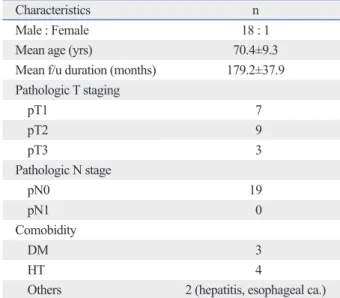
We evaluated 19 of 50 patients who had undergone surgery more than 10 years previously. Another 31 patients were not followed; seven patients had died following a recurrence, 15 patients died from exacerbation of comorbidity, and 9 pa- tients were lost to follow-up. The mean age of the 19 pa- tients (18 males and one female) was 70.4±9.3 years (range 44-84). The mean follow-up duration was 179.2±37.9 months (range 120.4-264.5). The pathologic T stages were T1 (7 patients), T2 (9 patients) and T3 (3 patients). All pa- tients displayed no lymph node involvement, no distant metastasis, and no recurrence (Table 1).
Complications were assessed according to the final fol- Table 1. Clinicopathologic Characteristics of Patinents with Bladder Cancer
Characteristics n
Male : Female 18 : 1
Mean age (yrs) 70.4±9.3
Mean f/u duration (months) 179.2±37.9 Pathologic T staging
pT1 7
pT2 9
pT3 3
Pathologic N stage
pN0 19
pN1 0
Comobidity
DM 3
HT 4
Others 2 (hepatitis, esophageal ca.) DM, diabete mellitus; HT, hypertension.
Table 2. Long-Term Complications and Its Detection Times
Complications n Mean detection
time (months) Delayed detection (10 yrs later) (n)
Atrophied kidney 6 2 bilateral cases (8 renal units)
Non-functional kidney (1 renal unit) 91.3±49.7 5 Hydronephrosis (moderate to severe) 5 1 bilateral case (6 renal units) 56.5±46.6 2
Chronic recurrence of pyelonephritis 5 13.8±6.6 0
Voiding difficulty (using CIC, intermittently) 3 Bladder neck contracture (2 patients) 9.0±5.2 0
Small bowel obstruction 1 180 1
Urinary stones 1 Renal stone (1 renal unit) 120 1
CIC, clean intermittent catheterization.
tinence rates in our study were 89.5%. Night-time inconti- nence rate (36.8%) was considerably higher than the day- time incontinence rate (10.5%) in this long-term (>10 years postoperatively) study. Of the incontinent patients, five pa- tients had not had prior incontinence and two patients had night-time incontinence only. The gradual decrease of con- tinence rates could possibly be due to a declining external sphincter function with age. The importance of age is un- derlined by the fact, that in those exceeding 10 years after surgery, the median ages were 70.4±9.3 years. A prior lon- gitudinal study reported a 17% prevalence of urinary incon- tinence among men 70 years of age,15 and another study conducted with this age group reported an approximately 15% rate of urinary incontinence in healthy men.16
Our long-term experience demonstrated a sustained fa- vorable voiding outcome with slightly increasing inconti- nence rates as patients aged. Nocturnal incontinence fol- lowing orthotopic bladder substitution results from the absence of a neuro-feedback to the brain, of sphincter-de- trusor reflex, as well as decreased sphincter tone at night.8,17 Apart from the same mechanisms responsible for the grad- ual decline in day-time continence with age, increased night- time diuresis and a shift of free water into the concentrated urine are additional factors.18 The decrease in nocturnal continence over time might also reflect a gradual decline in patient compliance.19 However, the low proportion of men frequently or regularly using pads shows that leakage is likely not a frequent impairment to the quality of life.19
Radical cystectomy with orthotopic neobladder is still as- sociated with significant complications. Reported rates and types of complications vary widely.7,20-22 Most early compli- cations including bleeding, neurologic, thromboembolic, car- diac and pulmonary complications, wound-related, gastroin- testinal, genitourinary problems and infection are related to urinary diversion. However, late complications are often in- sion, however, gradually decreased because of the desire to
provide an optimal quality of life with an orthotopic blad- der substitute. The use of the ileum for orthotopic bladder substitution has gained general acceptance within the past decade, and orthotopic continent diversions have become the “gold standard” reconstructive procedure after radical cystectomy.11 Nowadays, all cystectomy patients are poten- tial candidates for a neobladder.2,3,5 Also, contraindications for orthtopic neobladder are fewer than in the past. Ortho- topic neobladder substitution is contraindicated in patients with permanently compromised renal function or severe hepatic dysfunction, inadequate intellectual problem, and positive margin status of the urethra.2 In addition, orthotop- ic neobladder is relatively contraindicated in patients with compromised intestinal function, in particular inflammatory bowel disease, or recurrent urethral stricture.2
A Studer ileal bladder substitute initially described by Studer and colleagues uses a long, afferent, isoperistaltic, tu- bular ileal segment.3,4 The technique was established in 1984 and has been used worldwide.12 The advantages of this blad- der substitute include the simplicity of the construction and the ability to accommodate short ureters. One hundred eight patients underwent surgery at our institution between 1990 and 2011, and showed good results from this technique.
Following an othotopic bladder substitution, the greatest issues of concern include upper urinary tract changes and voiding dysfunctions. The absence of coordinated contrac- tions during the filling phase of bladder substitution is a low pressure reservoir. During voiding, the use of Valsalva ma- neuver results in complete emptying without reflux because the pressure increases in the bladder, the abdomen and the renal pelvis simultaneously.13,14 Furthermore, the unidirec- tional peristaltic movements of the ureters and proximal ile- al segment serves as a dynamic antireflux system during the filling phase.
In the present study, long-term outcomes were assessed in 19 men who lived a minimum of 10 years with their bladder substitute. The average voided volume of the neobladder was 344.1±100.2 mL with a post-void residual urine vol- ume of 146.8±82.7 mL. The maximum bladder capacity was 484.1±119.2 mL and maximum flow rate was 13.6±9.7 mL/sec in a urodynamic study (Table 3). Day-time inconti- nence may range from mild stress incontinence to severe incontinence in a small percentage of patients, but complete day-time continence is achieved in close to 90% of patients with neobladder.6 As many as 50% of patients experience some degree of night-time incontinence.6 The day-time con-
Table 3. Urodynamic Parameters for Patients with Ortho- topic Neobladder Substitution
Urodynamic parameters (n=13)
Maximum reservior capacity (mL) 484.1±119.2 Maximum filling pressure (cmH2O) 24.4±10.8 Maximum flow rate (mL/sec) 13.6±9.7 Maximum urethral closure pressure (cmH2O) 55.6±14.2 Post-void residual volume (mL) 146.8±82.7 Uroflowmetry pattern (n=13)27
Bell type (%) 5 (38.5)
Fractionated type (%) 6 (46.2)
Plateau type (%) 2 (15.4)
tive investigations and long-term follow-up are required to evaluate the definite conclusions.
The present results indicate that the long-term outcomes with the Studer orthotopic ileal neobladder are an accept- able complication rate, oncologically safe, and technically feasible, and produce good functional results. In conclu- sion, the impact of urinary diversion on the quality of life still remains controversial, although promising long-term functional data argue in favor of orthotopic bladder substi- tution as the preferred method for lower urinary tract recon- struction. In our experience, however, long-term outcomes of the Studer orthotopic ileal neobladder may be performed with an acceptable complication rate and good functional re- sults. A high rate of continence is achieved, however, it de- creased slightly more than 10 years after cystectomy. Also, renal deterioration and dysfunctional voiding were ob- served. Thus, the possibility of long-term adverse outcomes should also be considered when deciding orthotopic neo- bladder operation.
ACKNOWLEDGEMENTS
This work was supported by Pusan National University Yangsan Hospital Research Grant.
REFERENCES
1. Studer UE, Hautmann RE, Hohenfellner M, Mills RD, Okada Y, Rowland RG, et al. Indications for continent diversion after cys- tectomy and factors affecting long-term results. Urol Oncol 1998;
4:172-82.
2. Park J, Ahn H. Radical cystectomy and orthotopic bladder substi- tution using ileum. Korean J Urol 2011;52:233-40.
3. Studer UE, Zingg EJ. Ileal orthotopic bladder substitutes. What we have learned from 12 years’ experience with 200 patients. Urol Clin North Am 1997;24:781-93.
4. Burkhard FC, Studer UE. Orthotopic bladder substitution. Curr Opin Urol 2000;10:343-9.
5. World Health Organization (WHO) Consensus Conference on Bladder Cancer, Hautmann RE, Abol-Enein H, Hafez K, Haro I, Mansson W, et al. Urinary diversion. Urology 2007;69(1 Sup- pl):17-49.
6. Hautmann RE, Volkmer BG, Schumacher MC, Gschwend JE, Studer UE. Long-term results of standard procedures in urology:
the ileal neobladder. World J Urol 2006;24:305-14.
7. Parekh DJ, Gilbert WB, Koch MO, Smith JA Jr. Continent urinary reconstruction versus ileal conduit: a contemporary single-institu- tion comparison of perioperative morbidity and mortality. Urology 2000;55:852-5.
8. Madersbacher S, Möhrle K, Burkhard F, Studer UE. Long-term
fluenced by the type of urinary diversion.6,11 The primary late complications of orthotopic diversion that may be related to the diversion itself include atrophied kidney, chronic pyelo- nephritis, decreased renal function, ureteroileal or urethral anastomotic site stricture, urinary tract stones, and inconti- nence.
Bacterial colonization of the neobladder diversion occurs in 40-80% of patients.23,24 Colonization is strongly associat- ed with residual urine,25 and approximately 6% of patients with neobladders progress to overt pyelonephritis at some point following urinary diversion.15 In the absence of ob- struction, upper urinary tract infections can be managed with an administration of culture-specific antibiotics. In our cases, 5 patients had recurrent pyelonephritis (Table 2).
One of the most difficult complications of urinary diver- sion is breakdown or stricture of the ureterointestinal anasto- mosis. In some cases where upper urinary tract changes were noted postoperatively, these were invariably associated with preexisting pathologies or a new obstruction. The re- ported incidence of this complication is approximately 2.4- 9%.6,26,27 In our institution, imaging studies were performed more than 10 years after surgery and moderate-to-severe hy- dronephrosis were evident in five patients (Table 2).
Failure to empty after orthotopic urinary diversion neces- sitates cystoscopic and radiographic examination to differ- entiate between dysfunctional voiding and neobladder-ure- thral obstruction. A report of a large series of neobladder emptying failures in men demonstrated an 8% incidence of mechanical dysfunction and a 3.5% incidence of dysfunc- tional voiding.26 Dysfunctional voiding commonly results from an unsuitable size or shape of the neobladder, from the position, length, or angulation of the neobladder neck, or from a denervated proximal urethra.28 Presently, two pa- tients who complained of voiding difficulty were bladder neck contracture (Table 2).
Orthotopic bladder substitution is technically difficult pro- cedure and time-consuming. Postoperatively, patients leave the hospital with indwelling catheters for a long time. Fol- lowing catheter withdrawal, patients are carefully instructed on how to void. Additionally, patients are also at a higher risk of metabolic problem, voiding difficulty.22,29 However, Continent urinary diversion remains the best option for pa- tients requiring radical cystectomy.
Our study had several limitations. The number of patients in this study was small, which imposed limitations on sta- tistical power. This was a retrospective analysis, which cre- ated the potential for selection bias. Further large, prospec-
pattern. Eur Urol 2004;46:604-9.
20. Lawrentschuk N, Colombo R, Hakenberg OW, Lerner SP, Måns- son W, Sagalowsky A, et al. Prevention and management of com- plications following radical cystectomy for bladder cancer. Eur Urol 2010;57:983-1001.
21. Novotny V, Hakenberg OW, Wiessner D, Heberling U, Litz RJ, Oehlschlaeger S, et al. Perioperative complications of radical cys- tectomy in a contemporary series. Eur Urol 2007;51:397-401.
22. Studer UE, Burkhard FC, Schumacher M, Kessler TM, Thoeny H, Fleischmann A, et al. Twenty years experience with an ileal ortho- topic low pressure bladder substitute--lessons to be learned. J Urol 2006;176:161-6.
23. Wood DP Jr, Bianco FJ Jr, Pontes JE, Heath MA, DaJusta D. Inci- dence and significance of positive urine cultures in patients with an orthotopic neobladder. J Urol 2003;169:2196-9.
24. Akerlund S, Campanello M, Kaijser B, Jonsson O. Bacteriuria in patients with a continent ileal reservoir for urinary diversion does not regularly require antibiotic treatment. Br J Urol 1994;74:177-81.
25. Wullt B, Holst E, Steven K, Carstensen J, Pedersen J, Gustafsson E, et al. Microbial flora in ileal and colonic neobladders. Eur Urol 2004;45:233-9.
26. Jensen JB, Lundbeck F, Jensen KM. Complications and neoblad- der function of the Hautmann orthotopic ileal neobladder. BJU Int 2006;98:1289-94.
27. Shaaban AA, Mosbah A, El-Bahnasawy MS, Madbouly K, Gho- neim MA. The urethral Kock pouch: long-term functional and on- cological results in men. BJU Int 2003;92:429-35.
28. Simon J, Bartsch G Jr, Küfer R, Gschwend JE, Volkmer BG, Hautmann RE. Neobladder emptying failure in males: incidence, etiology and therapeutic options. J Urol 2006;176(4 Pt 1):1468-72.
29. Racioppi M, D’Addessi A, Fanasca A, Mingrone G, Benedetti G, Capristo E, et al. Vitamin B12 and folic acid plasma levels after il- eocecal and ileal neobladder reconstruction. Urology 1997;50:
888-92.
voiding pattern of patients with ileal orthotopic bladder substi- tutes. J Urol 2002;167:2052-7.
9. Goodwin WE, Winter CC, Barker WF. “Cup-patch” technique of ileocystoplasty for bladder enlargement or partial substitution. J Urol 2002;168:667-70.
10. Jensen KM, Nielsen KK, Jensen H, Pedersen OS, Krarup T. Uri- nary flow studies in normal kindergarten--and schoolchildren.
Scand J Urol Nephrol 1983;17:11-21.
11. Hautmann RE. Urinary diversion: ileal conduit to neobladder. J Urol 2003;169:834-42.
12. Studer UE, Ackermann D, Casanova GA, Zingg EJ. Three years’
experience with an ileal low pressure bladder substitute. Br J Urol 1989;63:43-52.
13. Studer UE, Danuser H, Thalmann GN, Springer JP, Turner WH.
Antireflux nipples or afferent tubular segments in 70 patients with ileal low pressure bladder substitutes: long-term results of a pro- spective randomized trial. J Urol 1996;156:1913-7.
14. Hautmann RE, Miller K, Steiner U, Wenderoth U. The ileal neo- bladder: 6 years of experience with more than 200 patients. J Urol 1993;150:40-5.
15. Molander U, Sundh V, Steen B. Urinary incontinence and related symptoms in older men and women studied longitudinally be- tween 70 and 97 years of age. A population study. Arch Gerontol Geriatr 2002;35:237-44.
16. Temml C, Haidinger G, Schmidbauer J, Schatzl G, Madersbacher S.
Urinary incontinence in both sexes: prevalence rates and impact on quality of life and sexual life. Neurourol Urodyn 2000;19:259-71.
17. Steers WD. Voiding dysfunction in the orthotopic neobladder.
World J Urol 2000;18:330-7.
18. Stampfer DS, McDougal WS, McGovern FJ. The use of in bowel urology. Metabolic and nutritional complications. Urol Clin North Am 1997;24:715-22.
19. Perimenis P, Burkhard FC, Kessler TM, Gramann T, Studer UE.
Ileal orthotopic bladder substitute combined with an afferent tubu- lar segment: long-term upper urinary tract changes and voiding